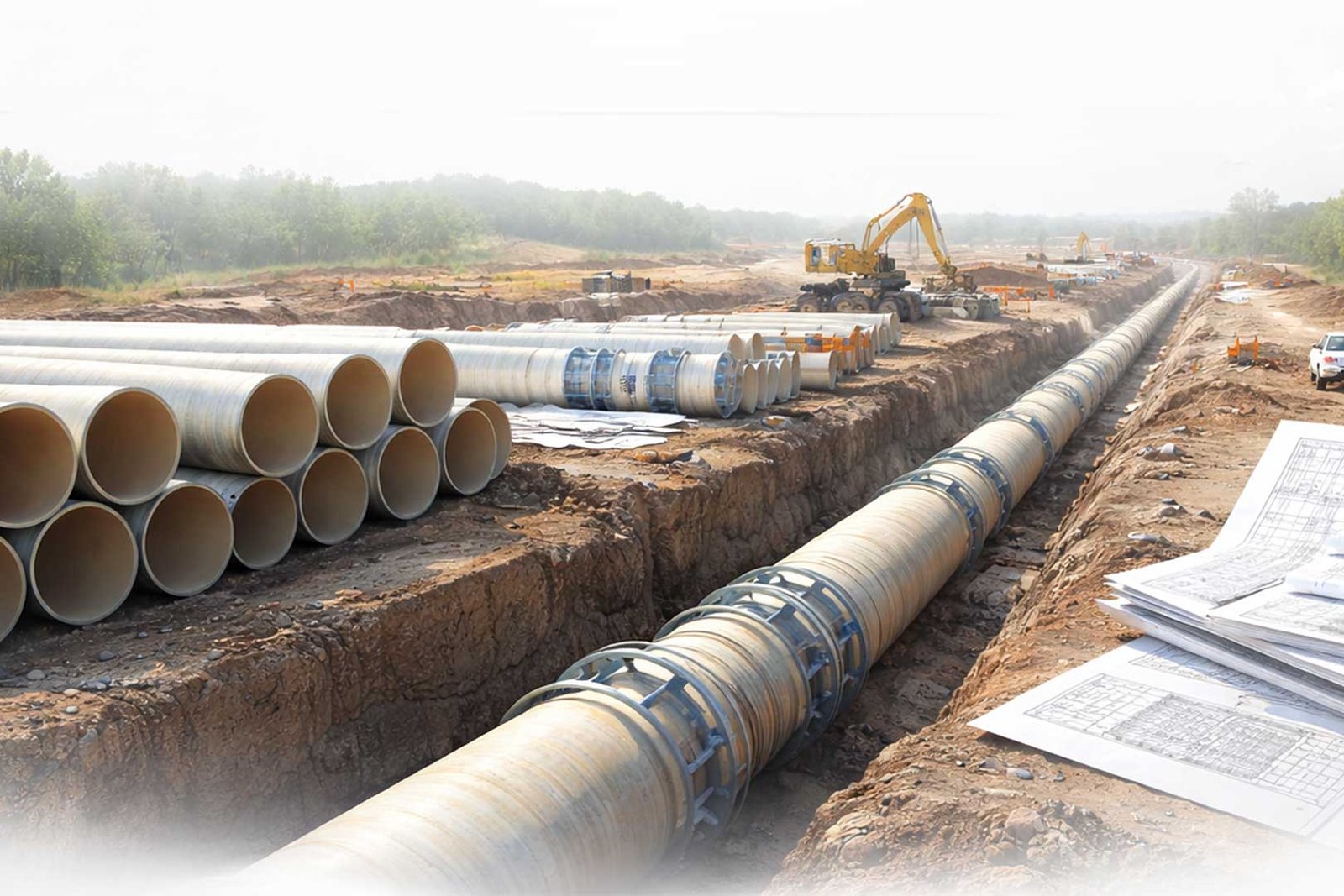
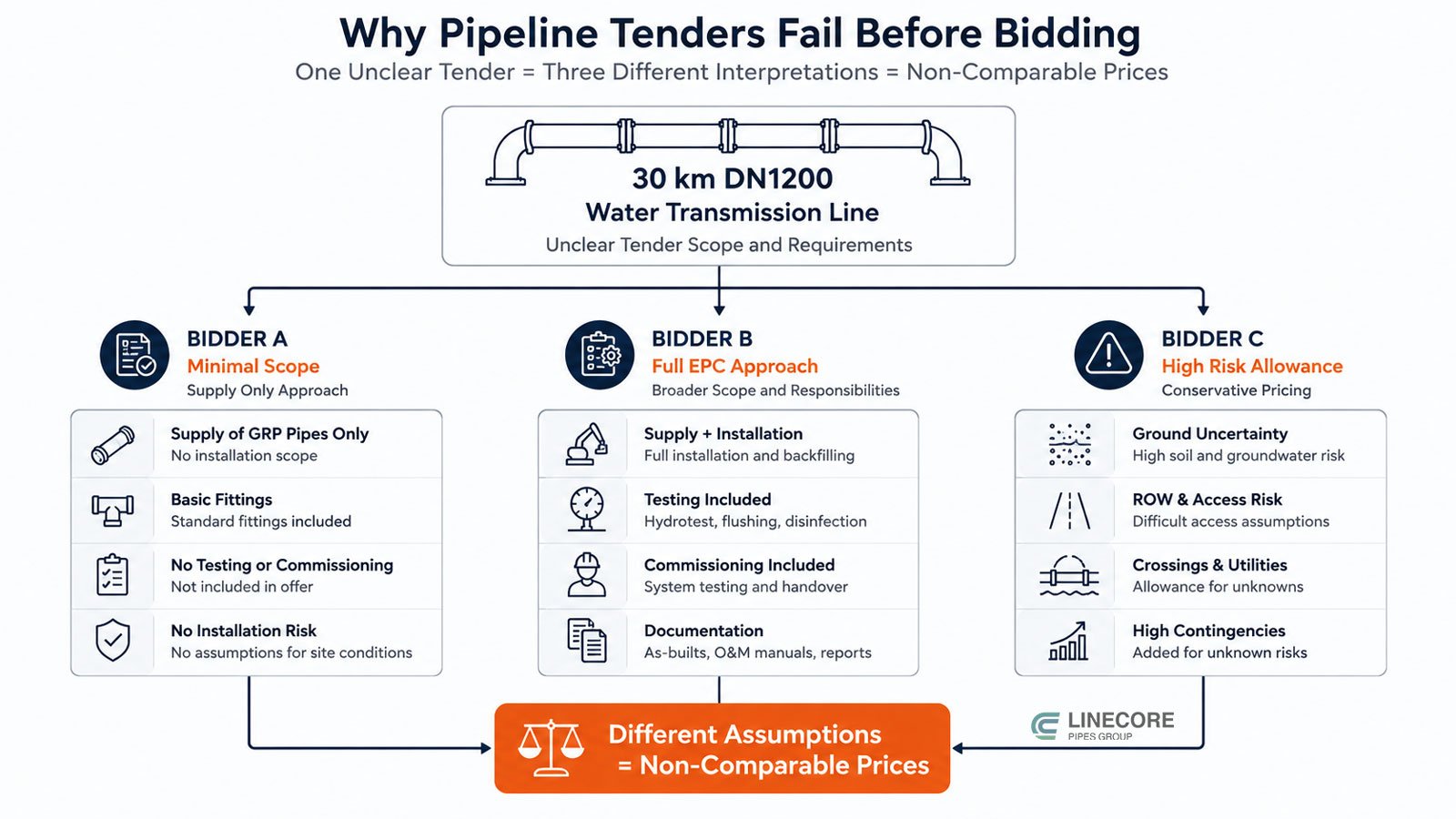
A pipeline tender can fail before the first bidder even opens the document. An owner may issue a tender for “Implementation of a 30 km water transmission line with DN1200 pipe.” The scope may look clear, but key technical and contractual details still remain undefined. A contractor or EPC company still lacks information on pressure conditions, installation scope, testing responsibility, and site constraints.
The same issue continues in testing and commissioning. One bidder may price supply only, while another includes installation and full execution risk. The owner then compares prices based on different assumptions, not the same project. This can result in delays or cost overruns later in execution.
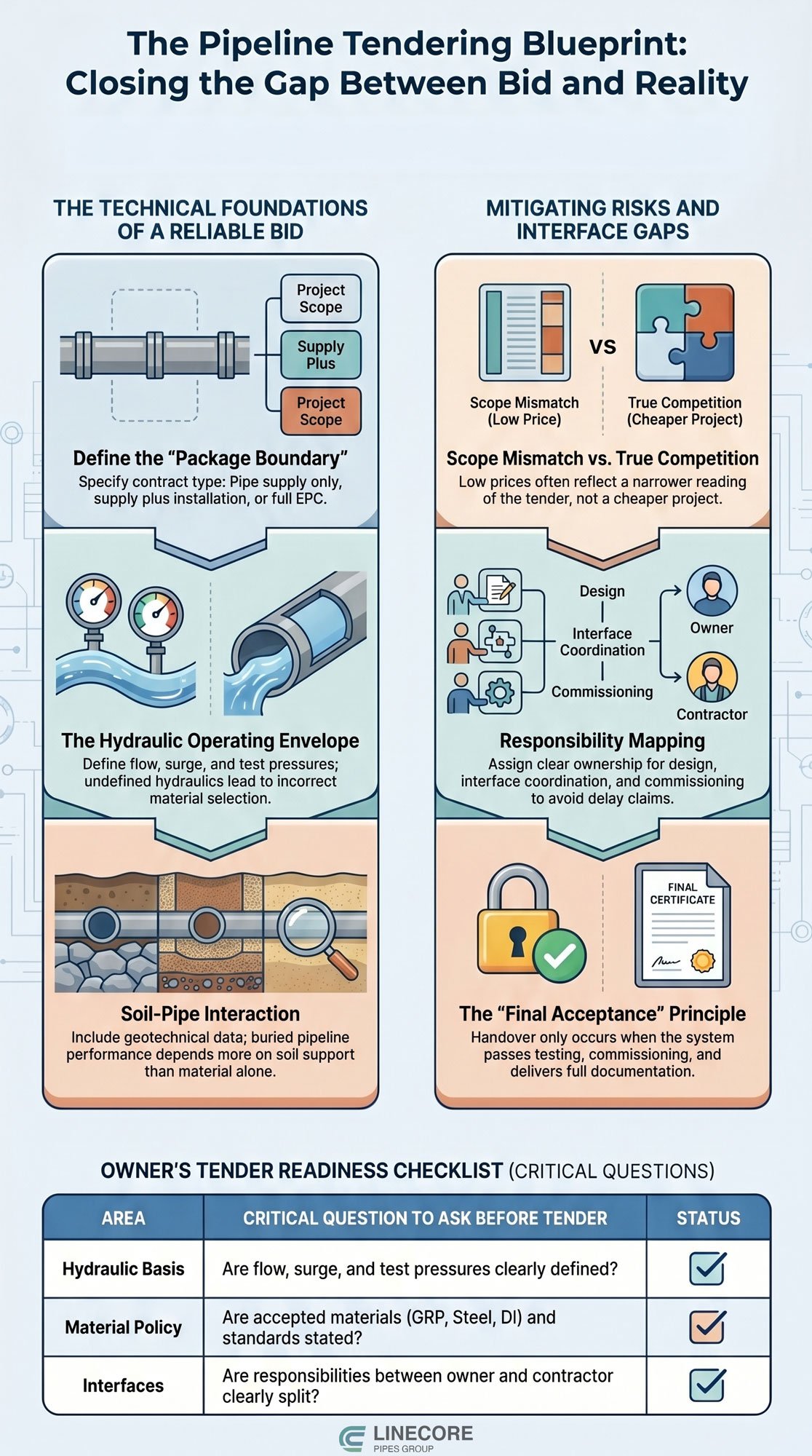
The pipeline Tendering Blueprint (source: Pipelinecoregroup.com)
Why Unclear Pipeline Tenders Create Non-Comparable Prices
Price comparison breaks down when each bidder reads the same pipeline scope in a different way. The numbers may look competitive, but the assumptions behind them rarely match.
Minimum Scope vs Full Execution vs Hidden Risk
Bidders split the project scope based on how much responsibility they assume, not what the owner intends.
One Bidder Prices Minimum Scope
That usually covers DN, pressure class, fittings, and basic documentation. No installation risk sits in this number, so the price stays low.
Second: What if a Bidder Prices Full Execution
That includes transport, installation, jointing, hydrotest, commissioning, site supervision, and documentation. Hydraulic head-loss and pump duty often influence material and diameter selection, which shifts cost further.
Third: What if a Bidder Adds Hidden Contingencies
These often link to unknown soil, groundwater, ROW delays, utility clashes, or unclear testing responsibility. Risk sits in the price, not in the scope.
Result
The owner compares three numbers built on different project definitions. It looks like competition, but it is not. It is a scope mismatch. A low price is not always a better price. Often it reflects a narrower reading of the tender, not a cheaper project.
The First Clarification: What Exactly Is the Pipeline Package?
Most tender problems start with one missing definition: the real boundary of the pipeline package. Without it, each bidder builds a different scope in their head before pricing begins.
Package Boundary Definition
The owner must define what sits inside and outside the contract. This starts with scope split. Pipe supply alone creates a different project than EPC delivery, especially in buried transmission systems, where installation quality drives performance. Below we included questions that stay simple but decisive:
- Pipe supply only or supply plus installation or full EPC
- Inclusion of fittings, valves, chambers, thrust blocks, air valves, washouts
- Inclusion of pump stations, surge tanks, SCADA, and electrical works
- Responsibility for design verification and route alignment
- Responsibility for interface coordination with other contractors
Hydraulic consequences sit behind these choices. For example, if installation sits outside scope, the bidder cannot control bedding quality or compaction. That directly affects deflection in flexible systems and long-term performance.
Before any pricing table, the owner should align all parties on one clear boundary. A simple structure helps avoid gaps:
| Tender item | Must be clarified before tender |
|---|---|
| Pipe supply | Diameter, pressure class, stiffness class, standards, joint type |
| Installation | Trench, bedding, backfill, compaction, supervision |
| Testing | Hydrotest, leakage criteria, disinfection, flushing |
| Commissioning | Responsibility, procedures, acceptance criteria |
| Documentation | Factory records, site records, O&M manuals, as-built files |
The Second Clarification: Hydraulic and Pressure Basis
Hydraulic data sets the real cost of a pipeline. When pressure, flow, and surge stay unclear, every bidder assumes a different system in their calculations.
Hydraulic Definition and Operating Envelope
Owners need to define the full operating window, not just a nominal pipe size. Flow and pressure shape everything from diameter selection to pump power and pipe class. Important inputs include:
- Design flow
- Maximum and minimum operating pressure
- Surge pressure and transient events
- Test pressure requirements
- Vacuum conditions in critical sections
- Hydraulic profile along the route
- Pump duty points and head requirements
- Air valve strategy along high points
- Future capacity allowance
- Allowable leakage limits
- Design life expectation
ResearchGate published an article highlighting that smaller diameter increases velocity and headloss. That pushes the pump head higher and changes energy demand over the system life. These effects must sit in the tender basis, not in bidder assumptions.
Pressure Class vs Stiffness Class
Pressure class does not replace stiffness class. They solve different problems. Pressure class controls internal loading. Stiffness class controls external soil and traffic loads in buried systems. Mixing both leads to wrong pipe selection, especially in GRP and composite pipelines.
- Technical Insight: A pipeline cannot be priced correctly if hydraulic duty stays undefined. Even small gaps in pressure or surge data shift both material selection and installed CAPEX.
The Third Clarification: Soil, Route, and Installation Conditions
A pipeline does not behave as a standalone product. It interacts with the surrounding ground, and that interaction drives performance over time more than pipe material alone.
Ground Conditions and Route Definition
Buried pipelines depend on soil behavior along the full alignment. When geotechnical and route data stay incomplete, each bidder fills the gap with different assumptions. That directly changes design, construction method, and price.
Owners should indicate soil type, groundwater level, trench stability, bedding and backfill requirements, compaction control, traffic loads, burial depth, slope and access limits, major crossings, and any corrosive soil zones.
- Consideration: Unclear ground data forces bidders to assume different excavation methods and support conditions. That leads to inconsistent pricing for the same route.
GRP and Composite Pipe Behavior in Soil Systems
Flexible pipe systems such as GRP depend on controlled soil support. Load transfer happens through bedding and compaction, not pipe wall stiffness alone. If compaction quality drops or embedment material changes, deflection and long-term ovality shift significantly.
In this sense, installation conditions become part of the structural design, not just field execution.
- Engineering Point: PubMed Central notes that a higher stiffness class cannot replace missing geotechnical data. Poor bedding or undefined compaction conditions introduce structural uncertainty, even when the pipe itself meets specification.
The Fourth Clarification: Material Policy and Accepted Alternatives
Material choice shapes both cost and technical behavior in a pipeline system. If the tender does not set clear acceptance rules, each bidder builds a different technical and commercial basis.
Material Acceptance and Comparison Rules
The owner must state how materials compete and how evaluation happens across alternatives.
| Aspect | What Must Be Clarified |
|---|---|
| Material scope | GRP, steel, DI, HDPE, concrete allowed or restricted |
| Tender type | Performance-based or material-specific |
| Standards | ISO, EN, AWWA, local editions |
| Evaluation basis | CAPEX only or lifecycle cost included |
| Comparison method | Equal technical baseline or separate evaluation paths |
GRP and Composite Pipe Requirements + A DN1200 Coastal Transmission Scenario
A DN1200 coastal water transmission line shows how material choice changes engineering decisions. One bidder can suggest steel with coating protection (with no consideration of further maintenance), another GRP for hydraulic efficiency and corrosion resistance, and another HDPE with fusion joints. Each option changes wall thickness, installation method, and long-term maintenance profile.
Pressure class, stiffness class, joint system, QA/QC, potable water approval, storage rules, repair method, installation method, hydrotest, and commissioning must sit in the tender. Without this, bidders design different systems for the same line.
- Ending Message: Material names alone do not describe pipeline behavior. Real performance comes from how the system handles pressure, soil, and service life under the same verified rules.
The Fifth Clarification: Scope Split Between Owner, Consultant, Contractor, and Supplier
Pipeline projects break down fast when responsibilities overlap or stay vague. Each party then works with a different understanding of who owns each task.
Responsibility Mapping Across Project Interfaces
Owners should assign clear responsibility across the full delivery chain, from design to handover.
| Scope Area | Responsibility Must Be Clear |
|---|---|
| Basic and detailed design | Owner, consultant, or EPC |
| Hydraulic and surge analysis | Consultant or contractor |
| Route survey and geotechnical work | Owner or contractor |
| Pipe manufacturing and supply | Supplier scope boundary |
| Installation and jointing | Contractor or EPC |
| Testing and commissioning | Clear single lead party |
| Documentation and as-built | Defined deliverable owner |
| Warranty and aftercare | Supplier vs contractor split |
Unclear boundaries shift risk during execution. A supplier may reject installation claims. A contractor may question pipe handling instructions. A consultant may avoid design liability. The owner then faces a system that works on paper but breaks in responsibility.
Interface Risk in Real Project Execution
In a 40 km transmission line, one unclear interface between installation and testing can stop commissioning for weeks. Small gaps between scopes turn into delay claims and cost escalation, even when physical works stay complete.
EPC Integration Perspective
LineCore Pipes Group reduces these interface gaps by combining pipe supply, engineering support, installation guidance, and EPC execution under a single responsibility structure. This removes overlap between design stage and field execution, mostly in water transmission systems with complicated designs.
The Sixth Clarification: Testing, Commissioning, and Final Acceptance
Many pipeline tenders stop at installation details and leave handover unclear. That gap often turns into disputes at the final stage.
Testing and Commissioning Requirements
Owners should set clear rules for how the system moves from construction to operation.
- Hydrostatic test pressure aligned with required standards
- Test section limits and acceptance criteria
- Leakage limits aligned with design
- Flushing and disinfection for potable systems
- Valve, surge, and appurtenance testing
- Commissioning sequence and readiness steps
- Acceptance certificate and punch list rules
Without these definitions, each contractor builds a different idea of “completion,” which shifts responsibility at handover.
Why Acceptance Gets Delayed
A pipeline can reach mechanical completion but still fail handover because test criteria differ between parties. One contractor may treat hydrotest as sufficient, while the owner expects full commissioning records and system validation before acceptance.
Final Acceptance Principle
A pipeline package does not finish when the pipe goes into the trench. It finishes when the system passes testing, completes commissioning, delivers documentation, and receives formal acceptance for operation.
The Seventh Clarification: Documentation and Quality Records
Pipeline performance depends on what gets built and what gets proven during execution. Without structured records, even well-built systems turn difficult to verify during handover or operation.
Documentation and Quality Control Records
Owners should request complete traceability from factory to site. Each stage needs clear evidence.
| Record Type | Requirement |
|---|---|
| Factory & material records | Material certificates, resin and glass traceability |
| Pipe verification | Test certificates, dimensional and class records |
| Fittings & joints | Coupling documentation, jointing records |
| QA/QC system | QA/QC plan, ITP |
| Site handling | Delivery, storage, installation records |
| Construction control | Compaction records, hydrotest reports |
| Compliance & issues | NCR reports, repair records |
| Final handover | As-built drawings, O&M manuals, warranty files |
Why Records Matter in Real Operation
If you don’t pass this chain, the final analysis is more likely to fail. Small defects in installation or joints become impossible to trace, which delays repair decisions and increases operational risk.
- Final Consideration: Documentation forms the technical memory of the pipeline after handover, not just a project requirement.
The Eighth Clarification: Repair, Warranty, and Operation Strategy
Pipeline decisions do not end at commissioning. Long-term behavior depends on how repair, warranty, and operation rules sit inside the contract from the start.
Repair, Warranty, and Operation Requirements
Owners should set clear expectations for how the system behaves after installation and during its service life.
- Accepted repair methods and procedures
- Responsibility for repairs during installation
- Approval authority for repair work
- Spare pipes, fittings, and gasket requirements
- Warranty period and exclusions
- Emergency repair response time
- Operator training requirements
- Long-term inspection and maintenance rules
A buried pipeline in a transmission system will face settlement, pressure variation, and occasional third-party damage. Without predefined repair rules, each event turns into a dispute between contractor and owner.
Lifecycle Perspective in Pipeline Projects
Warranty terms alone do not protect system performance. Operation teams need clarity on how to respond when leakage, joint failure, or accidental damage occurs under real field conditions.
The Ninth Clarification: Risk Allocation and Contract Model
Pipeline bids change significantly when risk sits in the wrong place. If uncertainty shifts fully to the contractor, pricing moves away from real execution conditions and reflects protection against unknowns instead.
Contract Structure and Risk Boundaries
Owners should set contract rules before pricing starts. The contract model shapes how bidders interpret responsibility, cost exposure, and execution risk.
- Contract type: supply, supply-installation, EPC, turnkey
- Payment terms and milestone structure
- Price escalation and adjustment rules
- Liquidated damages and performance guarantees
- Insurance requirements
- Permits, approvals, and authority interfaces
- ROW and land access responsibility
- Utility relocation scope
- Change order procedure
- Provisional sums for uncertain works
When unknown ground conditions, permits, or utility conflicts sit fully on the contractor without data, serious bidders respond in a predictable way. They increase prices or step away from bidding. Balanced risk allocation does not protect only the contractor. It also protects the owner from inflated pricing, weak competition, and future claims.
Risk Transfer in Real Pipeline Projects
In a 30 km transmission line, one unclear ROW segment can shift excavation method, delay civil works, and affect commissioning timing. That single uncertainty often spreads into multiple cost assumptions across the full bid.
Practical Checklist: What Owners Should Clarify Before Requesting Prices
Tender quality depends on how clearly the system is defined before pricing starts. Missing basics at this stage always show up later as cost gaps, claims, or design changes.
| Area | What Question to Ask Before Tender |
|---|---|
| Scope | Supply only, supply + installation, or EPC? |
| Hydraulic basis | Flow, pressure, surge, and test pressure defined? |
| Design life | Service life clearly stated? |
| Material policy | Accepted materials and standards defined? |
| GRP/composite requirements | Pressure class, stiffness class, joint type, QA/QC, and installation basis defined? |
| Route | Alignment, crossings, access, and constraints defined? |
| Soil | Geotechnical and groundwater data available? |
| Installation | Trench, bedding, backfill, and compaction requirements defined? |
| Interfaces | Responsibilities between owner, consultant, contractor, and supplier clear? |
| Testing | Hydrostatic testing responsibility and criteria defined? |
| Commissioning | Final acceptance criteria defined? |
| Documentation | Factory and site deliverables listed? |
| Repair | Repair method and responsibility defined? |
| Warranty | Warranty scope, duration, and exclusions clear? |
| Contract | Payment terms, risk allocation, delays, and change rules defined? |
A tender works only when all bidders read the same system. Without that, comparison loses meaning and pricing shifts away from reality.
Common Tender Mistakes Owners Should Avoid
Tender problems usually start from early decisions, not execution. Small gaps in definition turn into major cost and contract issues later.
- Asking for a price before defining the system: A pipe diameter alone does not describe a project. Without pressure, route, installation scope, and testing rules, each bidder builds a different system in their estimate.
- Mixing supply-only and EPC expectations: Supply and EPC carry different responsibility levels. If the owner expects full execution, the tender must state it clearly from the start.
- Treating pipe material as the only decision: Pipe material is only one part of the system. Design, installation, testing, commissioning, documentation, and operation shape the real project cost and performance.
- Wrong assumptions of the site conditions: Soil type, groundwater, access limits, crossings, and utilities have a direct effect on excavation method and installation cost. Missing this data shifts risk into pricing.
- Comparing unqualified prices: Prices without equal scope cannot be compared. A lower number may exclude installation, testing, or responsibility for execution risk.
- Leaving commissioning unclear: Without clear acceptance criteria, completion becomes subjective. This often leads to disputes at the handover stage.
- Over-transferring unknown risks: If unknown ground or permit risks move fully to the contractor, serious bidders either inflate prices or avoid bidding. This reduces competition and increases claims during execution.
How a Clear Tender Helps the Owner
A clear tender gives the owner comparable bids instead of conflicting assumptions. It reduces hidden costs, scope gaps, procurement delays, and disputes during execution. Contractors price the same system, not different interpretations of it.
That also improves project control after the award. Technical evaluation becomes faster, commissioning becomes clearer, and contract execution stays cleaner. In the long run, the pipeline performs closer to the original design basis because construction, testing, and handover follow one defined scope.
Linecore Pipes Group Perspective: From Pipe Supplier to Total Solution Maker
Linecore Pipes Group works beyond pipe supply and supports owners across the full water transmission lifecycle. The focus stays on system performance, not isolated components, because project outcomes depend on how each stage connects. LineCore supports piping projects in:
- Pipe system selection based on hydraulic and site conditions
- GRP and composite pipe engineering support
- Fittings and specials matched to system requirements
- Installation guidance for field execution
- EPC execution support where required
- Testing and commissioning assistance
- Documentation and handover support
- Long-term operation and repair planning
For complex water transmission lines, the best results do not come from selecting a pipe first and adjusting everything later. They come from defining the system correctly, then choosing the pipe, contractor, and execution model that fit that defined system.
about
The Author

Farshid Tavakoli is a seasoned professional in engineering and international trade. Holding degrees in Electrical Engineering, Mechatronics, and a Doctorate in Business Administration (DBA) from the University of Lyon, he also has a strong background in industrial automation and production line technologies.
For over 17 years, he has led an international trading company, gaining deep expertise in commercial solutions tailored to industrial needs. With more than 8 years of active involvement in infrastructure development, he specializes in the supply of electromechanical equipment for water and wastewater treatment plants and transfer projects.
Together with comapny expert team, he now provides consultancy and integrated solutions for sourcing and implementing complex infrastructure projects across the region.