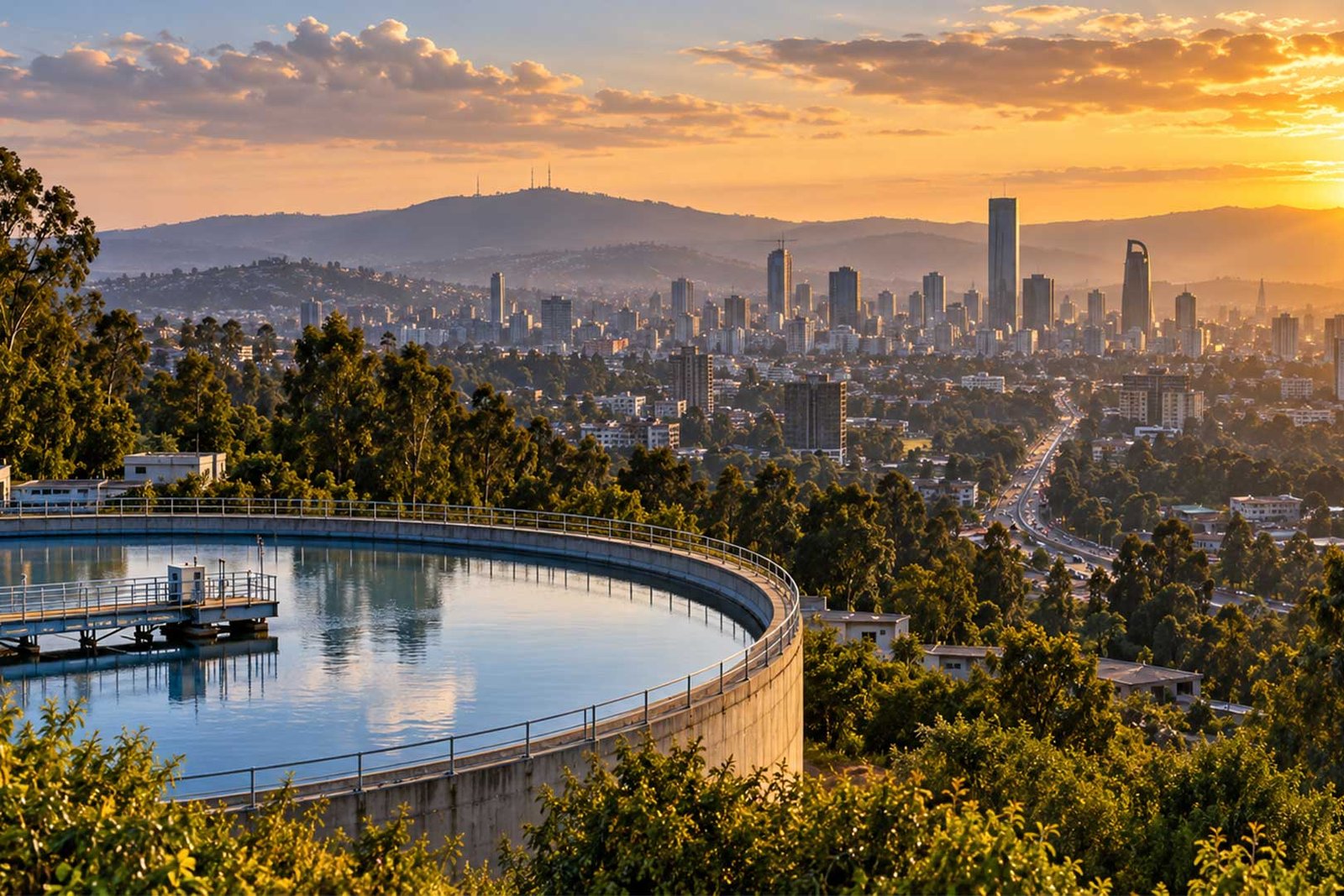
Addis Ababa can add more water and still struggle to give people reliable service. Why? Because water has a long way to go before it reaches a customer. It has to move from the source through treatment, pumps, major pipelines, reservoirs, and pressure zones. If one critical part fails and there is no backup, supply can drop quickly. So if you plan, finance, design, or deliver water projects in Addis, keep reading. The real opportunity is not only to add water, but to make the whole system more dependable.
Addis Ababa’s Challenge Is Reliability, Not Only Water Availability
To understand the problem properly, look beyond how much water Addis can produce. The figures and issues below help explain why available water does not always become reliable water at the customer’s tap.
Demand, Losses, and Intermittent Service
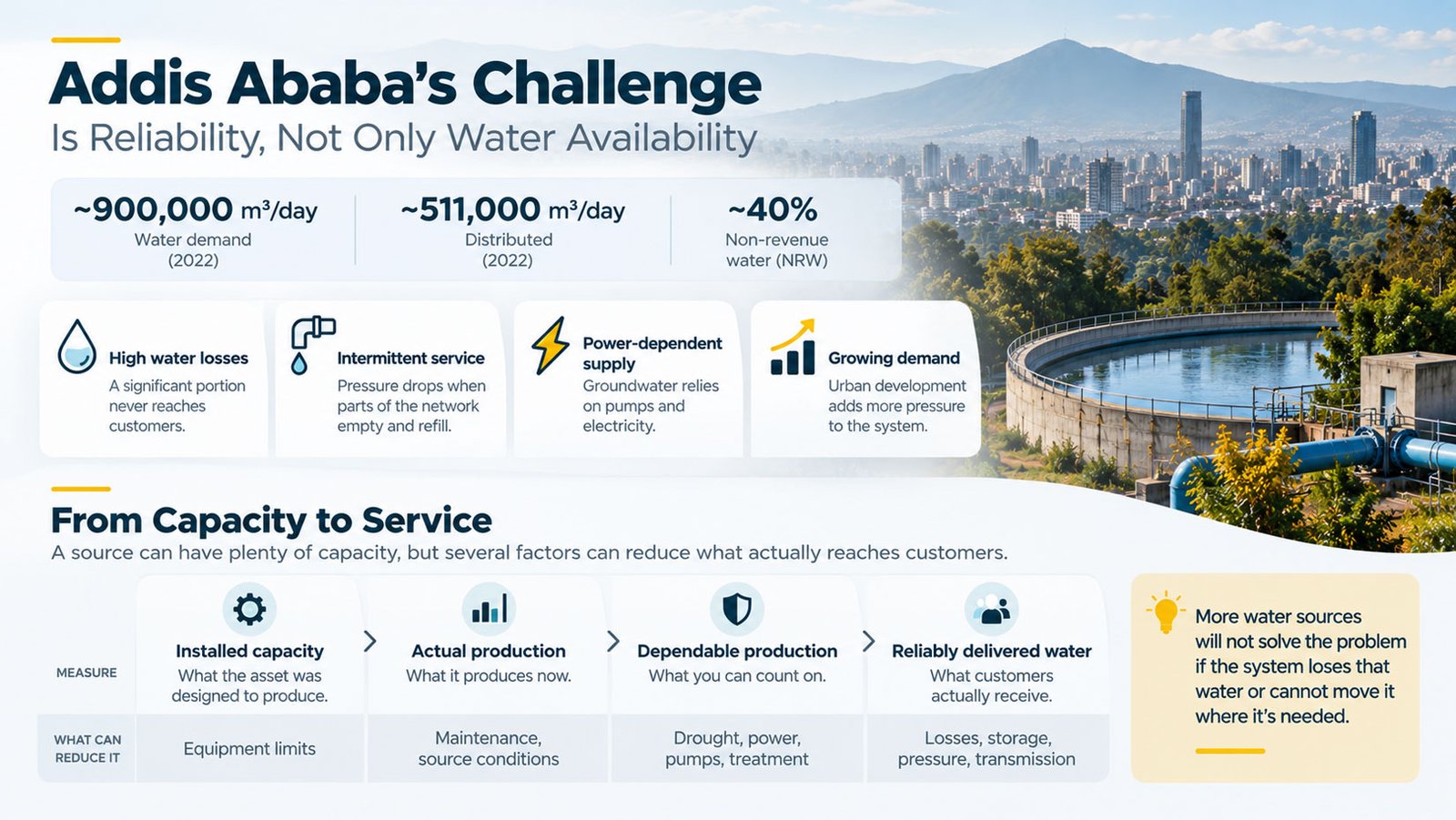
According to JICA, using a 2022 baseline, water demand was approaching 900,000 m³/day while distribution was around 511,000 m³/day. NRW was also around 40%, with intermittent service and inadequate pressure still affecting the system. Several problems sit behind those numbers:
- Water losses reduce useful supply. The system may produce the water, but some of it never reaches customers.
- Intermittent service creates pressure problems. Parts of the network empty and refill instead of staying under steady pressure.
- Groundwater depends on pumps and power. If electricity fails, borehole supply can fall too.
- Urban growth adds more demand. New development puts extra pressure on a system that already has gaps.
REACH also points to groundwater stress and power-related interruptions as important risks for Addis Ababa.
This is why Addis needs both new water sources and a stronger network. A new source will not solve much if the city loses that water or cannot move it where it is needed. At the same time, NRW reduction alone cannot cover future demand forever.
From Capacity to Dependable Service
It helps to separate the numbers you may see in project reports.
| Measure | What it means | What can reduce it |
|---|---|---|
| Installed capacity | What the asset was designed to produce | Equipment limits |
| Actual production | What it produces now | Maintenance, source conditions |
| Dependable production | What you can count on | Drought, power, pumps, treatment |
| Reliably delivered water | What customers actually receive | Losses, storage, pressure, transmission |
The last row tells you the most about service. A source can have plenty of capacity, but a neighborhood may still receive too little water because a pump fails, pressure drops, a reservoir runs low, or a trunk main cannot carry enough flow.
Real-World Example: JICA Links NRW to What Happens in the Network
JICA has worked on flow and pressure measurements, network monitoring, and pipe-renewal planning in Addis Ababa.
That gives you a much more useful view of NRW. Instead of treating it as one percentage, you can see where water disappears, where pressure causes trouble, and where pipe renewal could improve actual service.
Source Diversity: More Sources Do Not Automatically Mean More Resilience
More sources can look reassuring on paper. But if several of them depend on the same power system, aquifer, pump station, or trunk main, one failure may still affect a large part of supply. The next sections help you see whether the diversity is real.
Addis Ababa’s Existing Water-Source Portfolio
Addis relies on Legedadi, Dire, Gefersa, and a large groundwater system. AAWSA reports more than 100 operational deep and shallow wells and identifies groundwater as a major part of production.
The public production figures need some care, though. AAWSA’s listed source figures do not fully match its stated total production figure. Different dates or reporting methods may explain that, but we should not treat one current production total as confirmed until AAWSA clears up the difference.
Effective Diversity vs. Nominal Diversity
If you want to know how diverse the system really is, check whether the sources share the same weak points.
| Area | What to look at | What could go wrong |
|---|---|---|
| Hydrology | Drought, rainfall, sedimentation | Several surface sources weaken together |
| Groundwater | Aquifers, recharge, drawdown | Many wells share one groundwater risk |
| Power | Grid feeds, pumps, backup systems | One outage affects several sources |
| Conveyance | Trunk mains, pumps, reservoirs | Different sources meet at one bottleneck |
Think about ten wells that all need the same electrical supply. You may have ten wells, but one power problem can still affect all of them.
The same applies to transmission. Two completely different water sources can eventually feed the same major pipeline. You also need to know if operators can shift more water from one source when another drops out. Pressure limits, pipe capacity, treatment capacity, and reservoir levels can all get in the way.
Future Diversification
Gerbi and Sibilu could add more options, but their current status matters. Capital Ethiopia reported in 2025 that work on Gerbi was expected to start during the 2025/26 fiscal year. The research did not find a later official AAWSA notice that confirmed its current construction stage, contractor scope, or commissioning date. Gerbi is therefore safer to describe as reported or planned.
Sibilu remains an important longer-term option, although its current procurement position is less clear. New sources also need to work with the existing system. You have to consider transmission, power, pumping, storage, and how surface water and groundwater can support each other.
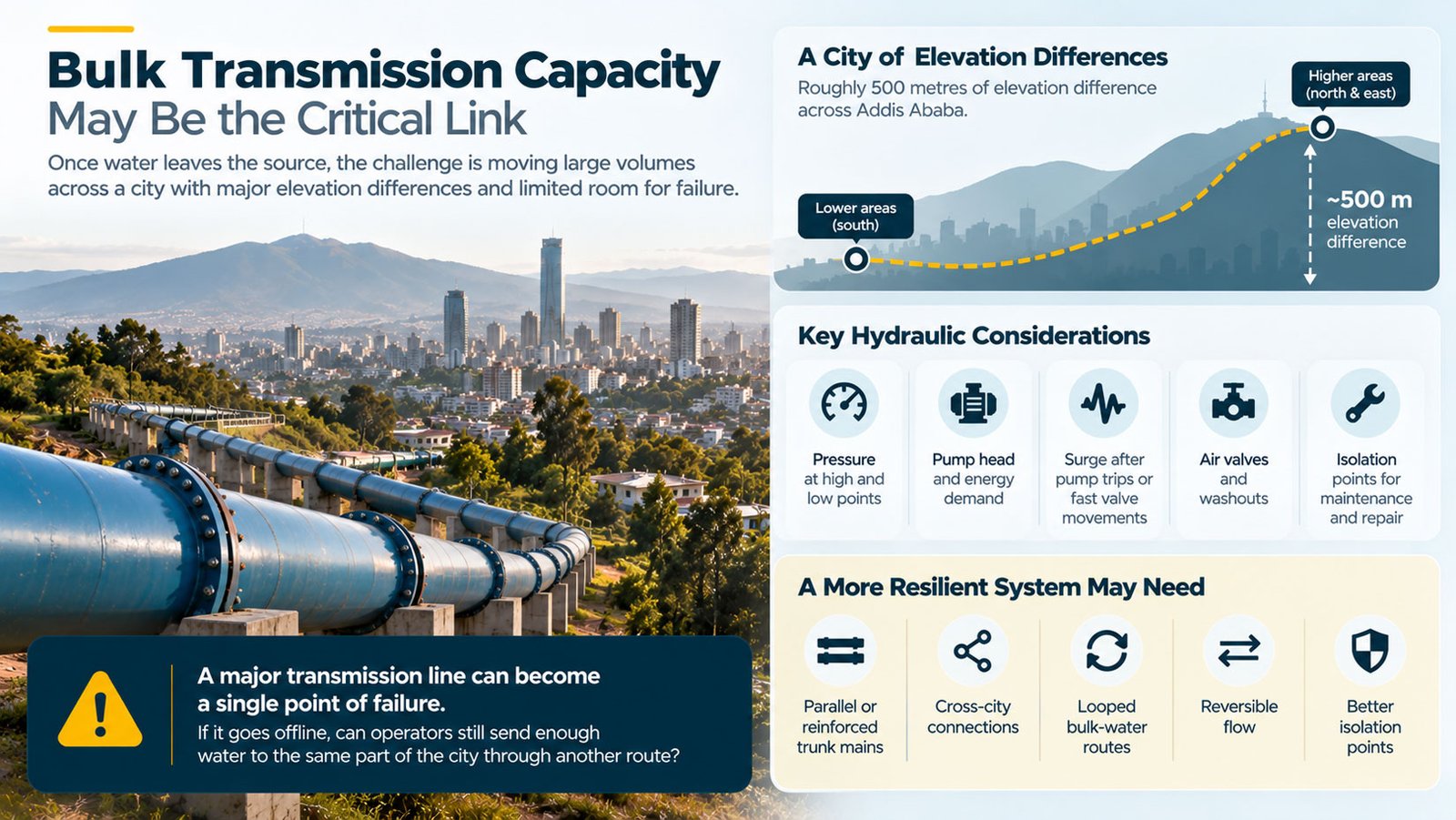
Bulk Transmission Capacity May Become the Critical Reliability Link
Once water leaves the source, the challenge changes. Now you have to move large volumes across a city with major elevation differences and limited room for failure. This is where transmission deserves much more attention.
Addis Ababa’s Difficult Hydraulic Geography
The research describes roughly 500 meters of elevation difference across the metropolitan area. Lower southern areas sit well below higher northern and eastern parts of Addis. That matters because water does not behave the same way across the whole route.
Downhill sections can face high pressure. Uphill sections need more pump head and energy. For a major line, you need to check:
- pressure at high and low points;
- pump head and energy demand;
- surge after pump trips or fast valve movements;
- air valves and washouts;
- isolation points for maintenance and repair.
A pump trip, for example, can create a sudden pressure wave through the pipeline. That can affect the pipe itself, fittings, valves, and surge-protection equipment.
The Risk of Critical Transmission Corridors
A major transmission line can become a single point of failure when too much of the system depends on it. If that line goes offline, can operators still send enough water to the same part of the city through another route? The Arup Water Resilience Profile identifies security of water supply as an important challenge for Addis Ababa. A more flexible system may need:
- parallel or reinforced trunk mains;
- cross-city connections;
- looped bulk-water routes;
- reversible flow;
- better isolation points.
You do not need to duplicate every pipeline. You need enough backup so one failure does not cut off much more of the city than necessary.
Public information still does not tell us how much demand Addis could serve if a critical trunk main failed. That is an important gap for future reliability planning.
Storage Must Be Treated as an Operational Reliability Asset
Storage can look impressive when you see one large volume in a report. But that number may tell you very little about what happens during an actual outage. The table below makes the difference easier to see.
Raw-Water Storage Is Not the Same as City Storage
Legedadi, Dire, and Gefersa provide raw-water storage. That water still has to pass through treatment and transmission before people can use it.
| Storage type | What it does | What you need to know |
|---|---|---|
| Source storage | Protects raw-water availability | How much source variation can it absorb? |
| Service storage | Balances demand and pressure | Which areas can use it? |
| Emergency storage | Supports supply during outages | How many hours can it last? |
Addis may have a large amount of raw water available while one part of the city has very little treated water it can use during a pump or transmission failure.
A More Useful Storage Question
For each major pressure zone, focus on how long it can keep supplying customers if upstream water suddenly stops. A useful measure is:
Storage autonomy = usable treated-water storage ÷ critical demand
That gives you a result you can understand in operational terms, hours of supply. The location of the reservoir also matters. A smaller reservoir with access to two independent supply routes may help the system more during an outage than a larger reservoir that depends on one vulnerable main.
Real-World Example: Stage III-A Looked at the System as a Whole
The African Development Bank Stage III-A work considered source development, treatment, transmission mains, service reservoirs, and pumping together.
The study is old, so it does not tell us what the network looks like today. But the idea still makes sense. Storage works best when the pipes, pumps, and pressure zones around it let operators use that stored water when they actually need it.
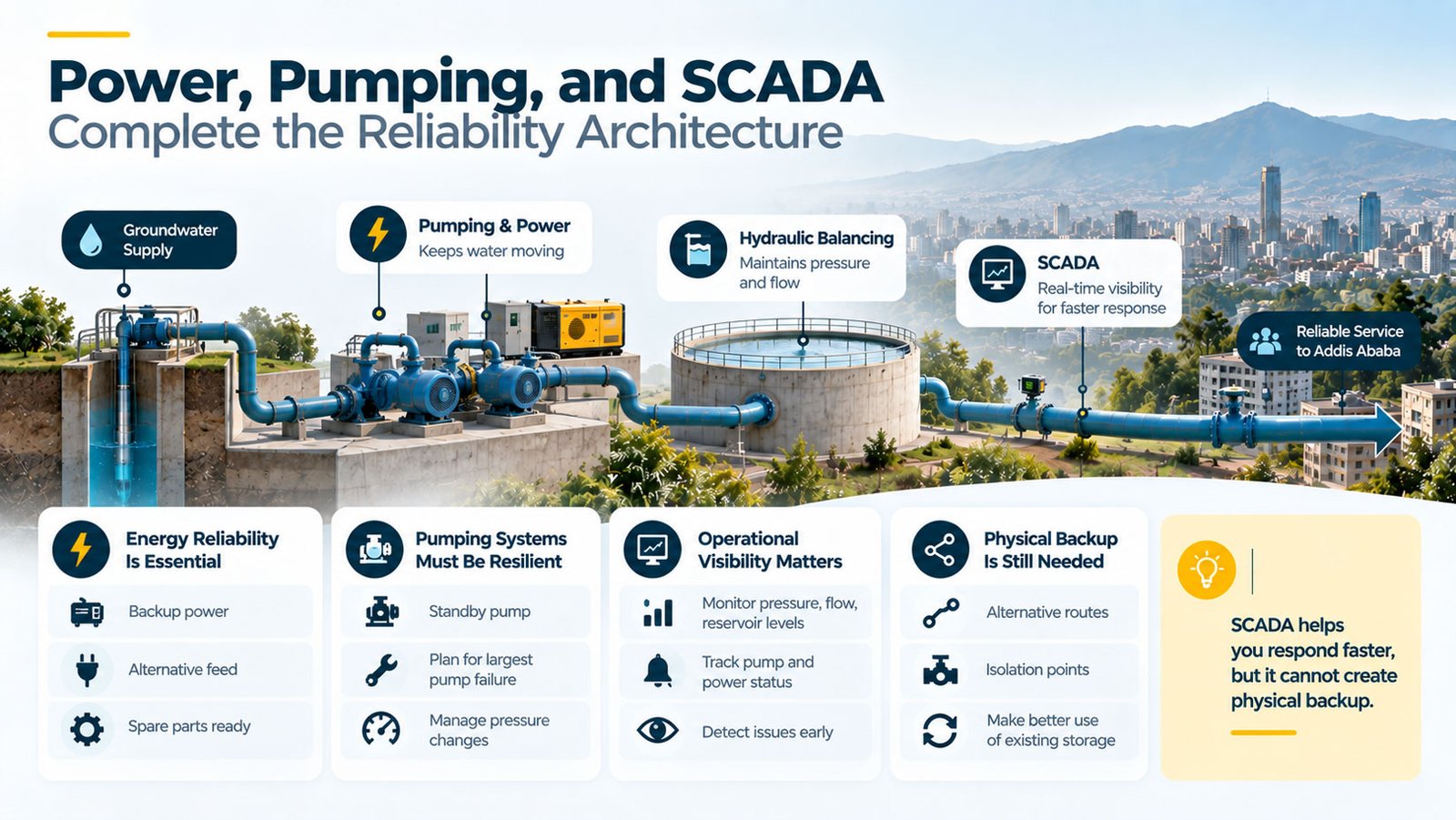
Pumping, Power, Hydraulic Balancing, and SCADA Complete the Reliability Architecture
Pipes and reservoirs are only part of the story. You also need the systems that keep water moving and help operators react when normal conditions change. This is where power, pumping, and visibility come into the picture.
Water Reliability Depends on Energy Reliability
Groundwater is not a dependable supply just because the water exists underground.
The pump has to work. Electricity has to reach it. The water still has to move through the collector system and into the wider network. The research links electricity outages with groundwater-supply interruptions in Addis Ababa. For any major pump station or wellfield, you would want to know:
- Is a standby pump available?
- What happens if the largest pump stops?
- Is there another electrical feed?
- Can the generator carry the required load?
- How long can backup power operate?
- Are critical spare parts available?
- What happens to pressure when a pump suddenly stops?
AWWA also treats power reliability as part of water-system resilience. You can test what happens when one important component fails, but you should not describe a system as “N-1 compliant” unless AAWSA itself uses and confirms that standard.
Operational Visibility Matters
Even when the physical backup exists, operators need to know when and how to use it. They need clear information on pressure, flow, reservoir levels, pump status, power status, valves, and alarms. SCADA can bring this information together and help the utility respond faster. But SCADA cannot create physical backup.
If a neighborhood has only one bulk-water route, software cannot create a second one. It can help operators spot the problem sooner, isolate the affected part, and make better use of storage or alternative routes that already exist.
The World Bank Ethiopia Water Compact supports stronger digital WASH systems and more resilient infrastructure. That shows the direction of national policy. It does not confirm that AAWSA has a specific drinking-water SCADA package under procurement today.
Where Future Addis Ababa Water Investment May Emerge
If you follow future infrastructure opportunities in Addis, reliability gaps can tell you where new work may appear. Some projects may add water, while others may help the city get much more value from the water it already has.
Infrastructure Priorities
Areas worth watching include:
- new and more diverse water sources;
- bulk transmission reinforcement;
- terminal and service reservoirs;
- NRW reduction and network rehabilitation;
- pump and electrical upgrades;
- pressure management and interconnections;
- SCADA and digital systems.
AAWSA announced more than 182 km of high- and medium-level water-line work in December 2025. That tells you network investment remains active. It does not mean all 182+ km represents large-diameter bulk transmission.
Before you judge the opportunity, check the actual package. Diameter, pressure, route, material, funding, and project purpose all matter.
Real-World Example: Upper Awash Uses More Than One Solution
Recent Upper Awash work documented by Arup looked at several possible interventions under different future conditions.
That approach fits Addis well. One project may add source capacity. Another may reduce losses. Another may improve storage or transmission. You do not have to expect one project to solve every problem.
Who Shapes the Pipeline?
For companies that want to follow the market, it pays to look earlier than the final tender.
AAWSA sits at the center of the local system. The Addis Ababa City Administration and Ministry of Water and Energy also matter. International partners such as the World Bank, JICA, AfDB, AFD, and EIB can support studies, finance, and major programs. Engineering consultants can also shape projects long before construction starts.
Watch master plans, feasibility studies, ESIA work, hydraulic studies, detailed design, financing, and owner’s-engineer assignments. These early stages can tell you where a project is heading before the final pipe or EPC package reaches the market.
What a Reliability-Led Investment Cycle Means for Pipeline and EPC Delivery
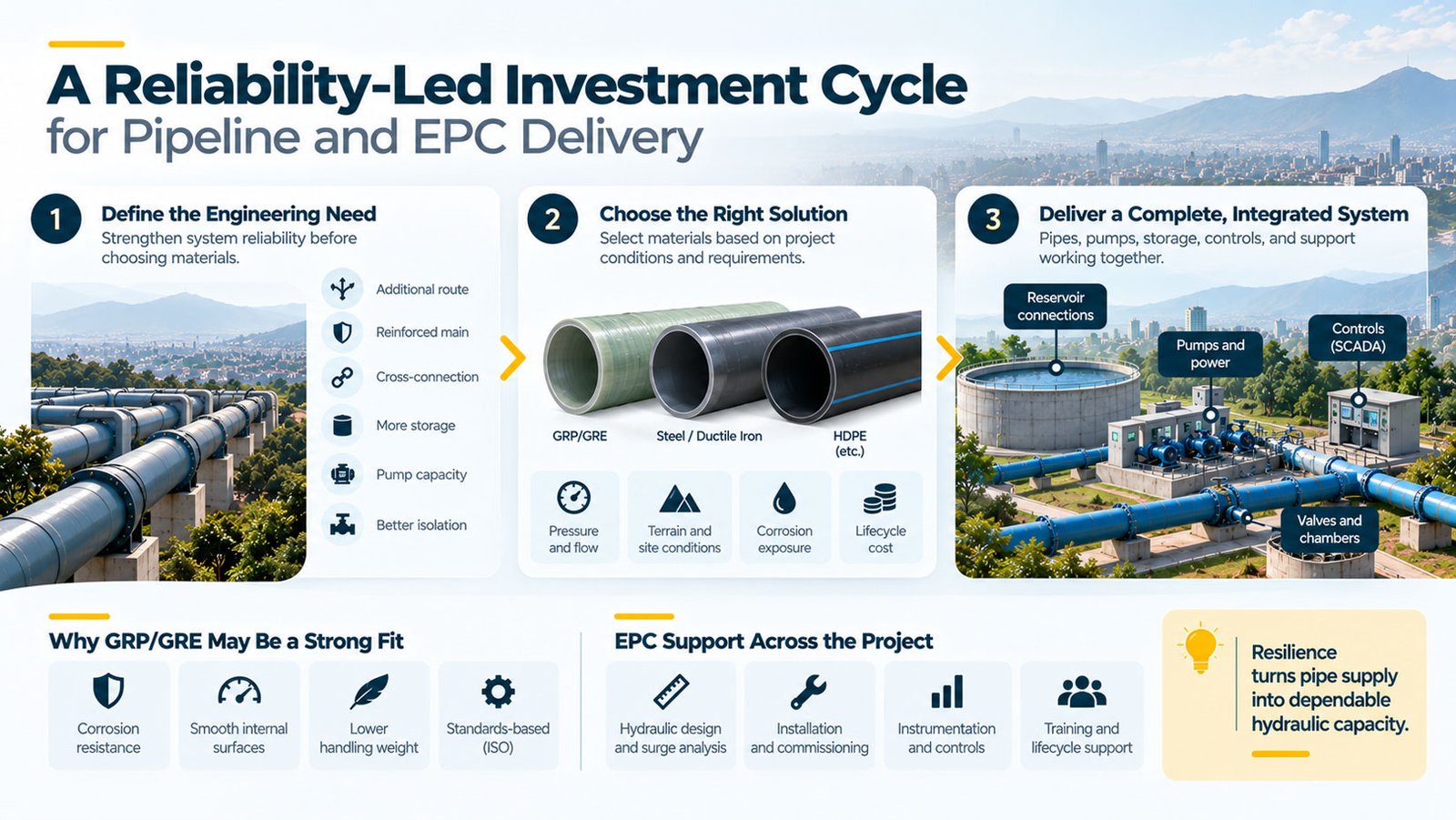
For a pipeline or EPC company, this is where the reliability discussion turns into a real project. Follow the engineering need first. Material selection and delivery strategy should come after that.
From Pipe Supply to Dependable Hydraulic Capacity
Imagine one trunk main carries too much of the dependable supply for a large area. Before anyone chooses a pipe material, the team needs to understand what would make that part of the system safer. It may need:
- another transmission route;
- a reinforced main;
- a cross-connection;
- more storage;
- different pump capacity;
- better isolation.
Once the required function is clear, you can define flow, pressure, surge, route, pumps, valves, and reservoir connections.
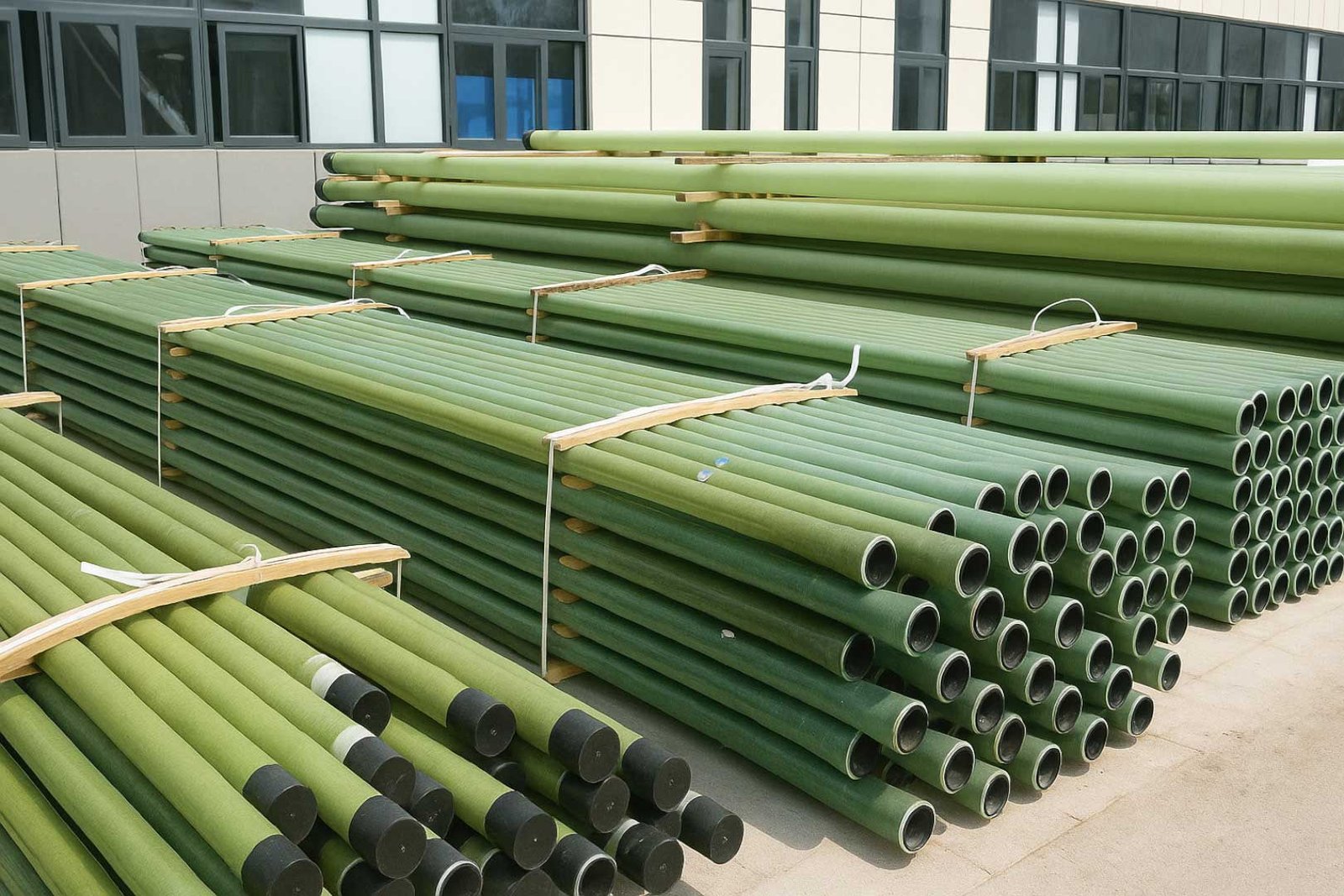
That is where Grand LineCore can contribute with large-diameter pipeline and engineering support. Resilience shifts the value proposition from supplying kilometers of pipe to delivering dependable hydraulic capacity.
Where GRP/GRE Can Fit
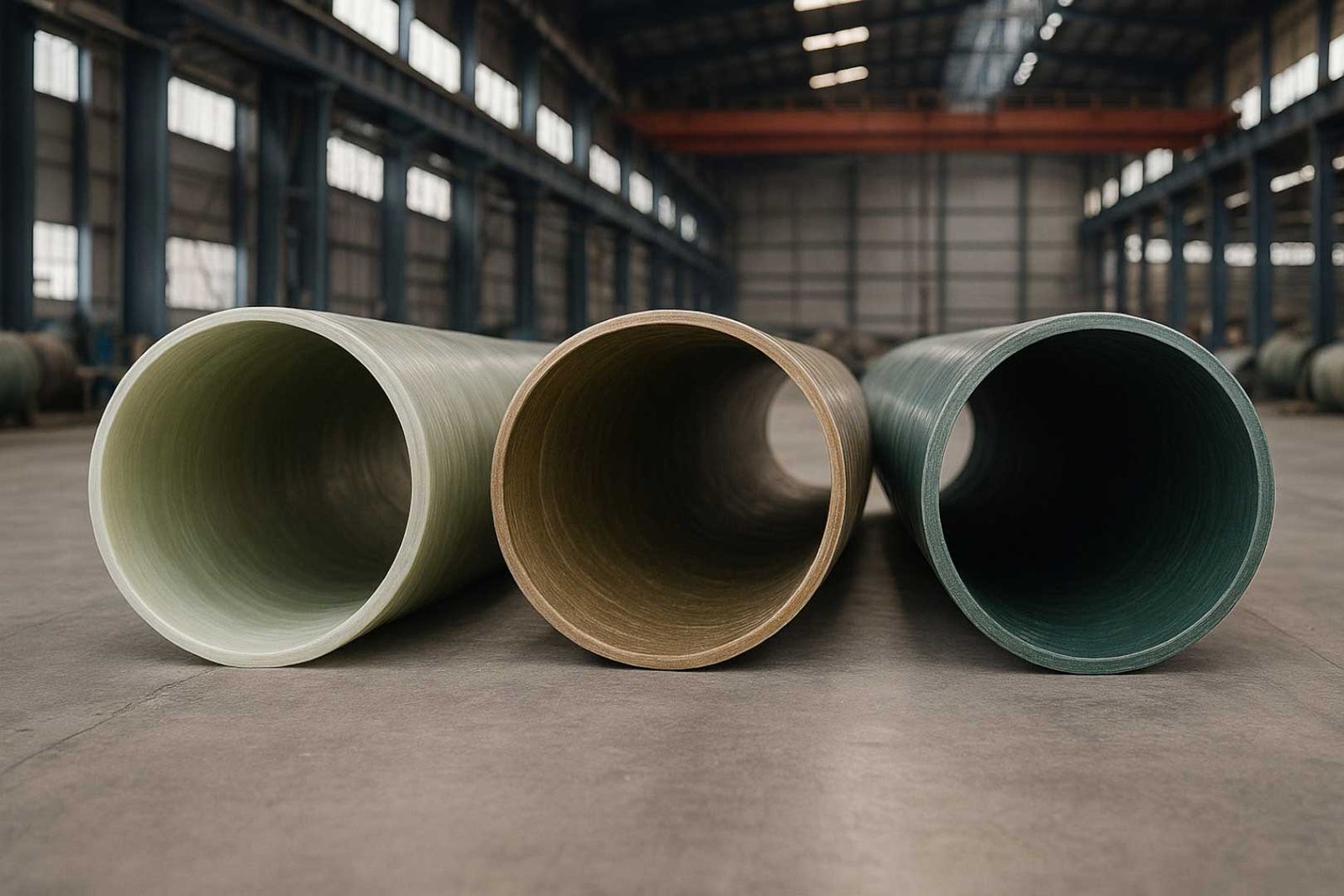
GRP and GRE may fit some large-diameter water projects very well. That does not mean they are the right answer for every line. ISO provides a standards basis for GRP water systems. Before you choose GRP, GRE, steel, ductile iron, HDPE, or another option, check:
- operating and surge pressure;
- required diameter and flow;
- soil and groundwater conditions;
- terrain and site access;
- corrosion exposure;
- thrust and restraint;
- installation requirements;
- repairs and spare parts;
- owner requirements;
- lifecycle cost.
The research identifies corrosion resistance, smooth internal surfaces, and lower handling weight as useful GRP/GRE characteristics to consider. They are advantages to evaluate, not proof that composite pipe should always win.
EPC Opportunity Is Broader Than Pipe
The pipeline cannot work properly on its own. The pump needs to suit the line. The line needs to handle surge. The reservoir needs the right connection. Power needs to support the pump station. Operators need controls they can actually use.
Grand LineCore can support projects through hydraulic design, surge analysis, pipeline engineering, pump integration, reservoir connections, valves and chambers, civil works, instrumentation, testing, commissioning, training, and lifecycle support. That broader view helps you avoid a common project problem: each component works on paper, but the interfaces between them do not work well enough in real operation.
Why Addis Ababa Matters Beyond the Capital
There is also a wider reason to pay attention to Addis. A difficult project in the capital can give a company something valuable for future work: proof that it can handle demanding conditions in Ethiopia. A strong Addis reference can help with future qualification, local experience, technical credibility, and relationships with utilities, consultants, and financiers.
The EIB reported that a Team Europe program completed in 2026 outside Addis included almost 1,500 km of pipelines, 75 reservoirs, and many pumps across 43 Ethiopian towns.
Those projects are outside Addis, so one capital-city project does not guarantee access to them. But they do show that Ethiopia’s wider water market faces many of the same needs: pipelines, reservoirs, pumps, and stronger utility systems.
For Grand LineCore, Addis can therefore become a useful reference market, not an automatic route to the next contract.
Conclusion: Building a Water System That Can Absorb Failure
Addis Ababa needs more water, but it also needs a system that can handle a bad day. That means sources that do not all share the same risks, transmission routes with real backup, treated-water storage in useful locations, dependable pumps and power, and enough visibility for operators to react quickly.
Grand LineCore can support that type of work where composite pipeline systems, hydraulic engineering, and EPC delivery fit the project. The real test is what happens when something fails. A resilient system should still have another way to keep water moving.
about
The Author

Farshid Tavakoli is a seasoned professional in engineering and international trade. Holding degrees in Electrical Engineering, Mechatronics, and a Doctorate in Business Administration (DBA) from the University of Lyon, he also has a strong background in industrial automation and production line technologies.
For over 17 years, he has led an international trading company, gaining deep expertise in commercial solutions tailored to industrial needs. With more than 8 years of active involvement in infrastructure development, he specializes in the supply of electromechanical equipment for water and wastewater treatment plants and transfer projects.
Together with comapny expert team, he now provides consultancy and integrated solutions for sourcing and implementing complex infrastructure projects across the region.