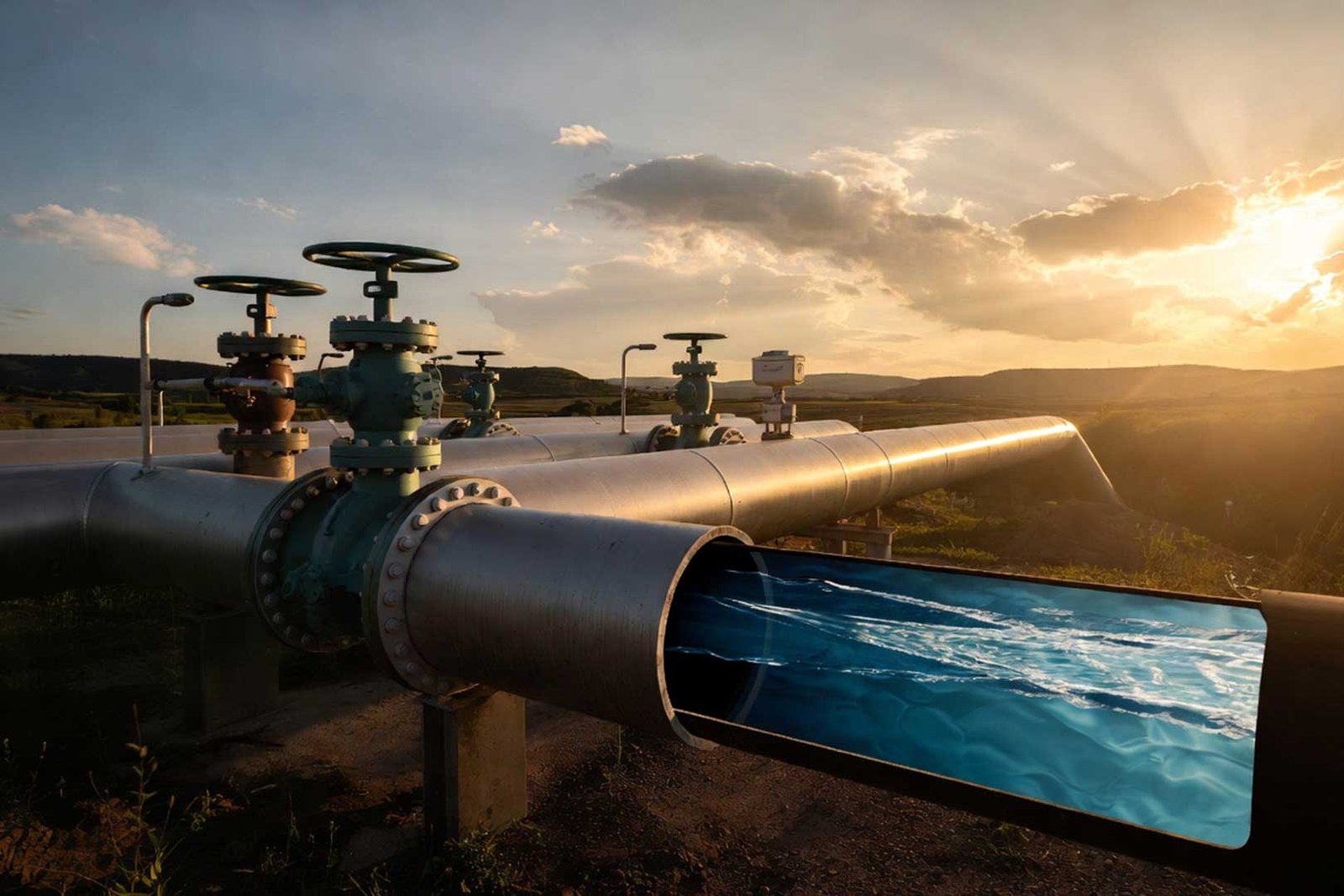
When a critical water main fails, you’re suddenly dealing with major outages, public health risks, flooding, road damage, and serious reputational hits. These pipes are your lifelines! They supply cities, treatment plants, hospitals, industries, and fire-protection systems. A break is never just a simple pipe problem.
Today and here, you’ll discover exactly how to prepare for such issues through smart design, GRP and composite materials, proper installation, monitoring, fast repairs, bypass strategies, and full EPC readiness. Stay with Linecore Pipes Group that supplies the GRP pipes and delivers the complete EPC solutions you need.
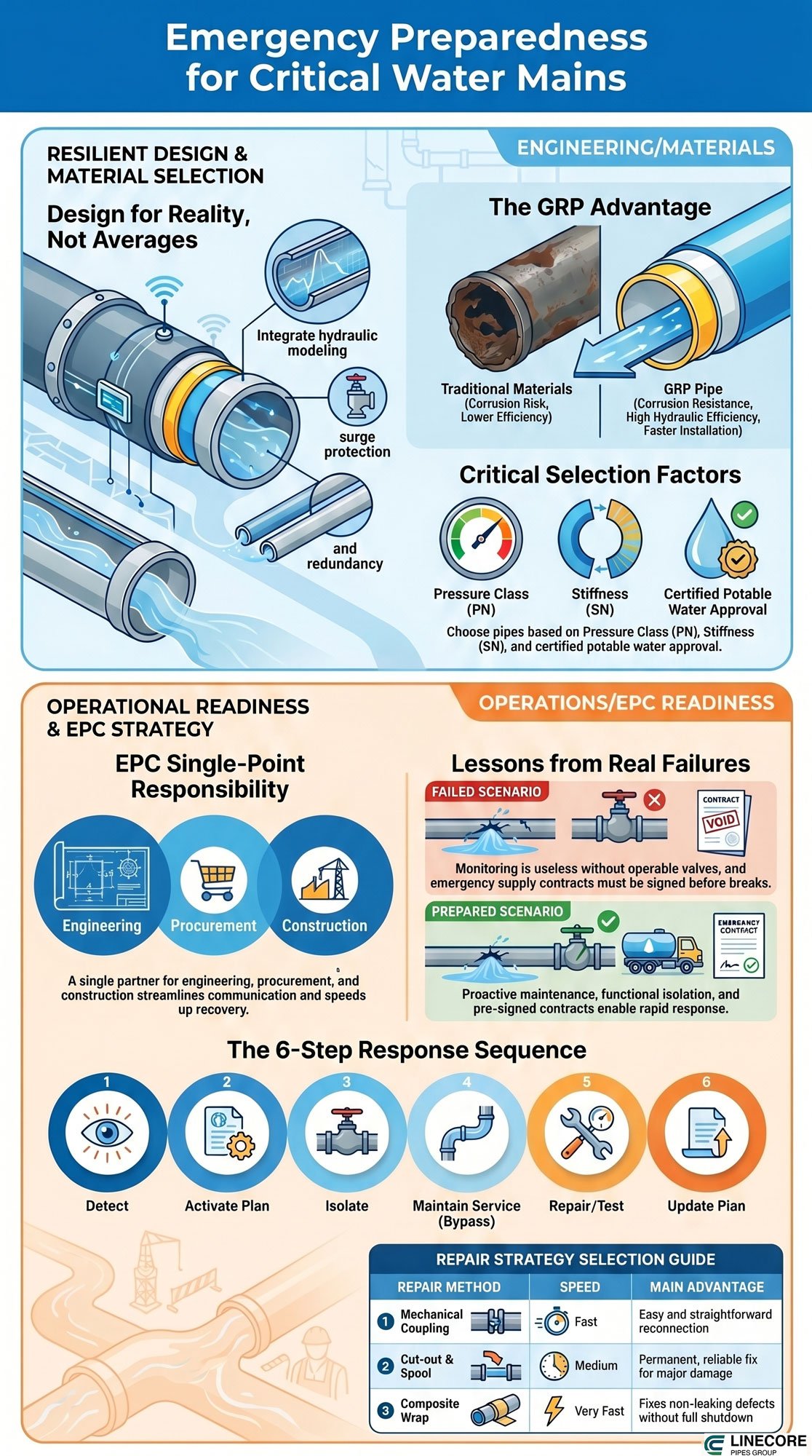
Emergency Preparedness for Critical Water Mains infographic (source: pipelinecoregroup.com)
What Makes a Water Main “Critical”?
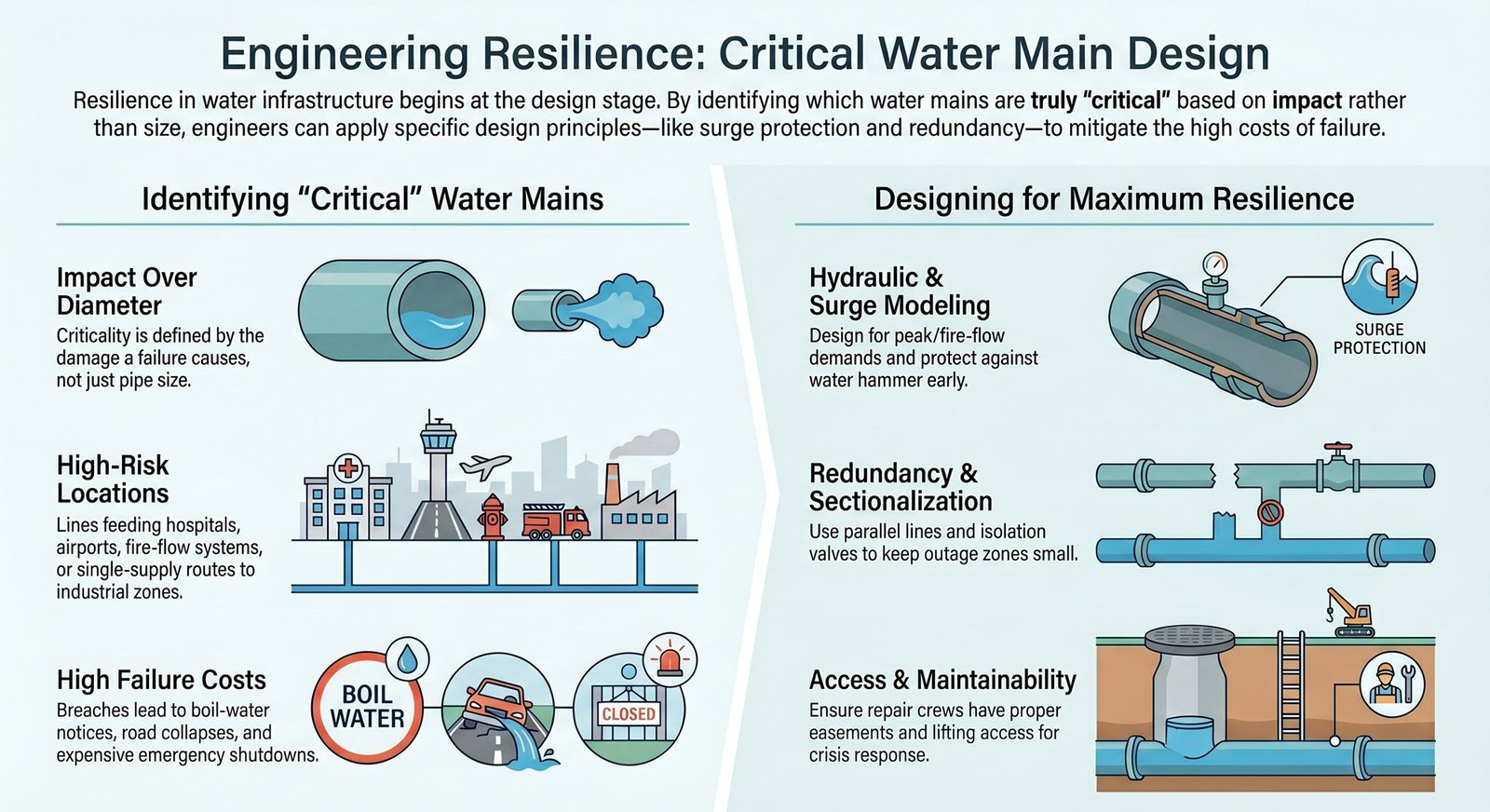
You know a main is critical by the damage its failure would cause, not just its diameter. َAs explained in one of the articles from Science Direct, your critical lines are the main transmission pipe leaving the treatment plant, the single supply route to your city or industrial zone, pipelines that feed hospitals, airports, fire-flow systems, or strategic facilities, long-distance raw or potable water mains, and any line with limited redundancy or hard-to-reach access.
When it breaks, you face loss of supply, emergency shutdowns, boil-water notices, road collapses, flooding, interrupted operations, and very expensive direct and indirect costs. You face a disaster all in all!
Why Emergency Preparedness Starts at the Design Stage
You can’t fix these problems after the pipe is buried in the ground. That’s why you need to build real resilience right from the design stage. Below are the reasons why:
1. Hydraulic Design for Normal and Emergency Operation
You design for real life, not just average days. Plan for peak flow, fire-flow demands, restricted operation after partial shutdown, alternative supply routes, and enough bypass capacity so you can keep water flowing when trouble hits.
2. Surge and Transient Protection
Water hammer can smash even strong pipes. You protect yourself by modeling pump trips, fast valve closures, and filling/draining operations early. Surge tanks, air valves, controlled valve timing, and the right pipe choice reduce the risk.
3. Redundancy and Sectionalization
Don’t rely on a single pipe. You add parallel lines, cross-connections, isolation valves, and storage support. This keeps outage zones small. Most importantly, your valves must actually work when needed.
4. Access and Maintainability
You have to think about the repair crews who will show up during a crisis. Plan proper easements, excavation space, lifting access, road crossings, valve chambers, and clear paths so they can reach and fix the problem quickly.
Composite Pipe Materials for Critical Water Mains
You need the right pipe material for your critical water mains. GRP and other composites give you real advantages, but only when you pick the correct one for your conditions.
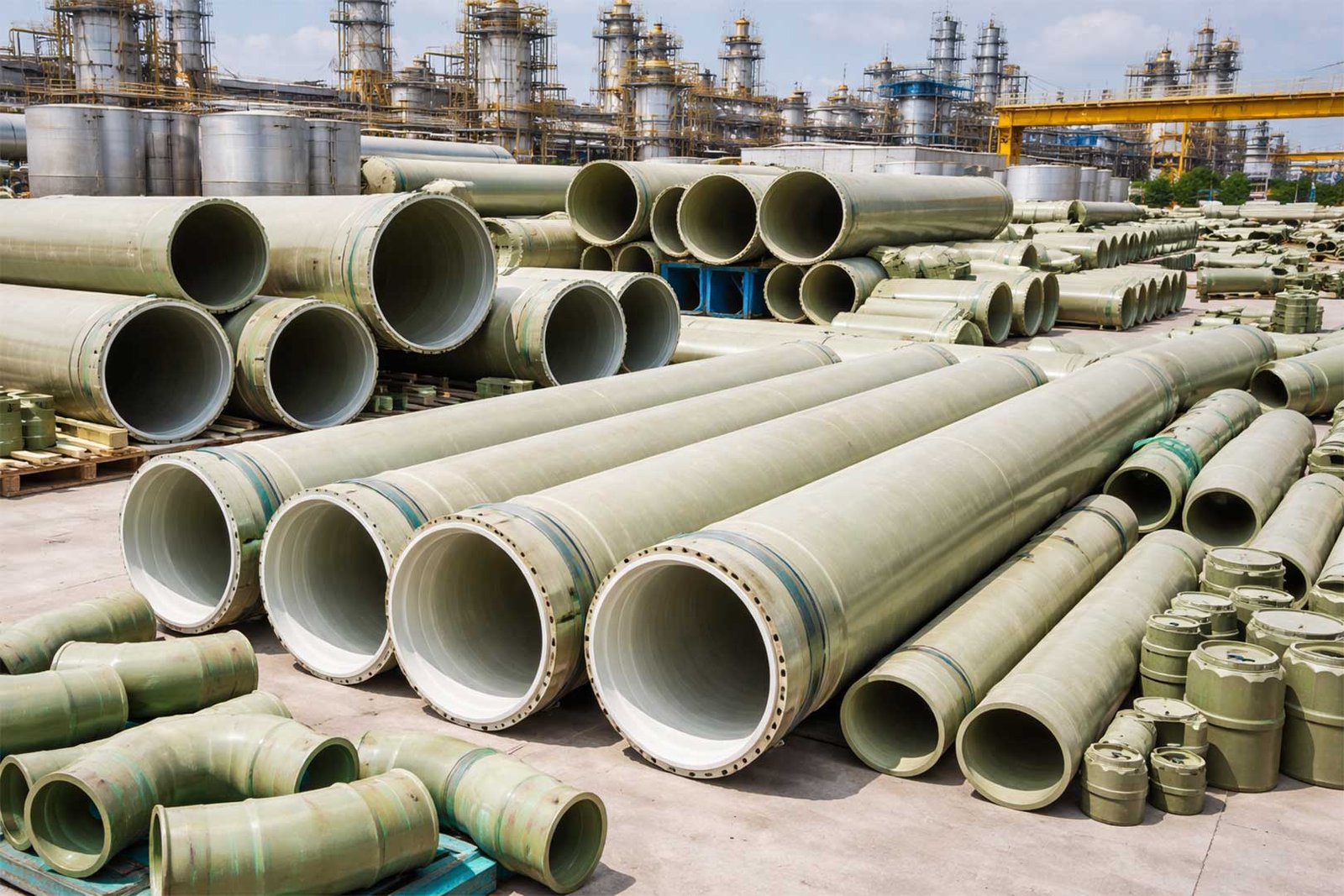
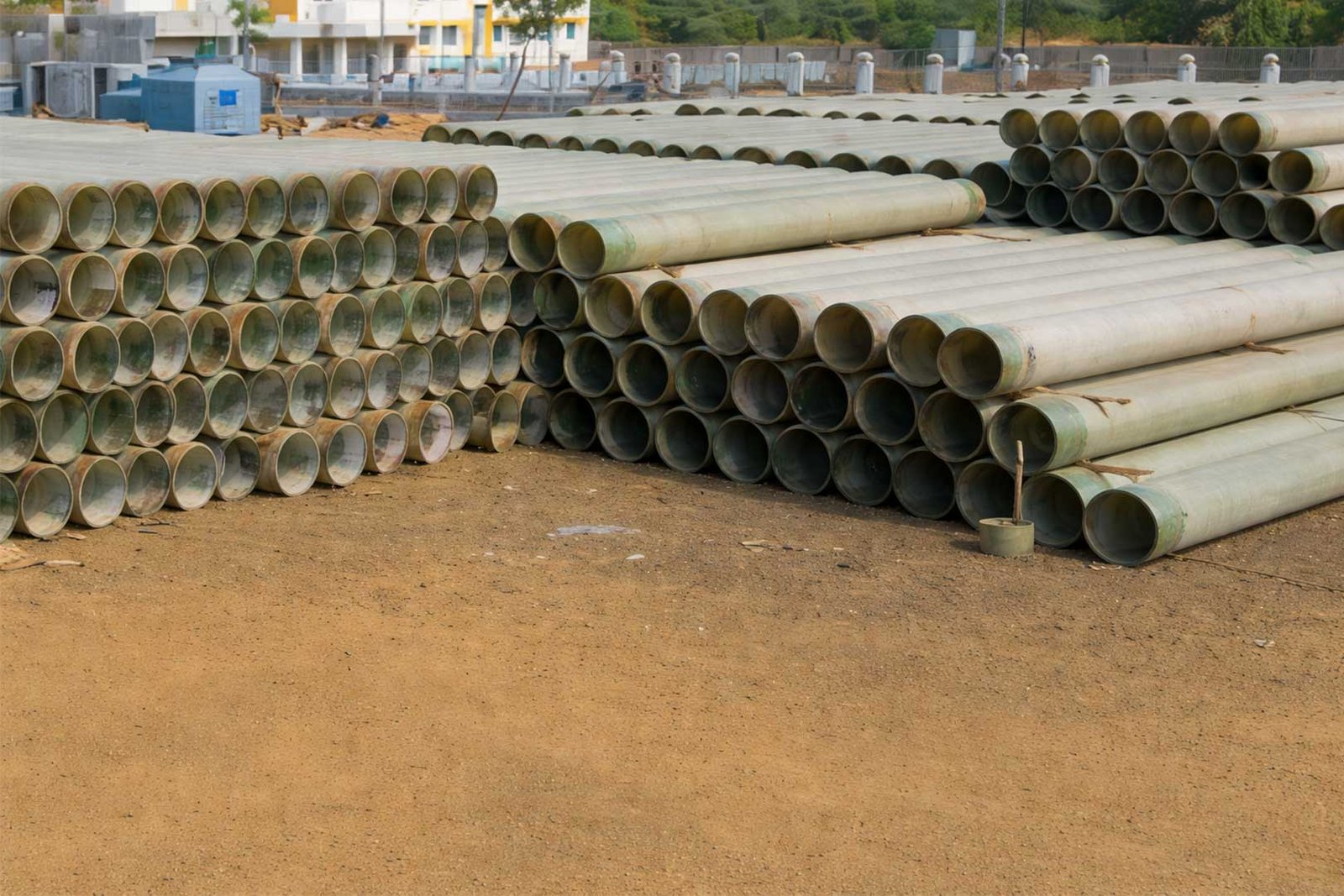
GRP Pipes for Water Transmission
You should focus on GRP for the most critical water mains. According to NHC, it stands out because:
- Excellent corrosion resistance, even in aggressive soils or seawater
- Smooth internal surface for great hydraulic efficiency and lower pumping costs
- Lightweight and easy to handle
- Much faster installation than heavier pipes
- Long service life when properly designed and installed
- Suitable for potable water, raw water, seawater, and industrial applications (when certified for your project)
Other Composite Pipe Options
Sometimes you need something different, have a look at the following list:
- GRE pipes: Best for higher chemical resistance or higher pressure
- Reinforced thermoplastic / spoolable pipes: Ideal for temporary bypasses or difficult access
- Composite wraps or liners: Useful for selected repairs and strengthening
Note: These materials are not interchangeable. You must choose the right system based on pressure, diameter, water type, temperature, joint type, installation conditions, certification, and your project standards.
Here’s a simple table to help you choose the right GRP pipe for your project:
| Selection Factor | What to Check | Why It Matters for You |
|---|---|---|
| Pressure Class | PN rating vs operating + surge | Keeps you safe during transients |
| Stiffness Class | SN rating vs burial & loading | Prevents deflection problems |
| Resin System | Polyester, vinyl ester, epoxy | Matches your water chemistry |
| Joint Type | Elastomeric, mechanical, laminated | Makes repairs faster when you need them |
| Potable Approval | NSF/ANSI 61 or equivalent | Protects your drinking water |
| Installation Method | Buried, jacking, aboveground | Affects how easily you can fix it later |
| Emergency Repair Method | Spools, couplings, wraps | Determines how fast you recover |
GRP Pipe Advantages in Emergency-Ready Water Infrastructure
GRP pipes don’t just work well; they actually help you stay ready when things go wrong. We will explain the biggest advantages you get when you use them for critical water mains.
1. Corrosion Resistance
You cut out a lot of headaches with GRP. It resists corrosion naturally, so you don’t have to worry much about aggressive soils, seawater, saline environments, internal corrosion, failed coatings, or spending money on cathodic protection. This means fewer surprises and lower maintenance costs over the years.
2. Jointing and Repair Flexibility
You have more options when it’s time to join or repair the pipe. You benefit from:
- Double-bell couplings
- Mechanical couplings
- Laminated field joints
- Spool replacement strategies
These make repairs quicker and give you more flexibility in the field.
3. Hydraulic Efficiency
Your smooth inner surface makes a real difference. It reduces head loss so water flows more easily, which lowers your pumping energy costs. This efficiency helps you every single day and becomes even more important during emergencies when you need maximum flow.
4. Lightweight Logistics and Faster Installation
You get a big practical advantage here. GRP pipes are much lighter, so you can transport them more easily, use less heavy equipment, and handle them faster on site. This is especially helpful for remote locations or when you need to respond quickly during an emergency.
Monitoring, Inspection, and Early Warning Systems
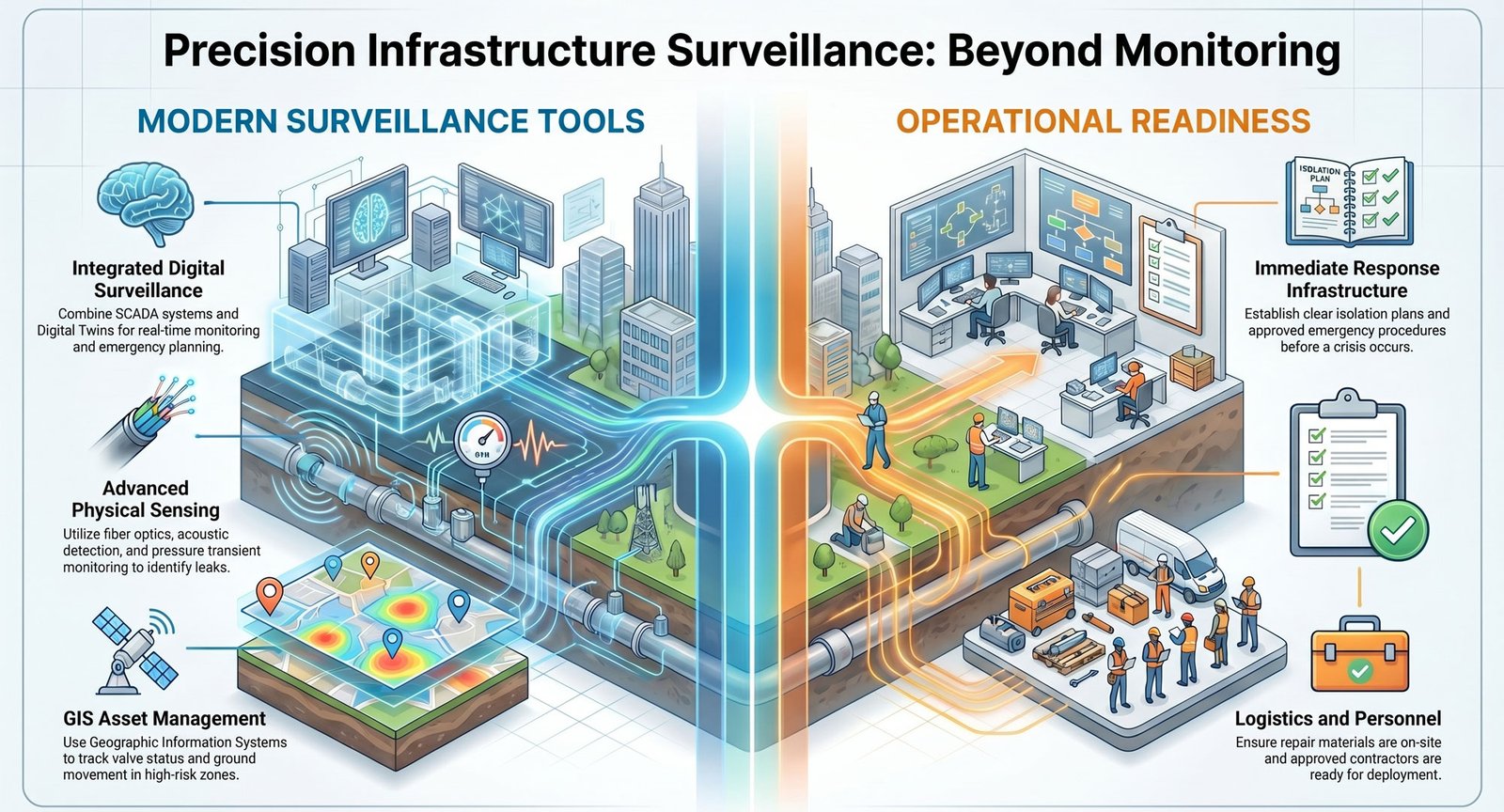
You need to watch pressure changes, flow problems, pump trips, surge events, leaks, valve status, and ground movement in risky spots. Use these modern tools to help:
- SCADA integration
- Acoustic leak detection
- Pressure transient monitoring
- Fiber optic sensing
- GIS asset management
- Digital twins for emergency planning
Note: just watching is not enough. The data won’t help you unless you also have clear isolation plans, repair materials, approved contractors, and ready emergency procedures.
Emergency Repair and Bypass Strategies
When a critical water main breaks, every minute counts. You need a clear plan so you can respond fast, protect people, and get water flowing again as quickly as possible. Here’s a simple, practical sequence you should follow when something goes wrong.
- Detect the event and confirm it with SCADA and field checks
- Activate your emergency response plan
- Isolate the affected section
- Protect public health and keep service running (install temporary bypass if needed)
- Carry out the repair, test it, disinfect, and recommission the line
- Review what happened and update your plan
Here’s a quick comparison of the main repair methods you can use — so you can choose the best one for your situation:
| Repair Method | Best For | Speed | Main Advantage for You | Limitation |
|---|---|---|---|---|
| Cut-out & Spool Replacement | Major damage | Medium | Permanent, reliable fix | Needs good access |
| Mechanical Coupling | Quick reconnection | Fast | Easy and straightforward | Requires restraint check |
| Laminated Field Joint | Permanent composite fix | Medium | Strong and integrated | Needs trained crew |
| Composite Wrap | Non-leaking defects | Very Fast | Often done without full shutdown | Not for complete bursts |
| Temporary Bypass | Keep service running | Fastest | Maintains supply for your customers | Needs careful planning |
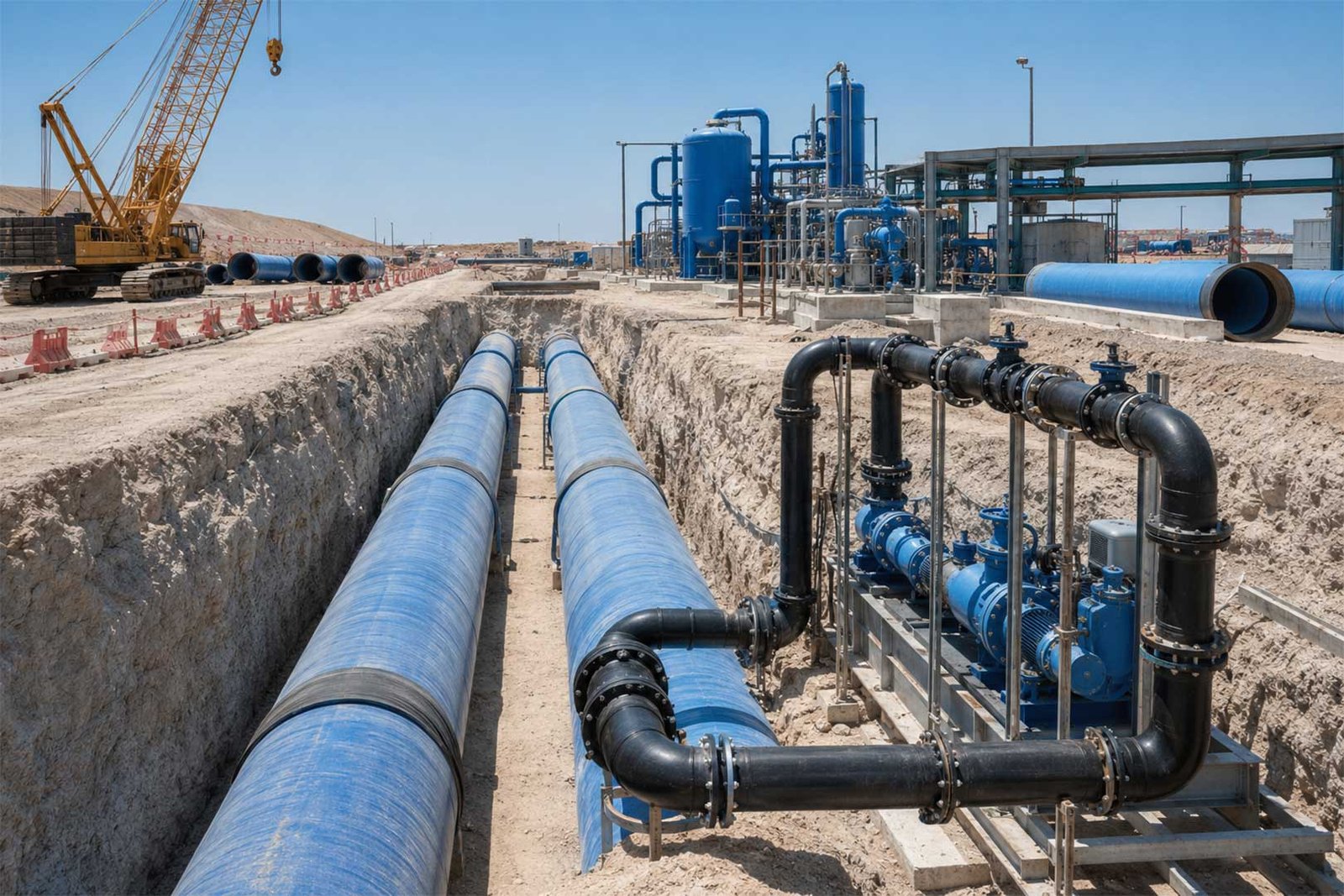
You need to plan bypass capacity, tie-in points, water quality, disinfection, traffic protection, pressure control, emergency pumps, and temporary pipelines.
EPC Readiness: From Pipe Supplier to Total Solution Maker
You don’t want to be chasing different suppliers and contractors when a critical main fails. That’s why EPC makes a huge difference. It turns you from managing many pieces into having one reliable partner who handles everything. Let’s see why:
Why EPC Matters in Water Main Emergencies
With EPC, you get single-point responsibility. Everything moves faster because one team handles engineering, procurement, and construction. You get better control over materials, installation, testing, and commissioning. Most importantly, your team has far less stress during a crisis and a much stronger chance of quick recovery.
How You Prepare Before Anything Goes Wrong
You work with your EPC partner to get everything ready in advance:
- Pre-engineered pipeline solutions and approved material specifications
- Prequalified vendors and suppliers
- Emergency stock and standard repair packages
- Clear mobilization plans, permitting, and access routes
- Strong QA/QC procedures so nothing gets missed
Procurement and Supply Chain Readiness
You secure long-lead items like pipes and fittings early. You also arrange couplings, gaskets, valves, regional stocking, factory inspections, transport planning, and emergency call-off agreements. This means you’re not stuck waiting when you need parts urgently.
Field Mobilization Capability
When an emergency hits, you have a ready team, including engineering assessment experts, site crews, equipment, lifting and handling plans, traffic management, and full testing and recommissioning support.
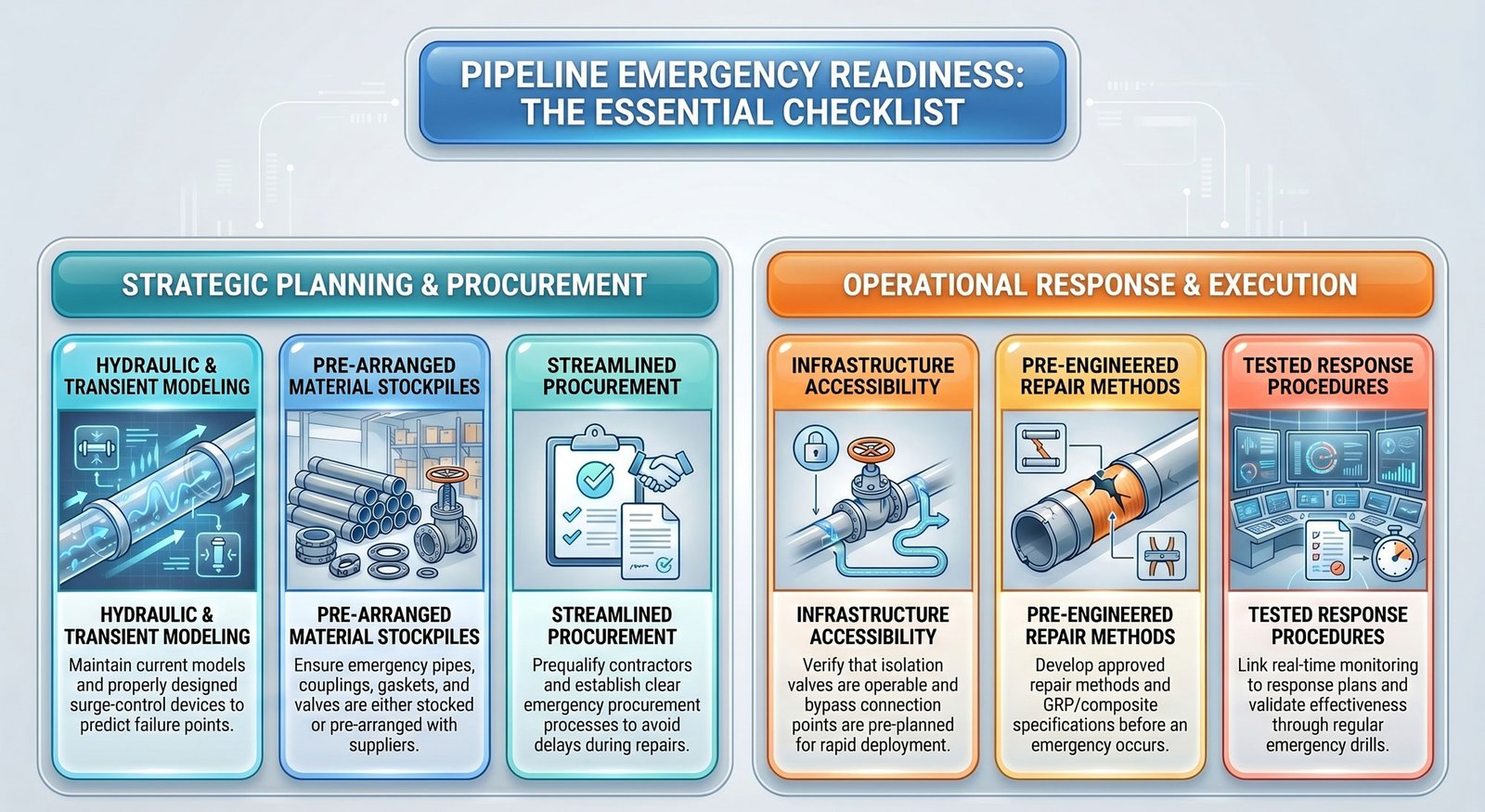
Readiness Checklist for Owners and Utilities
Here’s a practical checklist to help you quickly see how prepared you really are. Go through it and mark what’s done.
Design & Planning
- Is your main classification by consequence of failure?
- Do you have a current hydraulic and transient model?
- Are surge-control devices properly designed and maintained?
- Are alternative supply routes available?
Materials & Suppliers
- Are emergency pipe, couplings, gaskets, and valves stocked or pre-arranged?
- Are your GRP/composite pipe specifications already approved?
- Are suppliers and contractors prequalified?
- Do you have a clear emergency procurement process?
Response & Execution
- Are isolation valves accessible and operable?
- Are bypass connection points pre-planned?
- Are repair methods pre-engineered?
- Are permits, access routes, and traffic plans clear?
- Has your emergency response plan been tested with drills?
- Is monitoring connected to real response procedures?
Case-Based Lessons for Critical Water Main Preparedness
You probably agree that real failures teach us the best lessons. Here are four important ones that can help you avoid big problems with your own critical water mains:
Lesson 1: Redundancy Reduces Outage Severity
In Calgary, a major feeder main broke and caused chaos. Because they had almost no backup supply, thousands of people lost water for a long time (source: CBC).
What we learn: Don’t put everything on one pipe. If you build redundancy and alternative routes now, one break stays small instead of becoming a huge disaster for you and your customers.
Lesson 2: Monitoring Must Be Paired With Isolation
One utility had good sensors that caught a problem early. But when they tried to isolate the section, the valves didn’t work. ResearchGate states that a small issue quickly turned into a major outage for over 100,000 people.
What we learn: Early warnings are useless if you can’t act fast. You need working valves, ready crews, and a clear plan, not just sensors.
Lesson 3: Emergency Procurement Must Be Prepared Before Failure
According to the Environmental Protection Agency, when a big pipe failed in Massachusetts, the utility fixed it and restored full supply in less than two days. Why? They already had suppliers, contracts, and materials ready to go.
What we learn: Don’t wait until the pipe breaks to look for parts. Get your suppliers, stock, and emergency agreements in place now so you can move quickly when you really need them.
Lesson 4: Installation Quality Determines Long-Term Reliability
Even expensive, high-quality GRP pipes have failed early because the bedding was poor, compaction was weak, or the joints weren’t done properly.
What we learn: Good pipe isn’t enough. You also need proper installation, correct bedding, compaction, jointing, and testing, if you want it to last for decades without trouble.
Why Choose Linecore Pipes Group for Your Critical Water Mains?
You don’t have to wait for a crisis to get serious about preparedness. Build resilience now with smart design, the right composite materials, quality installation, and full EPC support. It protects your operations and the people who depend on you.
Linecore Pipes Group combines composite pipe technology with EPC execution capability. We help you move from simple material supply to full pipeline readiness, from design and procurement to installation, testing, commissioning, and emergency response support.
Ready to strengthen your critical water mains? Contact Linecore Pipes Group today.
about
The Author

Farshid Tavakoli is a seasoned professional in engineering and international trade. Holding degrees in Electrical Engineering, Mechatronics, and a Doctorate in Business Administration (DBA) from the University of Lyon, he also has a strong background in industrial automation and production line technologies.
For over 17 years, he has led an international trading company, gaining deep expertise in commercial solutions tailored to industrial needs. With more than 8 years of active involvement in infrastructure development, he specializes in the supply of electromechanical equipment for water and wastewater treatment plants and transfer projects.
Together with comapny expert team, he now provides consultancy and integrated solutions for sourcing and implementing complex infrastructure projects across the region.