Water transmission projects usually get expensive long before pipe orders or construction work begin. Early choices around pipeline diameter, route alignment, pump stations, pressure class, and surge protection shape most of the final project cost. Once these decisions move forward, changing them later becomes difficult and expensive.
LineCore Pipes Group helps project owners control capital cost from the early design stage. Through GRP and composite pipe systems, hydraulic coordination, and EPC delivery, the focus stays on building a smarter transmission system from the start.
Real CAPEX savings rarely come from choosing the lowest pipe price. They appear when the hydraulic decisions are correct before it’s late!
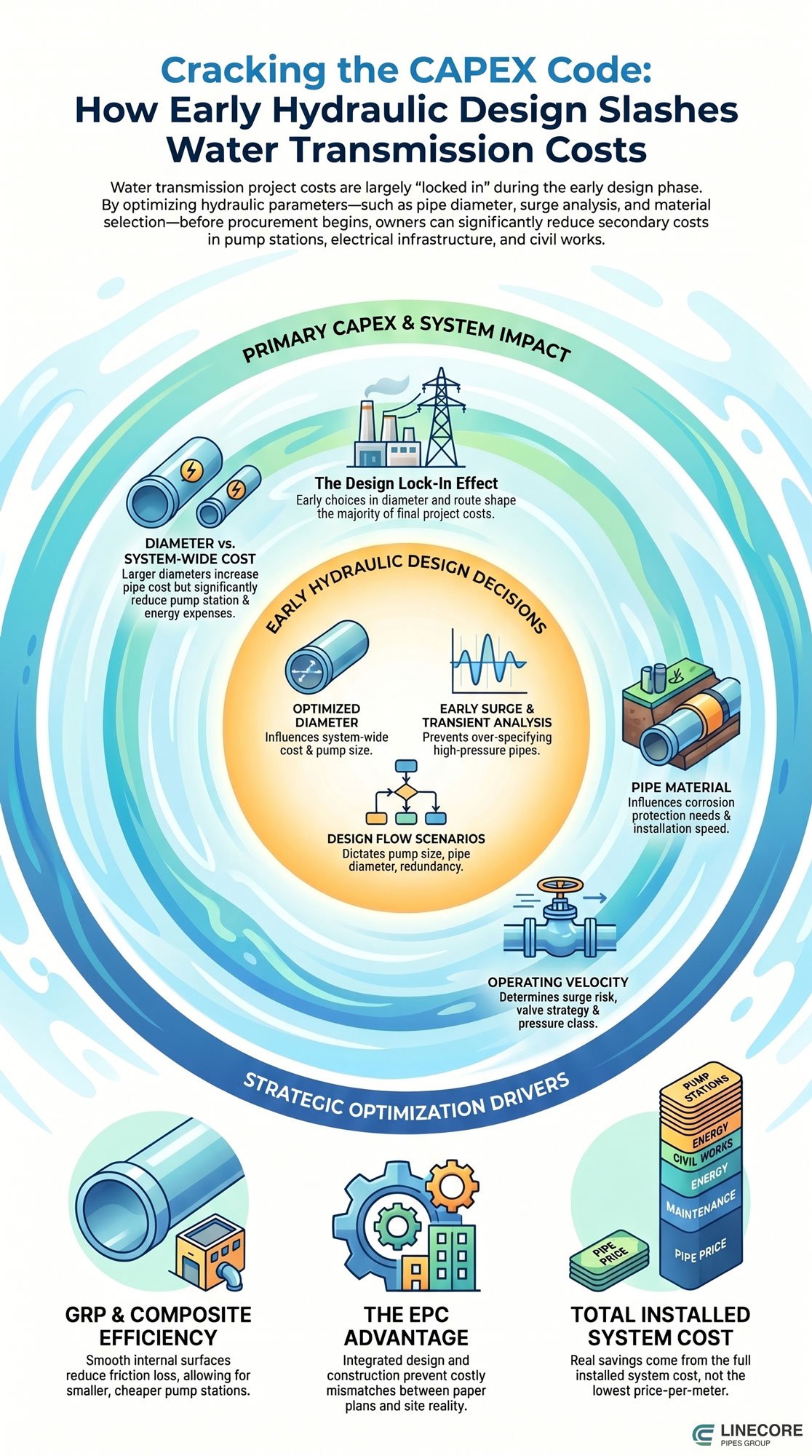
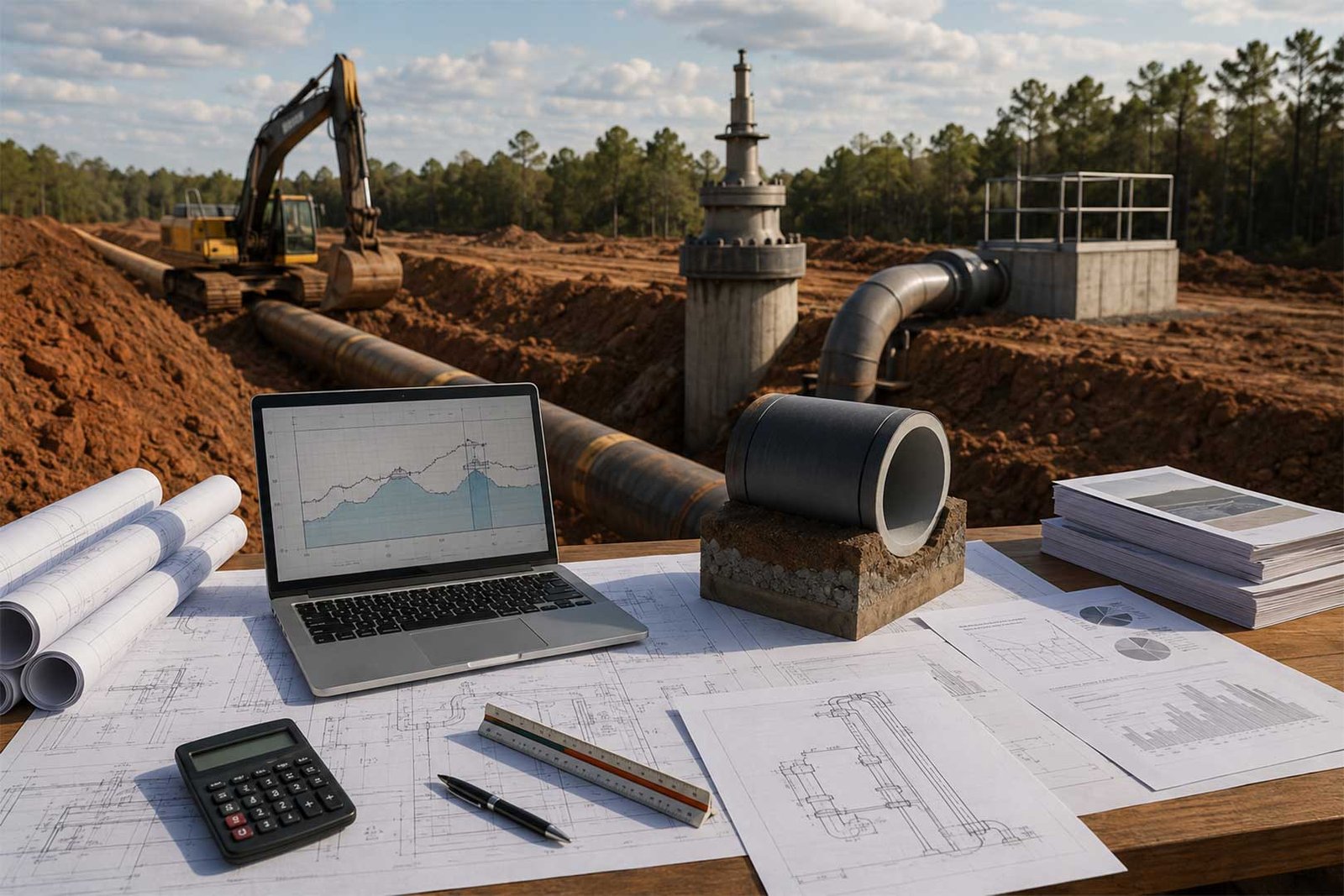
Early hydraulic decisions reduce capex infographic (source: Pipelinecoregroup.com)
Why Early Hydraulic Design Has the Biggest CAPEX Effect
Early hydraulic decisions shape far more than pipeline sizing in the piping systems. They influence pump stations, surge protection, civil works, route alignment, and long-term operating requirements. Once these choices move into FEED and procurement, changing them later becomes expensive and disruptive.
Hydraulic Decisions Affect More Than Pipe Cost
Early hydraulic planning influences civil, mechanical, electrical, and installation costs at the same time.
| Early Decision | CAPEX Impact |
|---|---|
| Design flow and demand scenarios | Pipe diameter, pump size, redundancy |
| Pipe diameter | Material volume, trench width, fittings, head-loss |
| Operating velocity | Surge risk, valve strategy, pressure class |
| Route alignment | Pipeline length, crossings, pumping head, permits |
| Pipe material | Corrosion protection, installation method, service life |
| Pump duty point | Pump station size, electrical package, standby power |
| Surge analysis | Pressure class, surge vessels, air valves, control systems |
A change in one hydraulic parameter often creates cost changes across several systems. A smaller pipe may reduce material cost but increase headloss, pump size, and surge pressure later.
The “Design Lock-In” Problem
Late hydraulic changes usually come with high cost and schedule pressure. By that stage, civil works, permits, pump stations, and procurement packages already follow earlier design assumptions.
A small decision made during pre-FEED can later turn into a major construction cost. Changing pipeline diameter after pump sizing or route approval may affect trench dimensions, fittings, electrical systems, and delivery schedules at the same time.
Pipe Diameter Optimization: The First Major CAPEX Lever
Many water projects treat pipe diameter as a standard sizing exercise. In reality, diameter controls much of the system around it. One early sizing choice can later change pump station cost, trench dimensions, surge pressure, electrical load, and even future expansion options.
Diameter Changes More Than Pipe Quantity
Pipe diameter directly influences:
- Pumping head and energy demand
- Excavation scope and fittings
- Surge behavior and pressure requirements
- Future operating flexibility
A larger diameter may reduce friction loss and pumping pressure, but it also increases material volume, handling weight, and installation scope. A smaller diameter may cut pipe cost early while pushing more cost into pumps and electrical systems later.
The Cost of Oversizing and Undersizing
Oversized pipelines often create unnecessary material and installation costs. They may also reduce flow velocity to a level that creates operational issues inside the line.
Undersized pipelines usually create the opposite problem. Higher head-loss may require larger pumps, higher pressure classes, and more electrical capacity. Over time, energy costs can rise sharply.
Smaller Pipe Does Not Always Mean Lower CAPEX
The best solution rarely comes from a conservative sizing rule or the lowest pipe price. Strong hydraulic design compares multiple diameter, material, and pump combinations before the project moves into procurement.
Pump Station Sizing: How Hydraulic Choices Affect Mechanical and Electrical CAPEX
Pump station cost follows hydraulic performance. Higher friction loss across the pipeline usually pushes more cost into pumps, motors, electrical systems, and standby power infrastructure.
Total Dynamic Head Directly Shapes Pump Station Cost
A pipeline with poor hydraulic efficiency places more load on the pump station. Higher head-loss force engineers to add components below:
- Larger pumps and motors
- Bigger MCC and VFD systems
- Higher standby power capacity
- More complex controls and electrical infrastructure
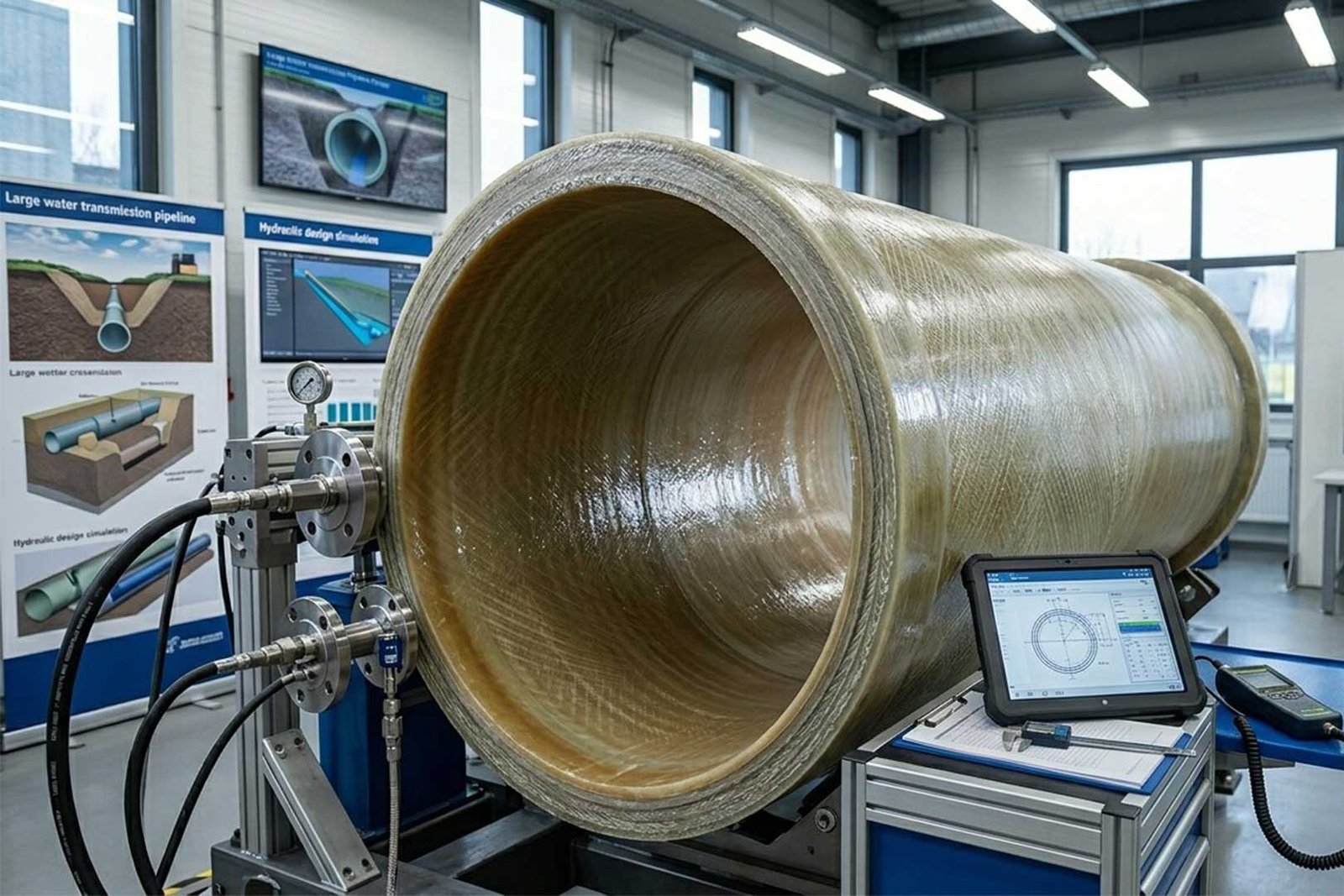
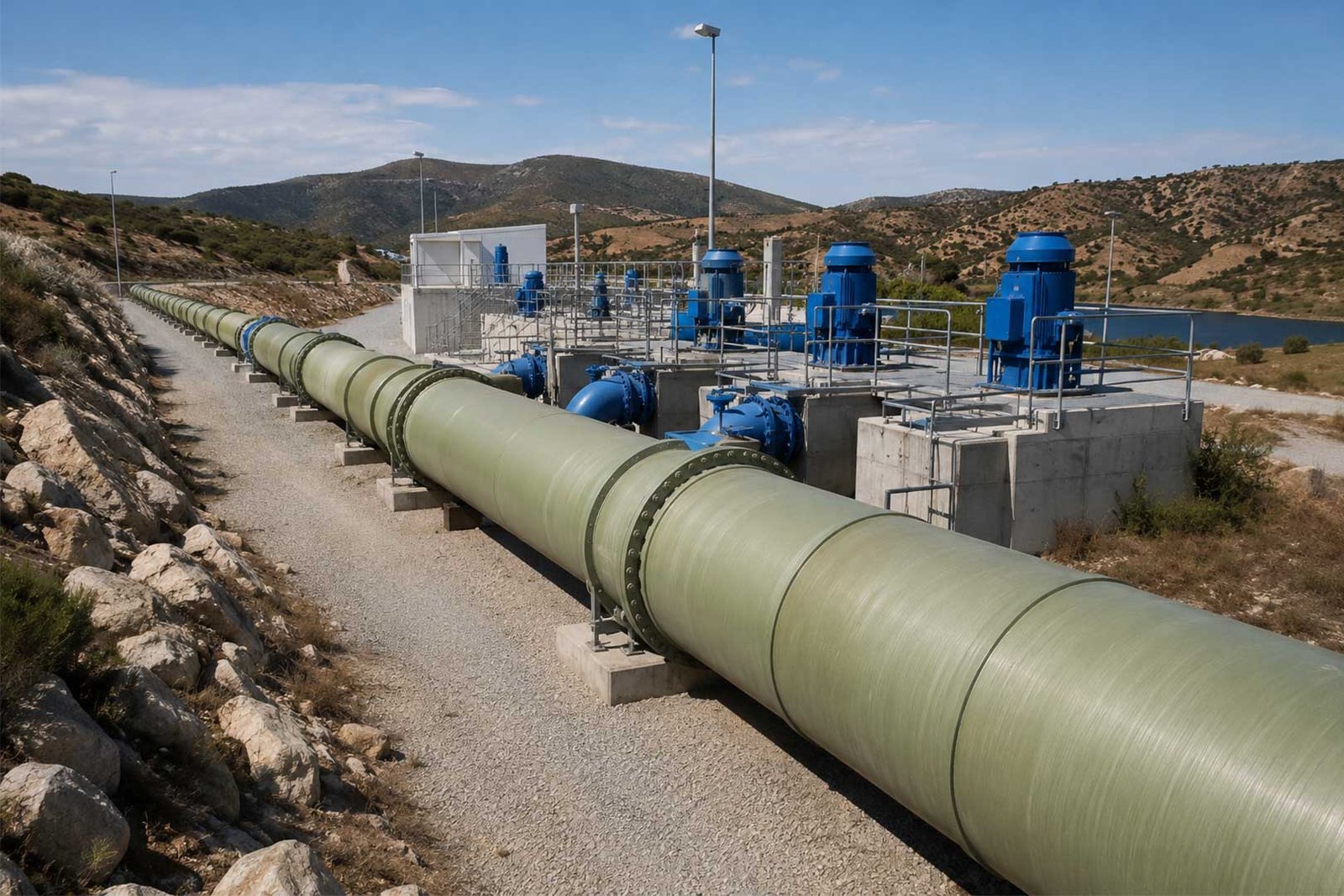
This is where GRP and composite pipelines show more impressive hydraulic performance compared to alternatives. Smooth internal pipe surfaces can help reduce friction losses, depending on diameter, pressure class, route profile, and operating conditions.
Engineering Insight: The U.S. Department of Energy Pump Systems Sourcebook notes that pump systems operating away from their best efficiency point can create significantly higher operating and power costs over time.
Better Hydraulics Can Reduce Installed Power
A smaller pipeline with high head-loss may lower pipe cost early but increase mechanical and electrical CAPEX later. An optimized GRP or composite pipeline may reduce pumping pressure and electrical demand, even if the pipe itself is not the lowest first-cost option.
Two Common Hydraulic Design Scenarios
Small hydraulic changes can shift major mechanical and electrical costs across the project.
| Scenario | Hydraulic Result | CAPEX Impact |
|---|---|---|
| DN800 steel pipeline with higher velocity | Higher head-loss and pumping pressure | Larger pumps, motors, MCCs, and surge systems |
| Optimized DN1000 GRP pipeline | Lower friction loss and smoother flow | Lower installed power and reduced electrical CAPEX |
Surge and Water Hammer: The Hidden CAPEX Driver
Surge issues usually stay hidden until the main pipeline design is already complete. Once that happens, even small corrections can push CAPEX much higher.
Why Water Hammer Cannot Be Ignored Early
Water hammer starts when flow changes too quickly inside the line. A pump trip, quick valve closure, emergency shutdown, or trapped air can send pressure waves through the system. If teams wait too long to study surge conditions, they may go through thicker pipe classes or extra protection equipment just to avoid future problems.
Early Surge Analysis Helps Reduce Overdesign
Early surge studies help systems to improve aspects below:
- Pressure class: ResearchGate highlights that lower surge loads can remove the need for heavier pipes.
- Valve closure timing: Slower closure rates help keep pressure spikes under control.
- Pump start and stop sequence: Better operating sequences reduce stress across the pipeline.
- Air valve and surge vessel locations: Good placement improves protection without adding unnecessary components.
A Thoughtful Surge Strategy Starts With the Full Hydraulic System
For LineCore Pipes Group, surge control begins during hydraulic design, where pipe material, route profile, valves, and pump operation work together as one system.
Route Selection: CAPEX Is Also Hidden in the Corridor
Route planning shapes the full cost profile of water transmission systems before design freezes. Alignment decisions set hydraulic demand, construction effort, access conditions, and long-term operational costs.
A Shorter Route Does Not Always Lead to Lower Cost
Route choice sets elevation profile, pumping head, crossings, excavation depth, access roads, land acquisition, environmental approvals, valve chamber locations, and construction productivity.
Hydraulic Route Screening
Project teams evaluate alternative alignments using longitudinal profiles, high and low points, air valve and washout requirements, pumping head, surge behavior, crossings, and construction access. These factors reveal cost differences that distance alone cannot capture. Check the table below to compare these aspects.
| Route factor | Possible CAPEX effect |
|---|---|
| Higher elevation route | Larger pump head |
| More crossings | Higher civil and permitting cost |
| Poor access | Slower installation and higher equipment cost |
| Longer but smoother profile | May reduce surge and pumping complexity |
| Better staging access | Faster construction and lower preliminaries |
Material Selection: Why GRP and Composite Pipes Can Support CAPEX Reduction
Material selection only creates value when it links hydraulics, construction, and lifecycle behavior. GRP and composite pipes can reduce total installed CAPEX when viewed as part of the full system, not as standalone items.
1. Moving Beyond Pipe Price per Meter
Focusing only on unit cost hides system effects. GRP and composite solutions influence hydraulics, installation effort, and maintenance scope at the same time. The real value appears when these interactions are considered together.
2. Corrosion Resistance and Lifecycle Cost
Unlike metallic pipes, GRP pipes do not require coatings, linings, or cathodic protection. This removes several cost layers linked to corrosion control and long-term rehabilitation planning.
3. Hydraulic Smoothness and Pumping Demand
Lower internal roughness reduces friction losses. This can lower pumping head and reduce pump and motor sizing in long transmission systems.
4. Lightweight Handling and Installation Speed
Reduced weight simplifies transport and lifting. It also lowers equipment demand and can improve installation productivity on site. All these come from the high strength-to-weight ratio of GRP pipes compared to metallic pipes. (Source: ScienceDirect)
5. Jointing Efficiency and Service Life
GRP systems often support faster assembly under suitable site conditions. They also represent a high resistance in saline, industrial, and wastewater environments, which supports longer service life and fewer replacement cycles.
The EPC Advantage: How EPC Turns Hydraulic Optimization Into Real CAPEX Savings
EPC ties hydraulic design, procurement, and construction together in one single workflow. In the usual fragmented approach, these pieces sit in separate contracts. Those gaps create redesigns, delays, and extra installation costs.
With EPC, LineCore Pipes Group keeps the design intent locked in with what actually happens in the field right from the start. Hydraulic choices, material selections, and construction plans all move through the same coordinated process.
Why EPC Cuts the Disconnects
Design teams worry about hydraulics. Contractors focus on getting the job done on site. EPC puts both sides in one chain.
Hydraulic reviews, pipe selection, procurement, fabrication, installation methods, testing, commissioning, and schedule all stay linked. That cuts the usual mismatch between the paper design and what crews actually encounter in the trench.
Single-Point Responsibility
One team owns everything from design through delivery. No more constant handoffs between different parties. Decisions happen faster. Site problems get fixed quicker because everyone knows exactly who is accountable.
Early Procurement and Constructability
Procurement happens with real construction conditions in mind. That means fewer last-minute changes out on site. Pipe lengths, delivery order, and installation steps line up with how the trench work actually progresses.
Quick tip: Before you freeze procurement, check how crews will handle, store, and join the pipes. Those small site realities drive your final cost more than tweaks to the hydraulic model.
Practical CAPEX Reduction Framework for Water Transmission Projects
CAPEX control in water transmission starts with structure, not equipment. A clear step-by-step framework helps prevent early assumptions from locking in high-cost outcomes later in design and construction.
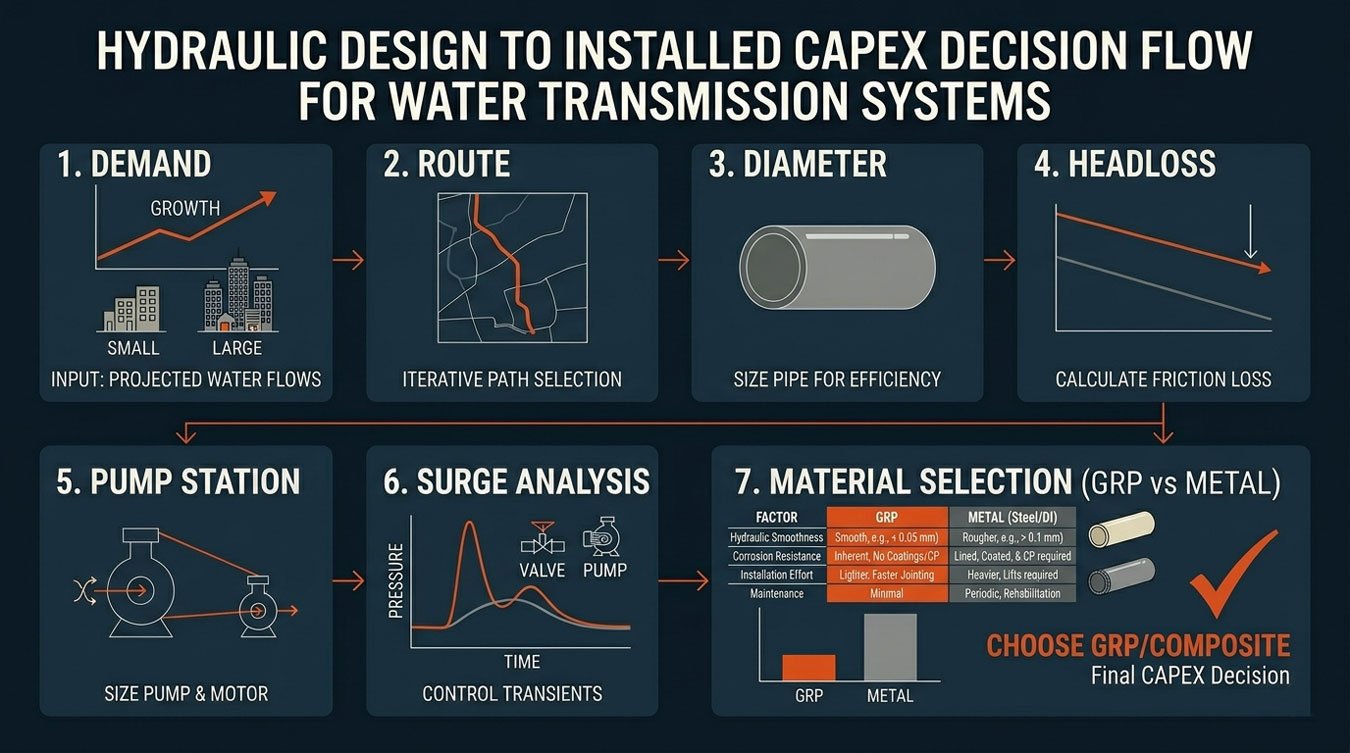
Below, we provide you a step-by-step workflow, check it out to understand how CAPEX reduction works.
● Step 1: Confirm the Design Flow and Future Demand
Start by locking in the current demand, any planned expansions, peak flows, emergency transfers, and all the different operating conditions the system will face.
● Step 2: Build Real Hydraulic Alternatives
Look at several practical options. Compare different pipe diameters, materials, routes, and pumping setups to see what works best.
● Step 3: Check Head-loss And Pump Duty
Calculate the total dynamic head. This tells you exactly what size pump station you need, how much power it will draw, and what redundancy makes sense.
● Step 4: Run Transient Analysis
Test the system under real stress: pump trips, sudden valve closures, filling, draining, and shutdown scenarios. See where problems could appear.
● Step 5: Choose the Right Pipe Material and Pressure Class
Pick the pipe based on the hydraulics, how corrosive the environment is, the pressure it must handle, the installation method, and how it will perform over the full lifecycle.
● Step 6: Review Constructability and Logistics
Look closely at site access, lifting requirements, trenching conditions, delivery sequence, staging areas, and how fast crews can actually install everything.
● Step 7: Compare the Total Installed CAPEX
Add up everything: pipes, fittings, pumps, valves, civil works, surge protection, permits, logistics, and a realistic contingency. This gives you the true bottom-line cost for each option.
What Project Owners Should Ask Before Final Design Freeze
In this section we provided a useful checklist to make sure if you are close enough to the right design.
- Has pipeline diameter been optimized against pump station cost?
- Have multiple route profiles been checked hydraulically?
- Has transient analysis been completed before pressure class selection?
- Are we comparing pipe price or full installed CAPEX?
- Has corrosion protection cost been included for metallic options?
- Have logistics, pipe weight, and installation productivity been considered?
- Can GRP or composite pipes reduce pumping head or installation cost?
- Is EPC input included early enough for constructability input?
- Are lifecycle and energy costs part of the model?
- Are future expansion needs included in the design basis?
How Linecore Pipes Group Supports CAPEX-Efficient Water Transmission
Water transmission projects depend on early coordination between hydraulic design, material selection, and construction planning. Cost certainty improves when each of EPC aspects whether engineering decisions, procurement, and execution follow one integrated logic from the beginning.
Integrated Pipe Supply and EPC Execution
LineCore Pipes Group provides GRP pipes, composite pipe systems, and full EPC solutions for water transmission networks. The team also manages engineering coordination, procurement planning, logistics, installation, and commissioning. This structure keeps design intent aligned with field reality.
Value Proposition
The combination of composite pipe supply and EPC capability helps clients shape hydraulic design early, avoid unnecessary oversizing, and select systems that match real operating conditions. This approach strengthens cost control across the full project lifecycle.
What Projects Fit Better?
This model fits municipal transmission, desalination transfer, industrial supply, irrigation systems, wastewater and treated effluent lines, mining pipelines, large buried pipelines, and systems in corrosive soil or saline environments.
about
The Author

Farshid Tavakoli is a seasoned professional in engineering and international trade. Holding degrees in Electrical Engineering, Mechatronics, and a Doctorate in Business Administration (DBA) from the University of Lyon, he also has a strong background in industrial automation and production line technologies.
For over 17 years, he has led an international trading company, gaining deep expertise in commercial solutions tailored to industrial needs. With more than 8 years of active involvement in infrastructure development, he specializes in the supply of electromechanical equipment for water and wastewater treatment plants and transfer projects.
Together with comapny expert team, he now provides consultancy and integrated solutions for sourcing and implementing complex infrastructure projects across the region.