A productive borehole can feel like a big step forward, but you are still only at the beginning. The real challenge begins when several groundwater sources need to work together and deliver reliable water across long distances, changing elevations, and multiple communities. Ethiopia’s own project experience shows how quickly a promising source can run into problems.
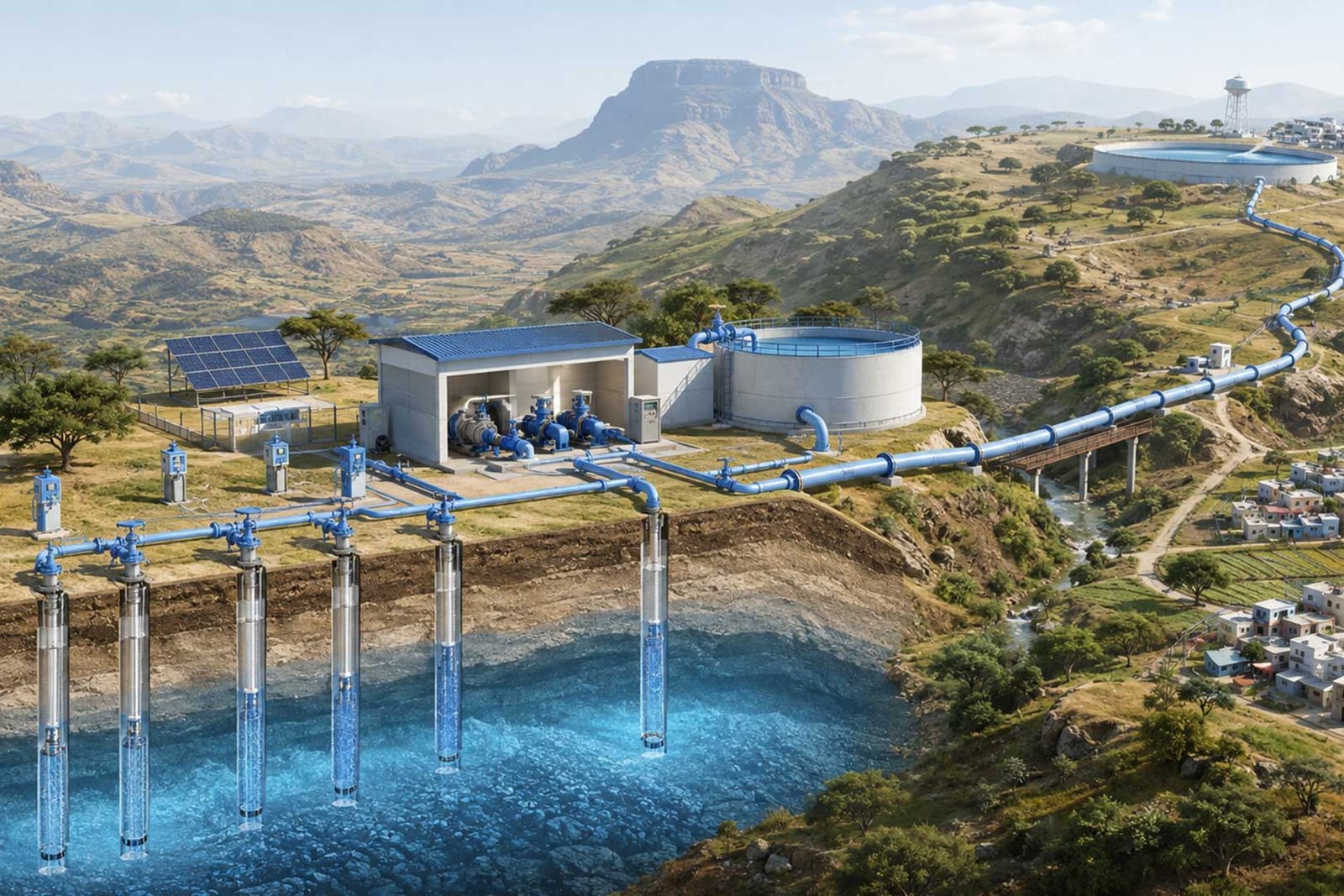
Keep going to see how a promising wellfield becomes a regional supply system that can handle pumping, pressure, storage, power, water quality, and long-term operation when real-world conditions get difficult.
Step 1: From Individual Boreholes to a Managed Wellfield
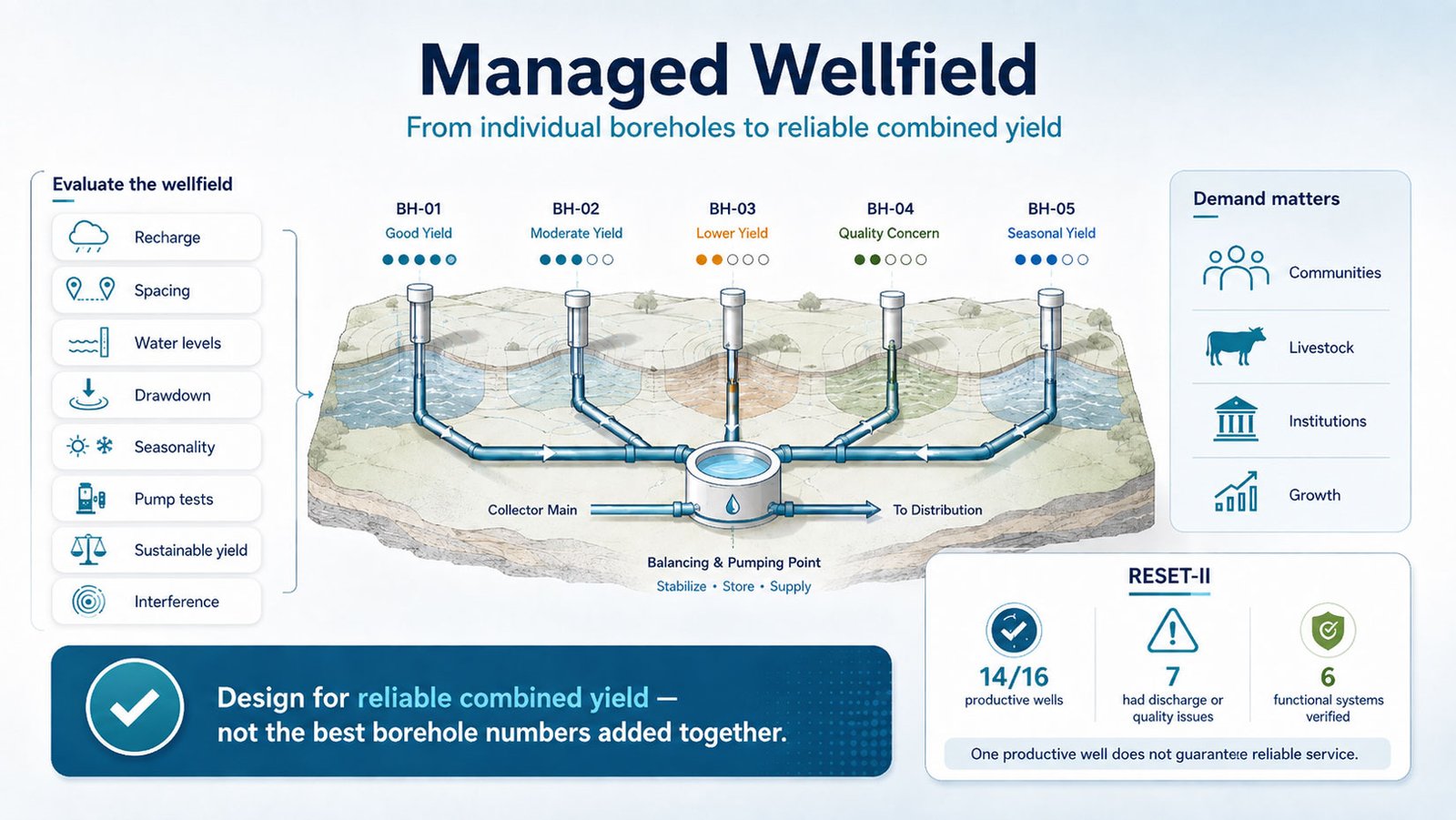
A strong pumping test from one borehole does not tell you what the whole wellfield can safely deliver. What matters is how those wells perform together, day after day, without putting too much pressure on the aquifer. Start by checking the conditions that shape reliable combined yield.
- aquifer extent and recharge
- borehole spacing
- static and pumping water levels
- drawdown
- seasonal groundwater changes
- pumping-test results
- sustainable abstraction
- interference between nearby wells
Ethiopia’s Ministry of Water and Energy uses this kind of investigation before groundwater development moves forward.
Demand belongs in the same conversation. The number of people you need to serve, livestock demand where relevant, institutional and commercial users, peak demand, future growth, and planned branches all affect the source capacity, storage, and transmission infrastructure you need.
Design around the reliable combined yield of the wellfield, not the best number from each borehole added together.
RESET-II Shows Why a Productive Borehole Is Not Enough
A useful warning comes from UNICEF. Its RESET-II evaluation found 14 productive wells among 16 drilled or tested, but seven had poor discharge or groundwater-quality problems. UNICEF verified only six functional systems, and some post-drilling works depended on later financing. A productive well does not automatically give a community dependable water service.
Step 2: Aggregating Boreholes Through Collector Mains
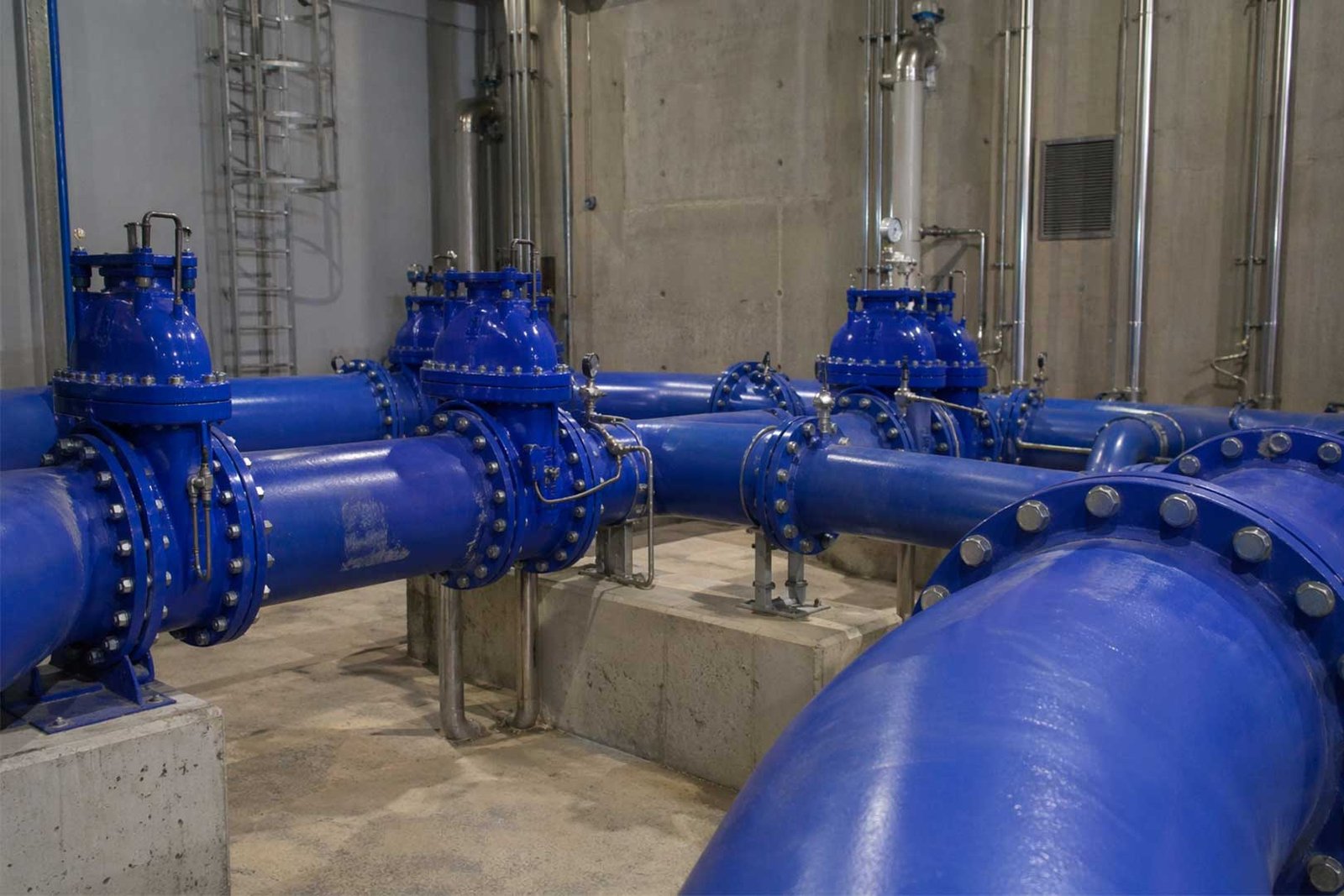
Once several wells feed the same regional system, you need to make them behave like one managed source. That is harder than simply connecting them to a common pipe because each borehole may have a different elevation, yield, water level, pump curve, and discharge pressure. A practical collector network may need:
- wellhead assemblies and individual rising mains
- isolation and non-return valves
- flow and pressure measurement
- branch connections and manifolds
- a collector main
- a central collection or balancing point
- room for maintenance and future wells
Hydraulic balance matters here. Without it, one stronger borehole can dominate the manifold while another struggles to discharge. You may also see reverse flow, unstable pumps, unnecessary head loss, uneven abstraction, and much harder troubleshooting.
The collector system is the point where separate groundwater sources start behaving like one controlled bulk-water supply.
Step 3: Pumping and Balancing the Combined Groundwater Flow
Well pumps and regional transmission pumps do different jobs. Keeping those jobs separate can make the whole system easier to control, especially as the route gets longer or climbs to higher elevations.
| System element | What it does | Why it matters |
|---|---|---|
| Well pump | Lifts water from the aquifer | Keeps abstraction matched to well conditions |
| Balancing storage | Separates well production from downstream demand | Stabilizes flow and reduces pump cycling |
| Transmission pump | Moves the combined flow through the regional system | Handles bulk conveyance and route head |
| Booster station | Adds head where the route needs it | Supports staged pumping on suitable routes |
Balancing tanks can also give operators a short reserve, make maintenance easier, and smooth out the difference between what the wellfield produces and what the transmission system needs at that moment.
Booster stations can help on routes with difficult elevation gain, long distances, or pressure limits, but they do not belong in every groundwater system. The actual terrain, hydraulic model, pressure class, and energy strategy should decide.
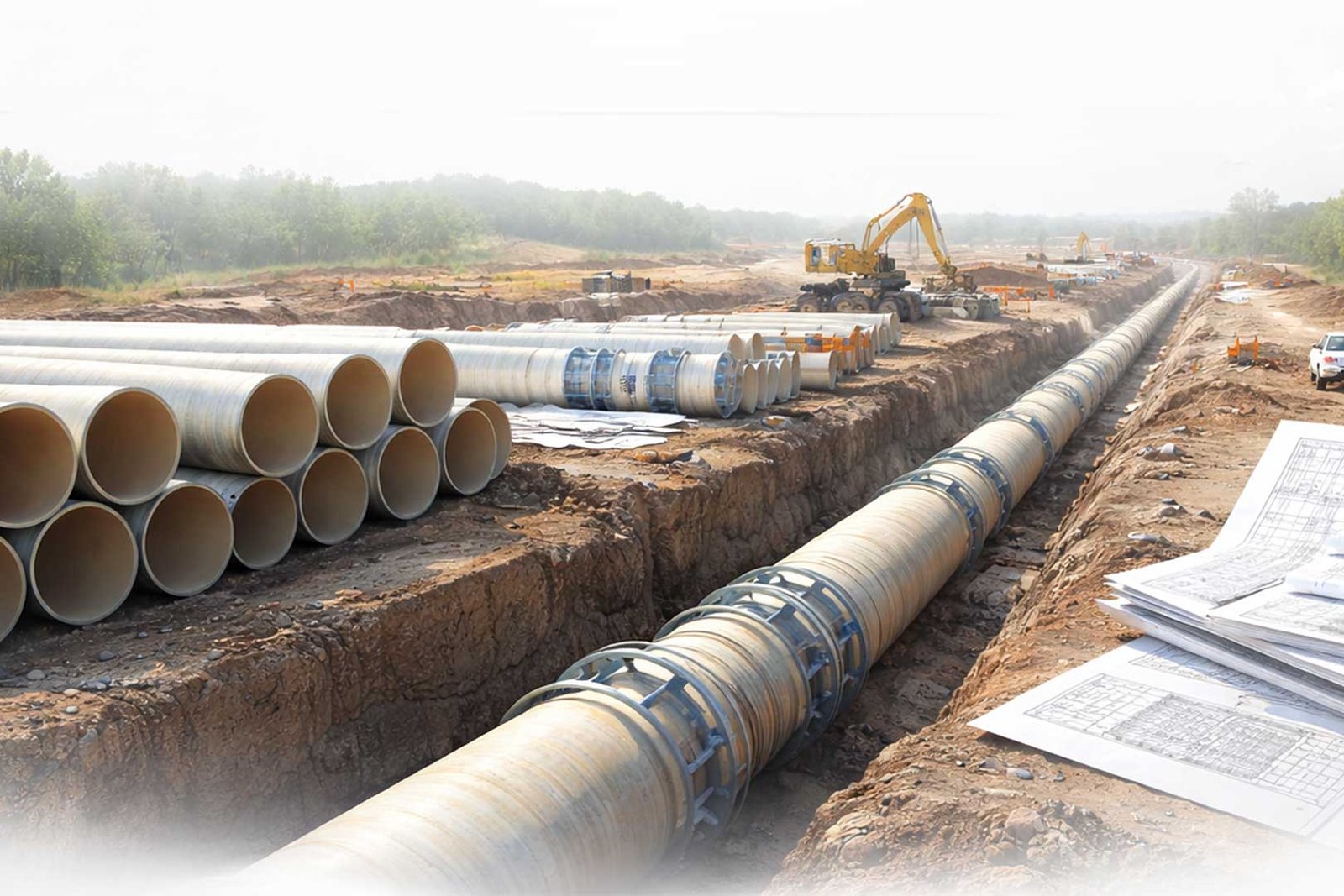
Step 4: Designing the Regional Groundwater Transmission Main
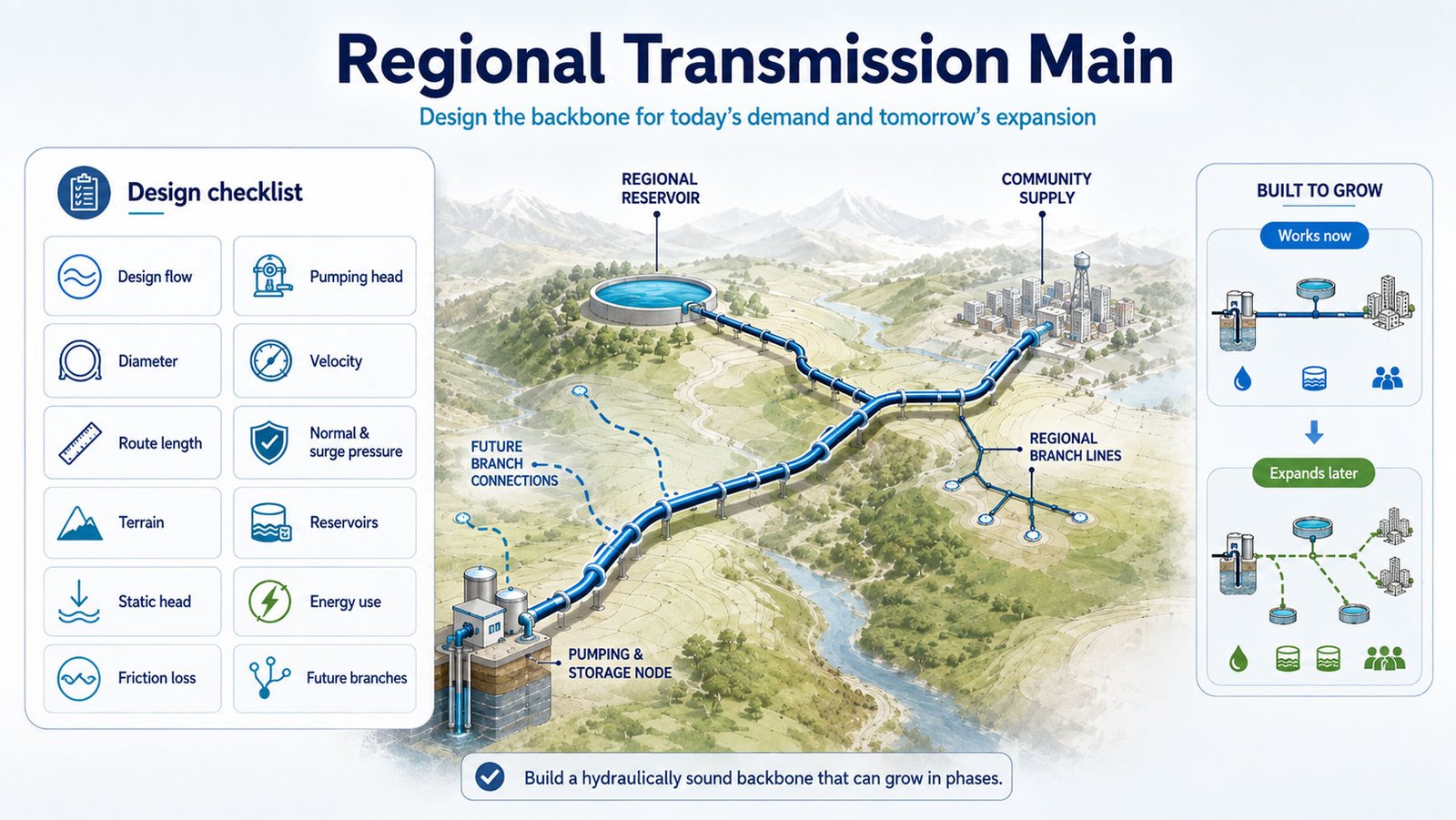
This is where the system moves beyond local water supply and becomes regional infrastructure. The transmission backbone carries large volumes between major hydraulic points and toward reservoirs, towns, or regional branches. The design needs to work for today without making future expansion difficult. That means looking at:
- design flow
- pipeline diameter
- route length
- terrain profile
- static head
- friction losses
- pumping head
- allowable velocity
- normal and surge pressure
- reservoir arrangement
- energy use
- future demand and branch connections
There is no useful way to choose a DN, PN, or final route length before your team has project-specific hydraulic data.
A better approach is to build a backbone that works hydraulically now but can still accept more boreholes, reservoirs, communities, and branches later. That also makes phased investment easier because the first project package does not have to build the entire future system at once.
Real-World Example: Adami Tesso and Kumato Regional Water Supply
A good example of this shift from a local groundwater source to a wider supply system comes from Adami Tesso and Kumato. According to the World Bank, the rural piped water system serves more than 24,000 people through 22 public taps and also includes six cattle troughs.
Once groundwater needs to reach several communities and different types of users, the project has to think beyond the borehole itself and plan pumping, piped conveyance, storage, downstream delivery, and long-term operation as one system.
Step 5: Managing Ethiopia’s Elevation and Pressure Challenges
Two pipelines can have similar lengths and still behave very differently if their elevation profiles are different. Across Ethiopia, that makes topography a major part of pressure control, pump duty, energy use, and pipeline protection.
Pressure Zoning and Surge Control
Long routes may face high static pressure in low areas, weak residual pressure at higher points, air accumulation, changing pump duties, and transient pressure problems. Depending on the route, the design may use
- intermediate reservoirs
- break-pressure tanks
- booster stations
- pressure-control valves
- air valves
- isolation valves
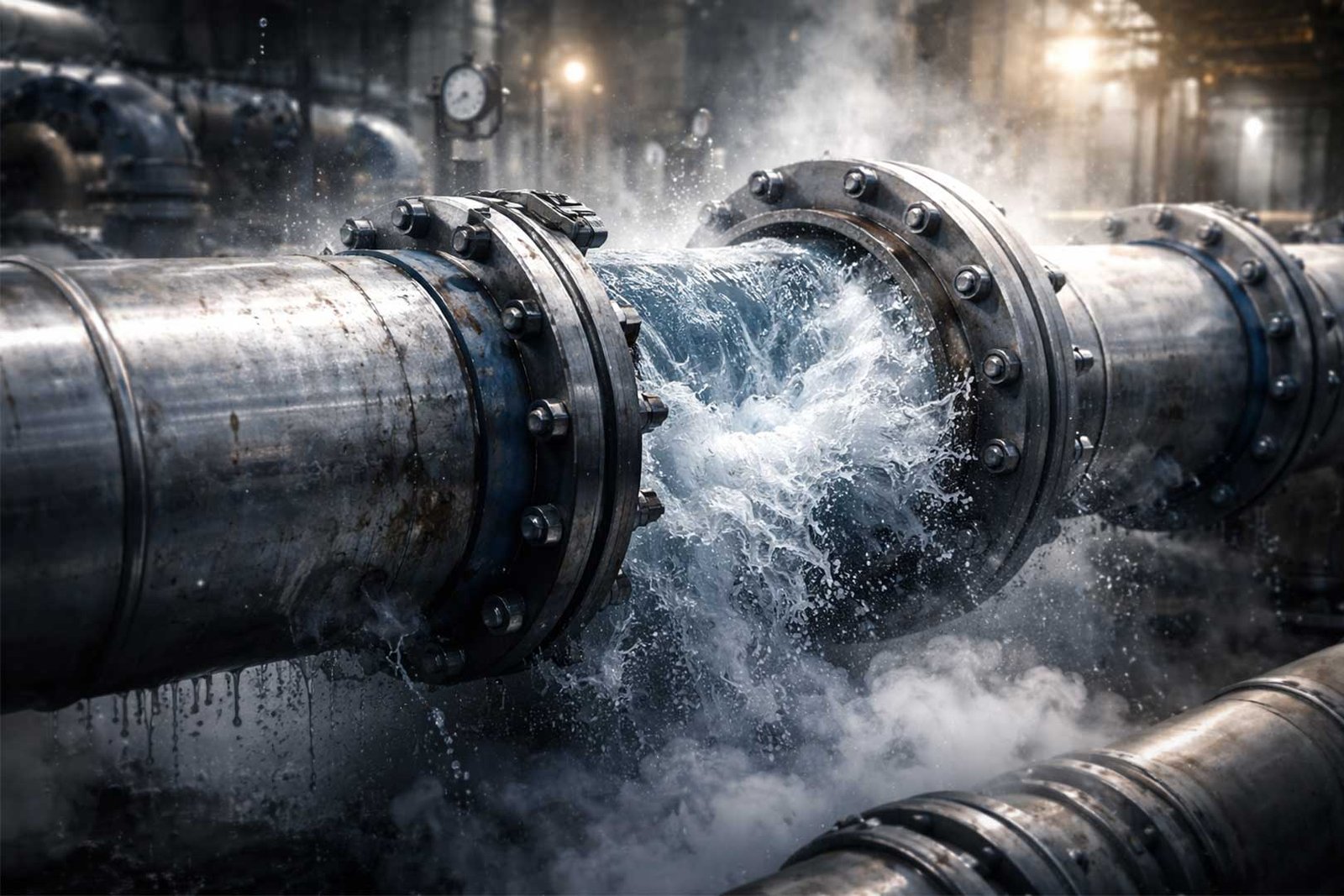
Pump starts, stops, power failures, and fast valve movements can also create water hammer. Controlled pumping, VFDs where appropriate, surge vessels, air-management devices, suitable valve-closing behavior, and proper transient analysis can help manage it.
The pressure class should reflect the full hydraulic and transient conditions of the system, not only the normal operating pressure.
Step 6: Selecting Pipe Materials for Groundwater Transmission
There is no single pipe material that fits every Ethiopian groundwater project. The better question is which material fits this route, this pressure, this water chemistry, and the way this particular system will actually be built and maintained. Before you choose, compare
- diameter
- operating and surge pressure
- groundwater chemistry
- soil corrosivity
- external loading
- route conditions
- installation quality
- hydraulic roughness
- maintenance and repair capability
- logistics
- lifecycle cost
- utility standards
- consultant specifications
Where Different Materials May Fit
You do not need to use the same pipe material across the whole project. One section may need to handle high pressure, another may run through corrosive soil, while a smaller branch may need more flexibility. So it makes more sense to match the material to each part of the system.
| Material | Where it may make sense | What still needs checking |
|---|---|---|
| GRP or GRE | Buried bulk mains, larger diameters, corrosion-sensitive conditions, hydraulically sensitive pumped systems, remote routes | Surge, burial design, joints, installation quality, owner acceptance, repair support |
| Steel | Very high-pressure sections, exposed pipe, difficult crossings, fabricated specials | Welding, coatings, corrosion protection, QA and field repair |
| Ductile iron | Established utility systems and mechanically demanding municipal routes | Weight, corrosion protection, restraint, local repair familiarity |
| HDPE | Flexible alignments, smaller or medium diameters, selected rural or lower-pressure systems | Pressure, diameter, fusion equipment, trained operators |
Where the project conditions support it, GRP can offer useful advantages such as corrosion resistance, smooth hydraulics, and lower handling weight. ISO provides the current international framework for GRP water-pressure systems.
Look Beyond the Purchase Price
Pipe price is only the beginning. Freight, handling, trench and bedding work, jointing, restraint, corrosion protection, specialist labor, repairs, pumping energy, downtime, and eventual replacement can all change the real cost.
Smooth hydraulics may reduce pumping energy. Lower corrosion or maintenance requirements may reduce intervention and downtime. But those benefits need to come from the actual project analysis, not a generic material claim.
Step 7: Groundwater Quality Can Change the Entire Infrastructure Design
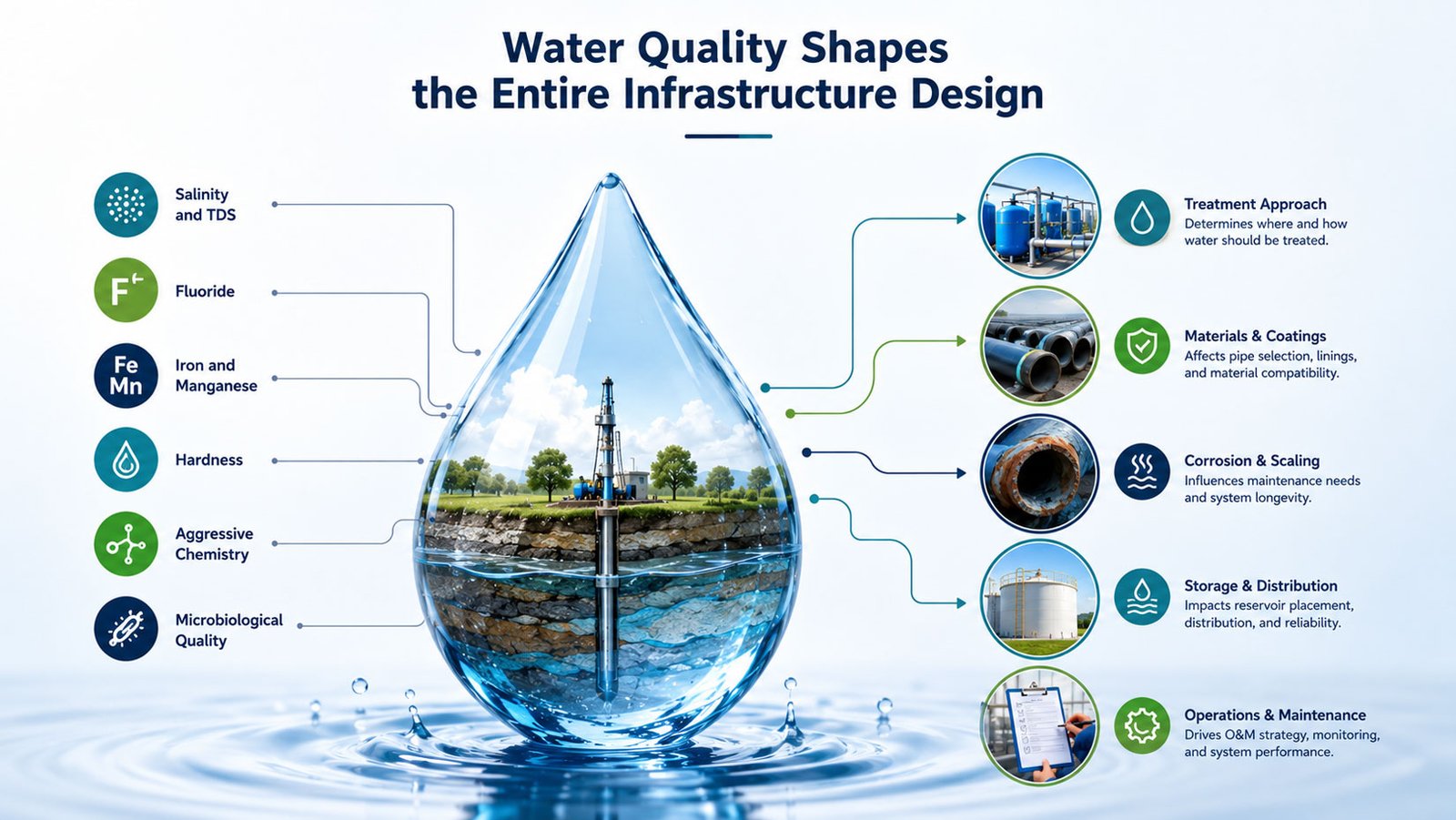
Water quality does not sit in a separate box from pipeline engineering. It can affect which wells you combine, where you treat the water, which materials you use, and how much maintenance the system may need. Useful project testing may include
- salinity and TDS
- fluoride
- iron and manganese
- hardness
- potentially aggressive chemistry
- microbiological quality where relevant
The World Health Organization recommends a risk-based approach that considers source quality when teams choose abstraction, treatment, storage, and distribution technologies.
Some projects may treat groundwater close to the wellfield before sending it into the regional main. Others may move raw water toward a central plant closer to the demand area. The right setup depends on the contaminants, well locations, treatment technology, distance, chemistry, and operating model.
Water chemistry can also affect corrosion, coatings and linings, scaling, material compatibility, treatment needs, and maintenance. And importantly, not every Ethiopian groundwater source has the same chemistry.
Step 8: The Water–Energy Nexus of Groundwater Supply
Groundwater systems use energy twice in a very practical sense. First, you have to lift the water from the aquifer. Then you may need more pumping to move it through the regional transmission system.
If groundwater levels fall, the pump may have to work harder. That means more head, more energy, and potentially higher operating costs. A project may use:
- grid electricity
- solar PV
- backup generation
- hybrid power
- storage-supported operating schedules
The Ministry of Water and Energy identifies water pumping as a productive use of electricity and also notes the continued use of diesel generators in water and agriculture applications.
UNICEF’s Hariro example gives this a practical shape. An off-grid borehole system moved from diesel pumping to a variable-speed solar-powered arrangement. That does not mean solar fits every wellfield. It means power options need to be compared against pumping head, operating hours, storage, grid reliability, lifecycle cost, and the level of service the system has to maintain.
Power failures also affect storage, pump redundancy, restart procedures, surge, and which users can keep receiving water during an interruption.
Step 9: Storage Turns Variable Production Into Reliable Regional Supply
A reservoir is not simply spare water sitting in a tank. In a regional groundwater system, storage can solve several hydraulic and operational problems at once. Different reservoirs may serve different jobs. Look at the table below:
| Storage type | What it can help with |
|---|---|
| Wellfield balancing storage | Smooth differences between production and transmission demand |
| Intermediate storage | Support staged pumping and operating flexibility |
| Break-pressure storage | Help control pressure along difficult routes |
| Command reservoir | Support pressure zones and useful gravity supply |
| Terminal or service storage | Buffer downstream demand and interruptions |
Storage can give operators more room during pump downtime, power interruptions, peak demand, source changes, maintenance, and emergencies.
Where you put that storage matters just as much as how much you build. Terrain, pumping stages, pressure requirements, supply zones, and gravity opportunities should guide reservoir location.
Step 10: Building Reliability Into the System Before Construction
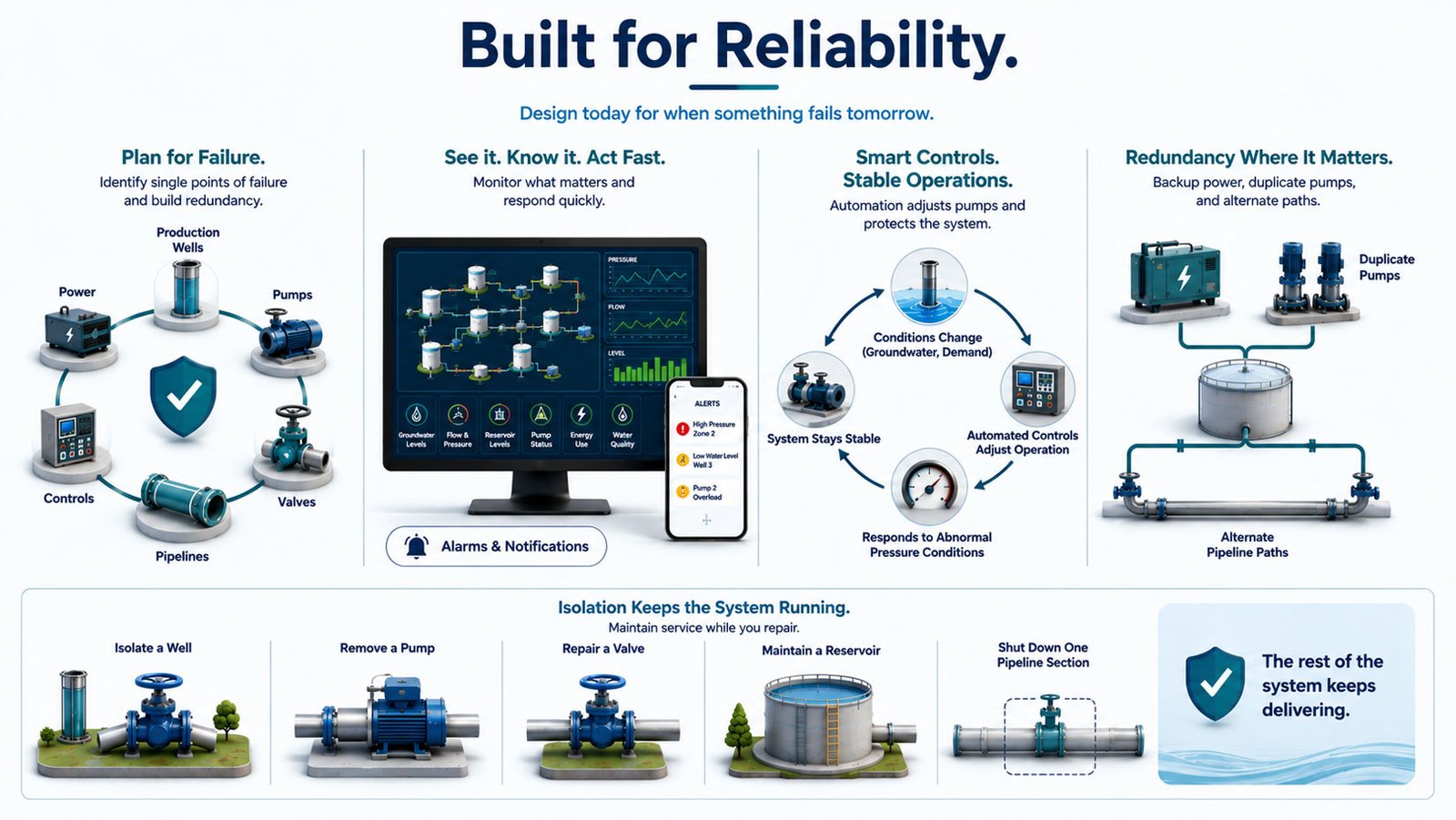
A system should not need a perfect day to keep working. One of the best questions you can ask during design is what happens when a borehole, pump, power source, valve, pipeline section, or control system fails. Look closely at possible single points of failure such as:
- production wells
- well and booster pumps
- generators or power feeds
- critical valves
- pipeline sections
- controls and instrumentation
Operators also need to know what is happening inside the system. That may mean monitoring groundwater levels, flow, pressure, reservoir levels, pump status, energy use, water quality, and alarms. Where it makes sense, telemetry and SCADA can make that picture much clearer.
The research also describes automated controls that can adjust pump operation as groundwater levels change and react quickly to abnormal pressure conditions.
The World Bank uses continued functionality as an outcome for groundwater-based rural piped systems, with a 90 percent functionality objective once systems have operated long enough to assess performance.
Isolation matters too. A good layout should let the operator remove a pump, isolate a well, repair a valve, maintain a reservoir, or shut down one pipeline section without unnecessarily taking the entire regional system offline.
Step 11: O&M Determines Whether Groundwater Infrastructure Remains Functional
The project team eventually leaves. The operator does not.
That operator inherits the wells, screens, pumps, collector mains, booster stations, valves, reservoirs, power systems, instruments, treatment equipment, and transmission main. So maintenance planning cannot wait until handover.
It needs to cover
- equipment standardization
- spare-parts availability
- maintenance access
- local technician capability
- vendor support
- operator training
- clear asset records and handover documents
And success should not be measured only by what was built.
A more useful question is whether the system keeps delivering the required quantity and quality of water. Supply availability, pump downtime, reservoir security, energy use, leakage, maintenance frequency, water-quality compliance, and groundwater-level trends all help answer that.
Ethiopia’s One WASH review also found gaps in post-construction spare-parts and O&M support. That makes maintainability a real design issue, not an administrative detail to solve later.
Ethiopia Example: Gelchet-Sarite Shows What a Regional Groundwater System Looks Like
Gelchet-Sarite in Borana gives you a much clearer picture of what groundwater infrastructure looks like once it moves beyond drilling.
African Development Bank records cover groundwater development, pumping tests, backbone pipe, reservoirs, electromechanical works, transmission infrastructure, and regional supply routes.
Separate procurements covered five new deep wells and rehabilitation of seven existing wells, four 1,000 m³ reservoirs, and an electromechanical package that included multiple pumps and four booster stations. These are procurement figures, so they should not automatically be treated as the final as-built configuration.
AfDB’s 2025 appraisal reported 21 km installed from a 24 km steel backbone contract at that point. Additional financing also supported route extensions, solar pumping, and storage. Then in July 2026, another Web-route package combined civil works, pipes and fittings, and electromechanical equipment.
Financing the Entire Infrastructure Chain, Not Just the Boreholes
A productive borehole can feel like the breakthrough. But if you do not fund the rest of the system, that water may still never become a reliable service. You may still need investment in
- pumps, power, and treatment
- collector mains and transmission pipelines
- reservoirs and downstream infrastructure
- commissioning and operator preparation
- maintenance, spare parts, and future rehabilitation
The Ministry of Water and Energy also highlights tariff setting, asset management, and the financial sustainability of service providers as important priorities.
Why an Integrated EPC Approach Matters for Groundwater-Based Regional Supply
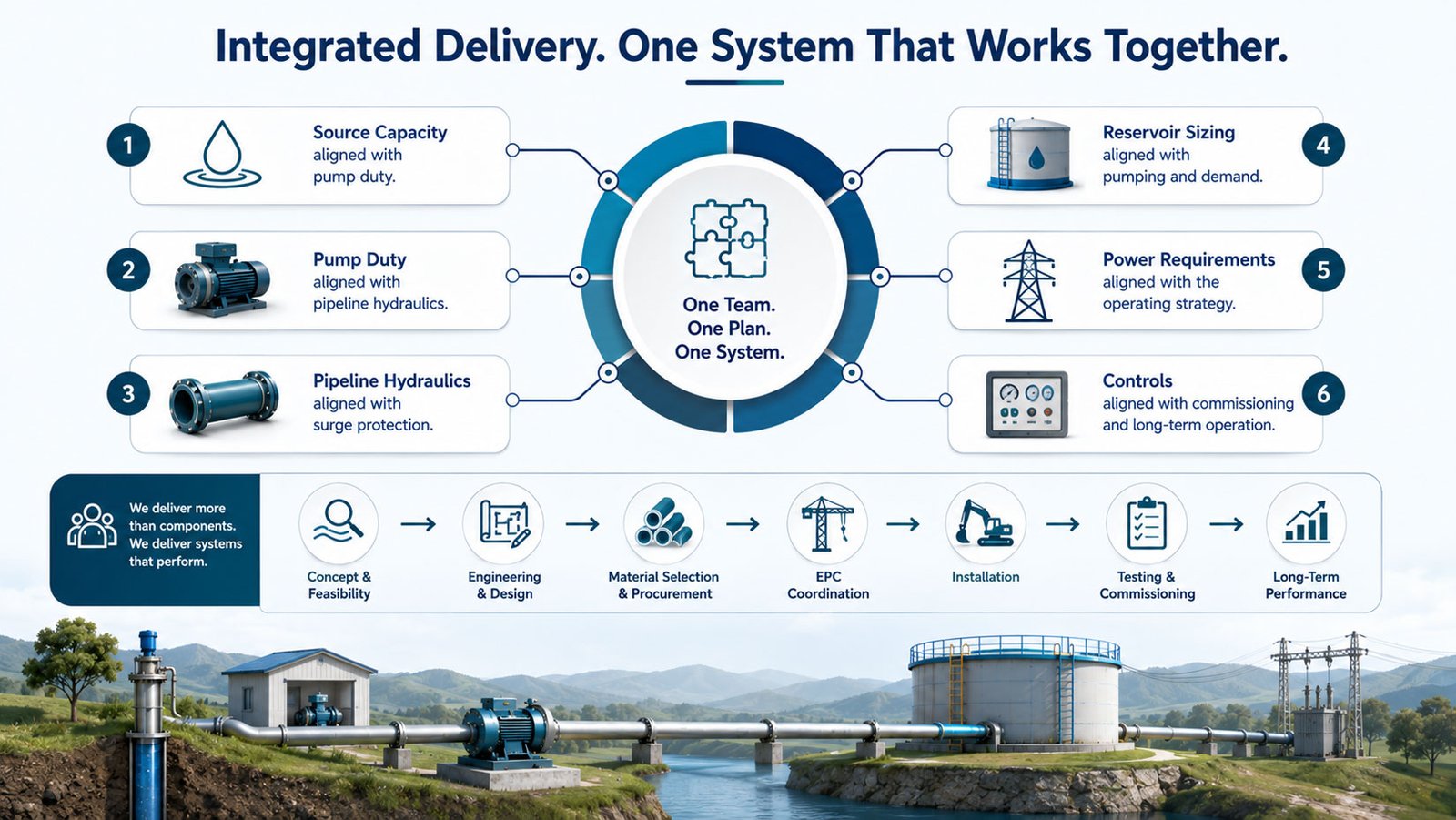
A regional groundwater system brings a lot of disciplines into the same project. Hydrogeology, hydraulics, civil works, pipelines, pumps, electrical systems, controls, treatment, storage, power, and commissioning all have to line up. The difficult parts often sit between those packages. Integrated delivery needs to keep the following ones:
- source capacity aligned with pump duty
- pump duty aligned with pipeline hydraulics
- pipeline hydraulics aligned with surge protection
- reservoir sizing aligned with pumping and demand
- power requirements aligned with the operating strategy
- controls aligned with commissioning and long-term operation
Grand LineCore looks at groundwater transmission as a complete infrastructure system, not just a pipe package. That means helping you think through the parts that actually make the system work together, from GRP and other composite pipeline options to material selection, pipeline engineering, procurement, EPC coordination, installation, testing, commissioning, and long-term performance.
So, instead of solving one piece at a time, you build a system where the source, pipeline, pumping, storage, and operation all make sense together from the start.
What Makes a Groundwater Regional Supply System Resilient?
Resilience becomes much easier to understand when you stop treating it as a vague climate term. In practice, it means asking whether the system can keep supplying water when conditions change or one important component becomes unavailable.
| Area | What a resilient system needs |
|---|---|
| Groundwater | Sustainable abstraction |
| Sources | Redundancy where practical |
| Collection | Hydraulically balanced aggregation |
| Pumping | Stages matched to terrain and duty |
| Storage | Enough operational buffering and pressure control |
| Transmission | Safe performance in normal and abnormal conditions |
| Materials | A good fit for pressure, chemistry, installation, and lifecycle needs |
| Energy | Power that supports service continuity |
| Visibility | Monitoring across wells, pumps, pressure, storage, quality, and energy |
| Maintainability | Assets the operator can realistically support |
In the end, the number of boreholes drilled or kilometres of pipe installed tells you very little about whether the project actually works.
The better measure is like this: How consistently can the system deliver the water people need, at the quality they need, over the long term?
Engineering Groundwater Transmission as a Complete System
A reliable regional groundwater system is never just a wellfield and a pipeline. It is a chain of decisions that all have to work together. Source capacity, collection, pumping, pressure, storage, materials, energy, controls, installation, and O&M can each become a weak point if they are treated separately.
That is where Grand LineCore fits in. We support water-transmission infrastructure through GRP and other composite pipeline solutions alongside integrated EPC-oriented delivery. So if you are planning a regional groundwater project, the bigger question is not simply which pipe to buy. It is whether the entire system can move water reliably, adapt as conditions change, and keep doing its job for years after construction ends.
about
The Author

Farshid Tavakoli is a seasoned professional in engineering and international trade. Holding degrees in Electrical Engineering, Mechatronics, and a Doctorate in Business Administration (DBA) from the University of Lyon, he also has a strong background in industrial automation and production line technologies.
For over 17 years, he has led an international trading company, gaining deep expertise in commercial solutions tailored to industrial needs. With more than 8 years of active involvement in infrastructure development, he specializes in the supply of electromechanical equipment for water and wastewater treatment plants and transfer projects.
Together with comapny expert team, he now provides consultancy and integrated solutions for sourcing and implementing complex infrastructure projects across the region.