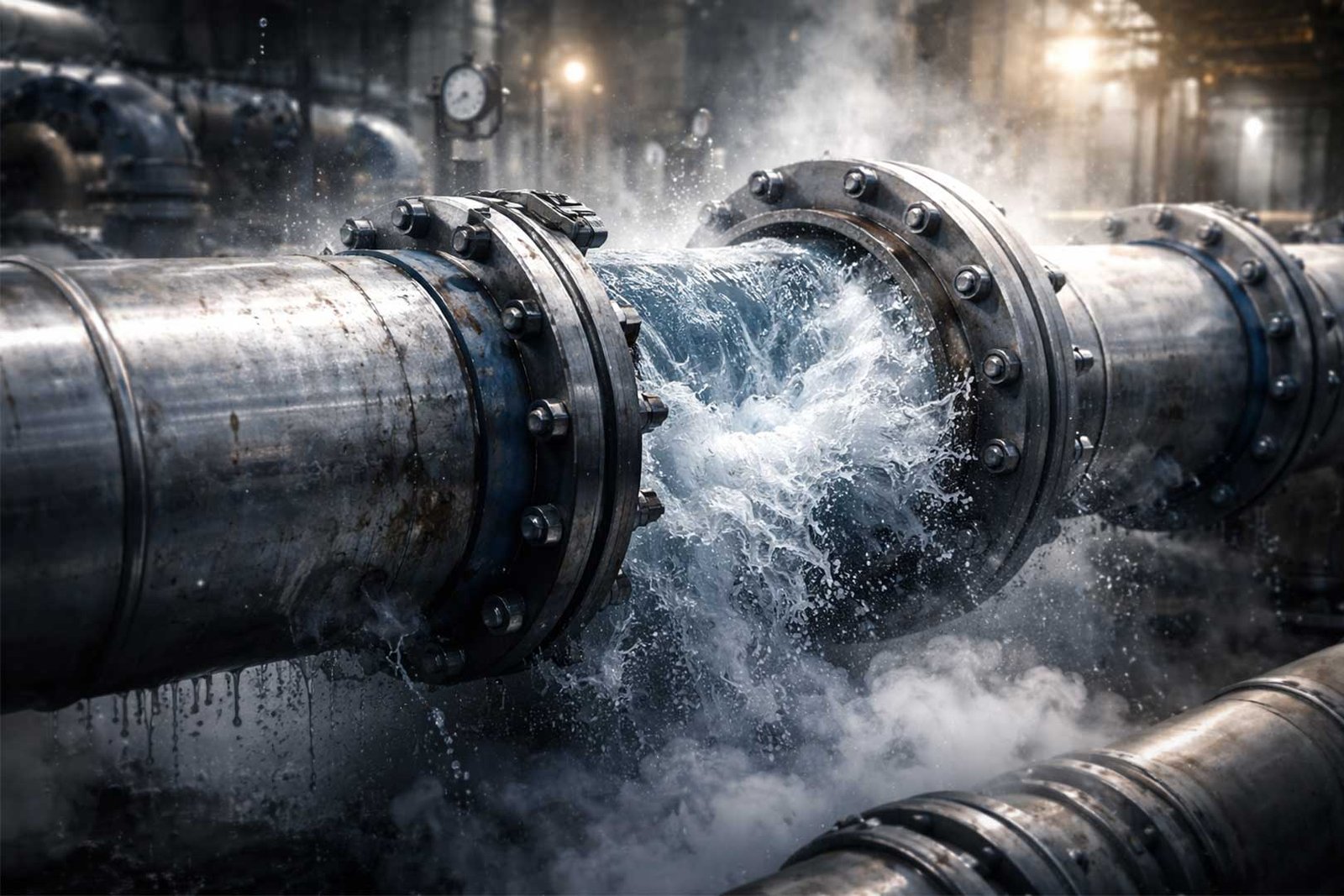
Most pipeline failures don’t happen during normal, steady design pressure. They hit during sudden transients. A water hammer is a powerful pressure wave that suddenly appears when flowing liquid stops or changes direction fast. For example, when a pump trips or someone closes a valve quickly.
In real EPC projects, such situations are almost never driven by one single mistake. They usually happen when several small design gaps gather together. We, as a GRP manufacturer and EPC contractor, see exactly where projects actually fail on site, not just in theory. So, we decided to show you the most common design mistakes that destroy projects and how to prevent them.
What Actually Happens During Water Hammer
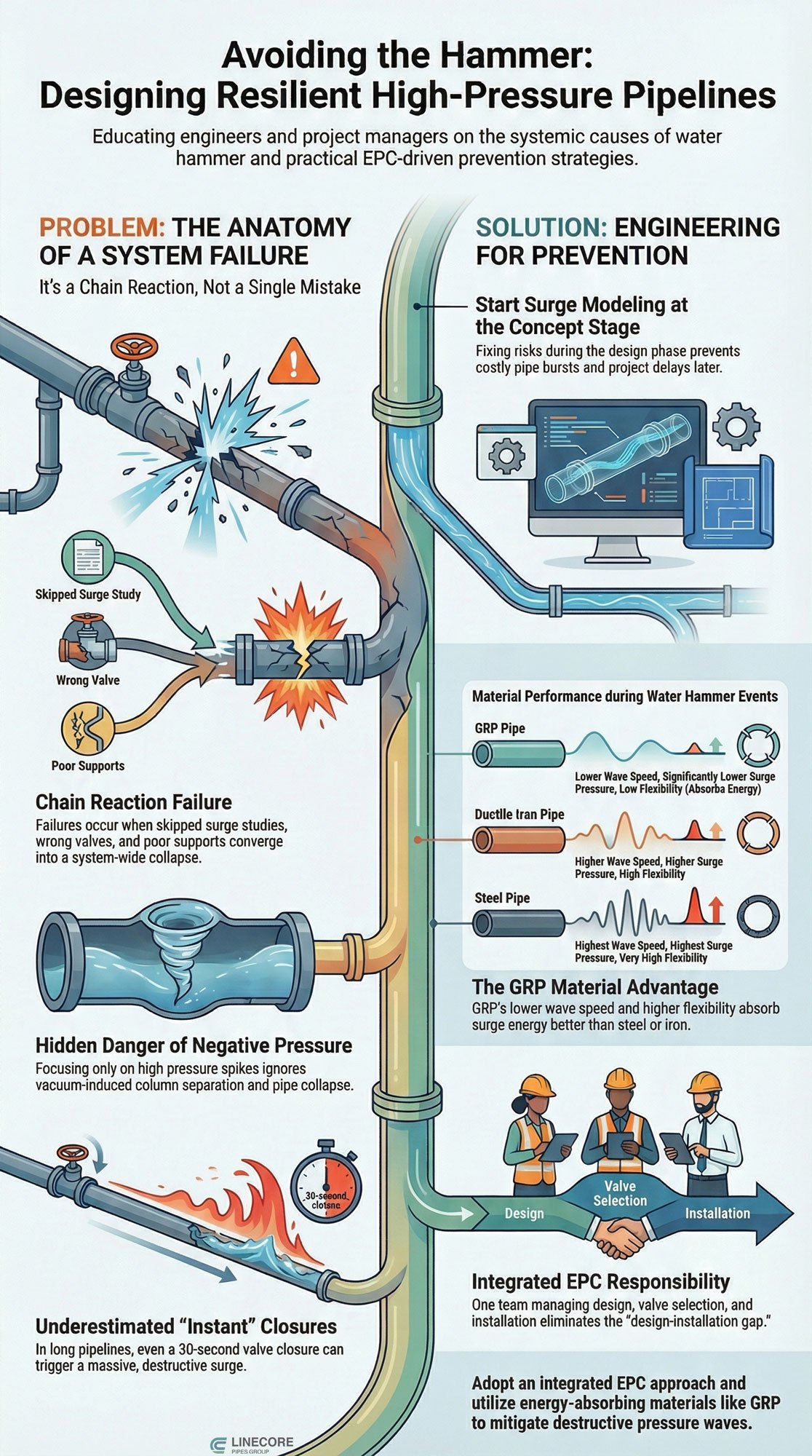
Water Hammer design mistakes infographic (source:Pipelinecoregroup.com)
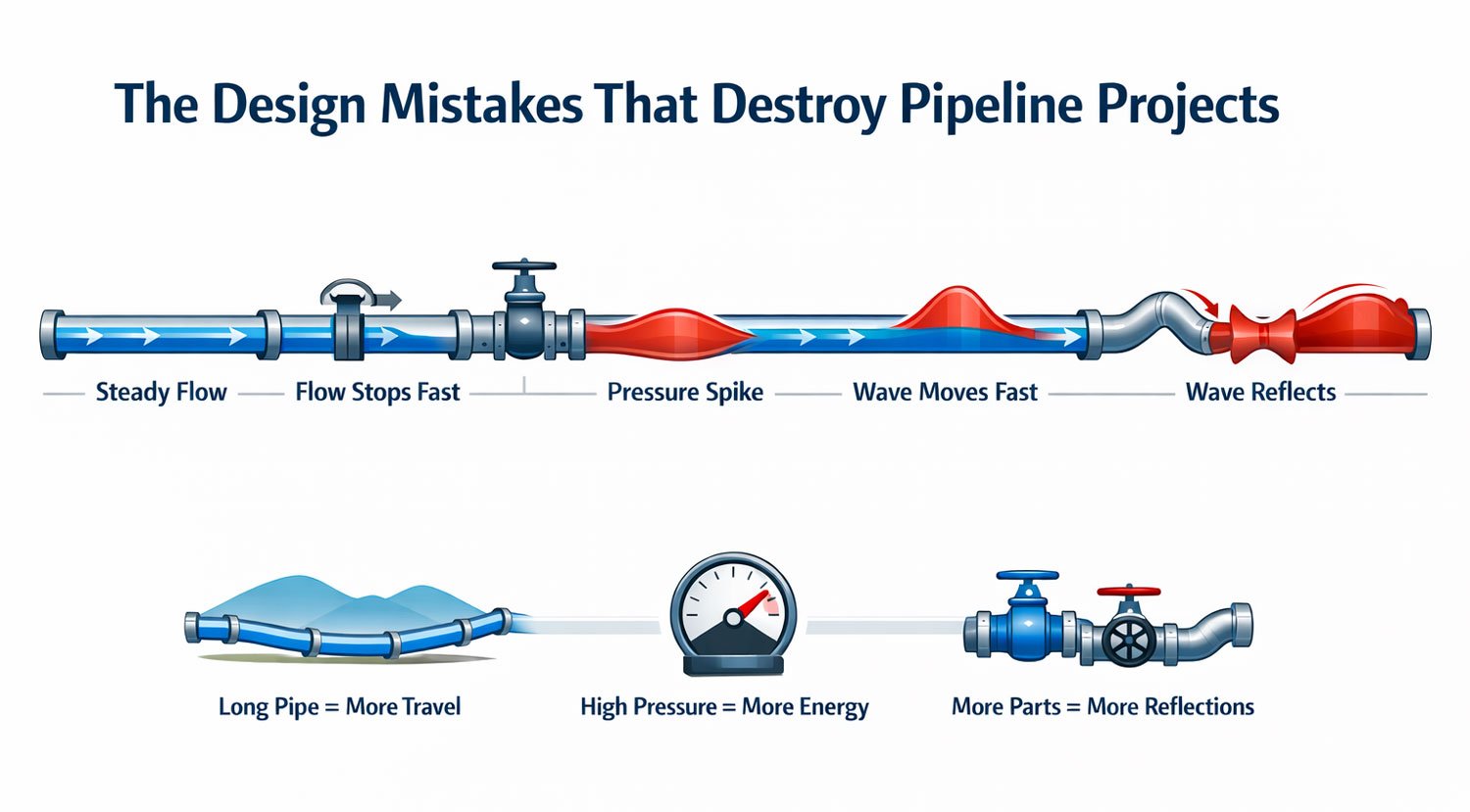
If we want to explain what happens during a water hammer, we should picture this. Water flows smoothly through the pipeline. Then the flow suddenly stops. A pump might trip, or someone closes a valve fast. Below is what happens next:
- The moving water slams into the closed spot and creates a strong pressure wave.
- This wave shoots quickly down the pipe.
- The wave hits the end of the pipe, a valve, or a bend, then bounces back.
- These bouncing waves often crash into each other and become even stronger.
It’s not just pressure. The real issue is the sudden movement, plus all the trapped energy that needs to go somewhere. Even normal operations can trigger it. A routine pump trip or a quick valve closure is enough. That’s why water hammer surprises so many projects.
The Design Mistakes That Destroy Pipeline Projects
Long pipelines have a much harder time when it comes to water hammers. Let’s see why this happens:
- According to the KSB SE & Co, the longer the pipe, the more time the pressure wave has to travel and bounce back and forth. These things often cause the surge to be really strong.
- High pressure means the system already stores a lot of energy. So with a surge, the force becomes more dangerous.
- Long pipelines contain several moving parts, such as pumps, valves, and big ups and downs. All these parts make the problem worse.
The Real Problem: It’s Not One Mistake — It’s System Failure
As we discussed earlier, Water hammer never happens due to a single mistake. Several issues may come together and cause the failures. A typical chain looks like this. You skip a proper surge study. You chose the wrong valve. You install poor supports. Together, these gaps create a serious failure.
Here is the important point. A water hammer is not really a pipe problem. It is a complete system engineering problem. If the whole system is not designed and built properly, even small gaps can destroy your entire project.
The Design Mistakes That Destroy Pipeline Projects
Over the years, we have seen the same pattern repeat in failed projects. The damage rarely comes from the pipe itself. It almost always comes from a handful of design mistakes that can be avoided in various projects. We will talk about the most common ones that quietly destroy high-pressure pipeline projects:
1. No Proper Surge Analysis (or done too late)
Many teams design the pipeline only for steady pressure and ignore the dynamic forces of water hammer. They base everything on wrong assumptions and end up with wrong results. Surge analysis must start right at the concept stage, not after the pipes have already been ordered.
2. Wrong Valve Selection and Operation
You choose the wrong valve, and then you should wait for serious trouble in real life. Check valve slam is one of the most frequent issues. Even closing a valve in 30 seconds can still be named “instant” for a long pipeline and create a massive surge.
Real-World Example: Nuclear Plant Check Valve Slam (1985)
In 1985, a nuclear power plant in the USA lost power suddenly. The pumps stopped right away. Five check valves slammed shut at the same time. This created a very strong surge. The pressure wave damaged pipes and caused leaks. The problem was not the pipe. According to the NRC, it was a fast pump trip and bad check valves.
3. Ignoring Negative Pressure (The Hidden Killer)
Most people only focus on high-pressure spikes. But what about the negative pressure? It’s often far more dangerous, and you must watch it. When pressure drops too low, it creates a vacuum, column separation, pipe collapse, joint failure, and powerful secondary shocks.
4. Poor Air Management (Underrated Risk)
Air can get trapped at the high points of the pipeline. These air pockets are dangerous. They become like small bombs ready to explode. A common mistake is forgetting to install air valves or installing ones that are too small. Because of this, the pipe can break or leak at that spot, even if the rest of the system looks completely fine.
Real-World Example: Hydroelectric Plant Valve Failure
As Scholarly explains, at a small hydroelectric plant, workers closed a valve too fast during shutdown. There was no air valve at the high point. The surge became very strong. It cracked the pipe near the joint and caused a big flood. The pipe was strong enough for normal use, but the water hammer broke it easily.
5. Underestimating Structural Forces (Supports and Anchors)
Water hammer does much more harm than just putting the pipe under pressure. It physically moves the whole pipeline, and breaks supports and anchors. Support failures are among the most common consequences in damaged systems.
6. Treating Material Selection as “Pressure Class Only”
Many engineers believe that if the pressure rating is high enough, everything will be okay. This is a dangerous misconception. Material choice actually affects wave speed, fatigue resistance, and joint performance, especially in GRP systems. Check the AWWA M45 GRP pipe surge allowance and safety factors:
| Parameter | Specification |
|---|---|
| Internal Pressure Safety Factor | 1.8 |
| Surge Allowance | Up to 40% above pressure class |
| Hydrostatic Design Basis | 50-year hoop strength |
| Buckling Safety Factor | Minimum 2.0 (buried installations) |
7. Ignoring Fatigue and Repeated Transients
Water hammer does not happen just once. It can repeat thousands of times during the life of the pipeline. If they repeat over and over, they lead to small cracks and weepage, which is especially risky for GRP and GRE pipes.
8. Poor EPC Integration (Design–Installation Gap)
The concept of the project is something, but the whole project installed on site is something else. Horrible, not? Wrong installation, missing supports, and poor alignment are very common. Data shows that poor engineering, combined with bad installation, causes most of the failures.
Why GRP Pipelines Behave Differently Under Water Hammer
GRP pipes offer much more flexibility compared to steel or iron pipes. That is why GRPs resist the water hammer much better. The pipe can bend a little and absorb some of the energy. Because of this, the surge pressure is usually lower than in metal pipes.GRP pipes also give you these benefits:
- They don’t rust or corrode easily.
- Their smooth inside helps water flow better.
GRP pipes need proper joints and good supports. If you don’t design and install them correctly, the benefits disappear.
Remember: GRP reduces the risk of water hammer, but only when they are installed and engineered in the right way. Here is a comparison between them:
| Property | GRP Pipe | Ductile Iron Pipe | Steel Pipe |
|---|---|---|---|
| Wave Speed | Lower | Higher | Highest |
| Surge Pressure | Significantly lower | Higher | Highest |
| Flexibility (Young’s Modulus) | Low (absorbs energy) | High | Very high |
| Corrosion Resistance | Excellent (inherent) | Moderate (needs lining) | Poor (needs CP) |
| Weight | Very light | Heavy | Heavy |
| Flow Efficiency (C-value) | 140–150 | 100–140 | 100–120 |
Real Project Lessons (What Experience Teaches)
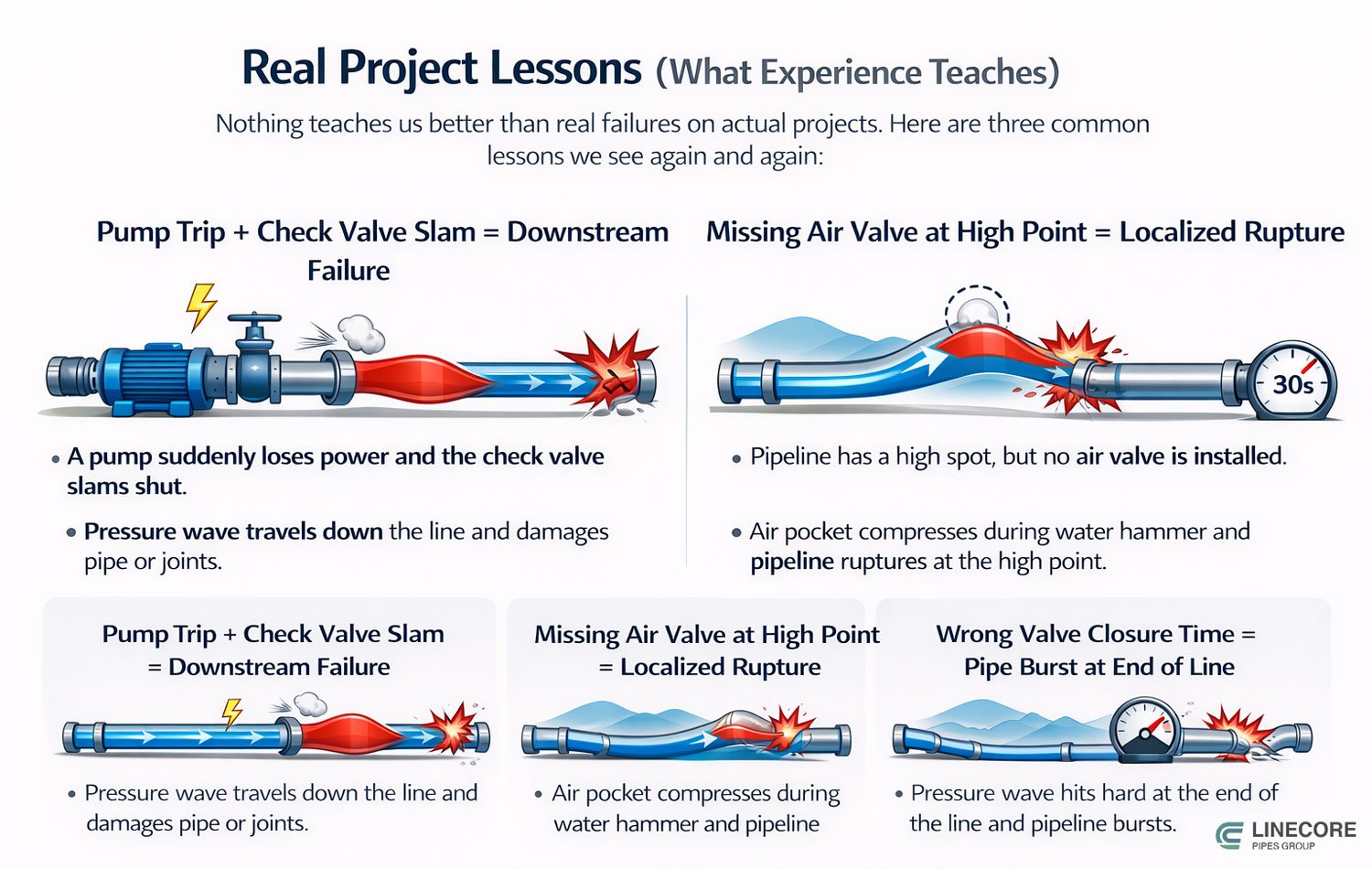
Nothing teaches us better than real failures on actual projects. Here are three common lessons we see again and again:
1. Pump Trip + Check Valve Slam = Downstream Failure
A pump suddenly loses power and trips. The check valve slams shut very quickly. This creates a strong pressure wave that travels down the line and damages the pipe or joints far away from the pump. Many projects have suffered leaks or bursts because of this exact sequence.
2. Missing Air Valve at High Point = Localized Rupture
The pipeline has a high spot, but no air valve (or the wrong size) is installed. When water hammer occurs, the trapped air pocket compresses and then pushes back violently. This causes a sudden rupture exactly at that high point, even if the rest of the pipeline looks fine.
3. Wrong Valve Closure Time = Pipe Burst at End of Line
The team closes the valve in what seems like a reasonable time. For instance, 30 seconds. But for a long pipeline, this is still too fast. The pressure wave builds up and hits hardest at the far end of the line, often causing the pipe to burst there.
How EPC-Driven Design Prevents These Failures
At LineCore Pipes Group, we don’t aim to just provide GRP pipes. We take full responsibility for the complete system. Our EPC-driven approach stops the common mistakes before they cause trouble. Here’s exactly how we do it:
- We deliver one complete solution. You get the GRP pipes, proper design, surge analysis, and expert installation, all from the same team.
- We begin surge modeling very early, right at the concept stage. This lets us fix problems long before anyone buys the pipes.
- We carefully select the right valves and equipment according to your real pipeline length and actual operating conditions.
- We accept full system responsibility. You won’t have to manage many different suppliers. One team handles the design, the build, and the final safety of the pipeline.
This way of working reduces risks a lot. We deliver strong and reliable pipelines that stay protected against water hammer right at the beginning.
Real-World Example: LNG Project Early Surge Modeling
Engineers were designing a big LNG cooling system. They first used a simple model. It looked safe. Later, they did a detailed surge study with real data. They found dangerously low pressure risks when the pumps stopped. They fixed the design early by changing the pumps and removing some valves. This stopped big problems before building started (source: AFT)
Practical Mitigation Strategies to Prevent Water Hammer
As we saw, water hammer causes many troubles. You don’t need complicated solutions to protect your project. Below you can check a few effective ways:
- Control the Event: avoid closing the valves suddenly. Do it in various stages and control pumps with soft starters.
- Protect the System: By considering surge tanks or air valves in sensitive points, you can deal with the pressure spikes well.
- Strengthen the Structure: Install strong supports and anchors to stop the pipe from moving during a surge.
- Validate Before Operation: Run full commissioning tests and install monitoring devices to catch problems early.
Here’s a clear overview of practical ways to protect your pipeline:
| Strategy | Action | How It Works | Main Benefit |
|---|---|---|---|
| Control the Event | Close valves slowly in stages
Use soft starters for pumps |
Gives pressure wave time to settle | Reduces sudden shocks |
| Protect the System | Install surge tanks, air valves at high points, relief valves | Absorbs spikes and releases trapped air/pressure | Prevents damage from pressure changes |
| Strengthen the Structure | Install proper supports and anchors | Keeps pipe steady during surge | Stops pipe movement and joint failure |
| Validate Before Operation | Run full commissioning tests + monitoring | Checks system before full use | Catches problems early |
The Real Cost of Water Hammer
Water hammer costs a lot when you ignore it. It does not just damage the pipe. When a surge causes failure, you also face long project delays, costly downtime, and serious damage to your company’s reputation. Here is the real problem. The cost to fix water hammer after it happens is always much higher than the cost to prevent it from the beginning.
Many projects learn this the hard way. A small investment in proper design and protection can save you millions in repairs, lost time, and lost trust.
From Pipe Supplier to System Partner
Water hammer is predictable and not unavoidable. Success comes from systems thinking and an integrated EPC approach. When one experienced team handles the whole system, the risks drop dramatically. Projects do not fail because of water hammer. They fail because someone underestimated it.
If you have a high-pressure pipeline project and want to protect it from water hammer, here is where you should stop. We, at LineCore Pipes Group, offer more than just pipes. We provide complete GRP pipeline solutions together with full EPC support.
Contact us today for a preliminary surge assessment or design consultation. Let us help you build a safe, reliable, and long-lasting pipeline.
about
The Author

Farshid Tavakoli is a seasoned professional in engineering and international trade. Holding degrees in Electrical Engineering, Mechatronics, and a Doctorate in Business Administration (DBA) from the University of Lyon, he also has a strong background in industrial automation and production line technologies.
For over 17 years, he has led an international trading company, gaining deep expertise in commercial solutions tailored to industrial needs. With more than 8 years of active involvement in infrastructure development, he specializes in the supply of electromechanical equipment for water and wastewater treatment plants and transfer projects.
Together with comapny expert team, he now provides consultancy and integrated solutions for sourcing and implementing complex infrastructure projects across the region.