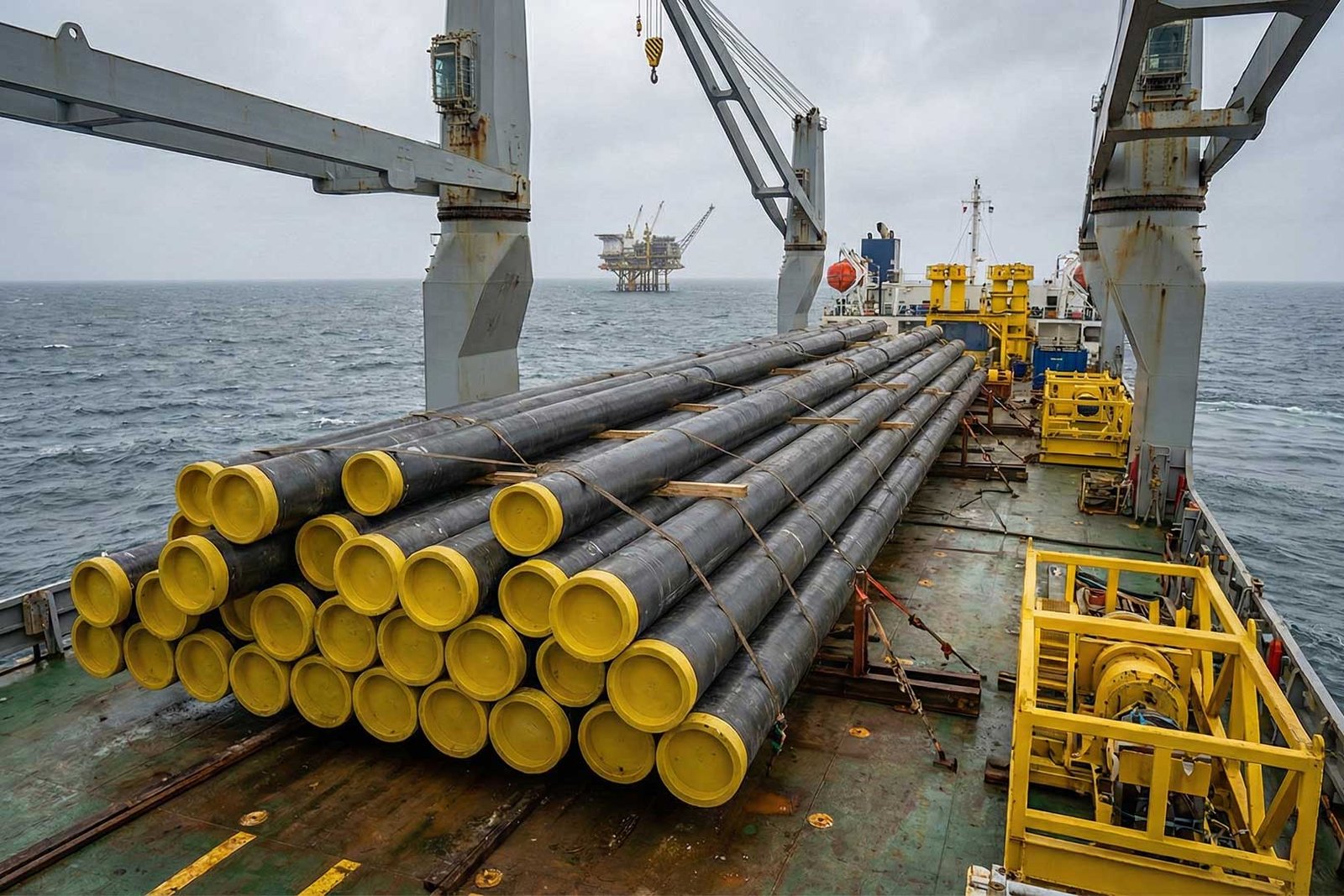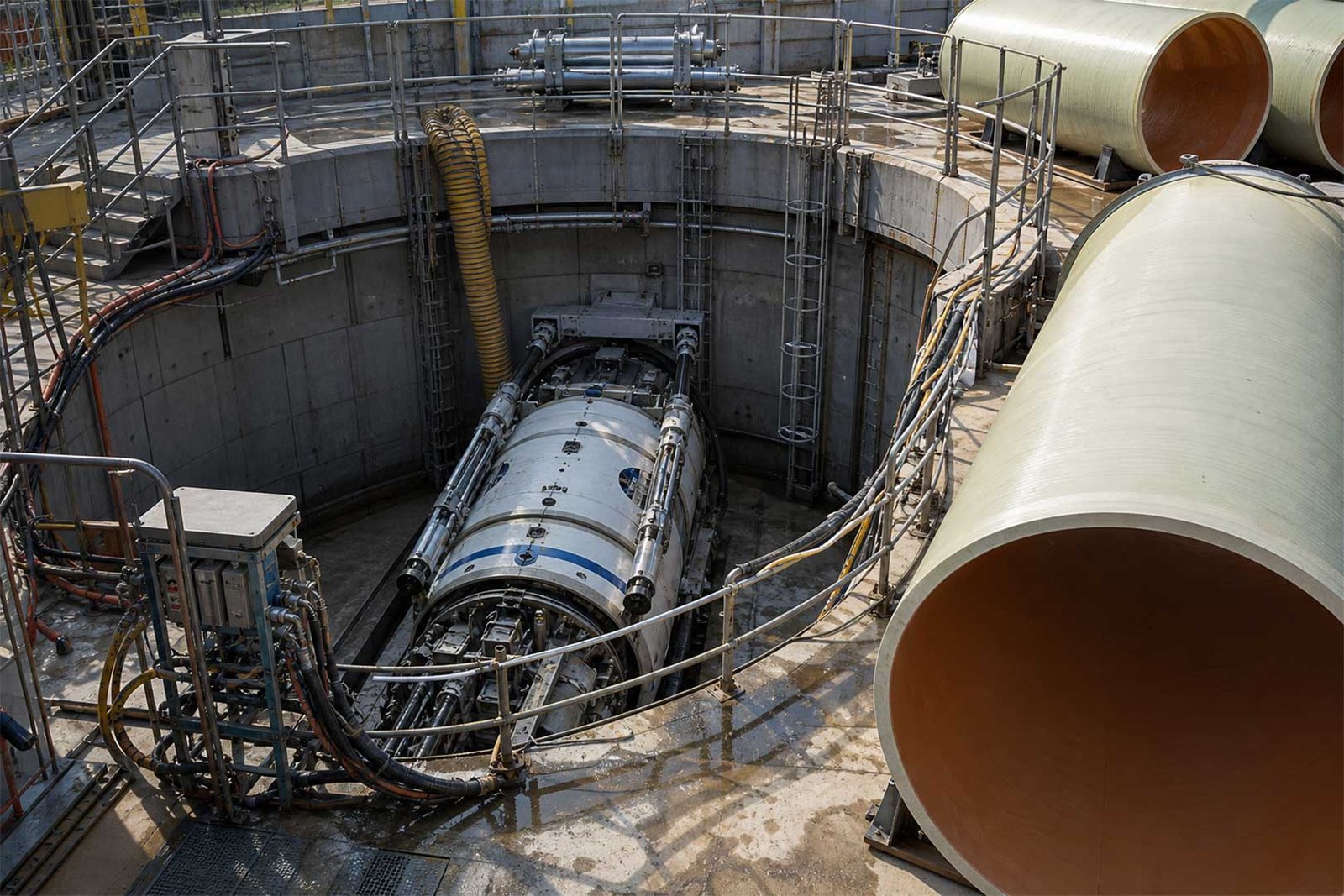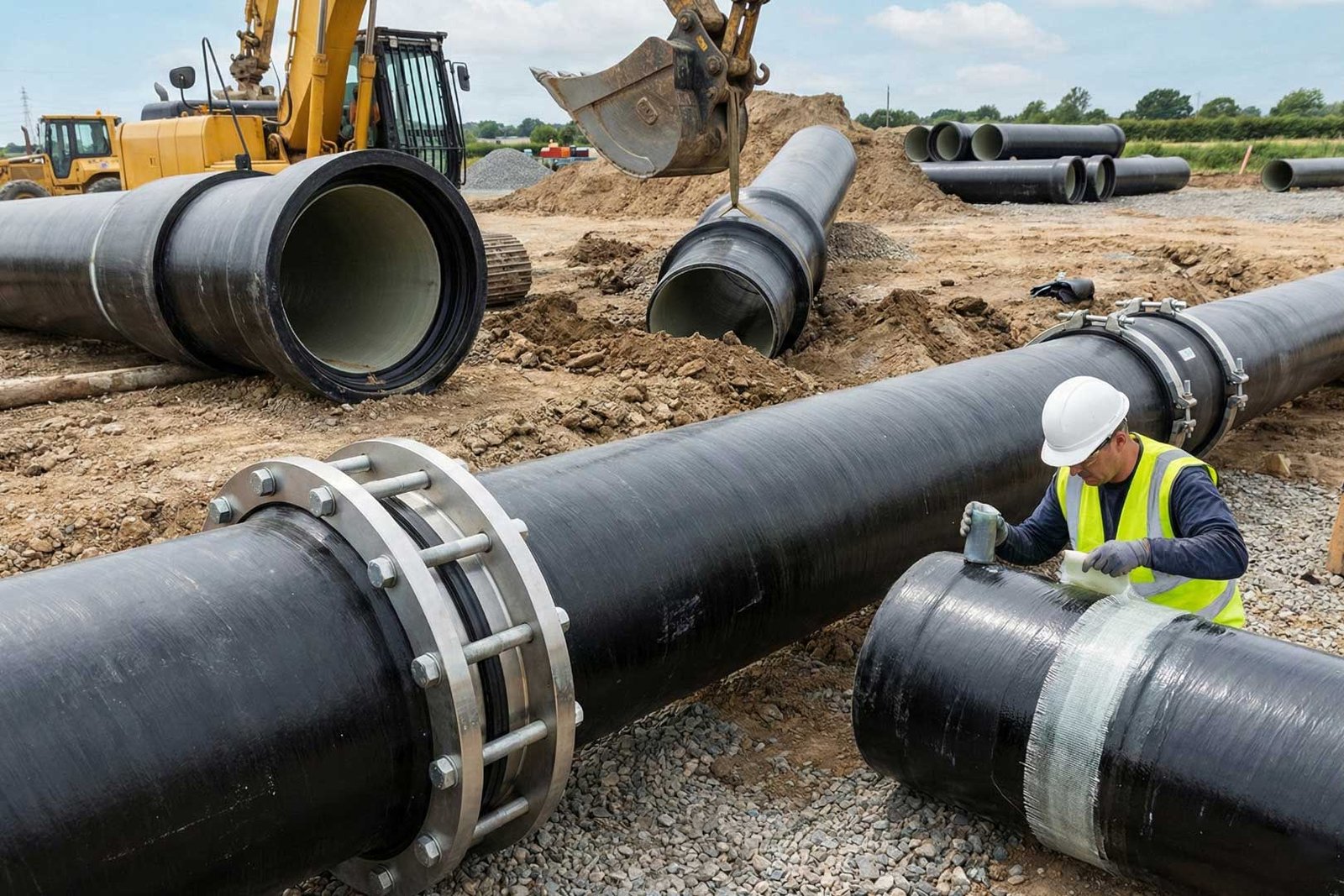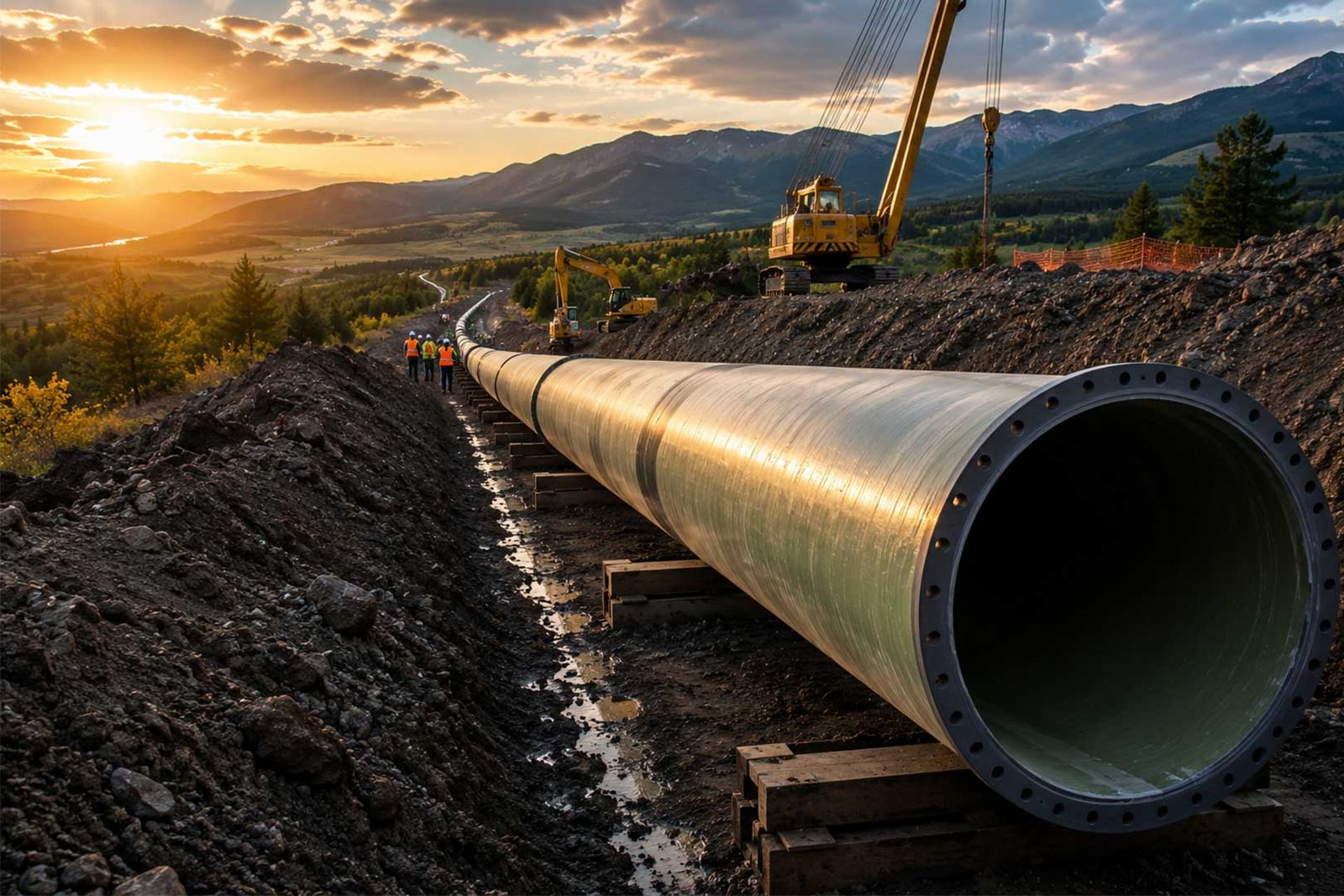
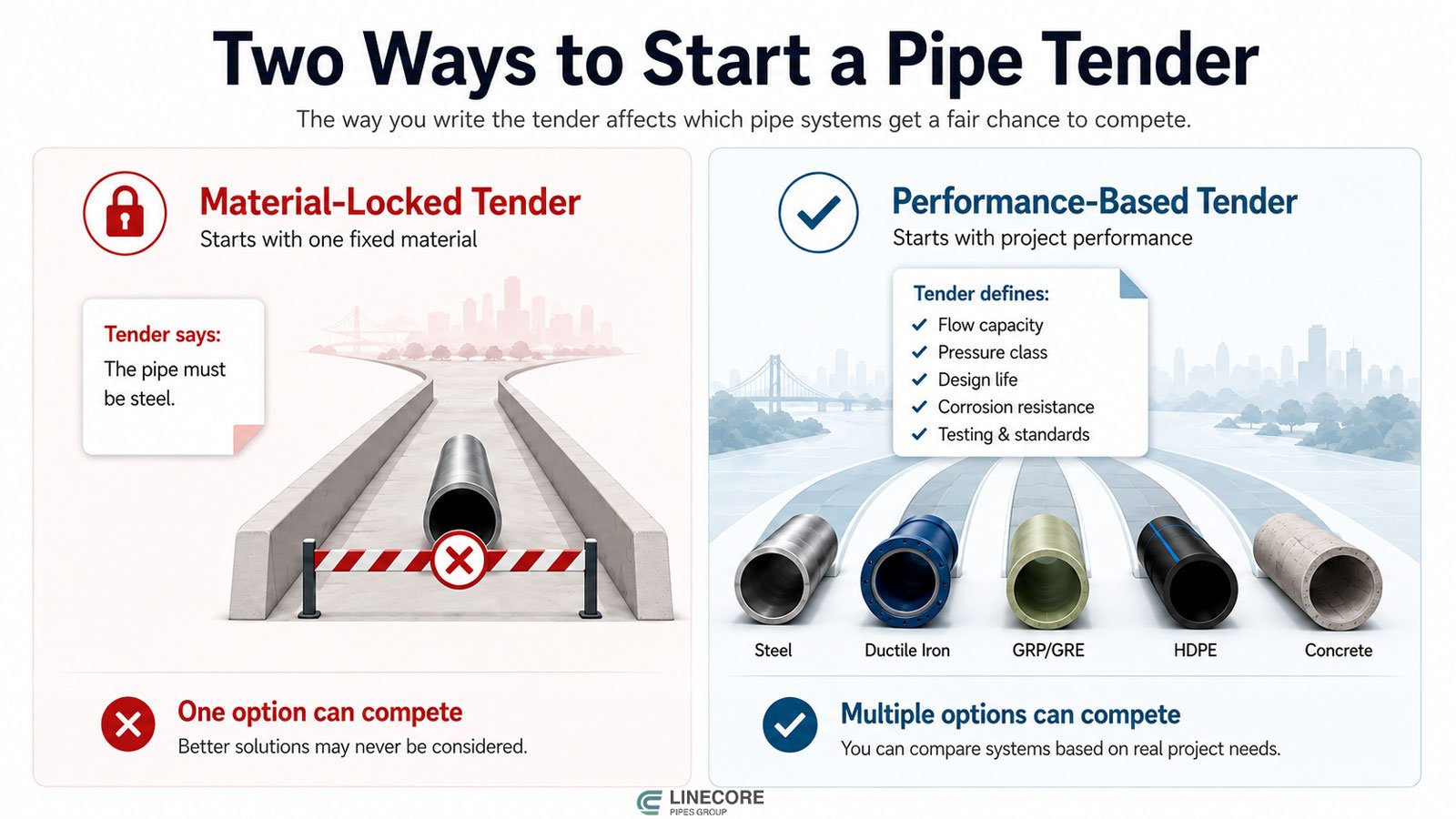
Many pipe tenders limit your options before the project even starts. Often, it happens with one simple line: “The pipe must be steel.” Or: “The pipe must be ductile iron.” That may sound clear, but it can also stop better options from being compared properly. That is what performance-based pipe tendering is about. Instead of starting with “Which pipe material do we want?” you start with the question that matters most:
What does this pipeline actually need to do?
In this post, you’ll see how performance-based pipe tendering helps you keep better options open, compare materials more fairly, and evaluate pipe systems based on real project needs before the specification is locked in.
What Is Performance-Based Pipe Tendering?
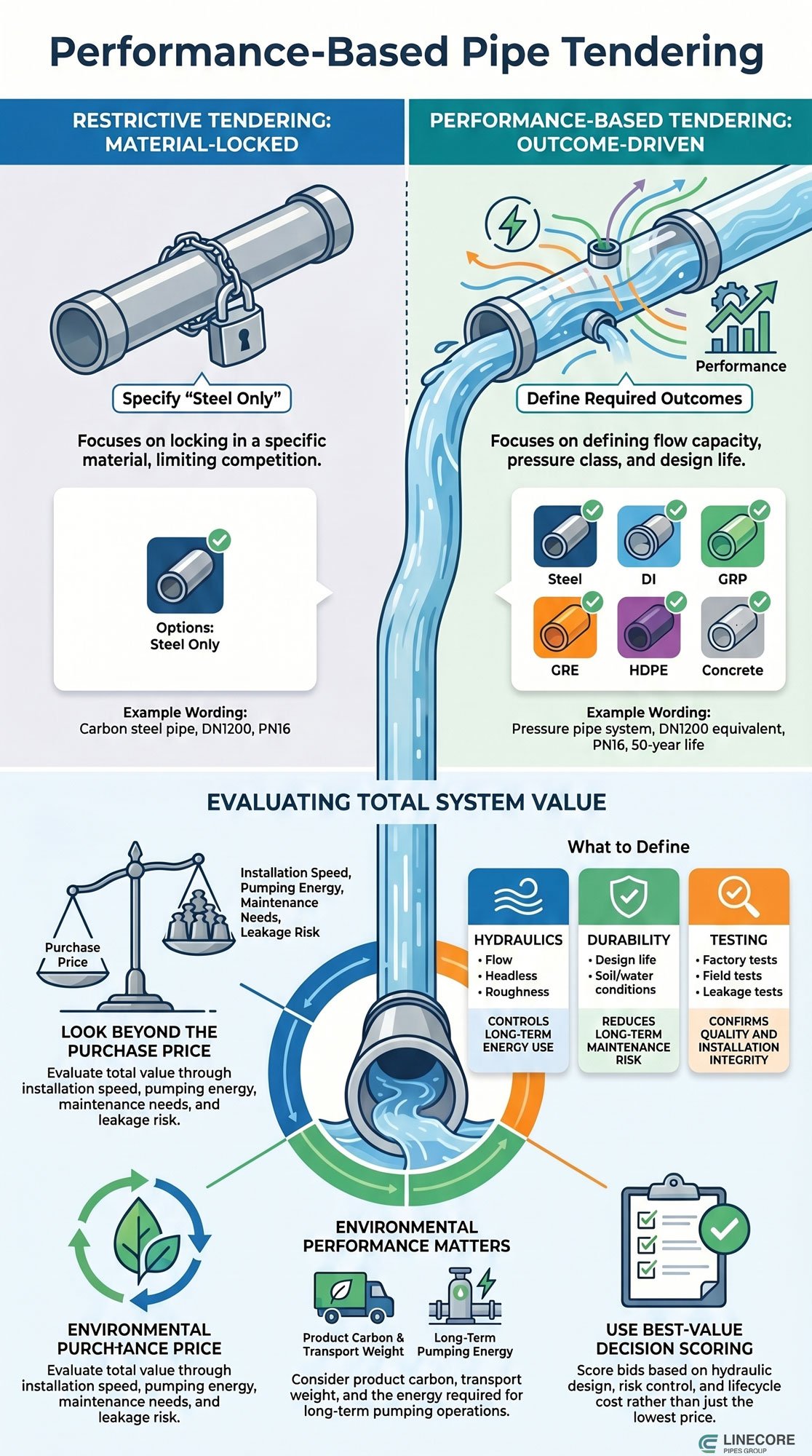
Performance-based pipe tendering means writing the tender around what the pipeline must achieve, not just the material bidders must use. Instead of writing “steel only” or “ductile iron only,” you define requirements such as:
- Flow capacity
- Pressure class
- Surge resistance
- Design life
- Corrosion resistance
- Soil and groundwater conditions
- Testing requirements
- Accepted standards
The World Bank explains that owners can either prescribe detailed inputs or define the performance the asset must deliver. For pipe tenders, that is a big difference. You are not lowering standards. You are making the tender clearer where it matters. You are saying, “Show us which system can meet the job properly.”
Real-World Example: Mountain Home AFB Water Resilience Project
This is a good example of this mindset. Idaho Department of Water Resources reports that the project used a two-step design-build process for an intake, pump station, conveyance pipeline, and related works. The RFQ set minimum technical and performance requirements, but it also made clear that the conceptual design was not the final locked solution.
That is the right balance. The owner kept control of the required outcome, while giving the design-builder room to develop the best way to meet it.
The Problem with Material-Locked Tenders
Let’s be fair. Steel is not bad. Ductile iron is not bad. GRP, GRE, HDPE, and concrete are not automatically better or worse. Each material has places where it makes sense. The real problem is when the tender chooses the material before the project has compared the options. For example: “Supply and installation of carbon steel pipe, DN1200, PN16.”
That wording forces every bidder into the same category. As a result, you may never see other systems that could offer:
- Faster installation
- Easier transport and handling
- Better corrosion resistance
- Lower lifecycle cost
- Better fit for site conditions
- Stronger hydraulic performance
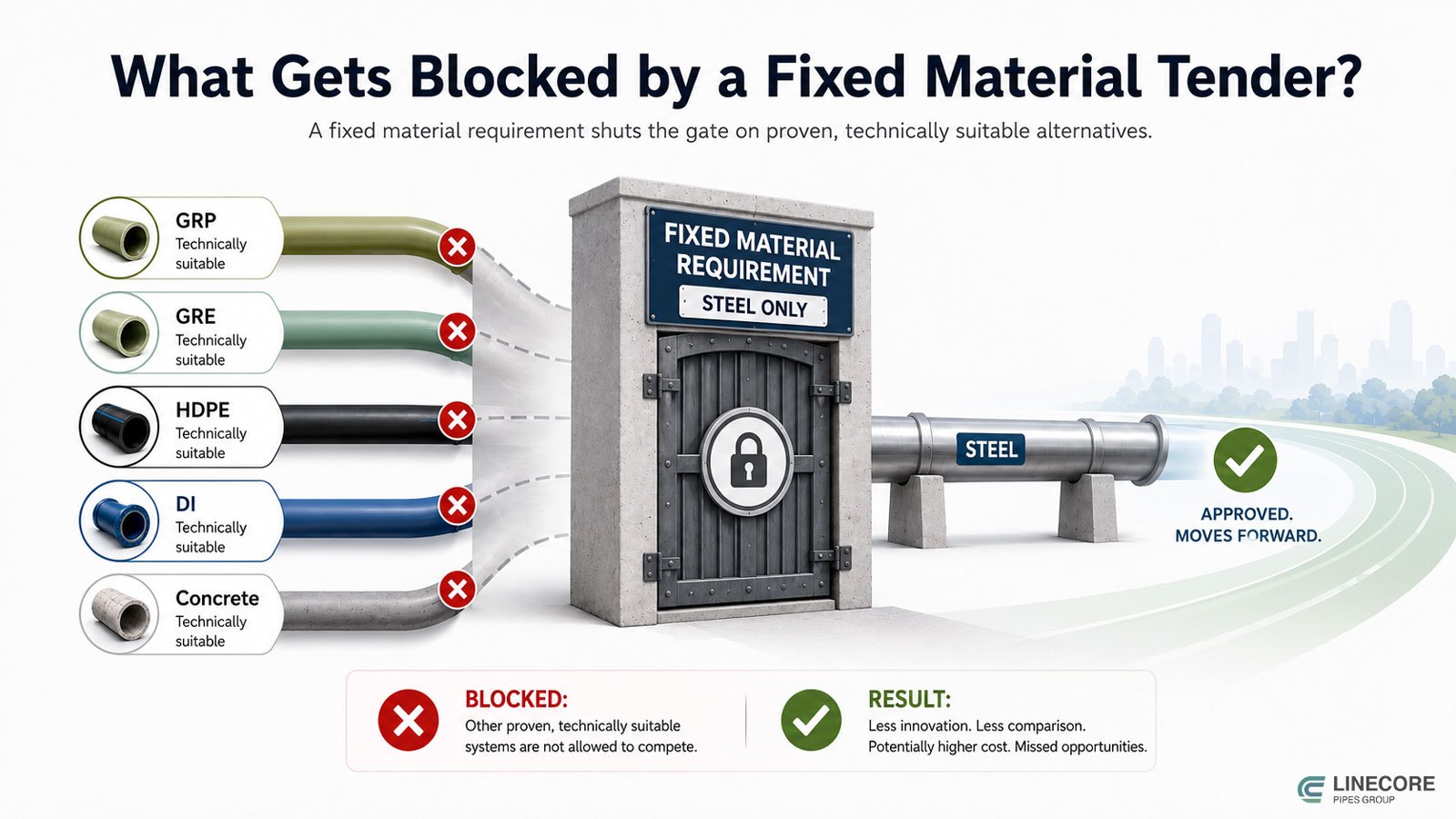
This is something Linecore Pipes Group sees often. A better technical solution may exist, but the tender structure can stop it from being considered. A performance-based pipe tender helps you compare complete pipe systems based on what the project actually needs.
A Simple Before-and-After Tender Example
Here’s a simple way to see the difference. The wording does not need to be complicated, but it does need to leave room for fair comparison.
| Tender type | Example wording | What can compete | What happens |
|---|---|---|---|
| Restrictive | Carbon steel pipe, DN1200, PN16 | Steel only | Options close early |
| Performance-based | Pressure pipe system, DN1200 equivalent, PN16, 50-year life | Steel, DI, GRP, GRE, HDPE, concrete | Options stay open |
| Better approach | Define the job first | Let materials prove fit | Compare fairly |
In the performance-based version, steel can still win. But so can ductile iron, GRP, GRE, HDPE, concrete, or a hybrid system, if it meets the requirements.
That is the key. Performance-based tendering does not mean “anything goes.” It means any qualified solution can compete if it proves it can meet the owner’s needs.
What Should Owners Specify Instead?
A good performance-based tender is not vague. Actually, it needs to be very clear. But it should be clear about performance, not just material. Think of it this way that you are giving bidders the target, the conditions, and the proof they need to provide.
| Area | What to define | Why it matters | Ask bidders for |
|---|---|---|---|
| Hydraulics | Flow, headloss, diameter, roughness | Controls energy use | Hydraulic model |
| Pressure | Working, test, surge, fatigue | Protects the system | Surge analysis |
| Durability | Design life, water, soil | Reduces long-term risk | Material data |
| Installation | Burial, crossings, access | Avoids site problems | Method statement |
| Testing | Factory, field, leakage | Confirms quality | Test records |
| Standards | AWWA, ISO, ASTM, EN | Keeps proof measurable | Compliance evidence |
This is also where “or equivalent” wording matters. The U.S. Federal Acquisition Regulation, under FAR 11.103, supports using performance specifications where practical so suppliers can offer solutions that meet the required function. That idea fits pipe tendering well.
For standards, owners can also refer to recognized sources like the AWWA standards list and allow equivalent international standards where the bidder can prove they are suitable.
Why This Matters for Water Transmission Projects
Water transmission lines are long-life assets. The material selected during tendering can affect cost, maintenance, energy use, and reliability for decades.
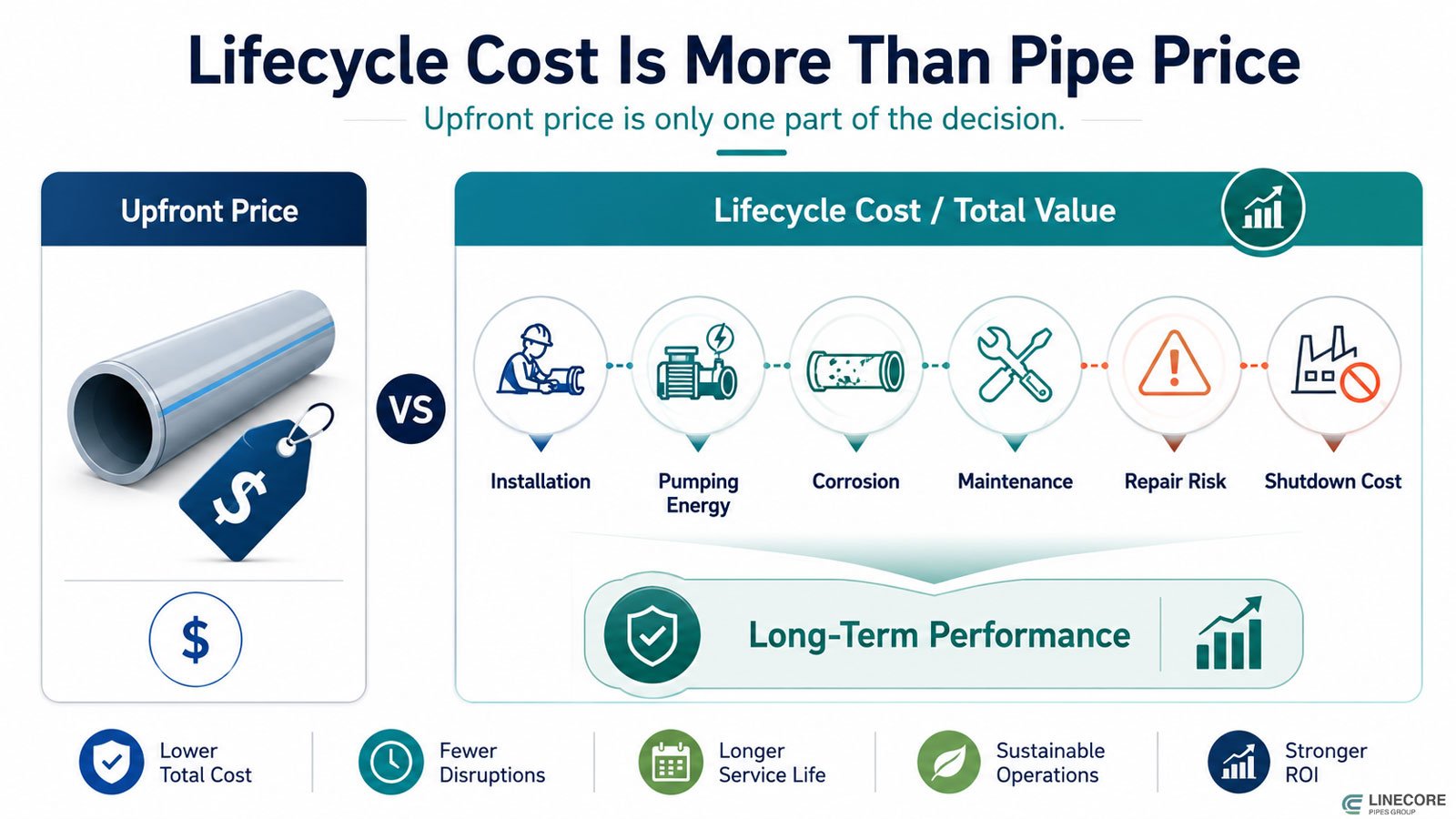
That is why the cheapest pipe on bid day is not always the lowest-cost system over time. A proper comparison should consider:
- Installation speed
- Corrosion protection
- Pumping energy
- Repair access
- Leakage risk
- Shutdown cost
- Maintenance needs
- Long-term hydraulic performance
For example, a smoother internal surface may reduce pumping energy. A lighter pipe may simplify transport and installation. A corrosion-resistant pipe may reduce the need for coatings, cathodic protection, inspections, or heavy maintenance.
How GRP and Composite Pipes Can Compete Fairly
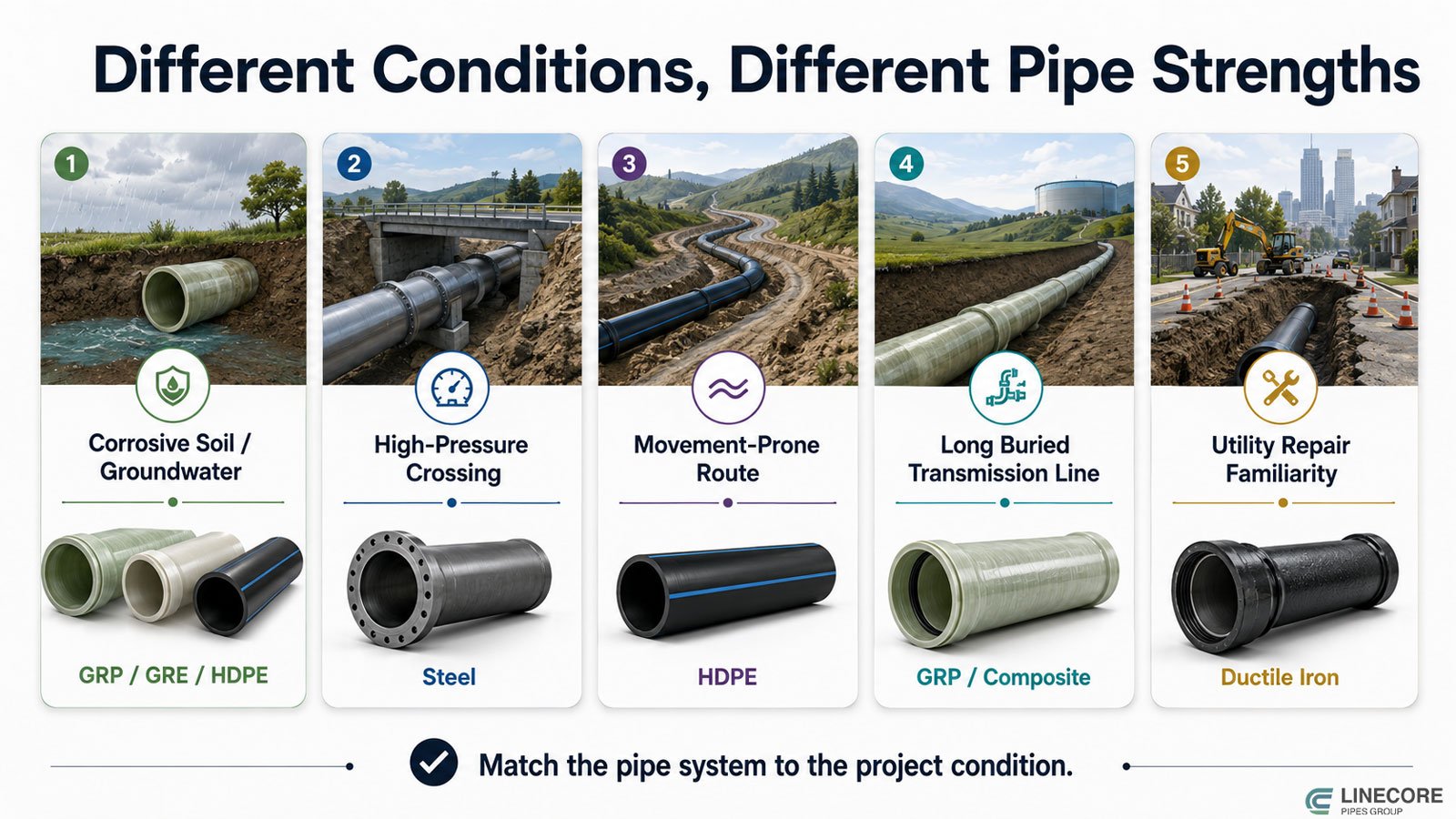
GRP and composite pipes should be evaluated when they fit the project conditions, not excluded before the tender process begins. For many buried water transmission lines, GRP can be a strong option because it offers corrosion resistance, smooth internal hydraulics, lower weight, easier handling, faster installation potential, and reduced need for external corrosion protection.
However, GRP is not automatically the best answer for every project. Different materials can be stronger in different situations:
- Steel may suit very high pressure, welded restrained systems, special crossings, or fabricated sections.
- Ductile iron may suit projects where local repair familiarity and fittings flexibility matter.
- HDPE may suit routes where fused joints, ground movement, or leakage control are key concerns.
- GRP/composite systems may suit buried, corrosive, long-distance transmission lines where weight, hydraulics, and corrosion resistance matter.
The point is not to favour one material in every case. The point is to avoid excluding technically suitable systems before they have been compared. A performance-based tender allows each pipe system to prove itself against the same project requirements.
Compare Pipe Options by Performance, Not Habit
Pipe material decisions are often influenced by past practice, utility standards, contractor familiarity, and local repair experience.
These factors can be useful, especially when they support easier installation, maintenance, repairs, and spare parts planning:
| Factor | GRP/composite | Steel | DI / HDPE |
|---|---|---|---|
| Corrosion | Strong resistance | Needs protection | DI needs protection; HDPE strong |
| Hydraulics | Smooth bore | Good when lined | DI moderate; HDPE good |
| Weight | Light | Heavy | DI heavy; HDPE lighter |
| Installation | Easier handling | Welding/coating work | DI familiar; HDPE fusion needed |
| Pressure | Good within class | Strong at high pressure | DI strong; HDPE varies |
| Maintenance | Lower corrosion work | Monitoring needed | DI familiar; HDPE low corrosion |
| Best use | Buried, corrosive, long runs | High pressure, specials | DI familiarity; HDPE movement/leaks |
Owner-side guidance supports this project-specific thinking too. The Water Corporation talks more about pipeline selection through whole-life risk, site conditions, and long-term suitability. That is the right way to think. The material should win because it fits the project, not because the tender copied an old habit.
Environmental Impact Should Be Part of the Comparison
Environmental impact is becoming a bigger part of pipe tender evaluation. Owners are expected to consider not only purchase price, but also carbon, transport, installation energy, pumping energy, and long-term maintenance impact.
This does not mean choosing a pipe based on one broad “green” claim. It means comparing environmental performance in a project-specific way. Let’s have a look at the environmental impacts:
Product Carbon
The tender should ask bidders to show the carbon impact of the pipe material itself. An Environmental Product Declaration, or equivalent verified data, can help owners compare embodied carbon more clearly.
Transport Impact
Pipe weight, delivery distance, and number of loads can all affect emissions. A lighter pipe may reduce transport effort, lifting needs, and site handling requirements.
Installation Energy
Installation method also matters. Equipment use, installation time, trench conditions, lifting needs, and crew productivity can all affect the project’s environmental footprint.
Operating Energy
For long water transmission lines, pumping energy can be one of the biggest long-term drivers. A smoother internal surface may reduce headloss and lower energy use over the life of the pipeline.
Maintenance and Replacement Impact
A system with higher maintenance needs may require more inspections, repairs, shutdowns, and replacement work. These activities also carry environmental and operational costs.
Alternative Technical Concepts Can Keep Better Ideas Alive
Sometimes the owner already has a base design but still wants room for better ideas. That is where Alternative Technical Concepts, or ATCs, can help. An ATC lets bidders suggest a different technical approach before award, as long as it is equal to or better than the original requirement.
The FHWA explains how ATCs can help public agencies capture better ideas while keeping the process fair and controlled. For pipe tenders, this can be very useful. You keep the core requirements fixed, but you give bidders space to bring smarter solutions.
Real-World Example: West End Raw Water Pipeline in Billings
The West End Raw Water Pipeline Project in Billings, Montana shows why early flexibility can matter. The project included around 3.5 miles of 36- to 42-inch raw water pipeline, with crossings under Interstate 90, railroad, creek, and irrigation features. That kind of project has real constructability questions. Access, sequencing, crossings, and site risks can all affect the final solution.
By using a CM/GC model, the owner allowed contractor input during preconstruction. That helped keep room open for better ideas around materials, methods, and construction sequencing before everything was locked.
The Role of EPC in Performance-Based Pipe Tendering
In water transmission projects, the owner is not only buying pipe. The goal is a complete system that delivers the required flow, pressure, service life, and reliability. EPC helps because key parts of the system are planned together:
- Engineering: hydraulics, surge, route, and material selection
- Procurement: pipe, fittings, logistics, and delivery risk
- Construction: methods, crews, access, and sequencing
- Commissioning: testing, QA/QC, acceptance, and performance proof
This matters in performance-based tenders because the bidder can propose a full system, not just a product. NTMWD indicates that keeping options open is not only about pipe material. In large water transmission projects, value can also come from better packaging, early procurement, route sequencing, and delivery planning.
Related
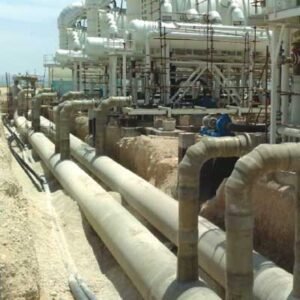
EPCC contracting for pipeline and water projects: engineering, procurement, construction and commissioning under one contract, from tender to handover.
For Linecore Pipes Group, this supports its role as a GRP/composite pipe supplier and total solution maker for water transmission lines. The pipe is only one part of the result. The real question is whether the whole system performs.
Standards and Acceptance Criteria Keep the Tender Safe
Some owners worry that opening the tender to different materials will make things messy. It can, if the tender is loose. But if the performance requirements, standards, and tests are clear, the process can stay controlled.
| Requirement | Why it matters | Proof needed | Owner benefit |
|---|---|---|---|
| Product standard | Confirms base quality | AWWA/ISO/ASTM/EN data | Screens weak bids |
| Joint testing | Controls leakage | Test records | Protects integrity |
| Hydrotest | Checks field work | Field test report | Confirms installation |
| Corrosion strategy | Reduces long-term risk | Material/coating/CP data | Protects asset life |
| Design life | Sets expectation | Calculations/tests | Avoids vague claims |
| Commissioning | Confirms service | Flow/pressure data | Links bid to outcome |
For design-build projects, the World Bank’s design-build procurement documents show how performance requirements, testing, securities, and acceptance can be written into the contract. So flexibility does not mean weak control. You can keep the door open and still protect the project.
How to Evaluate Bids Fairly
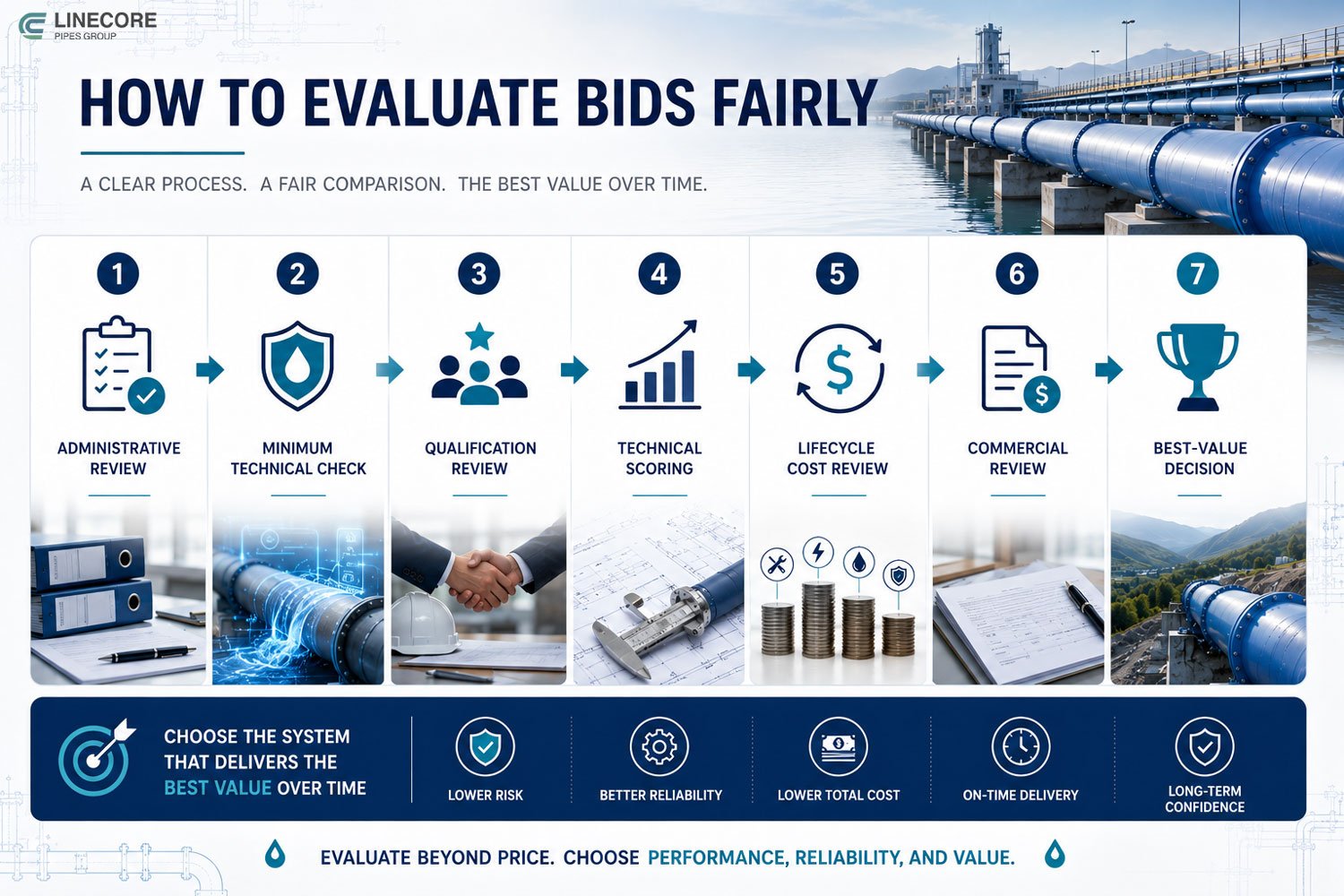
A performance-based tender needs a clear evaluation process. If you allow different pipe systems to compete, you need a fair way to compare them. The goal is not to pick the cheapest pipe on paper. The goal is to choose the system that gives you the best mix of performance, cost, risk, and delivery confidence. A simple evaluation flow can include:
- Administrative review: Is the bid complete and valid?
- Minimum technical check: Does the system meet your required flow, pressure, design life, testing, and standards?
- Qualification review: Does the manufacturer, EPC provider, or installer have relevant experience?
- Technical scoring: How strong is the hydraulic design, corrosion strategy, installation method, QA/QC, and risk control?
- Lifecycle cost review: What will the system cost you to install, operate, maintain, repair, and keep reliable over time?
- Commercial review: Are the price, schedule, warranty, payment terms, and performance guarantees clear?
- Best-value decision: Which bid gives you the strongest overall result, not just the lowest supply price?
This matters because a low pipe price can hide higher costs later. You may pay more through corrosion protection, slower installation, extra maintenance, higher pumping energy, repairs, or shutdown risk.
Real-World Example: Val Vista Transmission Main Rehabilitation
The Phoenix Val Vista Transmission Main Rehabilitation shows why complex pipeline projects need more than a low pipe price. The 90- to 96-inch work required careful staging, testing, QA/QC, and risk control.
Because the project used a CMAR model, the lesson is simple: for high-risk transmission lines, evaluate the delivery method and execution plan, not just the pipe product.
Common Mistakes in Pipe Tender Documents
A lot of tender problems come from old habits.
| Mistake | Why it hurts | Better approach | Benefit |
|---|---|---|---|
| Naming one material | Blocks options | Define performance | More competition |
| Copying old specs | Carries old assumptions | Review project needs | Better fit |
| Price-only focus | Misses lifecycle cost | Score total value | Lower risk |
| Ignoring corrosion | Understates maintenance | Require strategy | Longer service life |
| Ignoring energy | Misses OPEX | Compare headloss | Better operating cost |
| No equivalents | Limits standards | Allow proven equals | Wider market |
| No alternatives | Blocks better ideas | Allow ATCs | More innovation |
| Supplier-list only | Skips performance proof | Evaluate capability | Better decisions |
| Familiarity only | Rewards habit | Measure performance | Fairer comparison |
The biggest mistake is simple: Nobody stops to ask, “Does this old specification still fit this project?” That question should be asked before the tender goes out.
When a Specific Material Requirement Is Still Fine
Performance-based tendering does not mean every material must always be allowed. Sometimes one material really is justified. For example, the project may have very high pressure, special crossings, existing network compatibility, emergency repair stock needs, severe external loading, regulatory requirements, or a proven utility standard.
That is okay. But the reason should be clear and project-specific. If the tender restricts the material, the owner should be able to explain why. It should not just be because “this is what we used last time.”
Why Owners Should Keep Options Open Before Tendering
Once a tender is published, changing it can be difficult. At that stage:
- Consultants may not want to reopen the specification.
- Owners may worry about delays.
- Suppliers with alternative systems may not even bid if the tender looks closed.
So the best time to keep options open is before the tender is issued. For GRP and composite pipe solutions, this matters a lot. The goal should not be to fight a closed specification later. The better approach is to help owners and consultants write tenders that allow qualified composite systems from the start. That gives the owner more options, better competition, and a clearer basis for choosing the best value.
Practical Checklist for Owners and Consultants
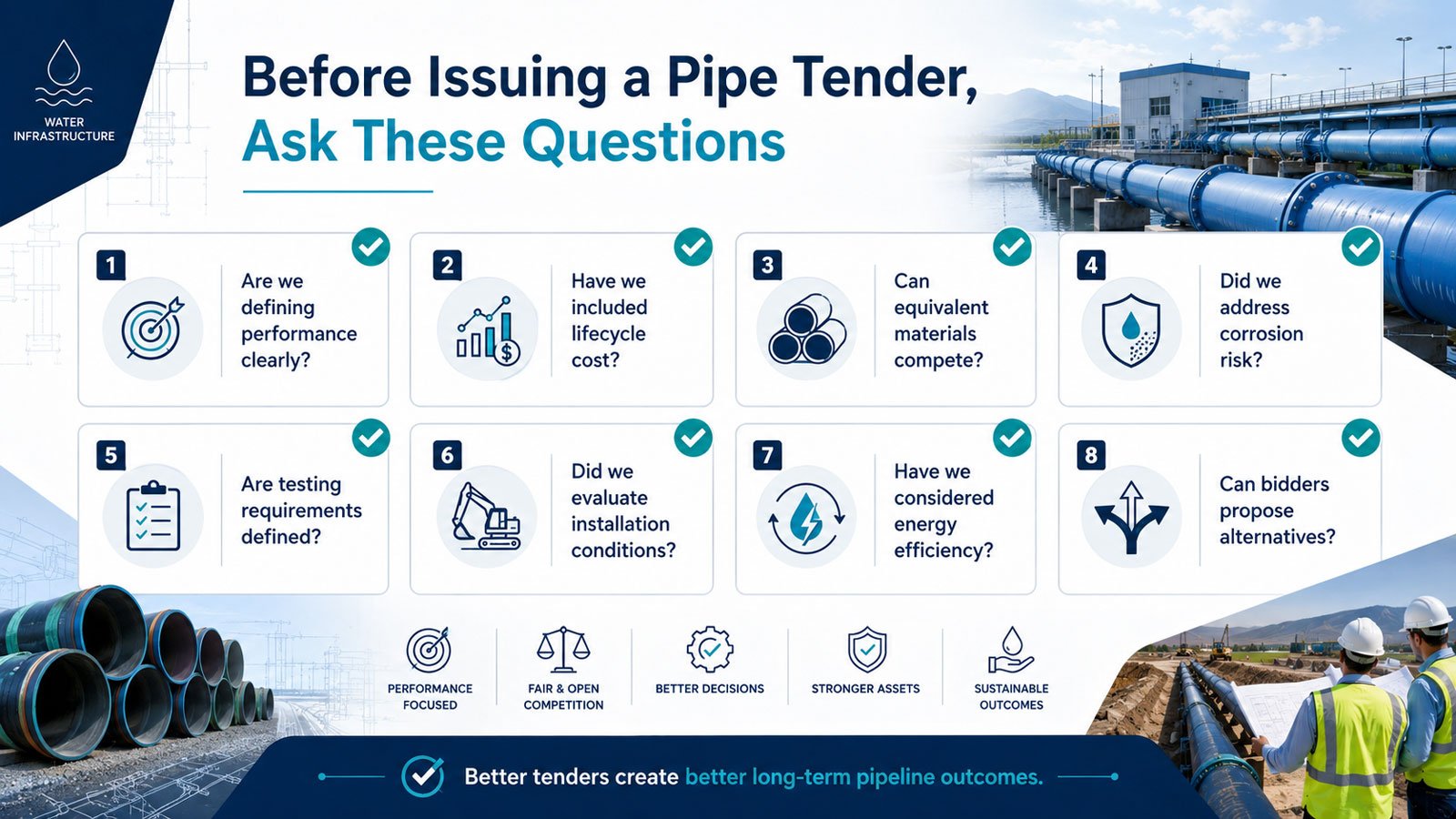
Before issuing a pipe tender, ask:
- Are we defining performance, or only naming a material?
- Have we defined flow, pressure, surge, and design life?
- Have we described soil, groundwater, and installation conditions?
- Have we allowed equivalent materials and standards?
- Have we included lifecycle cost in the evaluation?
- Have we considered installation speed and logistics?
- Have we asked for corrosion strategy and maintenance needs?
- Have we included environmental impact, transport, installation energy, and pumping energy?
- Have we allowed alternative technical proposals?
- Have we defined factory testing, field testing, and acceptance criteria?
- Are we relying too much on approved supplier lists or local familiarity?
- Are we accidentally excluding GRP, GRE, HDPE, or another suitable option?
If the answer to some of these is “not really,” the tender may be closing too early.
Final Thoughts
Performance-based pipe tendering helps owners compare better. You still define pressure, flow, design life, standards, testing, and acceptance. You just avoid locking the material before the project has seen its real options.
For water transmission lines, the best pipe is not always the cheapest pipe per meter. It is the system that performs well, manages risk, reduces long-term cost, and gives the owner confidence for decades.
about
The Author

Farshid Tavakoli is a seasoned professional in engineering and international trade. Holding degrees in Electrical Engineering, Mechatronics, and a Doctorate in Business Administration (DBA) from the University of Lyon, he also has a strong background in industrial automation and production line technologies.
For over 17 years, he has led an international trading company, gaining deep expertise in commercial solutions tailored to industrial needs. With more than 8 years of active involvement in infrastructure development, he specializes in the supply of electromechanical equipment for water and wastewater treatment plants and transfer projects.
Together with comapny expert team, he now provides consultancy and integrated solutions for sourcing and implementing complex infrastructure projects across the region.