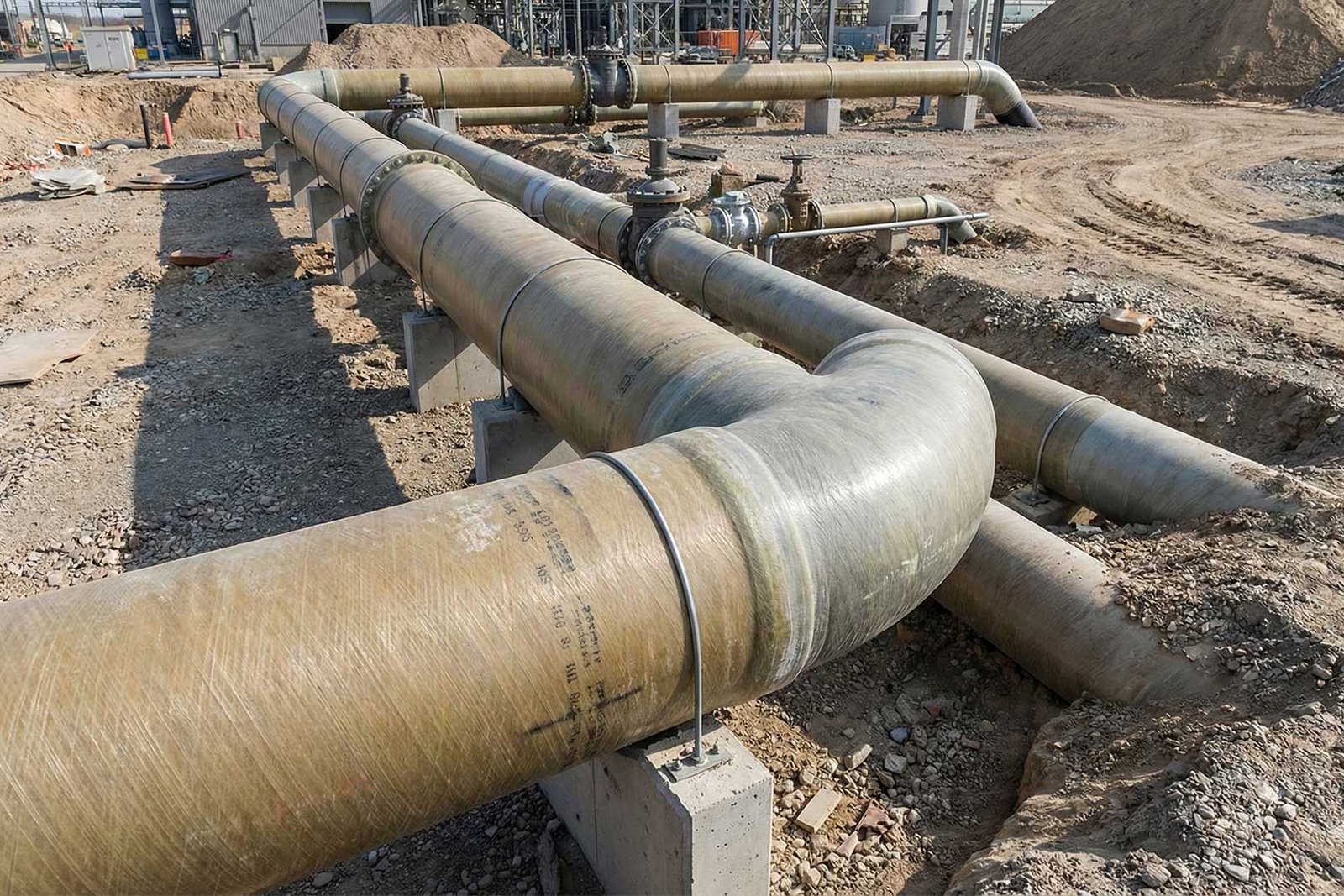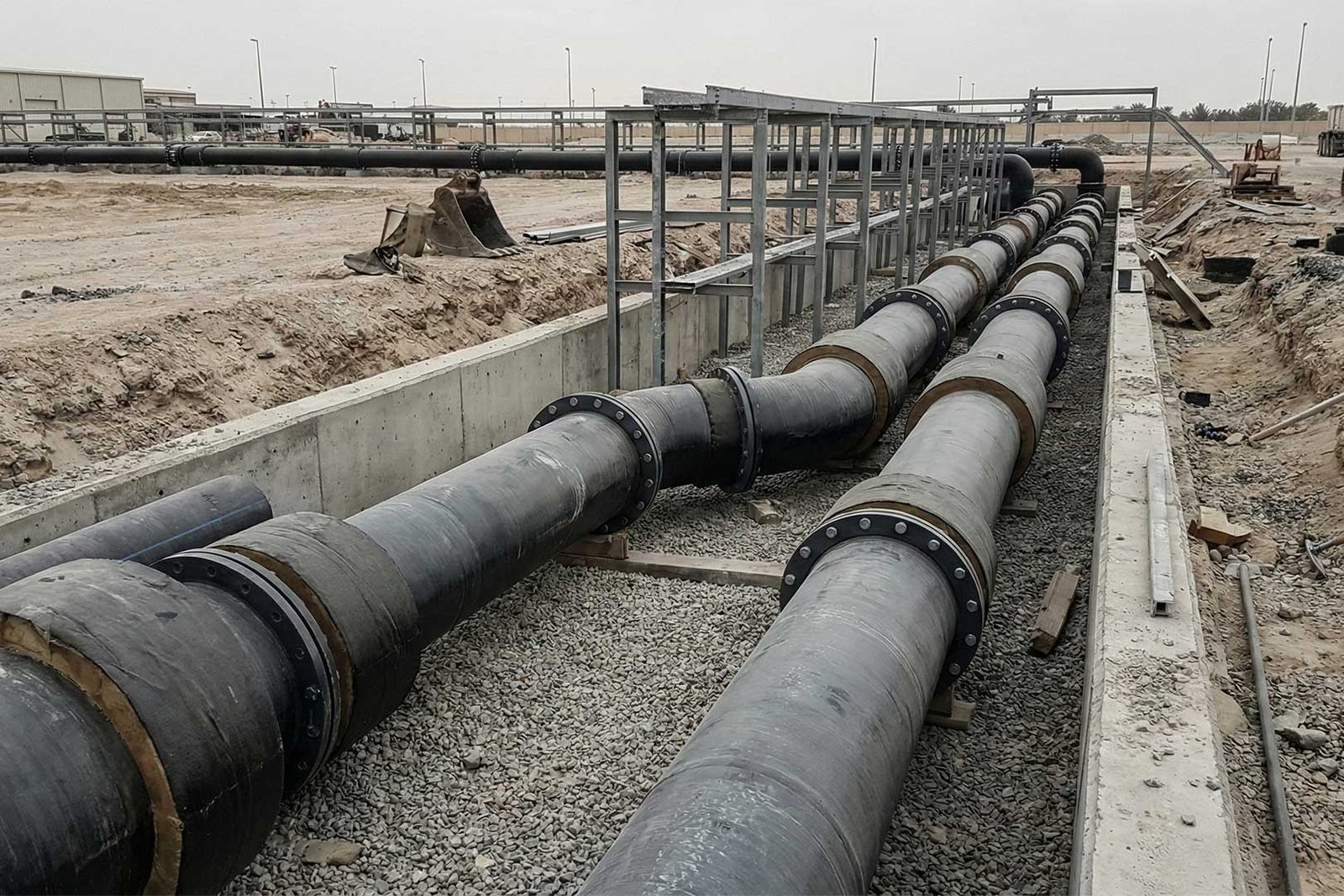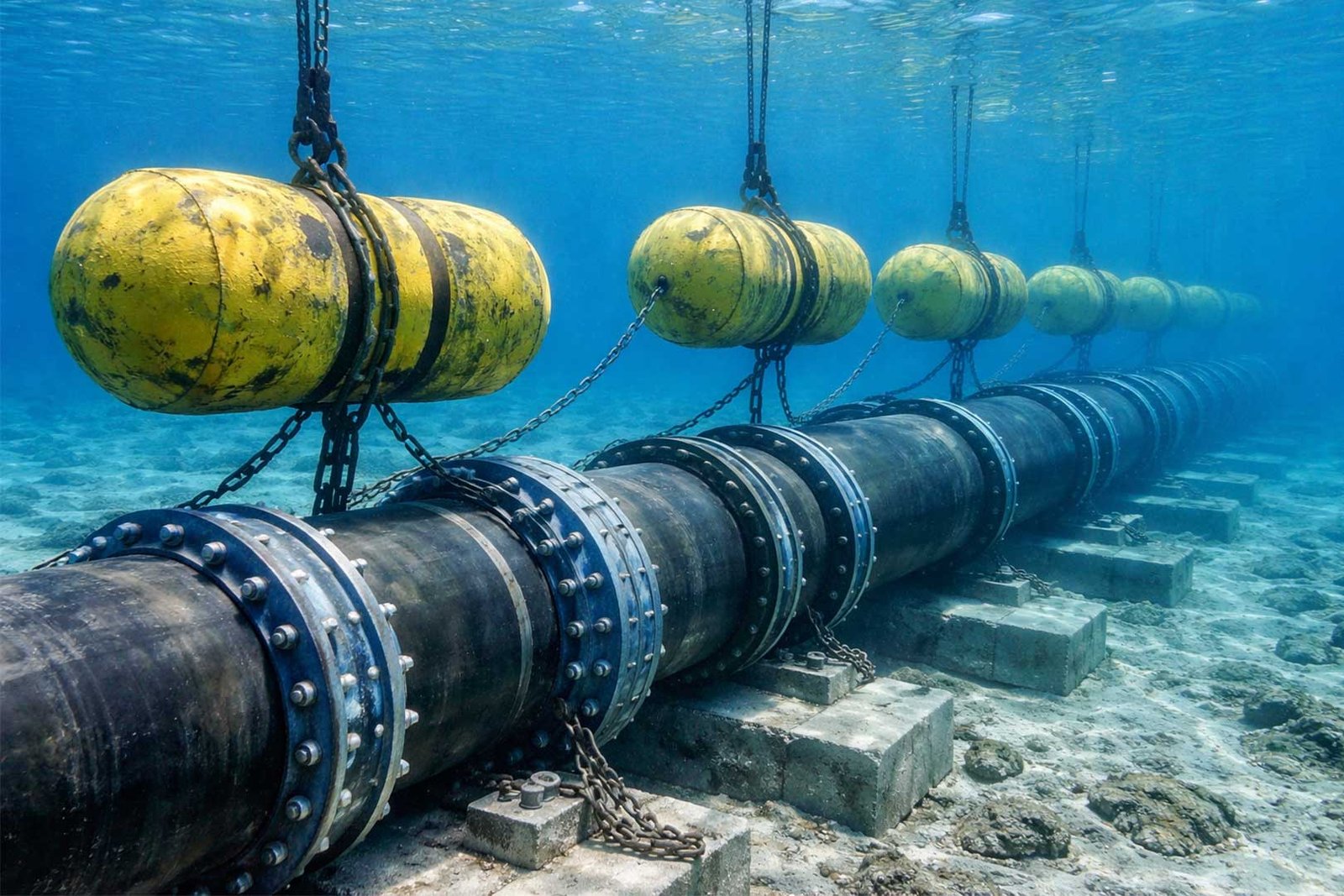
GRP intake and outfall pipes fight corrosion very well and can last for a long time. But they still often fail during or right after marine installation in desalination projects. These failures cause big costs beyond your imagination, including plant shutdowns, emergency repairs, and replacing hundreds of meters of pipe. The biggest problems come from buoyancy that lifts the pipe, weak anchoring, poor backfill, and strong wave forces during the critical float-and-sink phase.
That’s why we are going to explain the main failure causes, buoyancy risks, smart installation practices, important standards, and ways to reduce risks to keep everything safe. It gives your engineering and procurement teams flawless steps to build perfect GRP pipelines.
Why GRP Is Used in Seawater Intake and Outfall Pipelines
Engineers pick GRP pipes for seawater intake and outfall systems in desalination projects. This is because these lightweight composite pipes provide you with exceptional advantages in marine work (source: ResearchGate). GRPs are almost corrosion-resistant and work much better than steel and concrete, so you will need zero maintenance since they last longer. GRP also supports very large diameters, which allows high water flow without extra pipes.
These features make transport and installation easier and cheaper on land. However, that lightweight nature that we consider as an advantage can give rise to a serious structural risk in such projects.
The Real Root Cause: Buoyancy in Large Diameter GRP Pipelines
Buoyancy is responsible for the most GRP intake and outfall pipeline failures. GRP pipes are much lighter than steel or concrete. GRP pipes are much lighter than steel or concrete. They have low specific gravity, so they may tend to float in water. This creates a strong uplift force, especially in large-diameter pipes. Let’s have a look at the issues that buoyancy may create:
- The worst thing you can imagine happens when the pipeline is completely empty. This produces the strongest upward force.
- In intake lines, a sudden pump shutdown traps air inside the pipe and makes it lift.
- In outfall lines, suction conditions craft a vacuum that pushes the pipe upward.
- When the pipe floats, it rises out of the trench. This breaks joints, damages seals, and causes major leaks.
Case Study: What Happened in the Albania Project
In the Vlore Bay project in Albania, both the seawater intake and outfall GRP pipelines failed because of buoyancy. The International Scientific Journals reports that the pipes were not properly covered with backfill. When the system started, suction and trapped air made uncovered sections float up. This broke the joints and damaged the seals. In the end, workers had to replace hundreds of meters of pipe on both lines.
Marine Installation Phase: Where Most Failures Occur
The marine installation phase is where the most failure happens. Workers usually use the “float and sink” method. They join the pipes on land, float them out to sea, and then sink them to the seabed. This phase is risky for GRP pipes because they are light and bend easily. Below we listed all dangers:
S-Curve Bending During Sinking
As the pipe sinks from the surface to the seabed, it makes a sharp S-shape. This tight bend puts heavy stress on the pipe. The pipe may crack due to sharp bend or it may get damaged.
Offshore Joint Stress Concentration
Workers often join the pipes together offshore in waves and currents. These joints face a lot of stress and movement, so they can leak or break more easily.
Improper Ballasting During Lowering
Workers attach concrete weights to control the sinking speed. If the weights are wrong or placed at bad spacing, the pipe sinks unevenly and gets too much stress.
Sudden Sinking and Pipe Overstress
Sometimes the pipe drops too fast during sinking. This sudden drop creates strong forces that can crack the pipe or damage its layers.
Typical Failure Modes in Desal Intake and Outfall Pipelines
You see GRP pipelines in desalination projects fail in various ways. These failures usually occur because of buoyancy, installation stresses, or pressure issues. Check the main ones as follows:
- Pipeline floats and displaces: The light pipe floats easily and gets out of its place when you don’t weigh or bury it properly.
- Joint separates during sinking: Joints pull apart while the pipe is sinking into the sea.
- Buckling under external hydrostatic pressure: The pipe collapses inward because of the heavy pressure from deep seawater.
- Collapse during vacuum condition: The pipe caves in when vacuum or low pressure forms inside the line.
- Installation induced cracks and delamination: Rough handling or tight bending during installation causes cracks and layer separation.
- Anchor block spacing failures: You place the concrete weights at the wrong spacing, so they fail to hold the pipe down.
Here is a simple summary of the failures and how to prevent them:
| Failure Cause | Main Indicator | Best Mitigation |
|---|---|---|
| Buoyancy / Uplift | Pipe floats or shifts | Use proper anchor blocks + sufficient burial cover |
| Poor Backfill / Compaction | Uneven deflection, settled joints | Use granular backfill + good compaction |
| Joint Misalignment / Separation | Leaks at joints | Prefabricate long strings (fewer offshore joints) |
| Wave / Current Load | Pipe displacement | Deeper burial + hydrodynamic analysis |
| Vacuum / Overpressure | Pipe collapse | Design for external pressure + gentle pump controls |
| Scour / Erosion | Exposed pipe sections | Rock dumping, riprap or scour mats |
| Installation Damage | Cracks or delamination | Careful handling + proper S-bend control |
Backfill and Burial Failures in Coastal Installations
Even after the pipe is laid on the seabed, many failures still happen because of poor backfill and burial. These mistakes can make the pipe move or float later.
Insufficient Trench Depth
As IEEE Xplore states, if the trench is not deep enough, waves and currents can easily wash away the soil cover. The pipe stays exposed and can float up when water moves around it.
Pro Tip: Always keep at least 1 metre of soil cover above the pipe in coastal areas. Less than that is risky.
Poor Compaction Underwater
It is very hard to compact the backfill properly underwater. The material stays loose and settles later. This creates gaps around the pipe and leaves it without good support.
Wrong Bedding Material
Using the wrong sand or gravel causes problems. The bedding may not hold the pipe steady or water can wash it away easily.
Backfill Erosion by Waves
Strong waves and currents slowly wash away the backfill after installation. Over time, the protective cover disappears and leaves the pipe unprotected.
Exposed Pipe Sections Leading to Flotation
Once parts of the pipe become exposed, its lightweight makes it float upward. This can break joints, damage seals, and cause big leaks or complete failure.
Pro Tip: After backfilling, always check the pipe with divers or an ROV to make sure it is fully covered before you leave the site.
Seabed and Hydrodynamic Risks: The Hidden Dangers Teams Ignore
Many teams only focus on the pipe itself. They forget about the seabed and the power of moving water. These hidden risks cause a lot of failures after the pipeline is installed. The main seabed and hydrodynamic risks include:
- Waves and currents wash away sand from under the pipe. This leaves the pipe hanging with no support.
- When the pipe loses support, it creates long free spans. The pipe sags and bends too much, putting heavy stress on the joints.
- Strong waves and currents push and pull the pipe sideways. This moves it out of position.
- During storms or big waves, the sandy seabed can suddenly turn soft like liquid. The light GRP pipe then either floats up or sinks too deep.
- Poor backfill or strong currents wash away the material in the trench. This leaves the pipe exposed and unsupported.
Ballasting and Anchoring Design Mistakes
Many GRP pipeline failures happen because teams underestimate the uplift force on these light pipes. They often space the ballast weights wrong, design the concrete weights incorrectly, or forget to place anchor blocks at bends and direction changes.
The area near the shoreline is especially risky. Here, the pipe moves from land to sea and faces changing forces. Without proper ballasting and anchoring, the pipe can float, shift sideways, or break its joints.
Joint System Weakness in Marine GRP Pipelines
Joints are the weakest part of GRP pipelines in the sea. To be honest, joints cause more problems than the pipe itself. If the joints fail, the whole pipeline can fail, even if the pipe looks perfect. That’s why you need to pay special attention to them. Below are the main ways joints fail:
- Mechanical coupling vulnerability: Mechanical couplings can loosen or leak when waves and currents move the pipe.
- Joint rotation during sinking: During the float-and-sink process, the pipe bends, and the joints rotate. This puts extra stress on the seals.
- Misalignment during offshore assembly: It is hard to align pipes perfectly when joining them offshore in waves. Many joints end up misaligned.
- Seal damage under bending stress: When the pipe bends too much during sinking, the seals get squeezed or stretched and get damaged.
- Long string vs segmented installation risk: Using many short pipes means more joints offshore, which increases risk. Long strings have fewer joints but are harder to control while sinking.
Case Study: Saudi Arabia Desalination Plant
According to Sylmasta, in a big desalination plant in Saudi Arabia, a 3000mm diameter GRP discharge pipe had serious problems during installation. The workers could not align the pipe sections properly. After installation, gaps appeared at the joints. When they started the system, water leaked through these gaps and flooded the area.
Because the pipe was already partially buried, fixing it was very difficult and expensive. The team had to do an underwater patch repair.
QA/QC Gaps During Marine Installation
You’ve spent months designing a perfect GRP pipeline, the materials have arrived, and the barge is ready. Then the pipe goes into the water… and everything starts going wrong. The truth is, most GRP failures don’t happen because the pipe is bad. They happen because nobody was watching closely enough during installation.
If you skip proper monitoring, forget to check deflection while sinking, rush the pressure test, skip the underwater inspection, or don’t verify the ballast weights, you’re basically inviting trouble. Do these checks right, and you’ll sleep much better once the pipeline is on the seabed.
Engineering Best Practices to Prevent GRP Marine Failures
You can avoid most GRP pipeline failures if you follow these smart engineering practices from the very beginning.
Buoyancy Analysis During FEED Stage
Do a detailed buoyancy study right at the Front End Engineering Design (FEED) stage. Calculate the uplift forces for the empty pipe case. This helps you plan the right amount of ballast and burial depth before it’s too late.
Installation Method Based Design
Design the pipe and joints according to the actual installation method you will use. Whether it’s float-and-sink, lay barge, or bottom pull, the design must consider the stresses that will happen during sinking.
Proper Trench and Cover Calculation
Calculate the exact trench depth and cover thickness based on wave conditions, currents, and pipe stiffness. Never guess. Instead, use proper engineering calculations to make sure the pipe stays safely buried.
Hydrodynamic Stability Assessment
Perform a full hydrodynamic analysis. Make sure you check these important factors (source: MDPI):
- Wave and current loads acting on the pipe
- Vortex-induced vibrations (VIV)
- Risk of seabed scour
- On-bottom stability during bad weather
This gives you a clear picture of how the pipe will behave once it is on the seabed.
Anchor and Ballast Optimization
Design the concrete ballast weights and anchor blocks carefully. Get the spacing, size, and shape right so they control sinking without overstressing the pipe. Good optimization saves both weight and money.
Long String Prefabrication Strategy
Prefabricate long pipe strings on land whenever possible. Fewer offshore joints mean fewer weak points and much less risk during installation. This is one of the smartest ways to reduce failures in marine GRP projects.
Here’s a simple table that shows the most important actions you can take to prevent failures in GRP intake and outfall pipelines:
| Area | Key Action | Why It Helps |
|---|---|---|
| Design Phase | Perform buoyancy analysis in FEED stage | Prevents under-design of ballast and burial |
| Installation Method | Use long string prefabrication | Reduces number of risky offshore joints |
| Burial & Backfill | Ensure minimum 1m cover + good compaction | Stops pipe exposure and flotation |
| Ballast & Anchoring | Optimize weight spacing and anchor blocks | Controls uplift and on-bottom stability |
| Quality Control | Do proper deflection checks and underwater inspection | Catches problems before they become expensive |
| Project Delivery | Choose EPC with single responsibility | Eliminates interface risks and miscommunication |
Why EPC Delivery Eliminates Most Intake & Outfall Risks
Now, there is something important you should know. When you use EPC delivery for your GRP intake and outfall project, one single team takes care of everything, like engineering, procurement, and construction. This approach removes a lot of the usual problems and risks. Let’s see why EPC works so well:
- Single responsibility for design and installation
- Constructability based pipe design
- Integrated buoyancy and structural calculations
- Coordinated marine installation planning
- Reduced interface risk between vendor and contractor
- Faster commissioning with lower failure risk
Ready to Build a Reliable GRP Intake and Outfall Pipeline?
At LineCore Pipes Group, we deliver complete intake and outfall pipeline solutions for desalination projects. We are here for everything, from supplying large diameter GRP pipes to marine engineering, buoyancy and ballast design, offshore installation planning, and full EPC execution. We also handle long distance seawater pipelines. You hire one team responsible for the entire project.
If you want a strong and trouble-free GRP pipeline, contact us at LineCore Pipes Group today. Let’s discuss your next project.
about
The Author

Farshid Tavakoli is a seasoned professional in engineering and international trade. Holding degrees in Electrical Engineering, Mechatronics, and a Doctorate in Business Administration (DBA) from the University of Lyon, he also has a strong background in industrial automation and production line technologies.
For over 17 years, he has led an international trading company, gaining deep expertise in commercial solutions tailored to industrial needs. With more than 8 years of active involvement in infrastructure development, he specializes in the supply of electromechanical equipment for water and wastewater treatment plants and transfer projects.
Together with comapny expert team, he now provides consultancy and integrated solutions for sourcing and implementing complex infrastructure projects across the region.