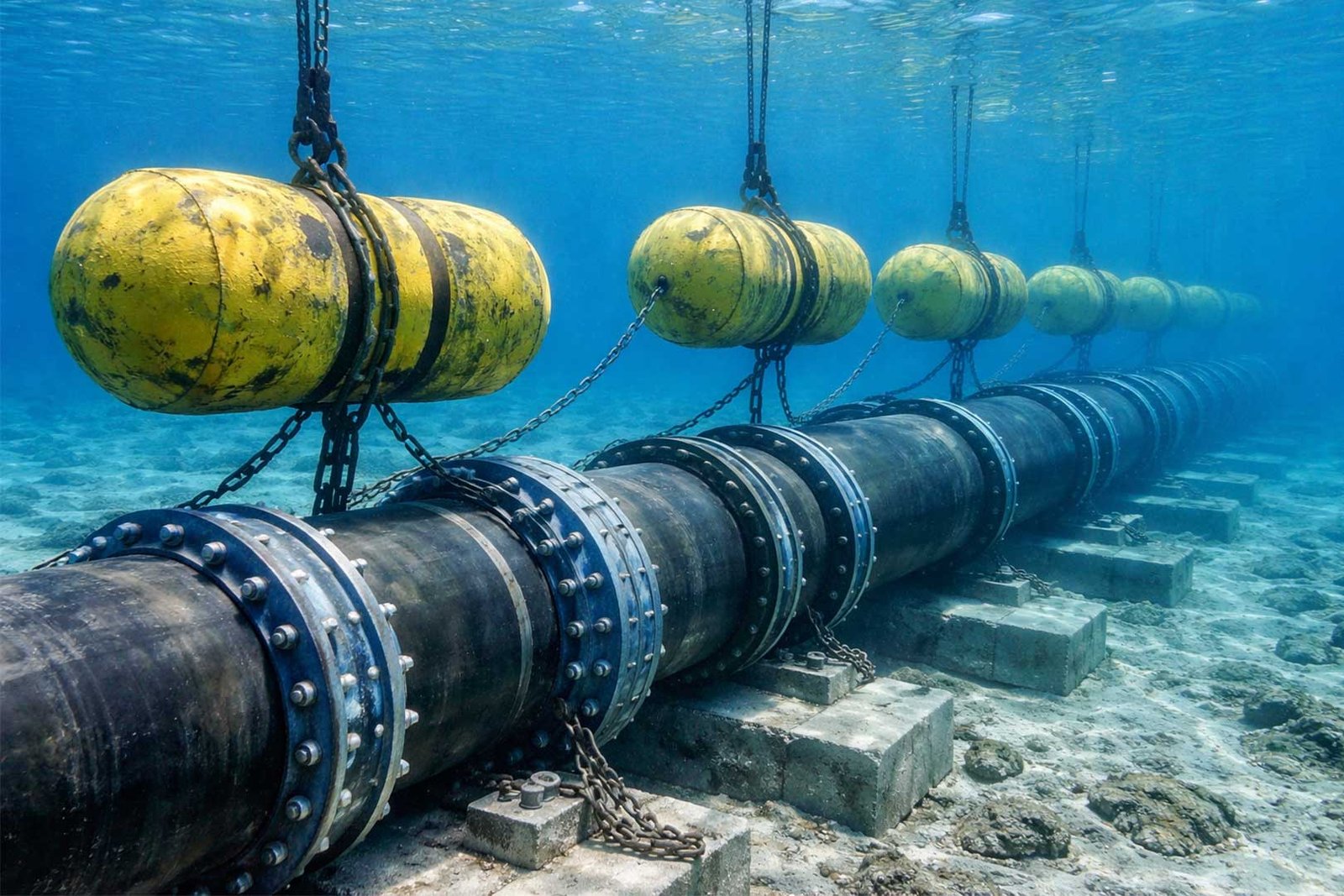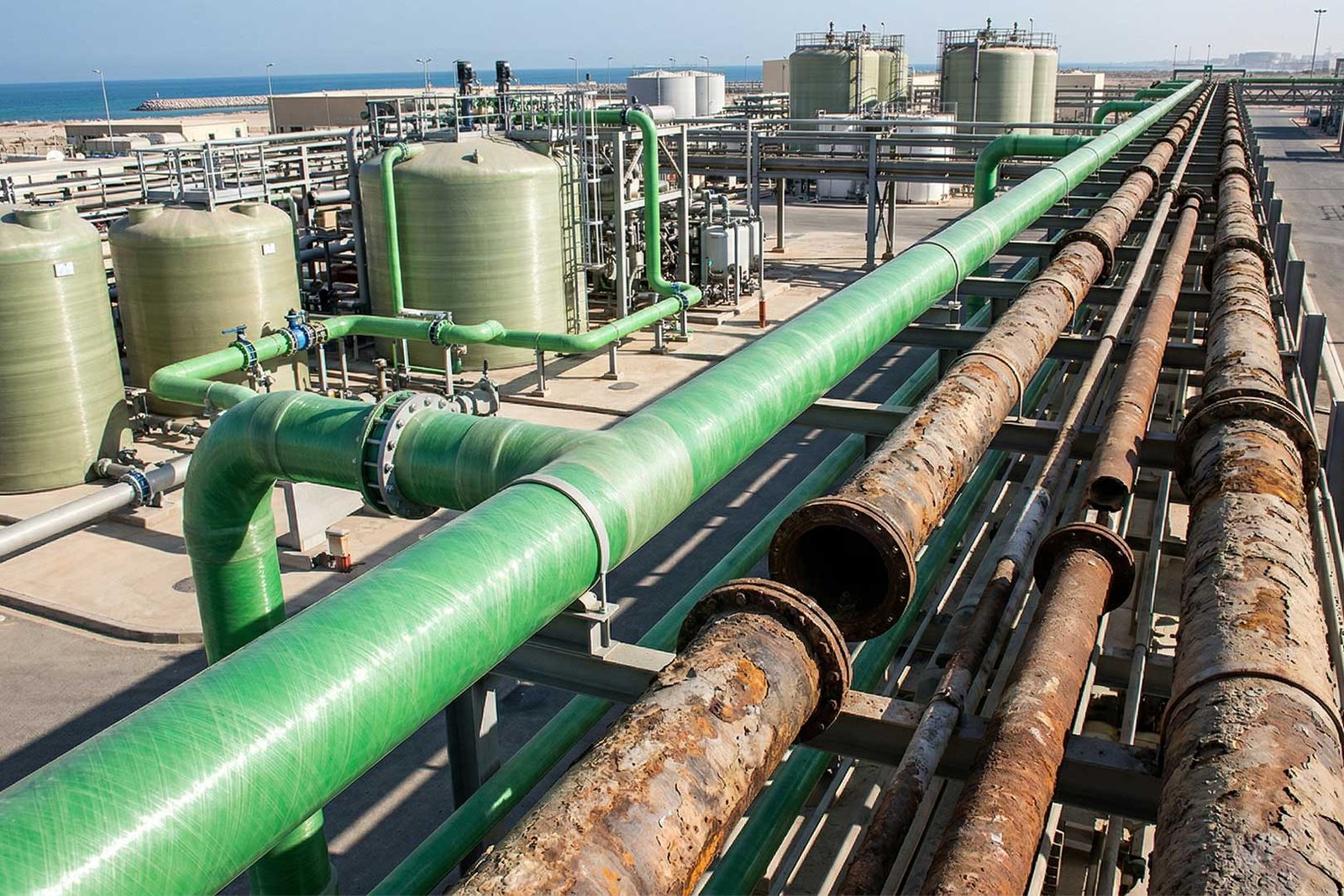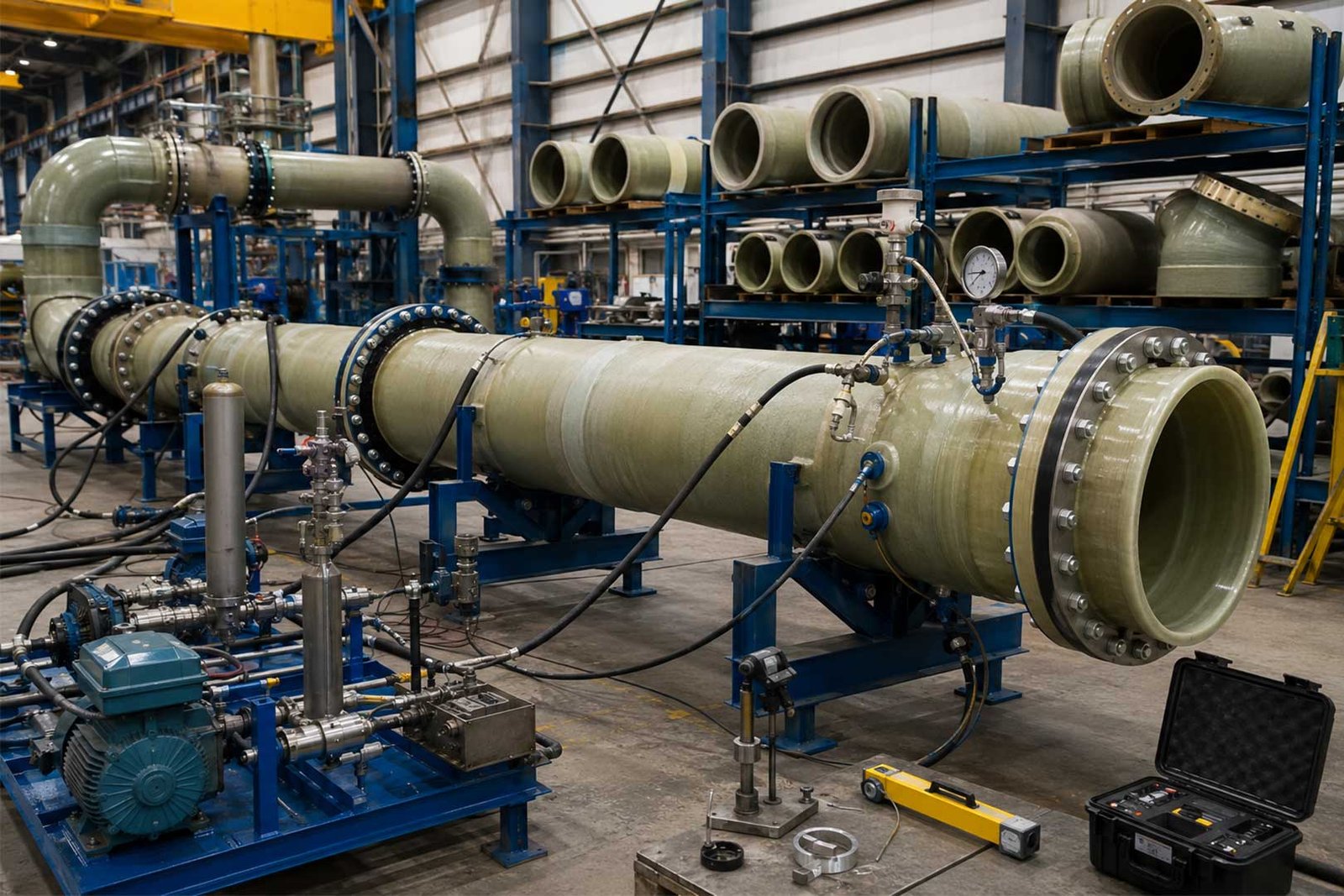
On paper, a GRP or GRE pipeline can look perfect. In the field, pressure, soil, and installation don’t care about paper. That is why water transmission projects cannot rely solely on product datasheets. Design validation and Factory Acceptance Testing (FAT) verify that GRP/GRE pipes, joints, and fittings can withstand hydraulic, structural, and installation demands before they reach the site.
This article is intended for owners, consultants, EPC contractors, and procurement teams seeking practical guidance on validation requirements, FAT criteria, and quality controls that reduce project risk and support reliable commissioning.
What Data Is Needed Before GRP/GRE Pipeline Validation?
GRP and GRE pipeline validation starts long before calculations. It depends on how complete the project inputs are. Missing data usually shifts design choices later during FAT or construction.
1. Hydraulic and Operating Data
Design begins with hydraulic and operating data such as flow rate, operating pressure, surge pressure, pump curves, and valve closure time. These values set the system energy profile. A small change in diameter increases head loss and raises pumping power demand significantly.
2. Pipe System Data
Pipe system data covers diameter, stiffness class, resin system, wall construction, joints, and fittings. These parameters control how the pipe will react under internal pressure and external load. On the other hand, misalignment between stiffness and soil condition usually shows up as long-term deflection issues.
3. Site, Installation and Compliance Data
Site conditions and compliance data include soil type, groundwater level, trench support, standards, inspection plans, and certification requirements. These inputs decide installation behavior and define what will be accepted during FAT and project approval stages.
What Happens Next?
Incorrect or incomplete inputs force redesign during validation or FAT review. In EPC projects, this often leads to pressure class changes, delayed procurement, and field modifications that increase joint stress and long-term leakage risk.
Standards Framework for Design Validation and FAT
GRP and GRE pipelines rely on international standards to guide design, pressure performance, structural behavior, joints, and chemical resistance. These standards also form the reference for FAT and installation acceptance.
| Standard | Purpose | Scope |
|---|---|---|
| ISO 23856 | Water systems | Design |
| AWWA C950 | Fiberglass pressure pipe | Water |
| AWWA M45 | Design guidance | Guidance |
| ASTM D3517 | Fiberglass pipe | Water conveyance |
| ASTM D2996 | Filament-wound pipe | Pressure |
| ISO 14692 | GRE systems | Industry |
| ASTM D2992 | Hydrostatic design | Long-term |
| ASTM D1598 | Creep test | Pressure |
| ASTM D1599 | Burst test | Short-term |
| ASTM D2412 | Stiffness | Load |
| ASTM D3567 | Dimensions | Tolerances |
| ASTM D3681 | Chemical resistance | Deflected |
| ISO/TS 20656 | Buried design | Soil |
| ISO 10466 | Ring deflection | Initial |
| ISO 10471 | Long-term deflection | Creep |
| ISO 25780 | Jacking pipes | Trenchless |
| ISO 8639 | Flexible joints | Socket |
| ISO 7432 | Restrained joints | Locked |
| ISO 8483 | Flange joints | Bolted |
| ISO 8533 | Cemented joints | Adhesive |
| ISO 18851 | Fittings | Proof test |
These standards connect directly to design inputs, FAT inspection, and installation control. Correct application reduces site failures, improves joint reliability, and ensures pipelines perform as intended under pressure, load, and environmental conditions.
Design Validation Criteria for GRP/GRE Composite Pipelines
Design validation starts before any calculation sheet or software model. If input data is wrong, everything downstream becomes questionable. Pressure, hydraulics, and material behavior must all be aligned with real site conditions, not assumptions from datasheets.
Note: Most early pipeline failures come from ignoring surge conditions rather than steady-state pressure.
1. Pressure Class Validation
The goal here is simple: the pipe must handle what it’s actually going to see. That includes normal pressure, surges, test pressure, and temperature swings. If the numbers don’t match reality, leaks, overstressed joints, or early fatigue show up fast.
Pressure class in GRE/GRP systems must account for operating pressure, surge pressure, and support spacing, as internal pressure alone does not represent actual stress conditions in real installations. (Source: WhatIsPiping)
Think of it as giving the pipeline a “real-world reality check” before it ever goes in the ground.
2. Long-Term Hydrostatic Strength Validation
Here we’re checking if the material can last its full design life. Short-term burst tests look impressive, but they don’t tell you how the pipe behaves under constant pressure over years.
Quick note: ASTM D2992 shows long-term hydrostatic testing used to create a base for design pressure based on regression analysis, which is critical because short-term burst tests cannot predict long-term failure behavior.
3. Hydraulic Performance Validation
It’s not enough that the pipe survives pressure, it has to move water efficiently. Rough pipes, tight bends, or bad fitting layouts can eat up energy and force bigger pumps.
Even small increases in headloss add up over long distances. Always think flow AND cost, not just pressure.
4. Surge and Transient Pressure Validation
Most pipeline headaches come from sudden events: pump trips, fast valve closures, or unexpected shutdowns. Research of MDPI shows that transient pressure events such as water hammer are strongly influenced by pipe material stiffness and system boundary conditions, not just flow rate.
Engineering tip: Air valves, surge vessels, and check valves must match what the system actually does, not just theory. Peak pressure at bends and junctions often dictates whether a pipeline lasts or fails.
5. Buried Pipe Structural Validation
Once the pipe goes underground, the soil becomes part of the system. It’s not just the pipe carrying load anymore, it’s the pipe plus the ground working together.
Soil stiffness, compaction quality, burial depth, and traffic loads all decide how much the pipe will deform over time. If these are ignored, long-term deflection becomes the first visible problem on site.
Standard Note: AWWA M45 provides design guidance showing that deflection and buckling in GRP pipes are often controlled by installation quality rather than material strength alone.
6. External Load and Vacuum Validation
This checks what happens when the pipe is not just full and pressurized, but also when it is empty or under external stress. Construction loads, groundwater uplift, and soil pressure can all act at the same time.
The tricky part is vacuum conditions. When internal pressure drops, the pipe suddenly depends entirely on stiffness and bedding support. That’s usually where weak designs show up first.
7. Chemical Compatibility Validation
Pipes don’t just carry water; they carry whatever’s in it. Chlorine, salts, pH swings, or cleaning chemicals can slowly degrade resin, liners, gaskets, or adhesives.
Validation here means checking the fluid and the surrounding soil or groundwater. Compatibility is not optional, ignored chemical effects show up as leaks or lining failure years down the line. Always confirm materials with real fluid data.
8. Thermal and Aboveground Validation
Aboveground sections face sun, ambient swings, and hot fluid. Expansion, support spacing, and local stress at saddles matter. Even small miscalculations in thermal movement can bend a pipe or overstress joints.
Consideration: Ambient extremes, operational range, and anchor points. Thermal checks keep everything aligned under every temperature scenario.
9. Joint System Validation
Joints face both pressure and movement in service. They need to handle installation conditions as well as long-term stresses. Check points for joints:
- Joint type and restraint
- Angular deflection allowance
- Gasket performance
- Pressure and vacuum rating
- Type-test evidence
Proper joint performance depends on sealing, restraint, and installation working together.
10. Fitting and Special Component Validation
Fittings take more stress than straight pipes because flow changes direction and load concentrates at geometry changes. Bends, tees, reducers, and flanged connections need their own verification.
Treating fittings like standard pipe sections is a common mistake. Each special piece should be checked for reinforcement detail, load paths, and proof testing before it is accepted into the system.
Design Validation Deliverables
Design validation is only meaningful when captured in controlled documents. They record what was checked, the assumptions used, and how the design was approved for execution. Without them, validation is theoretical and hard to verify.
Required Engineering Documents
The most important outputs which shows how the pipeline behaves under real operating conditions are mentioned here:
- Design basis and hydraulic calculations
- Surge analysis and pressure class selection
- Structural checks for buried pipes and external loads
- Joint and fitting qualification evidence
- Inspection and Test Plan
These documents cover flow, pressure, structural performance, and joint behavior. Together, they form a complete validation record.
Project-Specific Documents
Some installations need additional documentation.
- Thermal analysis and support calculations
- Installation method statements
These support aboveground pipelines, temperature-sensitive systems, or non-standard load conditions.
Engineering Note: Design validation documents link design to procurement, FAT, installation, and commissioning. They are a technical record, not just paperwork.
FAT Scope for GRP/GRE Composite Pipelines
FAT is the last check in the factory before pipes and fittings leave for site. It’s where you confirm that what was produced actually matches what was designed and specified, not just what was ordered on paper.
Purpose of FAT
Based on SciecneDirect, FAT checks that the pipes and fittings leaving the factory really match the approved design and project specs. It shows how well materials can be traced, spots any production issues early, and gives the official go-ahead before shipment.
FAT vs Type Testing vs Site Testing
Type testing proves the design itself is sound. FAT looks at the actual batch to make sure it meets that design. Site testing comes last, after installation, to make sure the pipeline is correctly assembled and leak-free before it goes live.
Pre-FAT Document Review
Before the FAT team even steps into the factory, it’s important to make sure all the paperwork is in order. This keeps the inspection focused and avoids surprises when checking pipes, fittings, and joints. Below we provide all essential documents needed before FAT.
- Approved datasheets and drawings
- Project specs and standards
- Inspection and Test Plan
- Manufacturing and QC procedures
- Material and calibration certificates
- Traceability records
- Previous type-test reports
- Approved deviations
- Open NCRs
Acceptance Criteria: FAT shouldn’t start if anything critical is missing. All key documents, test procedures, and measuring tools need to be ready so the inspection can run smoothly and nothing is overlooked.
FAT Inspection and Testing Criteria for GRP/GRE Composite Pipelines
Factory Acceptance Testing ensures that each manufactured pipe, joint, and fitting meets the approved design and project requirements before shipment. FAT identifies early production issues, confirms material traceability, and produces official release documentation.
1. Raw Material Verification
This is where everything starts, so it has to be right.
ResreachGate insists on the choice of resin, glass fiber, fillers, catalysts, liners, adhesives, and gaskets to be checked. against what was actually approved. If something is off here, it doesn’t matter how good the later steps are. Most hidden issues in GRP/GRE pipes start from wrong or inconsistent raw materials, so traceability is not optional.
In other words, if a material selection stage goes wrong, it’s more likely to lead the whole project into failure.
2. Visual Inspection
This is the first real “hands-on” check of the product.
You’re basically looking for anything that shouldn’t be there: cracks, delamination, blisters, exposed fibers, or damage at the ends. Markings also matter because they link the pipe back to its records. Small surface issues can sometimes be repaired, but anything structural gets rejected immediately.
3. Dimensional Inspection
A pipe can look fine but still cause problems if its size is off. Inspectors check diameters, wall thickness, length, and flange details to make sure everything fits on site without adjustments. Small factory mistakes can turn into delays later.
4. Cure and Hardness Verification
Curing is key to how a pipe lasts over time. Hardness readings and cure records are checked to confirm the laminate meets the design. Pipes released too soon may seem okay but can fail under pressure, heat, or environmental conditions.
5. Laminate and Wall Construction
We verify the “skeleton” of the pipe.
Glass and resin content, layer sequence, wall thickness, and topcoat are all checked. Mistakes here reduce structural integrity and chemical resistance, so it’s crucial to compare against the approved procedure.
6. Pipe Stiffness and Hydrostatic Testing
Pipes are loaded and pressurized like they would be in service.
Stiffness, deflection, cracking, and burst behavior are observed. Any sign of weakness is flagged. Hydrostatic pressure tests simulate real conditions to confirm the pipeline won’t leak or fail under operating or transient pressures.
7. Joint and Fitting Verification
Every joint and fitting is inspected for correct components, gaskets, angles, and dimensions.
A bad coupling or misaligned flange can compromise the whole system. Each component must match its qualified design, with evidence to prove it.
| FAT Aspect | What Is Checked | Acceptance |
|---|---|---|
| Raw Material | Resin, fiber, fillers, gaskets | Must match specs, fully traceable |
| Visual | Surface defects, ends, markings | No structural defects allowed |
| Dimensions | OD, wall, length, flanges | Within approved tolerances |
| Cure/Hardness | Laminate cure, Barcol value | Meets required curing level |
| Laminate | Layer build, resin/glass ratio | Matches qualified design |
| Stiffness/Hydrotest | Deflection, pressure, leakage | No failure, leakage, or rupture |
| Joints/Fittings | Couplings, gaskets, alignment | Must match approved design |
The table above shows the acceptance criteria of these inspections in your piping project. Though, based on each project conditions it may differ.
Documents Needed for FAT Execution
Before starting FAT, make sure all required documents from the Pre-FAT Document Review are available. This includes approved datasheets, drawings, specifications, ITPs, material certificates, and traceability records.
Having them ready keeps the inspection process smooth and avoids pauses during testing. It also helps align hold points and makes it easier to close NCRs without delays.
Consideration: In most FAT delays, the issue is not testing capacity but missing or mismatched documents. A quick cross-check between ITP, drawings, and material certificates before arrival at the factory prevents most of these interruptions.
Validation Responsibility Matrix
Pipeline validation involves several parties, and responsibilities often overlap. Defining who does what helps avoid gaps and keeps the project moving smoothly.
EPC Quality Controls After FAT
A successful FAT is only the start. Pipeline performance still depends on transport, installation, and field testing.
- Transport and Storage Control: Handle pipes carefully, protect ends and gaskets, follow stacking limits, and inspect deliveries before installation.
- Installation Control: Use the approved trench profile, bedding, and compaction method. Assemble joints correctly, control angular deflection, and maintain field inspection records.
- Field Hydrotest and Commissioning: Plan test sections, remove air, increase pressure gradually, monitor for leaks, and complete final acceptance documentation.
How LineCore Links Factory Quality to Site Execution
LineCore Pipes Group connects factory quality with site execution through EPC control, installation supervision, field testing, and commissioning support.
GRP/GRE Validation and FAT: Where Problems Usually Appear
Problems in GRE validation and FAT come from three main stages. Below, we provided these three and your most frequent questions about them.
Design Stage
- Did the design cover every pressure case?
Some projects check operating pressure but leave out surge loads or vacuum scenarios.
- Was the entire pipeline considered?
The pipe itself may pass approval, while joints, fittings, or chemical compatibility checks receive less scrutiny.
FAT Stage
- Can each material and test result be linked to a record?
Missing certificates, unclear documentation, and gaps in test records are frequent FAT findings.
- Is the shipment ready for release?
Open NCRs or missing documents can hold up approval, even when the products pass inspection.
Site Stage
- Was the pipeline put in place correctly?
Inadequate bedding, weak compaction, and excessive joint movement remain among the issues found most often on site.
- Were tests and repairs documented?
Damaged pipe ends, unauthorized repairs, or incomplete hydrotest records may lead to issues when the system is turned over.
A Buyer Checklist for GRP/GRE Pipeline Supply
This checklist helps buyers to check that design, testing, and quality requirements are covered before approving GRP/GRE pipe supply. It can be filled during procurement or pre-FAT reviews to keep decisions clear and documented. We filled it in as a sample, you can use that for your piping project too.
| Question | Notes |
|---|---|
| Pressure class validated vs operating, surge, test pressure? | Covers 16 bar operating, 24 bar surge |
| Buried pipe deflection checked vs soil/installation? | Trench & backfill conditions verified |
| Chemical compatibility confirmed? | Potable water and standard chemicals |
| Joints & fittings qualified separately? | Type test reports included |
| FAT procedure approved before production? | Owner & EPC approved protocol |
| Hold & witness points defined? | Witness schedule provided |
| Hydrostatic test pressure & hold time agreed? | 24 bar, 2-hour hold |
| Stiffness test requirements defined? | Min 1200 N/mm², ring deflection tested |
| Pipe & fittings traceable? | Batch & serial numbers linked |
| Final FAT dossier documents complete? | Design basis, ITP, test reports, certificates |
| Who controls installation quality post-delivery? | EPC QC team with owner witnessing |
Why LineCore Pipes Group for Validated GRP/GRE Pipeline Projects
LineCore Pipes Group supports GRP/GRE pipeline projects with coordinated design input, FAT planning, and structured documentation control. The scope covers pipes, fittings, and joints as a complete package, aligned with project validation requirements from early design through factory acceptance.
Support also extends to installation, field testing, and commissioning to keep execution consistent between factory and site.
Contact LineCore Pipes Group is linking your GRP/GRE project from design validation through to commissioning.
about
The Author

Farshid Tavakoli is a seasoned professional in engineering and international trade. Holding degrees in Electrical Engineering, Mechatronics, and a Doctorate in Business Administration (DBA) from the University of Lyon, he also has a strong background in industrial automation and production line technologies.
For over 17 years, he has led an international trading company, gaining deep expertise in commercial solutions tailored to industrial needs. With more than 8 years of active involvement in infrastructure development, he specializes in the supply of electromechanical equipment for water and wastewater treatment plants and transfer projects.
Together with comapny expert team, he now provides consultancy and integrated solutions for sourcing and implementing complex infrastructure projects across the region.