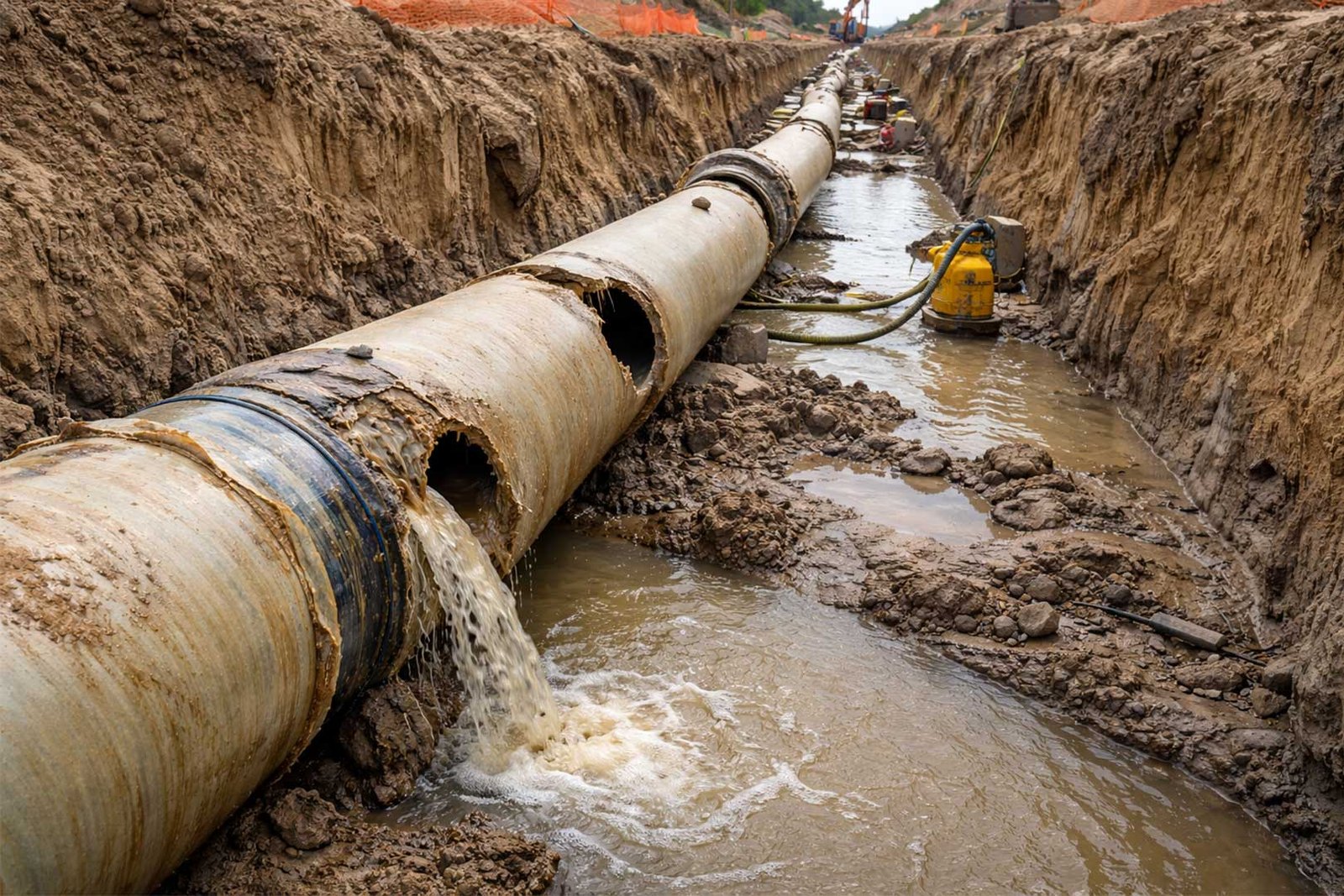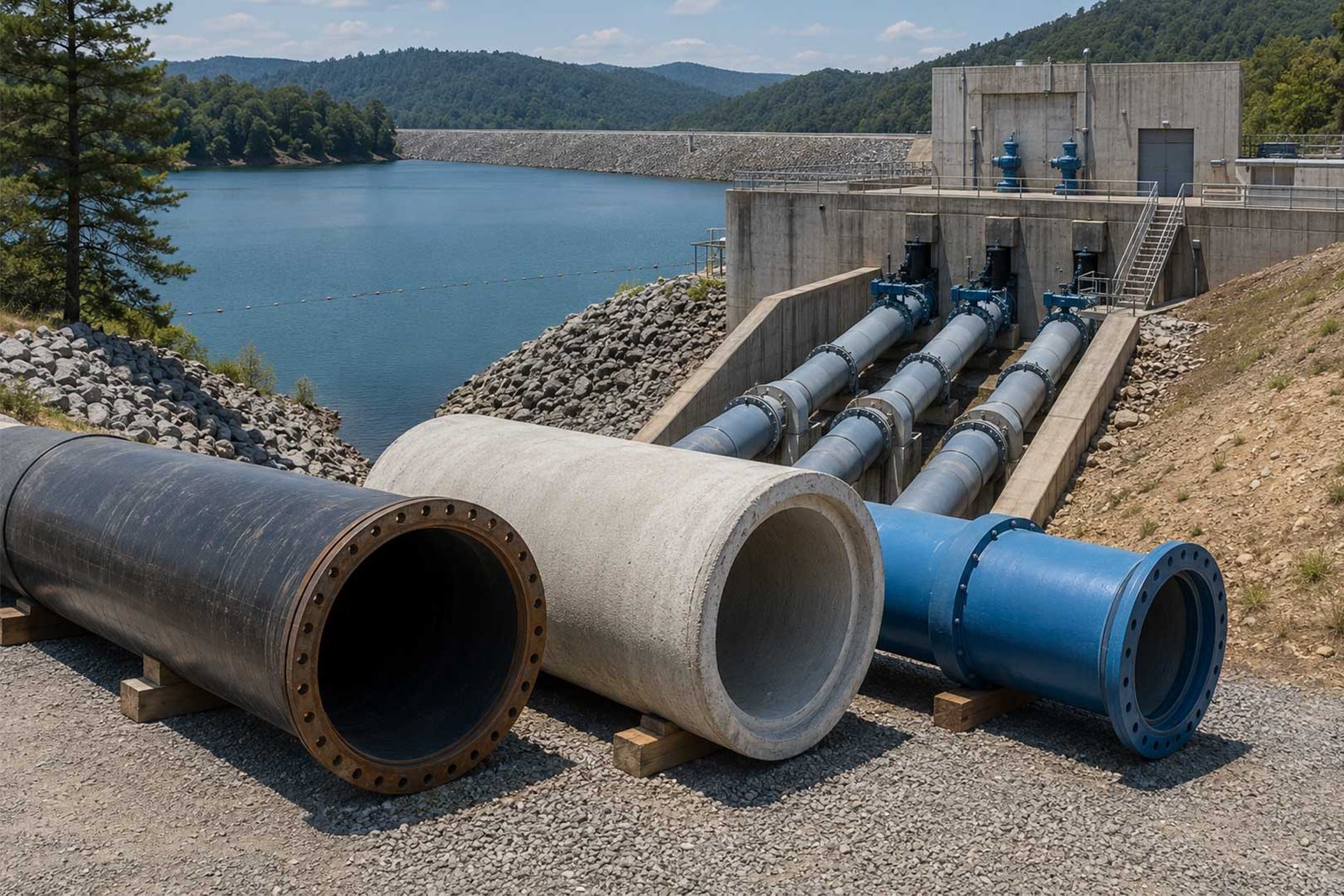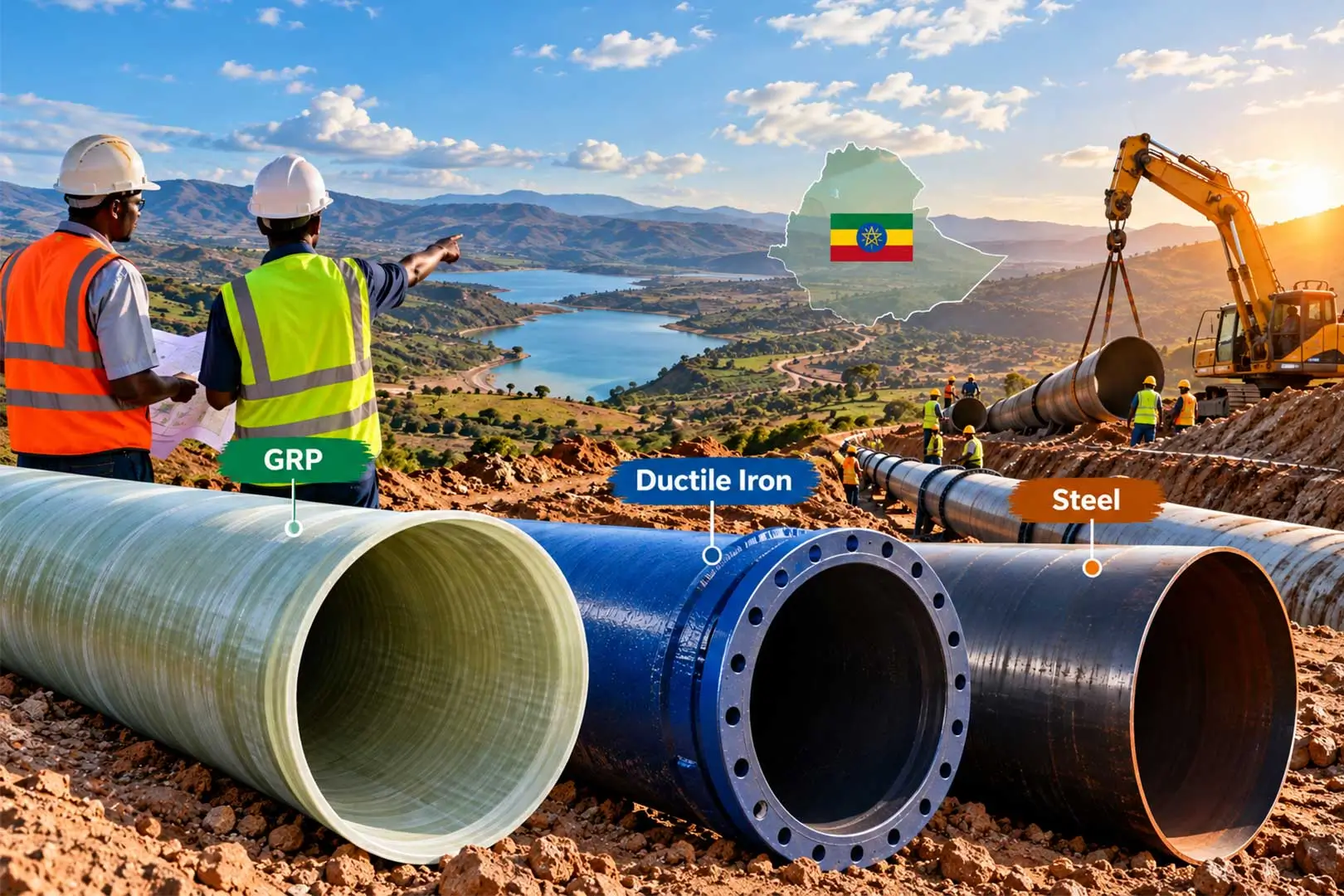
A water pipeline tender in Ethiopia is typically much more than buying pipes. One contract can cover the civil works, pipes and fittings, installation, design review, pumps, electrical equipment, testing, and even commissioning.
So if you are a pipe manufacturer, EPC contractor, or specialist supplier, you need to look at the whole package, not just the pipe part. Who is issuing the tender? Which rules apply? What do you need to prove? And does your responsibility stop at shipping, or continue all the way to the project site?
That is what we will tell you today with the help of recent Ethiopian water tenders so you can see how these opportunities actually work in practice. Stay with us to the end:
Who Actually Issues Water Pipeline Tenders in Ethiopia?
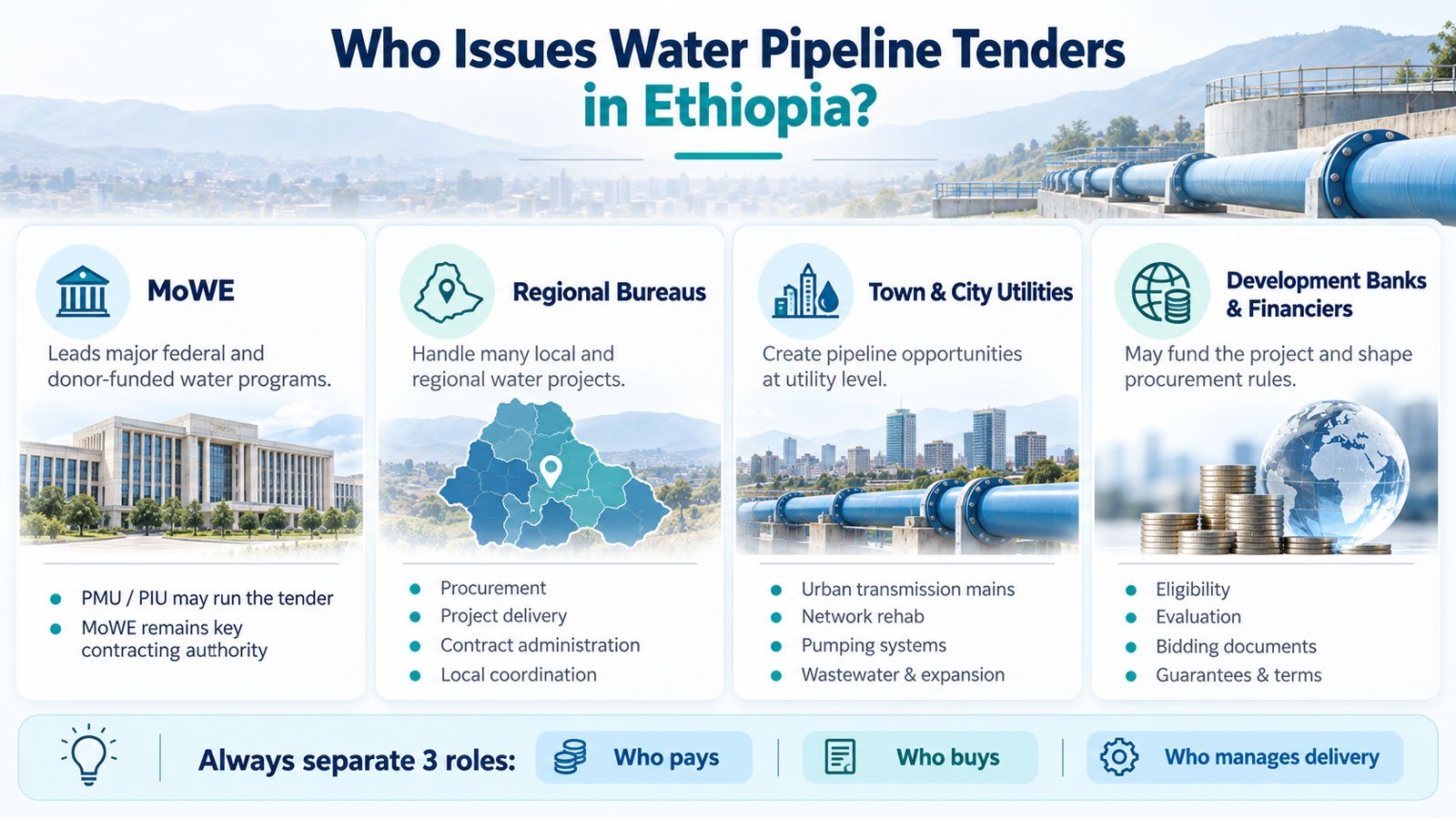
Water projects in Ethiopia do not all come from the same place. MoWE may lead one project, a regional bureau may handle another, and a town utility may manage the next. On donor-funded projects, the World Bank or AfDB can also shape the procurement process.
The roles below show where you should look for opportunities and who may control different parts of the contract.
Ministry of Water and Energy
The Ministry of Water and Energy, or MoWE, plays a major role in large federal and donor-funded water programs.
A Project Management Unit or Project Implementation Unit may manage the daily tender process while MoWE stays in charge of the contract. Regional organizations may also help with implementation. You can follow current MoWE water tenders to see how these projects reach the market.
Regional Water and Energy Bureaus
Regional bureaus handle many local and regional water-supply and transmission projects. They may manage:
- procurement
- construction and project delivery
- contract administration
- local coordination
If you only watch federal tender pages, you can miss useful opportunities. Regional procurement deserves its own place in your tender monitoring.
Municipal and Town Water Utilities
Town and city utilities can also create pipeline work, especially around:
- urban transmission mains
- network rehabilitation
- pumping systems
- electromechanical packages
- wastewater systems
- water-supply expansion
Development Banks and Other Financiers
The World Bank, AfDB/ADF, and other development partners may provide the money even when an Ethiopian organization signs the contract.
That funding can affect bidder eligibility, evaluation, bidding documents, guarantees, and contract terms.
So when you find a tender, separate three roles in your mind: the organization paying for the project, the organization buying the work, and the organization managing delivery.
Which Procurement Rules Govern the Tender?
The rulebook can change from one water project to the next. A federal project may follow Ethiopia’s public procurement system, while a World Bank- or AfDB-financed project may use the financier’s procurement framework.
That difference can affect whether you can bid and how the buyer evaluates your offer, so the tender document itself should guide you.
Ethiopian Public Procurement Rules
Ethiopia uses open tendering as its main competitive procurement route. The current 2025 procurement directive covers national and international procurement and works alongside federal standard bidding documents.
For a live opportunity, focus on:
- the procurement method
- who can bid
- qualification requirements
- required forms
- the bidding document
You do not need to turn every tender into a legal research project.
Donor-Funded Projects Can Use Different Rules
World Bank-financed projects may follow World Bank Procurement Regulations for IPF Borrowers. AfDB and ADF projects may follow the AfDB procurement framework.
This means you should never take a rule from one Ethiopian project and assume another project uses the same rule.
“National Competition” Does Not Tell You Everything
The words “national competition” alone do not tell you whether a foreign company can participate. Read three things separately:
- the procurement method
- the bidder eligibility clause
- the financier’s rules
Also check when the buyer expects Ethiopian registration. The tender may ask for it when you submit your bid, before you sign the contract, or later during execution.
Do not assume every foreign bidder needs an Ethiopian partner unless the tender actually says so.
How Ethiopian Water Pipeline Contracts Are Packaged
This is where pipe companies can easily miss real demand. A project may need kilometres of pipe but place that demand inside a much larger construction package.
Recent projects show several ways Ethiopia combines pipeline supply with civil, installation, and electromechanical work.
Pipe Supply Often Sits Inside a Bigger Contract
One water package may cover:
- trenching and earthworks
- reservoirs, tanks, and related structures
- pipes, fittings, valves, and specials
- pipe laying and jointing
- pumps and electrical equipment
- control systems
- design review
- testing and commissioning
| Recent project | What the package includes |
|---|---|
| Bursa Climate Resilient Rural Piped System | Civil works, pipes/fittings, installation, design review, electromechanical work |
| Ebala-Adilo Town Water Supply | Civil works, pipe supply and laying, design review, electromechanical equipment |
| Borena rural piped systems | Civil works, pipes/fittings, design review, electromechanical equipment |
| Web Water Supply Route | Civil works, pipe/fitting supply and installation, plus electromechanical scope in part of the route |
Owners May Tender Some Services Separately
One water project can create more than one contract. An owner may run a separate tender for:
- construction supervision
- design review
- contract administration
- quality assurance
So do not assume the main works tender represents every opportunity around the project.
Where Can a Pipe Manufacturer Fit?
The package may give you several ways to participate:
- prime EPC or works contractor
- JV member
- specialist subcontractor
- authorized pipe manufacturer
- pipe and fitting supplier to the winning contractor
The right role depends on the scope and qualification rules.
What Foreign Suppliers and EPC Contractors Must Prove
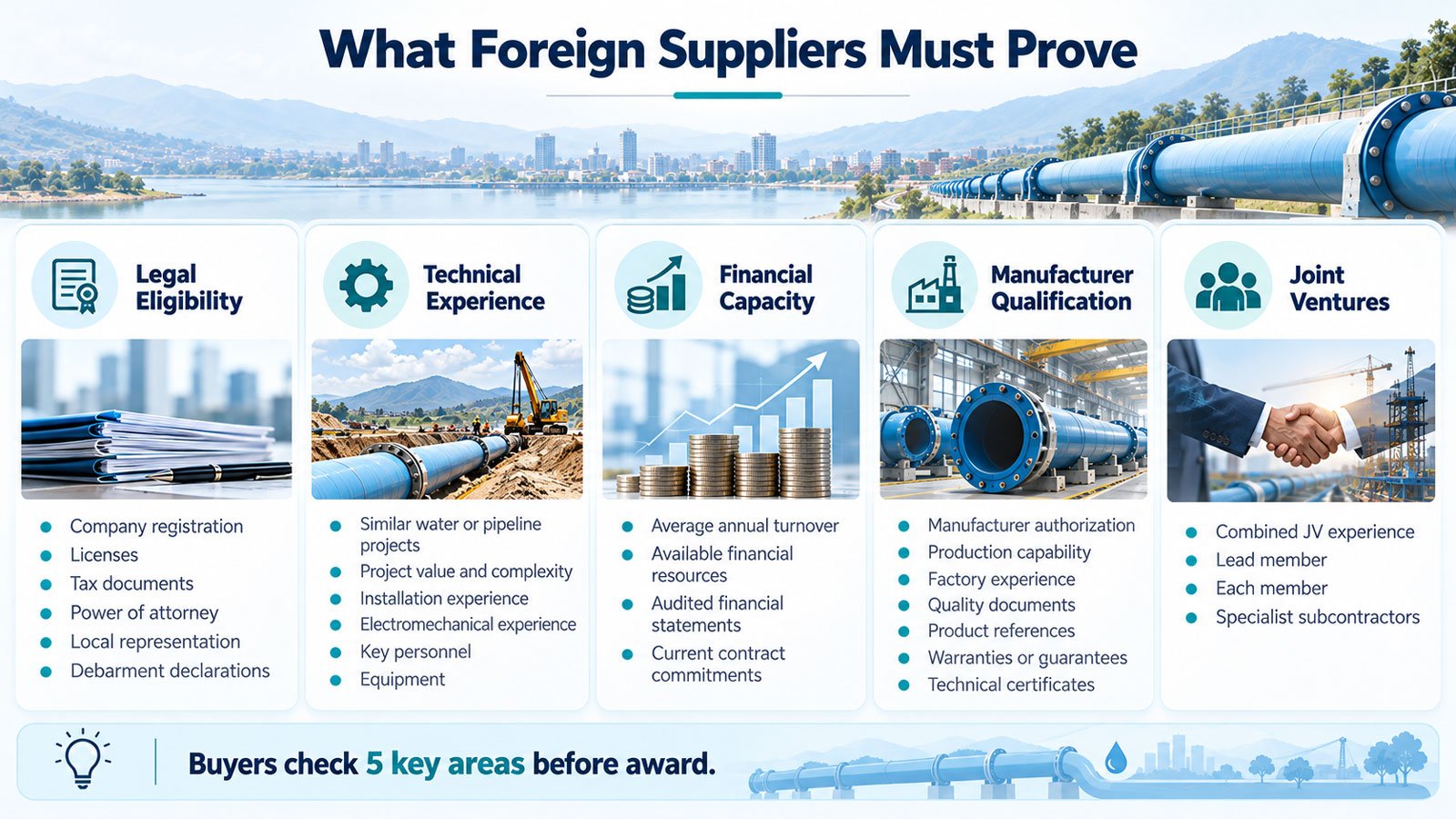
When you bid, the buyer wants to know more than whether your pipe meets the specification. They also want proof that your company has the legal standing, experience, money, people, and factory support to finish the job. These five areas usually shape that decision.
Legal Eligibility
The tender may ask you for:
- company registration
- licenses
- tax documents where relevant
- power of attorney
- local representation
- debarment or ineligibility declarations
Pay attention to timing. The buyer may ask for one document with your bid and another before contract signing or during execution. And again, do not assume that every foreign bidder needs a local partner.
Technical Experience
Your past work can carry a lot of weight. The buyer may look at:
- general contracting experience
- similar pipeline or water projects
- project value and complexity
- installation experience
- electromechanical experience
- key personnel
- equipment
Financial Capacity
The buyer also wants confidence that you can carry the contract financially. Expect requirements around:
- average annual turnover
- available financial resources or liquidity
- audited financial statements
- current contract commitments
Do not use one “standard Ethiopian minimum.” Each tender can set different numbers.
Manufacturer Qualification and Authorization
If you supply the pipe, the tender may look closely at the manufacturer too.
You may need:
- manufacturer authorization
- production capability
- factory experience
- quality documents
- product references
- warranties or guarantees
- tender-specific technical certificates
The Bursa package provides a useful example because it includes manufacturer authorization along with financial and experience requirements.
Joint Ventures
A JV does not automatically allow all members to combine every qualification. The tender may set separate rules for:
- combined JV experience
- the lead member
- each individual member
- specialist subcontractors
Read those rules before you choose your partners.
How Do Employers Evaluate Bids?
The lowest price does not automatically win. The buyer may reject a cheap offer if the bidder fails eligibility, qualification, technical, or other evaluation requirements. The process makes more sense when you look at how the buyer opens and reviews the bid.
One Envelope or Two?
In a one-envelope process, you submit qualification, technical information, and price within one submission structure.
In a two-envelope process, you separate the technical or non-price part from the financial offer. The buyer reviews the first part before moving to price.
A typical evaluation may follow this order:
- eligibility
- qualification
- technical responsiveness
- rated criteria, if the tender uses them
- financial evaluation
- adjustments or preferences
- award
The World Bank procurement framework also allows rated criteria in relevant tenders, so quality and other non-price factors may influence the result.
Domestic Preference and Unusual Pricing
Some Ethiopian procurements can use domestic preference. Donor-funded projects may apply different rules.
Never take one preference percentage from another tender and use it as a general Ethiopia rule. Read the bidding document for the project in front of you.
You should also keep your price realistic. An abnormally low, front-loaded, or materially unbalanced offer can trigger questions, extra explanations, or additional security requirements.
Bid Security, Performance Guarantees and Payment Risk
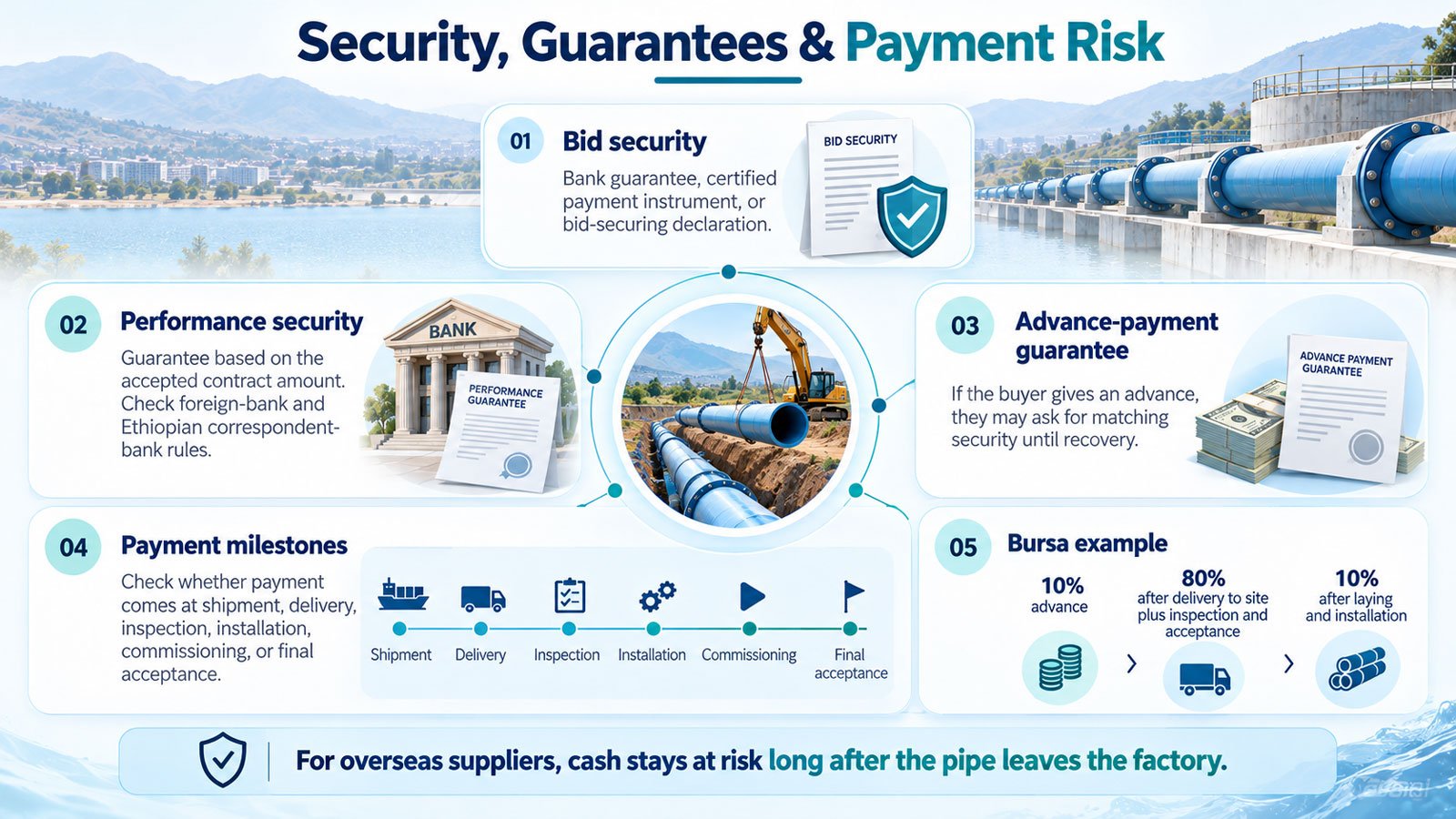
The contract price does not tell you how much cash you will need to carry the job. You may need to produce pipe, arrange shipping, and hold bank guarantees long before the buyer releases most of your payment. The clauses below can change the commercial risk quickly.
- Bid security: The tender may ask for a bank guarantee, certified payment instrument, or Bid-Securing Declaration.
- Performance security: The successful bidder may need a guarantee based on the accepted contract amount. Check any rules around foreign banks and Ethiopian correspondent banks.
- Advance-payment guarantee: If the buyer gives you an advance, they may ask for matching security until the contract recovers that amount.
- Payment milestones: Study when the buyer pays you: shipment, delivery, inspection, installation, commissioning, or final acceptance.
The Bursa contract gives a good example. Its pipe-and-fitting schedule provides 10% advance payment, 80% after delivery to site plus inspection and acceptance, and 10% after laying and installation.
For an overseas manufacturer, that means you carry transport, damage, schedule, and acceptance risk long after the pipe leaves your factory.
From an Overseas Pipe Factory to an Ethiopian Project Site
Shipping the pipe does not always end your job. Depending on the contract, your responsibility may continue through banking, customs, inland transport, unloading, storage, and final acceptance. That journey creates several costs that you need to understand before you quote a delivered price.
Bid and Payment Currency
Currency can change your margin during a long contract. Look at:
- ETB and foreign-currency components
- imported and local costs
- payment currency
- FX or price-adjustment clauses
Letters of Credit and Trade Finance
Your payment method can affect when you buy materials, ship cargo, and release documents. Check LC, CAD, and other trade-finance terms carefully. Ethiopia’s 2026 FX changes changed some rules around letters of credit and Cash Against Documents, so use current banking requirements rather than old assumptions.
Customs and Import Responsibilities
Customs can change your landed cost if the contract leaves responsibilities unclear. Make sure you know:
- who acts as importer of record
- who pays duties and taxes
- whether exemptions apply
- which HS classification applies
- which conformity documents you need
- whether you need certificates of origin
- who handles inspection paperwork
Djibouti to the Final Project Site
Djibouti may only mark the start of the inland part of your delivery. The Addis-Djibouti corridor carries more than 95% of Ethiopia’s import-export trade by volume.
After Djibouti, your cargo may still move through transit and customs, inland clearance or a dry port, road transport, unloading, storage, and project-site inspection. For large-diameter pipe, think about:
- nesting or containerization
- breakbulk shipping
- inland trucking
- remote-site access
- unloading and storage
- cargo damage
- delivery deadlines
Read the delivery term closely. “Shipment,” “delivery into Ethiopia,” “delivery to the employer’s warehouse,” and “delivery to site” can leave you with very different costs and risks.
Technical Documentation, Inspection and Acceptance
A good pipe alone does not guarantee acceptance. Your testing, certificates, inspection records, and manuals also need to match the tender.
Ethiopia does not use one universal GRP or pipeline specification for every water project, so the technical specification should guide your compliance work. Look for requirements covering:
- permitted pipe material
- diameter
- pressure class
- stiffness class
- ISO, EN, AWWA, or Ethiopian standards
- jointing system
- factory QA/QC
- type testing
- batch and routine testing
- third-party inspection
- pre-shipment inspection
- certificates and traceability
- project-site inspection
- hydrostatic testing
- commissioning
- defect-liability and warranty duties
- O&M manuals
- as-built documents
These documents can affect payment as well as acceptance. If you miss a test report, certificate, manual, or commissioning record, the buyer may delay the next payment milestone.
Practical Market-Entry Routes for International Pipe and EPC Companies
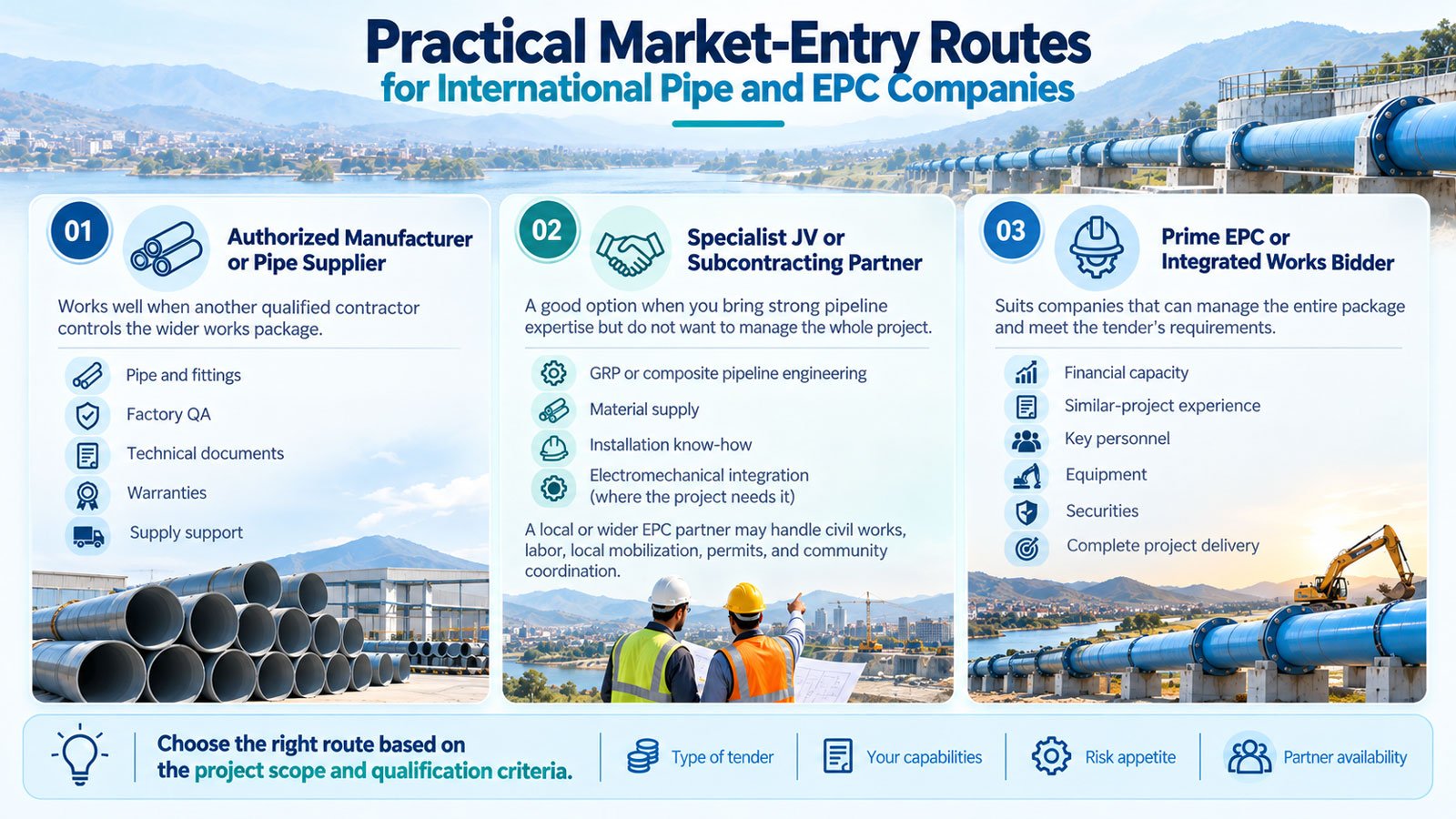
You do not need one fixed Ethiopia strategy for every project. One tender may suit a pipe supplier, another may work better with a JV, and a larger package may call for a full EPC contractor. The scope and qualification criteria should guide which of these three routes makes the most sense:
Route 1: Authorized Manufacturer or Pipe Supplier
This route works well when another qualified contractor controls the wider works package. You can focus on:
- pipe and fittings
- factory QA
- technical documents
- warranties
- supply support
Route 2: Specialist JV or Subcontracting Partner
This route can work when you bring strong pipeline expertise but do not want to manage the whole project. You may provide:
- GRP or composite pipeline engineering
- material supply
- installation know-how
- electromechanical integration where the project needs it
A local or wider EPC partner may handle civil works, labor, local mobilization, permits, and community coordination.
Route 3: Prime EPC or Integrated Works Bidder
This route suits companies that can manage the entire package. You need to meet the tender’s requirements for:
- financial capacity
- similar-project experience
- key personnel
- equipment
- securities
- complete project delivery
This route gives you more control, but it also puts more responsibility on your side from bid preparation through final acceptance.
Conclusion: Read the Contract Package Before Choosing How to Enter
Ethiopia does not use one single water pipeline tender model. One project may follow Ethiopian federal rules, another may use World Bank rules, and another may combine pipes with civil and electromechanical works under one larger package.
That changes who can bid, how the buyer evaluates offers, what guarantees you need, when you receive payment, and how far your delivery responsibility continues.
You should also look beyond tenders with “pipe supply” in the title. A lot of pipe demand sits inside rural water systems, town water projects, transmission schemes, and integrated EPC contracts.
For Grand LineCore, that can create several ways into the market: authorized manufacturer, pipe supplier, specialist subcontractor, JV member, or prime EPC contractor. The best route depends on the package in front of you, the qualifications it asks for, and the part of the project you can genuinely deliver well.
about
The Author

Farshid Tavakoli is a seasoned professional in engineering and international trade. Holding degrees in Electrical Engineering, Mechatronics, and a Doctorate in Business Administration (DBA) from the University of Lyon, he also has a strong background in industrial automation and production line technologies.
For over 17 years, he has led an international trading company, gaining deep expertise in commercial solutions tailored to industrial needs. With more than 8 years of active involvement in infrastructure development, he specializes in the supply of electromechanical equipment for water and wastewater treatment plants and transfer projects.
Together with comapny expert team, he now provides consultancy and integrated solutions for sourcing and implementing complex infrastructure projects across the region.