East Africa’s water challenge looks different from one country to another, but the infrastructure need is becoming more similar. Ethiopia faces distance and topography, Kenya water-access pressure, Tanzania fast urban growth, Rwanda concentrated demand, and Uganda source-to-city distance.
Across the region, utilities increasingly need to capture, treat, store, pump, and move water farther. Kenya’s coast already reports a 327,000 m³/day supply gap, while Tanzania’s Simiyu scheme uses more than 460 km of pipelines. Read on to see what is driving this shift, where the strongest opportunities are emerging, and what reliable transmission systems now need.
Why East Africa’s Water Challenge Is Increasingly a Transmission Challenge
If you are planning water infrastructure, knowing how much water a country has is only part of the picture. What matters more is whether dependable water can actually reach growing demand at the right time, pressure, and volume.
Kenya shows this clearly. The Financial Times describes an important part of the country’s problem as economic water scarcity. The resources may exist, but infrastructure and other limits can stop that water from reaching the places that need it.
You are more likely to need major transmission infrastructure when
- metropolitan areas grow beyond the capacity of nearby sources
- secondary cities expand far from dependable lakes, rivers, reservoirs, or aquifers
- industrial and agricultural demand appears outside existing utility networks
- elevation creates high-head pumping or pressure-management challenges
- dry-season water availability falls far below the annual average
So the answer is not simply more local distribution. You may need bulk-water pipelines, raw-water and treated-water trunk mains, pumping and booster stations, balancing reservoirs, new water sources, emergency interconnections, and regional conveyance systems.
The Connected Forces Driving Bulk-Water Demand Across the Region
Bulk-water demand is not rising for one reason. Several pressures are building at the same time and pushing existing systems beyond their old limits. The main forces behind that demand are closely connected.
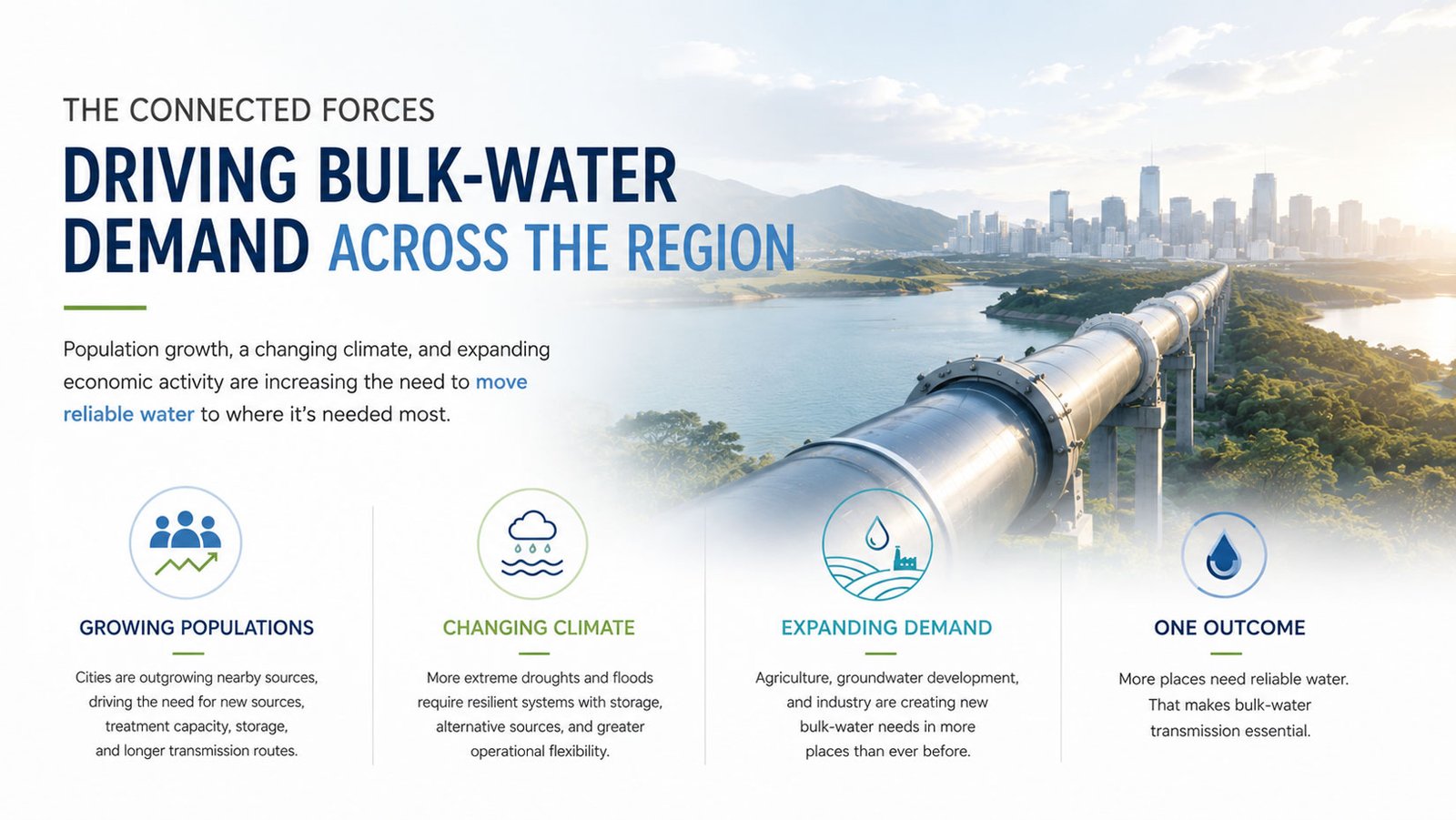
Cities Are Outgrowing Nearby Sources
The research puts Ethiopia at about 132 million people in 2024 and roughly 225 million by 2050. Tanzania rises from about 69 million to around 130 million over the same period. The Guardian also reports a regional urbanization outlook in which Dar es Salaam is expected to pass 10 million people by 2035.
Population growth becomes a real infrastructure challenge when the existing water system can no longer keep up. As cities expand, you may start to see
- nearby water sources reaching their limits
- treatment plants struggling to meet higher demand
- growing urban areas moving farther from dependable sources
- a need for new water sources and larger reservoirs
- longer transmission routes to bring reliable water into the city
This keeps your analysis tied to the actual amount of new bulk-water capacity that may be required instead of assuming that more people automatically means a specific project opportunity.
Climate Is Changing How Sources Are Planned
Annual averages can hide the problem you actually have to design for. Kenya’s recent pattern of severe drought followed by destructive flooding shows why you need to think about dry-season reliability, reservoir stress, flood exposure, and what happens when too much of the system depends on one source.
Depending on your project, resilience may mean
- new or larger storage
- alternative sources
- parallel transmission mains
- emergency interconnections
- backup groundwater wellfields
- more operating flexibility during drought or maintenance
These are possible responses to greater hydrological variability. They do not mean every project needs all of them.
Demand Is Expanding Beyond Municipal Supply
If you focus only on city drinking-water networks, you may miss a large part of the future transmission market. Agriculture, groundwater projects, and new economic zones can all create their own bulk-water needs.
- Irrigation Food-security pressure and irrigation expansion can create demand for multipurpose dams, reservoir-to-command-area conveyance, pumped irrigation, and sometimes pressurized pipelines instead of open channels. The same source may also serve municipal, agricultural, and industrial users.
- Groundwater A large wellfield can require production wells, collection mains, water-quality monitoring, treatment, booster pumping, trunk mains, and balancing storage.
- Industry Industrial parks, SEZs, mining and processing sites, ports, new cities, and logistics corridors may need dedicated sources, high-capacity off-takes, treatment, storage, process-water mains, and sometimes wastewater or reuse infrastructure.
The CIWA Program shows why you should look at groundwater in the Horn of Africa as a regional resilience and infrastructure issue rather than simply a group of individual boreholes.
Case study: Kigali turns groundwater into bulk urban supply
The African Development Bank documents Kigali’s bulk-water arrangement around approximately 40,000 m³/day from a wellfield, supported by forwarding infrastructure, pumping, and strategic reservoirs. For you, the lesson is simple. A groundwater project can create the same collection, treatment, pumping, trunk-transmission, and storage needs as a surface-water scheme.
From Municipal Networks to Source–Storage–Transmission–Demand Systems
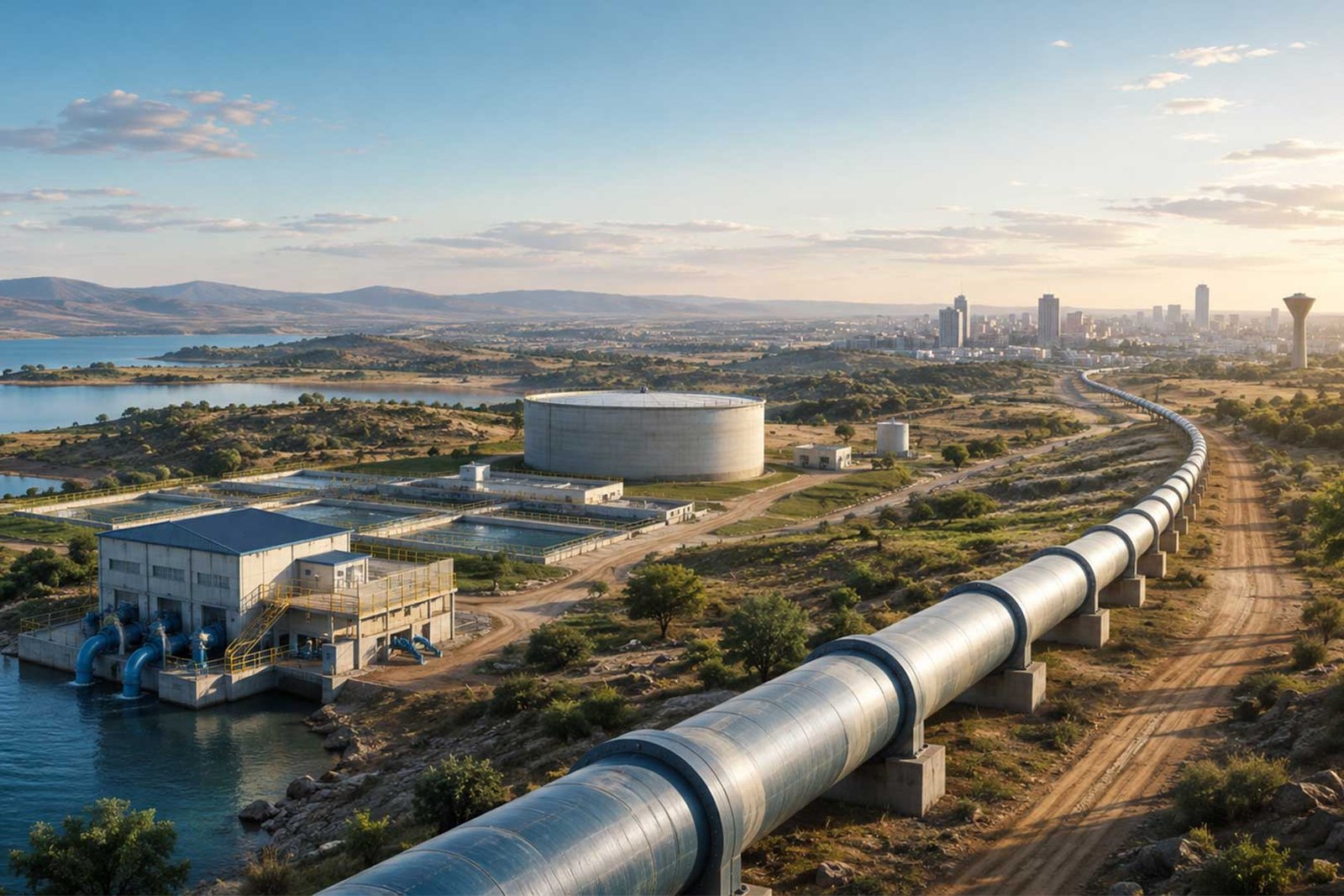
Once your source and demand center move farther apart, the pipeline cannot work on its own. The whole water system has to function as one connected network. A complete transmission system depends on much more than the pipe itself.
| System | Main function |
|---|---|
| Transmission | Bulk movement between sources, treatment plants, reservoirs, cities, regions, or irrigation areas |
| Distribution | Local delivery through urban, neighborhood, or consumer networks |
| Mixed system | Treatment, transmission, reservoirs, and distribution within one integrated program |
A complete system may include
- source intake and raw-water pumping
- raw-water transmission to the treatment plant
- treatment and clear-water pumping
- high-capacity trunk mains
- intermediate and terminal storage
- booster stations where extra pressure is needed
- final connections to cities, industrial areas, or irrigation networks
Then you still have the systems that keep everything working properly, including power, surge protection, valves, pressure control, SCADA, testing, commissioning, operator training, and O&M preparation.
Comparing Ethiopia, Kenya, Tanzania, Rwanda, and Uganda Through Common Infrastructure Dynamics
These five markets face very different water conditions, but many are arriving at similar infrastructure needs. Their differences become much clearer when you compare them through the same water-transmission lens. The table below brings those contrasts together.
| Market | Dominant driver | Likely transmission response | Delivery and financing angle |
|---|---|---|---|
| Ethiopia | Population scale, urban growth, distance, elevation, irrigation | Source-to-city mains, high-head pumping, wellfields, regional systems | State-led and development-finance programs |
| Kenya | Access constraints, ASALs, climate extremes, coastal growth | Diversification, reservoir-to-city lines, pumped corridors | PPP, water-agency, and DFI ecosystem |
| Tanzania | Population growth, dispersed cities, distant sources | Lake/river-to-city systems, long regional mains, storage | Sovereign, climate, DFI, and bilateral finance |
| Rwanda | Dense demand, Kigali growth, high relief | Pumped bulk supply, wellfields, balancing reservoirs | Structured PPP and DFI delivery |
| Uganda | Major lake/river sources plus growing cities | Abstraction, trunk mains, multi-town corridors | Utility-led programs with international finance |
Three regional conclusions stand out
- Different water conditions can lead to the same physical response with more pumping, storage, transmission, and interconnection
- Ethiopia and Tanzania show what demographic scale can mean for infrastructure, while Kenya highlights access and resilience and Rwanda and Uganda show different bulk-supply models
- You still need to look carefully at procurement, financing, utility capacity, logistics, and local execution because these conditions vary a lot between markets
Case study: Mzima II connects a distant source to Kenya’s coast.
InvestKenya describes a 220 km, DN1200 bulk pipeline designed to move 105,000 m³/day from Mzima Springs toward the coastal counties. The important point for you is not only the pipeline length. It shows how one dependable source, a storage terminal, several counties, and growing coastal demand can become one transmission corridor.
Where Future Water-Transmission Opportunities Are Most Likely to Emerge
If you want to spot future opportunities, the type of problem a project needs to solve tells you more than one broad regional market number. Some types of projects create a much stronger need for bulk transmission than others. The strongest opportunities tend to appear across a few clear project types.
| Opportunity archetype | Why transmission becomes necessary | Typical infrastructure |
|---|---|---|
| Metropolitan augmentation | Nearby sources cannot meet future demand | Intakes, WTPs, trunk mains, reservoirs |
| Secondary-city / multi-town systems | One dependable source can serve several settlements | Regional treatment, inter-city mains, boosters |
| Source diversification | Utilities need resilience | Alternative sources, interconnections, emergency storage |
| Lake/river/reservoir-to-city | Source is distant from demand | Abstraction, treatment, long-distance mains |
| Groundwater wellfields | Distributed wells must feed one dependable supply | Collection mains, treatment, pumping, storage |
| Irrigation / multipurpose | Water must reach agricultural command areas | Pressurized mains, pump stations, terminals |
| Industrial / SEZ supply | New economic nodes exceed utility capacity | Dedicated off-takes, treatment, storage |
| Parallel-main expansion | Existing trunk infrastructure reaches hydraulic capacity | Parallel mains, booster upgrades |
| Cross-border / inter-basin | Source and demand cross administrative boundaries | Shared storage, regional treatment, long conveyance |
Four geographic patterns are especially worth watching
- coastal urban and industrial corridors
- lake-basin to inland-city conveyance corridors
- highland or reservoir-to-metropolitan systems
- deep-aquifer and arid-region wellfield networks
The Dodoma program on AfDB MapAfrica shows how storage, treatment, and trunk conveyance can work together as one wider regional system.
Case study: Simiyu shows lake-to-region conveyance
The Green Climate Fund documents a scheme that draws water from Lake Victoria, treats about 69.4 million liters per day, and uses more than 460 km of transmission and distribution pipelines to serve several districts and reservoirs. The lesson for you is the service model. One dependable source can support a much larger inland area when treatment, storage, and long-distance conveyance are planned together.
You still need to verify the project-specific diameter, pressure, material, value, schedule, and construction status before you treat any opportunity as commercially mature.
What the Next Generation of Water-Transmission Systems Must Include
Longer routes bring more technical and operational pressure into one project. Reliability depends on how well the whole system works together, not only on the pipeline. For a dependable long-distance system, several areas need close attention.
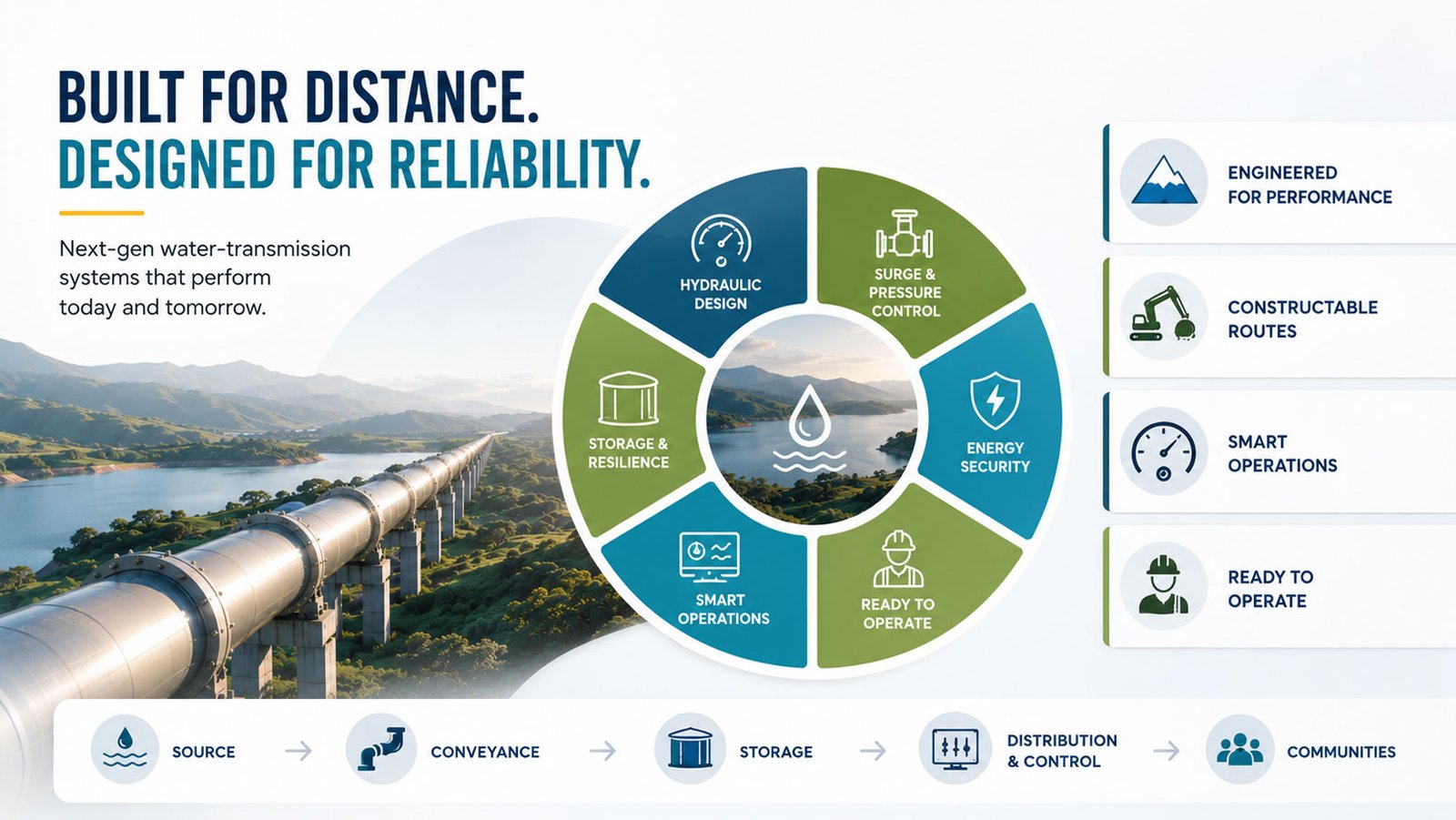
Hydraulics, Surge, and Resilience
Before you finalize the system, your project team needs to check:
- static lift and elevation differences
- gravity versus pumped conveyance
- friction losses and pumping energy
- pressure zoning and booster-station sequencing
- break-pressure tanks where the hydraulic profile requires them
- energy security, power interruptions, and pump-trip scenarios
- water hammer and negative-pressure risk
- air valves, surge vessels, relief systems, transient modelling, and restraint philosophy
Storage gives you another layer of resilience. Balancing reservoirs, terminal or emergency storage, parallel mains, multiple-source interconnections, and backup wellfields can give operators more flexibility during drought, maintenance, or source failure.
Case Study: Sibilu and Gerbi Show Why Topography Matters
A useful high-head example comes from Addis Ababa. The cited Sibilu and Gerbi design includes large raw-water mains connecting reservoir sources with treatment infrastructure, plus a tunnel connection toward a terminal reservoir. The project details from Ethiopians show why pipeline design cannot be separated from topography, treatment, storage, and pressure management.
Construction and Operational Readiness
Even a strong technical design can struggle if the route is difficult to build or the finished system is hard to operate. You need to think about remote access, crossings, difficult trench conditions, unstable or expansive soils, transport and handling, customs and import logistics, local equipment, workforce capability, and construction sequencing. You also need to plan for:
- pumps and variable-speed drives
- power and backup power
- instrumentation and flow/pressure monitoring
- SCADA and leak or failure detection
- testing and commissioning
- operator training
- O&M documentation and accurate handover records
That is why you should think of EPC in bulk-water transmission as an integrated delivery and governance model, not simply construction plus material supply.
Selecting Pipe Materials for Long-Distance Water Transmission
You should choose the pipe material only after you understand the actual project conditions. The right pipe is the one that fits your hydraulic profile, route, soil, water quality, installation conditions, owner standards, maintenance capability, and lifecycle needs. It should not be chosen because one material has the strongest generic product claim.
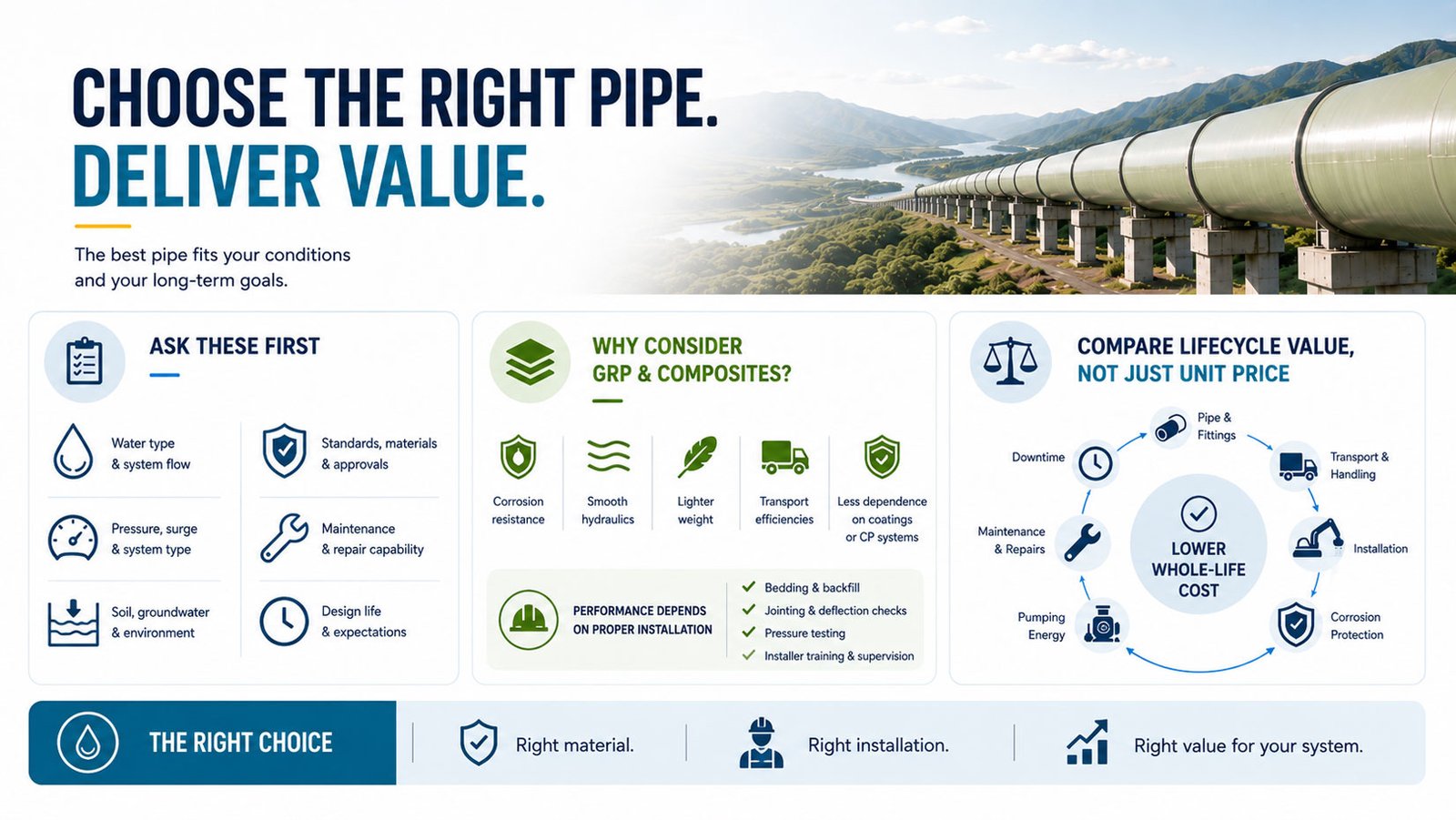
Questions to Answer Before Material Selection
Before you make a material decision, check
- whether you are moving raw or treated water
- the design flow and diameter
- operating, surge, and vacuum conditions
- whether the system is gravity-fed or pumped
- burial depth and external loading
- soil stiffness, groundwater level, and chemistry
- temperature, crossings, and route access
- owner standards and approved materials
- repair capability, design life, and maintenance capacity
Where GRP and Composites May Deserve Early Evaluation
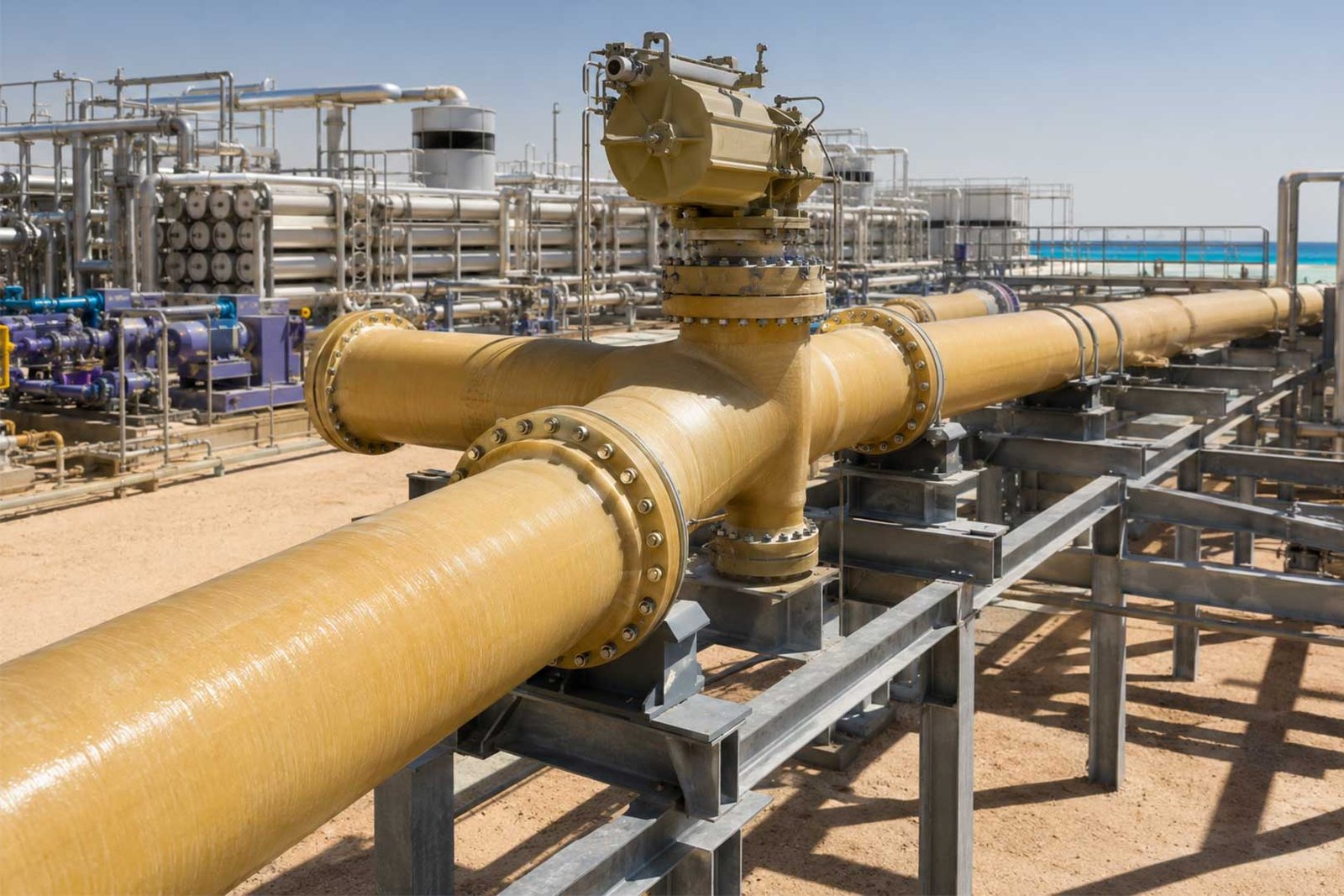
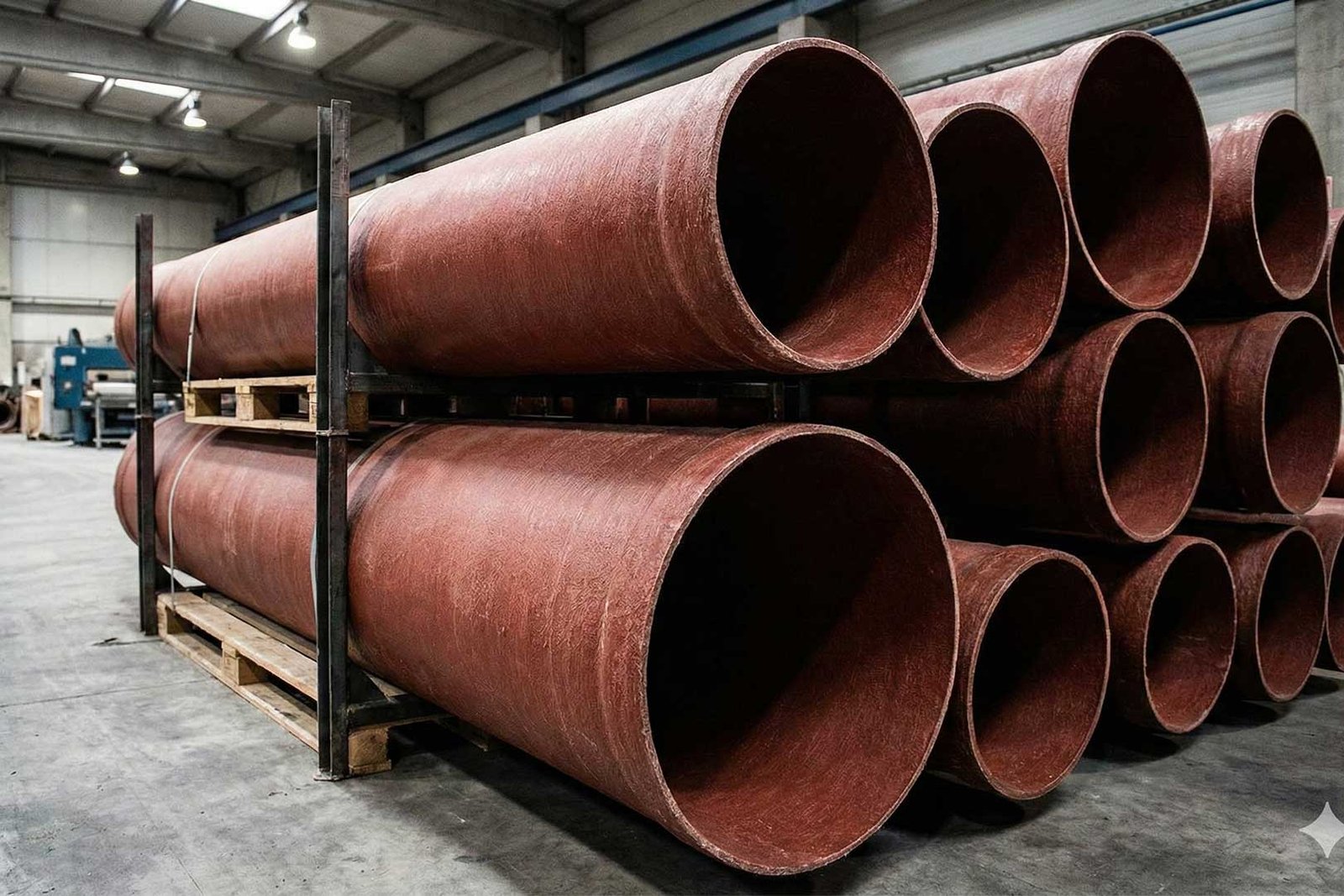
GRP and other composites may be worth looking at early if your project involves long buried mains, medium- and large-diameter conveyance, corrosive or saline soils, coastal routes, chemically variable groundwater, pumped systems where hydraulic smoothness matters, or remote routes where transport and handling are difficult. The research connects GRP with
- corrosion resistance
- smooth internal hydraulics
- lower handling weight
- potential transport efficiencies
- less dependence on coatings or cathodic-protection systems
Those benefits do not remove the need for good installation. You still need proper bedding, backfill, compaction, jointing, deflection checks, handling protection, pressure testing, installer training, field supervision, and surge or vacuum validation. Other materials still have valid roles like:
- Ductile iron can fit conventional municipal environments and established owner standards
- Steel can fit very high-pressure, exposed, industrial, or structurally demanding applications
- HDPE can fit smaller-diameter, flexible, lower-pressure, or fragmented systems
- Other systems can fit project-specific applications where the design conditions call for them
Compare Lifecycle Value, Not Only Unit Price
If you compare materials only by purchase price, you are missing a big part of the decision. Your comparison should include
- pipe and fittings
- transport and handling
- trenching and installation
- corrosion protection
- pumping requirements
- maintenance and repairs
- downtime
- rehabilitation or replacement
A lower purchase price does not automatically give you a lower whole-life project cost. You need to judge the material at system level, not only by the price of one meter of pipe.
Financing and Project Preparation Determine Which Demand Becomes a Real EPC Opportunity
A serious water need can remain only a concept for years. Finance, design maturity, procurement, and institutional support decide whether it can move toward construction. Project maturity gives you a clearer picture of how real the opportunity actually is.
The research identifies funding through national and utility budgets, World Bank and AfDB finance, European and bilateral development finance, climate funds, export credit, blended finance, and PPP, BOT, or DBO structures. The funding route can also affect procurement, safeguards, technical standards, qualification criteria, consultant appointments, timing, and lifecycle expectations.
Project Maturity Matters as Much as Project Size
| Stage | Commercial meaning |
|---|---|
| Master plan / concept | Long-term intelligence and early design influence |
| Feasibility / ESIA | Strong time to engage owners, consultants, and financiers |
| Detailed design | Specifications and system architecture become clearer |
| Financing approved | Commercial credibility improves |
| EOI / RFQ / prequalification | Qualification opportunity |
| EPC tender | Immediate opportunity, usually less technical flexibility |
| Award / construction | Supply, execution, and interface requirements |
| Operational / expansion | Rehabilitation, parallel-main, and O&M opportunities |
The Kenya Public Private Partnerships Directorate is a good example of the kind of source you can use to separate an early concept from a more commercially mature opportunity.
You also need to keep an eye on procurement and disbursement delays, foreign-exchange constraints, customs and import logistics, political or institutional changes, weak owner or utility capacity, limited contractor capability or supervision, unreliable power, O&M limitations, and fragmented stakeholder coordination.
Grand LineCore’s Role in the Regional Water-Transmission Transition
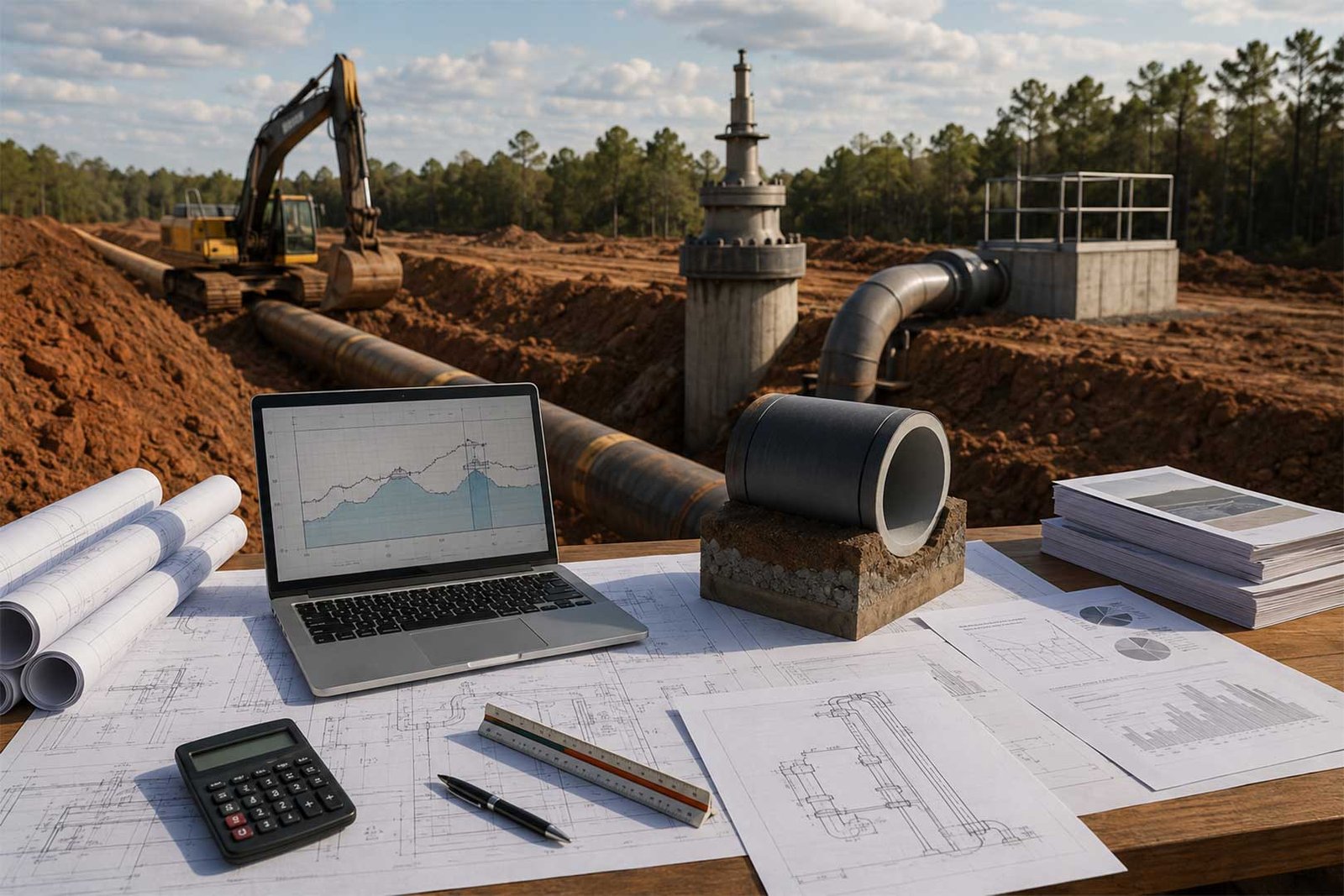
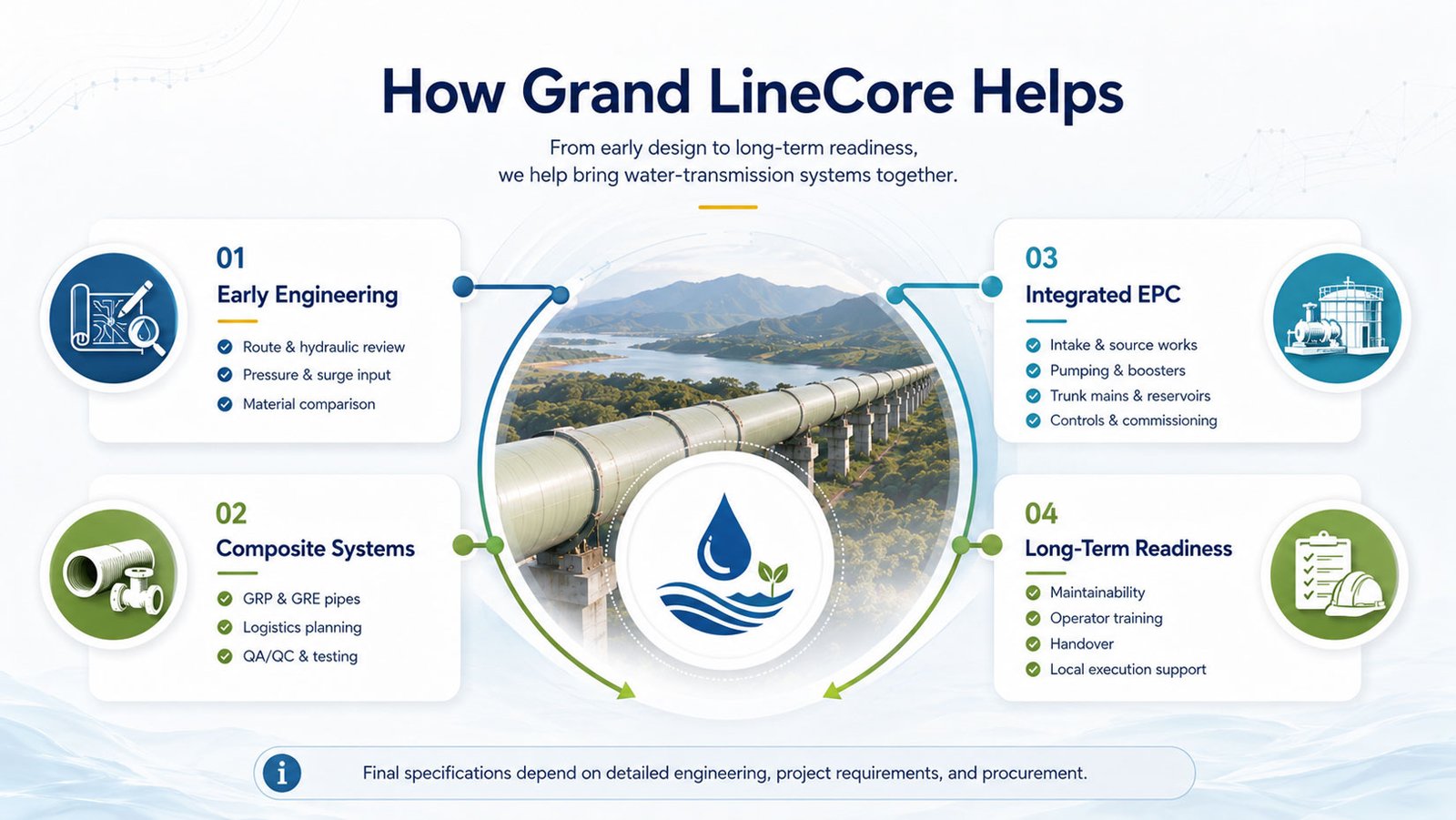
If you are planning a transmission project, your challenge goes well beyond buying pipe. The engineering, material, installation, pumping, storage, controls, testing, and commissioning pieces all need to work together before you have a reliable operating system. Where the project conditions and procurement rules allow, Grand LineCore can help you bring those pieces together. Its relevant capability pillars are
- Early engineering and technical support including route and hydraulic review, pressure and surge assessment, project-specific material comparison, lifecycle-oriented value engineering, and technical input for owners, consultants, and EPC partners
- Composite pipeline systems including GRP and GRE pipes, fittings, logistics planning, installation procedures, QA/QC, and testing support
- Integrated EPC support including intake and source interfaces, pumping and booster stations, trunk mains, reservoirs, civil works, electrical and control systems, surge protection, testing, and commissioning
- Long-term infrastructure readiness including maintainability, operator training, handover, lifecycle planning, and regional or local execution partnerships where relevant and verified
The final specification and material choice still depend on your detailed engineering, owner and consultant requirements, and the procurement process that applies to your project.
East Africa’s Water Future Will Depend on Connected Systems
If you treat East Africa as one market, you miss the real picture. Different countries face different conditions, but many are moving toward larger bulk-water systems as reliable sources and growing demand move farther apart.
Population growth, climate volatility, irrigation, groundwater, and industry are increasing demand for connected source, treatment, pumping, storage, transmission, control, commissioning, and O&M systems. The strongest EPC opportunities will be where real need, credible financing, mature preparation, and institutional capacity come together.
Ethiopia remains Grand LineCore’s main strategic reference, while Kenya, Tanzania, Rwanda, and Uganda show different paths through the same shift. Grand LineCore can support bulk-water, groundwater, irrigation, industrial-water, and regional conveyance projects as integrated infrastructure solutions.
about
The Author

Farshid Tavakoli is a seasoned professional in engineering and international trade. Holding degrees in Electrical Engineering, Mechatronics, and a Doctorate in Business Administration (DBA) from the University of Lyon, he also has a strong background in industrial automation and production line technologies.
For over 17 years, he has led an international trading company, gaining deep expertise in commercial solutions tailored to industrial needs. With more than 8 years of active involvement in infrastructure development, he specializes in the supply of electromechanical equipment for water and wastewater treatment plants and transfer projects.
Together with comapny expert team, he now provides consultancy and integrated solutions for sourcing and implementing complex infrastructure projects across the region.