If you are reviewing a GRP water transmission line, PN is only part of the story. You also need to know how that line behaves when it is empty under high groundwater, partly filled during draining, or exposed to vacuum after a pump shutdown.
Those conditions put inward pressure on the wall. A line that performs well under positive internal pressure still needs a separate buckling check for that load direction.
Today, we want to walk you through the cases worth checking, the pipe data that affect the result, and the evidence you should have before approving the design.
What Is GRP Pipe Buckling?
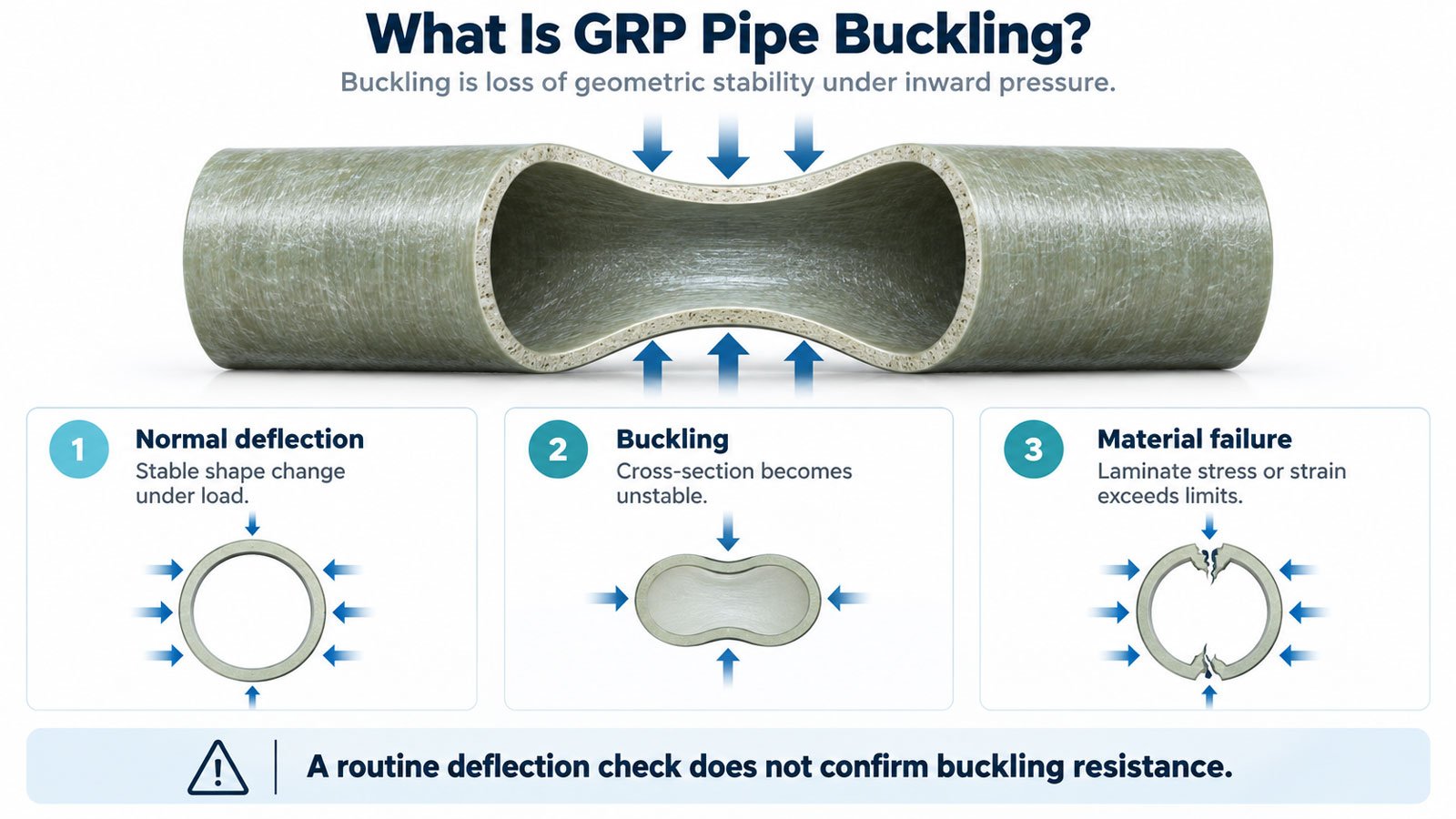
GRP pipe buckling is a loss of geometric stability under inward pressure. The cross-section starts to collapse even though the fiberglass-resin laminate may still be within its material-strength limit. If you keep three different pipe responses separate, the design review becomes much easier to follow.
- Normal deflection is a stable change in shape under load, with surrounding soil supporting the pipe.
- Buckling happens when the cross-section becomes unstable under external pressure or internal vacuum.
- Material failure occurs when laminate stress or strain passes its allowed resistance.
Passing a routine deflection check does not tell you that the line has enough buckling resistance.
When Does GRP Pipe Buckling Occur? Main Risk Scenarios
Your demanding buckling case may happen while the line is empty, draining, isolated, or out of service. Positive internal water pressure usually works against inward collapse, so the normal operating case may never be the one that controls your design. For a project review, put these conditions on one page before choosing the pipe:
| Project condition | Main inward load | What you need to check |
|---|---|---|
| Empty or partly filled line under high groundwater | External hydrostatic pressure | Groundwater, cover, soil restraint, pipe resistance |
| Deep burial | Earth load with groundwater where present | Combined demand and pipe-soil stability |
| Dewatering stopped before commissioning | Groundwater rebound around an empty line | Temporary construction condition |
| Hydrotest drainage or maintenance shutdown | Low internal pressure while groundwater stays high | Venting, drainage sequence, groundwater, duration |
| Pump trip or rapid draining | Negative internal pressure | Minimum transient pressure and required air inflow |
| Above-ground section | Atmospheric pressure during vacuum | Product-specific external-pressure rating |
Partly filled sections deserve attention too. During draining, you may have water in the lower part of the line, negative gas pressure above it, and groundwater acting outside at the same time.
Bridge crossings, valve chambers, pump-station connections, and other exposed sections also need their own check because you cannot credit them with the soil restraint used for an underground section.
NOV: Vacuum Can Start During Routine Operations
The NOV fiberglass piping design guide identifies pump shutdown, valve closure, slug flow, and system drain-down as conditions that produce vacuum. If any of those states exist on your route, they belong in the buckling review.
Related
GRP Cooling Water Piping for Power Plants: Design Inputs, System Layout and Procurement Requirements
Your cooling-water pipes need to keep water flowing to the condenser, day after day.
What Factors Control GRP Pipe Buckling Resistance?
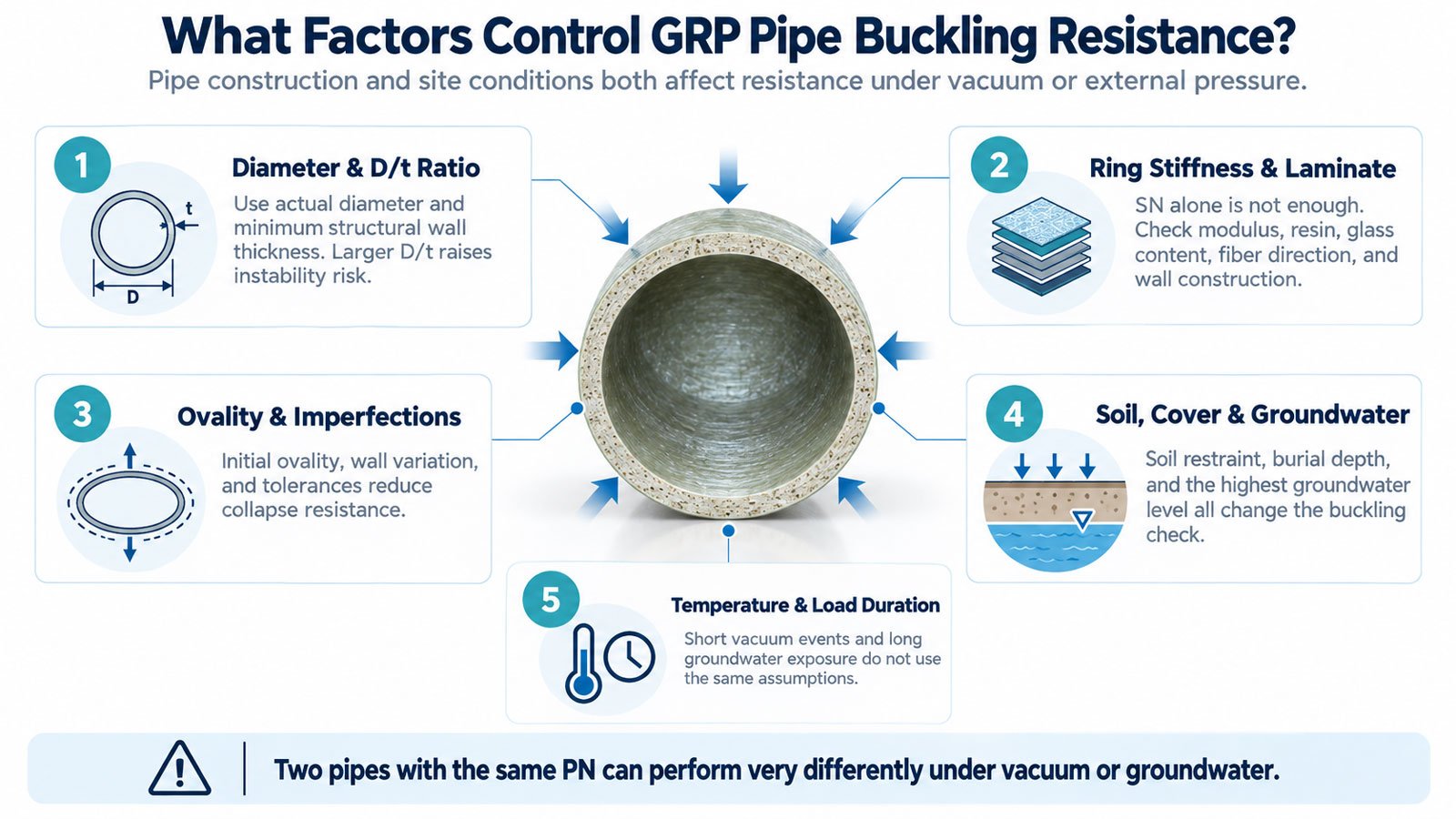
Buckling resistance comes from the actual pipe construction and the condition around it. Two products carrying the same PN marking can behave very differently when groundwater or vacuum pushes inward. If you are comparing vendor offers, these are the details worth lining up side by side.
Pipe Diameter and Diameter-to-Thickness Ratio
Start with actual dimensions rather than DN alone. Your calculation needs the diameter and minimum reinforced structural wall thickness. A larger D/t ratio generally makes the shell more sensitive to instability.
Ring Stiffness and Laminate Properties
Ring stiffness tells you how the pipe resists radial deformation, but SN does not give you one fixed vacuum value for every project.
You also need the circumferential modulus, resin system, glass content, fiber direction, manufacturing method, and structural wall construction.
SN2500, SN5000, and SN10000 describe stiffness classes. Get the allowable vacuum that applies to the product and installation you are buying.
Ovality and Geometric Imperfections
A pipe rarely matches a perfect mathematical cylinder. Initial ovality, minimum wall thickness, and manufacturing tolerances affect the reserve against collapse. Keep that issue separate from your field-deflection limit. The two checks deal with different structural questions.
A published study of composite cylindrical shells under hydrostatic pressure examined ovality and thickness variation together, which makes it a useful background when you are reviewing shell sensitivity.
Soil Restraint, Burial Depth, and Groundwater
For an underground line, the surrounding soil forms part of the buckling calculation. The structural model uses the soil constrained modulus to represent that restraint.
More cover does two things at once. It changes the external load and also changes the soil response. That is why a deeper line needs a proper calculation instead of a shortcut.
For groundwater, use the highest credible level during any period when the line could be empty, partly filled, or under negative pressure. State the level against a defined pipe reference such as the crown.
Temperature, Load Duration, and Design Factors
GRP stiffness changes with temperature. A short vacuum event after a pump trip is also different from an empty line left under groundwater for weeks.
Your governing design method and manufacturer data should set the temperature assumptions, load duration, and design factors used in the check.
How Engineers Assess GRP Pipe Buckling Risk
You assess buckling by matching the inward load at a location with the resistance available at that same location and project stage. The hydraulic model tells you how low the internal pressure goes. The structural review tells you if the selected pipe and its support condition can take it. If your name is going on the approval, make sure the design file covers this sequence.
- List construction, commissioning, normal operation, draining, shutdown, maintenance, and temporary isolation cases.
- Define groundwater, earth load, internal vacuum, and any combinations that happen together.
- Obtain minimum transient pressure along the route and state the pressure reference clearly.
- Get the manufacturer’s allowable external pressure and vacuum for the exact pipe construction.
- Check actual dimensions, ring stiffness, soil constrained modulus, ovality assumptions, temperature basis, and load duration.
- Apply the design margin required by the selected method and record the standards, editions, assumptions, and limits.
Groundwater and vacuum belong in the same calculation whenever they occur at the same time. The research uses a case with 10 m of groundwater above the pipe and an 80 kPa vacuum to make that combined-load point easy to see.
Amiblu: Give the Supplier the Project Data
Amiblu’s published M45 structural-analysis input sheet asks for DN, pressure class, nominal stiffness, internal vacuum, native-soil stiffness, cover depth, and groundwater level.
That is a much better request than asking a vendor if “SN5000 is enough” without giving them the load case.
How to Prevent GRP Pipe Buckling and Collapse
You prevent buckling by keeping the pipe selection, hydraulic model, groundwater case, and operating procedure tied to the same design assumptions. A gap between those documents is where a temporary condition can get missed.Before the line goes into service, these are the controls worth agreeing across the project team.
- Select pipe stiffness and construction using the external-pressure calculation.
- Obtain the allowable vacuum for the exact product and installation condition.
- Compare that value with pump-trip, shutdown, rapid-drain, and hydrotest-drainage cases.
- Size air/vacuum valves from required air inflow and manufacturer performance curves.
- Check what happens if a valve is blocked, closed, isolated, badly located, or too small.
- Use combination air valves where the hydraulic design calls for high-volume air admission and release.
- Review anti-slam features where rapid air discharge could create a damaging pressure event.
- Check groundwater rebound after temporary dewatering stops.
- Review exposed sections and temporary operating states separately.
- Set drainage, commissioning, shutdown, or maintenance limits where the calculation requires them.
A large valve connection does not prove that enough air will enter. You need the inflow curve at the negative pressure your line is allowed to reach.
What Should EPC Engineers Request From GRP Pipe Manufacturers?
Before you approve a supplier’s vacuum claim, have them put the basis of that claim in the submittal. “Full vacuum capable” means very little if you do not know the diameter, wall construction, installation condition, temperature, or test basis behind it. The supplier submittal should contain four groups of information.
- Pipe structural information should cover actual diameter, minimum reinforced wall thickness, D/t, ring stiffness, laminate properties, tolerances, initial ovality, and temperature-dependent data.
- External-pressure qualification should state allowable external pressure and vacuum, ASTM D2924 evidence where applicable, specimen dimensions, failure mode, extrapolation limits, design factors, and short-term versus sustained-load restrictions.
- Project-specific calculations should use your groundwater, soil parameters, cover, predicted minimum internal pressure, temporary states, maintenance cases, and exposed sections.
- Supporting engineering records should identify standards and editions, assumptions, stated limits, and engineering approval of the proposed pipe construction.
Relevant Standards for GRP External-Pressure and Vacuum Design
You will see several standards in a GRP submittal, but they do different jobs. One may cover the product, another the structural design, and another the external-pressure test.
Keep this short reference beside the specification.
| Reference | Where it fits |
|---|---|
| AWWA M45-2026 | Fiberglass pipe design and underground buckling checks |
| AWWA C950-25 | Fiberglass pressure-pipe product requirements |
| ASTM D2924-24 | External-pressure resistance testing |
| ASTM D3517-26 | Machine-made fiberglass pressure-pipe specification |
| ISO 23856:2021 | GRP-UP water piping-system requirements |
| AWWA M51 | Air-valve selection, sizing, location, and operating guidance |
| AWWA C512-25 | Product requirements for metallic air-release, air/vacuum, and combination valves |
ISO 23856:2021 replaced ISO 10467 and ISO 10639 for the applications covered by the newer standard.
Frequently Asked Questions About GRP Pipe Buckling
1- Does PN16 Mean a GRP Pipe Is Rated for Full Vacuum?
No. PN16 describes internal pressure class. You still need the manufacturer’s external-pressure rating and the calculation for your exact pipe construction and installation condition.
2- Does Higher Ring Stiffness Prevent Buckling by Itself?
No. Higher ring stiffness raises resistance, while geometry, groundwater, soil restraint, imperfections, temperature, and combined loads still affect the final check.
3- Will an Empty Underground GRP Pipe Collapse Without Internal Vacuum?
High groundwater and external loading can create enough inward pressure to govern the buckling check even when pressure inside the line stays close to atmospheric.
Conclusion: Engineering GRP Pipelines for Buckling Resistance
If you are closing out a GRP specification, do not stop at PN and SN. Check the conditions the line will see when it is empty, draining, under groundwater, exposed above ground, or pulled into vacuum.
Before procurement moves forward, match the highest inward load for each project state with manufacturer-supported resistance for the exact pipe construction you plan to buy.
Grand LineCore supplies GRP piping and supports water-transmission EPC projects where pipe selection, structural calculations, hydraulic conditions, air-valve performance, and manufacturer verification need to agree before construction starts. Contact Grand LineCore to discuss the GRP pipe specifications and engineering requirements for your next water transmission project.
about
The Author

Farshid Tavakoli is a seasoned professional in engineering and international trade. Holding degrees in Electrical Engineering, Mechatronics, and a Doctorate in Business Administration (DBA) from the University of Lyon, he also has a strong background in industrial automation and production line technologies.
For over 17 years, he has led an international trading company, gaining deep expertise in commercial solutions tailored to industrial needs. With more than 8 years of active involvement in infrastructure development, he specializes in the supply of electromechanical equipment for water and wastewater treatment plants and transfer projects.
Together with comapny expert team, he now provides consultancy and integrated solutions for sourcing and implementing complex infrastructure projects across the region.