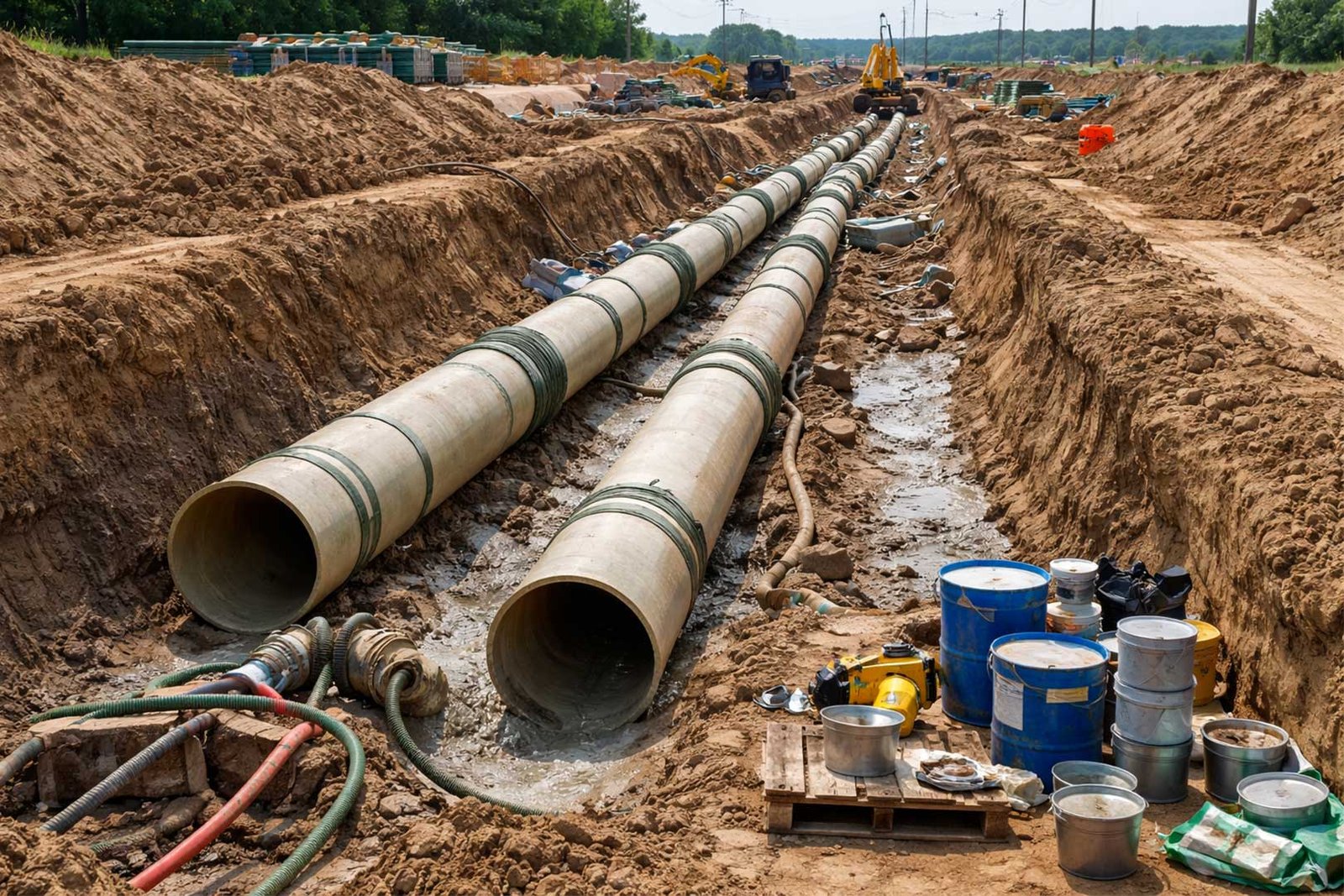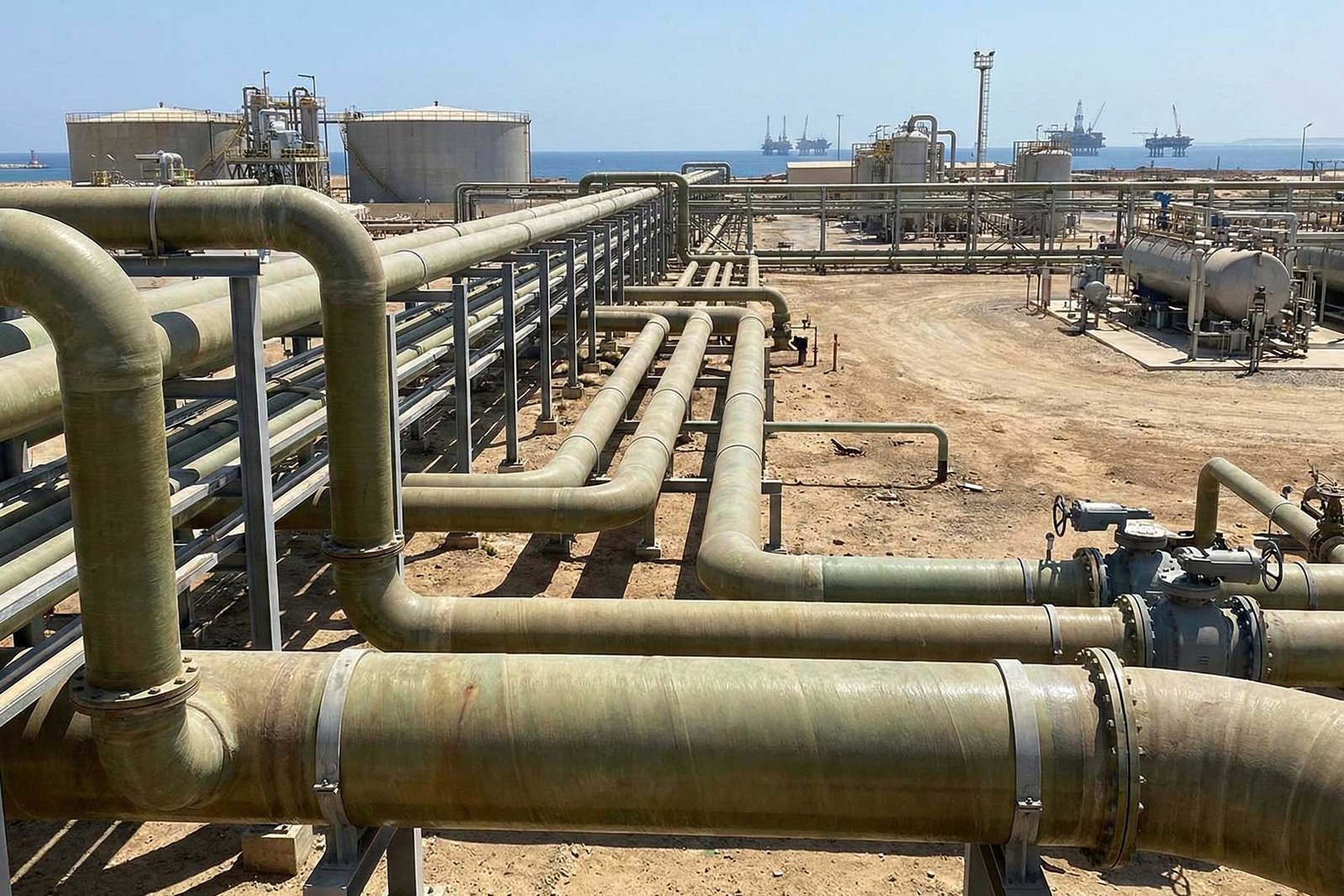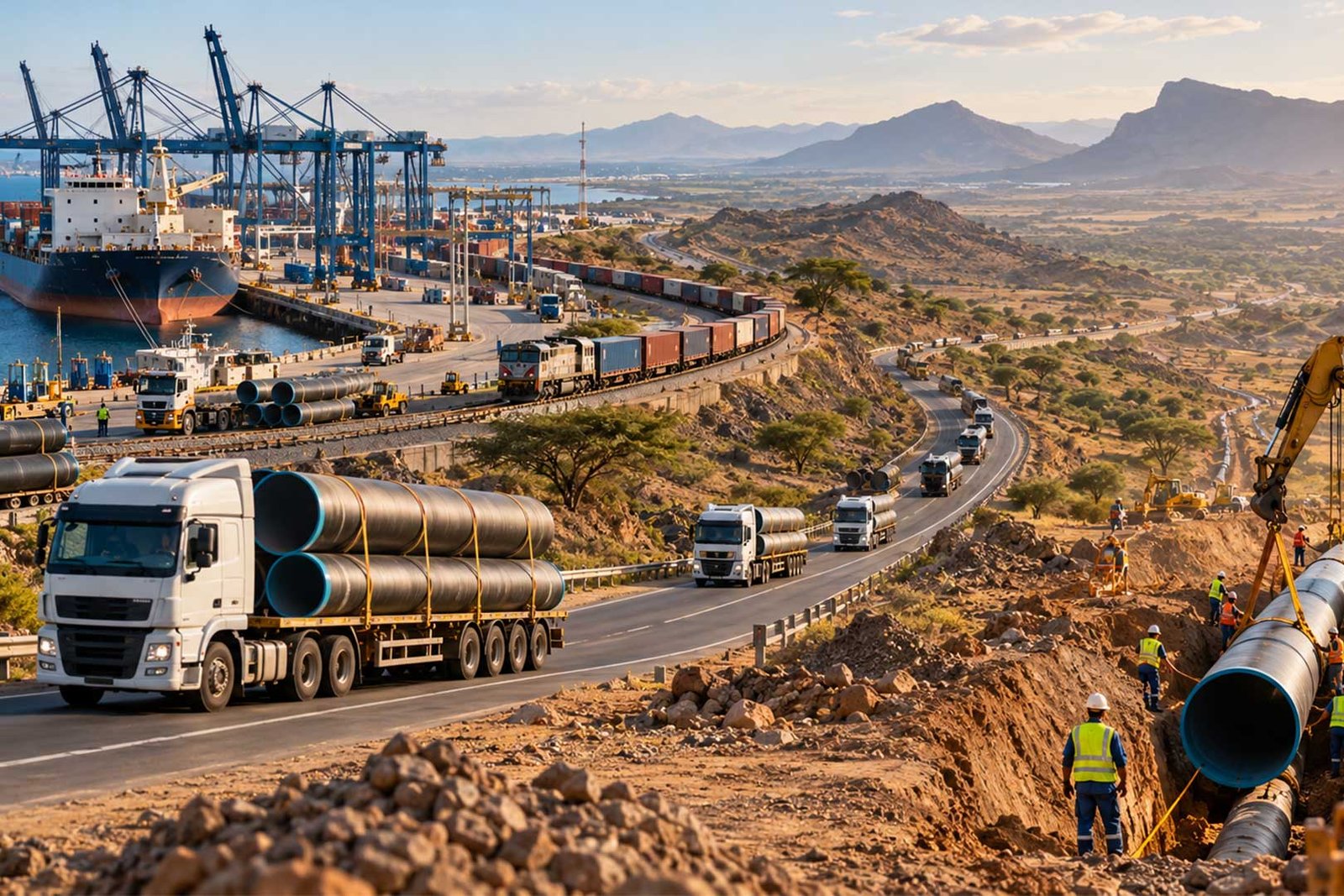
A pipe can leave the factory on time and still reach your construction team too late. That is the real logistics risk on major Ethiopian water projects.
Your pipes, fittings, valves, pumps, electrical equipment, instruments, and treatment packages may come from different suppliers, but they can still depend on the same delivery chain. For EPC work, “shipped” is not enough. The material needs to reach the right work front, in good condition, when your team actually needs it.
In this post, we’ll tell you where delays can happen, what to watch for, and how to keep your water EPC project moving. Stay with us to the end.
Why the Ethiopia–Djibouti Corridor Is an EPC Delivery Variable
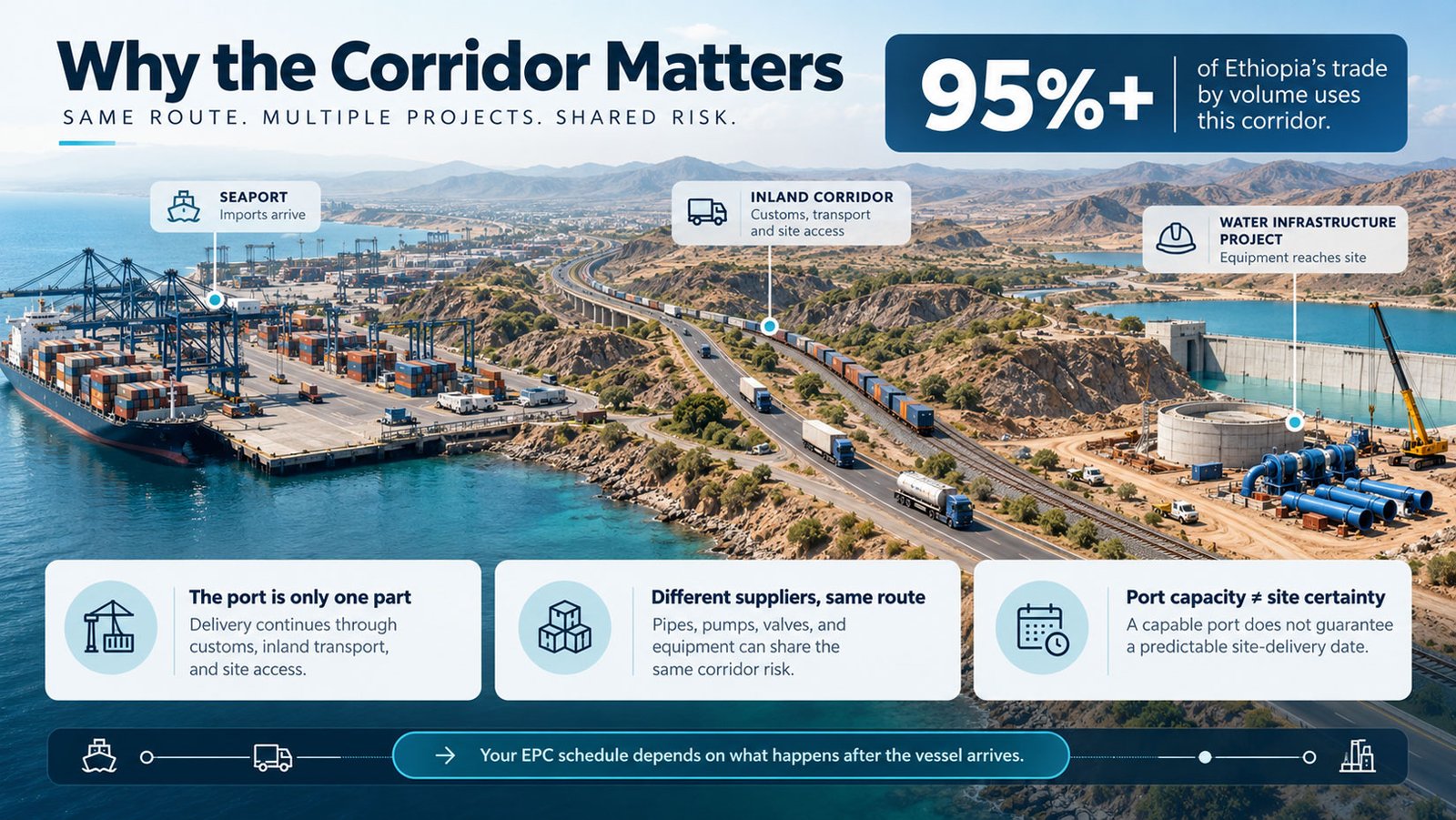
The Ethiopia–Djibouti corridor carries most of Ethiopia’s international trade, so several important project packages can depend on the same route at the same time. The World Bank’s Addis–Djibouti corridor program reports that more than 95% of Ethiopia’s import-export trade by volume moves through this corridor. For your project, the main issue is corridor concentration risk, not simply “Djibouti congestion.”
- The port is only one part of the journey. Doraleh Multipurpose Port can handle containers, breakbulk, bulk, and RoRo cargo, and it also has direct rail access.
- Different suppliers can still share the same logistics risk. Your pipe may come from one factory and your pumps from another, but both can depend on the same customs, inland transport, dry-port, and final-mile system.
- Good port capacity does not guarantee a predictable site date. The World Bank’s 2026 Modjo Dry Port update also explains how wider logistics performance still depends on coordination across the full system.
A capable port helps. But your EPC schedule depends on what happens after the vessel arrives too.
From Factory Gate to Trench Front: Where Logistics Risk Enters
Your material has a long journey before your construction team can actually use it. The key is to plan the full trip, not just the ocean freight.
Before the Cargo Leaves the Factory
Many delivery problems start before the shipment moves. Before dispatch, your team should confirm:
- packing method
- actual dimensions and weights
- inspection status
- shipping documents
- lifting requirements
- booking details
This matters even more for large pipes and special equipment. If the cargo information or packing is wrong, the same problem can follow you through the port, customs, inland transport, and site delivery.
Through Djibouti and Customs
Once the cargo reaches Djibouti, several things need to line up. Your team may need to manage vessel discharge, suitable lifting equipment, temporary storage, damage checks, customs documents, transit requirements, and any permits or exemptions that apply.
Large project cargo may need a very different plan from normal containers. A shipment can be sitting at the port and still be unavailable because one document or approval is missing.
From the Corridor to Your Work Front
Clearing the port is not the end of the journey. You still need to plan road or rail movement, dry-port handling, inland transport, site access, unloading, inspection, and storage. For remote projects, the final part of the route can be especially difficult.
Even after the truck reaches your gate, the material is not automatically ready for construction. Your team still needs to inspect it and move the right items to the right work front.
That is why shipping lead time should not be treated as one fixed number. The useful lead time is the full period from supplier release until the material is ready for installation.
Where Lead-Time Variability Actually Comes From
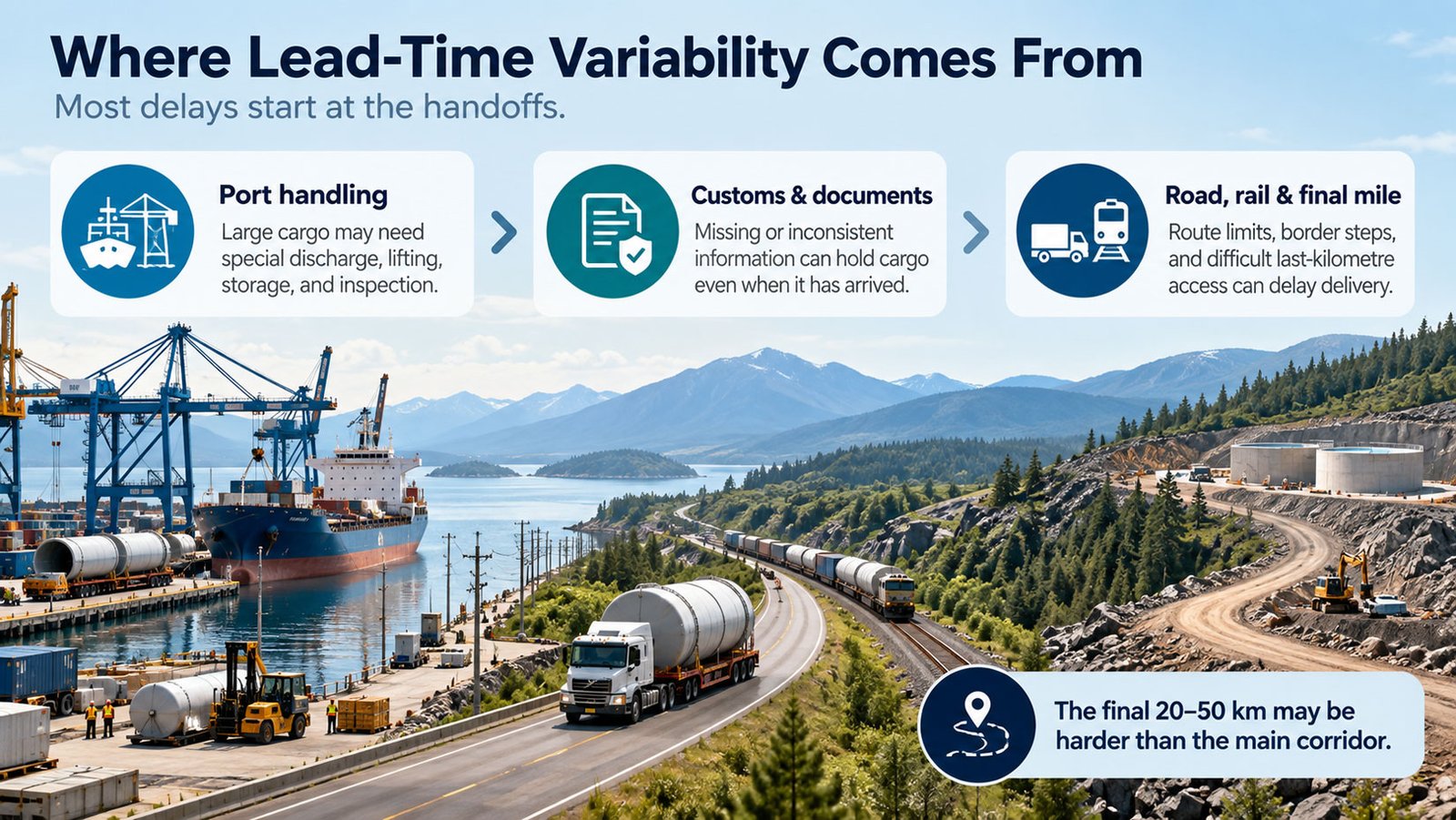
Most delivery problems appear where one stage hands the cargo to the next. If you plan those handoffs early, you have a much better chance of protecting your schedule.
Port Handling and Cargo Release
Not every water-project shipment can be treated like normal container cargo. Large pipes, special fittings, tanks, pumps, or heavy electrical packages may need different handling. Before arrival, check the discharge method, lifting equipment, available handling equipment, storage space, free-time exposure, and damage-inspection plan.
Djibouti has shown that it can handle very large project cargo. In 2025, DPFZA reported preparations for over-dimensional cargo weighing up to 400 tonnes, with dimensions up to 54 metres long and 12 metres in diameter.
Customs and Documentation Interfaces
A customs problem often begins as an information problem. Before shipment, your team should check the bill of lading, commercial invoice, packing list, HS classification, weights, dimensions, consignee details, destination information, and any permits or exemptions that apply.
The Ethiopian Customs Commission’s guidance lists documents such as invoices, packing lists, certificates of origin, transport documents, licences where applicable, and other supporting records.
Road, Rail, Border, and Final-Mile Constraints
Road and rail can both play a role. The better choice depends on your cargo, schedule, handling needs, and final destination. For each major shipment, check:
- truck, trailer, or wagon availability
- axle and dimensional limits
- border processes
- inland logistics hubs
- route condition
- site access and unloading space
Do not ignore the last part of the route. The final 20–50 km to a remote site may be harder than several hundred kilometres on the main corridor.
A narrow road, tight turn, steep grade, weak culvert, overhead restriction, or small unloading area can become the real problem. A road being open to normal trucks does not automatically mean it can handle your project cargo.
Why Large-Diameter GRP Creates a Different Logistics Problem
Large-diameter GRP creates a different transport challenge because space and geometry can matter just as much as weight. That makes transport planning part of pipe planning.
Transport Geometry Can Matter More Than Weight
Do not plan transport from nominal DN alone. For each large pipe shipment, check:
- actual outside diameter
- pipe length
- packaged dimensions
- trailer configuration
- route clearances
- turning space
- unloading method
A pipe may fit easily on the vessel but still be difficult to move around a tight inland turn or into your laydown area.
Packaging and Nesting Are Part of Logistics Engineering
Nesting smaller GRP pipes inside larger pipes can reduce freight volume, but it changes what happens after arrival. You need to think about loading, unloading, bundle weight, lifting capacity, de-nesting space, storage, and installation order. The FLOWTITE also gives guidance for handling, storing, transporting, and de-nesting nested GRP pipes.
If the pipe your crew needs first is packed inside another pipe, you need the space, equipment, and time to remove it safely. Packaging should work for the whole journey, not just ocean freight.
Handling, Storage, and Receiving Matter
Logistics responsibility does not stop at the project gate. For GRP, your site team should use controlled lifting, padded slings, prepared laydown areas, and proper supports. Receiving checks should cover pipe ends, couplings, fittings, accessories, and visible damage.
If something looks damaged, keep it separate until it has been properly inspected.
A Small Missing Item Can Stop a Very Large Pipeline
Having a lot of pipe on site does not mean your team has everything needed to keep working. You need to separate bulk inventory from critical inventory.
| Delayed item | Possible project consequence |
|---|---|
| Straight GRP pipe | Pipe-laying production slows |
| Gaskets or couplings | Jointing stops |
| Bends, tees, or reducers | Pipeline section stays incomplete |
| Control or isolation valves | Hydrotesting or chamber work is delayed |
| Pumps | Mechanical commissioning is delayed |
| Switchgear or transformers | Energization is delayed |
| Instrumentation or SCADA | Functional commissioning is delayed |
A small custom fitting may be more important to your schedule than hundreds of metres of straight pipe.
Logistics criticality is not based on cargo size or price. It depends on what that item allows your project to do next. A system can look almost installed and still not be ready to test or commission.
How Corridor Delays Cascade Into EPC Performance
A logistics delay rarely stays inside the logistics team. Once it reaches your project, it can quickly affect four areas.
- Schedule and Productivity: Missing material can leave trench fronts idle, crews underused, or activities out of sequence. Your team may then need to resequence work or accelerate later.
- Working Capital and Project Cost: A delay can create storage charges, truck standby, extra lifting, rehandling, longer site overhead, inventory financing, and slower milestone payments.
- Material Quality: More waiting and more handling create more chances for damage, storage problems, extra inspections, repairs, or NCRs.
- Commissioning: A missing pump, valve, switchgear item, instrument, or control package can delay testing and start-up even when most of the pipeline is already installed.
Lead Time Should Be Managed as a Range, Not a Promise
An average delivery time can help with early planning, but it should not be treated as a guaranteed date. For important packages, it is better to think in ranges.
| Planning level | Simple meaning | Where it can help |
|---|---|---|
| Average | Central planning value | Early estimates |
| P50 | About half of modeled outcomes finish by this point | Normal planning |
| P80 | Longer allowance with more confidence | Important packages |
| P90 | More conservative allowance | Critical packages with little float |
AACE International’s schedule-risk supports the use of probability and contingency when planning around uncertainty.
For your project, the right allowance should also depend on material criticality, available schedule float, construction demand, your ability to substitute or reorder, and whether commissioning depends on the item. A seven-day delay may mean very little for one shipment and become a critical-path problem for another.
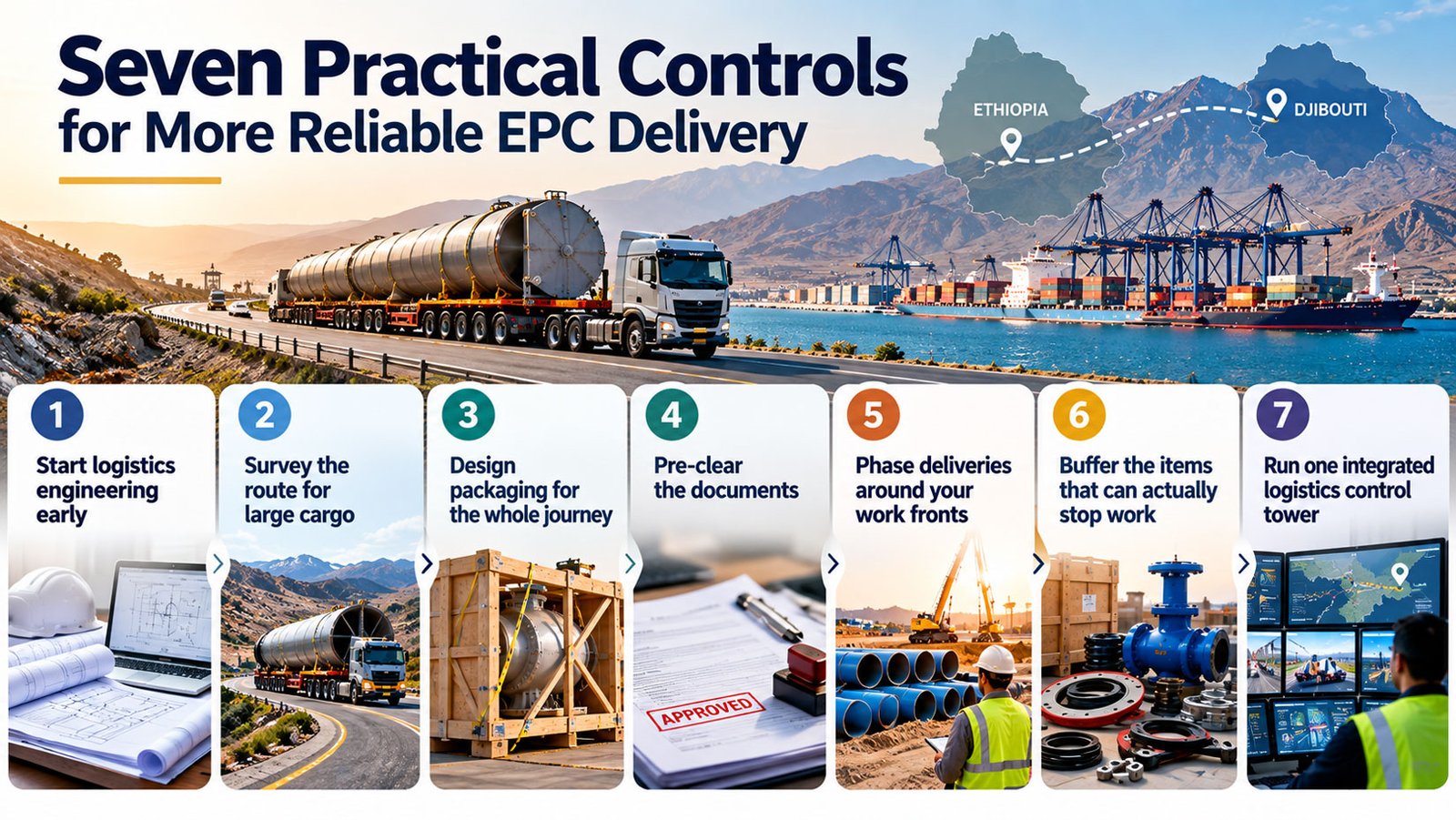
Seven Practical Controls for More Reliable EPC Delivery
You cannot remove every logistics risk, but you can manage many of them before they reach construction.
Plan Before You Ship
Good logistics starts before the cargo moves. Focus on these two checks before you lock in your delivery schedule.
- Start logistics engineering early: Begin during tender and design. Confirm cargo dimensions, transport mode, route, customs pathway, storage, lifting needs, and site access before you freeze the schedule.
- Survey the route for large cargo: Check bridges, culverts, road width, turning radius, gradients, overhead clearances, road works, and unloading access. A road that works for normal trucks may not work for your project cargo.
Prepare the Cargo and Paperwork
A shipment can be ready to move and still get delayed by poor packing or missing documents. Get these two things right before dispatch:
- Design packaging for the whole journey: Think about factory loading, port handling, inland transport, storage, unloading, de-nesting, and installation order. Try to avoid unnecessary rehandling.
- Pre-clear the documents: Check invoices, packing lists, bills of lading, HS classification, dimensions, weights, consignee information, and current permits or exemptions before shipment.
Match Deliveries to Construction
The right material arriving at the wrong time can still slow the project down. Use these two controls to keep deliveries in step with construction.
- Phase deliveries around your work fronts.: Shipping everything early can create storage and working-capital pressure. Depending completely on just-in-time delivery can leave your crews waiting.
- Buffer the items that can actually stop work: Give special attention to gaskets, couplings, repair kits, special fittings, and key installation consumables instead of simply keeping more bulk material.
Keep One Clear Delivery View
A delivery problem is much easier to manage when everyone sees it early. Use this final control to keep procurement, logistics, and construction on the same page:
- Run one integrated logistics control tower: Your procurement, logistics, and construction teams should see the same delivery status for every critical package, from manufacturing and packing through customs, inland transport, site receipt, inspection, and release to construction.
What Better Corridor Planning Means for Water Infrastructure Delivery
For a major transmission project, procurement is not complete when the purchase order is placed or when cargo reaches port. The material still needs to arrive in the right condition, sequence, and timeframe for construction. A more integrated EPC approach can connect:
- hydraulic and pipeline engineering
- GRP and composite pipe supply
- packaging engineering
- transportability assessment
- customs and logistics planning
- delivery sequencing
- site and laydown readiness
- installation
- testing and commissioning
Grand LineCore can support these connections as part of an engineering-led delivery approach. The value is not simply supplying pipe or equipment. It is helping your team connect engineering decisions with packaging, transport, site readiness, installation, testing, and commissioning.
For a major water system, successful procurement means getting every critical component to the place where your project can actually use it.
Conclusion: Logistics Is Part of Infrastructure Engineering
The Ethiopia–Djibouti corridor is not just a route your project has to accept. You can map it, measure it, plan it, monitor it, and build sensible buffers into your schedule. Better corridor planning can give you more schedule certainty, better control of working capital, safer handling of GRP and project cargo, and fewer surprises during commissioning.
For your project, the job is not finished when the material ships. It is finished when the right material reaches the right work front and your team can keep building.
about
The Author

Farshid Tavakoli is a seasoned professional in engineering and international trade. Holding degrees in Electrical Engineering, Mechatronics, and a Doctorate in Business Administration (DBA) from the University of Lyon, he also has a strong background in industrial automation and production line technologies.
For over 17 years, he has led an international trading company, gaining deep expertise in commercial solutions tailored to industrial needs. With more than 8 years of active involvement in infrastructure development, he specializes in the supply of electromechanical equipment for water and wastewater treatment plants and transfer projects.
Together with comapny expert team, he now provides consultancy and integrated solutions for sourcing and implementing complex infrastructure projects across the region.