A big national WASH program can sound like a huge opportunity. But if you work in water infrastructure, you need to know what is actually moving and what is still just a plan. One WASH gives you clues through financing, regional priorities, project studies, design, and procurement.
Go through this and you’ll see how projects move toward EPC work, where future transmission, pumping, wastewater, and utility opportunities may emerge, what early signals to watch, and what can still slow them down before they reach construction.
One WASH as an Infrastructure Delivery Framework
One WASH is easy to look at as a government program for improving water and sanitation. For you, there is another side that matters just as much.
It connects national needs with financing, regional planning, project preparation, procurement, and eventually construction. The One WASH Phase II Program Document shows how plans, budgets, regional allocations, and implementation sit inside this wider system. The important part is knowing where a project actually sits:
- Sector need where new infrastructure is clearly required
- Financing where money starts moving toward that need
- Project preparation where studies and engineering begin
- Procurement where contractors can start pursuing the work
- Construction where the project finally moves into delivery
A town can badly need a new water system and still be years away from an EPC contract. That is why you should never treat a national target, budget estimate, or financing plan as a ready-to-tender project.
How Financing Shapes Future Water Infrastructure
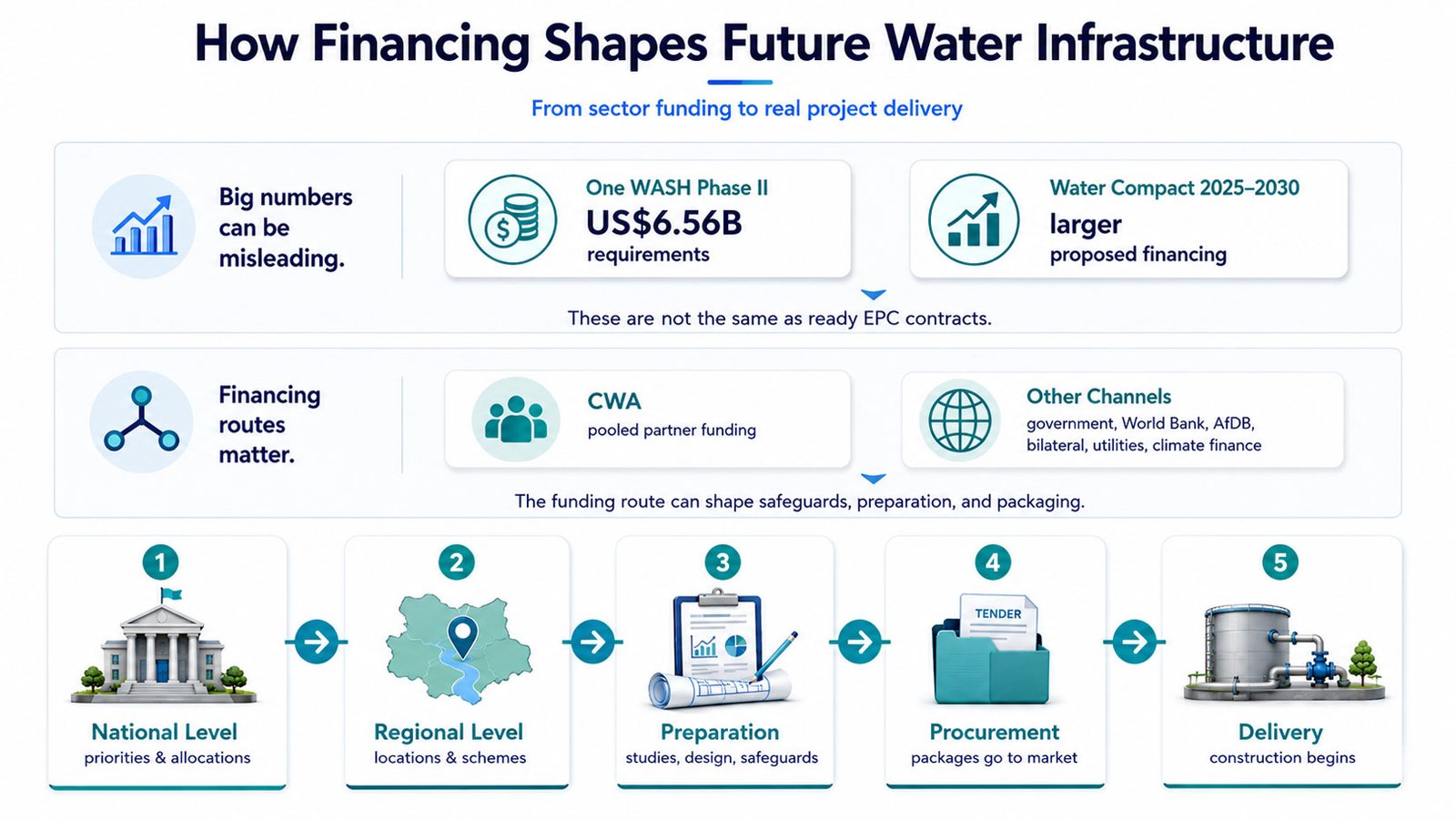
This is where big numbers can be misleading. The 2018 One WASH Phase II program estimated about US$6.56 billion in requirements, while Ethiopia’s newer Water Compact proposes a much larger financing structure for 2025 to 2030.
But neither figure represents a ready-to-tender EPC pipeline. One was an estimate of program needs, while the newer figure is still proposed financing.
The CWA is one important funding route, but it is not the whole picture. Government budgets, World Bank and AfDB programs, bilateral partners, utilities, and climate finance can all support projects through other channels.
For you, the financing route matters because it can shape how a project is prepared, procured, and packaged. The general flow is fairly simple like this:
- National level financing priorities and overall allocations
- Regional level locations and schemes receive attention
- Preparation stage studies, design, and safeguards move forward
- Procurement stage packages are defined and taken to market
- Delivery stage contractors move into construction
Annual WASH plans and regional allocations can therefore tell you a lot before a construction notice ever appears.
The Institutions Shaping the Project Pipeline
One WASH projects can pass through several organizations before you ever see them as tenders.
The Ministry of Water and Energy is a central infrastructure actor. The Ministry of Finance matters for financing and allocation. Regional bodies help turn national priorities into local projects, while utilities and implementing agencies bring actual system needs into the picture. If you are tracking future opportunities, these are the groups worth watching:
- Federal institutions for national priorities, financing, and program direction
- Regional authorities for project selection, engineering, procurement, and implementation
- Utilities for expansion, rehabilitation, pumping, storage, and O&M needs
- IFIs and development partners for financing, safeguards, governance, and procurement
- Consultants for feasibility, hydraulics, specifications, BOQs, and tender documents
Consultants are especially important. They may be shaping the technical side of a project months before a pipe or EPC tender reaches the market.
How a Water Infrastructure Need Becomes an EPC Project
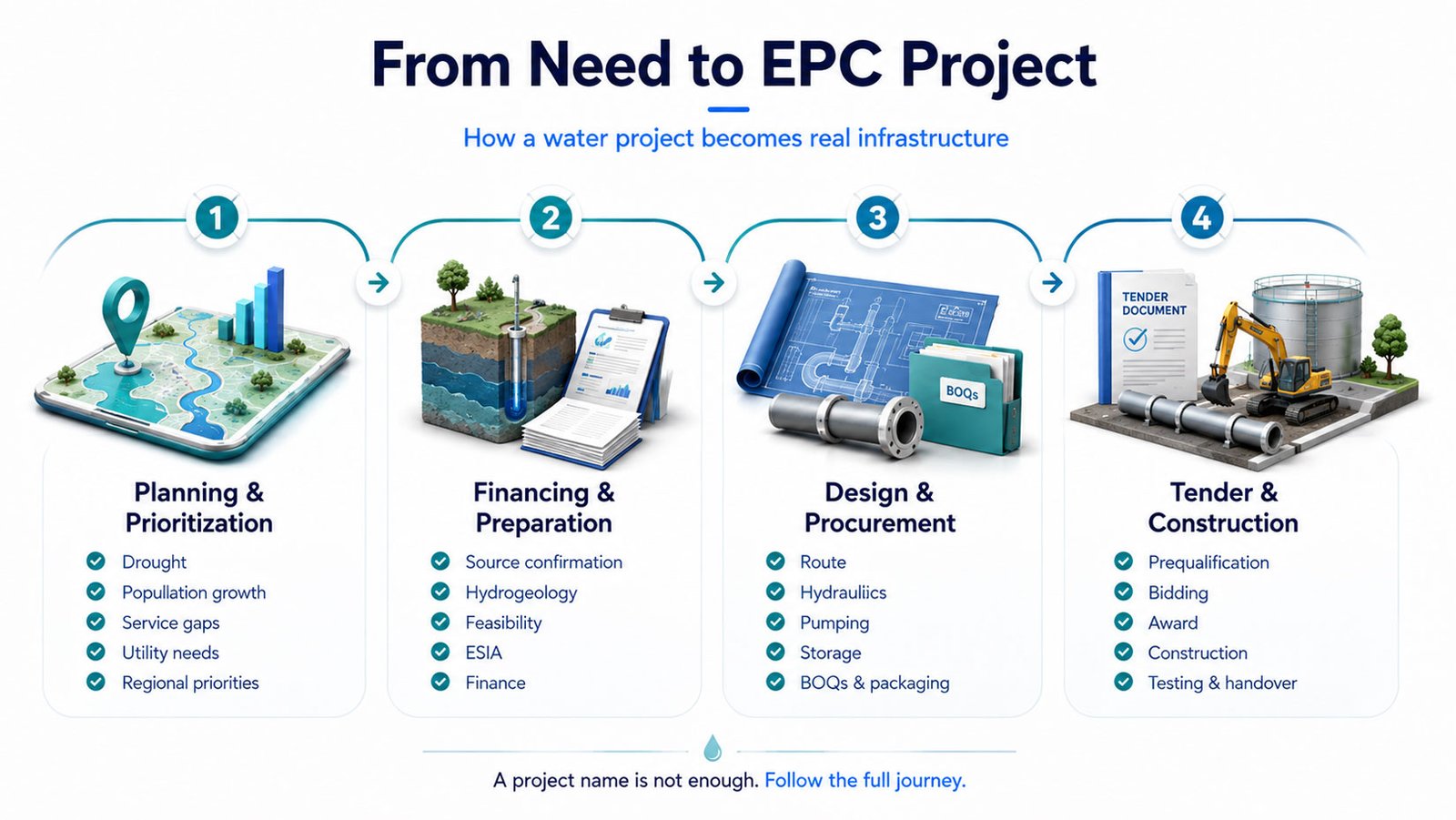
If you want to know whether an opportunity is serious, follow what is happening behind the project name:
Planning and Prioritization
Most projects start with a real problem. It might be drought, population growth, low service coverage, a struggling utility, or a regional development priority.
Ethiopia’s Phase III direction also calls for stronger national, regional, and woreda-level investment pipelines. That means early planning documents can give you useful clues about where future projects may appear.
Financing and Project Preparation
Once a project gets more serious, you start seeing technical work. That can include water-source confirmation, hydrogeological studies, test drilling, feasibility work, engineering surveys, environmental and social studies, and financing analysis.
A World Bank restructuring document shows how much this matters. Eighteen climate-resilient multi-village schemes were prioritized partly because of factors such as confirmed water sources, feasibility work, detailed design, local arrangements, and counterpart finance.
So the biggest project on paper is not always the closest project to construction.
Design and Procurement
Detailed design is where things become much more useful for you. Route, hydraulics, pumping, storage, pressure conditions, materials, specifications, and BOQs can all start becoming clearer.
The procurement structure also begins to appear. Pipe supply might be its own contract, or it might sit inside a wider civil works, supply-and-install, electromechanical, turnkey, or EPC package. One WASH procurement documents allow goods and works to be combined.
Tender and Construction
Larger packages may go through qualification or prequalification before the main tender.
After that comes bidding, evaluation, contract award, construction, supervision, testing, commissioning, and handover. That is the full journey you need to follow if you want to separate an interesting idea from a real EPC opportunity.
Where Future Infrastructure Opportunities May Emerge
One WASH covers a broad market. But if your work is closer to transmission and integrated infrastructure, some areas deserve more attention.
Urban Water Supply
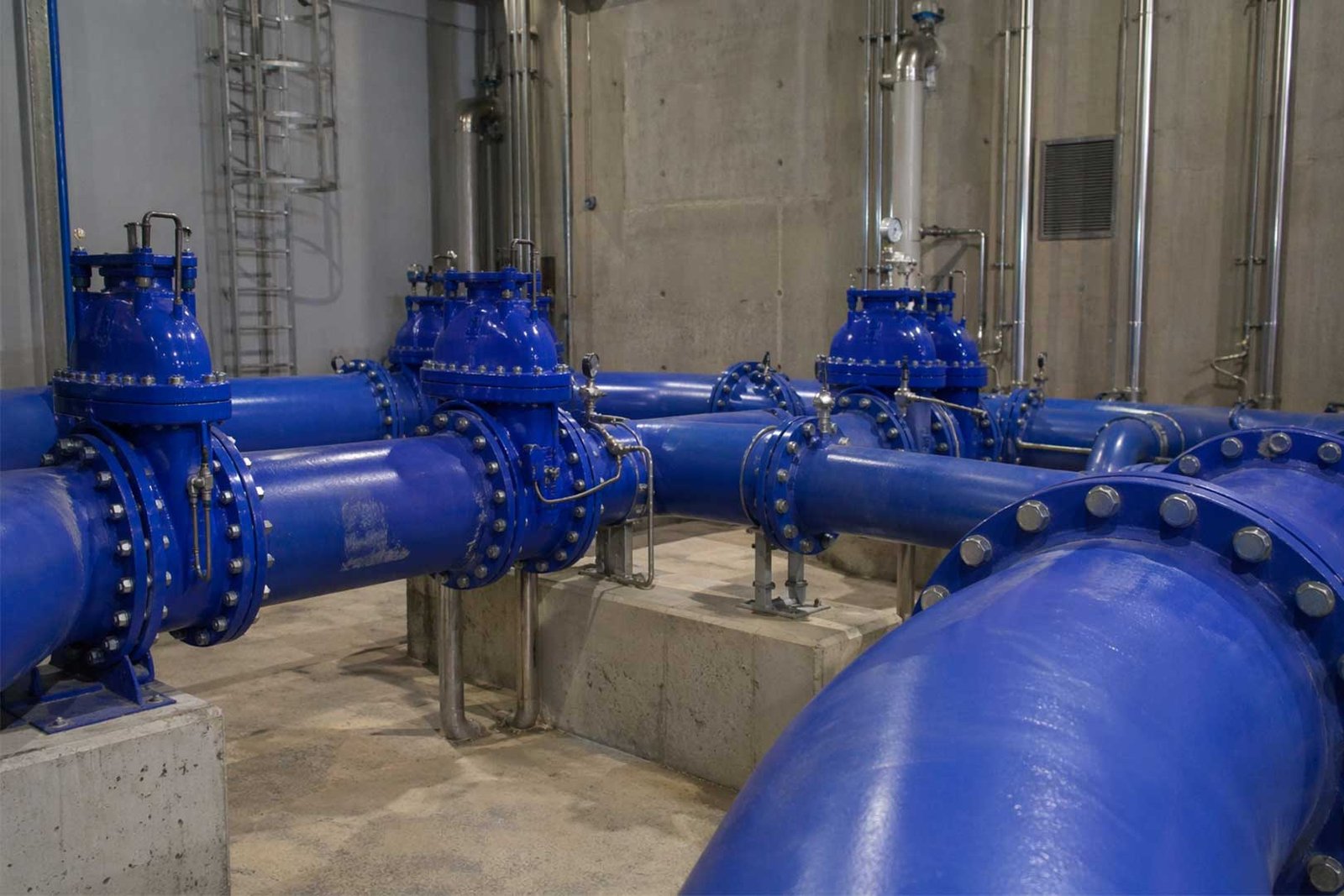
Urban projects can involve raw-water transmission, trunk mains, treatment connections, pumping stations, service reservoirs, network rehabilitation, expansion, NRW reduction, metering, and control systems.
Do not limit yourself to the One WASH-CWA label either. Separate World Bank, AfDB, AFD, government, and other projects can support the same national water priorities through different financing routes.
Climate-Resilient Water Systems
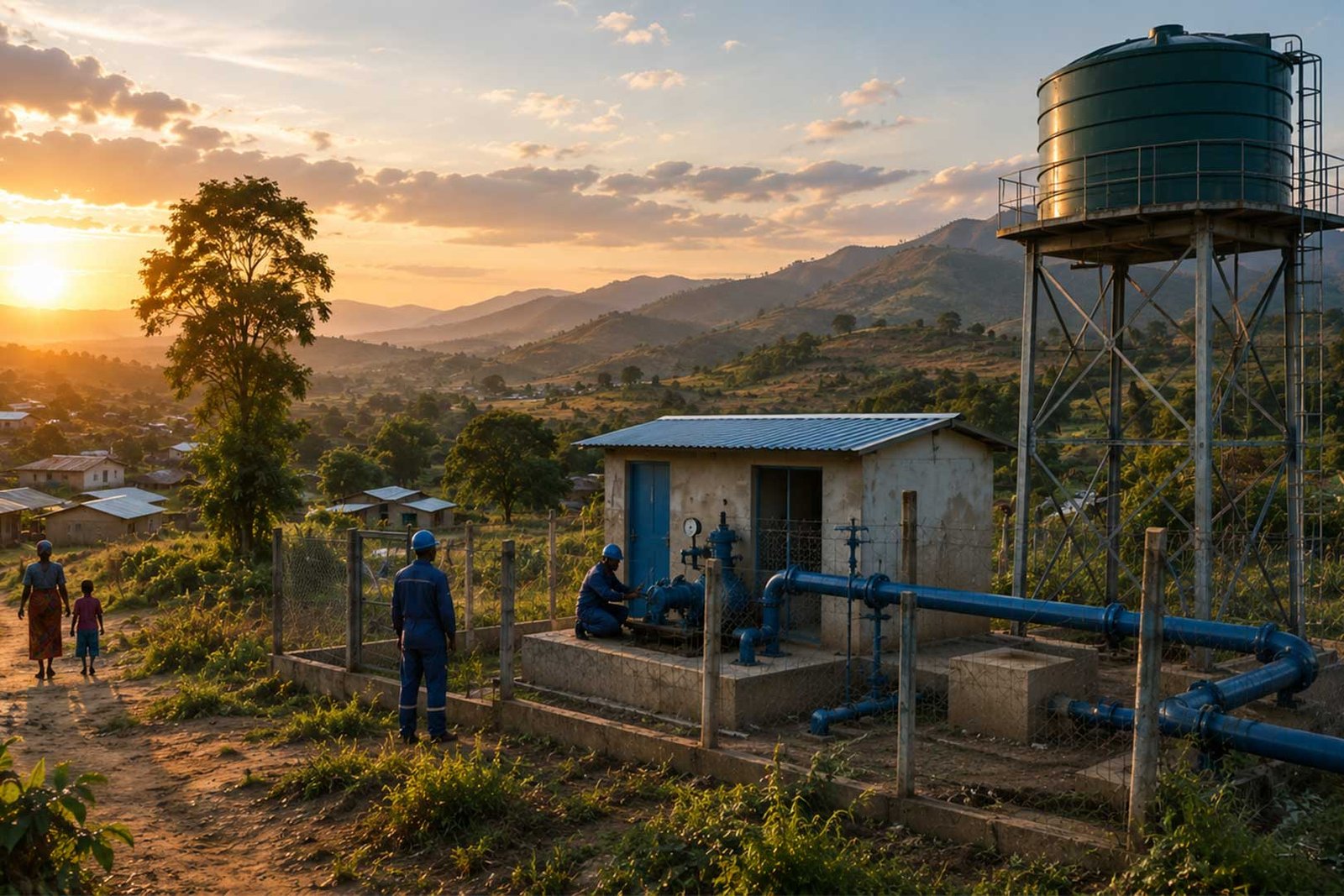
A climate-resilient project can be much more than a borehole.
You may be looking at deep groundwater feeding wellfields, collection mains, pumping stations, long-distance transmission, balancing storage, and several communities.
The AfDB Climate Resilient Urban and Rural WASH project includes source investigation, test drilling, feasibility, detailed design, environmental work, and tender-document preparation for future investment projects.
Bulk Water Transmission
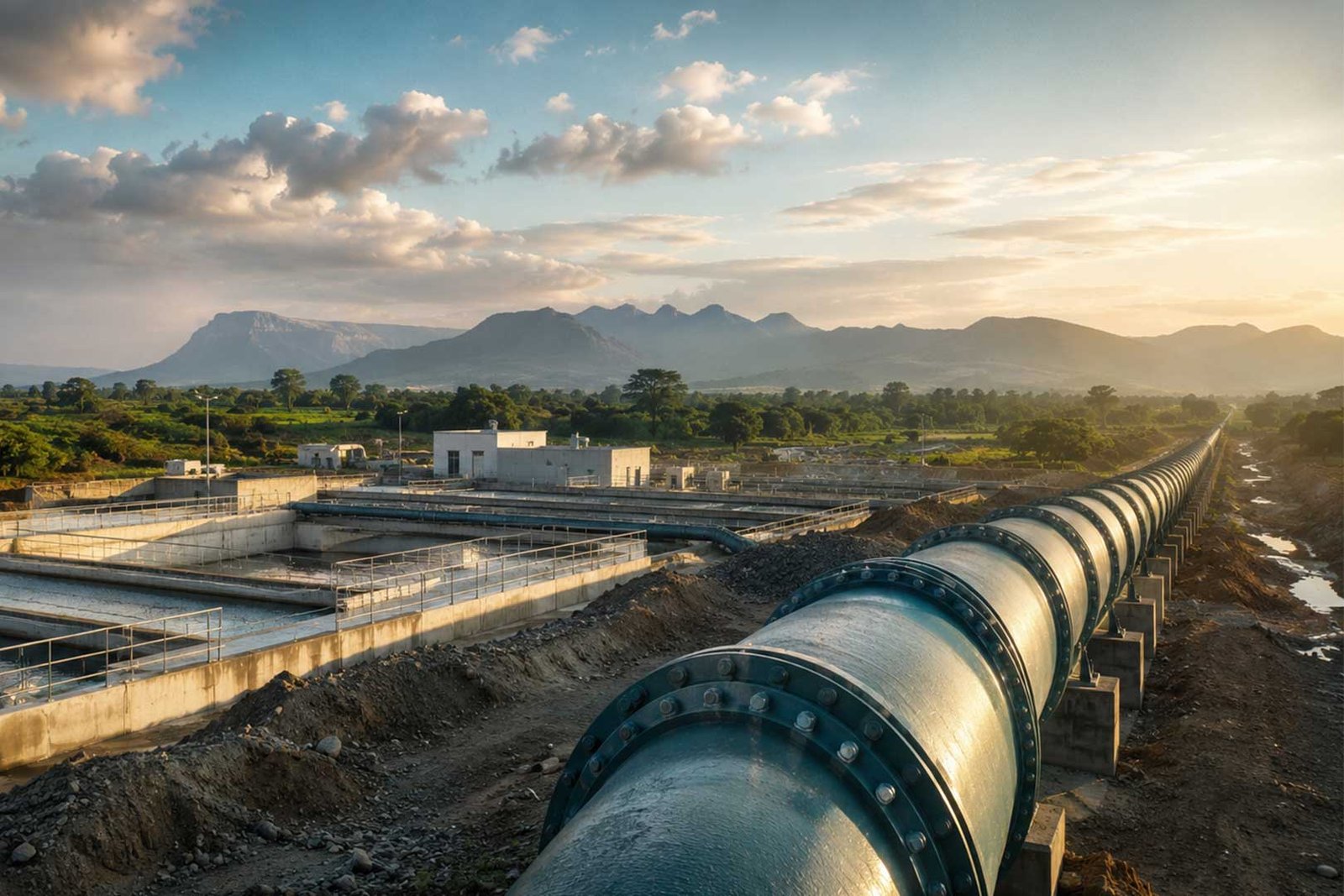
If you work with large pipeline systems, this is one of the areas to watch closely. Regional and multi-town systems may need long transmission routes, trunk or rising mains, wellfields, pumping stations, reservoirs, and electromechanical equipment.
Recent One WASH implementation has also included large-value water-supply contracts where pipes, fittings, and electromechanical goods represented a substantial part of the inputs.
Wastewater Infrastructure
Wastewater brings a different type of opportunity. Future projects may need gravity sewers, force mains, pumping stations, treatment connections, sludge pipelines, treated-effluent pipelines, and disposal or reuse infrastructure.
The Ministry of Water and Energy publishes wastewater and fecal-sludge project material alongside its wider water-sector resources.
Utility Modernization
Do not ignore projects that start with studies or operational improvements. NRW work, network rehabilitation, pumping optimization, hydraulic modelling, GIS, SCADA, metering, energy audits, and asset management can reveal bigger problems underneath.
An assessment may uncover weak pressure, missing storage, an undersized trunk main, heavy leakage, or a network that needs expansion. That does not guarantee a construction contract, but it can tell you where future investment may be needed.
The Role of GRP and Composite Pipeline Systems
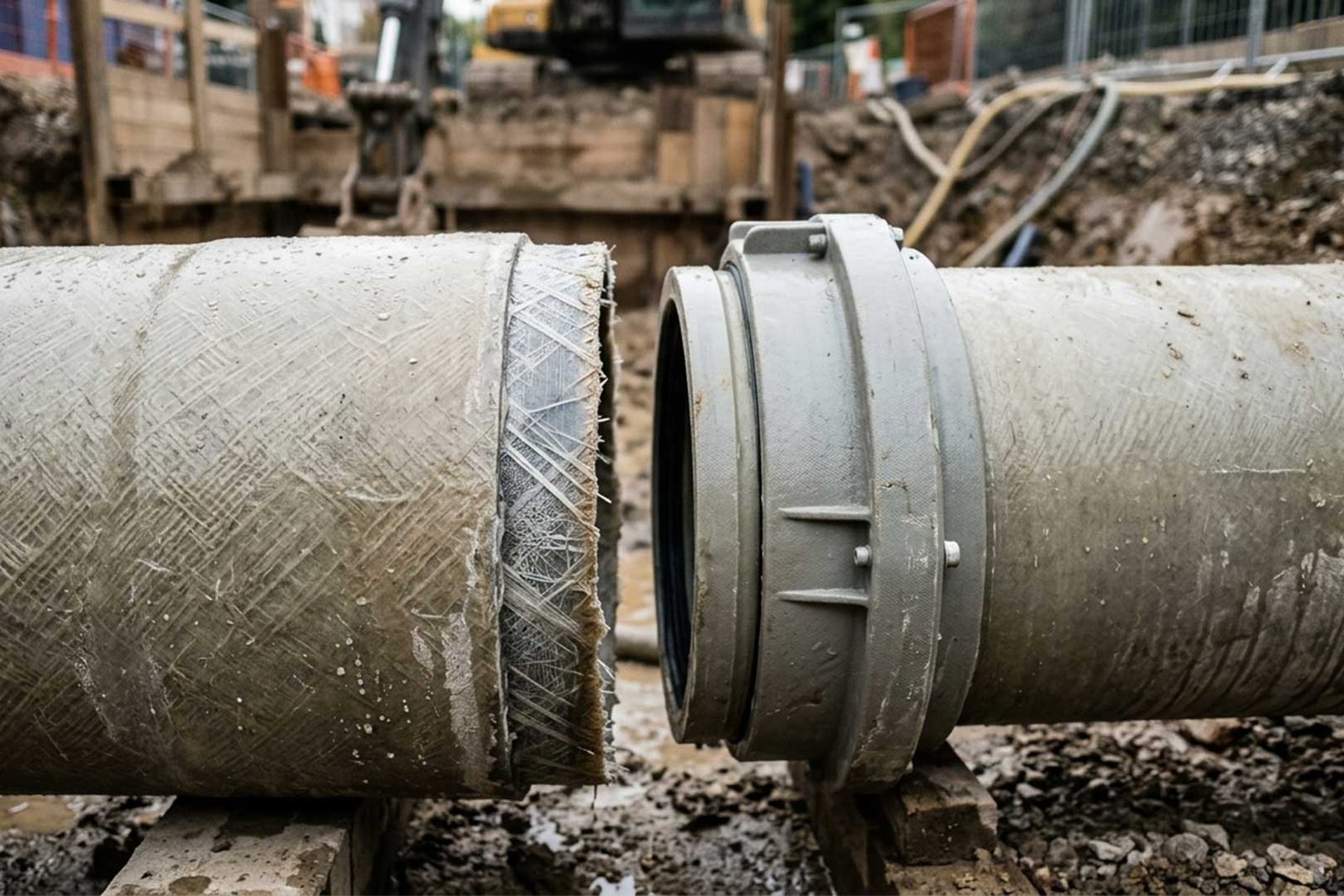
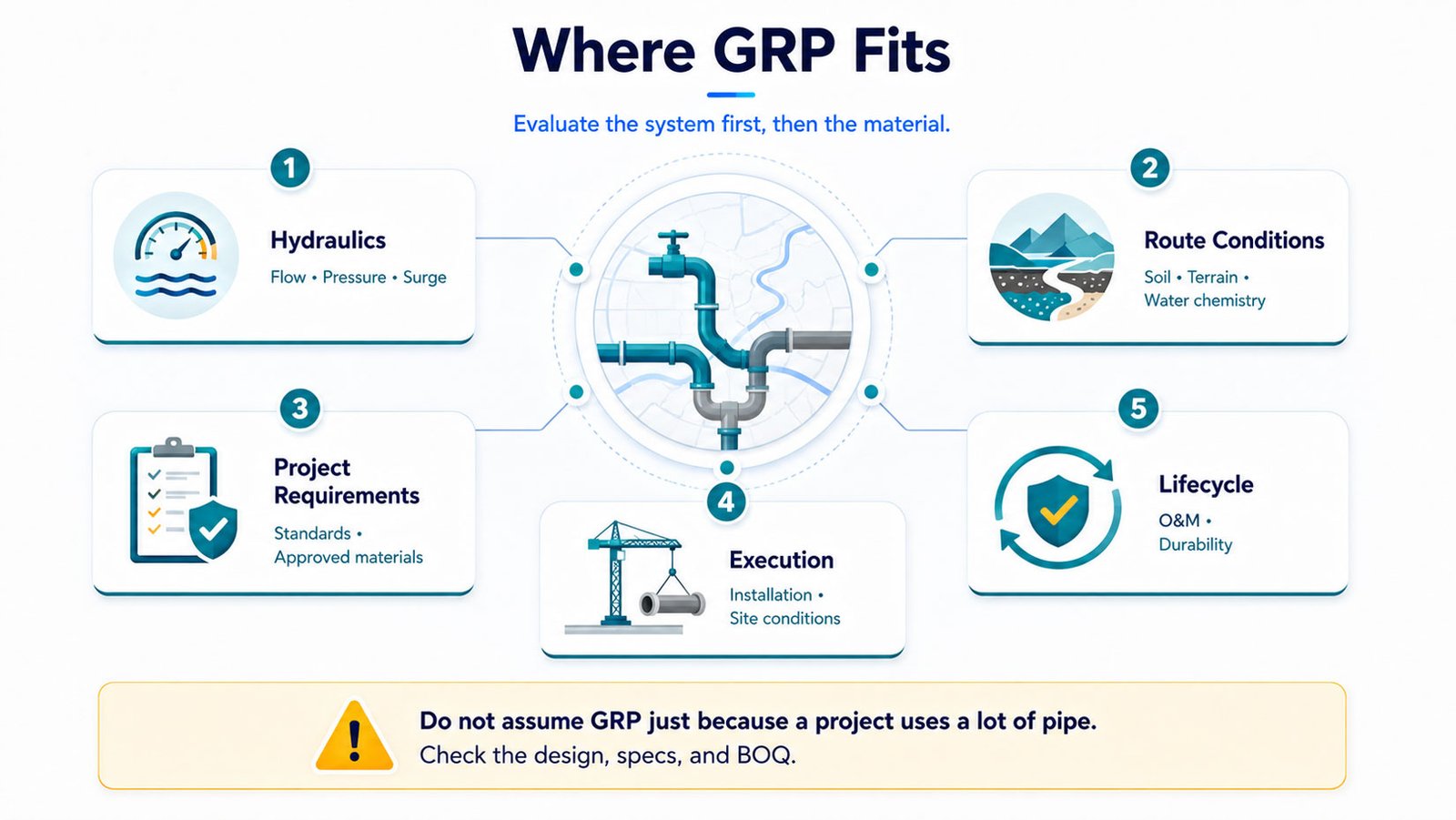
A growing water-infrastructure market does not automatically mean every transmission project is a GRP opportunity. You still need to look at the engineering. GRP and other composite systems may be worth evaluating for large-diameter or long-distance transmission where corrosion, hydraulics, handling, installation, or lifecycle performance matter.
Pumped systems bring friction into the picture because hydraulic losses can affect pumping requirements and energy use. Wastewater and aggressive environments can also put more attention on corrosion and maintenance. Before you make a material case, look at the actual project conditions.
- Hydraulics including flow, diameter, pressure, surge, and vacuum
- Route conditions including soil, water chemistry, terrain, and external loads
- Project requirements including utility standards and accepted materials
- Execution including installation capability and site conditions
- Lifecycle including O&M, maintenance, and long-term performance
Most importantly, do not assume GRP has been selected because a project requires a lot of pipe. You still need to see the design, specifications, and BOQ.
Early Signals That Reveal Future Projects
If you wait for the final tender, you get more certainty. You also get less time. Earlier documents can tell you whether a project is starting to get serious. These signals are available in Ethiopia now:
| Stage | Signals to watch | What they tell you | Why it matters |
|---|---|---|---|
| Financing | Approval, budget, additional finance, regional allocation | Funding is becoming clearer | Separates plans from serious projects |
| Preparation | Grant, TOR, source study, ESIA, detailed design | Technical scope is forming | Shows who is shaping the project |
| Procurement | Plan, GPN, prequalification, RFB | Packages and timing are clearer | Gives you time to prepare |
| Implementation | Award, progress report, restructuring, extension | Scope or timing may change | Reveals delayed or remaining work |
The World Bank published an updated One WASH-CWA procurement plan in August 2026. Ministry resources also continue to publish consultant TORs, safeguards material, design documents, finance information, and project resources.
That is why a consultant TOR, design contract, or restructuring document can sometimes tell you more about the future market than a list of open tenders.
How to Read Transmission Potential Before the Final Tender
Do not judge a project only by its title. A “regional water supply” scheme may hide a major transmission system underneath. Watch for terms such as:
- Regional supply including multi-town or multi-village systems
- Bulk conveyance including water transfer and trunk mains
- Pumped transmission including rising mains and booster stations
- Source development including groundwater and wellfields
- Storage including reservoirs and balancing tanks
Then connect the pieces. Where is the source? Does water need to be pumped? Is storage needed along the route? Are several towns being served? Is treatment part of the system?
You can use that information to understand the likely topology. But stop where the evidence stops. Do not invent pipe length, DN, pressure class, material, or EPC value. Those details should come from feasibility studies, designs, specifications, BOQs, or procurement documents.
Key Risks and Market Realities
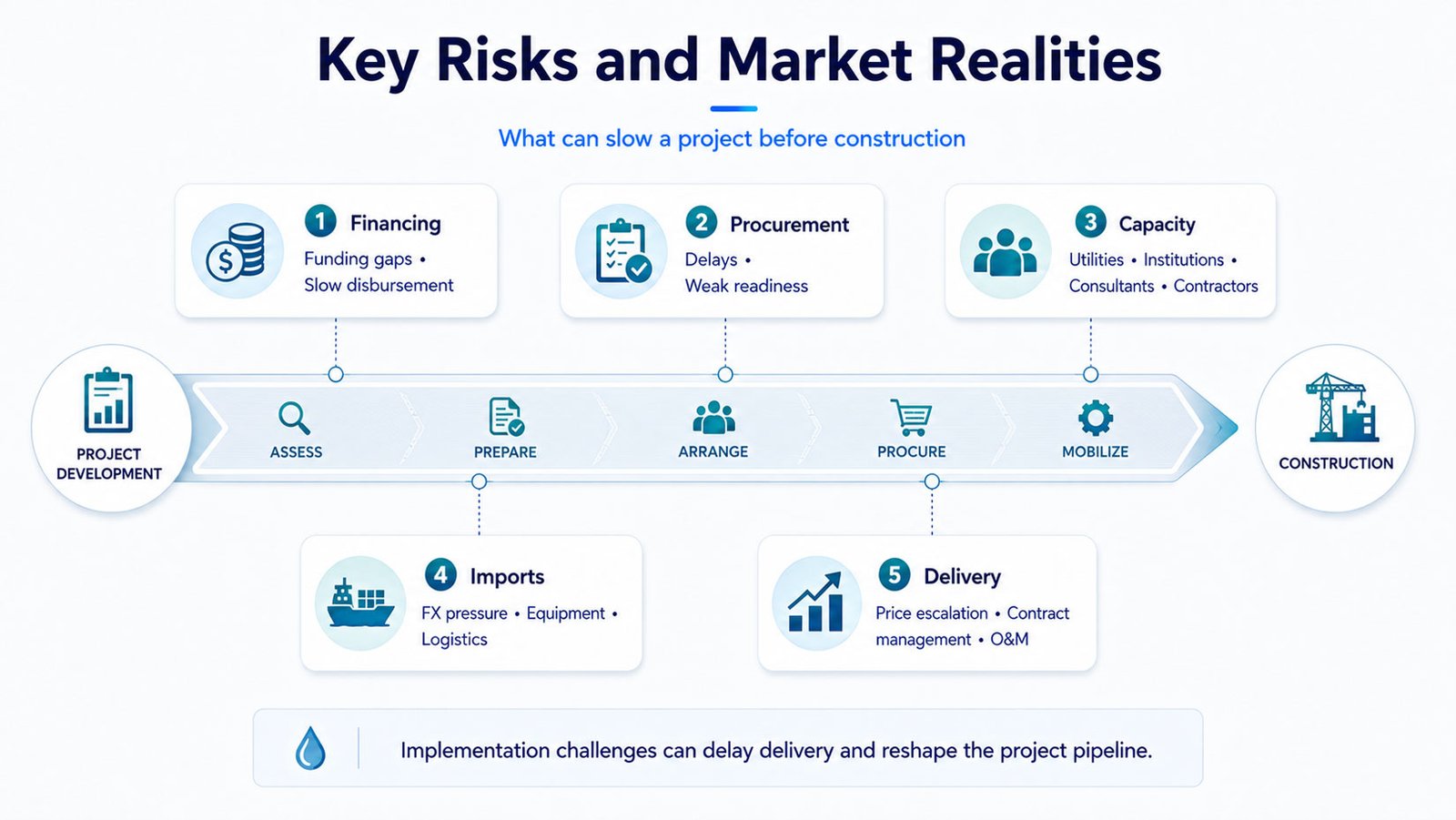
One WASH points to a large need for infrastructure. That does not mean every planned project will reach construction smoothly. Keep a few risks in view, including:
- Financing including funding gaps and slow disbursement
- Procurement including delays and weak project readiness
- Capacity including utilities, institutions, consultants, and contractors
- Imports including FX pressure, equipment availability, and logistics
- Delivery including price escalation, contract management, and O&M
Recent World Bank implementation experience shows how much these issues can affect the pipeline. Price escalation, procurement delays, drilling capacity, contractor and consultant performance, contract management, and imported pipes, fittings, and electromechanical equipment have all affected delivery.
What One WASH Means for Infrastructure Contractors and Solution Providers
One of the biggest benefits of understanding One WASH is seeing projects earlier. You do not have to wait until the tender is open to start deciding whether an opportunity fits your business.
Following financing, regional plans, consultants, design, and procurement can give you an earlier view of:
- Project maturity where serious opportunities are beginning to form
- Technical scope including transmission, pumping, storage, and wastewater
- Delivery fit including pipeline systems and possible EPC packaging
- IFI requirements including procurement, safeguards, and technical governance
That extra time matters. You can understand the project while the technical scope and contract structure are still taking shape.
For Grand LineCore, that means looking beyond a simple pipe order. Depending on the project, the opportunity may involve pipeline-system evaluation, transmission, pumping and storage interfaces, installation support, testing, commissioning, and integrated EPC delivery.
The Ministry of Water and Energy’s OWNP III update also points toward stronger national, regional, and local investment pipelines. That makes long-term project tracking even more useful.
The Opportunity Begins Before the Tender
One WASH becomes much more useful when you stop seeing it as a list of water targets and start seeing how those targets turn into projects. Financing tells you what may move. Project preparation tells you what is getting serious. Design starts defining the system. Procurement turns it into something you can actually pursue.
If you understand those stages, future opportunities in transmission, pumping, storage, wastewater, utility modernization, lifecycle pipeline systems, and EPC delivery become much easier to spot. And that is the real advantage. You are not waiting for a tender to tell you a project exists. You are already watching it take shape.
about
The Author
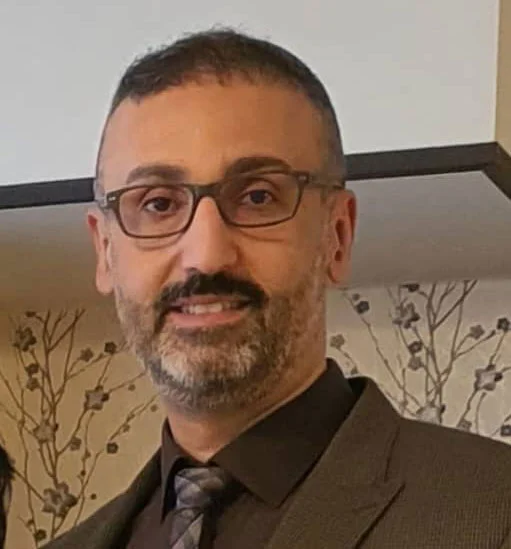
Farshid Tavakoli is a seasoned professional in engineering and international trade. Holding degrees in Electrical Engineering, Mechatronics, and a Doctorate in Business Administration (DBA) from the University of Lyon, he also has a strong background in industrial automation and production line technologies.
For over 17 years, he has led an international trading company, gaining deep expertise in commercial solutions tailored to industrial needs. With more than 8 years of active involvement in infrastructure development, he specializes in the supply of electromechanical equipment for water and wastewater treatment plants and transfer projects.
Together with comapny expert team, he now provides consultancy and integrated solutions for sourcing and implementing complex infrastructure projects across the region.