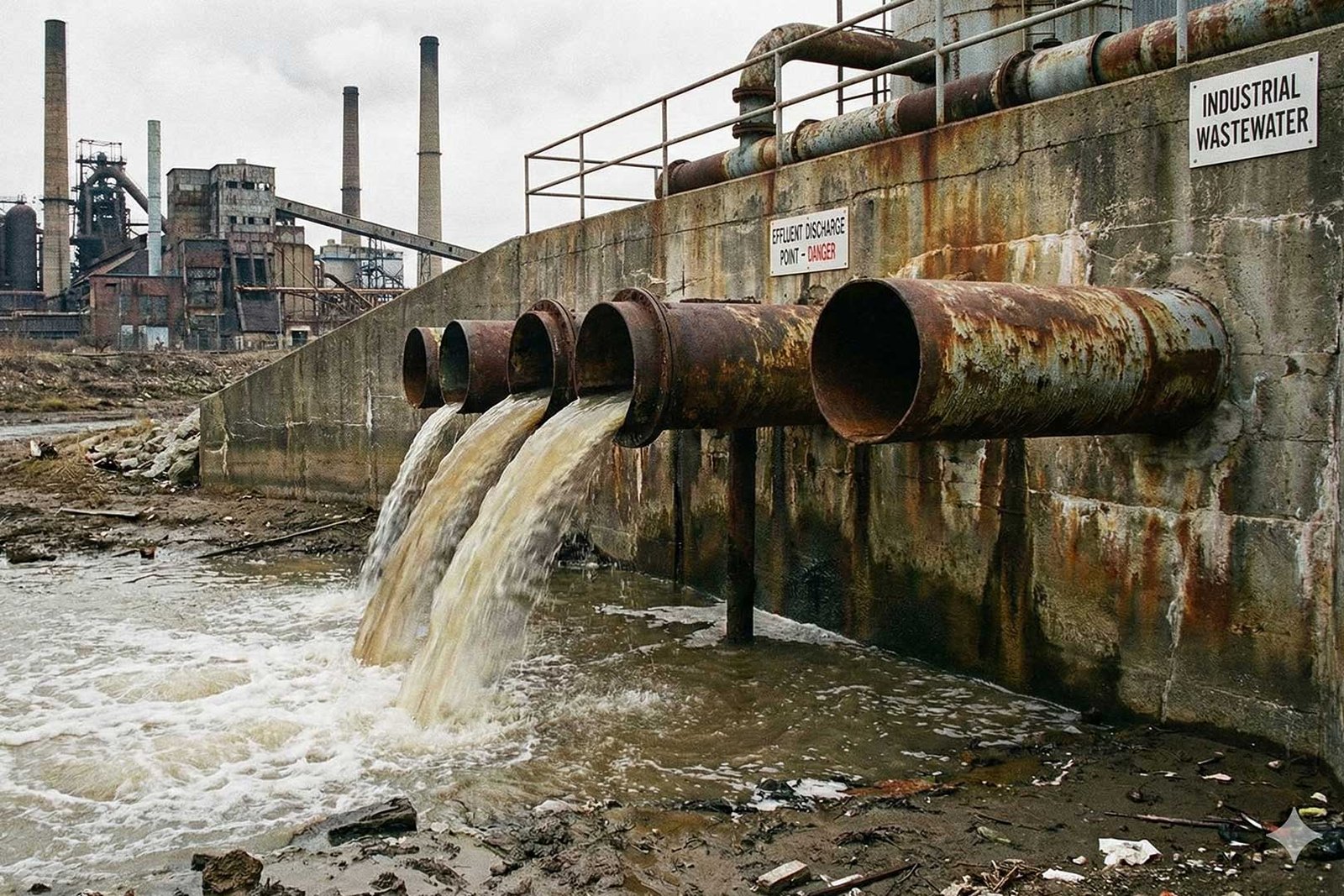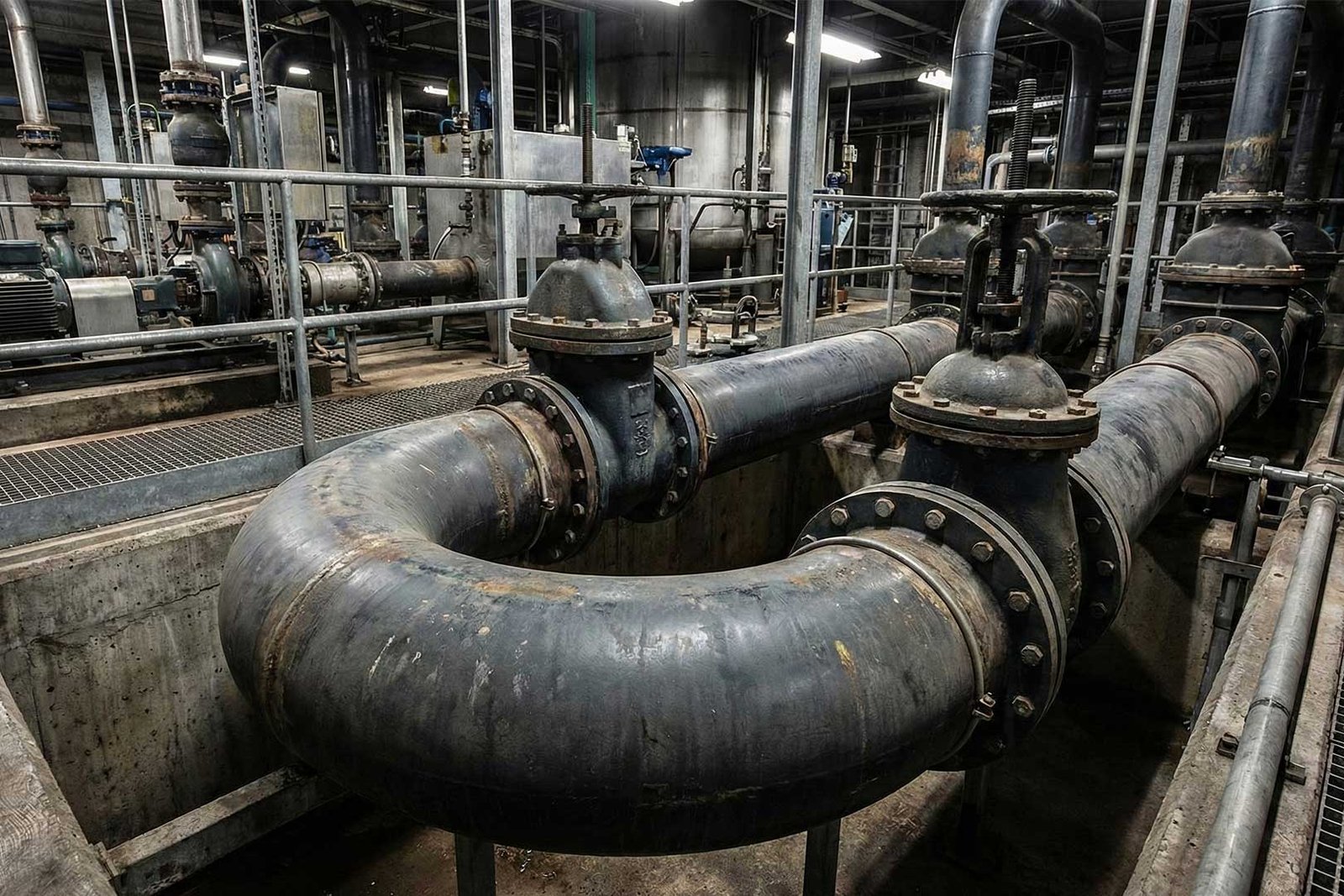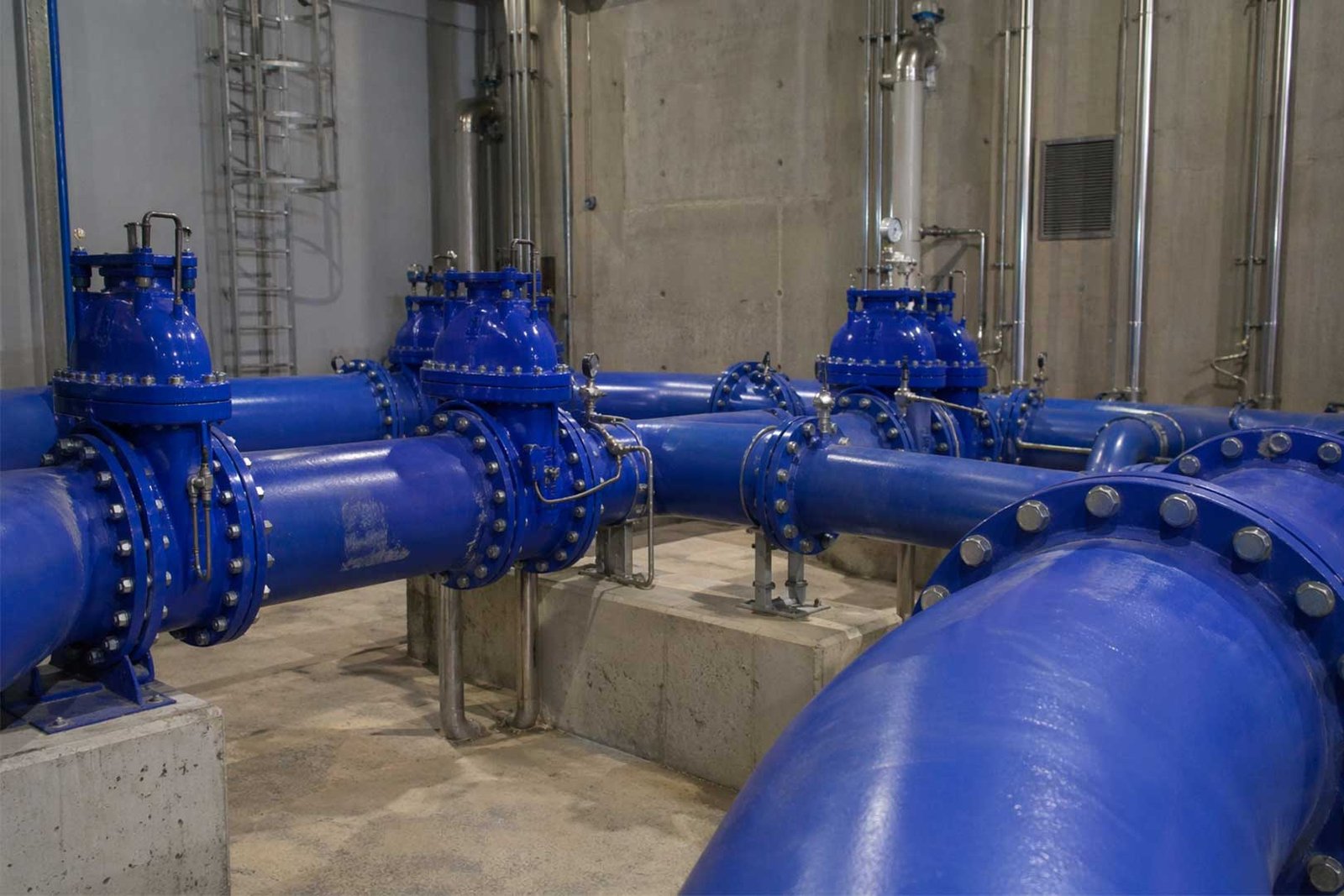
The Gulf Cooperation Council (GCC) region is where some of the most modern infrastructure projects are set up by drivers like Saudi Arabia’s Vision 2030 and the NEOM project. These projects require powerful buried piping systems for water transmission, desalination, sewage, or aggressive fluid transport. Due to the geological considerations of the GCC area, buried systems face settlement risks that force EPC contractors of composite pipes to guard the project from these geotechnical challenges.
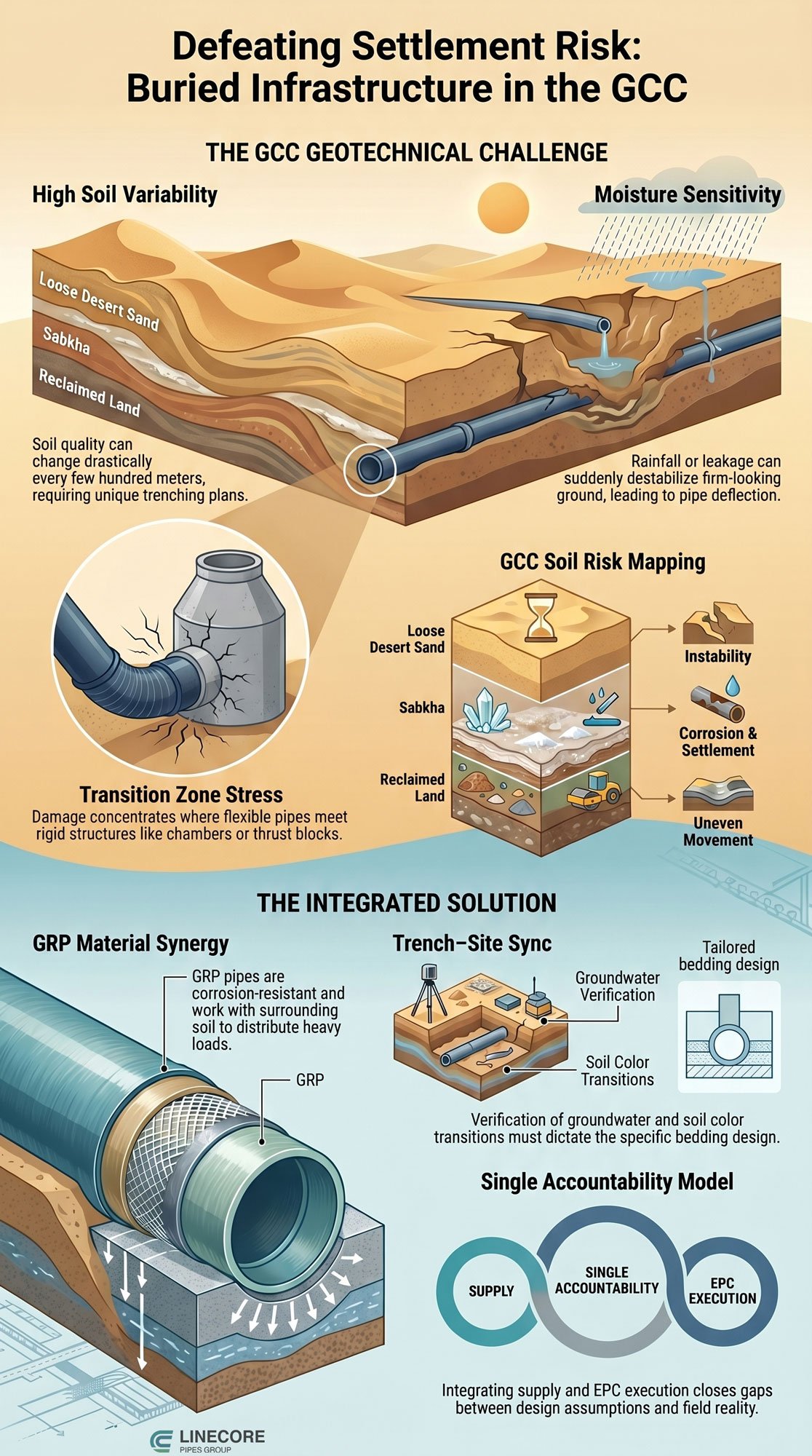
Defeating Settlement Risk: Burried Infrastructure in the GCC (source: Pipelinecoregroup.com)
Why Settlement Risk Matters in GCC Buried Infrastructure
Settlement risk is what threatens the pipelines in the GCC region; this phenomenon that originally comes from the geotechnical characteristics is a main issue, not just a theoretical topic for EPC contractors and manufacturers. What makes the situation even harder is the short-distance change between desert and coastal areas, where pipes must be routed. Other effective aspects:
- A look of dry ground that’s firm but changes when it becomes wet (by rainfall, leakage, or groundwater)
- The load volume or the compaction condition may change within the system’s length.
- Ground movement can affect other pieces of the system, like joints, fittings, chambers, or connection sections. (Source: ScienceDirect)
When the last option happens in water systems, it requires reworks, higher downtime, and further delays in projects plus huge long-term costs. As we mentioned in this section, settlement is a real issue in piping systems for pipes’ performance.
What Makes GCC Ground Conditions Different?
Ground conditions have such diversity across the GCC region that they represent a non-uniform pattern. In a short distance, soil quality might be changed so much that the condition of backfilling of pipe must be different. This issue pushes contractors to be attached to the science of soil and sandy areas with low cohesion or compaction. What else do contractors encounter?
- Sabkha soils with high salt content
- Reclaimed coastal area with changing compaction ratings
- calcareous soils with weak particle bonding
- Plus, imported fill adds to the dilemma
This complicity means a plan for trenching in one area does not certainly work for another one and requires a different plan for a few hundred meters’ distance. This problem stems from moisture, whether from rainfall or water leakage.
| Soil Type | Key Trait | Main Risk | Moisture Sensitivity |
|---|---|---|---|
| Loose Desert Sand | Low cohesion | Instability | High |
| Sabkha | High salt | Corrosion | Very High |
| Reclaimed Land | Variable compaction | Settlement | High |
| Calcareous Soil | Weak bonding | Erosion | Moderate |
| Imported Fill | N/A | Unpredictable | Variable |
The table above shows how differential settlement changes the game and adds burden for contractors in installation planning. More specifically, as MDPI highlights, when a section of pipeline moves more than another, it results in cracks or leakages. This uneven movement should be controlled as a driver of performance lags in buried pipelines.
The Most Common Settlement Triggers on Pipeline Projects
Settlement on piping projects is compounded by site conditions and execution gaps which the experience of contractors and site engineers during the time can prepare them for complex regions like GCC with variable soil compaction for the first issue.
Poor Trench Preparation
As a main cause in the trenching, whether for uneven trench holes or soft spots that weaken how much pipes can bear under heavy loads. Also, incorrect bedding and backfilling is what adds to the variable density of soil compaction, where all leads to uneven settlement. (Source: Springer)
Control of Moisture in Sandy Fills
As a vital factor in pipe settlement, the moisture of sand must be measured when too dryness or wetness of it can change the whole system of protection and foundation of pipe bedding or placement. What can add to the problem:
- Shallow groundwater
- Saline conditions
- Leakage during testing or operational sections
Fast-Track Construction
This point can limit the proper soil verification while adding to the chance of weak zones’ ignorance.
- Pro Tip: Where stiffness is changed in transition areas like chambers, thrust blocks, and other structures that convert the concentration of stress and movement, a changeable installation plan can avoid uneven settlement.
What Settlement Looks Like in Buried Transmission Systems
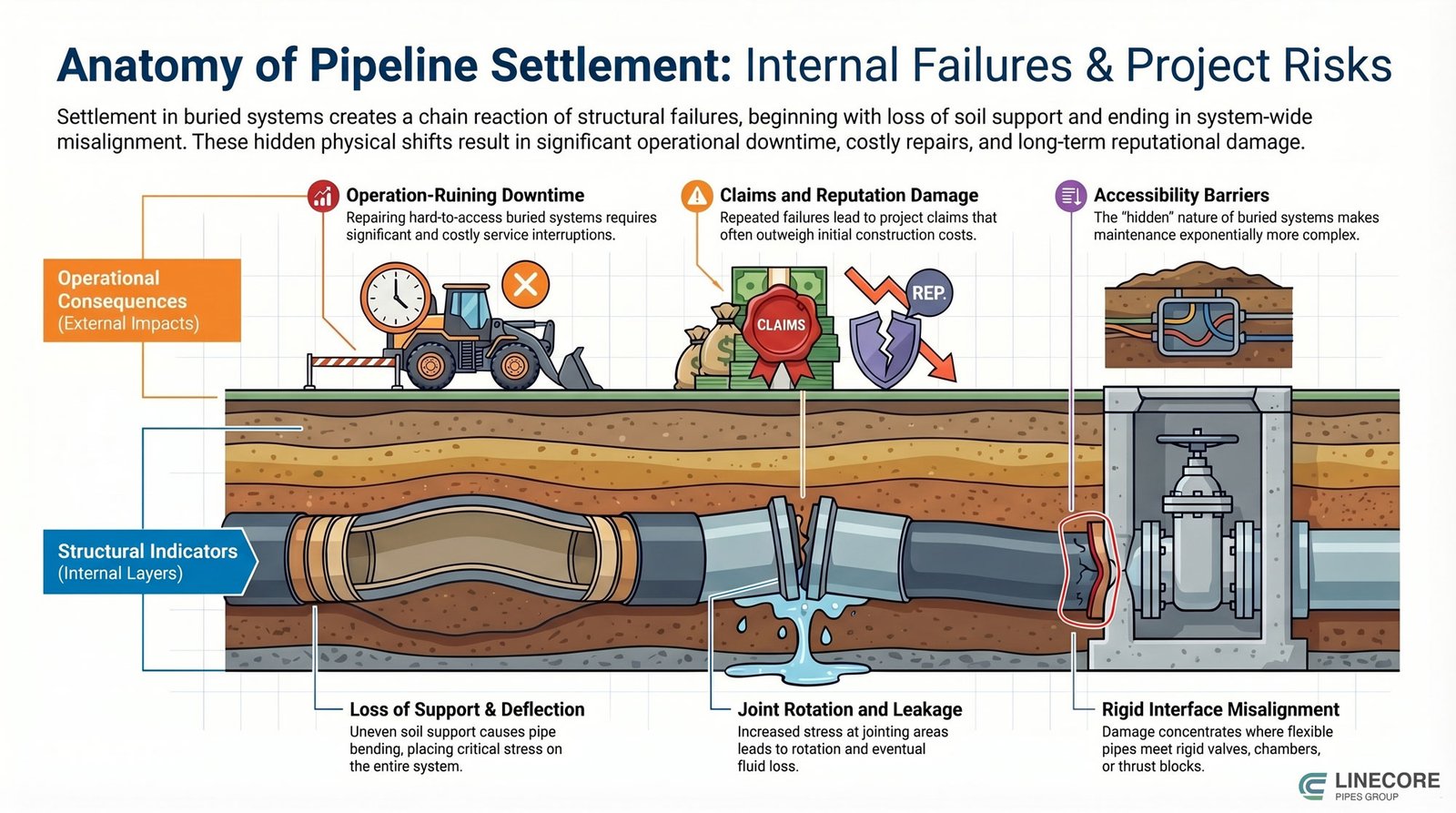
Settlement in buried transmission systems does not stay hidden for long. It shows up through clear physical signs that site teams and operators can observe during inspection or operation.
The first indication is often a loss of complete support around the pipe. When support is uneven, the pipe shows deflection or bending in some sections. (Source: ScienceDirect) This movement may seem not that important at first, but it adds stress on joining areas. Over time, joints may rotate a bit and result in leakage.
Misalignment is another common outcome. Chambers, fittings, and connection points may no longer sit in line with the pipeline. This creates additional stress, especially at rigid interfaces where flexibility is limited. Damage tends to concentrate in these areas, including around valves, thrust blocks, and other appurtenances.
What If All Else Fails
From a project manager perspective, these issues represent the actual consequences. Repairs or maintenance are not easy in hard-to-access buried systems, which can lead to prolonged downtime and increased operational costs.
Furthermore, downtime ruins the whole operation, while repeated failures can add to the claims and dissatisfaction. In many cases, the long-term problems with performance and reputation outweigh the initial construction cost.
Why Pipe Material and Installation Approach both Matter
Pipe material selection is a game-changer in long-distance transmission projects across the GCC, while the installation approach is what shouldn’t be neglected either.
What Material is the Best Option for Buried Systems?
GRP (glass-reinforced plastic) is what fits in this environment. A corrosion-resistant, well-performed in saline conditions that can handle large-scale water transmission lines with no flaws included. Low maintenance needs make GRP a winner compared to metallic pipes with no degradation under aggressive ground conditions.
But What Can Make GRP Pipe Fail in Buried Systems?
That said, GRP pipelines do not function as standalone structural elements. Their performance depends on interaction with the surrounding soil. The pipe and the embedment work together to carry loads. If bedding quality is poor or compaction is inconsistent, that interaction breaks down. (ResearchGate)
What if All Goes Right with the Design?
Even a well-designed GRP system can show reduced performance when settlement control is weak. An uneven support results in deflection, joint stress, and long-term issues. For this reason, material selection and installation approach must align from the start rather than be treated as separate decisions.
What Contractors Should Do before Construction Starts
To set the foundation correctly, thought-provoking preconstruction decisions should be made. Before the excavation step, contractors need a clear perception of what ground conditions are required for a well-performed pipeline’s installation system.
Identification of Crucial Zones
This factor is essentially considered when areas like Sabkha areas, sand dunes, reclaimed land, and sections with mixed or uncontrolled fill should be mapped in detail.
- These zones usually require different support or trenching methods to control the changes.
- Alignment transitions must be reviewed where pipes cross the roads or connect the chambers.
Confirmation of Groundwater Conditions
This condition must be verified, not just assumed. Consider that even shallow water tables or wet areas can make changes in trench size and stability.
This information is a guide for both excavation planning and material selection that we’ve discussed in the last section.
Trench–Site Sync
This process involves both pipe systems and trench configurations to match what is really going on at the site. As the soil condition is not stable in the GCC region, a single standard does not work for all sections.
- Settlement Warning: Do not treat the whole system the same; this might cause uneven performance and further settlement dilemmas.
Good Site Practices that Reduce Settlement Risk
On-site execution is what makes projects different; this roots in the manager’s experience. Small changes in installation approach can result in uneven support conditions and an increase in the chance of settlement. Check the table below to define what indicator can be worked as a suggestion to avoid settlement dilemmas.
| Indicator | What it suggests |
|---|---|
| Soft spots in trench bottom | Reduced bearing capacity and uneven support |
| Change in soil color or texture | Transition zone with different behavior |
| Water seepage into trench | Potential weakening of soil structure |
| Over-excavation with poor replacement fill | Loss of designed support conditions |
| Uneven support near chambers | Risk of stress concentration and misalignment |
Why Integrated EPC Thinking Reduces Risk
Settlement cannot be treated as only a soil problem or only a material issue. It sits at the intersection of design, product selection, and site execution. When these elements move forward with no coordination, there appear some gaps that result in further failures.
- Site-Aligned Design: Better final roots on how alignment works across all the project’s measures. The pipe you choose needs to work with both the surroundings and the structure; that’s why a good understanding on the routes with the actual conditions of the site is necessary.
- Installation QC: The joint approach, trench configuration, and bedding details must all operate together, not as separate design inputs. Quality control inspections during installation and commissioning then make sure that the system works as it should.
- Single Accountability: When supply and EPC execution sit with different parties, responsibility tends to fragment. Design assumptions may not match field practices, and site conditions may not feed back into engineering decisions.
A total-solution approach closes these gaps. LineCore Pipes Group operates as a GRP pipe supplier, an EPC execution partner, and a practical risk-management partner for water transmission lines. This model design makes the manager’s intention and on-site facts connected, which can decrease the stress of failure and improve long-term performance.
What Clients And Contractors Should Look For In A Project Partner
Choosing a project partner involves more than just looking at product details. The risk of settlement depends on how well that partner knows how things really are on the site and how to turn that knowledge into useful solutions.
1. GCC Soil Challenges
A major concern is whether the provider has worked with soil that changes from one place to another in the Gulf Cooperation Council. This comprises areas of sabkha, land that has been reclaimed, and soil profiles that are mixed. If you don’t grasp this, design suggestions could not be based on real problems in the field.
2. Installation & Components
Capability should go beyond just supplying pipes. The spouse needs to help with the installation process, which includes choosing the bedding, designing the trench, and compacting the soil. Not only straight pipeline portions should be looked at, but also important parts like couplings, fittings, chambers, and transition zones.
3. EPC & Quality Assurance
Another important factor is EPC coordination. A partner that can connect design and execution lowers the chance that plans and site procedures will be out of sync. Finally, it’s important to have a clear and useful structure for QA and QC. This involves checks for the right way to prepare a trench, place materials, and make sure that the compaction is consistent.
LineCore Pipes Group: From Pipe Supply to Project Performance
Settlement risk across the Gulf Cooperation Council can be controlled with early decisions and the right execution model. Water transmission projects need alignment between pipe material, trench support, and field practice. LineCore Pipes Group combines GRP pipe supply with EPC capability and practical site understanding, which helps reduce performance gaps. Planning a pipeline in desert, sabkha, or variable soil conditions? Get in touch with LineCore’s team to combine design and execution from scratch.
about
The Author
Farshid Tavakoli is a seasoned professional in engineering and international trade. Holding degrees in Electrical Engineering, Mechatronics, and a Doctorate in Business Administration (DBA) from the University of Lyon, he also has a strong background in industrial automation and production line technologies.
For over 17 years, he has led an international trading company, gaining deep expertise in commercial solutions tailored to industrial needs. With more than 8 years of active involvement in infrastructure development, he specializes in the supply of electromechanical equipment for water and wastewater treatment plants and transfer projects.
Together with comapny expert team, he now provides consultancy and integrated solutions for sourcing and implementing complex infrastructure projects across the region.