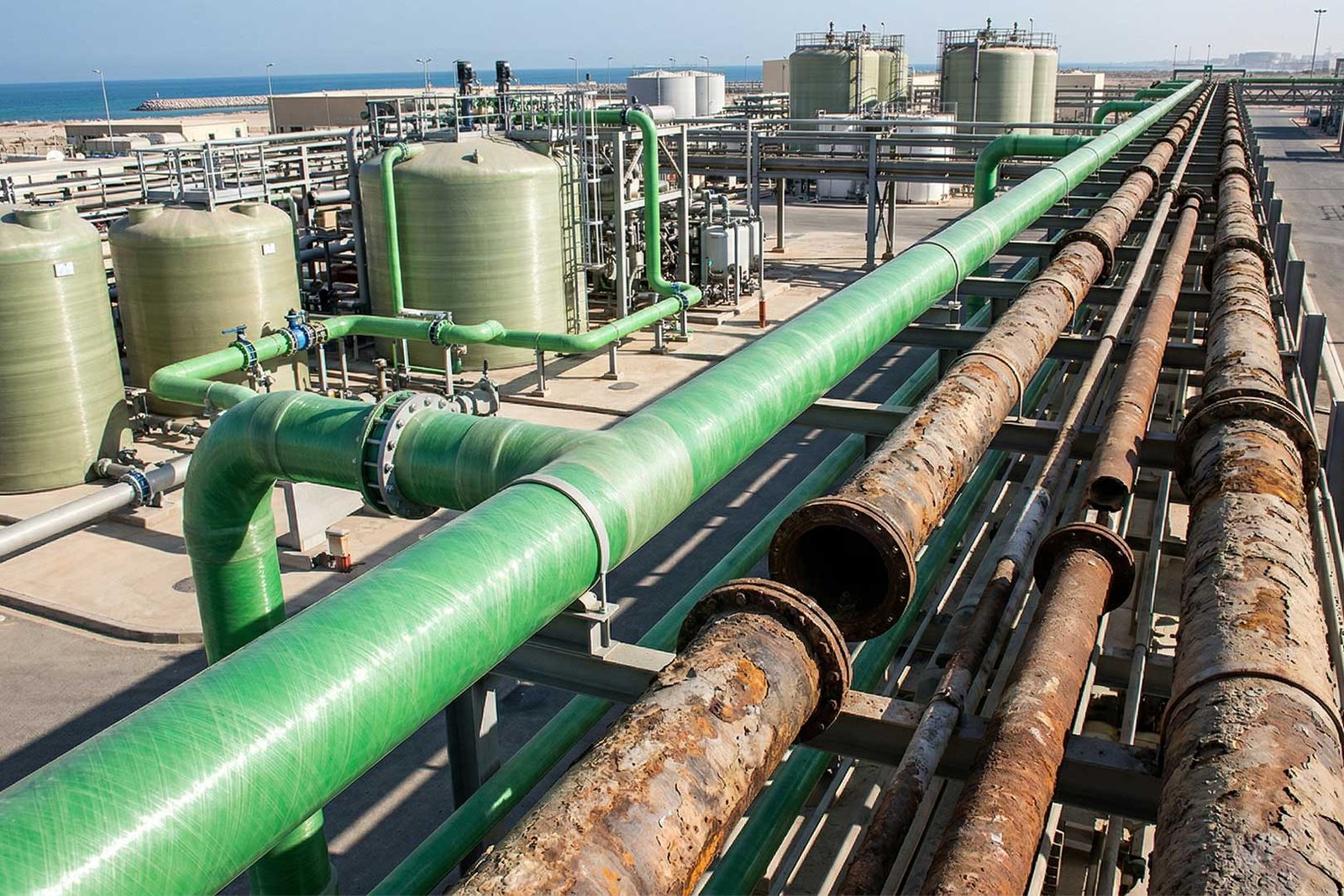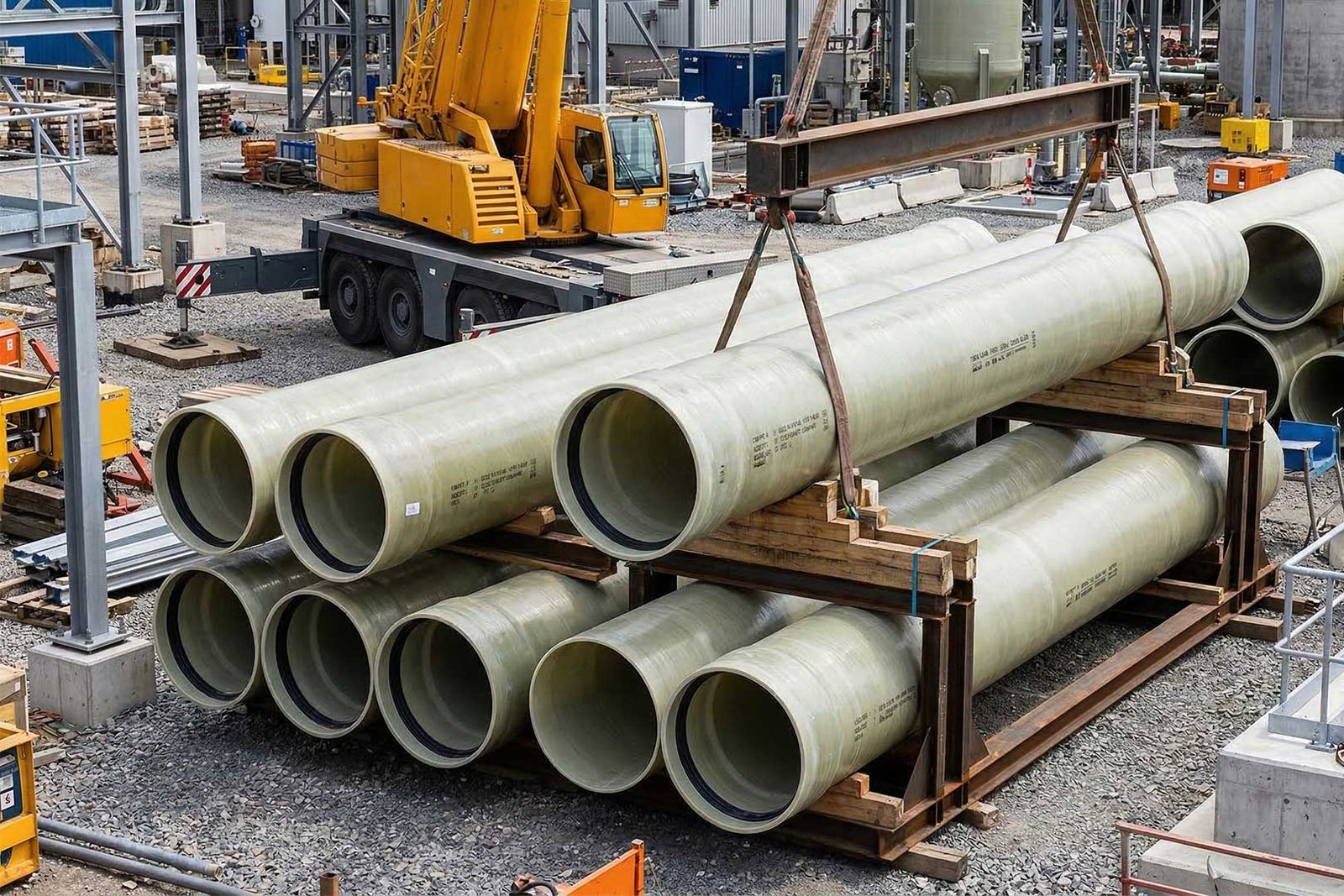
GRP pipes are always a winning option compared to heavy steel or ductile iron. Their weight is almost a quarter or even a tenth less than that of its competitors, which makes transportation much easier, installation much faster, and costs far lower. Although GRP’s lightweight is obvious, many projects require its precise weight per meter.
The weight of GRP pipes depends on factors such as size, pressure rating, and manufacturer. If you are one of those looking to calculate GRP pipe weight, here is the right stop. In this post, we will tell you their typical weights by diameter, how different PN pressure classes change the weight, why figures vary between suppliers, and where to find the precise, up-to-date numbers.
What Does GRP Pipe Weight Mean? (Pipe Weight per Meter Breakdown)
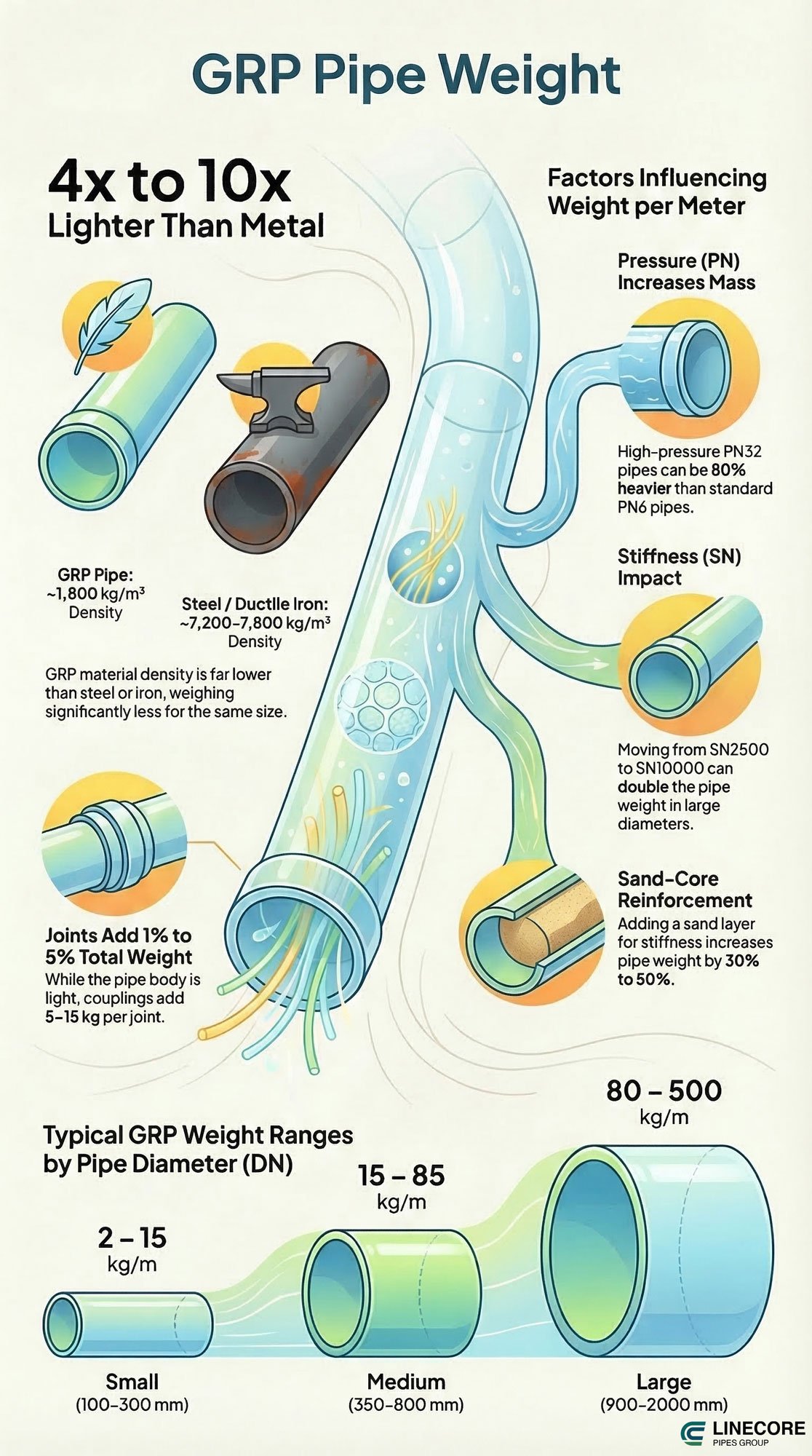
grp pipe weight infographic (source: Pipelinecoregroup.com)
GRP pipe weight refers to the weight per meter calculated for the pipe body. In other words, joints, couplings, and fluid inside the pipe are not counted in this weight (source: Scribed). Every chart or datasheet you see uses this standard figure. Still, there are some other subcategories for GRP pipe weights as well, and we compare them as follows:
Pipe Weight per Meter vs Total Line Weight
Pipe weight per meter simply means how much one meter of the pipe barrel (the main tube) weighs. It gives you a quick idea of how heavy the pipe is before installation or transport. In most cases, the weight falls into these general ranges:
- 2 to 15 kg per meter for small diameters (DN 100–300 mm)
- 15 to 80 kg per meter for medium diameters (DN 400–1000 mm)
- 80 or 200 kg or more per meter for larger sizes
On the other hand, the total weight means everything together, the entire system. All parts of the pipe, in addition to the couplings, fittings, or even the weight of the flow, are considered. It is required for budgeting and structural examination.
Nominal Weight vs Theoretical Weight
Nominal weight is exactly that standard weight written in catalogs and considers the wall thickness, the pipe density, or other factors. This is required for planning or suitable for quotes.
On the other hand, we have theoretical weight, the basic weight of the pipe that is calculated based on the following formula:
Weight per meter = Pipe Wall Volume × Density × 1 m
As you see, it is just a little different from nominal weight because of slight changes in wall thickness, the exact mix of resin and glass, or normal production variations
Pipe Body Weight vs Joint & Coupling Weight
Pipe body weight is only the weight of the long straight part of the pipe (the tube or barrel). It does not count the ends or the parts that connect pipes. This is the main weight you see in weight-per-meter lists and charts.
Joint and coupling weight is the extra weight from the pieces that join two pipes together, such as joints or couplings. Each one usually weighs 5 to 15 kg.
Pro Tip: When you put many pipes together, these extra pieces add about 1% to 5% more weight to the whole line.
Installed Weight vs Shipping Weight
Installed weight is the total weight when the pipeline starts working, and the installation is finished. Everything in this stage is calculated, the joints, the water or fluid, and various sections of the pipe. The soil around the pipes is also considered. This number helps engineers make sure the ground and supports are strong enough for a long time.
Shipping weight is only the weight when the pipes are being delivered to the site. It includes:
- The bare pipes (big ones are often put inside each other like nesting dolls to save space),
- The couplings and fittings are packed separately in boxes or crates.
Core Engineering Variables That Control GRP Pipe Weight
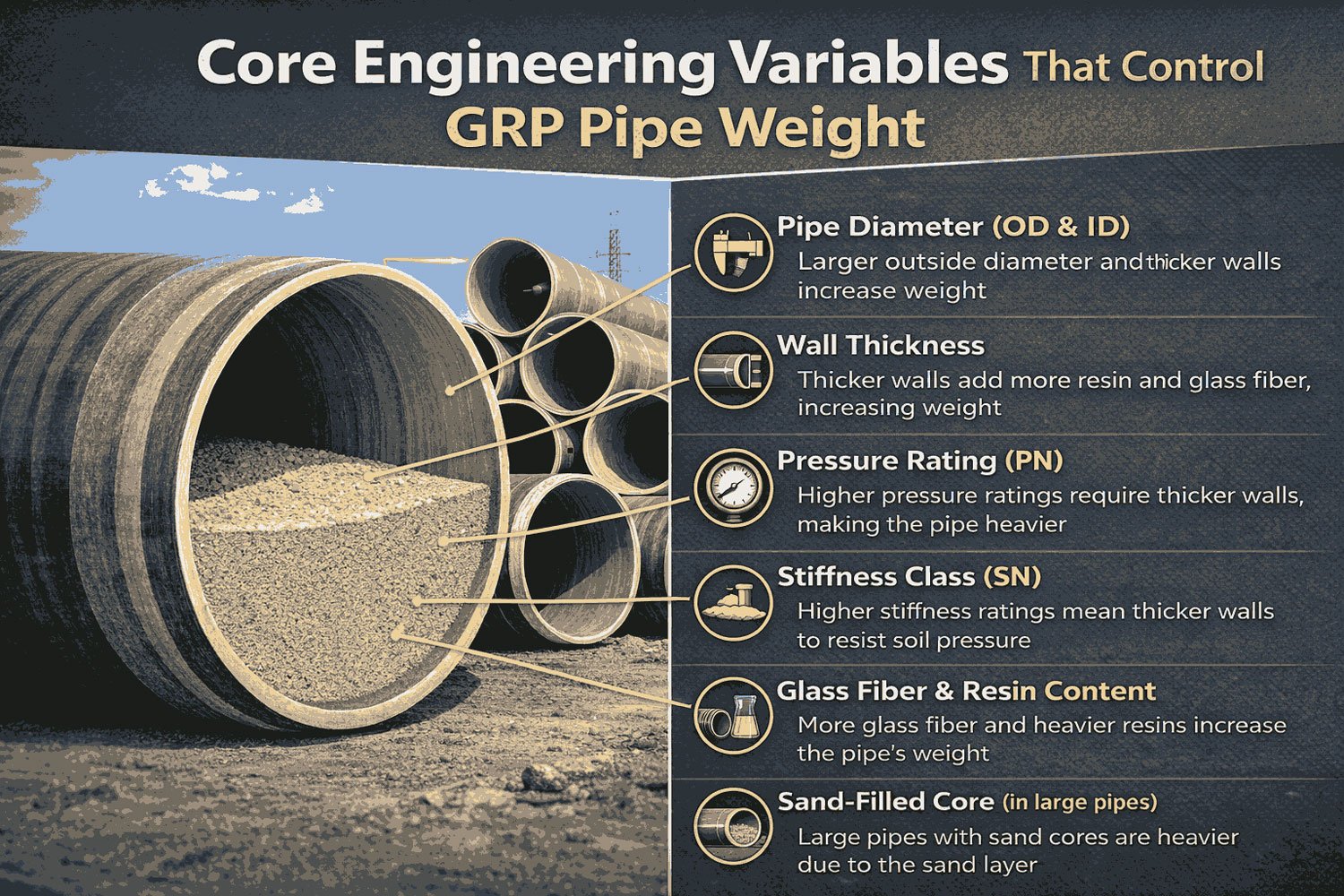
There are a variety of factors that control the GRP pipe weight as a whole. Knowing these factors helps you have a more precise calculation and approach. Below we have listed them for you:
Pipe Diameter (OD & ID): The bigger the outside diameter, the heavier it is, as it needs more material. Also, when the walls get thicker, the inside opening gets smaller, and the pipe weighs even more.
- Wall Thickness: The thickness of the pipe wall is the biggest factor in weight. Thicker walls use more resin and glass fibers, making the pipe much heavier.
- Pressure Rating (PN): Pipes with a higher pressure rating need thicker walls. According to ScienceDirect, this makes them up to 50% heavier than pipes with a lower rating.
- Stiffness Class (SN): Higher stiffness ratings help the pipe resist soil pressure and traffic. They need thicker walls or extra layers, and it also means the pipe will weigh more.
- Glass Fiber & Resin Content: Using more glass fibers makes the pipe stronger, but it also makes it a little heavier. Different resins have slightly different weights, so choosing a heavier resin equals extra weight.
- Sand-Filled Core (in large pipes): In large pipes, manufacturers add a sand layer in the middle of the wall. The sand makes the pipe heavier to a significant extent.
How GRP Density and Composite Layer Structure Impact Pipe Weight?
Glass fiber and resin that are used in making GRP pipes have a low density (almost 1700–2000 kg/m³). Compared to ductile iron (7200 kg/m³) and steel (7800 kg/m³), GRP pipes are almost 4–5 times lighter when it comes to the material. But this is not the end of the story!
GRP pipes are made in smart layers. The fibers are placed only where strength is needed, so no extra material is added. This keeps the pipe strong without making it heavy. Because of this design, GRP pipes are usually 4 to 10 times lighter than steel or iron pipes of the same size and pressure rating.
How to Calculate GRP Pipe Weight (Simple Engineering Formula)
Although seeming tough and complicated, you can calculate the GRP pipe weight through simple formulas. We will break down the things you should know in this formula and the final calculation as follows:
Geometric Model: Treating the Pipe as a Hollow Cylinder
A GRP pipe is a thick-walled tube. The outer diameter (OD or Do) is the complete width from the outside edge. The interior diameter (ID or Di) is the space inside where the fluid flows. The wall thickness is between these two diameters. We can only use these measurements to figure out the solid wall section.
Cross-Sectional Area of the Wall
The wall of the pipe forms a ring shape in the cross-section. To find the area of this ring (only the solid wall part), we use this simple formula:
A = (π / 4) × (OD² − ID²)
A is the wall area in square meters. π is about 3.1416. Both OD and ID should be in meters.
Volume per Meter of Length
We calculate the weight for one meter of pipe at a time. The wall material in one meter of pipe has a certain volume. This volume is very easy to find; take the cross-sectional area of the wall (A) and multiply it by 1 meter. So volume per meter equals wall area (A) in cubic meters per meter.
Example: If the wall area is 0.030 m², then one meter of pipe contains 0.030 cubic meters of GRP material.
Applying GRP Material Density
Density tells you how heavy the GRP material is for each cubic meter of space. As published on AVK, most GRP pipes have a density between 1700 and 2000 kg per cubic meter. Many manufacturers use around 1800 kg/m³ as a typical average value. To find the weight per meter, you simply multiply the volume per meter by this density number.
Final Weight Formula
The complete formula for GRP pipe weight per meter is:
W (kg/m) = density × (π / 4) × (OD² − ID²)
Use OD and ID in meters, and density in kg/m³. The result gives the weight in kilograms per meter for the pipe barrel only.
Practical GRP Pipe Weight Calculation Examples
In the table below, we have defined some of the most probable situations to happen in real projects. These examples clarify how you can exactly calculate the GRP pipe weight effectively and simply:
| Example | Pipe Specs | Weight per Meter | Total Pipe Body Weight | Notes / Key Insight |
|---|---|---|---|---|
| Small Diameter, Medium Pressure | DN 250 mm, PN 10, SN 2500, 12 m | 10 kg/m | 120 kg | Light – hand or small forklift |
| Large Diameter with Sand Core | DN 1600 mm, PN 6, SN 10000, sand core, 12 m | 280 kg/m | 3,360 kg | Sand adds 30–50% weight; crane needed |
| Total Project Pipeline Weight | 1,000 m, DN 800 mm, PN 16, 50 kg/m | 50 kg/m | 50,000 kg + 800 kg (80 couplings @ 10 kg) = 50,800 kg | Include couplings for budgeting |
| Adding Fittings, Flanges & Couplings | 1,000 m DN 800 line | 50 kg/m | Pipe 50,000 kg + fittings 1,900 kg = ~51,900 kg | Fittings add ~4%; factor early |
| Estimating Shipping Container Load | 40 ft container, DN 1200 mm, 180 kg/m, 12 m | 180 kg/m | 10–12 pipes nested ≈ 21,600–25,920 kg | Volume-limited; nesting saves space & cost |
GRP Pipe Weight per Meter by Diameter Range
The diameter category also affects the GRP weights. “How?” you ask? There is a series of weight ranges according to the pipe’s diameter. Although these ranges also depend on the manufacturer, pressure class, and stiffness class, we can consider them as follows:
- Small Diameter Pipes (DN 100–300): These are really light (between 2 and 15 kg/m) and easy to carry and install.
- Medium Diameter Pipes (DN 350–800): These are rather light as well, something between 15 and 85 kg/m.
- Large Diameter Pipes (DN 900–2000): We reach the heavier pipes because of thicker walls. These are usually 80–500 kg/m
- Ultra-Large Infrastructure Diameters (DN 2200+): The weight for these GRP pipes falls between 400 and1200 kg/m or more (often 500–1000 kg/m depending on SN and sand core).
Example: A small DN 200 pipe usually weighs 8 to 12 kg/m. A medium DN 600 pipe weighs around 35 to 70 kg/m. A large DN 1200 pipe weighs about 100 to 200 kg/m. An ultra-large DN 2500 pipe weighs 500 to 900 kg/m.
How Do Pressure and Stiffness Classes Affect GRP Pipe Weight?
The pressure class (PN) and stiffness class (SN) decide how thick the pipe wall must be. As mentioned previously, the thicker pipes are heavier too. If you want to know how PN and SN affect the pipe weight, have a look at the lists below:
Pressure class (PN) effect
Higher PN means the pipe must hold more internal pressure. To stay safe, the manufacturer makes the wall thicker. This adds weight. For the same pipe size:
- PN6 is the lightest
- PN10 to PN16 is 15 to 35% heavier than PN6
- PN20 to PN25 is 30 to 50% heavier than PN6
- PN32 can be 50 to 80% heavier than PN6
Example: A 600 mm pipe at PN6 might weigh about 40 kg per meter. The same pipe at PN25 can weigh 70 to 90 kg per meter.
Stiffness class (SN) effect
Higher SN makes the pipe stronger against outside forces like soil weight. This usually means thicker walls or extra layers. For the same pipe size:
- SN2500 is the lightest
- SN5000 is 20 to 40% heavier than SN2500 (source: Tom’s Hardware)
- SN10000 is 40 to 100% heavier than SN2500 (especially in big pipes)
Pro Tip: Engineers choose the lowest PN and SN that are still safe for the job. Too high PN or SN adds extra weight that is not necessary for the project and makes everything difficult and costly.
Manufacturing Technology and Its Impact on Weight
To understand the manufacturing effects on the pipe weight, we need to glance at the way that GRP is produced. GRP pipes are made using continuous filament winding. Glass fibers are wrapped around a rotating mold while resin is added in layers. This method keeps the glass and resin balance right, so the pipe stays strong without becoming too heavy.
The above process indicates that increasing the amount of glass means more weight, decreasing it too much lessens the strength. Manufacturers adjust this amount to keep the pipe strong and not too heavy at the same time. They control wall thickness by adjusting the winding angle, number of layers, and resin amount.
GRP Pipe Weight Compared to Other Pipe Materials
Some traditional pipe materials have long been replaced with GRP pipes due to their heavy weight. GRPs offer a wide variety of advantages over them. They are very light, so working on-site becomes much easier. You can also use smaller cranes and lighter tools to lift them. It is not a bad idea to have a quick comparison as follows:
GRP vs Carbon Steel
Carbon steel pipes are heavy because steel itself is very dense. GRP pipes are much lighter. For the same size and pressure rating, a GRP pipe usually weighs only about one-fourth to one-fifth of a carbon steel pipe. GRP is easier to lift and install and has a better strength-to-weight ratio. The glass fibers make the pipe strong without making it heavy.
GRP vs Ductile Iron
Ductile iron pipes are strong, but they are very heavy. Because iron is dense, the pipes weigh a lot. GRP pipes are much lighter for the same diameter and pressure rating. In many cases, a GRP pipe weighs only about 15 to 25% of a ductile iron pipe. Even though GRP is lighter, it is still very strong.
GRP vs Reinforced Concrete
Reinforced concrete pipes are extremely heavy. They are usually the heaviest type of pipe used in pipelines. That’s why GRP is always the winner when it comes to lightweight. Many project owners prefer GRP for their pipe system for this reason.
Design Standards That Indirectly Affect GRP Pipe Weight
Design standards set the basic rules for how strong, pressure-resistant, stiff, and long-lasting GRP pipes need to be. These rules force manufacturers to add enough wall thickness and material to keep the pipe safe and durable over time. Here is a simple table that shows the main standards and how they push up GRP pipe weight:
| Standard | Focus Area | How It Affects Weight | Key Impact on GRP Pipe Weight |
|---|---|---|---|
| ISO 10639 | GRP pipes for water & sewer | Minimum wall thickness, PN/SN classes, safety factors, 50-year hydrostatic tests | Thicker walls for PN/SN & long-term strength → higher weight |
| AWWA C950 | Fiberglass pressure pipe | Pressure, external loads, deflection limits, safety factors 1.8–2.0 | Extra thickness for pressure & burial loads → increased weight |
| EN Standards (e.g., EN 1796, EN 14364) | GRP pipes for water & sewer | Pressure resistance, stiffness classes, burial/chemical performance | Thicker layers for pressure & soil loads → adds weight |
| ASTM Structural Classes (e.g., D3262, D3517, D3754) | Fiberglass sewer & pressure pipes | Stiffness classes, pressure ratings, minimum load-bearing structure | Higher classes need more reinforcement/thickness → raises weight |
| Long-Term Design Life (50-Year Performance) | Required by all major standards | Extra thickness to resist creep, fatigue, pressure over 50+ years | Added material for long-term durability → increases weight |
Common Mistakes in GRP Pipe Weight Estimation
When calculating the pipe weight, you may make some mistakes that are so common among different types of projects. We will explain each mistake so you can avoid them:
- Incorrect Density Values: Although GRP density ranges from 1700 to 2000 kg/m³, Many use 1800 kg/m³ as the default. Choose the one that fits your needs based on the datasheet.
- Coupling Weight Not Included: Couplings add 5 to 15 kg each or about 1 to 5% to the total weight. You must especially consider them in the long pipeline systems.
- Confusion Between ID-Based and OD-Based Designs: You must use the correct diameter in the formulas to calculate the wall area and weight as best as possible.
- Tolerance Ranges Not Considered: Diameter and wall thickness typically range between ±1–2 mm. You must consider these small differences as they create weight changes.
- Manufacturer Tables Misread: Always check the manufacturer’s list for nominal weight, installed weight, or shipping weight. Check notes as well.
How to Select GRP Pipe Based on Weight? (Engineering Strategy & Optimization)
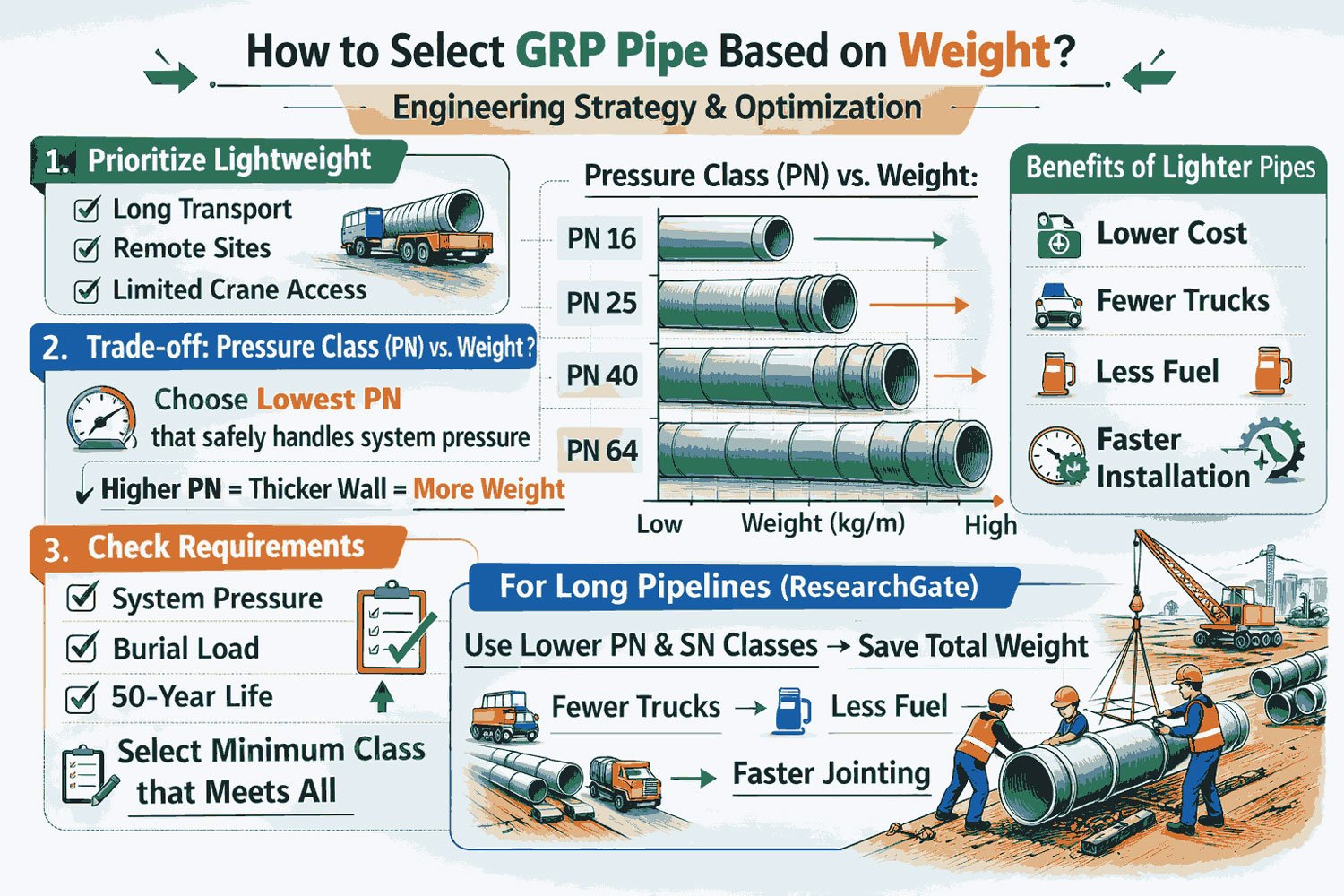
When choosing GRP pipes, focus on weight to lower costs and simplify installation. The best approach follows these points:
- Prioritize lightweight designs for long transport routes, limited crane access, or remote sites.
- Trade off pressure class (PN) and weight. Pick the lowest PN that safely handles your system pressure; higher PN adds extra thickness and mass.
- For long pipelines, as published on ResearchGate, using lower PN and SN classes to save significant total weight results in fewer trucks, less fuel, and faster jointing.
- Always select the minimum class that meets pressure, burial loads, and 50-year life requirements.
Pro Tip: Compare the total project cost (pipe plus transport plus installation) for two PN options early. Lighter pipes often win overall, even if the per-meter price is close.
Lightweight GRP Pipes from Line Core Pipes Group
If you are ready to build pipelines that work better and last longer, stop right here! GRP pipes by Line Core Pipes Group deliver lightweight strength and customizable solutions for water, wastewater, and industrial projects. We supply high-quality GRP pipes that meet all global standards and can be customized for your needs. They make installation easier and help your pipeline perform better.
Contact us for expert help and a quote. Let’s design the best pipeline for your project together!
FAQs
1- Does higher PN significantly increase weight?
Yes. Higher PN means the pipe needs thicker walls to handle more pressure. The extra material causes the pipes to get heavier. For example, going from PN6 to PN25 often adds 30% to 50% more weight.
2- Is GRP always lighter than DI pipe?
Yes. GRP pipes are always lighter than ductile iron pipes. For the same size and pressure rating, GRP usually weighs only one-fourth to one-sixth as much as DI because GRP material is much lighter.
3- How accurate are catalog weight tables?
Catalog tables are very accurate, usually within ±5% to 10% for the main pipe body. Small differences are the result of production changes like wall thickness or resin complex.
4- Does pipe length affect per-meter weight?
No. The weight per meter (kg/m) stays the same no matter how long the pipe is. Whether the pipe is 6 meters or 12 meters long, the per-meter weight does not change.
5- How do fittings change total shipment weight?
Fittings add extra weight to the shipment. Couplings usually weigh 5 to 15 kg each. Larger fittings like bends or tees weigh even more. In total, fittings can add 5% to 15% or more to the shipment weight.
about
The Author

Farshid Tavakoli is a seasoned professional in engineering and international trade. Holding degrees in Electrical Engineering, Mechatronics, and a Doctorate in Business Administration (DBA) from the University of Lyon, he also has a strong background in industrial automation and production line technologies.
For over 17 years, he has led an international trading company, gaining deep expertise in commercial solutions tailored to industrial needs. With more than 8 years of active involvement in infrastructure development, he specializes in the supply of electromechanical equipment for water and wastewater treatment plants and transfer projects.
Together with comapny expert team, he now provides consultancy and integrated solutions for sourcing and implementing complex infrastructure projects across the region.