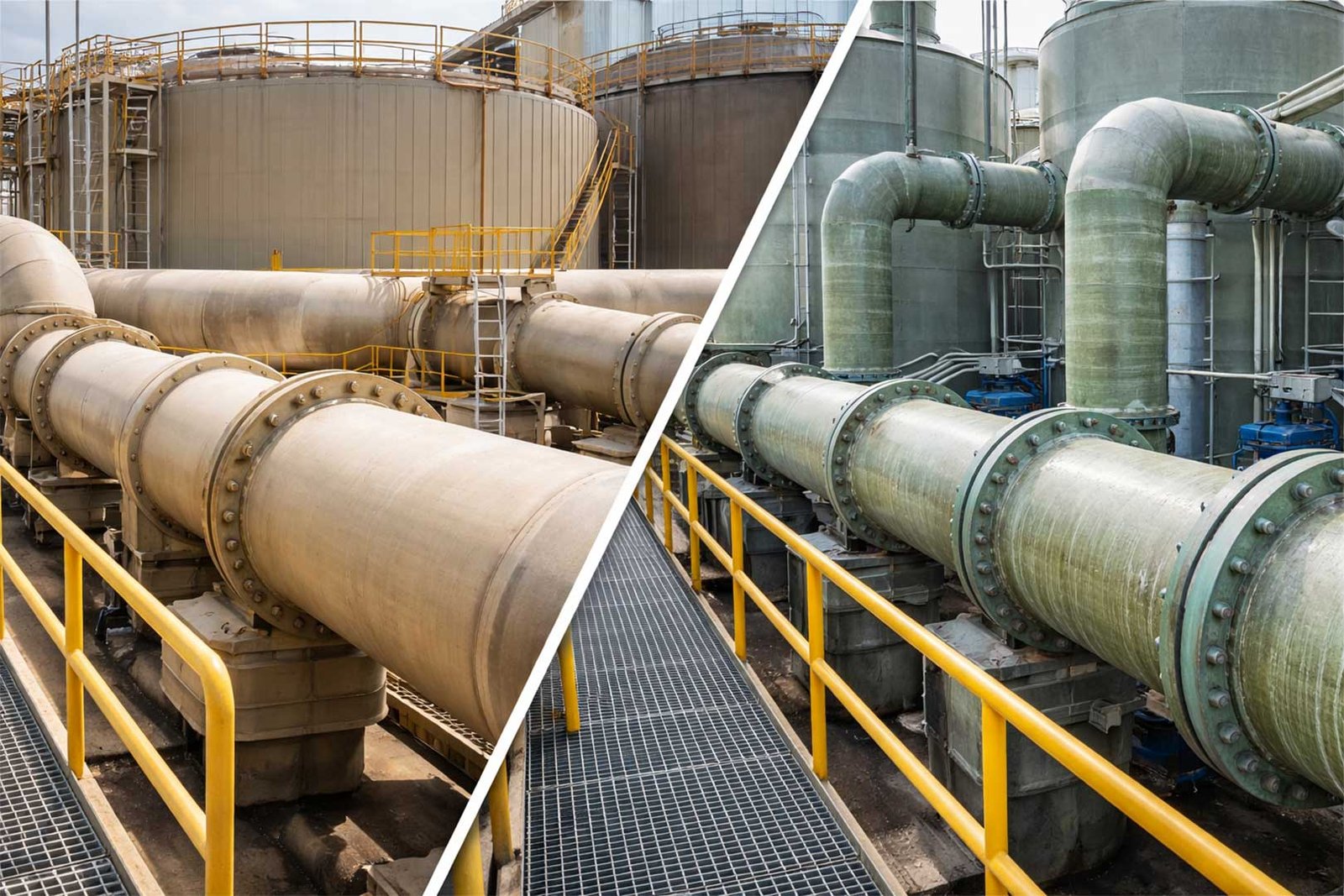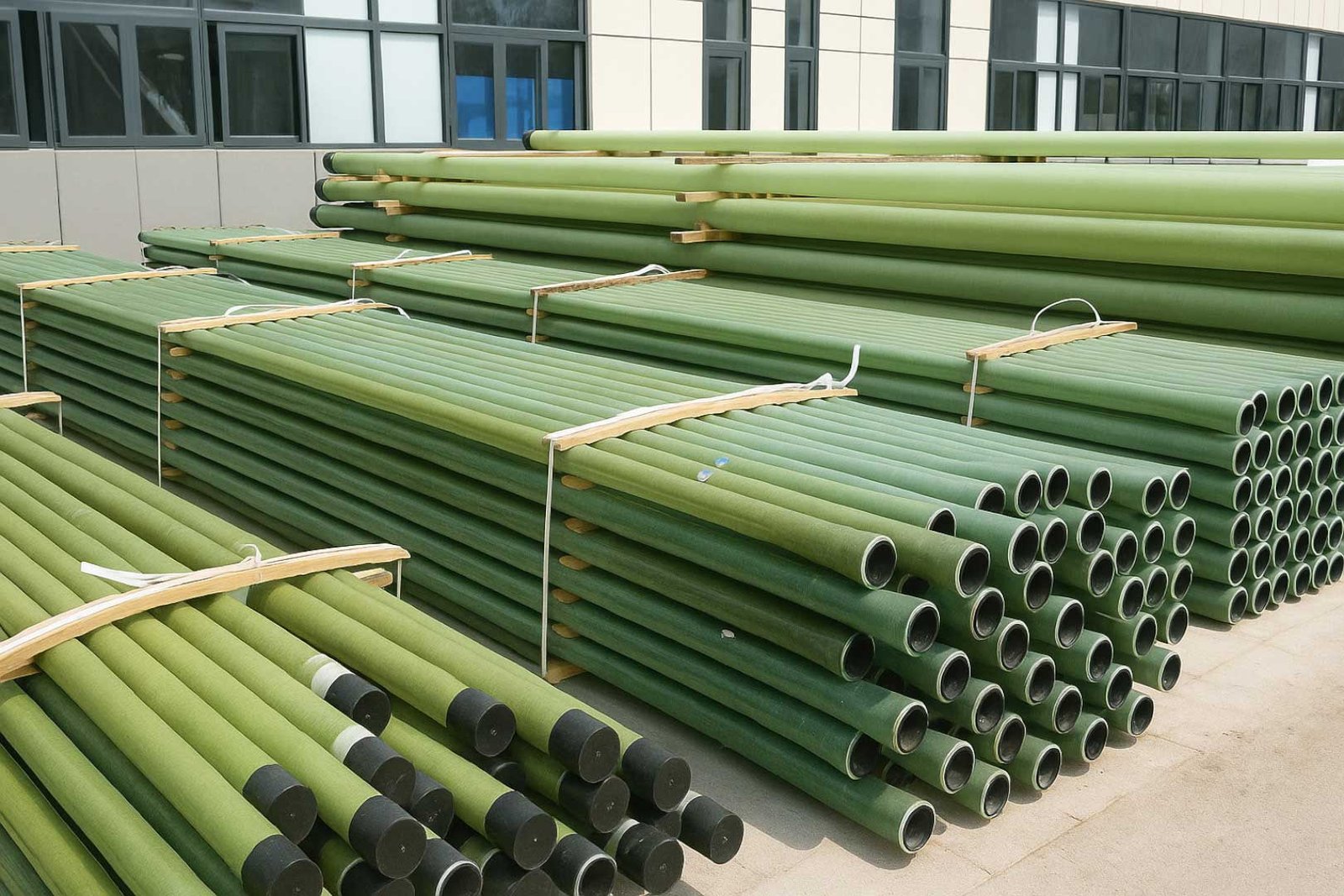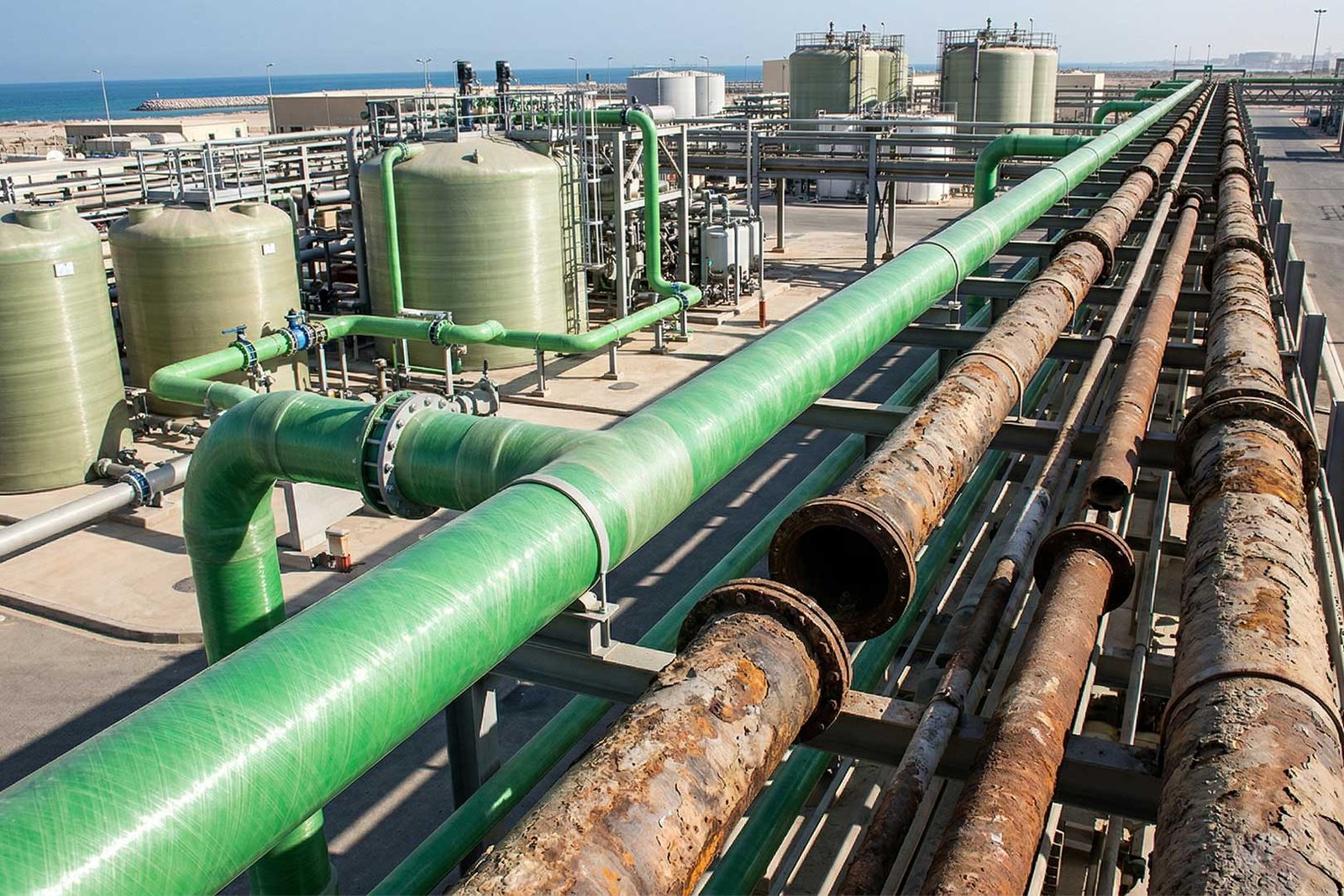
Every big pipeline project faces an important question: whether to switch from steel to Glass Reinforced Plastic (GRP) pipes. Many project owners and managers think about the advantages that GRP pipes offer, such as lower cost, cutting the risks, and making the projects run smoothly.
The GRP pipe market keeps growing. In 2025, it was worth about USD 1.98 billion. Experts expect it to reach USD 2.89 billion by 2034, with a steady 4.27% growth each year (Fortune Business Insights). Owners choose GRP because it stops corrosion naturally, skips cathodic protection, installs faster, and keeps a smooth flow for decades. Let’s see why switching from steel to GRPs is a game-changer and go through some real case studies.
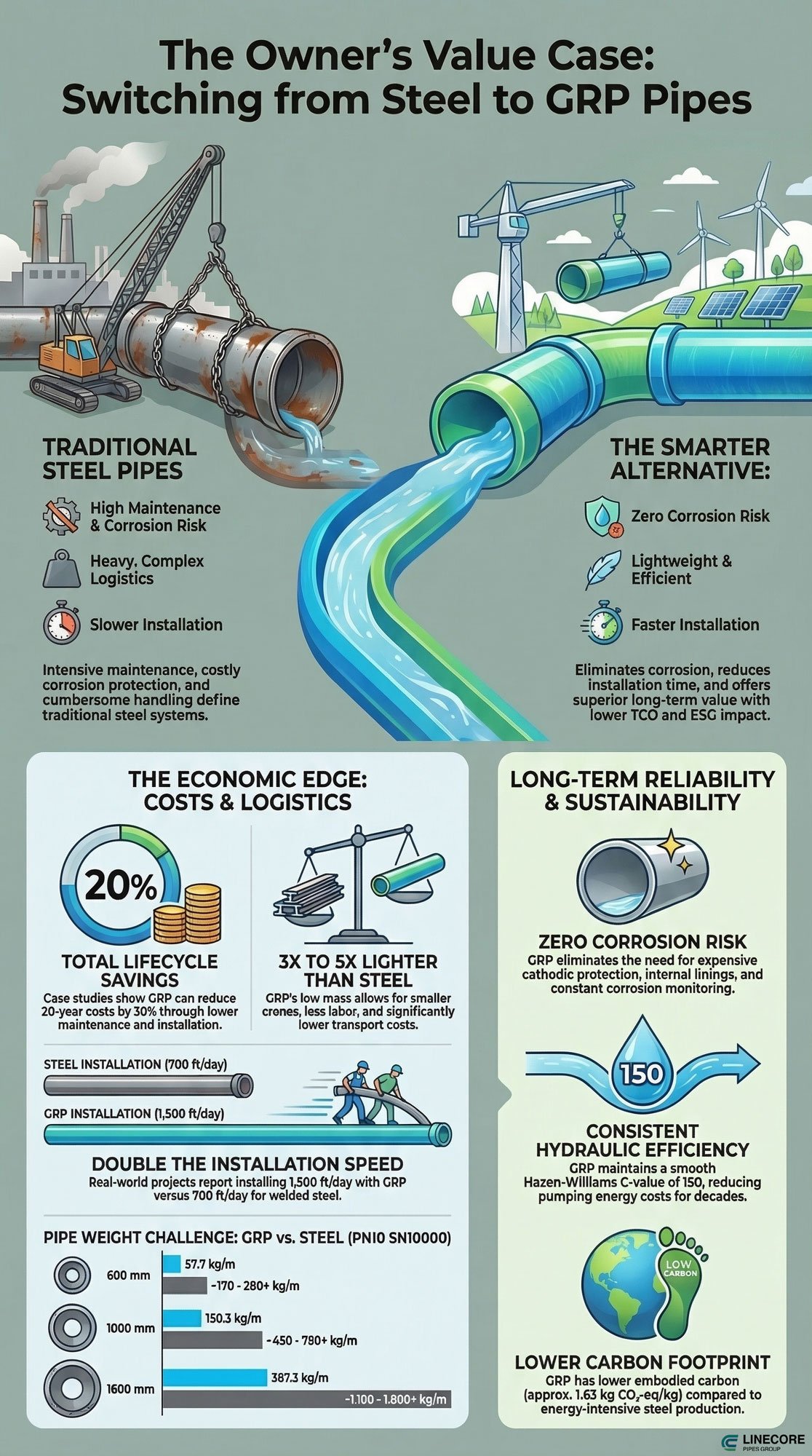
Switching from Steel to GRP pipes infographic (source: Pipelinecoregroup.com)
Why Owners Say Yes (or No) to Switching from Steel to GRP Pipes
Some questions arise in the minds of project owners and managers whose answers determine whether to proceed with a yes or a no. These questions include:
- Does the risk go down?
- Do costs drop over 20–30 years?
- Does the project finish faster and perform better long-term?
Steel pipes feel safe and familiar. But they bring a lot of extra work. You need external coatings, internal linings, cathodic protection in corrosive soils, and regular monitoring. That means more design effort, more quality checks during construction, and ongoing maintenance bills.
GRP works in a smarter way. It resists corrosion from the inside out. In most cases, you don’t need cathodic protection at all. The main things to get right are good manufacturing, proper joint assembly, and careful handling on site. The Bureau of Reclamation reported that early GRP pipes had failures. Modern standards like AWWA C950 fixed them.
| Dimension | Questions owners ask | What to collect | Owner-grade sources |
|---|---|---|---|
| Steel baseline scope | What does spec force us to buy, build, test, maintain? | Steel standard, fabrication, lining/coating, welding, CP per soil | AWWA standards, public corrosion guidance |
| GRP technical definition | What GRP system replaces steel, what limits apply? | DN, PN, SN, resin, chemical resistance, joint type, deflection, fittings | Manufacturer data + governing standards |
| Cost inputs | What line items change, who owns each cost? | Pipe supply, labor, equipment, QA, CP CAPEX/OPEX, pumping energy | Bid tabs, public cases, estimates |
| Reliability & consequence | What failure modes dominate, outage cost? | Steel: corrosion/coatings; GRP: joints/installation; isolation time | Failure literature, owner incident records |
| ESG and procurement | Embodied carbon & end-of-life plan? | EPD values, transport distances, recovery assumptions | Third-party EPD programs, manufacturer PDFs |
| Decision pathway | Who signs off, what documentation required? | Deviation template, equivalency matrix, risk register, TCO sign-off | Public governance processes, business cases |
Total Cost of Ownership (TCO): GRP vs Steel, Long-Term Pipeline Savings
The decision between these pipes depends highly on the TCO, the total cost of ownership. There are some simple and straightforward numbers that help the owners decide: upfront CAPEX, yearly OPEX, and potential failure costs. We will see the numbers for each pipe as follows:
Common Costs for Steel Pipes
There are a lot of costs that come with steel pipelines that owners and engineers need to consider for from the start. Steel pipes need the following:
- Pipe with a coating and lining (costs for materials and installation)
- Welding in the field and testing without damaging it (NDT)
- Repairs of joints and coatings on-site
- Cathodic protection system (made to fit the resistivity of the soil)
- Regular checks, monitoring stations, and renewals
These things make both initial capital expenditure (CAPEX) and long-term operating expenditure (OPEX) go up a lot, especially in soils that are corrosive.
Common Prices for GRP Pipes
GRP pipes shift the cost structure in a way that often delivers clear savings over the full lifecycle of the pipeline. Here’s where GRP typically focuses costs:
- Lightweight pipes, lower transport and handling costs
- Fast mechanical joints, reduced labor, and no welding required
- No need for corrosion protection systems
- Smooth, stable internal surface (Hazen-Williams C = 150), no degradation from corrosion or scaling, which keeps pumping energy low
This streamlined approach reduces complexity at the start of the project and eliminates many recurring maintenance line items.
| Line item | Units | Steel baseline | GRP alternative | Where to collect |
|---|---|---|---|---|
| Pipe supply | $/m by DN/class | Fabricated + lining/coating | GRP price (DN, PN, SN, joint, resin) | Case studies, budgets, quotes |
| Transport | $ and $/m | Haul distance, permits, mass limits | Nesting/higher payload | Logistics plan, mass tables |
| Installation labor | man-hours or $/m | Welding, NDT, field coating, hydrotest | Coupling jointing, gasket QA, hydrotest | Work breakdowns, case studies |
| Equipment | $/m | Cranes, weld rigs, coating gear | Lifting based on lower mass, joint tooling | Site statements |
| Corrosion protection | $ CAPEX, $/yr OPEX | CP system, monitoring, renewals per soil | Usually none; include inspections | Owner corrosion standards |
| Pumping energy | kWh/yr, $/yr | Roughness aging scenario, lining performance | GRP roughness, stability assumption | Hydraulic models, energy tariff |
| Reactive repairs & outage | events/yr, $/event | Corrosion leaks, coating failures, weld repairs | Joint leakage, impact damage if mis-specified | Owner incident data, failure examples |
Real Project Numbers That Prove the Savings
In the Franquelin hydropower penstock (Baie-Comeau, ~2010), 110-inch coated steel cost US$615 per foot. The 96-inch GRP option costs US$409 per foot. GRP installation was cheaper (US$350,000 vs US$500,000). Steel maintenance over 20 years added ~US$140,000 for cathodic protection and coatings. Even with some extra friction from the smaller diameter, GRP saved nearly 20% over 20 years. (source: Thompson Pipe Group)
In 2024, Australia’s Fraser Coast Water Grid compared DN600 GRP and DN600 mild steel cement-lined pipe. GRP had a lower capital cost: AUD 41.10 million vs AUD 45.59 million. Steel supply and delivery in rural areas cost AUD 613–628 per meter.
Shifting Risk: Steel Pipe Corrosion vs GRP Pipe Reliability
Corrosion is steel’s biggest weakness in buried pipelines. Protection depends on soil type and resistivity. Coatings break down. Cathodic protection is often the only way to stop ongoing rust. GRP pipes remove corrosion risk completely. The material doesn’t rust or corrode. No cathodic protection, no coatings, no constant checks in most soils. Risks move to three things you can control:
- Choosing the right resin
- Making strong, tight joints
- Handling and installing carefully
Early GRP pipes had failures. Modern standards like AWWA C950 fixed them. Well-installed GRP now has a very good long-term record.
Why GRP Pipes Beat Steel on Speed & Logistics
Time on site really matters. Every extra day means more costs, higher financing charges, and potential service interruptions. GRP pipes help crews work much faster because they weigh a fraction of steel. Lighter pipe equals quicker handling, smaller cranes, less labor, and easier access, especially in remote or tight sites.
Real-world proof from Oregon
َAs published on the TPG website, in the Columbia Improvement District irrigation project, crews installed 72 to 75-inch FRPM pipe at over 1,500 linear feet per day, more than double the 700 ft/day they projected for all-welded steel in the same soil conditions. Winter snow and cold didn’t slow them down at all.
How much lighter is GRP really?
GRP pipes weigh a lot less than steel pipes of the same size and pressure class. Here’s a quick look at typical weights for PN10 SN10000 GRP pipe (including couplings):
- DN600: 57.7 kg per meter
- DN1000: 150.3 kg per meter
- DN1600: 367.2 kg per meter
Steel pipes in the same diameters and pressure classes usually weigh 3 to 5 times more (sometimes even more), depending on wall thickness. It means you need much bigger cranes for steel, lifting and rigging takes longer, and transport trucks must be heavier.
| DN | Example product basis | Published weight | Source |
|---|---|---|---|
| 600 | PN10 SN10000 with couplings, EPD basis | 57.7 kg/m | [21] |
| 1000 | PN10 SN10000 with couplings, EPD basis | 150.3 kg/m | [21] |
| 1600 | PN10 SN10000 with couplings, EPD basis | 367.2 kg/m | [21] |
| 600 | PN16 SN5000, technical data basis | 33 kg/m | [22] |
| 1000 | PN16 SN5000, technical data basis | 89 kg/m | [22] |
| 1600 | PN16 SN5000, technical data basis | 222 kg/m | [22] |
Hydraulic Performance & Energy Savings: GRP Pipes vs Steel
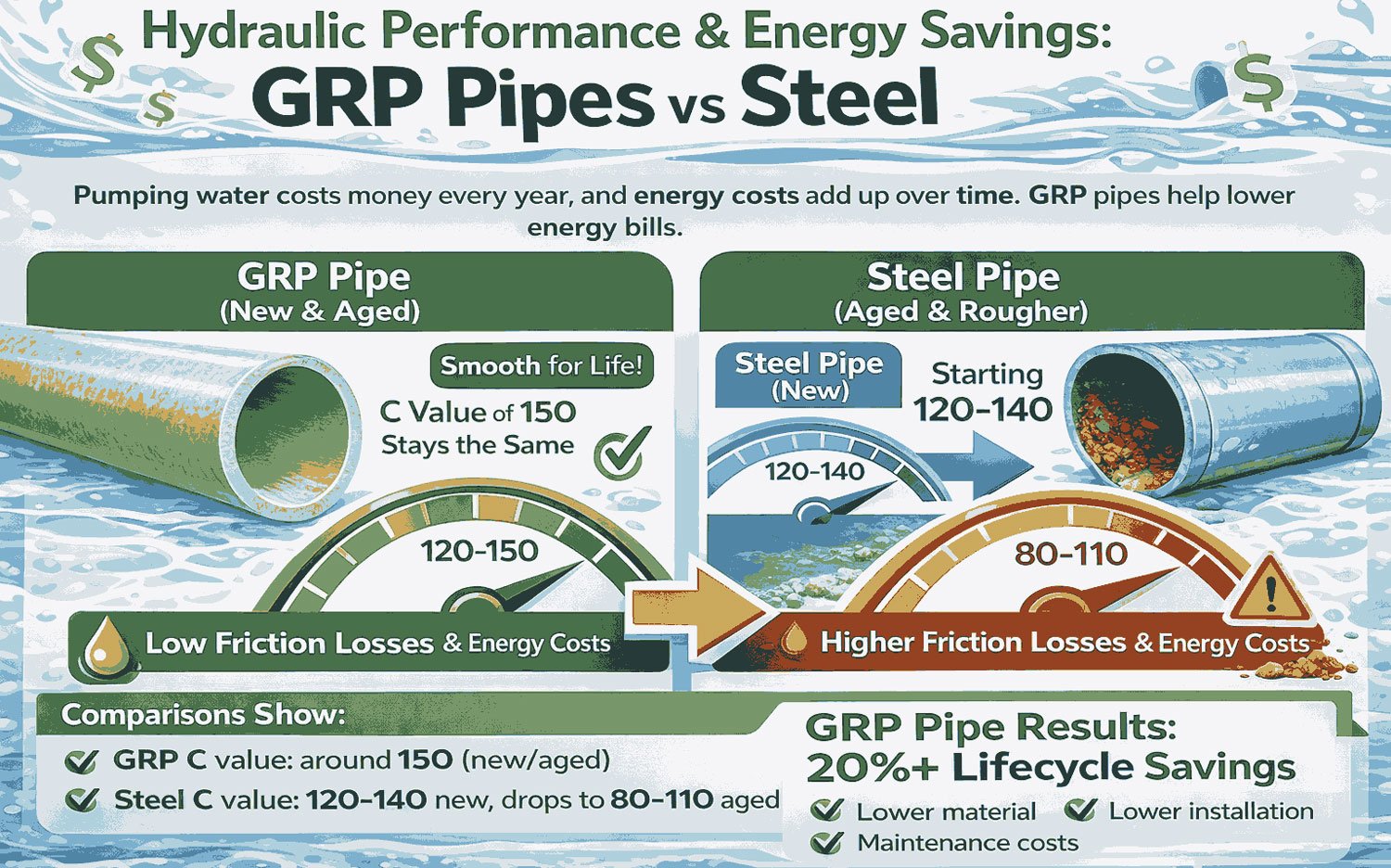
Pumping water costs money every year, and those costs add up a lot over 20 to 30 years. GRP pipes help keep energy bills lower because the inside surface stays smooth for the entire life of the pipe. GRP maintains a Hazen-Williams C value of about 150, and this number stays the same over time. No corrosion or buildup occurs inside the pipe, so friction losses remain low and consistent.
Steel pipes usually start with a C value around 120 to 140 (depending on lining or new condition). Over the years, however, corrosion and deposits make the inside rougher. This lowers the C value and increases friction. Higher friction creates more head loss. Pumps have to work harder, and you pay more for electricity as a result. To make a fair comparison, run your hydraulic models with two realistic scenarios:
- Both pipes are in new condition (using starting C values)
- Steel in an aged or degraded condition (using real inspection data or typical aging patterns)
GRP keeps C almost 150 in both cases, while steel drops noticeably in the aged scenario.
In the Franquelin hydropower penstock case, the extra friction loss came from choosing a smaller GRP diameter, not from the GRP material itself. The GRP actually had better roughness characteristics. Even so, the total lifecycle still saved nearly 20% thanks to lower material, installation, and maintenance costs.
Addressing Common Objections to GRP Pipes
Owners and engineers raise fair questions before switching from steel to GRP. Here are the most common concerns, with clear, evidence-based answers.
“Steel is proven, but GRP feels risky.”
Steel has a long history, but it demands constant corrosion control (coatings, cathodic protection, monitoring). Modern GRP follows strict standards like AWWA C950 and has over 40 years of reliable service in water, wastewater, and industrial pipelines worldwide. Many utilities now prefer GRP in corrosive soils precisely because it eliminates those ongoing risks.
“GRP joints leak or fail more easily.”
Early GRP systems had some joint problems decades ago. Today’s mechanical couplings, gaskets, and angular deflection capabilities, combined with proper installer training and field hydrostatic testing, make leaks very rare. In fact, many utilities report lower overall leakage rates with GRP than with welded steel.
“What about surges and water hammer?”
GRP pipes are engineered for surge pressures. Manufacturers design them with safety factors and PN classes that handle transients (typically 1.5 to 2 times working pressure). Always run a transient analysis during design, just like you would for steel. The right PN and SN rating ensures GRP performs safely under surge conditions.
“GRP costs more upfront.”
In some cases, the pipe material price is higher, but total installed cost is often lower or comparable. When you add cathodic protection, field welding labor, NDT, coating repairs, and long-term maintenance, GRP usually wins. Real TCO models (Franquelin with 20% savings, Fraser Coast lower CAPEX) prove this time and again.
“What about ESG and carbon footprint?”
Third-party verified Environmental Product Declarations (EPDs) show GRP frequently has lower embodied carbon per meter than equivalent steel pipe (for instance, 1.63 kg CO₂-eq/kg for some GRP families vs higher values for steel production in addition to coatings). GRP also avoids energy-intensive cathodic protection and reduces pumping energy over time due to stable hydraulics. These benefits help meet sustainability targets in public and private tenders.
| Owner objection | What it’s really about | What to provide | Test/standard anchors |
|---|---|---|---|
| “Steel is proven” | Risk aversion, standards | Steel baseline + GRP risk reduction | Corrosion guidance, coating QA |
| “GRP fails” | Legacy FRP failure memory | QA plan addressing past drivers | Reclamation RPM history, AWWA C950 acceptance |
| “Surge will break GRP” | Transient design concern | Transient analysis, surge allowances, proof test | FRP penstock surge data, GRP standards |
| “Joints leak” | Leakage & inspection risk | Joint selection, assembly procedure, test plan | Case study joint testing, installation manuals |
| “Energy savings are marketing” | OPEX credibility | Roughness assumptions, sensitivity cases, tariffs | Published roughness values, Franquelin friction pricing |
| “ESG claims are vague” | Compliance & audit trail | Verified EPDs, boundary discussion | GRP/steel EPDs with declared unit clarity |
ESG & Sustainability Benefits of GRP Pipes
Public and private owners increasingly need to report ESG performance. GRP helps here:
- Lower embodied carbon in production. Third-party EPDs show many GRP families at 1.63 kg CO₂-eq per kg. Steel pipes are often 2 to 3 times higher, depending on alloy and process (source: CloverPipe).
- No cathodic protection or anodes. GRP skips these entirely. Steel systems use ongoing electricity or consume metals, adding energy demand and waste.
- Stable hydraulics for decades. GRP’s smooth surface never degrades from corrosion or scaling. This lowers pumping energy year after year and reduces greenhouse gas emissions from power generation.
- Long service life with minimal degradation. GRP lasts over 50 years with almost no loss in performance. Fewer replacements mean less future material extraction, manufacturing, transport, and disposal emissions.
Many tenders now favor materials with better lifecycle carbon footprint and lower operating energy use. GRP performs well on both, especially in corrosive soils where steel needs heavy protection.
How to Get GRP Approved: Practical Checklist & Process
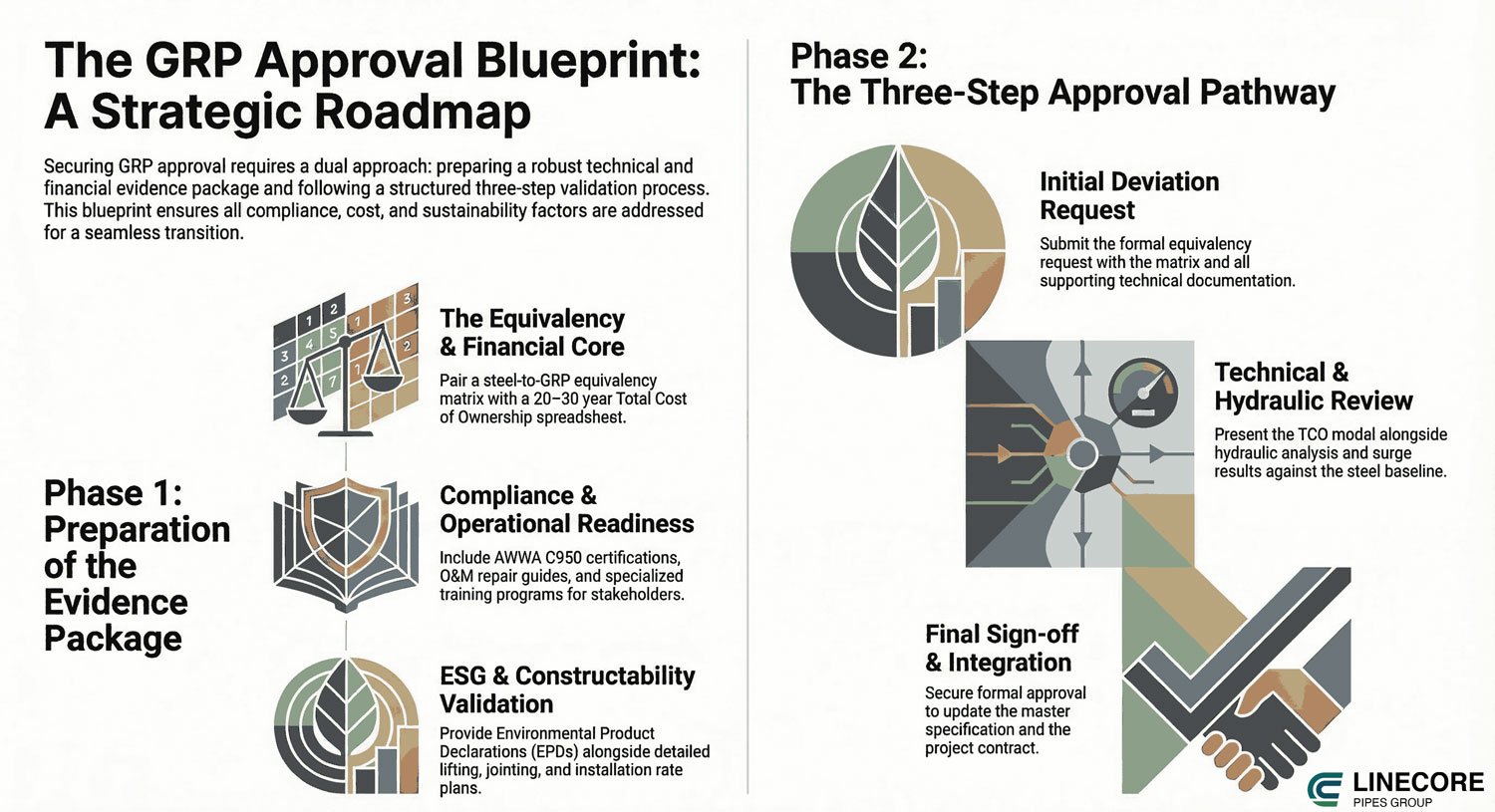
To get GRP approved, prepare an equivalency matrix comparing steel specs to GRP, a 20–30 year TCO spreadsheet with shared assumptions, a constructability plan (lifting, jointing, rates), compliance docs (AWWA C950 certs, tests), O&M support (spares, repair guide, training), and ESG EPDs for the GRP family. Submit them clearly for quick review and sign-off. Follow these typical steps:
- Submit a deviation or equivalency request. Attach the matrix and supporting documents.
- Present the current steel baseline. Show its risks and costs.
- Share your TCO model, hydraulic analysis, and surge results.
- Review constructability, operations, and ESG impacts together.
- Get formal sign-off. Then update the specification and contract.
Conclusion: Why Choose GRP Solutions with LineCore Pipes Group?
Switch from steel to GRP. This move cuts corrosion risk, lowers total costs across CAPEX, OPEX, and energy, speeds up installation, and supports ESG goals with reduced carbon and energy use. GRP often delivers the best value for pipelines in corrosive soils, tight budgets, high energy costs, or ESG pressure.
LineCore Pipes Group supplies proven GRP pipes and guides you through every step of equivalency paperwork, TCO modeling, hydraulics, surge analysis, installation planning, and crew training. Contact us today. Share your project details and let’s run the numbers together to see exactly how much GRP can save you.
about
The Author

Farshid Tavakoli is a seasoned professional in engineering and international trade. Holding degrees in Electrical Engineering, Mechatronics, and a Doctorate in Business Administration (DBA) from the University of Lyon, he also has a strong background in industrial automation and production line technologies.
For over 17 years, he has led an international trading company, gaining deep expertise in commercial solutions tailored to industrial needs. With more than 8 years of active involvement in infrastructure development, he specializes in the supply of electromechanical equipment for water and wastewater treatment plants and transfer projects.
Together with comapny expert team, he now provides consultancy and integrated solutions for sourcing and implementing complex infrastructure projects across the region.