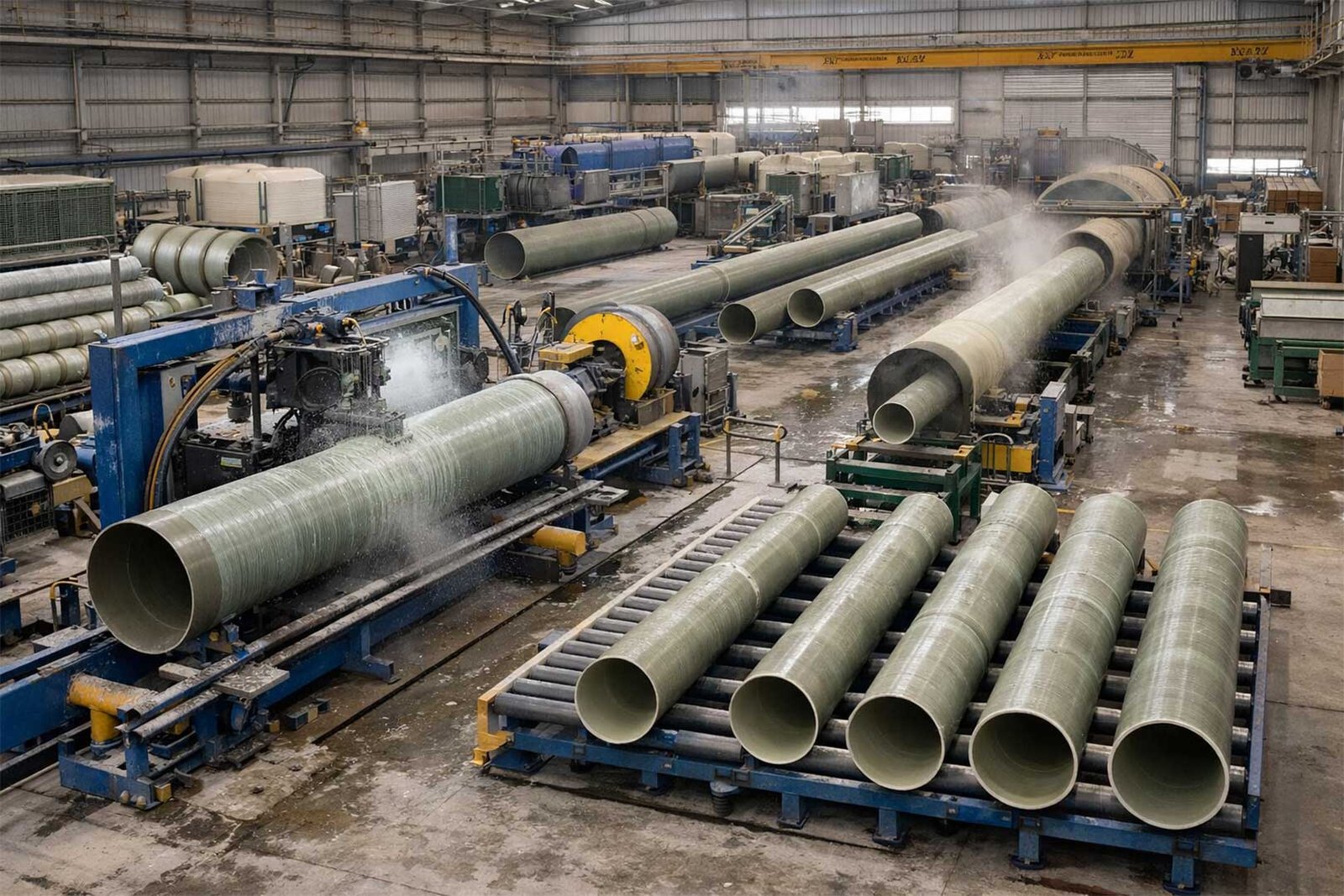
The water industry is moving quickly from old projects to modern EPC contracts. GRP pipes are popular because they are resistant to rust and allow water to pass smoothly. But a GRP pipeline only lasts long if the flexible pipe and the surrounding soil work together perfectly.
In an EPC “total solution” contract, backfill compaction is not a regular task on site. It has become an important promise that the contractor has to consider. The contractor takes full responsibility for achieving the correct soil stiffness in the ground. This moves nearly all the risk from the owner to the EPC team and stops fights.
In this post, we cover why Compaction matters for GRP lines, EPC contract rules, methods, testing, risks, costs, lessons, and more. Keep reading.
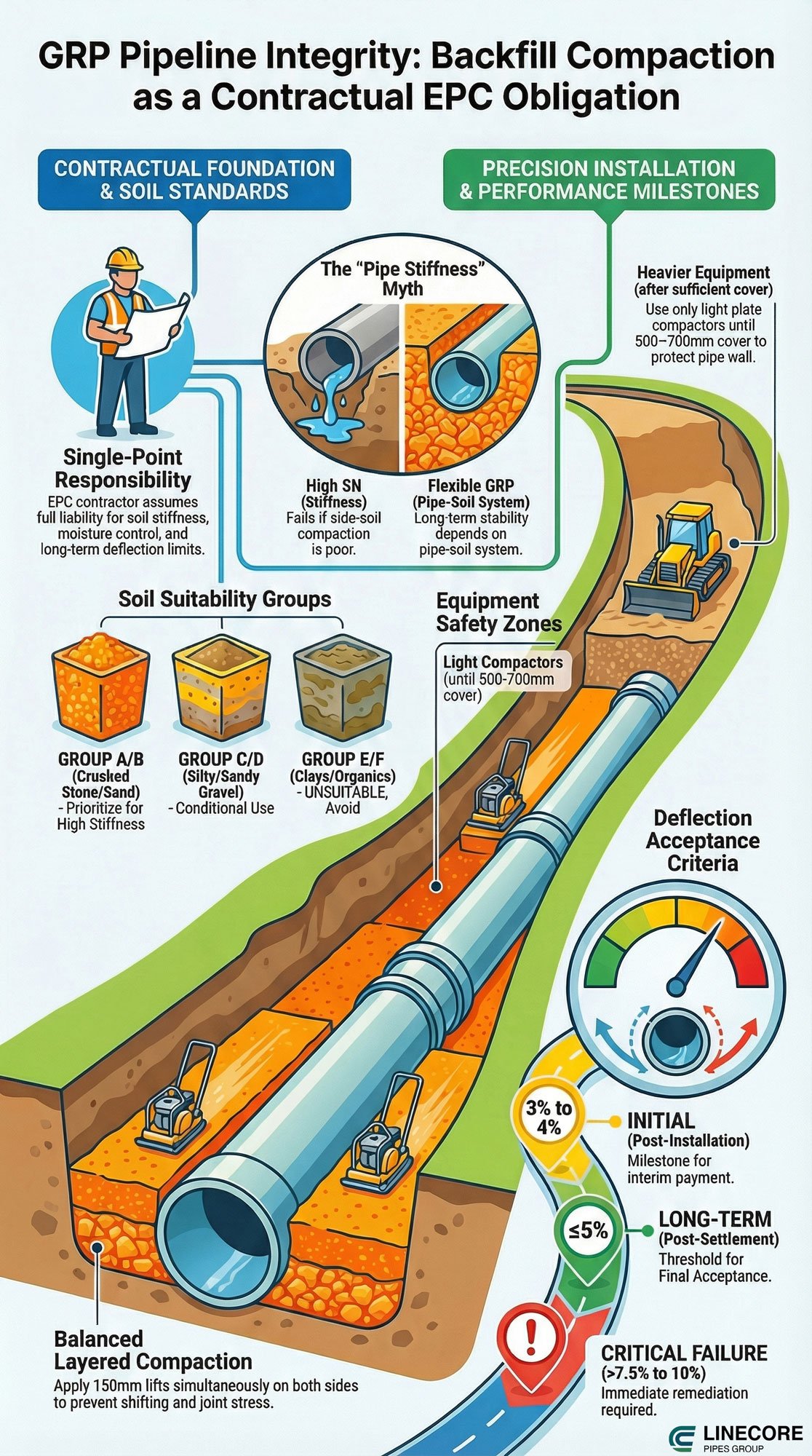
Why Backfill Compaction Is Critical for GRP Water Transmission Lines
GRP pipes are flexible, not hard like concrete or steel. They bend a little when soil or traffic weight puts them under pressure. This small bend is normal and helps the pipe, but the soil around it must support it as well. Let’s see why good backfill compaction matters:
- Soil or traffic pushes the top of the pipe down.
- Compacted soil pushes back hard and stops too much bending. This is called the Modulus of Soil Reaction (E′).
- Loose or bad Compaction means the soil can’t push back enough. The pipe bends too much (excessive deflection).
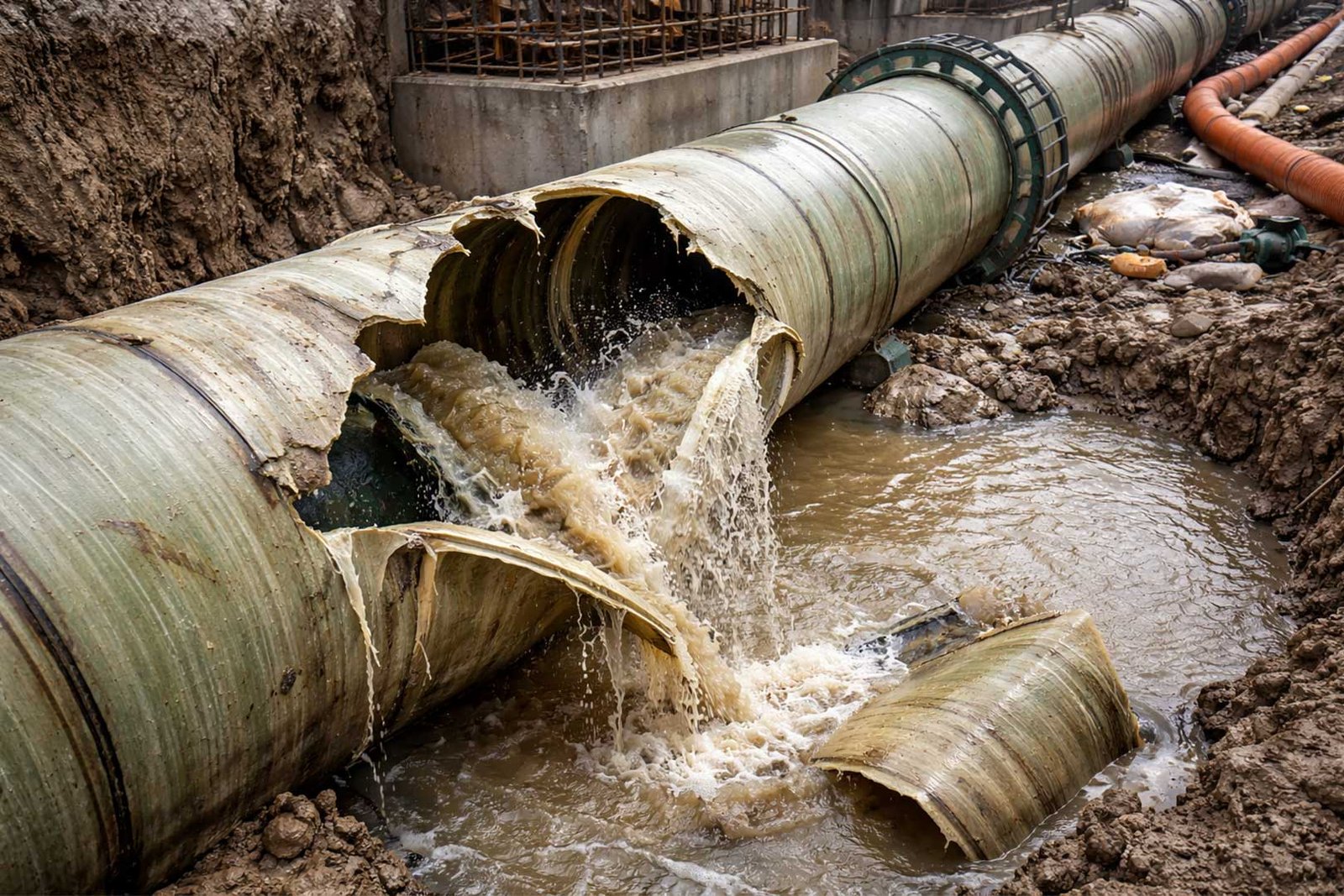
- Excessive deflection causes cracked or leaking joints, oval pipe shape, instability or collapse later, and less water flow.
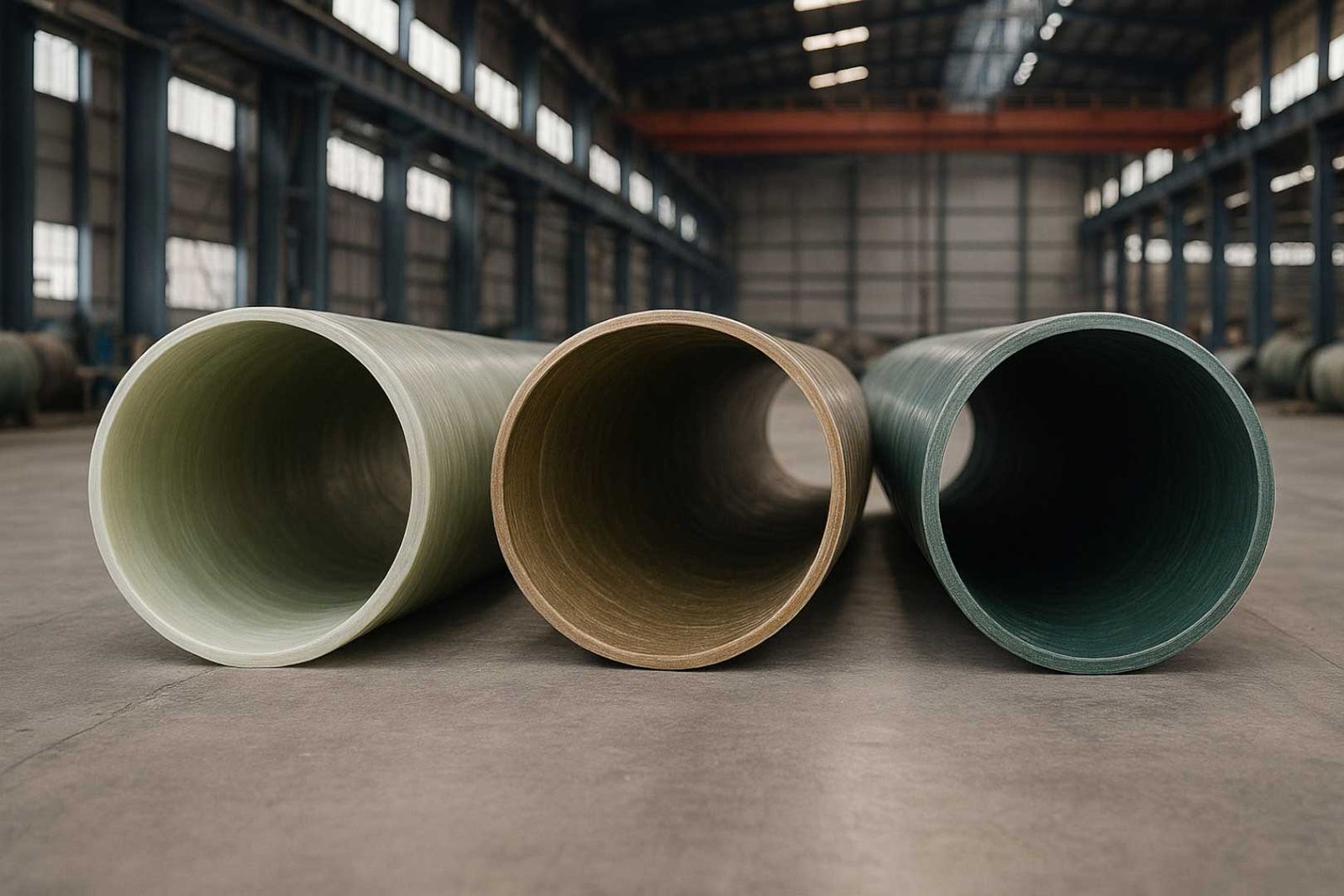
A stiffer pipe helps a bit at first. But real projects show it does not fix bad Compaction. Even stiff pipes fail without good side soil. Good backfill makes the pipe and soil work as one strong unit perfectly. Below, you can check different stiffness classes (SN) to match different soil and load needs:
| Stiffness Class | Nominal Value (N/m²) | Primary Application Scenarios | Typical Short-Term Deflection |
|---|---|---|---|
| SN 2500 | 2,500 | Shallow cover, low traffic, stable soils | ~5% |
| SN 5000 | 5,000 | Moderate burial, standard highway traffic | 2%–3% |
| SN 10000 | 10,000 | Deep burials, heavy traffic, soft soils | 1%–2% |
Egypt GRP Case Study
Over 20 years in Egypt, many GRP water and sewer lines leaked and broke. Scribed reports that people tried to fix it by making pipes stiffer (SN 5000 to SN 10000). But tests showed the real problem was poor compaction. The side soil did not give enough support, so the pipes changed shape too much. Rigid joints also made leaks worse.
What to learn: higher pipe stiffness is not enough, and good sidefill Compaction is a must.
Backfill Compaction as a Core EPC Contractual Obligation
In EPC contracts, one company handles the whole project. They do the design, supply the GRP pipes, install everything, and make sure it all works. This is called single-point responsibility. Because of this, backfill compaction becomes a very important promise in the contract. It is not just a small job. Here is why it is so important:
- Compaction connects directly to the performance guarantees.
- The contractor promises the pipeline will meet deflection limits for many years.
- Deflection limits act as clear contract targets.
- The contract sets exact density rules.
- The contractor is fully responsible for moisture control.
Typical Contractual Requirements for Backfill Compaction
EPC contracts have clear rules for backfill compaction. These rules help keep the GRP pipe and soil working well for many years. We review these rules so you get enough information about them:
Compaction Density Requirements
Contracts use Proctor tests to set density goals. In the pipe zone (around and above the pipe), they usually ask for 90 to 95% of the maximum dry density. As we go higher (crown cover and top backfill), it decreases to 85 to 90%. The contractor must consider these levels in every layer.
Moisture Control Obligations
The soil needs the right amount of water to compact well. The contractor is again fully responsible for this. If rain or groundwater makes the soil too wet, the contractor must dry it, mix it, or bring in new soil. If the moisture is wrong, the contractor fixes it at their own cost.
Pro tip: Check soil moisture every time. It should be just right. Test before each layer.
Backfill Material Suitability
Only clean, easy-to-compact soils are suitable for use near the pipe, such as sand, gravel, or crushed stone with low fines. Soils with too much clay, silt, or organics are not okay. If the soil on site is bad, the contractor must buy and bring better material and pay for it. The following soil groups tell us which materials are easy to compact and give the best support:
Table:
| Soil Group | Material Description | Ease of Compaction | Stiffness Contribution (E′) |
|---|---|---|---|
| Group A | Crushed stone, angular, <12% fines | High | Highest |
| Group B | Well-graded sand, gravelly sand | High | Moderate–High |
| Group C | Silty sand, sand-clay mixtures | Moderate | Moderate |
| Group D | Fine-grained silty or clayey sands | Low | Low |
| Group E | Highly plastic clays, silts | Very Low | Lowest (often unsuitable) |
| Group F | Organic soils, peat, debris | Unsuitable | Negligible |
QA/QC Requirements for Contract Compliance
EPC contracts need good QA and QC to make sure backfill compaction follows every rule and keeps the pipeline strong for many years (Source: ASTM D3839). The contractor does tests often, keeps good records, and fixes problems right away. Below you can check the main parts:
- Compaction Testing Frequency: The contractor tests a lot to spot problems early. Most contracts require tests every 50 to 100 meters of the pipeline. Some check by how much soil they placed (like every 250 cubic meters).
- Field Testing Methods: The contractor uses easy and trusted tests on-site. Nuclear density test. Moisture content tests are the well-known ones.
- Acceptance Criteria: The work passes only if two things are okay. Density must reach the goal (usually 85 to 95% Proctor). Pipe deflection must stay in the allowed range.
Method Statement Requirements in EPC Contracts
EPC contracts require a detailed Method Statement for backfill compaction. This document forms part of the contract. It shows exactly how the contractor will place and compact soil around GRP pipes to protect the pipe and get the right support.
Layered Backfilling and Lift Thickness
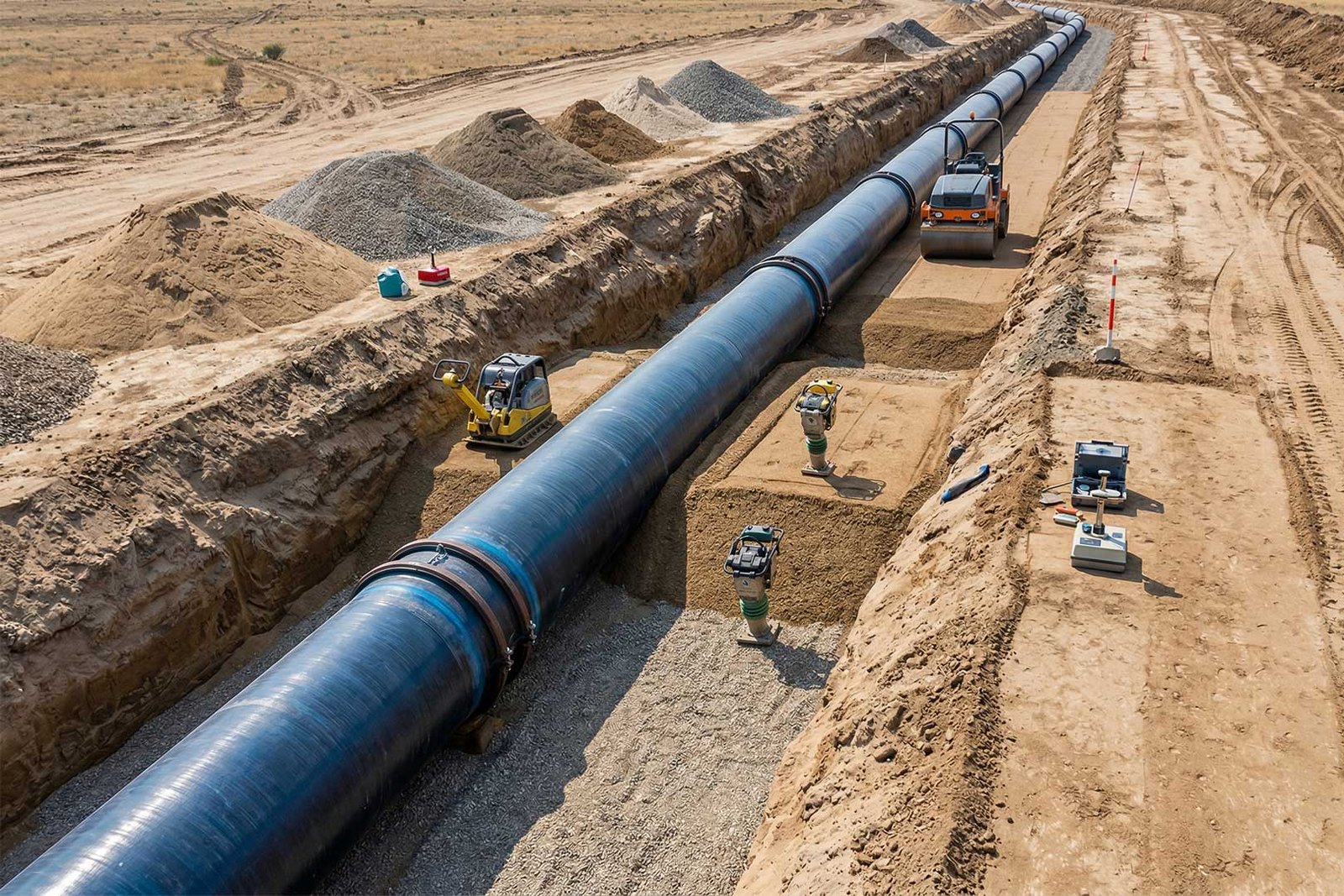
The contractor places backfill in thin layers called lifts. Initial lifts next to the pipe are 150 mm thick. Once the backfill reaches about the pipe diameter below the crown, lifts can increase to 300 mm. Compaction happens at the same time on both sides of the pipe (balanced side compaction). This keeps the pipe straight and stops stress on the joints.
Equipment Selection Near GRP Pipes
Only light equipment is used near the pipe. Plate compactors and light tampers are common choices. Heavy rollers are not allowed close to the pipe. The contractor waits until there is a minimum cover (usually 500 to 700 mm) before using heavy compaction equipment. This prevents damage to the flexible GRP pipe wall.
Protection of Pipe During Compaction
No equipment or soil drops directly on the pipe. Sidefill compaction takes place simultaneously on both sides to keep the pipe balanced. Joints get extra care, no heavy vibration or pressure near them. The Method Statement must explain how the pipe stays safe during every step.
Pro tip: Never put heavy equipment or drop soil on the pipe until you have 500–700 mm of cover on top. One mistake is enough to crack the pipe.
Pipe Deflection as Final Performance Indicator
Pipe deflection is the best way to check if backfill compaction and the pipe-soil system work well. The contractor measures it at key stages to prove the pipeline meets the contract.
- Initial deflection limits: Measured right after installation and backfill. Usually, 3 to 4% of the pipe diameter. This is an early check and often links to partial payments.
- Long-term deflection limits: Measured after full soil settlement. Must stay at or below 5% of the diameter. This is the main goal for final acceptance and warranty start.
- Failure thresholds: Over 7.5 to 10% deflection signals serious trouble like leaks, instability, or collapse. The contractor must fix it immediately.
- Contractual acceptance milestone: The owner or engineer watches the measurements. Passing initial limits releases payments. Final handover depends on long-term deflection being within limits.
here are the safe amounts and what they mean for the contract.
| Stage of Measurement | Typical Allowable Deflection | Contractual Significance |
|---|---|---|
| Initial (Post-Installation) | 3% to 4% of Diameter | Milestone for interim payment |
| Long-Term (Post-Settlement) | ≤5% of Diameter | Threshold for Final Acceptance & Warranty |
| Critical Failure | >7.5% to 10% | Immediate remediation required |
Risk Allocation in EPC Backfill Compaction
In EPC contracts, risk allocation is clear and simple. The contractor takes most of the responsibility for backfill compaction. This protects the owner while making the contractor fully accountable. Here are the responsibilities:
Contractor Responsibilities
The contractor handles all soil work. They check the soil type and quality first and compact the soil layer by layer. They make sure tests follow the contract rules. If anything goes wrong, they pay to fix it.
Owner Protection Mechanisms
The owner gets strong built-in safeguards, including:
- Performance guarantees require the contractor to deliver a pipeline that meets deflection and performance targets for many years.
- Retention money (usually 5–6%) is held back until the owner approves the final result.
- Warranty obligations make the contractor fix any compaction issues during the warranty period at no cost to the owner.
Interface Risk Elimination in EPC
In traditional projects, pipe suppliers and installers often blame each other when problems happen. In EPC, the contractor supplies the GRP pipe and installs it under one contract. This removes fights between the supplier and the installer. Single responsibility means one company owns the whole system. The owner deals with only one party for any issue, which makes fixes faster, simpler, and easier to finance.
GRP Pipe Specific Backfill Compaction Requirements
GRP pipes need special backfill rules to stay safe and supported. Bedding is 150 mm thick under the barrel and 75 mm under joints (Source: Flowtite). Trench width is narrow but wide enough for safe equipment (about 0.4 times pipe diameter).
Haunch support is critical. The sides under the pipe must be compacted first to avoid uneven loading. Compaction starts at the haunches and builds evenly around the pipe. Heavy equipment waits until 500–700 mm of cover is in place to protect the pipe wall. These steps keep the pipe stable and undamaged.
Iraq Large-Diameter Pipe Study
According to the MDPI Fibers Journal Study in Iraq, researchers tested 1400 mm GRP pipes in Iraq with real box experiments and computer models. Adding more cover (from 50 cm to 100 cm) reduced deflection by up to 38%. Raising bedding modulus from 14 MPa to 30 MPa cut stress by 40%. Lets have a look at the rest of metrics:
| Variable Change | Impact on Maximum Vertical Deflection | Significance |
|---|---|---|
| Cover increased from 50 cm to 75 cm | 33.3% Reduction | Highlights soil arching |
| Cover increased from 50 cm to 100 cm | 38.0% Reduction | Diminishing returns after certain depth |
| Bedding Modulus increased (14 to 30 MPa) | 40% Stress Reduction | Criticality of the foundation layer |
What to learn: the bedding layer under the pipe is just as important as the sidefill. Poor bedding causes point loading and cracks the pipe.
GRP Pipe Specific Backfill Compaction Requirements
GRP pipes need special backfill rules to stay safe and supported. Here are the key GRP requirements:
- Bedding must be 150 mm thick under the pipe barrel and 75 mm under the joints. This gives even support.
- Trench width is narrow but wide enough for safe equipment work. about 0.4 times the pipe diameter.
- Haunch support is very important. Compact the areas under the pipe sides first to stop uneven pressure.
- The compaction sequence starts at the haunches and builds up evenly on both sides of the pipe.
- Heavy equipment can only come in after 500 to 700 mm of cover is placed over the pipe.
Engineering Impact of Poor Compaction
Poor backfill compaction harms the GRP pipeline in many ways. When the soil does not support the pipe well, the pipe bends too much, and the system fails over time.
Structural Consequences
The pipe suffers excessive ovalization and turns egg-shaped instead of round. Joints start leaking because the changed shape stresses the seals. Pipe instability follows, and the pipe can shift, crack, or even collapse after years of use.
Hydraulic Consequences
The oval shape reduces the pipe’s effective diameter. This causes increased headloss from higher friction inside the pipe. Higher headloss raises pumping costs because more energy is needed to move the same amount of water.
Long Term Asset Risk
The ground settles unevenly around the pipe. Maintenance costs rise due to frequent leaks, repairs, and inspections. The pipeline’s design life shortens significantly, often dropping from 50+ years to much less because of ongoing damage.
Cost Implications for EPC Contractors
Poor Compaction makes costs higher for EPC contractors. Using native soil is cheaper but can fail if the soil is bad. Importing good material like sand or gravel costs more at first, but helps avoid trouble later. Rework is expensive; digging out bad soil, replacing it, and compacting again takes time and money. Testing adds extra costs because the contractor must check the density and moisture many times.
Productivity drops when Compaction fails or when the soil needs more work, slowing the whole job. Over time, poor Compaction causes higher pumping costs for the owner and shortens the pipe life, which can lead to claims against the contractor. Good Compaction keeps all these costs low from the beginning.
Integrated EPC Planning for Backfill Compaction
In every EPC project, the contractor plans backfill compaction right from the beginning. The whole team works together. This lowers risks, saves money, and makes the pipeline strong for many years. The steps for planning are as follows:
Early Geotechnical Evaluation
The USBR indicates that the contractor checks the soil all over the route first. They test it for type, strength, and how well it compacts. This shows if the soil on site is good enough or if they need to bring in better material. Early checks help you avoid surprises and digging again and again in the near future.
Pipe Stiffness Selection
The contractor picks the right GRP pipe stiffness (SN class). They pick it according to the soil test, burial depth, traffic loads, and expected support. Good planning lets them choose a lower SN class when Compaction will be excellent. This saves money on pipes.
Soil Improvement Planning
If the original soil is weak or not good, the contractor plans to fix it early. These plans may include:
- Replacing the soil with clean material or importing good soil.
- Use geotextiles or gravel bedding for extra support.
Equipment Planning
The contractor chooses the right tools for each soil type and trench spot. Light tampers and plate compactors work near the pipe. Heavy rollers wait for the upper layers. The tools match lift thickness and site conditions, so density comes fast and easy. Below, check the equipments:
| Method/Equipment | Max Layer Thickness | Use/Notes |
|---|---|---|
| Hand/plate tamper | ~150 mm | Good for small lifts, trenches. Gentle for haunch fill. Avoid on top until deep cover. |
| Gasoline/impact tamper | ~150–200 mm | Effective on coarse fill. Not above pipe until >300 mm cover. |
| Vibratory plate compactor | ~150 mm | Works on granular soils; effective on level surfaces. |
| Small rollers (4–8 t) | ~300 mm | Use on sand/gravel fill. Good for large, open areas. |
| Crawler vibrator | ~300 mm | Can penetrate ~300 mm. Requires wide trench (≥0.4× diameter for safety). |
Construction Sequencing
The contractor maps out the full order of work, like what you see in the following list:
- Trench digging and bedding placement come first.
- Then pipe laying and haunch compaction.
- Sidefill and crown cover follow, with testing after each lift or section.
Full System Warranty Advantage for EPC Solution Providers
In EPC projects, the contractor supplies the GRP pipes and installs them under one contract. This gives them a big advantage, a full system warranty.
As stated by FIDIC, the contractor takes responsibility for the pipe and the installation. They can offer a performance-based guarantee. For example, “this pipeline will not exceed 5% deflection for 50 years.” Have a look at the main advantages:
- This reduces client risk a lot. The owner deals with one company only.
- No arguments happen between the pipe supplier and the installer if something goes wrong.
- The owner gets peace of mind because one party owns the full pipe-soil system.
- It improves bankability. Banks and lenders like EPC projects more.
- They see a single responsible party with performance guarantees, retention money, and warranties.
- This makes financing easier and faster for water transmission projects.
Best Practice EPC Backfill Compaction Checklist
Here is a simple, practical checklist that EPC contractors use to make sure backfill compaction is done right every time. Follow these steps to avoid problems and meet contract rules.
1. Soil classification verified
The contractor checks the soil type and quality before starting. They make sure it matches the contract specs (clean granular for good support, no organics or high clay).
2. Bedding installed correctly
The contractor places the bedding layer properly. 150 mm thick under the pipe barrel and 75 mm under joints. The bedding is level, stable, and compacted to give even support.
3. Layered Compaction applied
The contractor places backfill in thin layers (150 mm near the pipe, up to 300 mm higher up). They compact each layer evenly on both sides at the same time (balanced side compaction) to stop the pipe from shifting.
4. Density tests completed
The contractor runs density tests after each lift or every 50–100 meters. Tests show the soil reaches the required level (usually 85–95% Proctor). They record all results.
5. Deflection measured
The contractor measures pipe deflection after backfill. Initial deflection stays within 3 to 4%, long-term within 5%. They check that it meets the contract limits.
6. Documentation delivered
The contractor keeps clear records: test results, photos, lift thicknesses, equipment used, and deflection readings. They hand over everything to the owner as proof that the work is correct.
Why Backfill Compaction Strengthens EPC Total Solution Delivery
Good backfill compaction makes the EPC “total solution” much better. It keeps the pipeline strong, saves money, and builds trust. Here’s how:
- The pipe and soil stay stable together. The system has worked perfectly for decades with very few problems.
- Proper support keeps the pipe round. Pumping uses less energy. Fewer leaks and repairs equals lower bills over 50 years.
- Strong sidefill and bedding stop too much ovalization, leaks, and damage. The pipe stays in good shape and works better for years to come.
- The contractor can promise strict deflection limits. They know Compaction will hold up because they control it.
- Great Compaction shows real skill and quality. It sets the contractor apart from others who just supply pipes and leave installation to chance.
LineCore Pipes Group: EPC Total Solution for GRP Water Transmission Projects
At LineCore Pipes Group, we give you a real EPC total solution for GRP water transmission projects. We supply the GRP pipes and install them under one responsibility, no separate teams or excuses. Our engineered backfill compaction keeps everything strong and reliable for the long term. We build with a QA/QC-driven approach and deliver a performance-based EPC model that works exactly as promised.
This cuts your risk as an owner or consultant. You get a full system warranty that covers the complete structure. If you’re looking for a turnkey GRP water transmission solution, just contact us today. We make it simple, safe, and built to last.
about
The Author

Farshid Tavakoli is a seasoned professional in engineering and international trade. Holding degrees in Electrical Engineering, Mechatronics, and a Doctorate in Business Administration (DBA) from the University of Lyon, he also has a strong background in industrial automation and production line technologies.
For over 17 years, he has led an international trading company, gaining deep expertise in commercial solutions tailored to industrial needs. With more than 8 years of active involvement in infrastructure development, he specializes in the supply of electromechanical equipment for water and wastewater treatment plants and transfer projects.
Together with comapny expert team, he now provides consultancy and integrated solutions for sourcing and implementing complex infrastructure projects across the region.