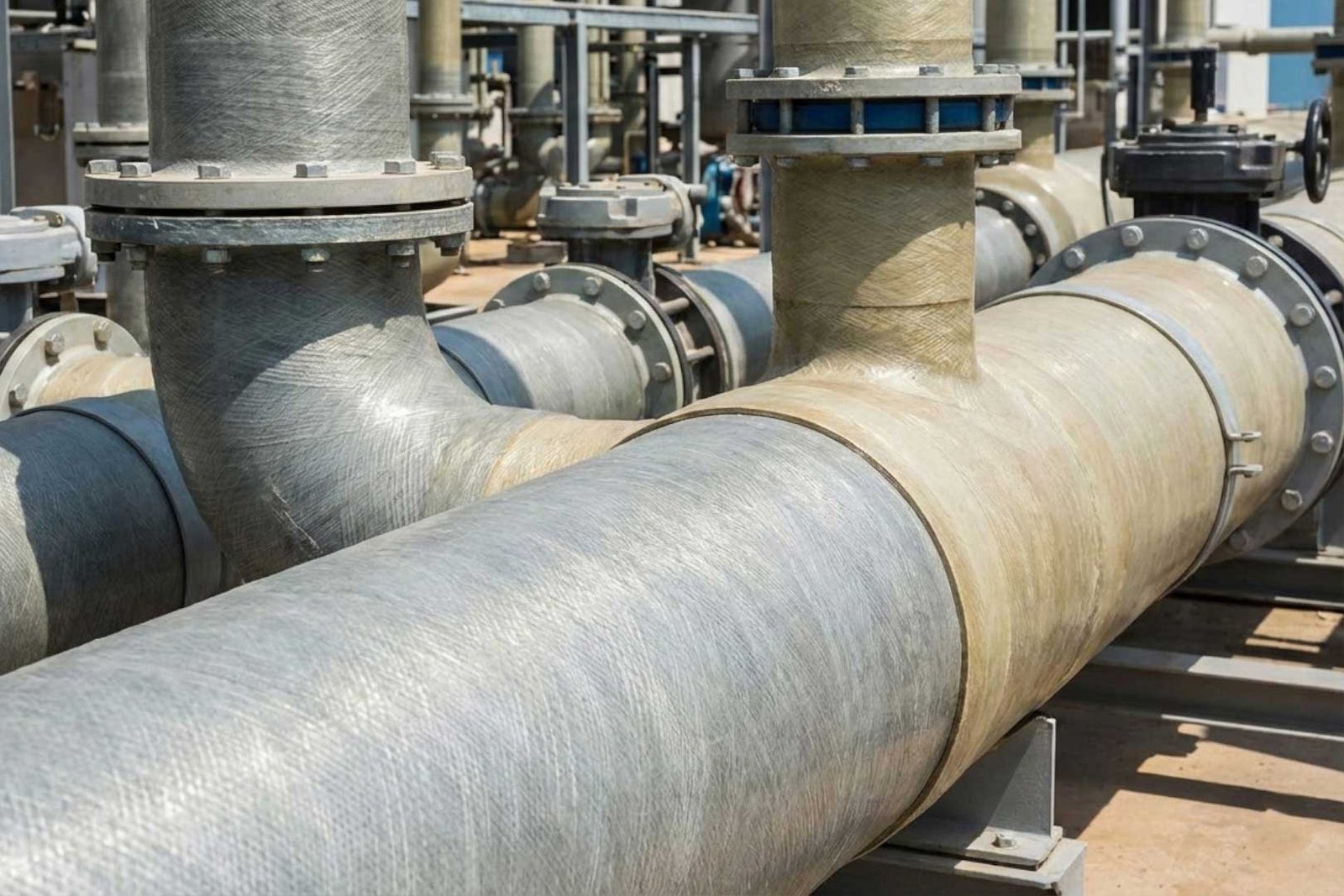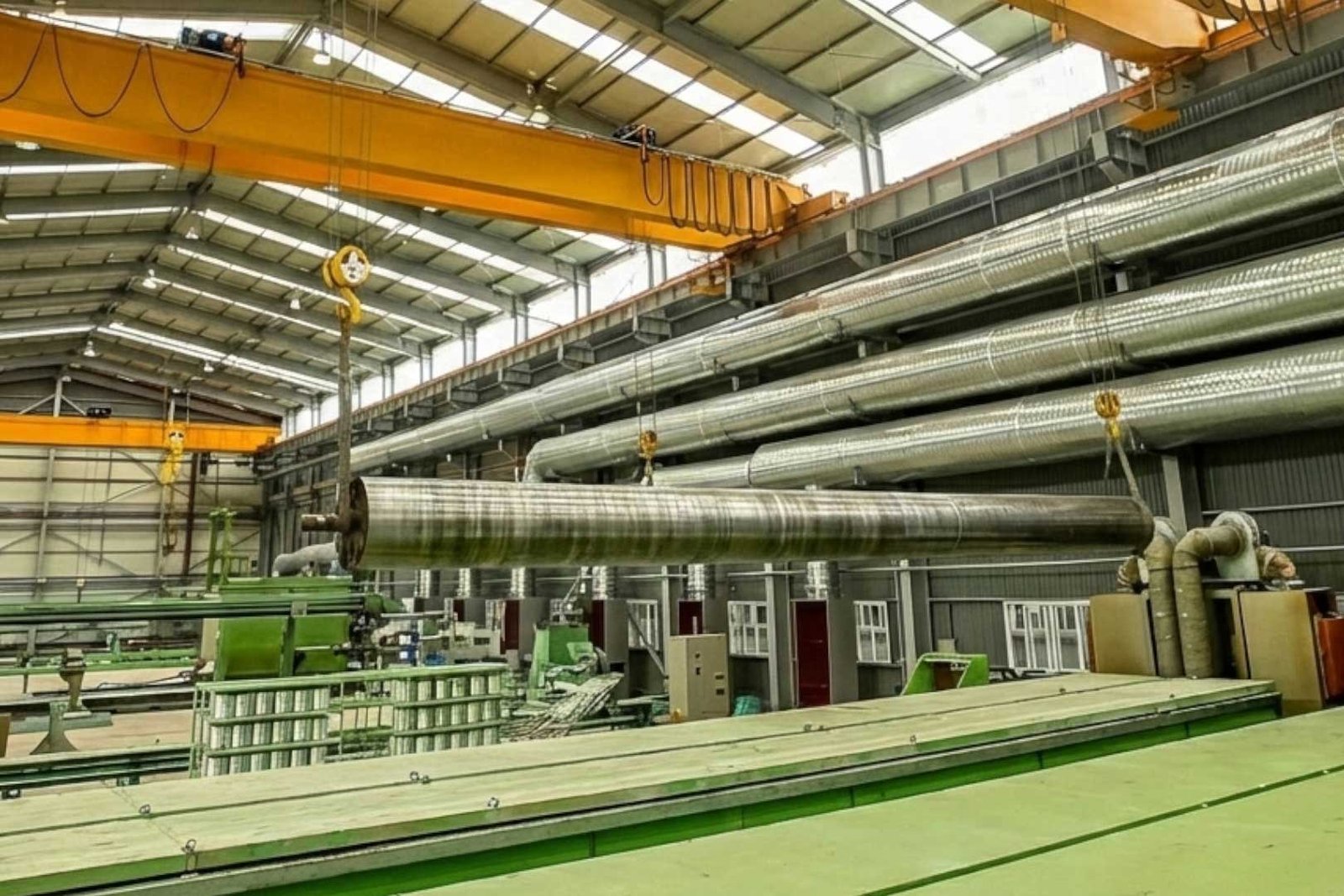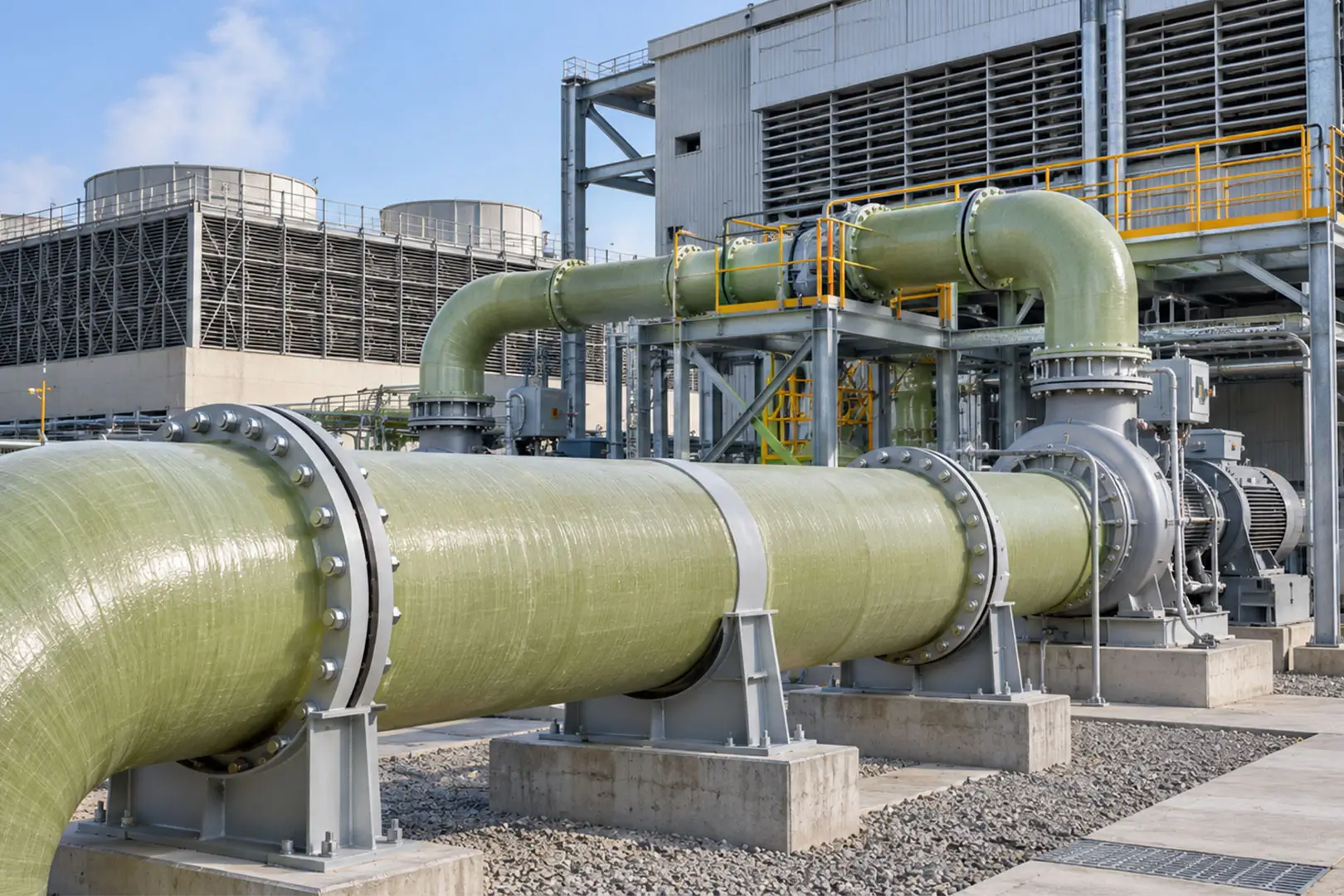
Your cooling-water pipes need to keep water flowing to the condenser, day after day. Glass-reinforced plastic (GRP) is light and resists corrosion, but size and pressure rating are only part of the choice.
Before you ask for a price, explain what your pipes will face. What is in the water? What happens if a pump stops suddenly? How will the pipes connect to your equipment? We will explain everything for you, including what to check and what to ask your supplier.
Why Cooling Water Pipe Selection Is an EPC Decision?
The pipes you choose affect how your condenser works, how the site is built, and when installation finishes. Your engineering, procurement, and construction (EPC) team needs to make that choice together.
Before you buy, agree on the design basis, like the conditions the system must handle. Include normal operation, sudden pressure changes, vacuum, temperature changes, and forces at equipment connections.
Understanding the Power Plant Cooling Water System
In a typical system with a cooling tower, water follows this route: cooling tower basin → circulating-water pumps → condenser → return piping → cooling tower. The water picks up heat at the condenser. The tower releases that heat before the water goes around again.
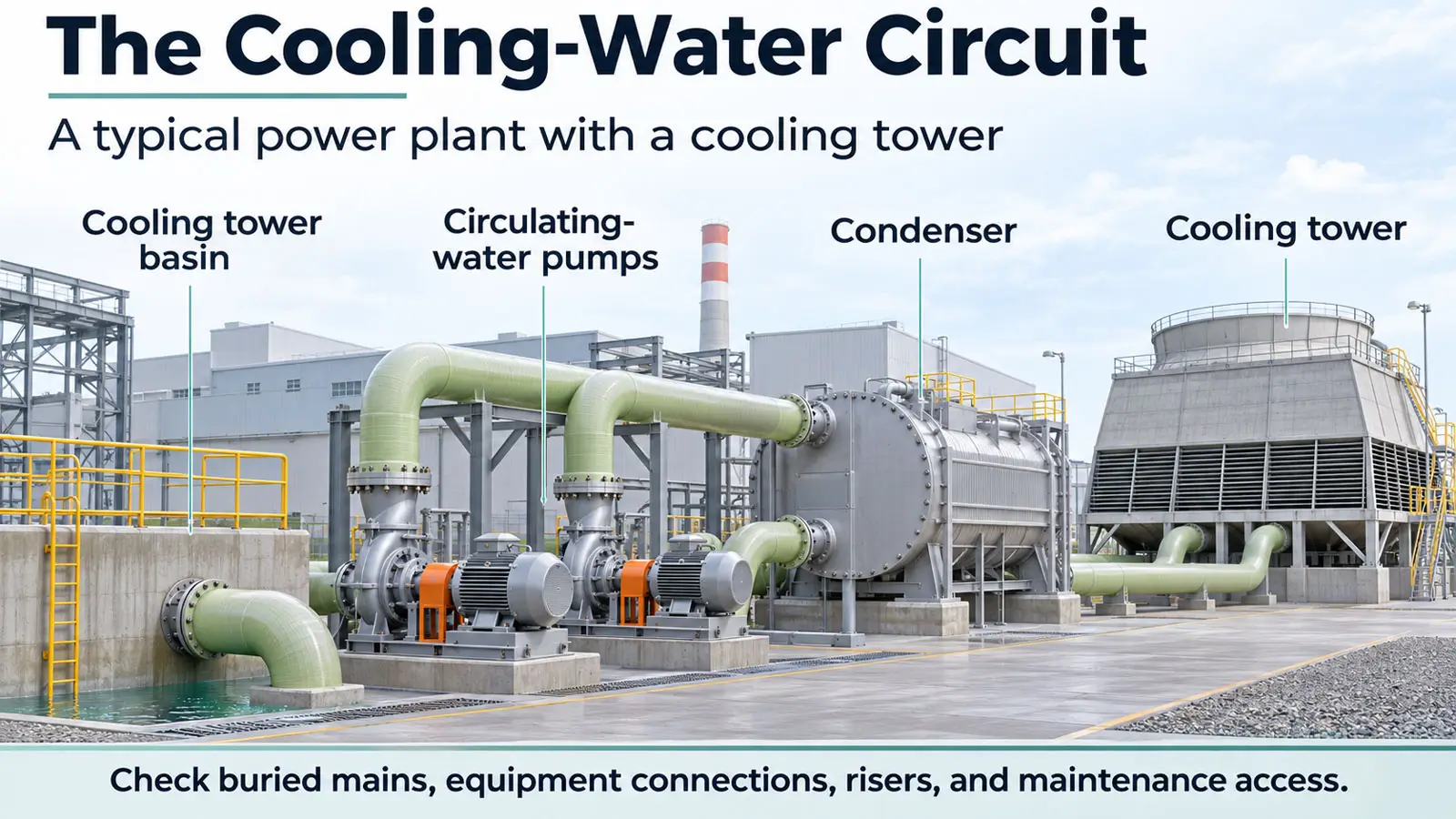
Mark the main pipes before and after the pumps, condenser connections, shutoff valves, tower risers, and smaller cooling-water branches on your drawing. Show which sections are buried and which sit aboveground beside equipment.
Tell your supplier how you plan to run the system. Using one pump or taking a tower cell out of service changes water flow and pressure.
Essential Design Inputs Before Selecting GRP/GRE Piping
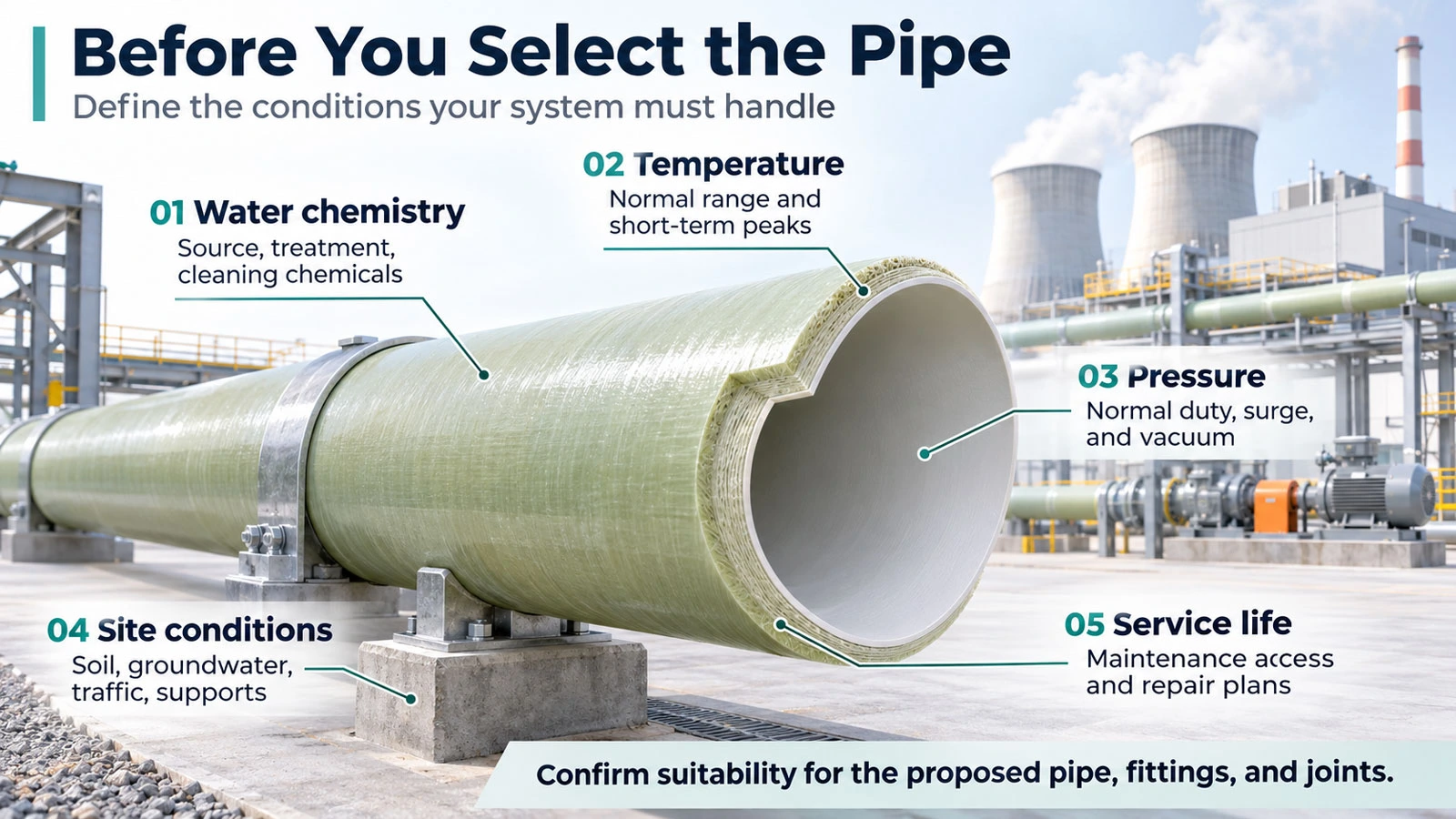
Your supplier needs to understand your water, operating conditions, and site before selecting GRP or glass-reinforced epoxy (GRE). Start with the checks below.
Water Source, Chemistry and Treatment
Send your water test results and name the source: freshwater, treated water, brackish water, or seawater. Include pH, salt and chloride levels, particles in the water, chlorine, biocides used to control growth, and cleaning chemicals.
Ask your supplier to check the resin and inner liner against those chemicals, their strength, the water temperature, and exposure time. Include pipe-cleaning treatments, even if you use them only occasionally.
Operating Temperature and Plant Duty
List the normal water temperatures going to and returning from the condenser. Include seasonal highs and lows, brief temperature peaks, and how often your plant starts, stops, or changes output.
Ask your supplier how these conditions affect the resin, pressure rating, and joints of the pipe being offered.
Pressure, Surge and Vacuum Conditions
List normal pressure and the pressures expected when pumps start, stop suddenly, or valves move. Attach your surge analysis, which checks sudden pressure changes, if available.
Check vacuum too. When pressure inside the pipe falls, loads outside it can cause inward collapse. The stated pressure rating alone does not confirm vacuum resistance.
Installation Environment and Design Life
Tell your supplier how deep the pipe will sit, what the soil is like, and whether groundwater or traffic will add loads. Describe expected ground movement and aboveground supports. Show tight spaces around equipment. State how long you need the system to last and what maintenance you expect.
Design Information the EPC Must Provide Before Pipe Selection
Use this table to check what your supplier needs before comparing offers.
| Input | What to provide | What it affects |
|---|---|---|
| Water chemistry | Water treatment and cleaning chemicals | Resin, liner, and gasket choice |
| Temperature and duty | Supply, return, peaks, and temperature changes | Pressure rating and connections |
| Pressure range | Normal pressure, surge, vacuum, and duration | Pipe and joint suitability |
| Installation | Cover, soil, groundwater, traffic, supports | Pipe stiffness, anchors, and installation |
| Design life | Service period and maintenance access | Test evidence and repair plans |
GRP/GRE vs. Steel vs. HDPE: Choosing for the Same Cooling Water Duty
Compare each material for the same water, pressure, temperature, and layout. The points below explain where each option could fit your project.
Where GRP and GRE Can Be Suitable
GRP/GRE offers corrosion resistance when correctly selected, low weight, large sizes, and smooth inner surfaces. Polyester and vinyl-ester GRP use different resins than epoxy-based GRE.
Check that the offered resin, liner, and joints suit your water and operating conditions. Confirm vacuum resistance and the forces the pipe can carry at equipment connections.
When Steel or HDPE May Be Preferable
Steel could suit your project where equipment connections carry high loads, temperatures are high, or your plant already uses steel fabrication methods. Include corrosion protection and inspection costs.
High-density polyethylene (HDPE) is flexible, and its sections can be joined by heat fusion. For buried lines, check the available sizes, temperature and pressure limits, vacuum resistance, and equipment connections. Compare the main checks below.
| Decision factor | GRP/GRE | Carbon steel | HDPE |
|---|---|---|---|
| Chemistry | Check resin, liner, and rubber seals | Specify lining and corrosion protection | Check resistance to your chemicals |
| Temperature | Check the offered product’s limits | Check metal and lining limits | Check the rating at your temperature |
| Large diameters | Check available sizes and fittings | Check manufacture and transport | Check available sizes and fittings |
| Surge and vacuum | Check pipe wall, stiffness, and joints | Check collapse resistance and anchoring | Check repeated pressure changes and collapse |
| Installation | Careful handling and joint installation | Welding, inspection, and coating repair | Fusion-joint quality and work space |
| Maintenance | Inspect joints, damage, and interfaces | Inspect corrosion, linings, and coatings | Inspect damage and connections |
| Equipment connections | Check connection forces and flanges | Fits many existing fabrication methods | Design connections and allow movement |
System Layout, Joint Selection and Equipment Connections
Plan how you will support the pipes and control movement before fixing the layout. Your civil engineer, piping engineer, equipment vendors, and pipe supplier need to agree on the following details.
Buried and Aboveground Piping Arrangements
Buried pipes, aboveground pipes, and vertical risers need different supports. Pay attention where pipes enter buildings or emerge aboveground: the ground and the structure may settle by different amounts.
Agree how joints will allow movement and how the pipe will be held in place before approving manufacturing drawings.
Selecting the Right Joint and Restraint System
Joints affect installation time, movement, and future repairs. Options include gasketed couplings, restrained mechanical joints that resist pull-apart forces, laminated joints made with resin and glass layers, adhesive-bonded joints, and bolted flanges. For each option, check:
- How much axial thrust, or lengthwise force, the joint carries and what movement it allows.
- Where anchors, restrained pipe sections, or concrete thrust blocks must resist pressure forces.
- Installer training, inspection, and time for resin or adhesive to harden.
- Access for future dismantling or repair.
NOV’s fiberglass engineering guide covers supports, anchors, movement caused by temperature, and connections to steel.
Connecting to Pumps, Condensers and Cooling Towers
Ask your pump vendor how much force the connections can take and how the pipes must line up. Use separate supports for heavy valves, leave removable pipe sections for maintenance, and check vibration and temperature-related movement.
At your condenser, check shutoff arrangements, connection forces, vents, drains, and space for maintenance. At the tower, check riser supports, water-distribution pipes, movement of the structure, and access.
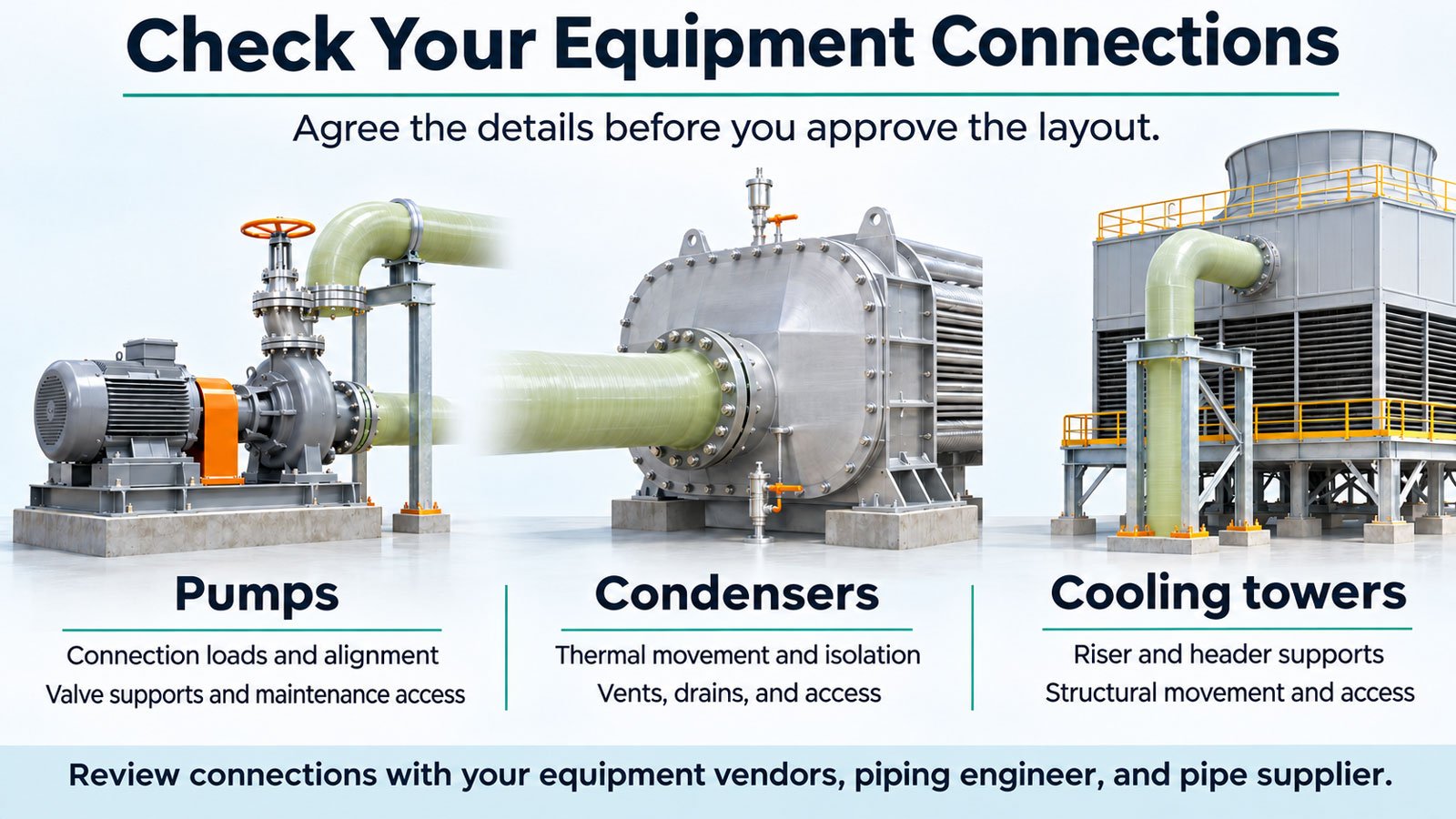
Future Pipe’s aboveground installation guide explains support and joint-alignment requirements for its products. Ask your equipment vendors, piping engineers, and supplier to review key connections before you approve the layout.
GRP Cooling Water Pipe Procurement: What Should Be Included in the RFQ?
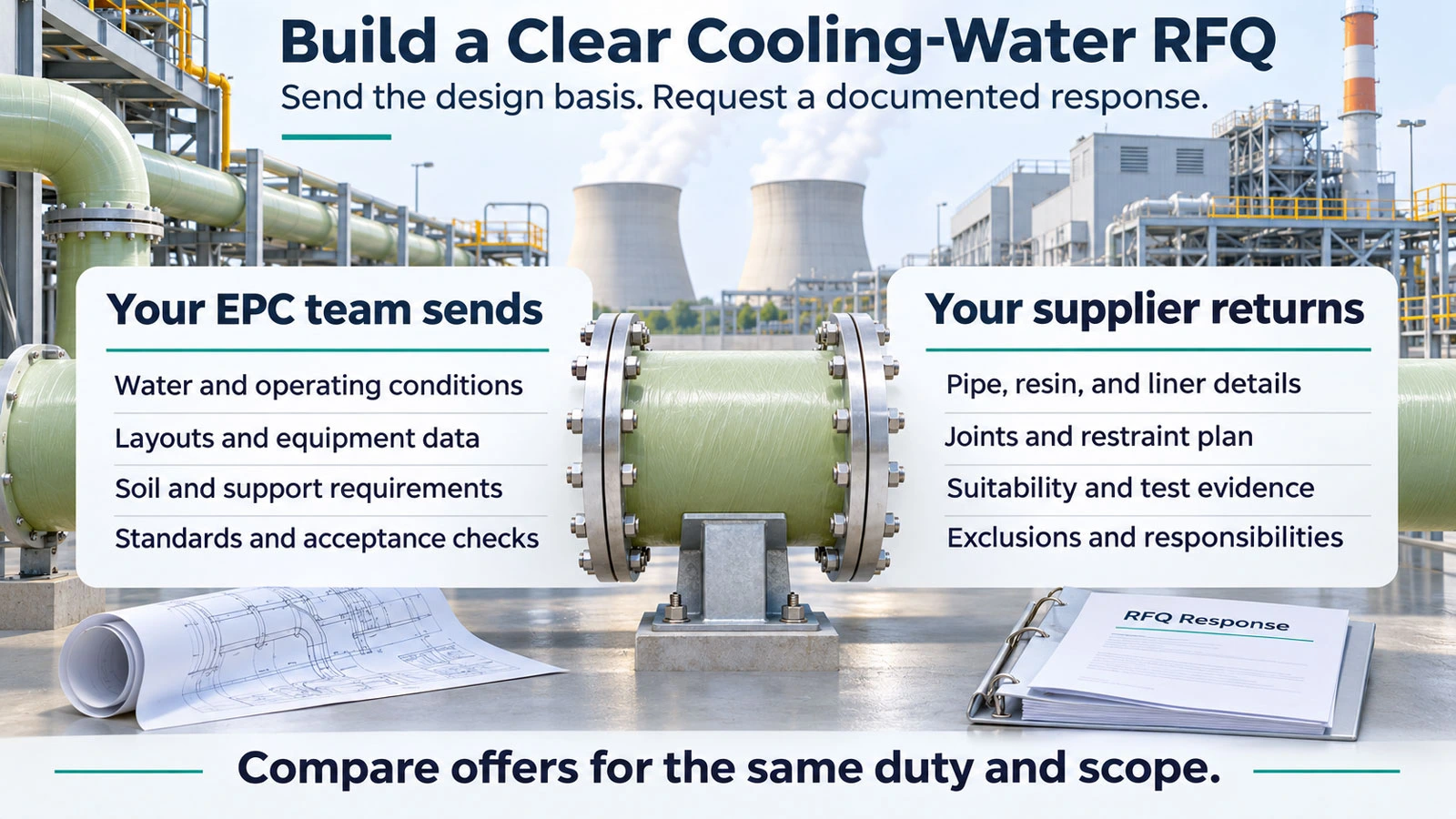
Your request for quotation (RFQ) should tell suppliers exactly what to price. Use the lists below so each offer covers the same conditions and work.
Information the EPC Contractor Should Send
Send drawings with your operating data so suppliers can check each pipe section. Group the information as follows:
- Operating conditions: water tests, temperatures, sudden pressure changes, vacuum, and required service life.
- Engineering: piping and instrumentation diagrams (P&IDs), pipe lists, layouts, flow and surge reports, equipment data, and allowable connection forces.
- Site details: underground routes and levels, soil reports, space limits, and support needs.
- Project requirements: standards, inspections, records, installation work, delivery scope, and acceptance checks.
Information the GRP Supplier Must Return
Ask each supplier to explain how its offer meets your requirements and identify missing information. Request the following:
- Pipe construction, resin, liner, diameter basis, pressure class, and stiffness class.
- Fittings, flanges, joints, and how the system will resist pressure forces.
- Written evidence that the system suits your chemicals, temperatures, and vacuum conditions.
- Product test evidence, similar projects, inspection records, and installation instructions.
- Any differences from your requirements, excluded work, site support, and who is responsible for each task.
Codes and Standards to Confirm
ISO 23856:2021 covers polyester-based GRP water systems, including vinyl-ester constructions and cooling-water applications. Do not assume it also covers epoxy GRE.
Check AWWA C950 and ASTM D3517 where your project requires them. Ask your engineering team which editions and plant piping codes apply, including ASME B31.1.
ISO 14692 addresses petroleum and natural-gas GRP piping. Use it when your project requires it and its scope fits. It is not the default standard for every power-plant cooling-water system.
Installation, Quality Assurance and Commissioning Considerations
Agree on the checks needed to accept your installed system before delivery. Make someone responsible for each stage:
- Review factory quality records, including material records, dimensions, pipe and fitting qualifications, joints, and inspection records.
- Agree how pipes will be protected in transport, unloaded, stored, and checked for damage.
- Check bedding, backfill, soil compaction, and ground movement for buried pipes. Aboveground, check supports, anchors, alignment, and joint quality.
- Agree which sections will be tested, how they will be filled and vented, leak-test conditions, flushing, and final records.
Use trained installers and approved procedures. Set test pressures and pass/fail checks to suit your pipes, joints, connected equipment, and project specification.
What Real Power Plant Projects Demonstrate
These two projects show why pressure checks and installation planning belong in your pipe discussions. Their results apply to those specific systems.
In Dynaflow’s 2024 combined-cycle cooling-water study, engineers checked six cases involving operating disturbances. Pressures stayed below the project’s 5 barg limit. However, near-vacuum conditions occurred, along with column separation, where low pressure creates vapor cavities in the water, around condenser and heat-exchanger areas.
At Enertec Hameln in Germany, Fiberpipe reports replacing the cooling-water cycle with 4 bar, SN 10,000 GRP piping and double-O-ring push-fit joints. The supplier reports installation in five days after planning the work and agreeing on testing and approval.
Conclusion — An Integrated Approach to GRP Cooling Water Pipeline Projects
Before you buy, agree on operating conditions, joints, and equipment connections. Use those decisions to check your supplier, guide installation, and test the finished system.
Grand Linecore supplies composite pipes and offers EPC services for water-infrastructure projects. Contact Grand Linecore to discuss the pipes, supply requirements, and engineering support your power plant needs before purchase.
about
The Author

Farshid Tavakoli is a seasoned professional in engineering and international trade. Holding degrees in Electrical Engineering, Mechatronics, and a Doctorate in Business Administration (DBA) from the University of Lyon, he also has a strong background in industrial automation and production line technologies.
For over 17 years, he has led an international trading company, gaining deep expertise in commercial solutions tailored to industrial needs. With more than 8 years of active involvement in infrastructure development, he specializes in the supply of electromechanical equipment for water and wastewater treatment plants and transfer projects.
Together with comapny expert team, he now provides consultancy and integrated solutions for sourcing and implementing complex infrastructure projects across the region.