You can choose a great pipe and still end up with the wrong pipeline. In Ethiopia, long pumped mains, steep elevation changes, large diameters, and remote construction can completely change what works for your project. That is why price or a simple product table is never enough.
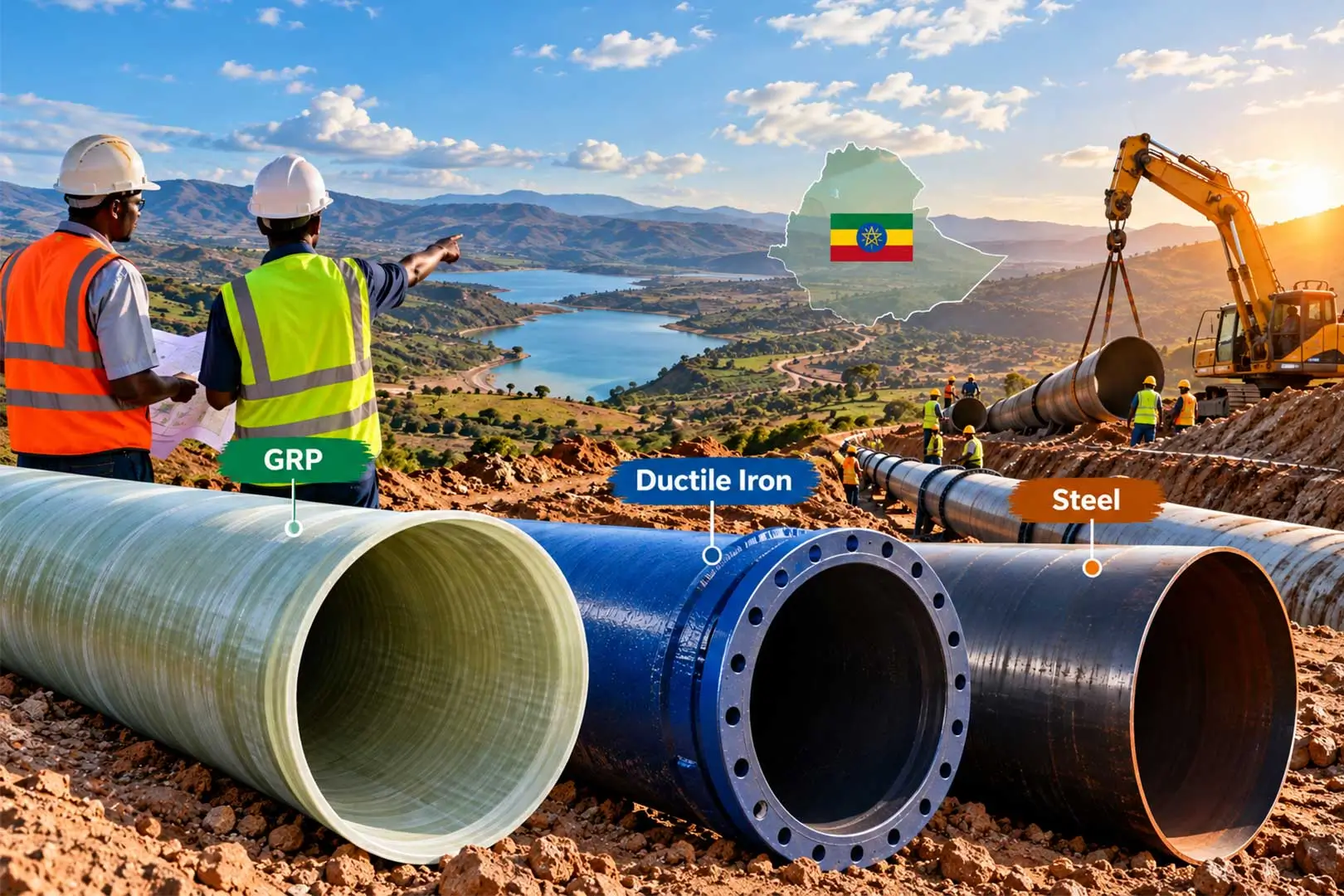
GRP, ductile iron, and steel can all make sense. Harar used a long DN600 ductile-iron main, while Galchet-Sarite/Borena documents show DI considered earlier and steel specified later. Ethiopian projects clearly do not point to one material every time.
So how do you choose without guessing? Stay with us to see what really matters before you lock in the material.
Start With the Hydraulic Profile, Not the Pipe Catalogue
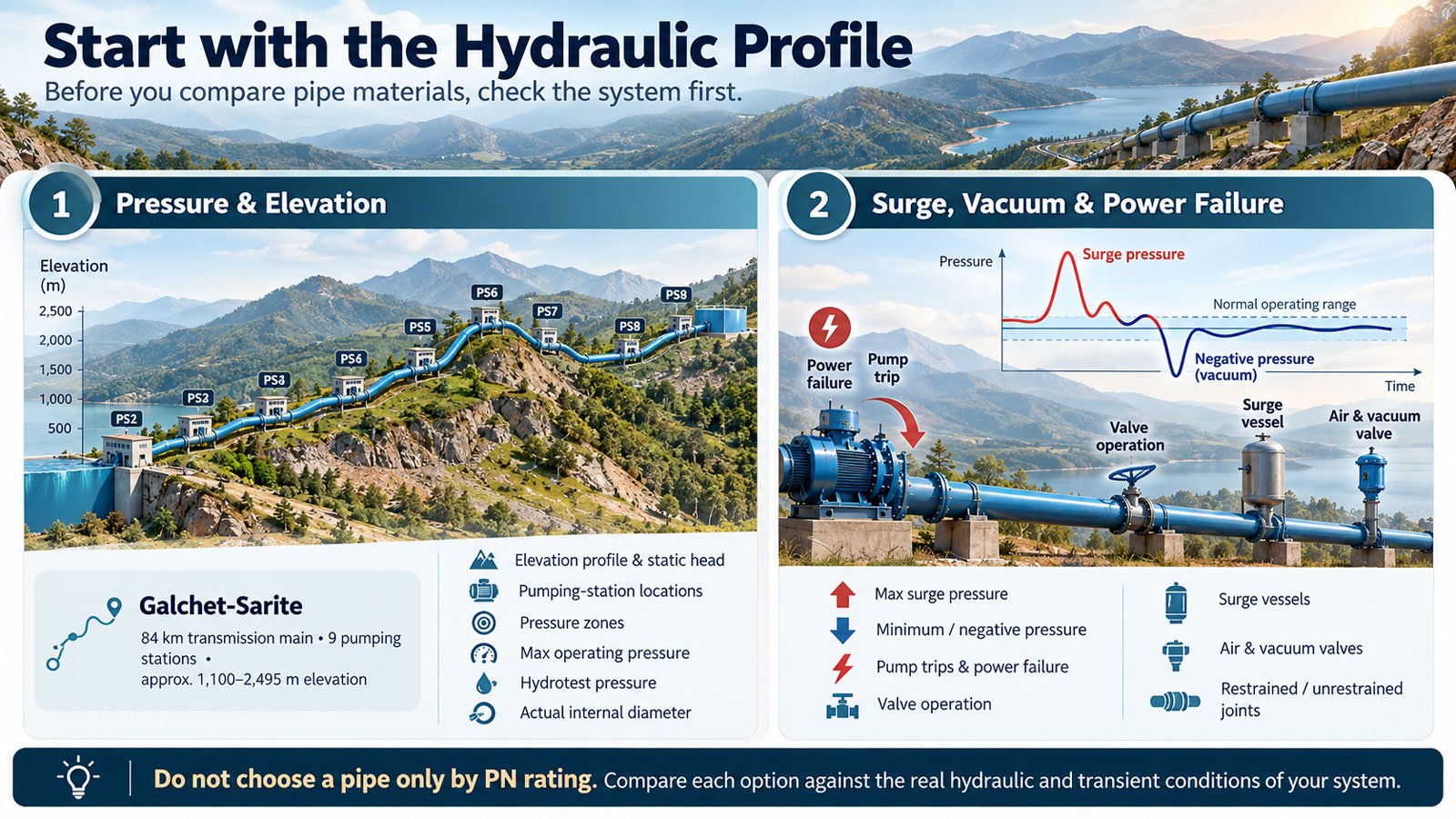
Your pipe has to match the hydraulic system, not just the catalogue. Start with these two checks before you compare materials:
Pressure and Elevation
For a long pumped main, check:
- elevation profile and static head
- pumping-station locations
- pressure zones
- maximum operating pressure
- hydrostatic test pressure
- actual internal diameter
Galchet-Sarite is a useful example. Ministry of Water and Energy describes 84 km of transmission main, nine pumping stations, and a project area with elevations ranging from about 1,100 to 2,495 metres above sea level. That is exactly why pipe selection has to follow the hydraulic profile.
Surge, Vacuum, and Power Failure
Normal pressure is only part of the picture. Your transient analysis should also look at maximum surge pressure, minimum or negative pressure, pump trips, power failures, valve operation, surge vessels, air and vacuum valves, and the way restrained or unrestrained joints behave.
Do not choose a material simply because its PN rating looks high enough. Compare each option against the actual transient envelope of your system.
GRP vs Ductile Iron vs Steel: Ethiopia-Specific Comparison at a Glance
No material wins every condition. Use this table as a quick screen, then test the shortlist against your real route and operating needs.
| Selection factor | GRP | Ductile iron | Steel |
|---|---|---|---|
| Long imported main | Lower mass can help | Heavier to transport | Depends on diameter and wall |
| Large diameter | Strong candidate | Established | Highly adaptable |
| Very high pressure | Project-dependent | Strong candidate | Often attractive |
| Corrosive conditions | Strong advantage | Protection may be needed | Coating/CP may be needed |
| Rough handling | Needs care | Robust | Robust, coating damage matters |
| Remote installation | Efficient with trained crew | Familiar push-in joining | Welding/NDT dependent |
| Thrust restraint | Joint-system dependent | Restrained joints/thrust blocks | Welded continuity |
| Emergency repair | GRP skills/spares needed | Often familiar | Welding skills useful |
| Pumping efficiency | Potential advantage | Competitive | Competitive |
| Djibouti logistics | Lower mass can help | Weight penalty | Project-specific |
For standards, ISO 23856 covers GRP water systems from DN50 to DN4000, while ISO 2531 covers ductile-iron water systems from DN40 to DN2600.
Where GRP Can Create a Real Advantage in Ethiopian Transmission Projects
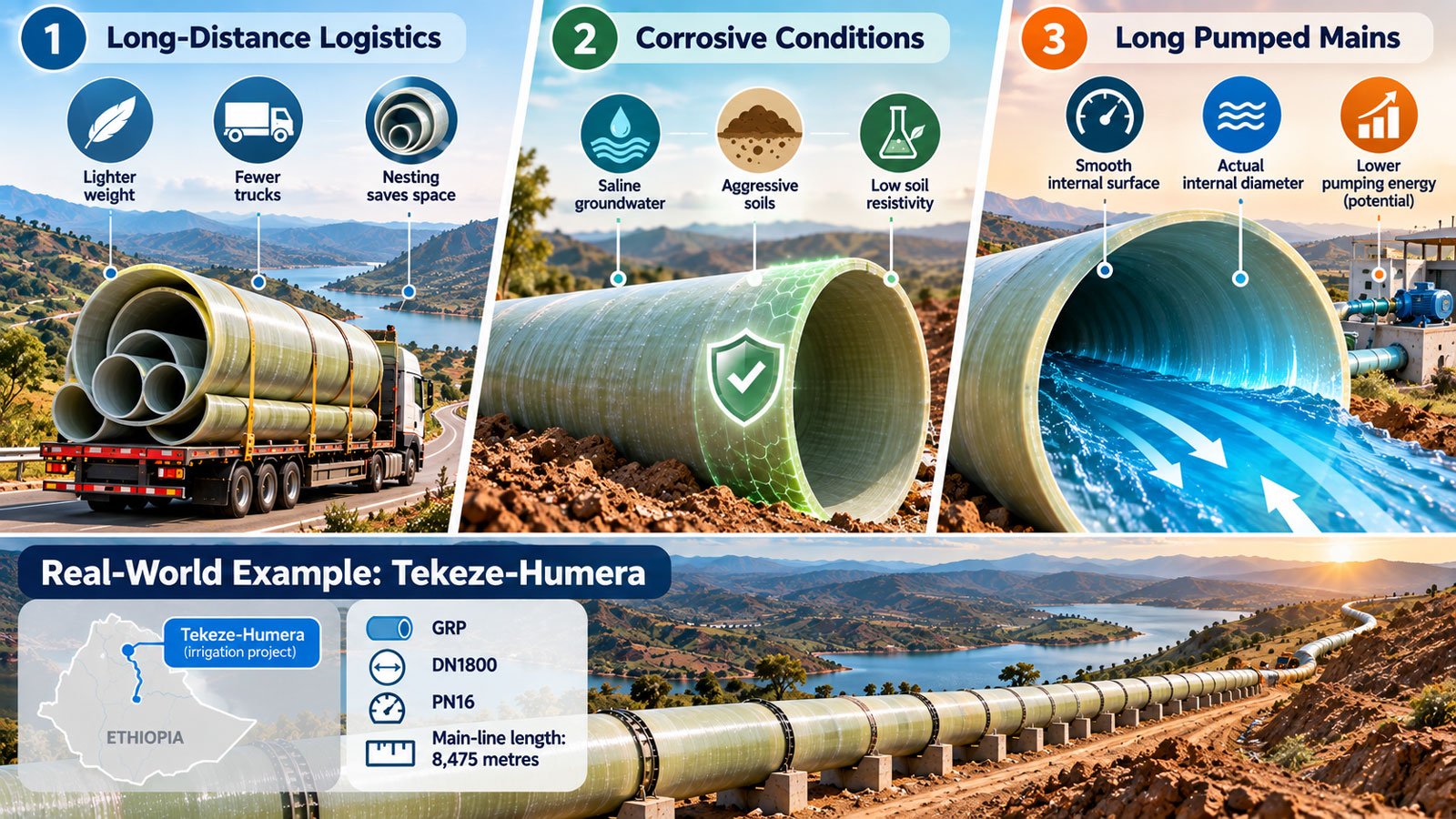
GRP becomes interesting when logistics, corrosion, and long-distance pumping all matter. These are the three areas where it can make a real difference:
Long-Distance Logistics
Lower pipe mass can reduce lifting demand and may reduce the number of trucks needed. Nesting smaller diameters inside larger pipes can also improve freight use where the sizes and packing plan allow it. For you, the useful number is delivered cost, not factory price.
Corrosive Conditions
GRP can become attractive where you have saline groundwater, aggressive soils, low soil resistivity, or places where long-term metallic corrosion protection would be difficult to maintain.
DI and steel can still be protected. For example, ISO 8179-1 specifies an external zinc-based protective coating system for ductile-iron pipeline components. The protection system, inspection needs, and long-term maintenance should all be part of your comparison.
Long Pumped Mains
A smooth internal surface and actual internal diameter can affect friction losses and annual pumping energy. But do not assume GRP automatically gives you the lowest energy cost.
Flow, static head, pipe length, roughness, actual internal diameter, and pump efficiency all need to be modeled together.
Real-World Example: Tekeze-Humera
The Tekeze-Humera ESIA gives a useful Ethiopian GRP design example. The study describes a pumped irrigation main using GRP DN1800, PN16, with a cited main-line length of 8,475 metres.
This is an irrigation design reference, not a completed municipal drinking-water project. Its value is showing that large-diameter pumped GRP has been considered in real Ethiopian infrastructure planning.
Where Ductile Iron Can Be the More Rational Choice
DI can be very practical when mechanical robustness and familiar installation matter more than freight savings. Look at these conditions where it may fit your project better:
- rough construction conditions
- mechanically demanding alignments
- frequent joint deflection
- push-in or restrained joints
- crews familiar with DI installation
- utilities familiar with DI repair
- sections where installation risk matters more than transport weight
Real-World Example: Harar
Harar is a strong Ethiopian DI example. The Harar project records a 75 km, DN600 ductile-iron transmission pipeline as part of the completed Harar Water Supply and Sanitation Project.
That does not make DI the answer for every route. It shows that DI has already been used on major Ethiopian transmission infrastructure.
Where Steel Earns Its Place
Steel becomes especially useful when pressure, restraint, fabrication, or special sections get more demanding. These are the applications where it often starts to make sense:
- very high-pressure sections
- pump-station manifolds
- severe thrust locations
- complicated fabricated specials
- crossings and above-ground sections
- locations where field modification matters
You also need to count what comes with steel: heavier transport, qualified welders, NDT, field-joint coating, corrosion protection, and possible cathodic protection. AWWA’s C206 guidance covers field welding of steel water pipes and includes ultrasonic testing as an accepted verification method in the referenced revision.
Real-World Example: Galchet-Sarite
Earlier Galchet-Sarite documents say DI was selected at that design stage for rising and transmission mains. Later, an AfDB procurement notice called for steel pipe for the Gelechet-Sarite wellfield backbone.
The documents do not explain why the material changed, so we should not guess. The useful lesson is that material decisions can change as a project develops.
The Hidden Ethiopia Factor: Djibouti-to-Site Logistics
For imported pipe, ex-works price tells you only part of the story. Compare these logistics differences before you decide which bid is really cheaper.
- GRP: lower mass can improve truck use and make lifting easier. Nesting may reduce freight volume, but careful handling is important because impact damage matters.
- Ductile iron: greater weight can increase trucking and lifting needs, but robust handling can help on difficult sites.
- Steel: weight depends on diameter and wall thickness. Pipe length and transport form matter too, and coatings need protection during handling.
This matters because the World Bank corridor program reports that more than 95% of Ethiopia’s trade by volume uses the Addis-Djibouti corridor.
The better metric is delivered and installed cost per metre, not factory price. Include sea freight, Djibouti handling, inland trucking, unloading, storage, lifting, and installation.
Installation Reality: Soil, Bedding, Jointing and Skilled Labour
A good material can still become a bad project choice if it is difficult to install correctly. Start with these two installation checks:
Soil and Groundwater
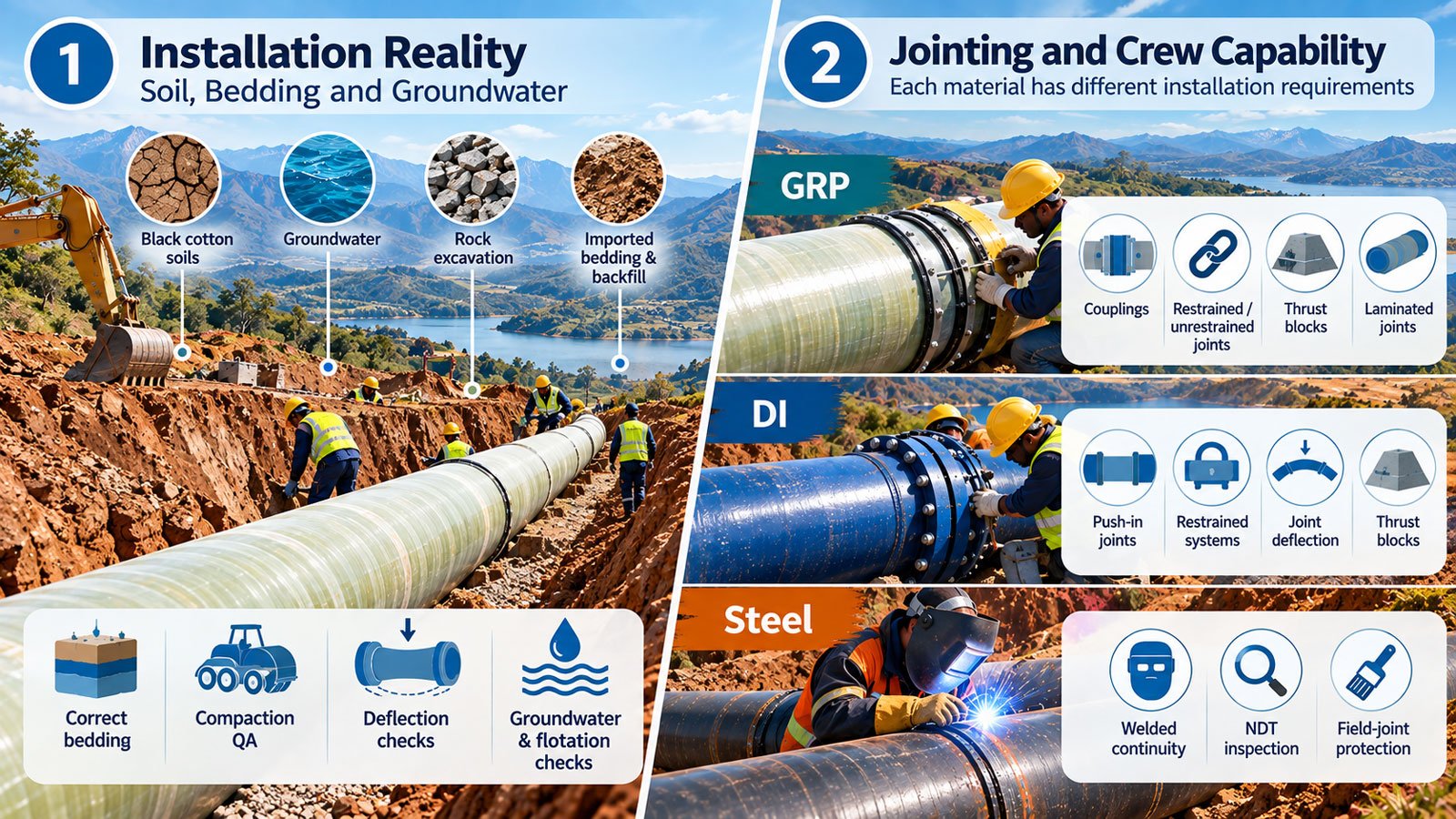
Your route may include black cotton soils, groundwater, rock excavation, settlement, or areas that need imported bedding and backfill. Ethiopian project studies have documented black cotton soils that expand and contract as their moisture changes, which can make construction more difficult.
For GRP, corrosion resistance does not remove the need for stiffness design, correct bedding, compaction QA, deflection checks, or groundwater and flotation checks.
For DI and steel, soil-corrosion measurements may also be needed so the protection system matches the route.
Jointing and Crew Capability
Each material asks something different from your site team:
- GRP: couplings, restrained/unrestrained joints, thrust blocks, or laminated joints
- DI: push-in joints, restrained systems, joint deflection, and thrust blocks
- Steel: welded continuity, NDT, and field-joint protection
Maintenance and Emergency Repair After Handover
Imagine a DN800 transmission main fails hundreds of kilometres from Addis Ababa. Your pipe choice now becomes a repair and mobilisation problem. Think about these resources before the system is handed over. You may need:
- repair clamps or replacement sections
- welding equipment and qualified welders
- GRP couplings or lamination kits
- trained repair technicians
- spare fittings and gaskets
- transport to the failure point
Ask yourself how quickly your utility can get the right people, tools, and spare parts to the failure.
Compare Lifecycle Cost, Not Just Pipe Purchase Price
The cheapest pipe at purchase can become expensive later. Add these costs before you compare the three options.
Lifecycle cost = supply + logistics + installation + pumping energy + corrosion protection + maintenance + repair/risk costs
Your comparison should include:
- pipe and fittings
- sea freight and inland trucking
- bedding, backfill, lifting, and thrust restraint
- welding and NDT
- pumping energy using actual internal diameter
- coatings or cathodic protection
- spares and emergency repair
Avoid universal claims such as “this pipe lasts X years.” The better requirement is that the selected system is designed for the required project life under the specified operating and installation conditions.
What Donor-Funded and EPC Projects Should Check Before Approving a Material
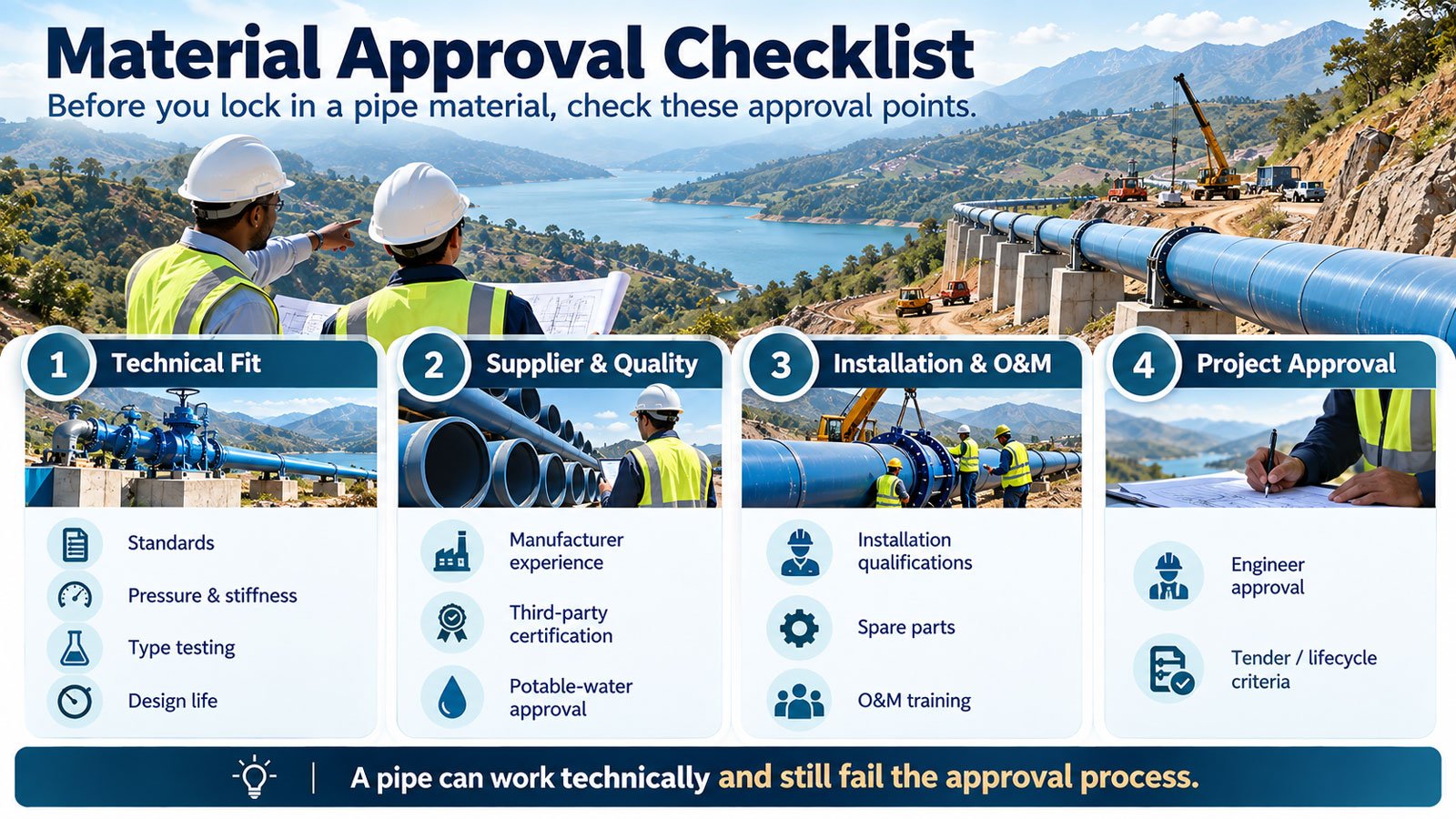
A pipe can work technically and still fail the employer’s approval process. Use this checklist before you approve an alternative or lock in a material:
- employer-approved standards
- required pressure and stiffness class
- manufacturer experience
- third-party certification
- potable-water approval
- type testing
- installation qualifications
- required design life
- spare-parts requirements
- O&M training
- engineer approval for alternatives
- lifecycle or rated-tender criteria
The World Bank’s technical-specification guidance explains how specifications define the goods and works being procured and how those requirements connect to procurement decisions.
A technically suitable pipe can still be commercially unsuitable if it cannot satisfy the project specification and approval requirements.
So Which Material Should Be Used in Ethiopia?
There is no single winner for every Ethiopian transmission route. Use these conditions to see where each option may fit best.
- GRP tends to become attractive when the main is long and large, transport weight matters, corrosion exposure is important, pumping energy deserves close attention, and bedding and installation QA can be controlled.
- Ductile iron tends to become attractive when mechanical robustness, push-in or restrained joints, demanding handling conditions, and utility familiarity with repair matter.
- Steel tends to become attractive when pressure is especially demanding, continuous axial restraint is needed, custom fabrication matters, or pump stations, crossings, and special sections dominate.
And you do not always need to choose one material for the entire route. A hybrid system may make more sense, such as GRP for long buried sections, steel around high-stress specials or pump stations, and DI where route or operating conditions justify it.
Planning a Water Transmission Project in Ethiopia?
Choosing the pipe should come after you understand the system, not before. Bring the hydraulics, route, logistics, installation, and lifecycle numbers together before you make the final call.
Grand LineCore can support that evaluation across GRP, ductile iron, steel, or a hybrid approach, from pipeline engineering and material review through supply, installation, testing, and EPC delivery. The goal is not to force one material into every part of your project. It is to help you choose the system that actually fits the route.
about
The Author

Farshid Tavakoli is a seasoned professional in engineering and international trade. Holding degrees in Electrical Engineering, Mechatronics, and a Doctorate in Business Administration (DBA) from the University of Lyon, he also has a strong background in industrial automation and production line technologies.
For over 17 years, he has led an international trading company, gaining deep expertise in commercial solutions tailored to industrial needs. With more than 8 years of active involvement in infrastructure development, he specializes in the supply of electromechanical equipment for water and wastewater treatment plants and transfer projects.
Together with comapny expert team, he now provides consultancy and integrated solutions for sourcing and implementing complex infrastructure projects across the region.