Aging networks, growing demand, water losses, service interruptions, and tight maintenance budgets are putting more pressure on East African utilities. Emergency repairs are also getting more expensive, while asset and maintenance records are often incomplete.
You cannot prevent every failure or replace every old pipe, pump, valve, and reservoir at once. So you should ask yourself which assets need your attention first, which failures would cause the biggest problems, and where should your limited budget go?
We will tell you how to move from reactive maintenance to risk-based lifecycle management and focus your time, money, and effort where they can reduce the most risk.
The Hidden Cost of Run-to-Failure Infrastructure
Reactive maintenance is not complicated. It is like something fails, your team responds, the asset is repaired, and operations restart.
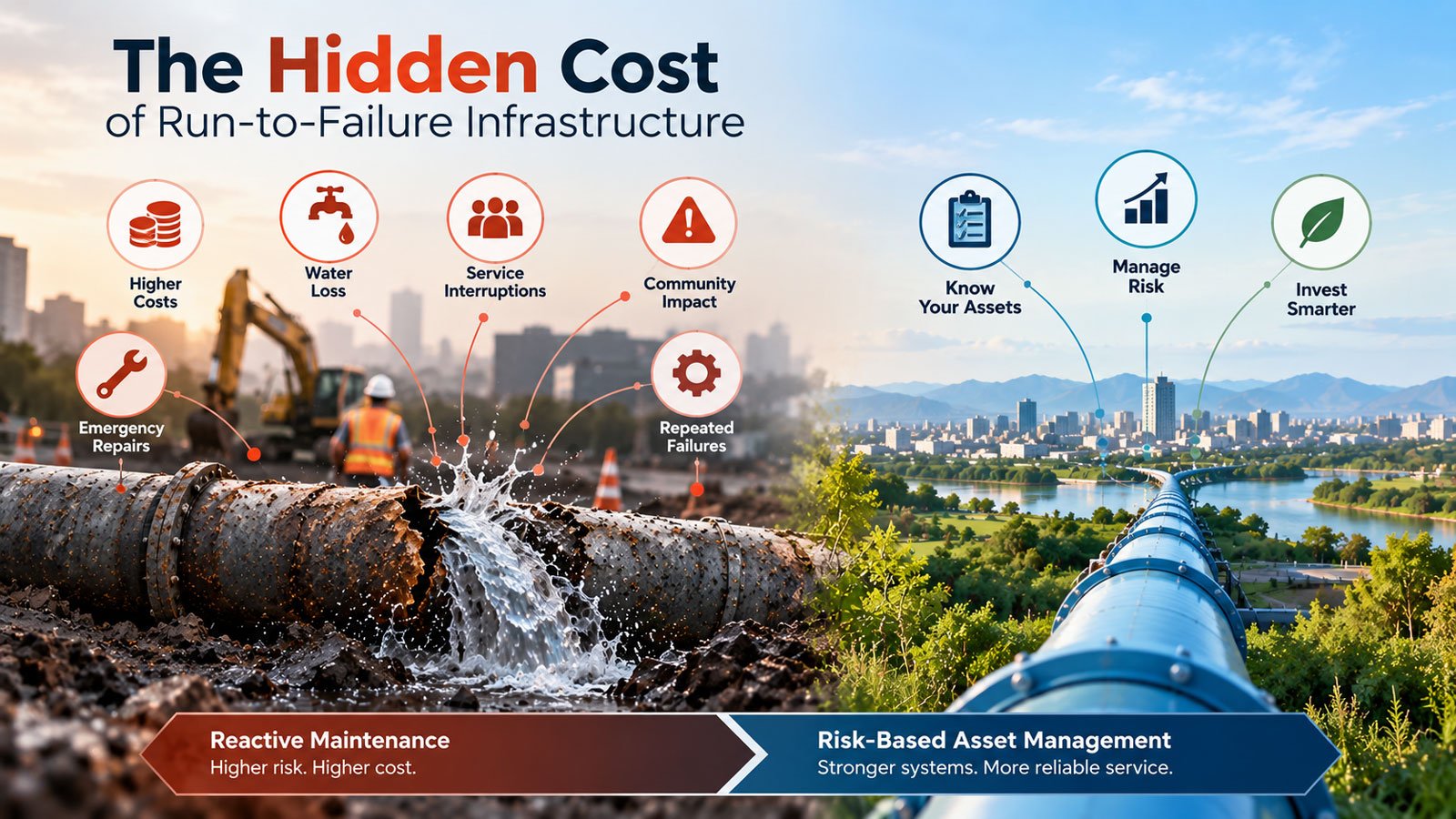
That approach still has a place. A low-cost, low-consequence asset may be perfectly reasonable to run to failure. The problem begins when the same logic is used for critical mains, pumps, valves, reservoirs, and other assets that can interrupt service for thousands of customers. At utility scale, emergency work can bring several costs at once, including:
- emergency excavation, overtime, and contractor callouts
- rushed spare-parts procurement and higher logistics costs
- water loss and lost revenue
- service interruptions and emergency tanker supply
- road, property, erosion, or flooding damage
- pressure disturbances when systems are isolated and repressurized
- repeated repairs on infrastructure that really needs rehabilitation
- capital budgets being pulled away from planned renewal
The real issue is not “reactive maintenance is bad.” It is that your utility should know which assets can safely remain reactive and which ones cannot.
The U.S. EPA asset-management guidance frames the goal around delivering the required level of service at an appropriate lifecycle cost while managing asset risk.
Why Risk Prioritization Matters Especially in East Africa
East African utilities do not operate under one common set of conditions. Kenya, Uganda, Tanzania, Rwanda, and Ethiopia have different regulators, ownership structures, network sizes, tariffs, and data maturity.
Still, the regional evidence shows a common problem: utilities are being asked to serve growing populations while managing losses, service interruptions, aging assets, and limited renewal budgets. Asset records, GIS/SCADA coverage, and technical capacity also vary, so the starting point is not the same everywhere. Let’s see why prioritization matters across the region:
| Country | What recent evidence shows | Why it matters for asset management |
|---|---|---|
| Kenya | WASREB reported about 44% sector NRW and average supply of about 18 hours/day in FY2023/24. It also reported a major gap between investment needs and available annual funding. | You cannot renew everything at once, so criticality matters. |
| Rwanda | WASAC identified aging infrastructure and vandalism among NRW challenges, with NRW reported at 38% and a national reduction target. | Condition, protection, and renewal decisions need better prioritization. |
| Uganda | NWSC reported a network above 23,000 km and a goal to improve NRW from a 34% baseline. | Large networks need consistent asset records and risk ranking. |
| Tanzania | EWURA continues to benchmark utility performance through its annual water-sector reviews. | Comparable performance data can support better maintenance and investment planning. |
| Ethiopia | Current World Bank urban-water programs include operational efficiency, NRW management, and utility business planning. | Asset management should be linked to wider utility modernization. |
The central question is if you cannot rehabilitate the whole network, what should you inspect, maintain, protect, or replace first?
What Risk-Based Asset Management Actually Means
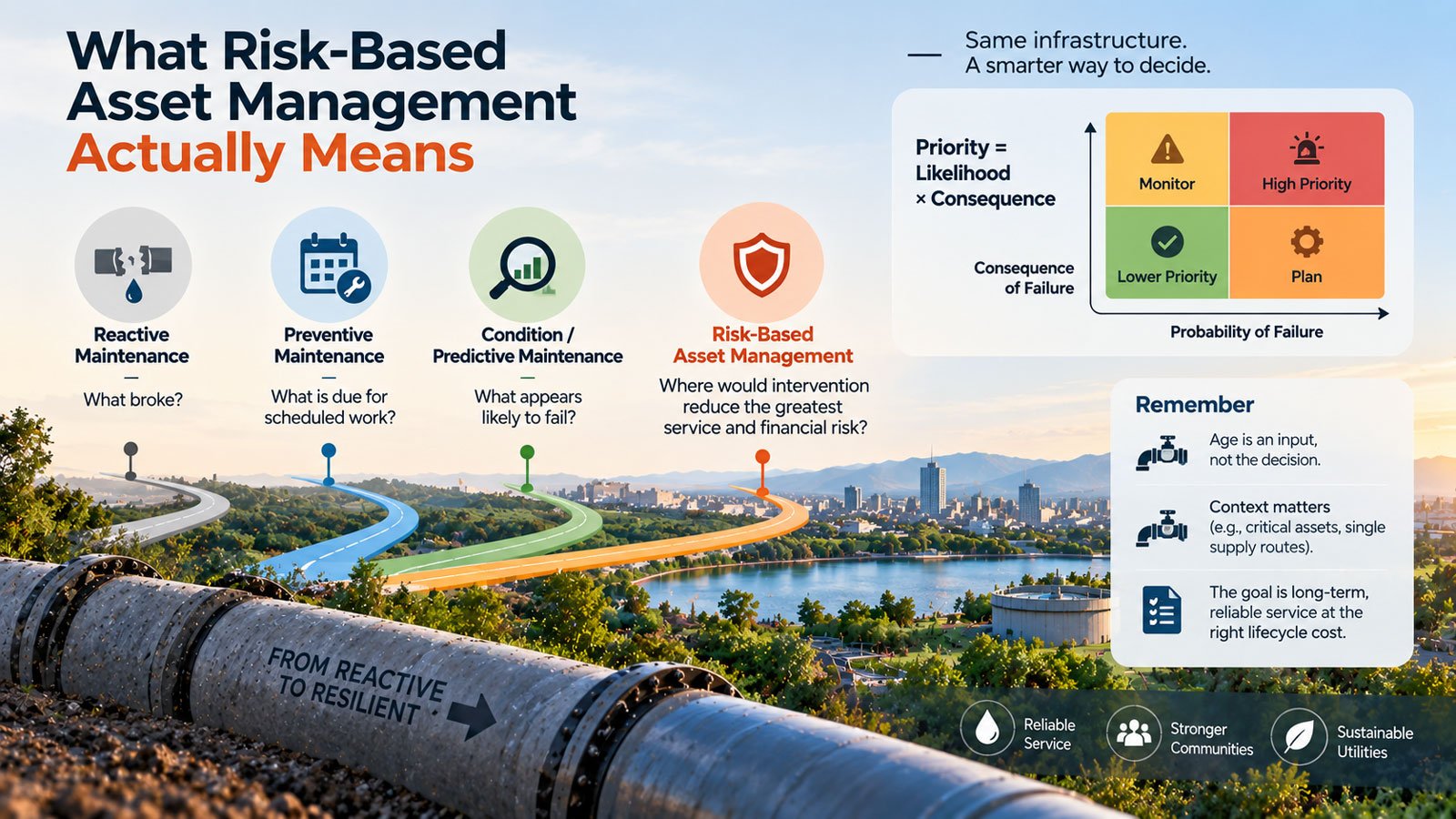
Risk-based asset management is broader than predictive maintenance. This fits the lifecycle approach in the AWWA Asset Management Policy and ISO 55000:2024, which both treat assets as long-term service and risk decisions, not isolated maintenance tasks. Here’s how the main maintenance approaches compare:
- Reactive maintenance asks: What broke?
- Preventive maintenance asks: What is due for scheduled work?
- Condition or predictive maintenance asks: What appears likely to fail?
- Risk-based asset management asks: Where would intervention reduce the greatest service and financial risk?
A simple way to think about priority is to combine the probability of failure with the consequence of failure.
You do not need a complicated mathematical model to start. One old pipe may still be stable and easy to isolate. Another asset may have failed only once, but if it is the only transmission route to a major reservoir, its failure could be far more serious. That is why age is an input, not the decision.
Which Assets Should Receive Attention First?
This is where risk-based management becomes practical. For each important pipeline, pump, valve, or reservoir, ask two different questions:
A. Probability of Failure
Look at factors such as:
- current condition and inspection findings
- previous failures and repeat repairs
- material and known deterioration mechanisms
- corrosion exposure where relevant
- soil, groundwater, settlement, erosion, external loading, or third-party damage
- operating pressure, cycling, surge, and vacuum conditions
- installation quality, joints, bedding, restraint, and construction QA/QC
- maintenance history and whether past repairs have failed again
A new asset can still be high-risk if it was poorly installed or operates outside design conditions. An older asset can remain reliable if its condition and operating environment are good.
B. Consequence of Failure
Then ask what happens if the asset becomes unavailable. Consider customers affected, hospitals and other critical users, hydraulic importance, alternative supply routes, outage duration, repair access, specialized equipment, spare-part availability, environmental or safety effects, water loss, and total repair cost. A simple matrix helps turn those two questions into action:
| Likelihood | Low consequence | Moderate consequence | High consequence | Extreme consequence |
|---|---|---|---|---|
| High | Planned intervention | Priority maintenance | High priority | Immediate management action |
| Medium | Routine management | Planned investigation | Priority investigation | High priority |
| Low | Accept / monitor | Monitor | Protect / inspect | Contingency planning + monitoring |
The categories are only a starting point. Your utility should set thresholds around its own service obligations, budget, and risk appetite.
Start With a Minimum Viable Asset Register
You do not need perfect records before you begin. Start with critical assets first and build a practical register. At minimum, capture:
- unique asset ID and GIS location
- asset class, size, material, and installation year
- design pressure, flow, and current operating conditions
- condition grade and inspection history
- failure and maintenance history
- replacement value and remaining-life range
- redundancy and critical customers served
- available drawings, manuals, certificates, and test records
Add one field that is especially useful, and that is data confidence: High, Medium, or Low.
“This pipe is in poor condition based on inspection” is not the same as “we think it may be in poor condition because records are missing.” Making uncertainty visible lets you decide where better information is worth paying for.
Turn GIS, SCADA and Inspection Data Into Decisions
Technology is useful only when it helps you make a better maintenance or capital decision. Here’s what each tool should help you understand:
| Tool or information source | The question it should answer |
|---|---|
| Asset register | What do we own? |
| GIS | Where is it, and what is connected to it? |
| Work-order / maintenance history | What has happened to it, and what did it cost? |
| SCADA / telemetry | How is it operating now? |
| Hydraulic model | What happens if conditions change or an asset is unavailable? |
| Condition monitoring | Is deterioration occurring? |
| Failure database | How and why are assets failing? |
| Risk register | Which asset deserves attention first? |
| Lifecycle plan | Should we maintain, repair, rehabilitate, replace, or add redundancy? |
For pipelines, useful tools may include pressure logging, flow monitoring, leak detection, DMA or zone monitoring, transient monitoring, and targeted condition assessment. For pumps, you may track run hours, starts, vibration, temperature, power, flow, and pressure.
The EPA distribution-system resources also connect hydraulic modeling and pressure management with renewal planning, energy use, and emergency response.
Most importantly, record failure causes properly. “Pipe repaired” tells you very little. “Joint leakage after pressure transient” gives you something you can learn from.
Move From Emergency Repair to Lifecycle Capital Planning
Once you know which assets carry the most risk, do not jump straight to replacement. For each high-risk asset, compare realistic options such as monitoring, planned maintenance, targeted repair, rehabilitation, replacement, adding redundancy, or changing how the system operates.
Then compare those choices over a defined period. Your lifecycle review should consider the costs that genuinely differ between options: installation, energy, inspection, planned maintenance, operating labor, expected emergency work, spares, downtime, rehabilitation, and eventual replacement.
This is where risk-based maintenance becomes capital planning. The cheapest pump, valve, or pipe at procurement may not be the lowest-cost asset over several decades.
Why Material Selection Changes Future Asset Risk
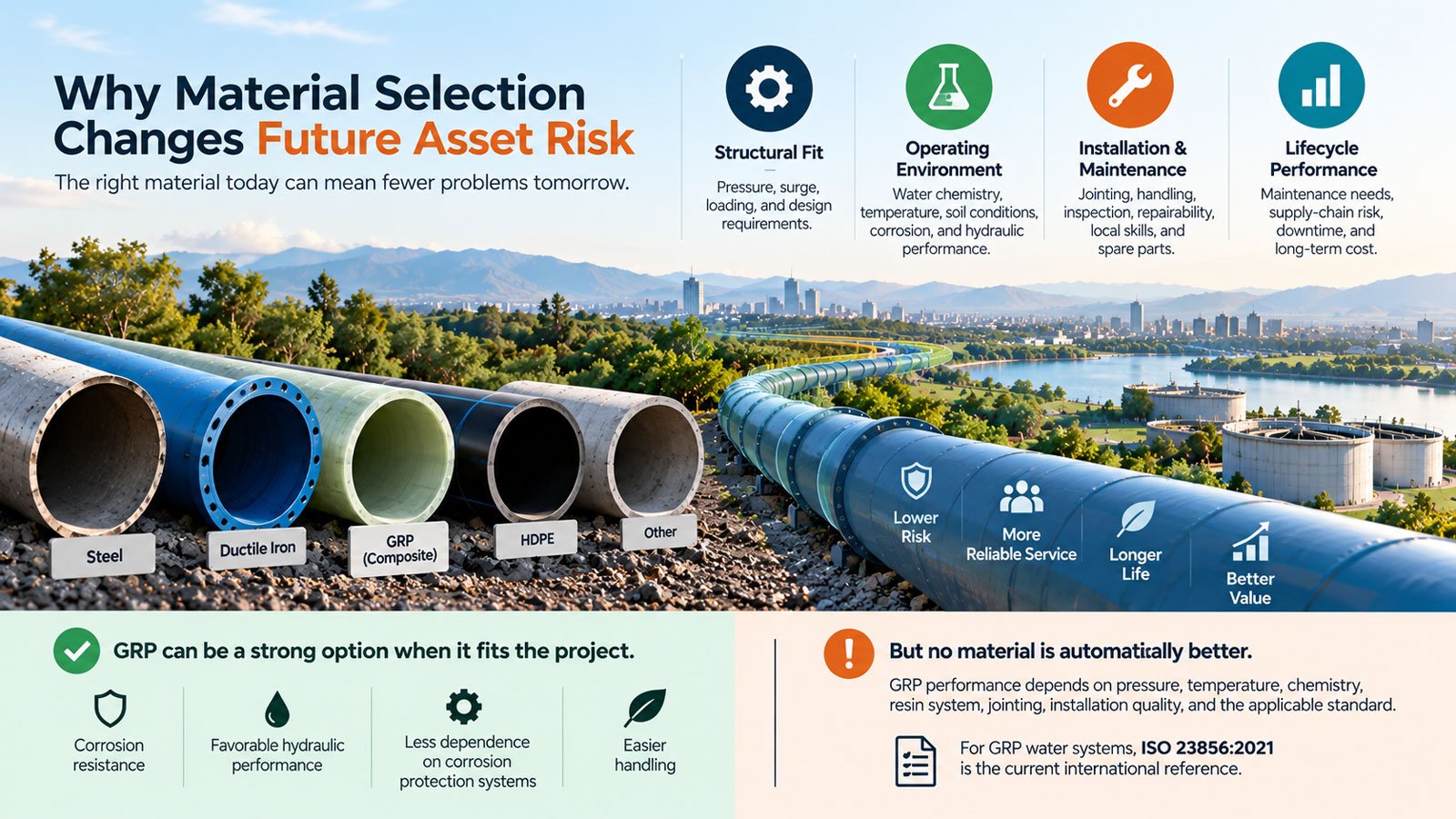
Material choice affects the kind of problems your team may need to manage later. Here’s what you should check before choosing a system:
- Structural fit: Pressure, surge, loading, and overall design requirements.
- Operating environment: Water chemistry, temperature, soil conditions, corrosion, and hydraulic performance.
- Installation and maintenance: Jointing, handling, inspection, repairability, local skills, and spare-part availability.
- Lifecycle performance: Maintenance needs, supply-chain risk, downtime, and long-term cost.
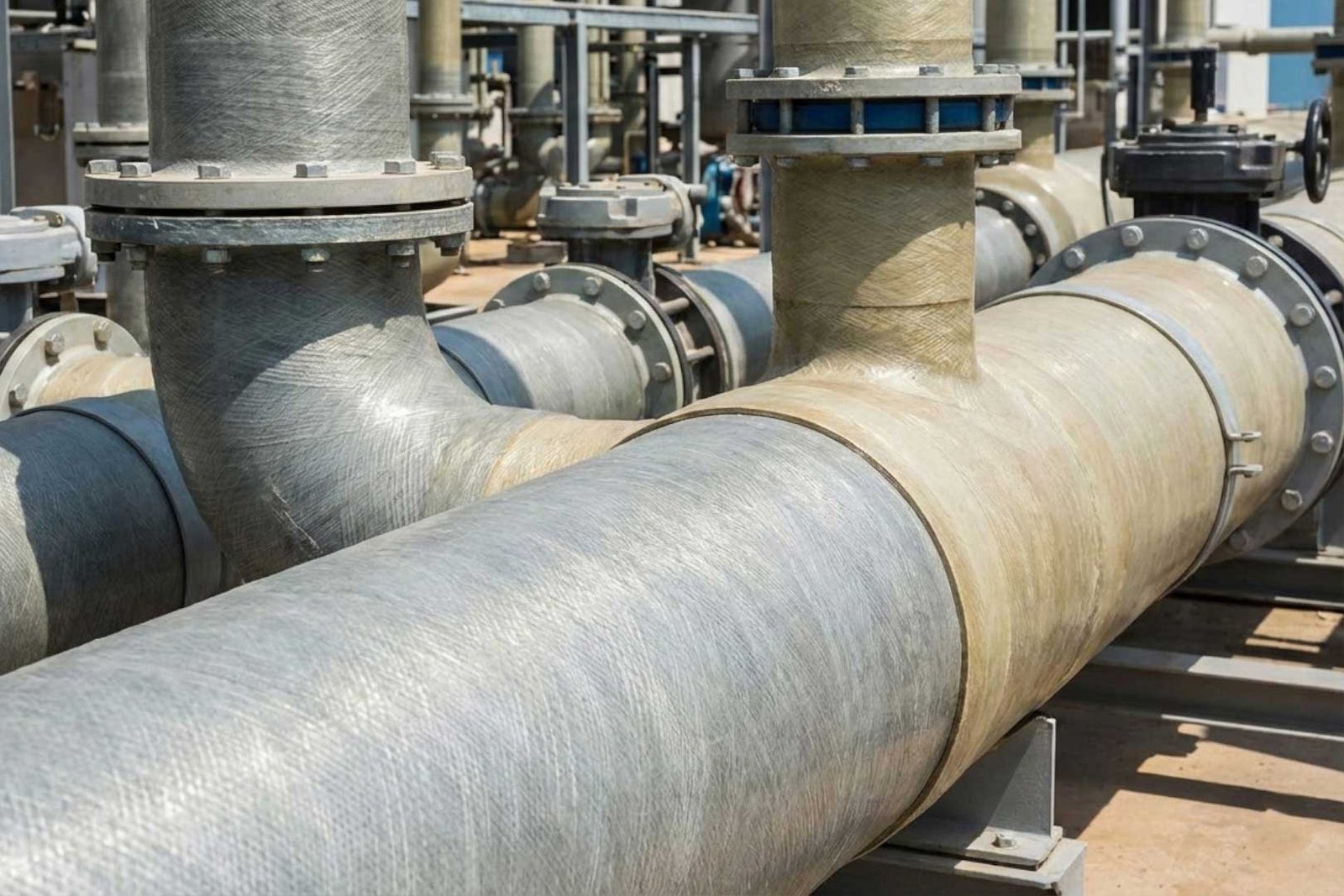
GRP and other composite systems can be strong options when they fit the project. Their potential advantages include corrosion resistance, favorable hydraulic characteristics, less dependence on corrosion-protection systems, and easier handling.
But GRP should not automatically be treated as better than steel, ductile iron, HDPE, or other suitable materials. Its performance still depends on pressure, temperature, chemistry, resin system, jointing, installation quality, and the applicable standard. For relevant GRP water systems, ISO 23856:2021 is the current international reference identified in the research.
Risk-Based Asset Management Starts Before Commissioning
Good asset management should begin before the asset enters service. Your EPC decisions can make future operation easier or harder through hydraulic design, surge analysis, material specification, installation QA/QC, jointing, testing, access for maintenance, repair planning, spare-parts strategy, and operator training.
A modern transmission project should therefore be handed over asset-management-ready. That handover should include:
- final GIS alignment and permanent asset IDs
- as-built drawings and component registers
- material and test certificates
- pressure-test and commissioning records
- baseline operating flows and pressures
- O&M manuals and inspection recommendations
- repair procedures and spare-parts schedules
- operator training records
- hydraulic-model files where included in the project scope
Kenya’s WASREB Asset Development Guidelines specifically connect commissioning, testing, training, manuals, as-builts, and final documentation with the asset-development lifecycle.
A Practical Transition Path for East African Utilities
You do not need a digital twin or advanced AI before you start managing risk better. A realistic path is:
- Identify the critical system. Start with major transmission mains, pumps, reservoirs, and treatment interfaces.
- Build the basic asset register.
- Rank asset criticality.
- Standardize failure and maintenance records.
- Inspect selectively. Spend inspection money where uncertainty affects an important decision.
- Connect useful operating data. Add flows, pressures, pump condition, and SCADA where it helps.
- Link risk to maintenance and CAPEX planning.
- Move toward predictive analytics when your data is ready.
The World Bank Utility of the Future approach follows a similar logic: diagnose first, improve operations, then build toward deeper investment and organizational change.
Conclusion: Build Infrastructure That Is Easier to Manage for Decades
Risk-based asset management comes down to three ideas: know the risk, invest according to criticality, and design future assets for lifecycle performance. You do not need to eliminate every failure. You need to understand which failures matter most and make better decisions before those failures control your budget.
Grand LineCore can support that approach as a supplier of GRP and composite piping systems and as an EPC water-transmission solution provider. The value is not only in supplying pipe, but in helping develop infrastructure around hydraulic performance, durability, maintainability, commissioning quality, documentation, repair readiness, and long-term operation.
Build assets that are not only ready to operate, but easier to manage for decades.
about
The Author
Farshid Tavakoli is a seasoned professional in engineering and international trade. Holding degrees in Electrical Engineering, Mechatronics, and a Doctorate in Business Administration (DBA) from the University of Lyon, he also has a strong background in industrial automation and production line technologies.
For over 17 years, he has led an international trading company, gaining deep expertise in commercial solutions tailored to industrial needs. With more than 8 years of active involvement in infrastructure development, he specializes in the supply of electromechanical equipment for water and wastewater treatment plants and transfer projects.
Together with comapny expert team, he now provides consultancy and integrated solutions for sourcing and implementing complex infrastructure projects across the region.