A high electricity bill can make your pumps look like the problem. But very often, the real problem starts somewhere else. You may be pumping more water than you need, creating too much pressure, losing water after you have already paid to pump it, or pushing water through a transmission line with avoidable friction. Your pumps may also be working far from their best operating point.
That is why cutting pumping costs is not simply about buying a better pump. It is about delivering each useful cubic meter of water reliably, with the least practical energy and long-term cost. Let’s read this post, because some of the biggest savings may be hiding outside the pump station:
Where Does Pumping Energy Actually Go?
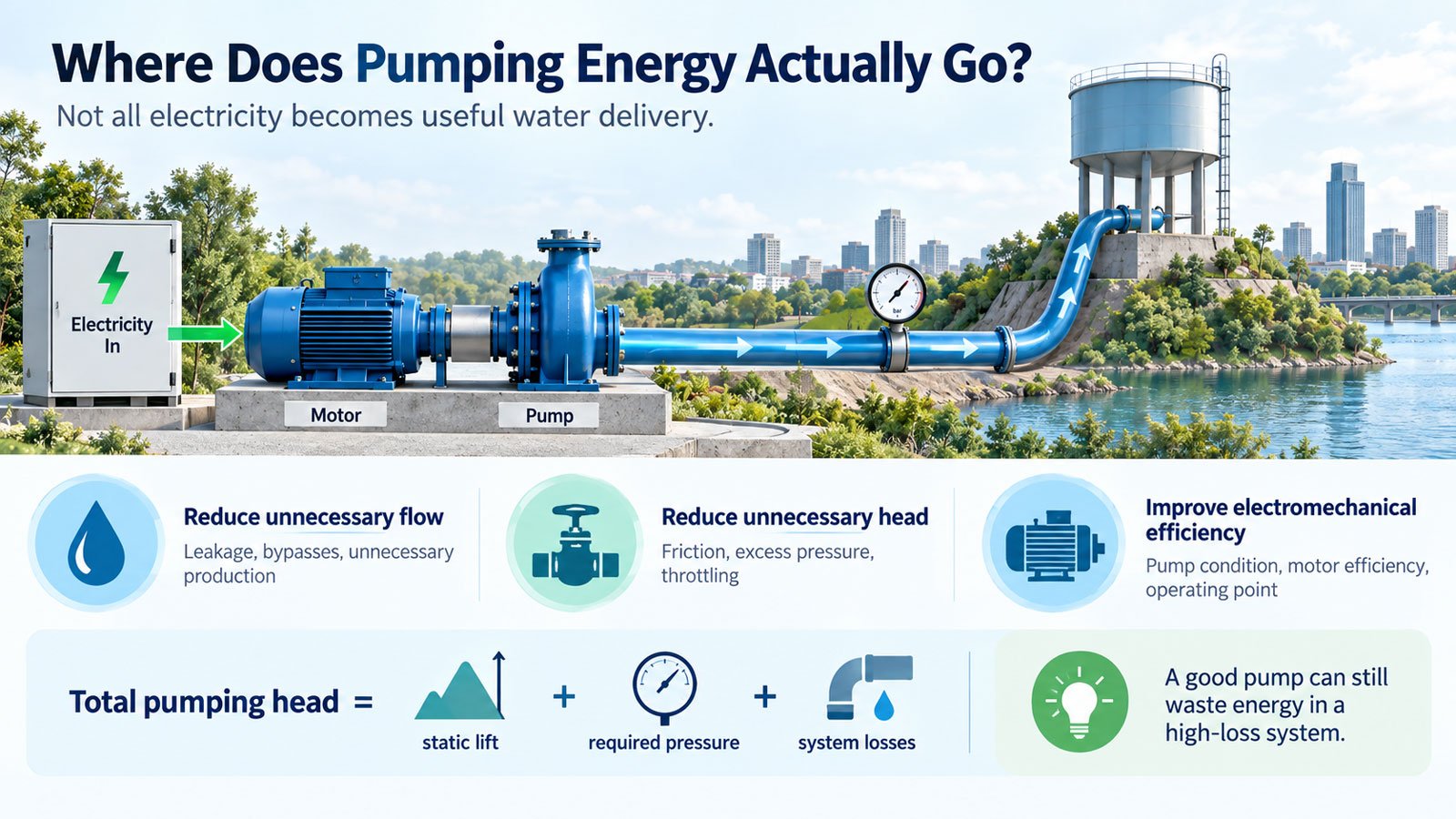
Electricity entering a pumping station does not all become useful water delivery. Some energy is lost in the motor and pump. The rest has to lift the water, maintain the pressure you need, and move water through pipes, valves, fittings, meters, and other parts of the system. Most opportunities fall into three areas:
- Reduce unnecessary flow. Physical leakage, unnecessary production, bypasses, and avoidable recirculation all mean you are using energy to move water that does not create useful service.
- Reduce unnecessary head. Static elevation is usually unavoidable. But excessive pipeline friction, unnecessary pressure, throttling, and some poor system configurations can often be improved.
- Improve electromechanical efficiency. Pump condition, motor efficiency, operating point, pump combinations, and control strategy all affect how much electrical input becomes useful hydraulic output.
In simple terms, your total pumping head comes from static lift, the pressure you actually need, and system losses.
The Inter-American Development Bank pumping-system guidance recommends looking at the motor, pump, and water-conveyance system together. That matters because even a very efficient pump can still use too much energy if it is pushing water through a high-loss pipeline or maintaining more pressure than the system needs.
Why the East African Operating Environment Makes Optimization More Important
If you work in Kenya, Tanzania, Uganda, Rwanda, or Ethiopia, you cannot assume that one utility’s solution will automatically work for another. Topography, water sources, tariffs, service conditions, and power reliability vary widely. Still, several pressures appear again and again.
Growing Urban Demand
As your city grows, you may need to move more water, run your pumps for longer, and serve new areas. That can increase both flow and pressure needs.
Longer Transmission Distances
If your water source is farther away, or at a different elevation, your pumps have to work harder. Longer pipelines can also mean more friction and higher pumping head.
Electricity Pricing
Your electricity cost may depend on more than just how many kWh you use. Kenya’s EPRA electricity tariff includes tariff components such as demand charges, while Uganda also uses different tariff periods for some customers. This means when and how you pump can affect your electricity bill.
Power Reliability
Power cuts, generator use, voltage problems, and pump restarts can all change the way you operate your system. If you have limited storage, you may have even less flexibility during an outage.
Existing Network Constraints
Older pumps, leaks, limited storage, high pressure, or pipeline bottlenecks can push your system away from the conditions it was originally designed for. That can mean more pumping, more energy use, and higher operating costs.
Five questions every utility should ask
- Where is our energy actually being used?
- How much pumping head is unavoidable?
- How much head are we creating unnecessarily?
- How much water are we pumping but not delivering usefully?
- What will today’s design cost us over the next 20 or 30 years?
Measure Before Investing: Establish the Water–Energy Baseline
Before you buy new pumps, install VSDs, or change a pipeline, make sure you understand what is happening now.
A useful energy and hydraulic audit should bring together electricity use, electricity cost, tariff structure, pumped volume, flow, pressure, pump input power, reservoir levels, operating hours, generator use, NRW, and real physical losses. A small group of KPIs can make the picture much clearer.
| KPI | What it tells you | Why it helps | Main caution |
|---|---|---|---|
| kWh/m³ pumped | Pumping energy intensity | Tracks system performance | Depends on required head |
| kWh/m³ delivered | Energy after real losses | Links leakage and energy | Needs good delivery data |
| Wire-to-water efficiency | Motor-pump performance | Finds inefficient equipment | Measure at real duty |
| Friction head / total head | Importance of hydraulic loss | Helps assess pipeline opportunity | Static head may dominate |
| Peak kW or kVA | Demand exposure | Helps with tariff review | Check actual supply terms |
| Generator fuel/m³ | Outage cost | Shows reliability burden | Keep separate from grid cost |
| Storage autonomy | Operating flexibility | Helps scheduling and outage planning | Depends on real demand |
Do not compare kWh/m³ blindly between utilities. A high-lift system will naturally look different from a gravity-assisted system.
The World Bank’s guidance on energy efficiency in water utilities supports this measure-first approach.
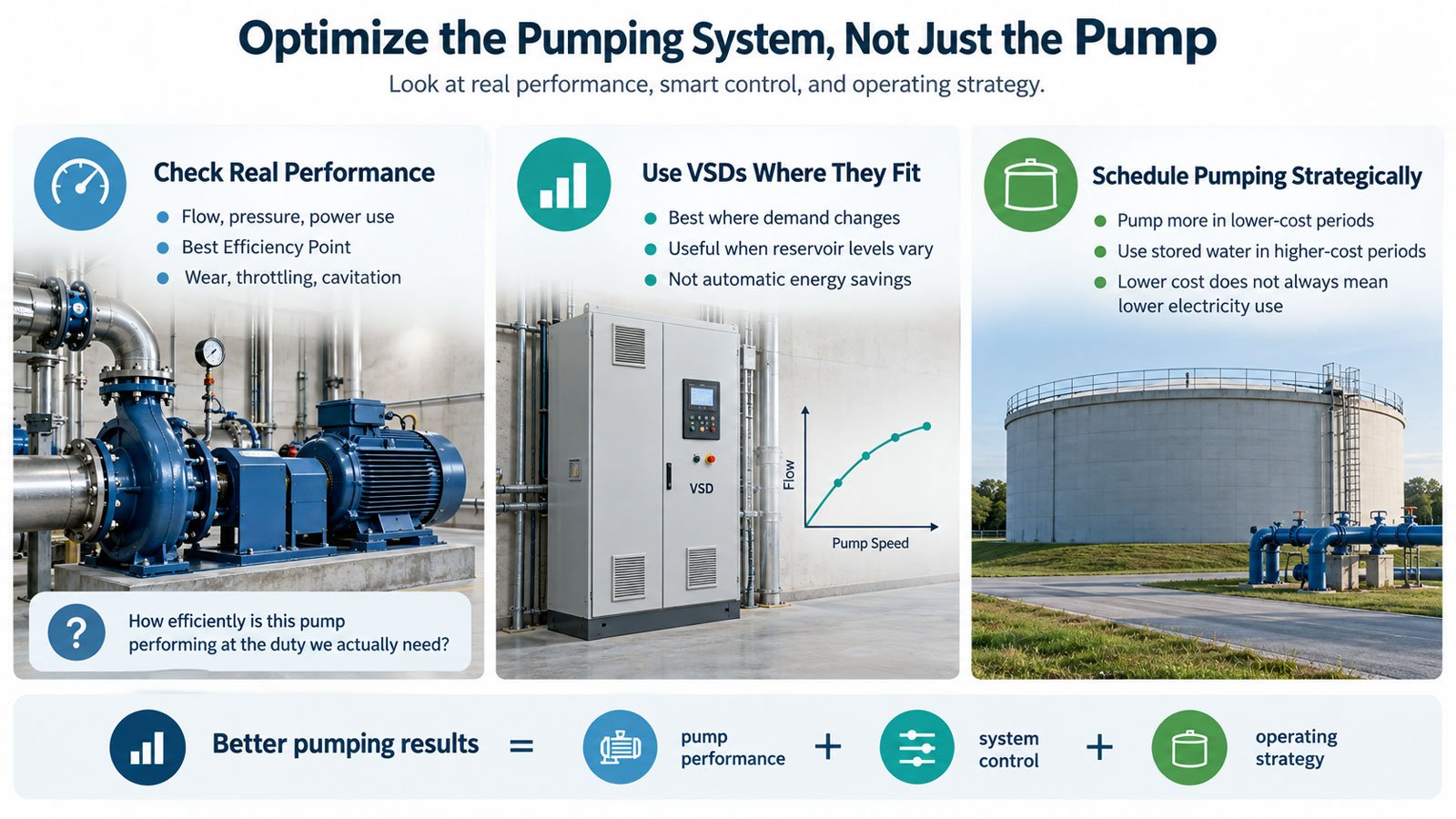
Optimize the Pumping System, Not Just the Pump
A pump nameplate tells you what the pump was designed to do, not how well it is performing today. Check for:
- Actual flow, pressure, and power use
- Operation away from the Best Efficiency Point
- Throttling, wear, cavitation, or poor parallel operation
So, do not ask, “Is this pump old?” Instead, you should ask, “How efficiently is this pump performing at the duty we actually need?”
Variable-Speed Drives
VSDs can work very well where demand changes, reservoir levels vary, pressure requirements move during the day, or throttling is being used to control flow. But they do not automatically save energy.
If friction makes up a large part of your system head, changing speed may create a strong opportunity. If static lift dominates, the savings may be smaller. The DOE and Hydraulic Institute treats VSD selection as a system decision, not a universal retrofit.
Pump scheduling
Storage can also give you more operating flexibility.
- Pump more during lower-cost tariff periods
- Use stored water during higher-cost periods
- Reduce demand charges where time-of-day tariffs apply
Rwanda’s tariff structure shows why when you pump can affect cost. But remember: lower electricity cost does not necessarily mean lower electricity use.
The Pipeline Is Part of the Energy System
Your transmission pipeline affects how hard your pumps have to work. Diameter, actual internal bore, fittings, internal condition, and hydraulic resistance all affect required head.
Diameter matters
A smaller pipe may reduce your initial cost. But if you push the same flow through a smaller internal diameter, velocity and friction can rise. That can mean more pump head and higher electricity use for years.
A larger pipe can reduce friction, but it costs more upfront. The right answer is not “always choose the larger pipe.” You need the diameter that gives you the best long-term result for your actual flow, route, electricity cost, operating hours, and future demand.
Use actual internal diameter
Two pipes with the same nominal DN may not have the same internal bore. Material, pressure class, wall construction, and stiffness can all affect the real flow area.
| Design check | Compare | Why it matters | Possible effect |
|---|---|---|---|
| Actual internal diameter | Real bore by class | Controls velocity | Friction and pump head |
| Design flow | Current and future demand | Defines hydraulic duty | Pipe and pump sizing |
| Internal condition | Roughness, scaling, deposits, corrosion | Changes resistance | Long-term energy use |
| Pressure and surge | Normal and transient pressure | Protects the system | Pressure class |
| Fittings and joints | Valves, bends, meters, geometry | Add local losses | Total head |
| Installation | Soil, bedding, loads, workmanship | Affects performance | Reliability and maintenance |
Internal roughness can also change with time. Corrosion, deposits, scaling, lining deterioration, and other changes may increase resistance.
Where GRP and composite pipes fit
GRP can be considered where it meets the required structural, pressure, surge, installation, chemical, and hydraulic conditions. For relevant GRP applications, ISO 23856:2021 is the current international standard identified in the research. But GRP should not automatically win.
You still need to compare it fairly with steel, ductile iron, HDPE, PCCP, or other suitable systems. Look at real internal diameter, hydraulic behavior, route conditions, pressure, surge, installation, repairability, maintenance, and long-term condition.
Real-World Example: Nzove-Ntora, Rwanda
Rwanda’s WASAC Nzove-Ntora transmission project included a new 900 mm, 9.357 km transmission main commissioned in 2024. WASAC reported that transfer capacity to the Ntora reservoir increased from about 37,000 to 53,000 m³/day.
That does not prove an energy saving. But it shows why transmission capacity, pipe hydraulics, reservoirs, and pumping duty need to be considered together.
Pressure, Leakage and Storage: System-Level Energy Savings
Some of your best energy opportunities may sit outside the pump station.
- Manage pressure around real service needs. Excessive pressure can increase pumping requirements and physical leakage. Pressure logging, elevation zones, PRVs, and District Metered Areas can help you see where pressure is necessary and where it is too high.
- Separate leakage from the wider NRW figure. NRW also includes apparent losses and authorized unbilled consumption. The EWURA NRW guidance makes this distinction clear. For energy analysis, real physical losses matter most because you may already have spent energy abstracting, treating, and pumping that water.
- Use storage as an operating tool. Reservoirs can help you manage demand peaks, outages, emergency supply, pump schedules, and tariff periods. Storage gives you more freedom to separate when you pump from when customers use the water.
Where a leak happens also matters. A cubic meter lost after several high-lift pumping stages can carry more embedded energy than the same volume lost much earlier in the system.
From Energy Saving to Lifecycle Cost
A cheap pipe or pump option can become expensive once you operate it for 20 or 30 years. When you compare alternatives, look at the costs that actually change between them. That may include initial construction, electricity use, maintenance, repairs, replacement timing, standby needs, downtime, and later rehabilitation.
You should also test what happens if energy prices rise, demand grows, operating hours change, or hydraulic condition changes with age.
| Comparison | Smaller diameter | Base design | Larger diameter | Why it matters |
|---|---|---|---|---|
| Initial pipeline cost | Calculate | Calculate | Calculate | Funding need |
| Friction head | Model | Model | Model | Pump duty |
| Input power | Calculate | Calculate | Calculate | Electrical demand |
| Annual energy use | Estimate | Estimate | Estimate | Operating cost |
| Maintenance need | Estimate | Estimate | Estimate | Long-term budget |
| Reliability impact | Assess | Assess | Assess | Service risk |
| 20/30-year present cost | Calculate | Calculate | Calculate | Economic choice |
The DOE/Hydraulic Institute lifecycle-cost guidance supports this broader way of comparing pumping systems.
The purpose is not to make the largest diameter or one material win. It is to find the option that delivers the required water reliably at the lowest sustainable long-term cost.
Real-World Example: Uganda’s Katosi System
Uganda’s National Water and Sewerage Corporation has invested in the Katosi Water Treatment Plant and associated transmission infrastructure as part of expanding supply to the Kampala area. The NWSC Corporate Plan makes Katosi a useful example of why production, transmission, pumping, storage, and network capacity need to be looked at together.
To judge its energy performance properly, you would still need verified operating data such as flow, elevation, pump duty, pressure, friction loss, reservoir operation, and electricity use. Without those numbers, you should not claim a specific saving.
The Bigger Utility Benefits
Better water-energy management can change much more than your electricity bill.
- Financial sustainability. Lower controllable operating costs can leave more money for maintenance, rehabilitation, debt service, or service expansion.
- Operational reliability. Better pump operation, storage, pressure control, and monitoring can make your system easier to manage when demand or power conditions change.
- Asset life. Lower pressure stress, fewer harmful hydraulic transients, and better pump operating conditions can reduce wear on pumps, motors, valves, and pipelines.
- Transmission efficiency. You want more of your energy input to result in useful water delivery.
- Climate and energy resilience. A system that needs less power can be less exposed to outages and generator fuel. Storage and flexible operation can also help when source or power conditions change.
Kenya’s WASREB Impact reports and Tanzania’s EWURA performance reports show why energy decisions have to sit inside the wider picture of service, water losses, utility finances, and operating performance.
Conclusion: Design the Water and Energy System Together
If you look only at the pump, pipeline, or electricity bill, you may miss the real problem. The best results come from looking at your source, pumps, pipelines, storage, pressure, leakage, controls, tariffs, and future demand as one connected system.
Grand LineCore can help you review your hydraulics, pipeline options, lifecycle costs, procurement, testing, and EPC planning.
Planning a new bulk-water system or improving an existing one? We can help you look at the whole system and find an approach that supports reliable performance and better long-term value.
about
The Author

Farshid Tavakoli is a seasoned professional in engineering and international trade. Holding degrees in Electrical Engineering, Mechatronics, and a Doctorate in Business Administration (DBA) from the University of Lyon, he also has a strong background in industrial automation and production line technologies.
For over 17 years, he has led an international trading company, gaining deep expertise in commercial solutions tailored to industrial needs. With more than 8 years of active involvement in infrastructure development, he specializes in the supply of electromechanical equipment for water and wastewater treatment plants and transfer projects.
Together with comapny expert team, he now provides consultancy and integrated solutions for sourcing and implementing complex infrastructure projects across the region.