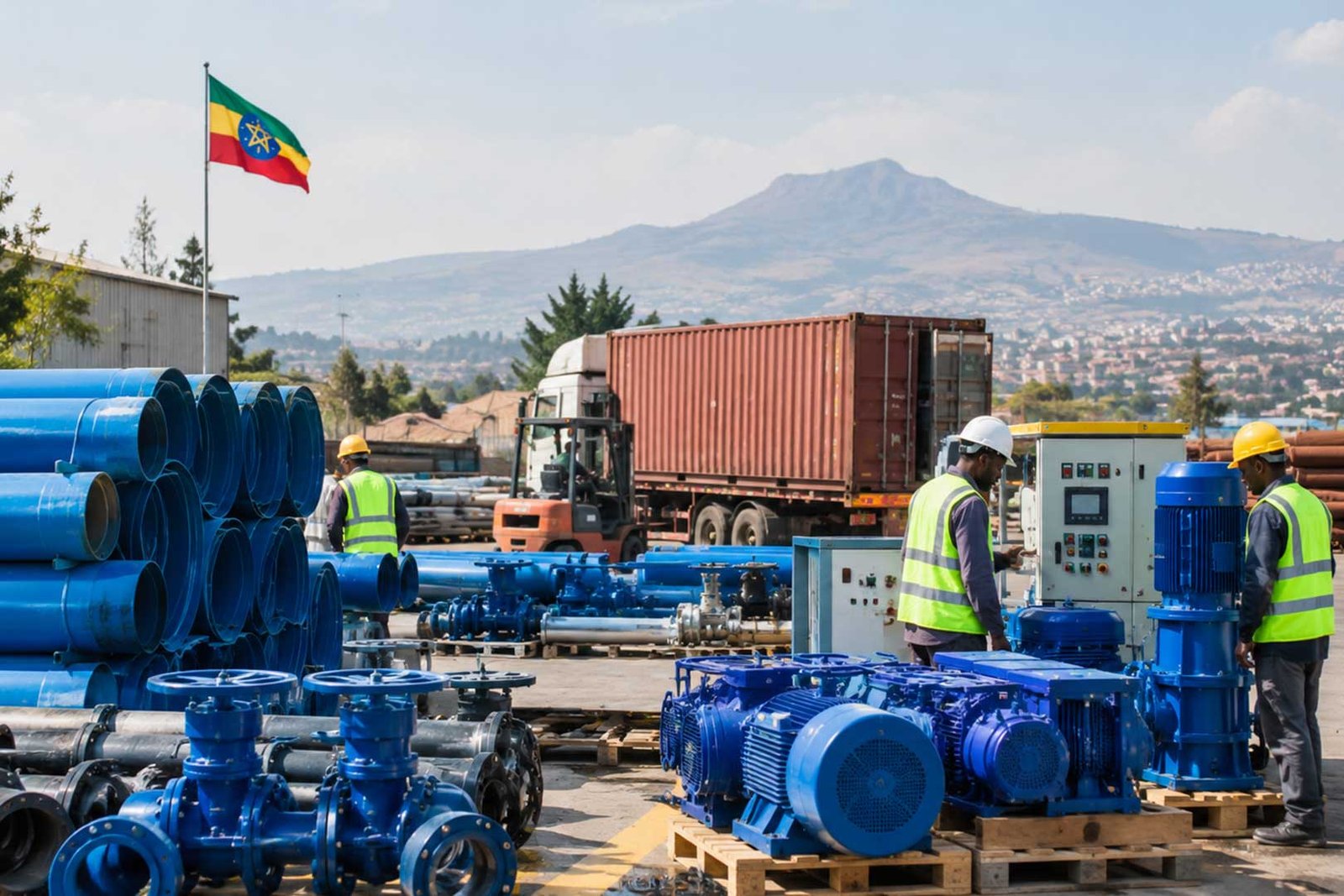
If you work on water projects in Ethiopia, you already know that getting equipment to site can take time. A pipe, pump, valve, or control panel may need to go through international shipping, Djibouti port, customs, inland transport, and foreign-currency payments before it reaches your project.
Making more products in Ethiopia could shorten parts of this process. But it will not remove the need for imports completely. So, we need to know: How much manufacturing, engineering, testing, maintenance, and supply-chain value can Ethiopia build locally while still keeping projects technically reliable and commercially competitive? Stay with us to get the right answer.
Ethiopia’s Import-Substitution Strategy Is About Industrial Depth, Not Complete Self-Sufficiency
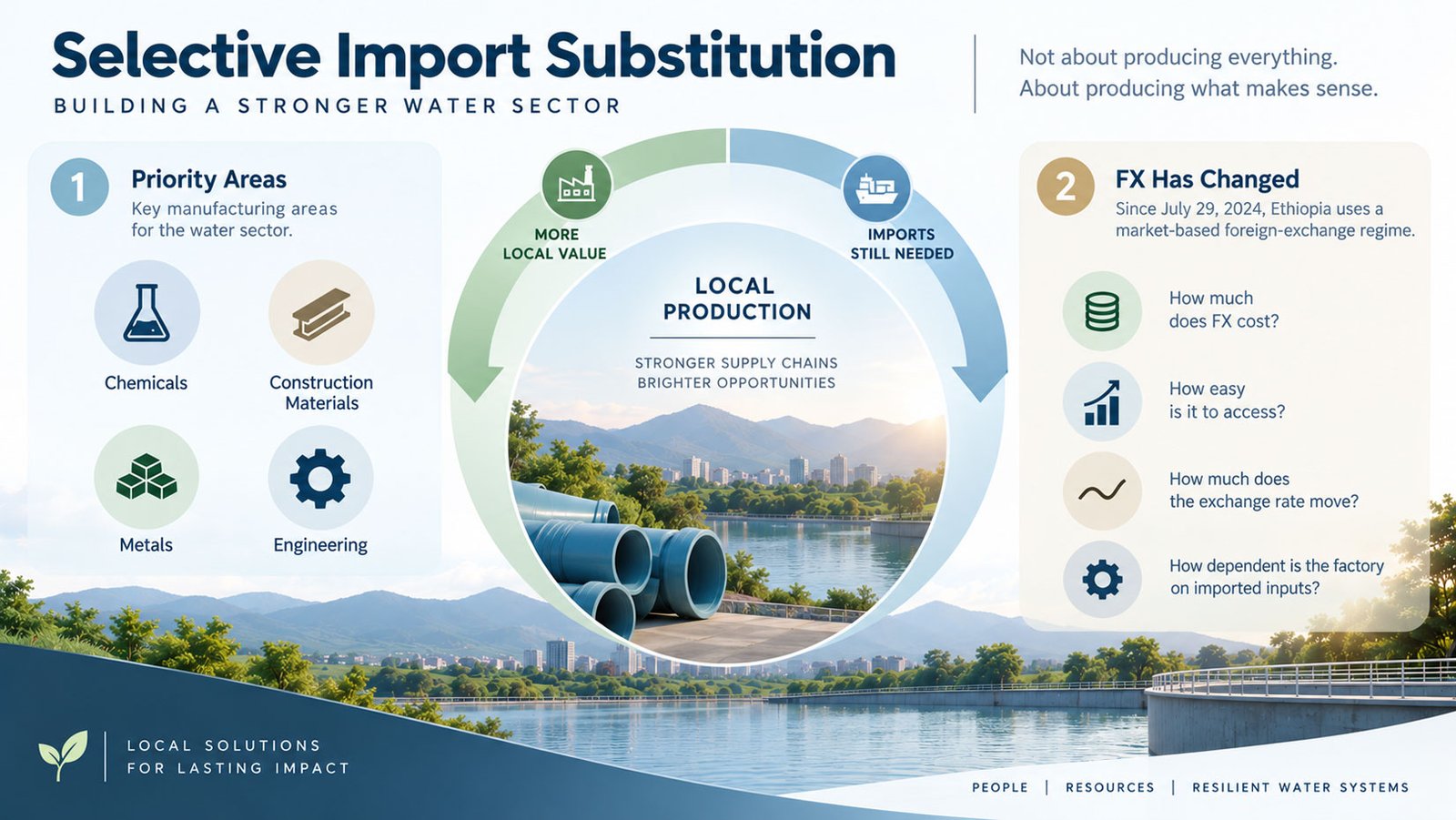
Ethiopia’s approach is better described as selective import substitution. In simple terms, the goal is not to produce everything inside the country. It is to identify products and industries where local production makes practical and economic sense.
The Ministry of Industry identifies five broad manufacturing areas in its import-substitution strategy. For the water sector, chemicals, construction materials, metals, and engineering are especially relevant.
The strategy identified 93 commodities that could potentially be produced locally, based on import levels, existing production, and available manufacturing capacity. For the water sector, this gives you a practical starting point for:
- manufacture or assemble more products locally where it makes sense
- build stronger local suppliers and engineering skills
- create more local value through testing, maintenance, and technical services
- keep importing specialist materials and components when they are still needed
Local manufacturing does not mean zero imports. A factory in Ethiopia may still need imported machinery, polymers, resins, glass reinforcement, motors, control systems, laboratory equipment, specialist components, and spare parts.
That is normal. Ethiopia’s own industrial policy recognizes that local manufacturers may still depend on imported inputs.
How the FX situation has changed
If you are looking at older information about Ethiopia, be careful with descriptions of companies waiting in centralized foreign-exchange allocation queues. That system has changed.
On July 29, 2024, the National Bank of Ethiopia introduced a market-based foreign-exchange regime and removed the previous NBE waiting-list system. For manufacturers today, the important questions are:
- How much does FX cost?
- How easy is it to access?
- How much does the exchange rate move?
- How dependent is the factory on imported inputs?
Why Water Infrastructure Is an Important Test Case for Import Substitution
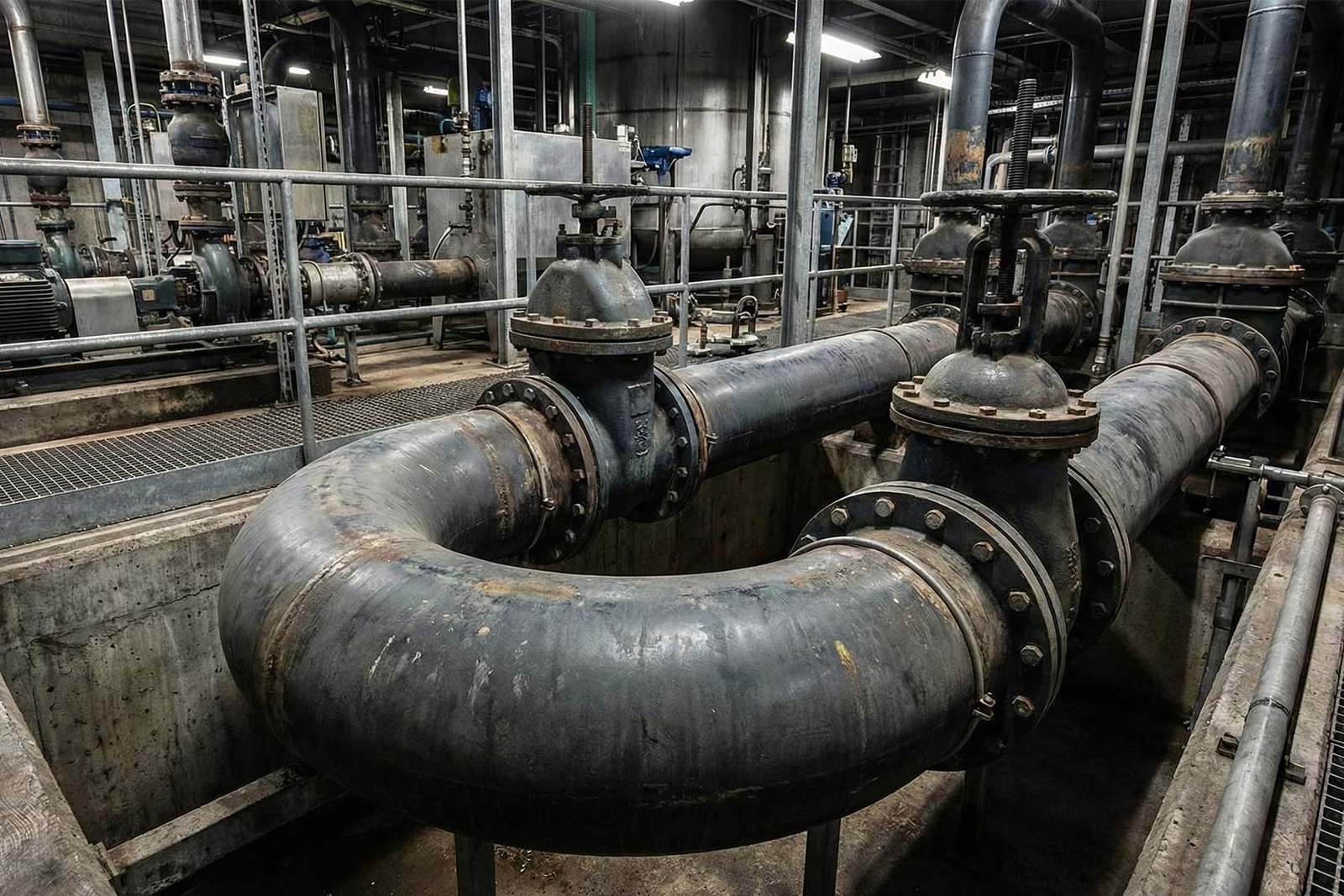
Water infrastructure is useful to look at because it is not a one-product industry. Even a fairly simple water-supply project can involve civil works, pipes, pumps, valves, electrical systems, controls, storage, testing, installation, and ongoing maintenance.
That means there are many different opportunities for local production and local services. Let’s have a look at them through the table below:
| Water area | Typical products | Possible local role | What you need to check |
|---|---|---|---|
| Bulk transmission | Large pipes, valves, fittings | Manufacturing, fabrication | Pressure, diameter |
| Urban networks | HDPE, PVC, DI, meters | Pipes, fittings, service | Utility specifications |
| Rural systems | Pumps, rising mains, storage | Assembly, maintenance | Power, spare parts |
| Wastewater | Pipes, pumps, treatment equipment | Fabrication, service | Chemistry, standards |
| Irrigation | Pipes, valves, filtration | Manufacturing, assembly | Scale, hydraulics |
| Treatment plants | Pumps, tanks, controls | Assembly, integration | QA, specialist inputs |
In real projects, these products are usually bought and installed as part of a larger package rather than one by one.
Real-world example: Beshasha shows how broad the supply chain can be
A November 2025 procurement notice from the African Development Bank for the Beshasha Town Water Supply System included about 5.2 km of ductile-iron pressure main and almost 42 km of HDPE distribution pipe.
But the package was not just about pipes. It also included pumps, electrical systems, civil works, O&M equipment, testing, training, and other supporting works.
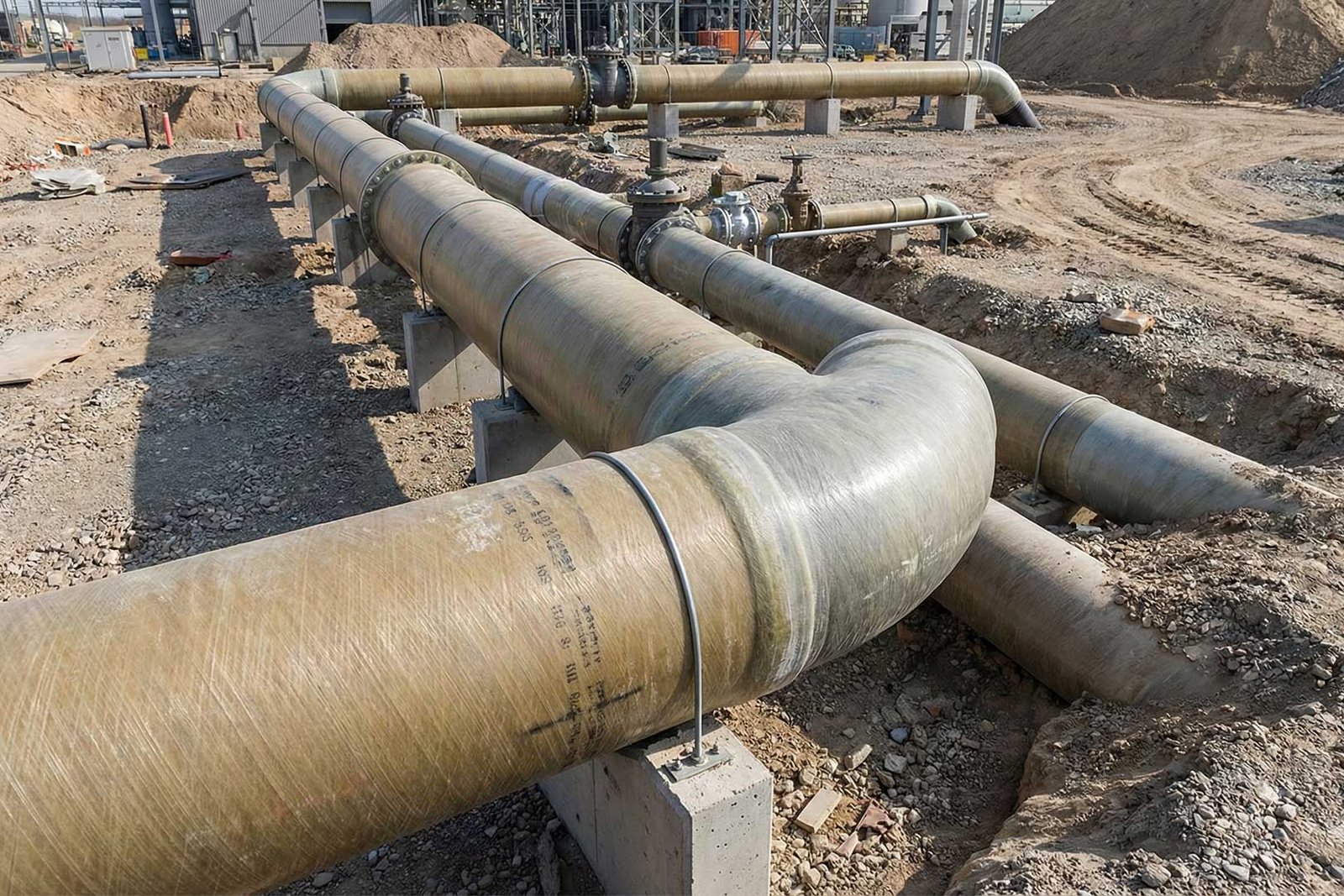
That is why you should not look at GRP on its own. You need to compare it with HDPE, PVC, ductile iron, steel, pumps, valves, treatment equipment, and the other products that make up a complete water project. Instead, you should see which parts of that package can Ethiopia competitively manufacture, assemble, fabricate, test, service, or maintain?
What Greater Local Manufacturing Could Change for Water Projects
Localization matters when it makes projects easier, faster, or more reliable to deliver. Simply changing the country-of-origin label is not enough. Read the following items to see how localization helps you:
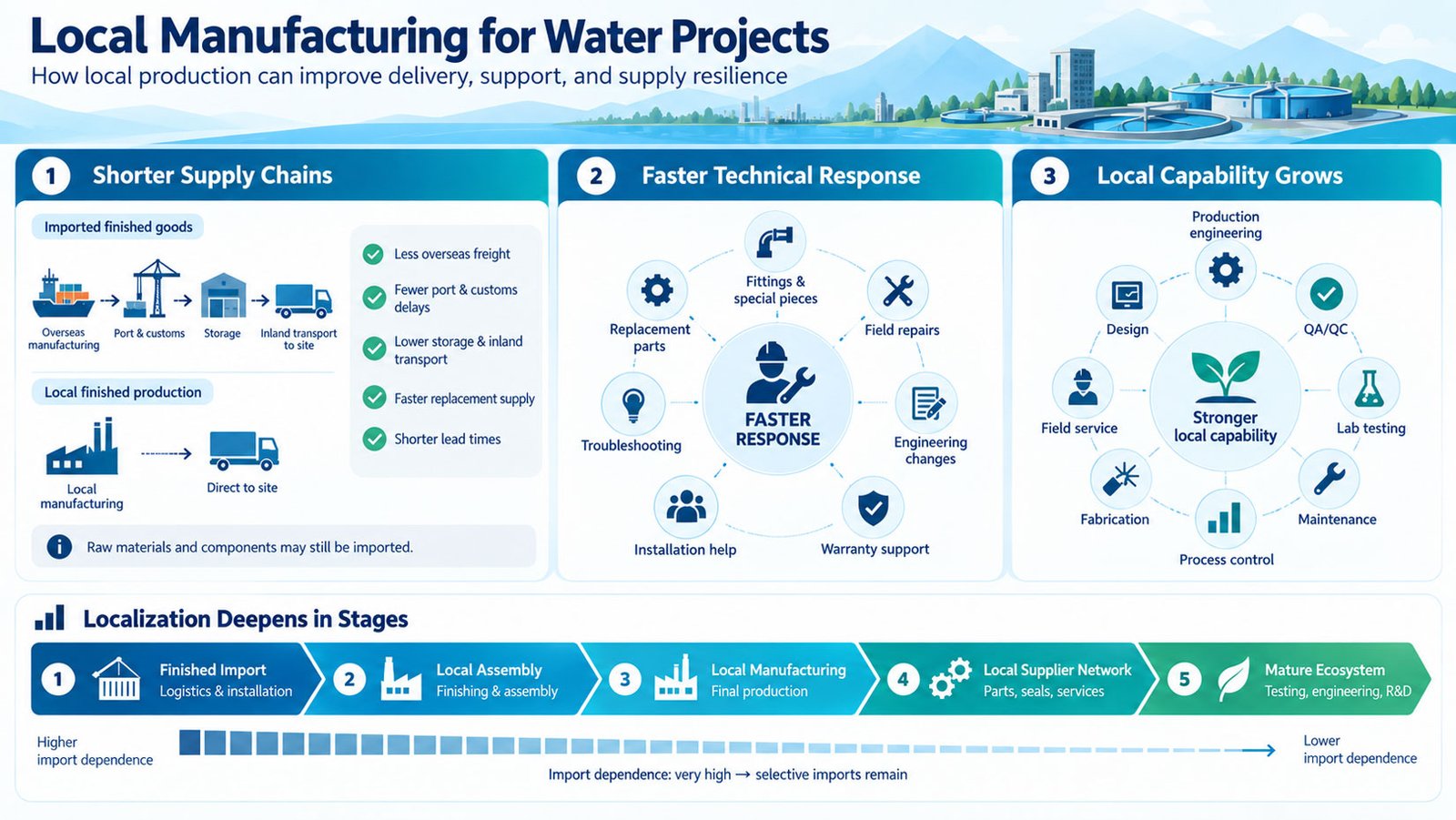
Shorter finished-product supply chains
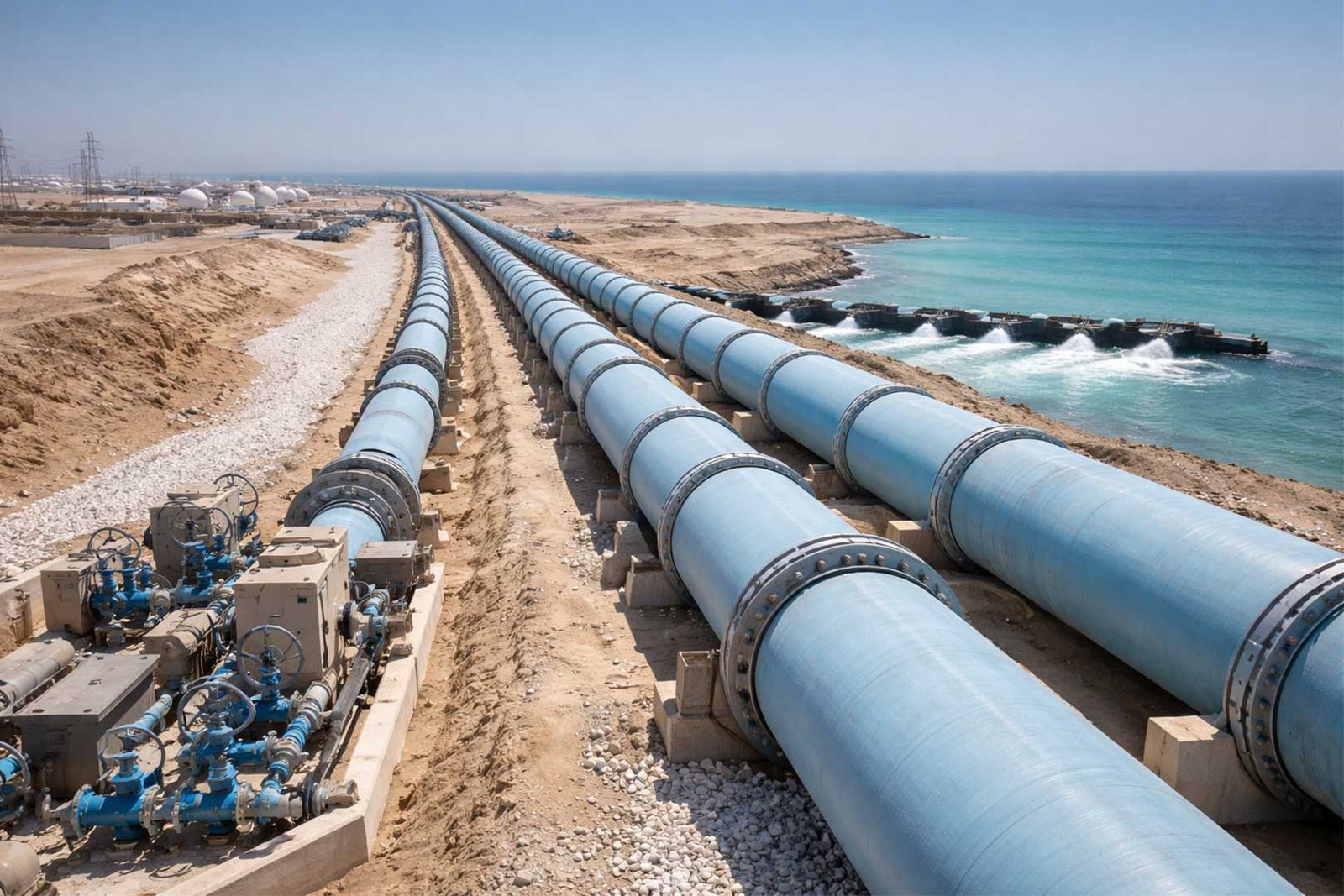
According to the World Bank, more than 90% of Ethiopia’s import-export trade passes through the Port of Djibouti. For large and bulky infrastructure products, producing the finished product inside Ethiopia could reduce your exposure to:
- overseas freight for finished products
- port and customs handling
- large storage requirements
- long-distance inland transport
- long lead times for replacement products
But this does not mean international logistics disappear. A local factory may still need to import raw materials, machinery, and components through the same trade corridor.
Faster technical response
Local manufacturing can also help during construction and after the system is operating. For example, you may have better access to:
- fittings and special pieces
- replacement components
- field repairs
- engineering changes
- troubleshooting
- warranty support
- faster help during installation
A stronger local manufacturing base can also build skills in production engineering, QA/QC, laboratory testing, maintenance, fabrication, process control, design, and field service. That local technical capacity may become just as important as the product itself.
Localization can deepen in stages
It is easier to think of localization as a series of steps, like what you see in this table:
| Stage | What happens locally | Import dependence |
|---|---|---|
| Finished import | Logistics and installation | Very high |
| Local assembly | Finishing and assembly | High |
| Local manufacturing | Final production | Core inputs may still be imported |
| Local supplier network | Parts, seals, services | Lower |
| Mature ecosystem | Testing, engineering, R&D | Selective imports remain |
This gives you a much clearer picture than simply asking whether a product is “Made in Ethiopia.” A product can be made locally and still contain imported materials. At the same time, it can create valuable local jobs, engineering knowledge, testing capacity, maintenance capability, and supply-chain experience.
The Raw-Material Challenge: A Local Product Can Still Depend on Imports
GRP is a good example. To manufacture GRP products, you may need:
- glass reinforcement
- polyester or vinyl-ester resin systems
- fillers
- catalysts
- additives
- gaskets
- metallic inserts or flanges
- production machinery
- testing equipment
Local Inputs and Imported Components
You should not assume all of these inputs are available locally. The same issue appears with other water-infrastructure products.
- HDPE: polymer feedstock may still need to be imported.
- Pumps: motors, drives, seals, and specialist parts may come from overseas.
- Treatment equipment: membranes, instruments, and control systems may still be internationally sourced.
Measuring Localization Beyond “Made Locally”
So instead of asking only whether a product is “local” or “imported,” it helps to look at three different measures.
- Gross import replacement tells you how much finished-product importing has been replaced.
- Net FX substitution goes one step further. It subtracts the foreign currency you still need for imported materials, components, machinery, and spare parts.
- Domestic value added looks at how much value is actually created in Ethiopia through manufacturing, labour, engineering, testing, energy, and services.
This means a product can be manufactured in Ethiopia and still depend partly on imports. That does not mean localization has failed. What matters is how much competitive value you can create locally.
Competitiveness Will Depend on the Complete Cost and Resilience Equation
The cheapest purchase price is not always the best project option. Local and imported products have different costs and different risks.
| Factor | Imported supply | Domestic supply | What you should ask |
|---|---|---|---|
| Materials | Finished product imported | Imported + local inputs | How much FX is needed? |
| Logistics | Ocean, port, inland transport | Mainly input + local freight | What does delivery to site cost? |
| Production | Overseas | Power, labour, plant | Is local production competitive at this scale? |
| Finance | Freight, inventory | Working capital, plant | What is the cash-flow impact? |
| QA | Supplier + inspection | Plant testing + QA | Are the standards equivalent? |
| Disruption | Shipping, ports, FX | Inputs, power, capacity | Which option recovers faster? |
So when you compare local and imported supply, look at:
installed cost + lifecycle impact + delivery risk + technical support
And base that comparison on the needs of the actual project.
Real-world example: Djibouti changes the logistics calculation
The World Bank highlights how strongly Ethiopia depends on the Djibouti trade corridor. For large-diameter pipes, that matters. Pipe takes up a lot of space. Weight, handling, nesting, storage, and inland transport can all affect the final cost.
But could you import smaller or denser industrial inputs, manufacture the bulky finished product inside Ethiopia, and get a better overall project cost? You need real freight quotes and manufacturing data to answer that properly.
Localization changes your risks, it does not remove them
Imported products can be affected by:
- shipping disruption
- port congestion
- FX volatility
- long replacement times
Local manufacturing has a different set of risks:
- shortages of imported raw materials
- electricity interruptions
- dependence on imported machinery or spare parts
- sudden demand that is higher than factory capacity
So localization does not make supply-chain risk disappear. It changes the type of risk you need to manage.
Procurement and Standards May Determine Whether Localization Actually Succeeds
A factory may be perfectly capable of making a product and still struggle to sell it into major projects. Why? Because manufacturing capability is only one part of the picture.
Procurement rules, technical specifications, testing, certification, and tender requirements matter just as much.
Procurement can influence local demand
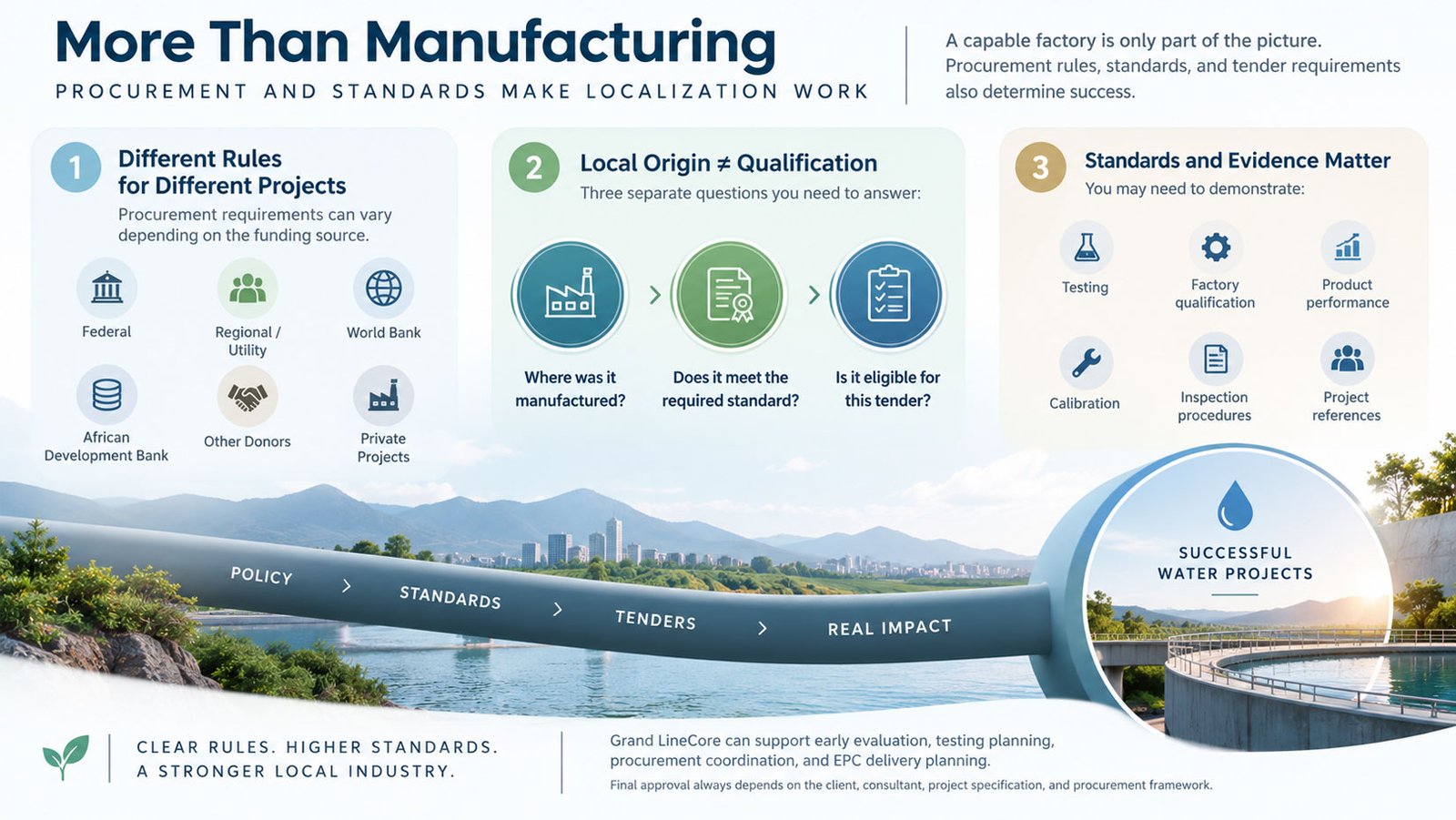
Ethiopia’s Federal Public Procurement Directive No. 1073/2025 includes provisions for preferences for locally manufactured goods. You can find the directive through the Public Procurement Authority. But you should not assume those rules apply to every water project in Ethiopia. Different rules may apply to:
- federal procurement
- regional or utility procurement
- World Bank-funded projects
- African Development Bank-funded projects
- other donor-funded projects
- private industrial projects
The funding source can change the tender rules significantly.
Real-world example: Climate-Resilient WASH shows why funding matters
Procurement documentation from the African Development Bank for the Climate Resilient Urban and Rural WASH project includes water-source rehabilitation, pumps, electricity supply, fittings, and electromechanical equipment. It is a useful reminder that you should not automatically apply a national local-preference rule to a donor-funded project. Always check the procurement framework for the specific project.
Local origin is not technical qualification
For any locally manufactured product, you still need to answer three separate questions:
- Where was the product manufactured?
- Does it meet the required technical standard?
- Is it eligible for this specific tender?
These are not the same thing. For GRP, ISO identifies ISO 23856:2021 as the current international benchmark covered by the research for relevant pressure and non-pressure water, drainage, and sewerage applications.
ISO lists ISO 10639:2017 as withdrawn. But that does not mean every Ethiopian water project automatically requires ISO 23856.
You still need to check the latest documents from the Ministry of Water and Energy, as well as utility specifications, donor requirements, consultant requirements, and the tender documents for the individual project. You may also need to demonstrate:
- accredited testing
- factory qualification
- long-term product performance
- equipment calibration
- inspection procedures
- laboratory capability
- successful project references
Grand LineCore can support you during early material evaluation, pipeline engineering, testing planning, procurement coordination, and EPC delivery planning.
Final approval, however, always depends on the client, consultant, project specification, and procurement framework.
The Constraints That Will Determine How Deep Localization Can Go
If Ethiopia wants local water-infrastructure manufacturing to grow in a reliable and competitive way, five things matter especially:
1. Reliable raw materials and industrial inputs
A factory cannot produce consistently if it cannot get the right materials. You need the right:
- quality
- quantity
- specification
- price
- continuity of supply
Local manufacturing only works when those inputs are dependable.
2. Reliable power and industrial infrastructure
National electricity-generation figures do not tell you everything you need to know about factory operations. At plant level, you need to think about:
- outages
- voltage stability
- connection capacity
- backup-power costs
These can directly affect production quality, capacity, and reliability.
3. Enough predictable demand
Factories need a steady level of work. Without enough production volume, it becomes difficult to justify investment in tooling, laboratories, certification, skilled staff, maintenance, and equipment. This is why total WASH spending alone does not tell you whether a local factory will succeed. You need to know things like:
- actual pipe quantities
- required diameters
- technical specifications
- tender timing
- expected production runs
4. Skills, testing, and quality systems
Technology transfer should leave something behind. Ideally, local manufacturing should build long-term capability in:
- engineering
- production
- QA/QC
- laboratory work
- maintenance
- field service
That is what turns a factory into a stronger industrial ecosystem.
5. Procurement and project economics that actually work
A factory can have good technology and good people but still struggle if the commercial conditions do not work. You need to consider:
- payment cycles
- financing
- FX volatility
- imported-input costs
- tender requirements
- qualification rules
Localization works best when manufacturing capability, project demand, procurement rules, and technical acceptance grow together.
Could Ethiopia Supply Other East African Markets Too?
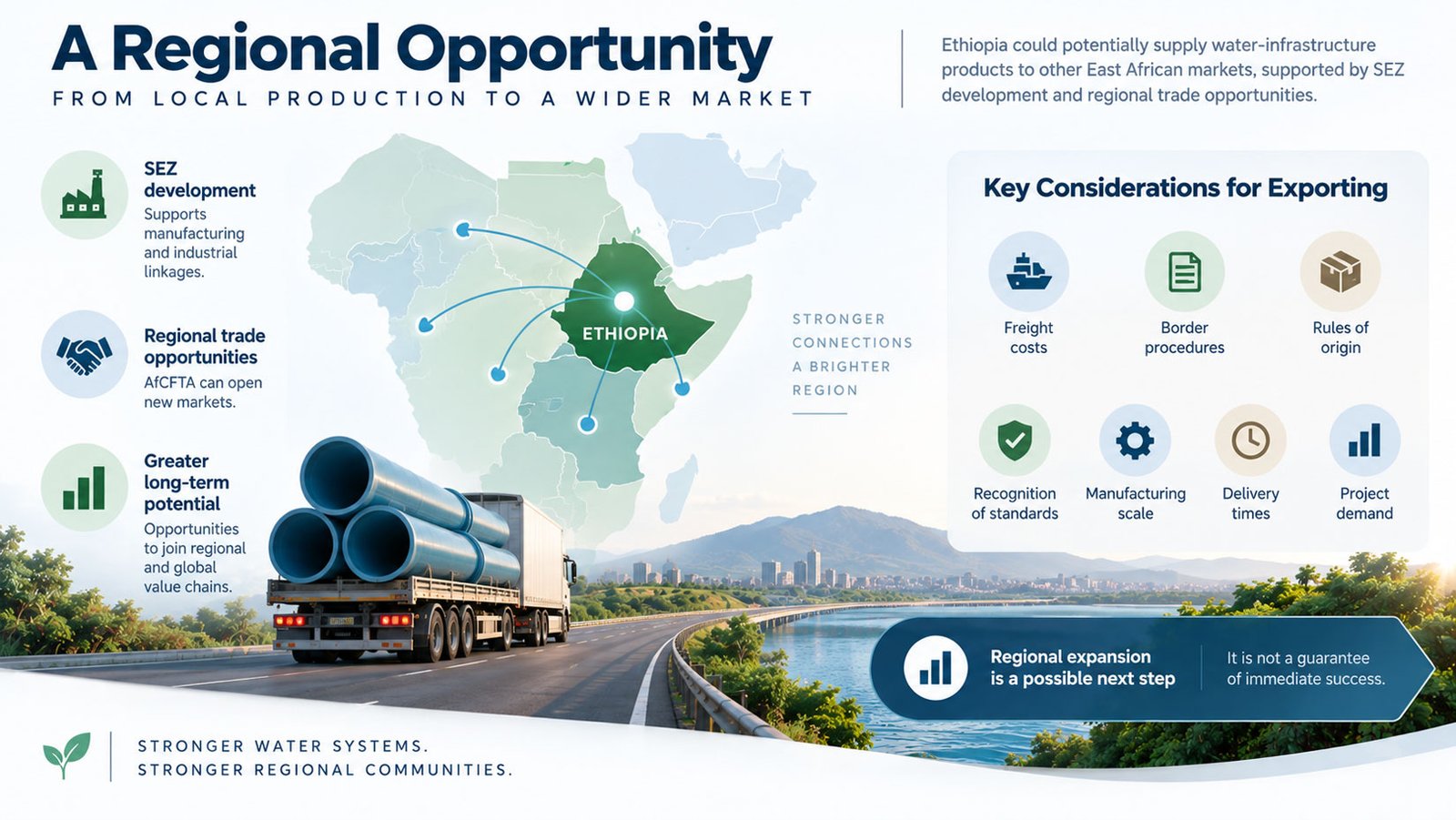
Potentially, yes. A stronger manufacturing base could eventually supply water-infrastructure projects outside Ethiopia.
The Invest Ethiopia Special Economic Zone framework connects SEZ development with manufacturing, industrial linkages, import substitution, infrastructure, and participation in regional and global value chains.
AfCFTA and growing regional infrastructure investment may create more opportunities. But you should be careful about assuming Ethiopia will automatically become a regional manufacturing hub. To export water-infrastructure products competitively, manufacturers would still need to deal with:
- freight costs
- border procedures
- rules of origin
- recognition of technical standards
- manufacturing scale
- delivery times
- project demand in neighbouring countries
Regional expansion is better seen as a possible next step. It is not proof that local manufacturing inside Ethiopia will automatically succeed.
Import Substitution Is Really About Building Capability
The biggest opportunity is not simply to make imports disappear. Ethiopia can still use international technology, machinery, materials, and specialist components while creating more value locally. The real shift is moving from mainly importing finished products toward a stronger local system for manufacturing, assembly, testing, engineering, installation, maintenance, and technical support.
If you are an owner, consultant, contractor, utility, or procurement team, the “Made in Ethiopia” label on its own should not be enough. You still need to look at:
- competitive cost
- reliable supply of materials
- technical standards
- project qualification
- delivery reliability
- local support capability
In the end, the best way to measure import substitution in Ethiopia’s water sector is not simply by counting how many imports disappear. It is by looking at how much reliable engineering, manufacturing, and project-delivery capability Ethiopia builds locally.
about
The Author

Farshid Tavakoli is a seasoned professional in engineering and international trade. Holding degrees in Electrical Engineering, Mechatronics, and a Doctorate in Business Administration (DBA) from the University of Lyon, he also has a strong background in industrial automation and production line technologies.
For over 17 years, he has led an international trading company, gaining deep expertise in commercial solutions tailored to industrial needs. With more than 8 years of active involvement in infrastructure development, he specializes in the supply of electromechanical equipment for water and wastewater treatment plants and transfer projects.
Together with comapny expert team, he now provides consultancy and integrated solutions for sourcing and implementing complex infrastructure projects across the region.