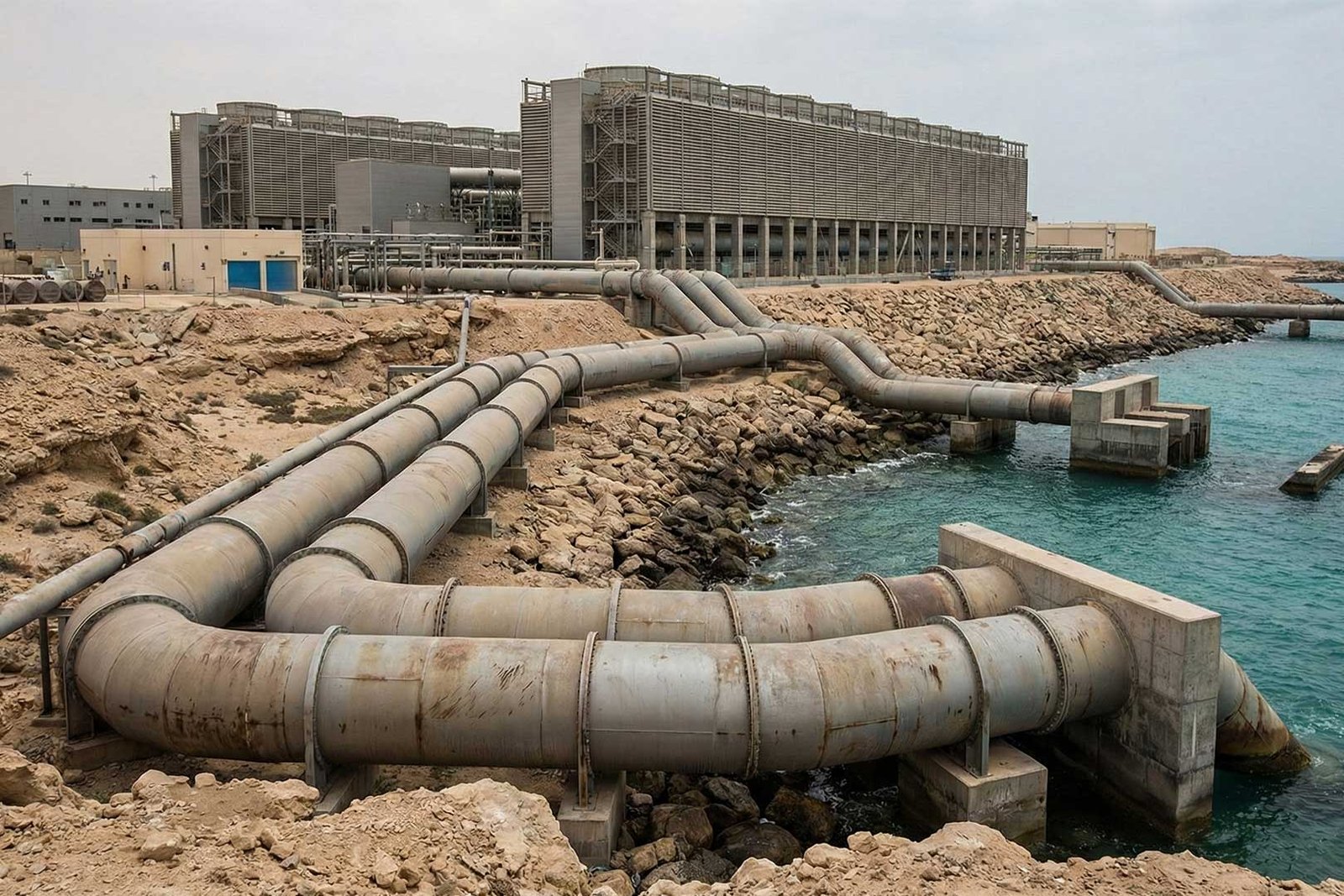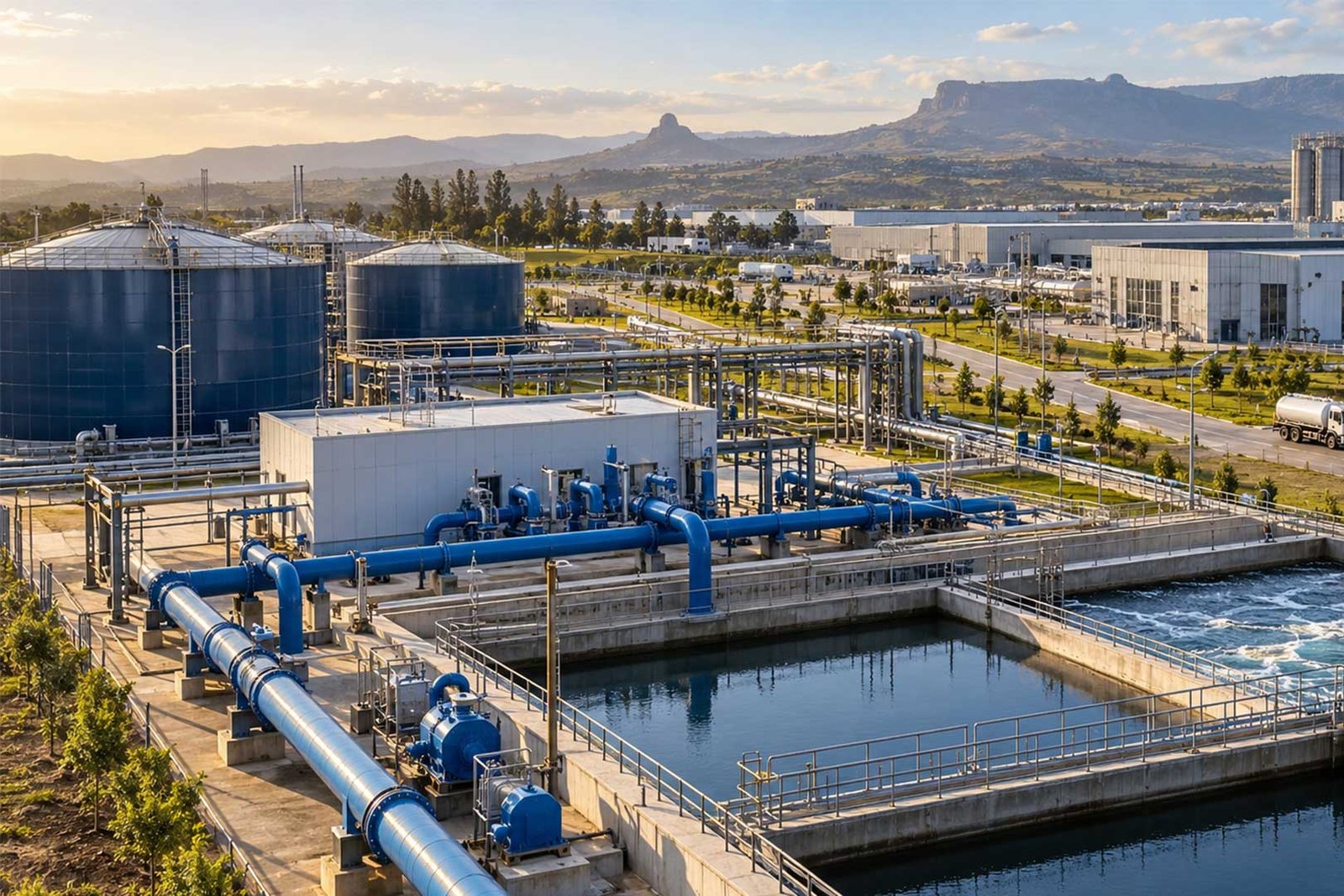
A water connection on a site plan tells you very little about whether an industrial zone can actually keep its factories running. As Ethiopia moves toward larger, more diverse Special Economic Zones, water is becoming a core part of industrial infrastructure.
Different tenants can change everything from demand and pressure to water quality, storage, wastewater treatment, and reuse. If you are planning, designing, or supplying these systems, those differences matter early. Read on to see how real Ethiopian SEZs are already showing where the biggest infrastructure needs may come next.
Why Ethiopia’s SEZ Expansion Changes the Water-Infrastructure Market
The water question changes as soon as the tenant mix changes. These two shifts explain why SEZs now need much more than a basic water connection.
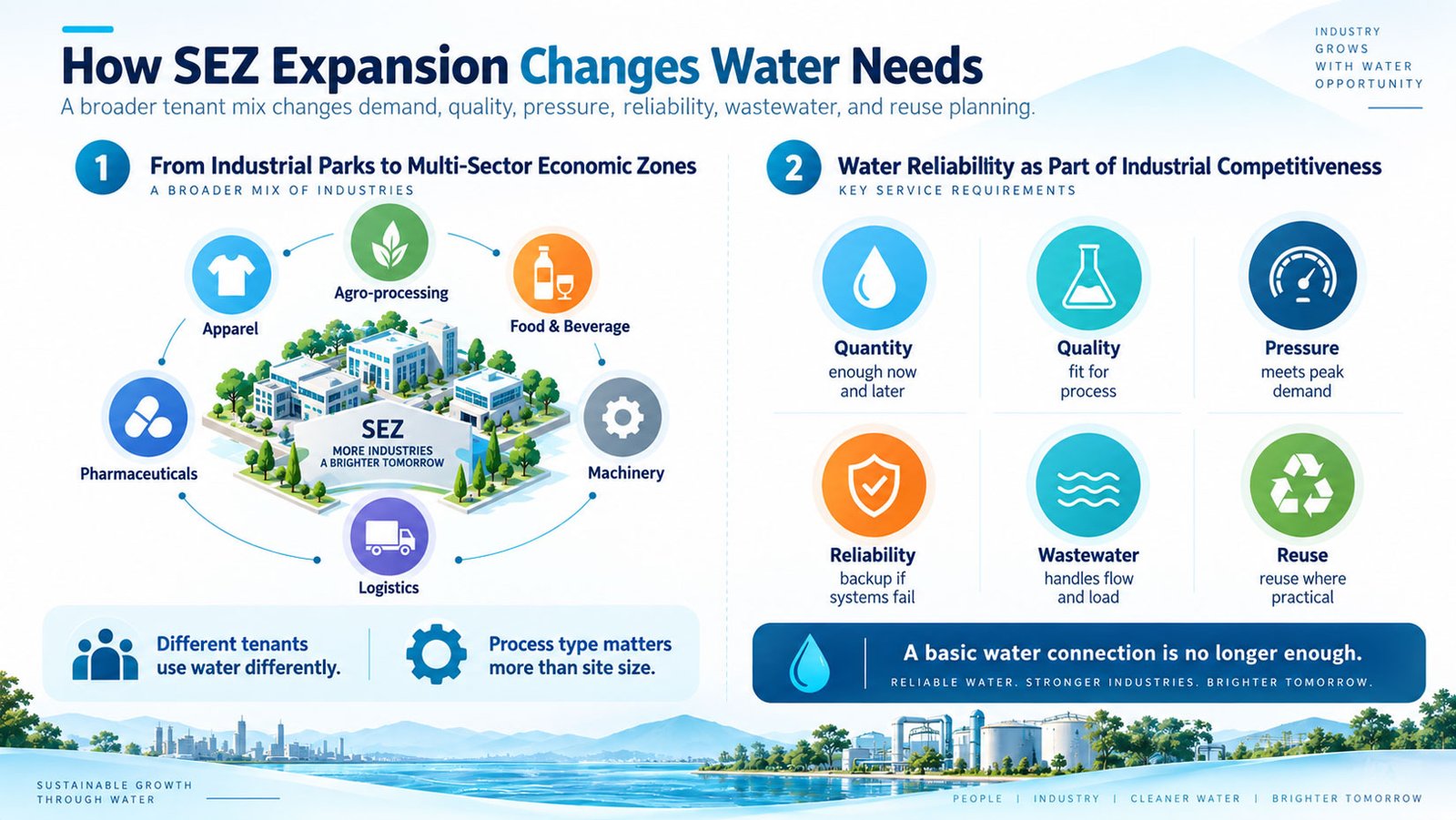
From Industrial Parks to Multi-Sector Economic Zones
Ethiopia’s newer SEZ model allows for a much wider mix of industries. That can include apparel, agro-processing, food and beverage, pharmaceuticals, machinery, logistics, and other manufacturing.
This matters because these businesses do not use water in the same way.
A garment factory that mainly cuts and sews fabric can have very different needs from a textile plant that washes or dyes it. A pharmaceutical facility may care more about water quality. A food processor can add heavy cleaning and organic wastewater loads.
So if you size a system mainly by hectares or number of sheds, you can miss the real demand. The production process matters much more.
Water Reliability as Part of Industrial Competitiveness
For an industrial tenant, “the site has water” is not enough. You need to know:
- Quantity: Can the source support today’s demand and future occupancy?
- Quality: Is the water suitable for the tenant’s process?
- Pressure: Can the system maintain the required flow during peak use?
- Reliability: What happens if a pump, source, power feed, or main fails?
- Wastewater: Can treatment handle both the flow and the actual pollution load?
- Reuse: Can treated water be used again where it makes sense?
That is the difference between having infrastructure and having a reliable industrial utility.
Real-World Example: Bole Lemi and Kilinto
The World Bank completion review recorded earlier concerns about whether Bole Lemi II’s groundwater supply could meet full occupancy. It also noted that a malt-processing investor had very different water needs from a garment factory.
That does not mean the same problem still exists in 2026. The current position would need to be checked.
But the lesson is useful for your project. A new tenant can change the original water balance very quickly.
Kilinto shows another side of the problem. Its pharmaceutical focus raises questions around higher-quality process water, tenant pretreatment, effluent separation, and more advanced wastewater treatment.
Where Ethiopia’s Industrial Water Demand Is Concentrating
The differences become much easier to see when you look at real zones. The table below shows how their water needs can change from one location to another.
| Zone / cluster | Main tenant profile | Main water issue | What it shows |
|---|---|---|---|
| Bole Lemi | Apparel, leather, mixed investors | Source capacity, changing demand | Tenant mix can change the water balance |
| Kilinto | Pharmaceuticals, higher-tech | Process-water quality, effluent treatment | Quality can matter as much as volume |
| Hawassa / Adama | Textile, apparel, mixed industry | Wastewater treatment and reuse | Existing zones can still need upgrades |
| Yirgalem / Bure / Bulbula | Agro-processing | Dedicated supply, treatment, wastewater | More self-contained utilities may be needed |
| Dire Dawa / Gadaa | Multi-sector growth | Future transmission, storage, shared utilities | Larger growth can need backbone systems |
From a Municipal Connection to a Dedicated Industrial Utility System
A connection at the park boundary is only the starting point. The three areas below show what it takes to turn that into a reliable industrial water system.
Bulk Water Source and Transmission
A growing SEZ may need a full chain of source development, abstraction, pumping, treatment, bulk transmission, storage, and internal distribution. Before you size the transmission system, check:
- Source security: Sustainable yield, seasonal changes, raw-water quality, and backup sources.
- Hydraulics: Route, elevation, flow, pressure, surge, pumping head, and crossings.
- Future demand: Occupancy growth, new tenants, parallel mains, and source expansion.
- Operations: Power reliability, metering, SCADA, leakage, and maintenance access.
A large installed pump does not automatically mean the source can support long-term demand.
Real-World Example: Yirgalem, Bure and Bulbula
The African Development Bank’s 2026 reporting recorded a 7-km HDPE water-supply line and a 200-m³ wastewater facility at Yirgalem. It also reported that electromechanical works for Bure’s water-treatment plant had been completed, tested, and commissioned.
Bulbula project documents also included dedicated source development, treatment, sewage and effluent treatment, and reuse.
For you, the main takeaway is simple. Agro-industrial zones can need a complete utility system, not just a municipal connection.
Storage, Pumping and Operational Redundancy
Storage and pumping should be planned around factory uptime. That can mean raw- and treated-water reservoirs, duty and standby pumps, emergency storage, backup power, looped networks, pressure zones, and SCADA.
The practical question is this: if one important asset fails, can you still keep the required water flowing at the right pressure?
Fire-Water Infrastructure
Fire water should be treated separately from normal industrial demand. You may need dedicated reserves, fire pumps, ring mains, hydrants, and specific flow and pressure requirements. The final design still depends on the applicable fire code, insurer requirements, pressure conditions, owner standards, and product approvals.
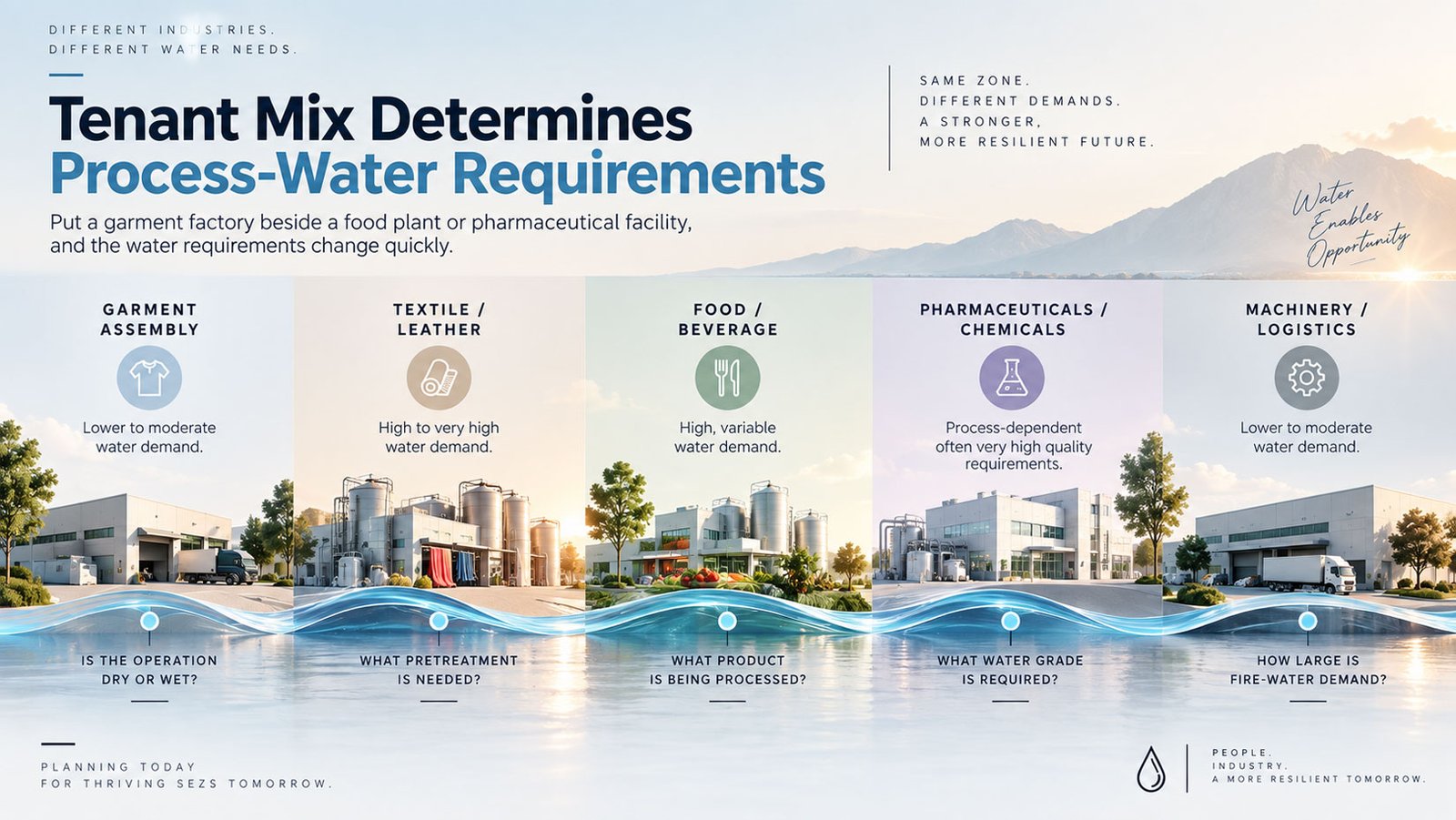
Tenant Mix Determines Process-Water Requirements
Put a garment factory beside a food plant or pharmaceutical facility, and the water requirements change quickly. The table below makes those differences easy to compare.
| Sector | Water demand | Quality sensitivity | Main wastewater concern | What you need to check |
|---|---|---|---|---|
| Garment assembly | Low to moderate | Moderate | Lower process load | Is the operation dry or wet? |
| Textile / leather | High to very high | Moderate to high | Color, COD, salinity, chemicals, metals | What pretreatment is needed? |
| Food / beverage | High, variable | High | CIP, wash water, organic load | What product is being processed? |
| Pharmaceuticals / chemicals | Process-dependent | Very high | Specialized chemical streams | What water grade is required? |
| Machinery / logistics | Low to moderate | Moderate | Cooling, wash-down, domestic load | How large is fire-water demand? |
Textile and Leather Processing
The IFC textile guidance shows why you should separate dry apparel from washing, dyeing, and finishing. Wet processes can create much higher water demand and more difficult wastewater. Leather processing can also introduce high dissolved solids and metals.
Food, Beverage and Agro-Processing
Food and beverage plants may use water for washing, CIP, cooling, cleaning, and the production process itself.
The IFC food and beverage guidance also shows that demand can vary widely by product. So “agro-processing” alone is not enough information for design.
Pharmaceuticals and Chemicals
Here, quality may matter as much as quantity. Depending on the process, tenants may need softening, ultrafiltration, reverse osmosis, demineralization, or other treatment. Wastewater may also need to be separated or pretreated before it enters the main system.
Machinery, Assembly and Logistics
These tenants usually need less continuous process water, but cooling, wash-down, domestic supply, and fire-water capacity can still be important. This is why one generic “m³ per hectare” figure does not work across every SEZ.
Wastewater and Reuse Are Becoming Industrial Infrastructure Markets
Getting water into the factory is only half the job. You can see the main infrastructure requirements in the three areas below.
Centralized Industrial Wastewater Corridors
A shared system can include tenant pretreatment, local sewers, larger interceptors, lift stations, centralized treatment, tertiary treatment, and eventually a reclaimed-water network.
This can make sense where industrial clustering allows compatible wastewater streams to be treated together.
Hydraulic Capacity Is Not Enough
A wastewater plant rated at 10,000 m³/day cannot automatically treat any 10,000 m³/day industrial mix.
Food, textile, tannery, and pharmaceutical facilities can create very different BOD, COD, salinity, color, metals, nutrients, solvents, and toxicity loads. So you need to check both flow capacity and pollutant-load capacity.
Reclaimed Water as a Second Industrial Utility
Treated water may be reused for cooling, cleaning, landscaping, utility make-up, or selected industrial processes where the quality is suitable.
The IFC water-conservation guidance includes treated-wastewater and process-water reuse among its conservation options.
Hawassa is a useful ZLD example, but that does not mean every SEZ needs ZLD. Reuse depends on water quality, cost, regulation, end users, and the network needed to deliver it.
Real-World Example: Hawassa and Adama
Hawassa is a strong Ethiopian example of advanced wastewater infrastructure. The World Bank’s 2025 eco-industrial-park review identifies ZLD treatment there. IPDC’s 2025 objectives also included a membrane-based potable-water treatment modification, although the supplied research did not find a later official source confirming its final completion.
Adama is also useful. IPDC has reported about 11 million litres per day of wastewater-treatment and reuse capacity there.
Together, they show that even established zones can still create work around treatment quality, reuse, rehabilitation, and optimization.
Where Future EPC Packages Could Emerge
The table below brings the main opportunity categories and their likely triggers together. These are market opportunities to watch, not announced tenders.
| Opportunity | Main trigger | Possible scope | Question to ask |
|---|---|---|---|
| Dedicated bulk water | New or undersupplied zone | Source, WTP, pumps, transmission, reservoirs | Can existing supply support the zone? |
| Capacity expansion | Higher occupancy / new tenant | Parallel mains, source expansion, storage | What happens at full build-out? |
| Process-water retrofit | New quality requirement | Filtration, UF, RO, softening, storage | What quality must reach the tenant? |
| Wastewater expansion | New load / treatment limit | CETP/WWTP, pretreatment, sludge, controls | Is the limit hydraulic or chemical? |
| Reclaimed-water network | Reliable effluent + reuse demand | Tertiary treatment, storage, pumps, mains | Who can use the reclaimed water? |
| Resilience package | Uptime risk | Dual mains, N+1 pumps, backup power, SCADA | What happens after one asset fails? |
Dedicated Bulk-Water Systems
New or expanding zones may need a full source-to-park package covering water source, treatment, pumping, transmission, and storage. IAIP reporting already shows this type of dedicated infrastructure being delivered.
Capacity Expansion and Parallel Transmission Mains
Higher occupancy or different tenants can create a need for source expansion, parallel mains, more pumping, larger reservoirs, or hydraulic rebalancing.
Process-Water Treatment and Retrofit Projects
A zone may have enough water but still need filtration, UF, RO, softening, or additional storage because a new tenant needs better-quality water.
Wastewater Treatment Expansion
Possible triggers include hydraulic limits, a different tenant mix, poor pretreatment, sludge problems, aging equipment, weak instrumentation, or the need for tertiary treatment.
Reclaimed-Water Networks
Where treated effluent is reliable and suitable users exist, a separate system can include tertiary treatment, storage, pumps, and dedicated reuse mains.
Resilience Packages
Dual mains, N+1 pumps, emergency storage, backup power, network looping, metering, SCADA, and pressure management can improve reliability without replacing the whole system.
Where GRP, GRE and Composite Pipeline Systems Fit
The two sections below show where composite systems may fit and what still needs to be checked.
High-Value Applications
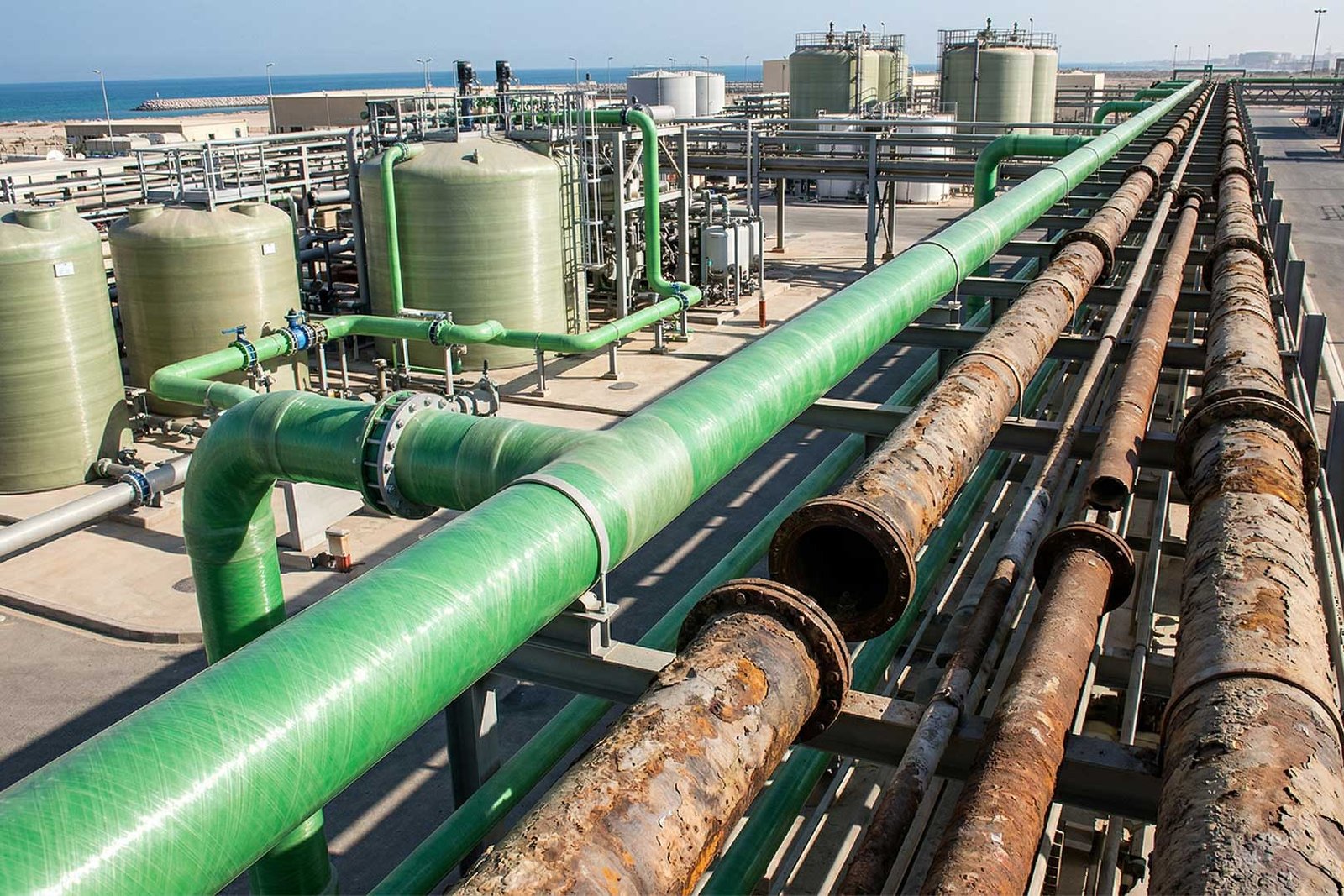
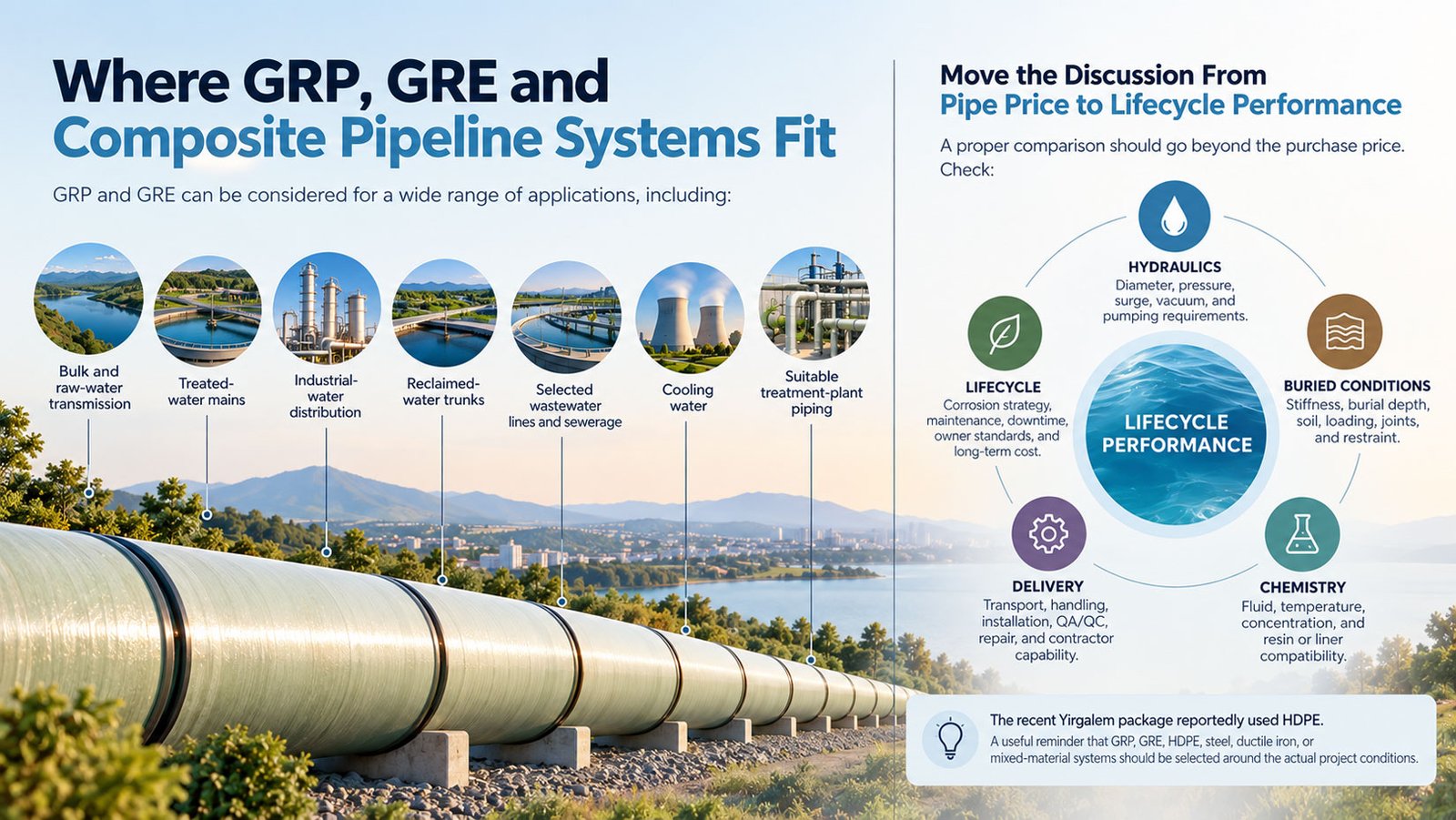
GRP and GRE can be considered for applications such as bulk and raw-water transmission, treated-water mains, industrial-water distribution, reclaimed-water trunks, selected wastewater lines, sewerage, cooling water, and suitable treatment-plant piping.
ISO 23856:2021, AWWA C950, and ASTM D3754-24 provide relevant standards bases across these types of applications.
Move the Discussion From Pipe Price to Lifecycle Performance
A proper comparison should go beyond the purchase price. Check:
- Hydraulics: Diameter, pressure, surge, vacuum, and pumping requirements.
- Buried conditions: Stiffness, burial depth, soil, loading, joints, and restraint.
- Chemistry: Fluid, temperature, concentration, and resin or liner compatibility.
- Delivery: Transport, handling, installation, QA/QC, repair, and contractor capability.
- Lifecycle: Corrosion strategy, maintenance, downtime, owner standards, and long-term cost.
The recent Yirgalem package reportedly used HDPE. That is a useful reminder that GRP, GRE, HDPE, steel, ductile iron, or mixed-material systems should be selected around the actual project conditions.
How Integrated Engineering and Supply Capabilities Can Support SEZ Water Infrastructure
Even good infrastructure can run into problems when each part is planned separately. The following three areas show where closer technical coordination can add the most value.
Think Beyond Individual Components
For your project, the source, treatment plant, pumps, pipelines, storage, process water, wastewater, and reuse system all affect one another.
If these parts are designed separately, problems can appear at the interfaces. A pipeline can be sized around the wrong demand. A treatment plant can have enough flow capacity but the wrong treatment capability. A reuse plant can produce water without having a practical network to deliver it.
The Role of Engineering, Manufacturers, EPC Contractors and Utility Specialists
A strong SEZ water system usually needs several teams working together:
- Engineering consultants
- Manufacturers
- EPC contractors
- Treatment specialists
- Utility operators
- SEZ developers
Each group handles a different part of the system. Good coordination helps connect hydraulics, material selection, construction, controls, commissioning, and long-term operation.
Grand LineCore can support projects where pipeline engineering, material evaluation, GRP/GRE systems, procurement, installation support, testing, commissioning, or EPC-oriented coordination are relevant. Final design and material decisions still depend on the owner, consultant, standards, approvals, and detailed engineering.
Why Early Technical Coordination Matters
The best time to solve these interface issues is during feasibility, master planning, detailed design, and procurement preparation.
That gives you time to define the hydraulic requirements, compare materials fairly, coordinate treatment and pipelines, size storage and pumping properly, and include wastewater and reuse before the project becomes expensive to change.
Ethiopia’s SEZ Water Infrastructure Is Becoming a Full-System Question
Ethiopia’s SEZ water challenge is becoming less about whether infrastructure exists and more about whether the complete utility system matches the industries it serves.
For your project, that means looking at the whole chain. Can suitable-quality water move from the source to the factory at the right flow and pressure? Can the resulting wastewater be collected and treated properly? Can part of that water be reused? And can the system keep operating when something important fails?
That is the bigger infrastructure opportunity. Not simply more pipe, but better industrial utility systems built around the factories that actually depend on them.
about
The Author

Farshid Tavakoli is a seasoned professional in engineering and international trade. Holding degrees in Electrical Engineering, Mechatronics, and a Doctorate in Business Administration (DBA) from the University of Lyon, he also has a strong background in industrial automation and production line technologies.
For over 17 years, he has led an international trading company, gaining deep expertise in commercial solutions tailored to industrial needs. With more than 8 years of active involvement in infrastructure development, he specializes in the supply of electromechanical equipment for water and wastewater treatment plants and transfer projects.
Together with comapny expert team, he now provides consultancy and integrated solutions for sourcing and implementing complex infrastructure projects across the region.