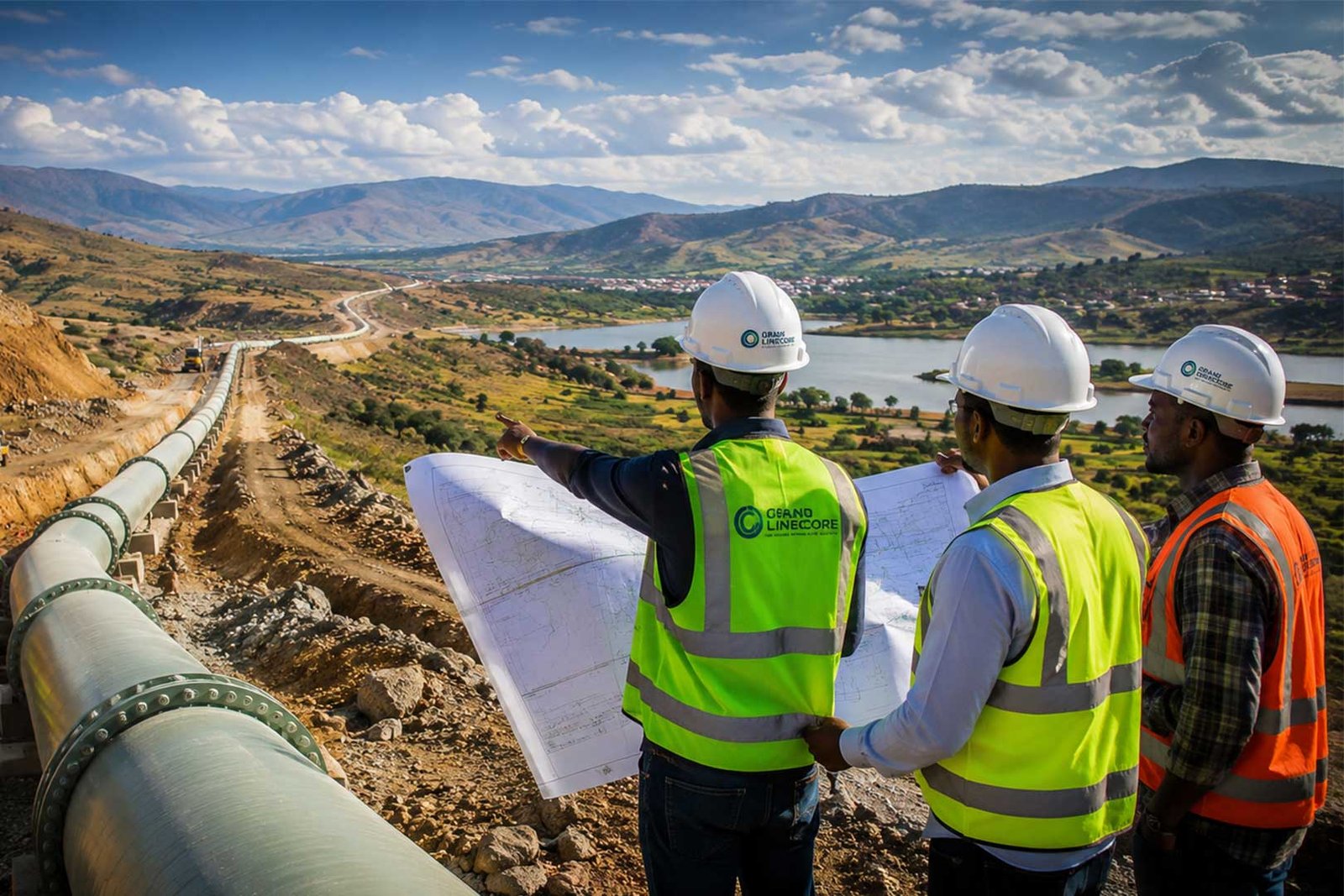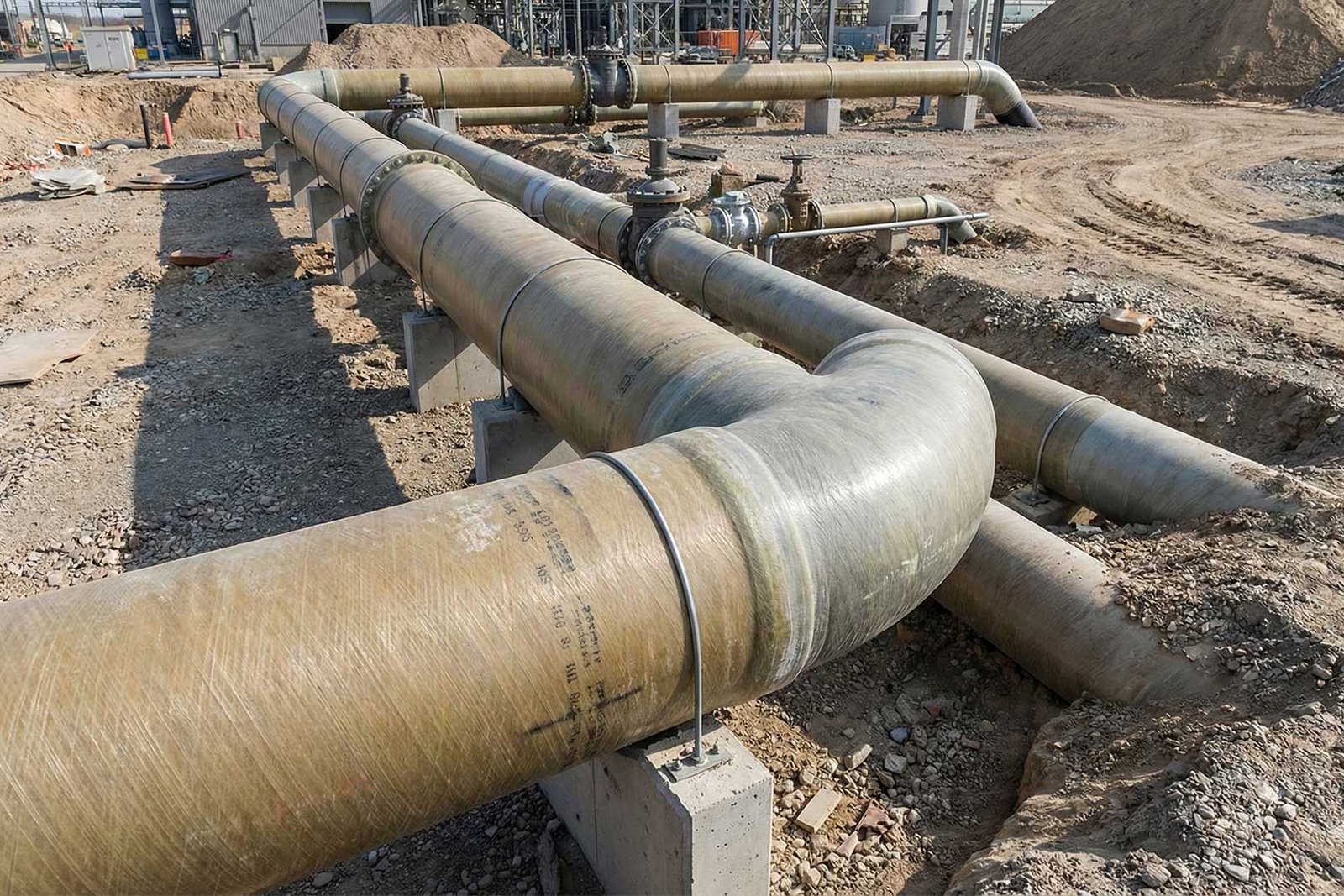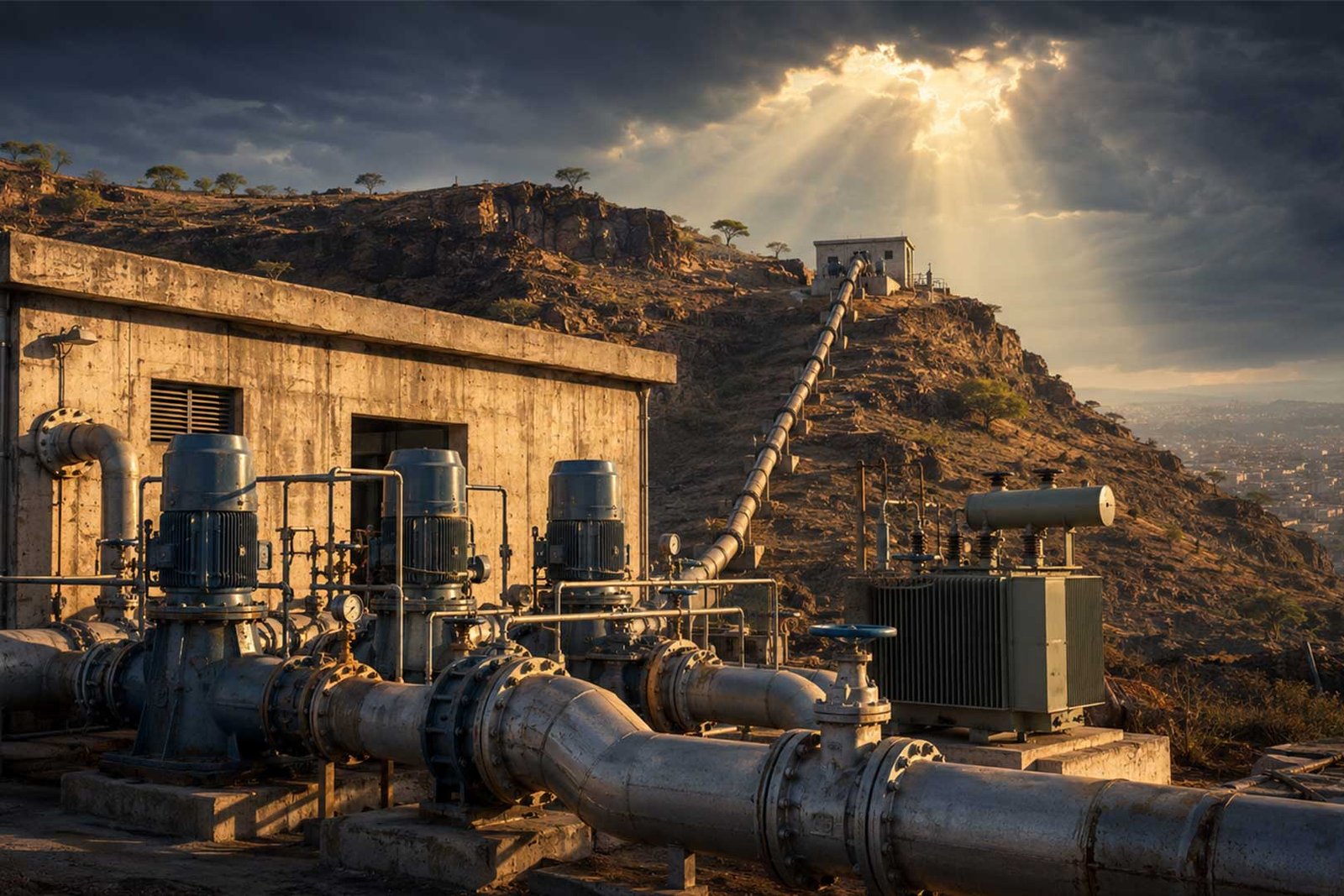
What if the best water source for a whole region sits far from the city that needs it most? That’s real life in parts of Ethiopia, and it forces a choice. Do you build for just one town, or design the system to serve several cities at once? That one decision changes the whole project.
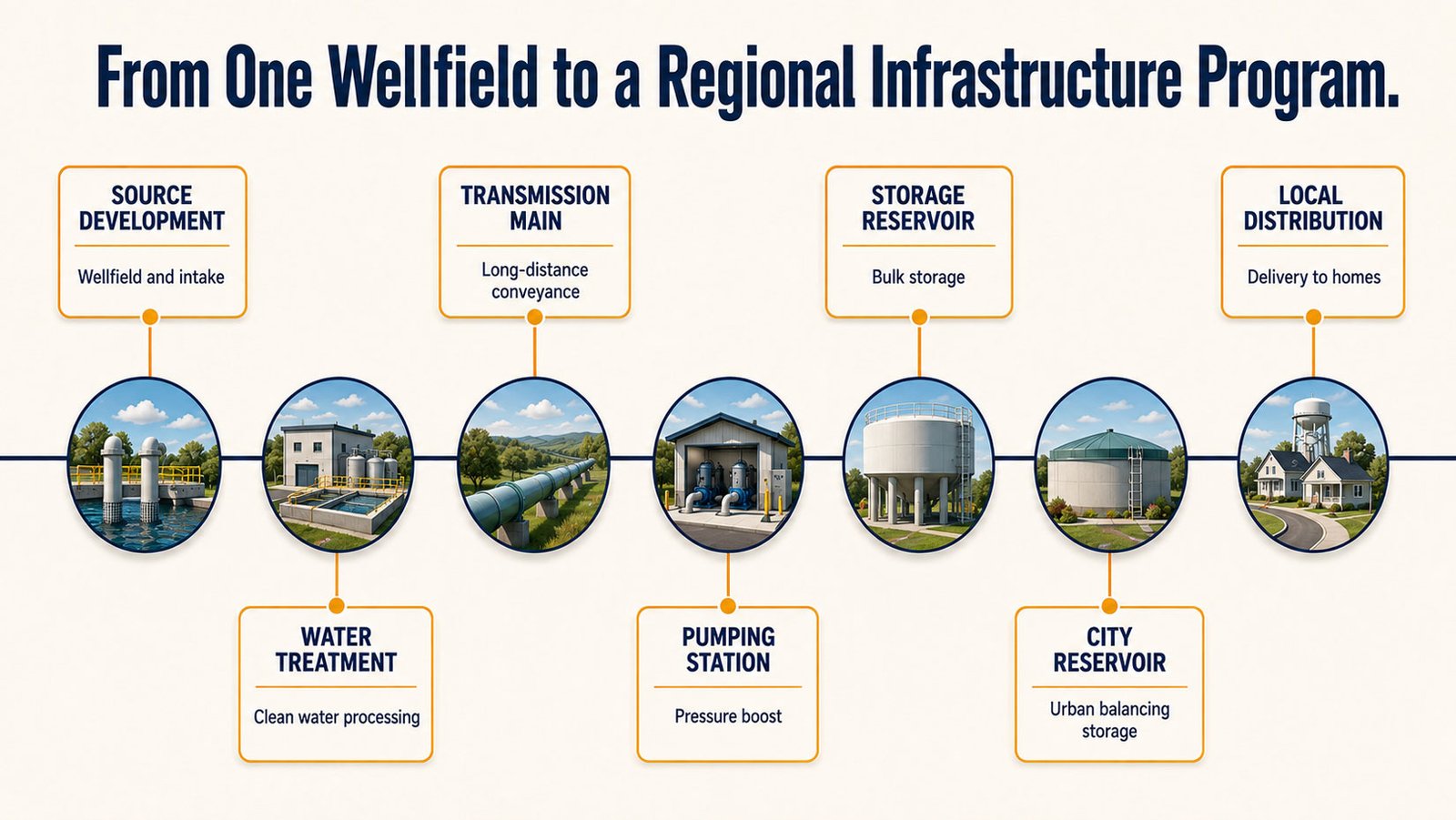
So how does it actually work? The idea is simple, even though the engineering behind it is not. One shared source feed shared treatment. That treatment feeds a transmission main, which then feeds pumping and storage. And from there, it finally reaches the pipes that bring water to your home.
What Is a Multi-City Water Supply System?
Not every project that touches more than one town deserves to be called “regional.” Let’s sort that out first:
One Regional Backbone, Multiple Urban Destinations
You can connect one wellfield to several towns. Or tap one water source for a few cities. Or run one treatment plant into several city reservoirs. World Bank guidance on town water systems shows the same setup that means a source feeds a transmission main, the first town gets water through its own reservoir, and the trunk line keeps going toward the next town. Bulk meters along the way track what each town actually gets.
Think of a normal town system as a road with one destination. A multi-city system is more like a highway with several exits, so you need to know how much traffic goes to each one.
Regional Transmission Is Different from Local Distribution
Regional transmission is the long journey from the source to the region, and local distribution starts once that journey ends. It helps to keep these two ideas apart, because it’s easy to get them mixed up. For instance, a program that mentions “ten towns” doesn’t always mean those towns share the same pipes.
So ask yourself one simple question: do they share an upstream asset, like a source, a treatment plant, a trunk main, or a regional reservoir? If not, you’re really just looking at a group of separate town projects, not one true regional system. The table below shows the difference.
| Aspect | Regional Transmission | Local Distribution | Handover Point |
|---|---|---|---|
| Core function | Moves bulk water from source toward each city | Delivers water from a reservoir to individual consumers | Bulk delivery point |
| Main assets | Trunk main, booster pumps, regional reservoirs | Secondary pipelines, service connections | Bulk custody meter |
| Geographic scale | Crosses towns and administrative zones | Contained within one town | City boundary |
| Typical operator | Regional water bureau or bulk transmission utility | Municipal water utility | Utility-to-utility handover |
Why One Water Source May Need to Serve Several Ethiopian Cities
Regionalization usually starts as a geography problem before it becomes an engineering one. The reason comes down to two things.
Water Sources and Urban Demand Do Not Always Occur in the Same Place
Cities tend to grow around roads, trade, and jobs, but water sources don’t care about any of that. They follow geology instead. So, you can end up with a good source in one place and growing demand somewhere else, and that gap is often exactly what pushes planners toward one shared regional system, instead of hunting for water next to every single town.
Developing Major Upstream Assets for Only One City May Not Always Be the Best Logic
If one good source can support several towns, it often makes more sense to build one shared regional system, since that beats repeating the same upstream work for every single town. Still, this is a judgment call, not a fixed rule. Regionalization isn’t automatically the right answer just because it’s possible.
How Regionalization Changes the Architecture of a Water Project
Once a source gets built at a regional scale, it stops being sized for just one city, and it becomes part of something bigger instead. That shift usually shows up in a few ways:
- One big wellfield doing the job of several smaller local sources
- One treatment plant standing in for several small municipal plants
- Shared pumping and power equipment, built at fewer, bigger sites
In every case, it’s about combining assets. It’s not about the treatment technology itself.
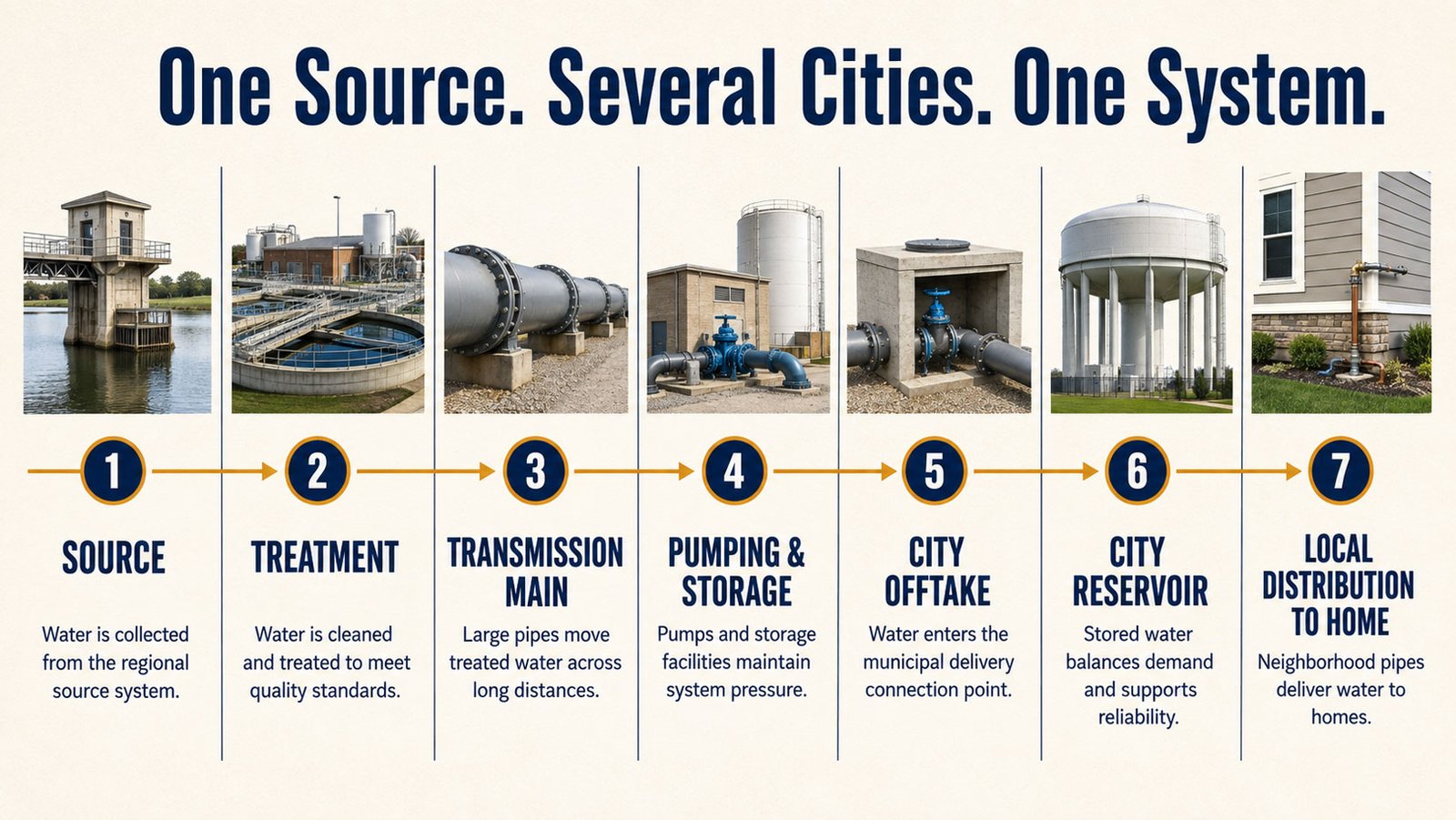
Long-Distance Transmission Becomes the Regional Backbone
A pipe stops being just a pipe the moment more than one city relies on it. That’s worth unpacking:
Connecting Remote Water Sources to Urban Corridors
You need a corridor that goes well beyond a normal town intake, since water has to travel from the source to the first city and then keep going toward more towns, with key points placed along the way.
The Transmission Main Becomes Shared Infrastructure
The World Bank’s multi-town model shows this well: the main doesn’t stop at the first town, but keeps going and delivers water to the next one too. In other words, its shared infrastructure serves several places at once, not a private line for one city.
Why Pumping Stations and Elevation Become Regional Planning Issues
Elevation rarely makes regional routing easy. Ethiopian corridors often connect a source and cities that sit at very different heights, which is why several schemes below use staged booster pumping instead of one big pumping step. Because of that, you can’t plan pumping around just one city when several towns share the same backbone: a change upstream can affect what reaches everyone downstream.
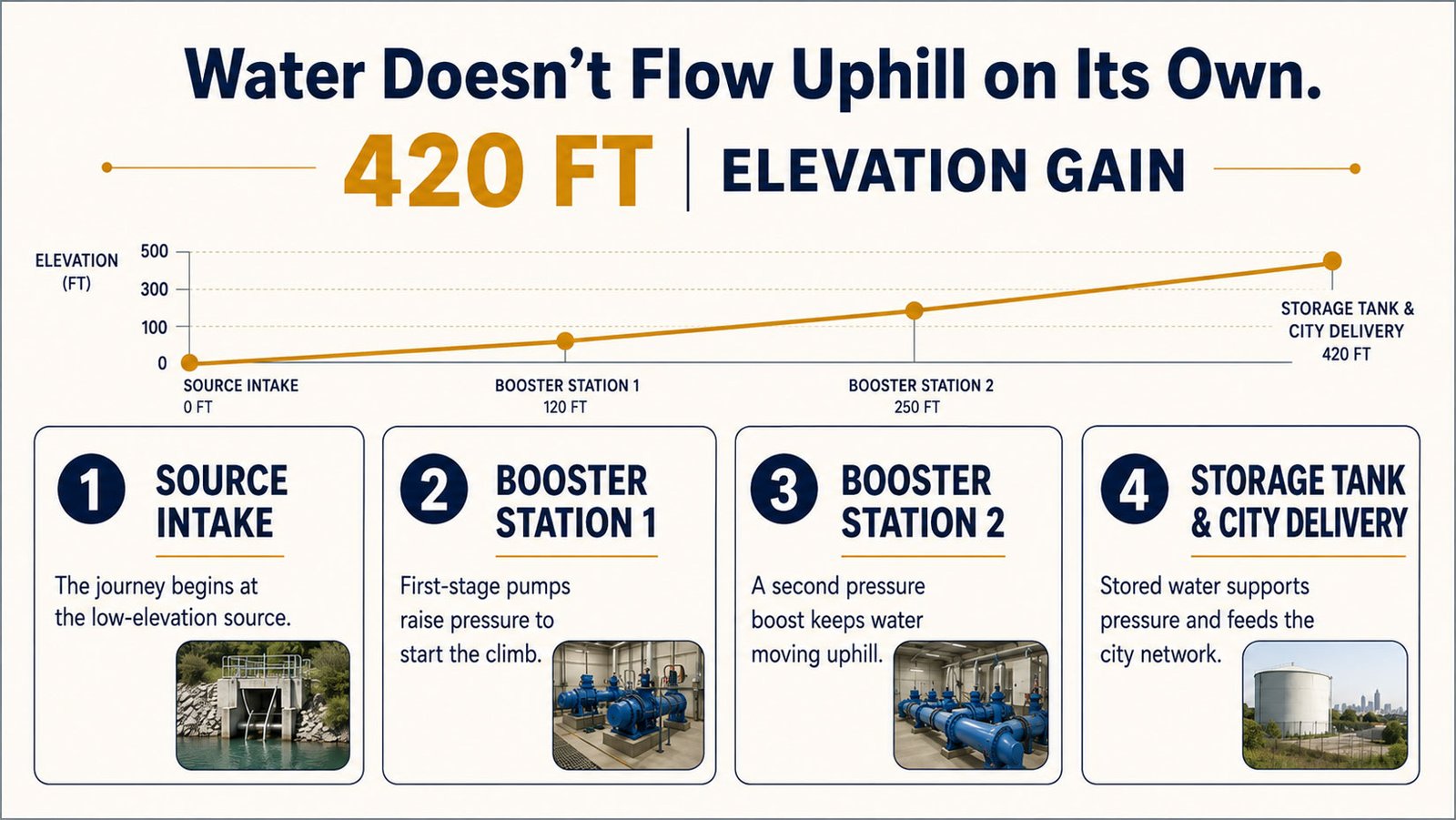
The Role of Regional Reservoirs and Balancing Storage
Storage does a lot more work in a regional system than a single city’s tank ever has to. There’s more to it than just holding water.
Regional Storage Is More Than a City Reservoir
It balances production against demand that keeps changing, separates different stages along a long corridor, and gives the system key delivery points. World Bank guidance says service reservoirs help balance flows, and can even keep water moving for a short time if pumping or transmission breaks down.
City Reservoirs Become Interfaces Between Regional and Local Systems
A city reservoir does that same balancing work, but it also marks the handoff point between the shared bulk system and the city’s own network. This is where the regional side ends and the local utility take over.
How One Regional System Delivers Water to Multiple Cities
Picture the corridor as one line with several stops. The diagram below shows how one source can end up feeding three separate towns.
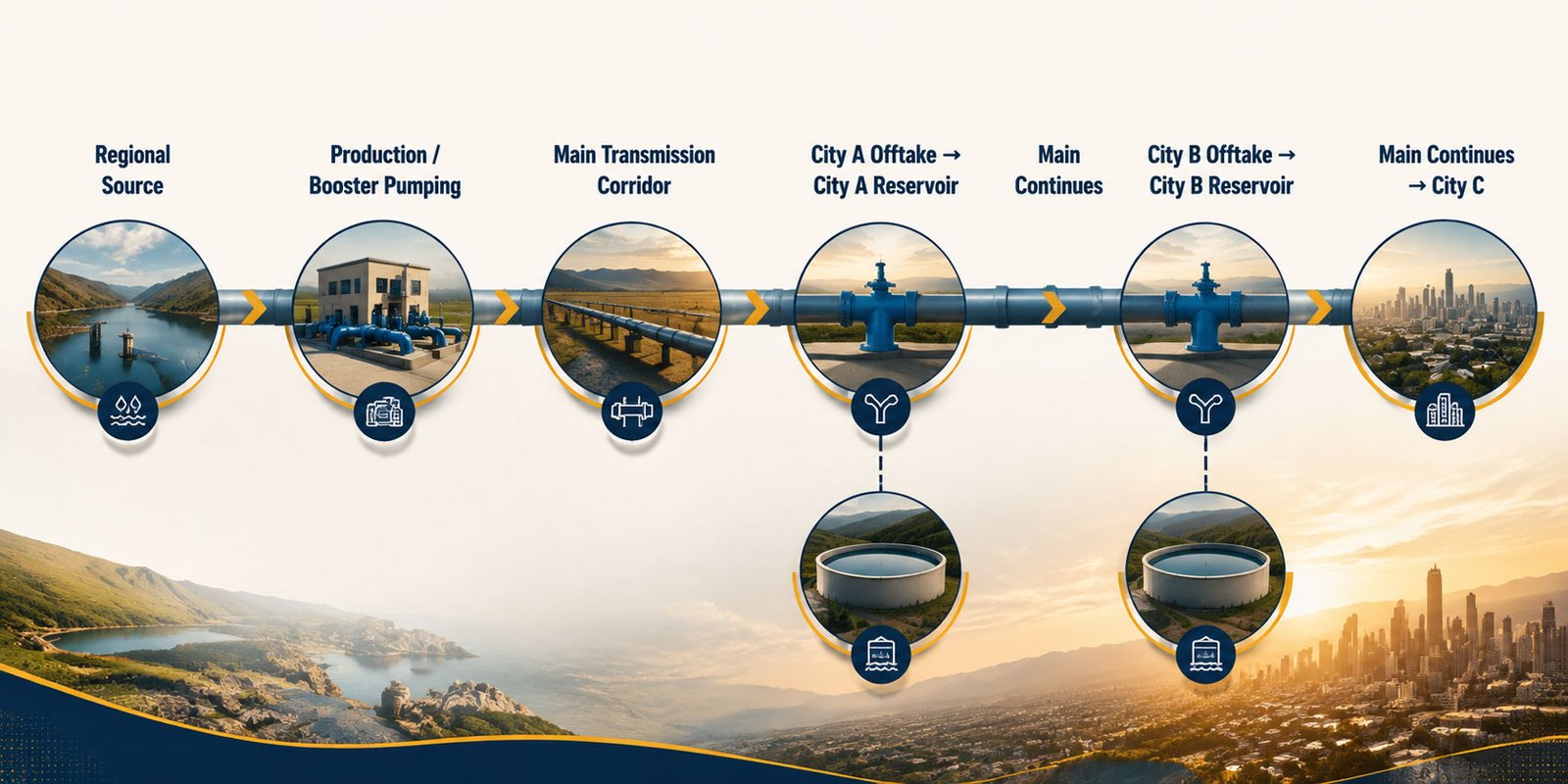
The real engineering question isn’t just how much water the pipeline can carry. It’s also how much belongs to each town, what happens when one town grows faster than the rest, and how the shared trunk relates to each city’s own branch.
Bulk Water Allocation Becomes a Core Regional Planning Requirement
Sharing one source only works if everyone knows their fair share. You need clear answers to a few practical questions:
- What each town’s starting allocation is
- What its design demand will look like as it grows
- Which town gets priority if total production ever gets tight
- Where bulk meters sit, so you can track each town’s delivery, and any water lost along the way, separately
Regional Water Systems Must Be Planned for More Than Today’s Demand
The cities connected today are rarely the system’s final shape. That’s not as obvious as it sounds. Let’s see:
Today’s Cities May Not Be Tomorrow’s System Boundary
Ethiopia’s urban population is projected by World Bank reporting on Ethiopia’s urban growth to top 42 million by 2034, up from roughly 15 million back in 2012. That said, the point isn’t urbanization in general. It’s that a backbone connecting several growing cities has to be sized for their combined future demand, not just what the first town needs today.
Designing for Phased Expansion
You should plan an early phase, meaning today’s source capacity and the cities connected from day one, separately from the system’s final shape, which means saving extra room for more wells, parallel pipes, or bigger storage. You’ll see this kind of thinking in more than one scheme below, and it’s exactly what keeps a regional system from needing a full rebuild later.
Three Ethiopian Regional Water Systems
Instead of skimming past shallow examples, let’s slow down and look at three schemes that each teach you something different.
Harar: Hydrogeology and Cross-Jurisdictional Governance
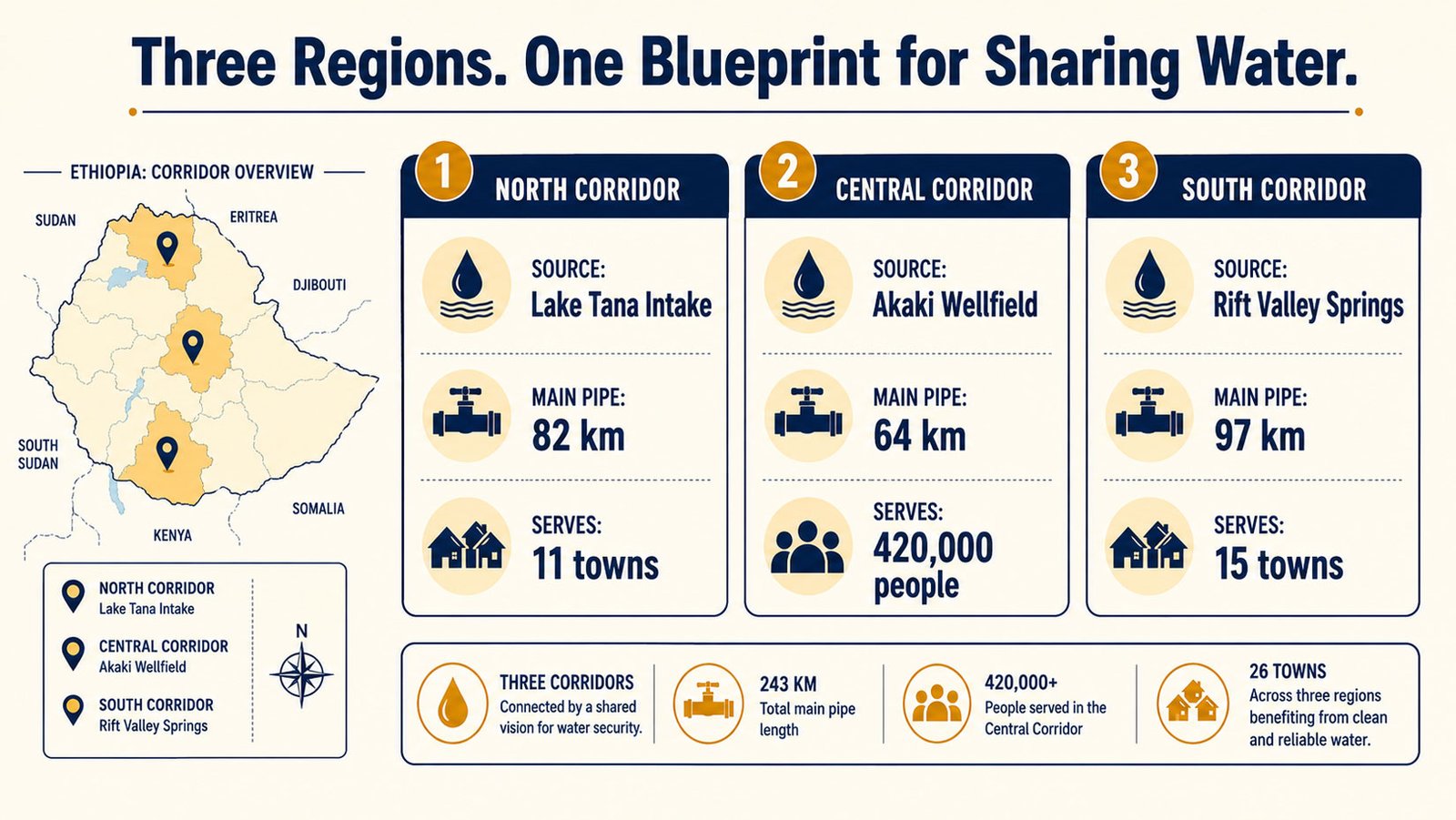
The African Development Bank describes the Harar Water Supply and Sanitation Project as meeting domestic and industrial demand in Harar, Alemaya, and Awudai, and it was built from the start with more than one city in mind.
- Source: a wellfield at Dire Jara
- Transmission: reported figures describe a main about 75 kilometers long, lifted toward Harar through several booster pumping stations across the Rift Valley escarpment
- Towns served: Harar, Alemaya, and Awudai are confirmed. Some project material also mentions extra delivery points along the same route, which is worth checking against the official project records
- Governance: because the corridor runs through Oromia territory, the Harar Town Water Supply and Sewerage Services Authority works with Oromia’s regional water bureau to run it
The lesson here is simple: once a source and a corridor cross administrative line, you have to plan governance right alongside the engineering, not add it later. That’s why reported plans for a second wellfield further along the region are already being treated as a future addition, once the main source runs out of room. It’s phased expansion actually happening, not just an idea on paper.
Itang: The Economic Case for Regionalization
Ethiopia’s Itang scheme, in Gambella, grew around one wellfield in the Baro River basin, and it supplies the host towns of Itang and Thurpam, plus three nearby refugee settlements, all under one shared utility.
- Source and structure: one motorized wellfield feeding a single regional utility, instead of separate town systems
- Communities served: two host towns plus three UNICEF-documented refugee settlements
- Cost progression: a study on water-service costs for refugees and host communities in Ethiopia and Uganda, published by IWA Publishing, tracks cost per cubic meter as the scheme moved from emergency supply to a full regional network
| Phase | Population Served | Daily Bulk Flow (m³/day) | Unit Cost (USD/m³) |
|---|---|---|---|
| Emergency (boreholes + trucking) | 138,354 | 1,000 | $11.38 |
| Piped network | 214,561 | 3,590 | $1.61 |
| Utility management | 261,175 | 4,113 | $1.03 |
| Solarized utility | 261,175 | 4,133 | $0.93 |
That drop is some of the clearest proof you’ll find that going regional isn’t just a nice engineering idea. Done well, it can truly change how much a scheme costs to run.
Borana: One Wellfield, Many Delivery Points
The Borana Resilient Water Development for Improved Livelihoods Program, in Oromia, shows regional supply working at a completely different scale, according to the Borana Resilient Water Development Program’s project page.
- Source: an 11-borehole wellfield at Gelchet
- Transmission: a reported 82-kilometre backbone main, plus more than 140 kilometers of secondary distribution lines
- Reach: 12 small towns and 62 rural kebeles across the Elweya, Dubluk, and Yabelo woredas
- Beneficiaries: reportedly well over 300,000 people, plus hundreds of thousands of livestock, served through public kiosks and dedicated watering troughs
The lesson here isn’t about governance or money, it’s about scale. Once one source serves dozens of delivery points, instead of just two or three cities, sharing and measuring the water stops being a small design detail. It becomes how the whole system runs, every single day.
Why Multi-City Water Supply Can Become an EPC-Scale Infrastructure Project
Add it all up, and a regional scheme stops looking like a simple pipeline job. What actually needs to come together looks like this:
- Source and wellfield development
- Production and treatment facilities
- Pumping stations
- Long-distance transmission
- Reservoirs and city branches
- Electrical infrastructure
- Testing and commissioning
None of that complexity comes from pipeline length alone. It comes from making all these parts and city connections work together as one reliable system, which is why a World Bank review of Ethiopia’s One WASH program found that some climate-resilient work had been split into separate civil, electrical, and pipe-fitting contracts. As a result, a delay in just one part could hold up the whole project.
Why Regional Water Supply Creates Strategic Long-Distance Transmission Opportunities in Ethiopia
Follow this chain far enough, and you can see the business case build itself:
- Regional source development
- Multiple demand centers
- Greater conveyance distance
- A shared transmission backbone
- Pumping and storage nodes
- Several city connections
- A larger, integrated EPC scope
It’s worth repeating a point from earlier: a program name mentioning several towns doesn’t prove they share one water system. What actually makes a project relevant is the data behind it: a shared source, trunk main, or storage, not how many towns are listed in the funding papers. In fact, some of Ethiopia’s water financing is already built around that same idea.
| Program | Funding Agencies | Infrastructure Focus | Footprint |
|---|---|---|---|
| One WASH National Program (Phase II) | World Bank, AfDB, bilateral partners | Multi-town bulk schemes, wellfield integration, transmission spines | Oromia, Amhara, Tigray, Somali, SNNPR, Afar |
| Second Urban Water Supply & Sanitation Project | World Bank | Transmission mains, regional reservoirs | Addis Ababa peri-urban / high-growth areas |
| Horn of Africa Groundwater for Resilience | World Bank, CIWA trust fund | Regional groundwater conveyance, rural piped systems | Underserved rural and peri-urban areas nationally |
When the data confirms a true regional layout, like it does for Harar, Itang, and Borana, that’s exactly the kind of project where long-distance transmission and full EPC support become truly valuable.
What Should Be Considered When Planning a Multi-City Water System?
Before you commit to a regional layout, ask yourself a few questions that decide whether it’s the right call:
- Can the regional source support several demand centers?
- Which cities should form part of the initial system?
- What is the combined long-term regional demand?
- What should be shared, and what should remain city-specific?
- Where should the main transmission corridor run, and where are pumping and storage required?
- How should bulk water be split between the cities, and where should the handoff points sit?
- How can future cities or branches be added later?
- How should engineering, procurement, construction, and commissioning be coordinated across the whole project?
From Individual City Projects to Regional Water Infrastructure
Strip away the case studies, and one idea holds this whole article together. A multi-city system isn’t just several town projects tied together with rope. Instead, it’s a regional backbone where the source, the corridor, and the storage are shared, cities get clear bulk allocations, and local networks connect through controlled handoff points. And the whole thing is built to grow as demand grows, just like Harar’s own plan for a future new source.
The real value isn’t just more kilometers of pipeline. One shared source can turn production, transmission, pumping, storage, several cities, and future growth into a single working system.
Grand LineCore: Integrated Solutions for Regional Water Transmission Infrastructure
Projects at this scale need more than one supplier handling one small piece each. Grand LineCore works as a Total Infrastructure Solution Provider and engineering-led partner for long-distance water transmission.
That means support from engineering and pipeline supply, all the way through construction, QA/QC, installation, and commissioning, combining pipeline manufacturing, including GRP systems, with real EPC experience across Ethiopia and the wider East African region.
about
The Author

Farshid Tavakoli is a seasoned professional in engineering and international trade. Holding degrees in Electrical Engineering, Mechatronics, and a Doctorate in Business Administration (DBA) from the University of Lyon, he also has a strong background in industrial automation and production line technologies.
For over 17 years, he has led an international trading company, gaining deep expertise in commercial solutions tailored to industrial needs. With more than 8 years of active involvement in infrastructure development, he specializes in the supply of electromechanical equipment for water and wastewater treatment plants and transfer projects.
Together with comapny expert team, he now provides consultancy and integrated solutions for sourcing and implementing complex infrastructure projects across the region.