Drought does not always mean there is no water. Sometimes, the water exists, it is simply too far from the people who need it.
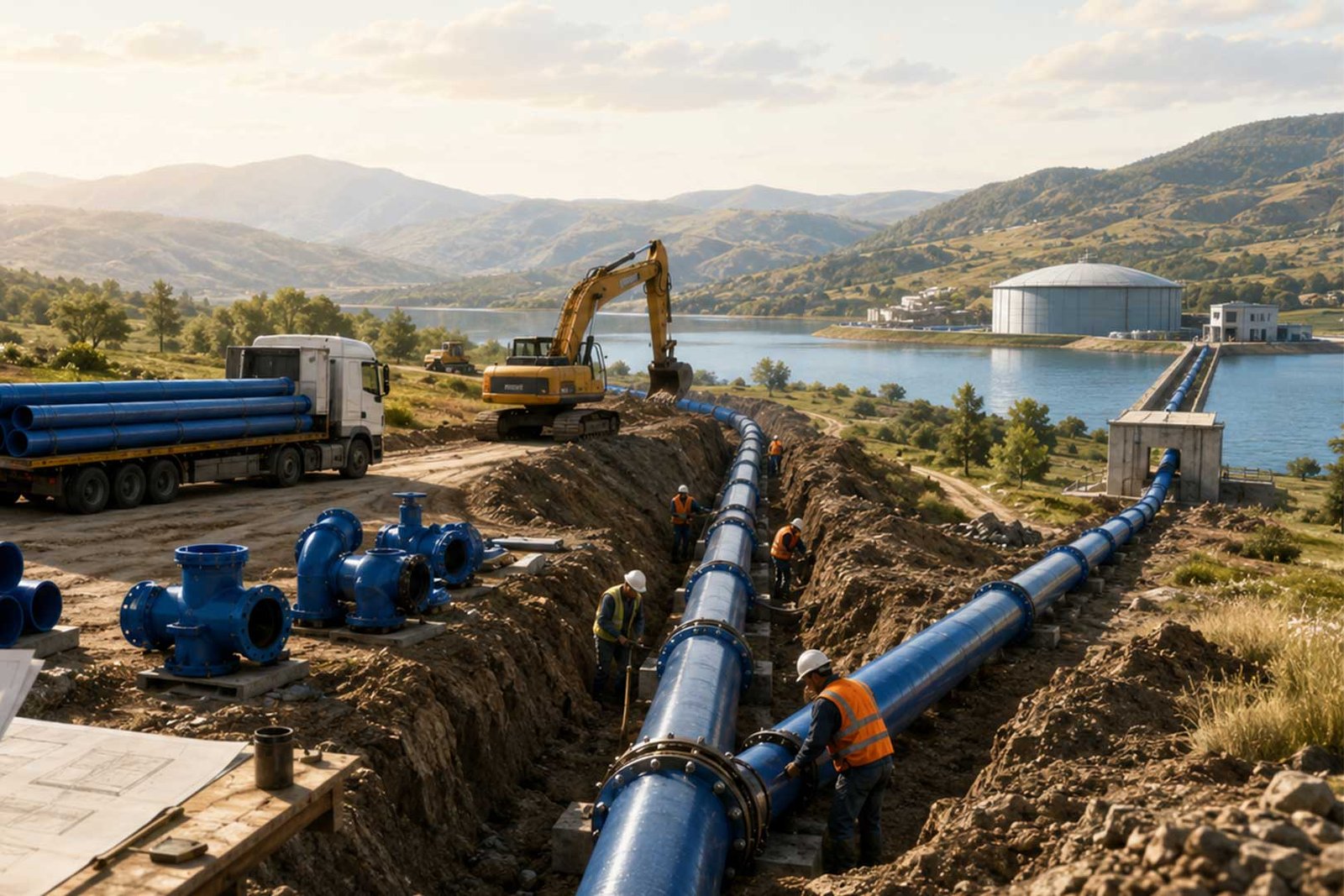
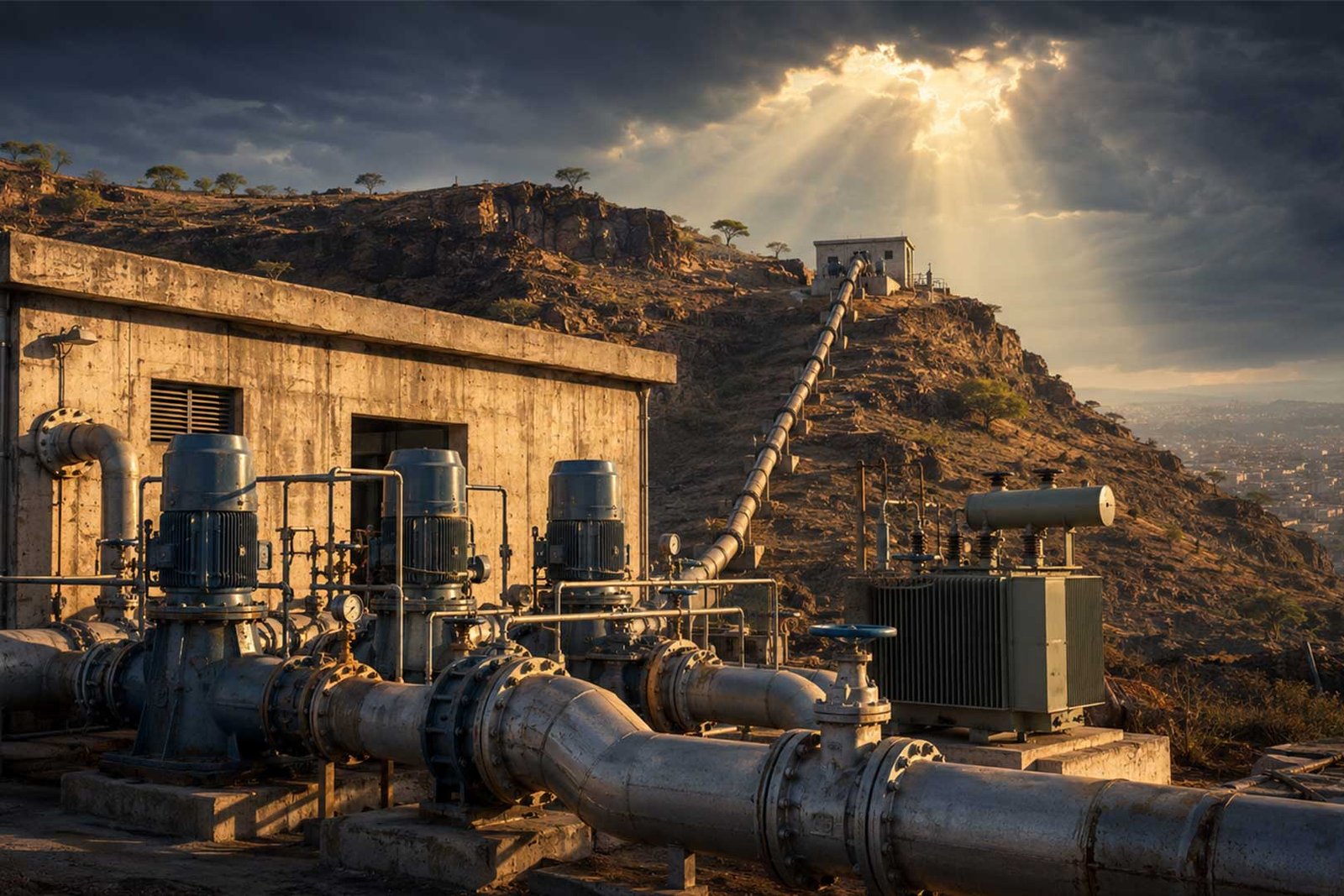
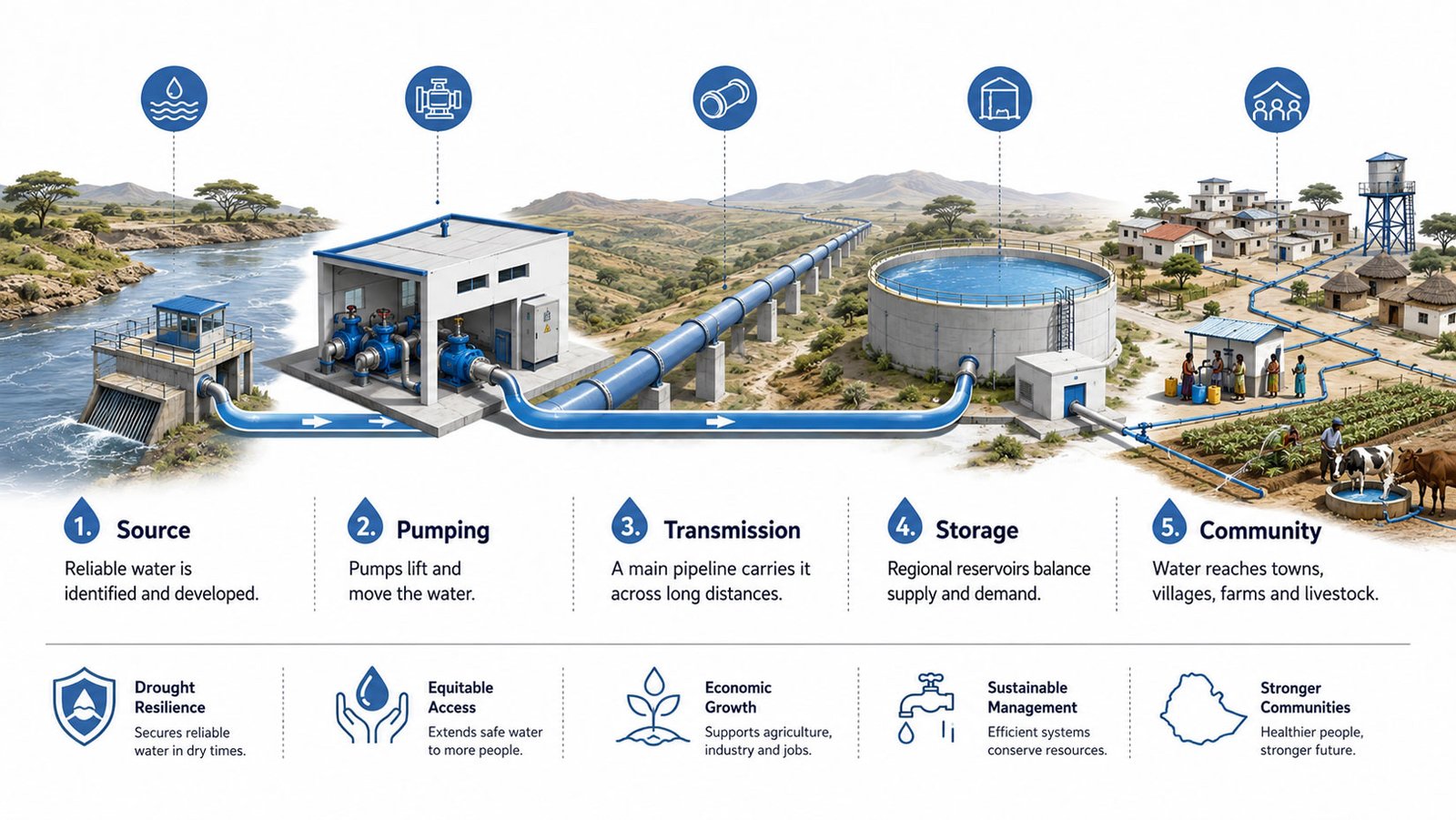
That is the challenge many projects face in Ethiopia. A reliable source can sit dozens of kilometers from a town or dryland community, so a borehole or reservoir alone is not enough. You also need pumps, transmission pipelines, storage, pressure control, dependable power and a local network that works with the wider system.
Grand LineCore looks at all these parts as one complete water system. Here is what that system needs and why each part matters:
Quick Takeaways
- Drought resilience often means moving water from distant sources to where people need it.
- WASH, groundwater and livelihood programs can include major pipelines, pumps and reservoirs.
- Source reliability, pressure, energy, distance and storage all shape the final system.
- Pipe materials should match the route, site conditions and long-term operating needs.
- Integrated EPC helps pumps, pipelines, storage, power and controls work as one system.
Why Drought Mitigation Frequently Requires Moving Water
Ethiopia has substantial water resources. The World Bank’s Ethiopia climate report talks about around 122 billion cubic meters of renewable surface water across 12 river basins.
However, access is uneven. Western basins produce much of the country’s surface water, while many fast-growing towns, industrial areas and dryland communities sit farther east. Around 27 million people already live where water scarcity affects daily life.
This mismatch means drought mitigation often depends on connecting a dependable source to a distant demand area. To understand why drought mitigation often becomes a transmission project, you first need to look at three things:
1. Reliable Sources Can Sit Far From the Demand Centre
A project often starts because the local source is seasonal, unreliable or too small. A better source can sit tens of kilometers away. The process usually looks like this:
- Local supply becomes unreliable or too limited.
- Studies identify a better source.
- The source sits far from demand.
- The project needs bulk conveyance.
- The team adds pumps, storage, pressure controls and network connections.
Once this pattern appears, the project has become a water-transfer system.
2. Source Development Alone Does Not Deliver Water Security
A borehole, river intake or reservoir only starts the process. The system must also move, store and deliver the water. That system can include:
- Production boreholes or surface-water intakes
- Wellfield collector and transmission mains
- Pump and booster stations
- Break-pressure, balance or command reservoirs
- Treatment where needed
- Reliable power and backup systems
- SCADA, instruments and flow controls
- Municipal or multi-village connections
Each part supports the next, so the source alone cannot provide reliable service.
3. Storage and Transmission Do Different Jobs
Transmission moves water between major points, while pumps help it cross distance and elevation. Storage then helps the utility manage demand, control pressure and maintain service during short interruptions.
The source provides water, transmission moves it and storage manages it. Resilience depends on the full chain.
What a Bulk Water Transmission System Includes
Bulk transmission and local distribution work together, but they do different jobs. That difference helps you read project documents accurately. The table below compares their purpose, typical distance, main connections, key assets and design requirements so you can quickly see the difference:
| Feature | Bulk transmission | Local distribution |
|---|---|---|
| Main purpose | Moves large water volumes | Delivers water to users |
| Typical distance | Medium or long routes | Local service areas |
| Main connections | Sources, plants and reservoirs | Reservoirs and consumers |
| Key assets | Pumps and pressure controls | Branches and service lines |
| Main design factors | Distance, elevation and energy | Routes and connection density |
Common Configurations in Ethiopia
A bulk water system can move water from a distant wellfield to a town, from a river to a treatment plant, or from one reservoir to several communities. It can also serve several villages, connect different cities or support cross-border supply.
The setup can change, but the goal stays the same: move reliable water to the people who need it.
How Ethiopian Drought-Resilience Programs Become Pipeline Projects
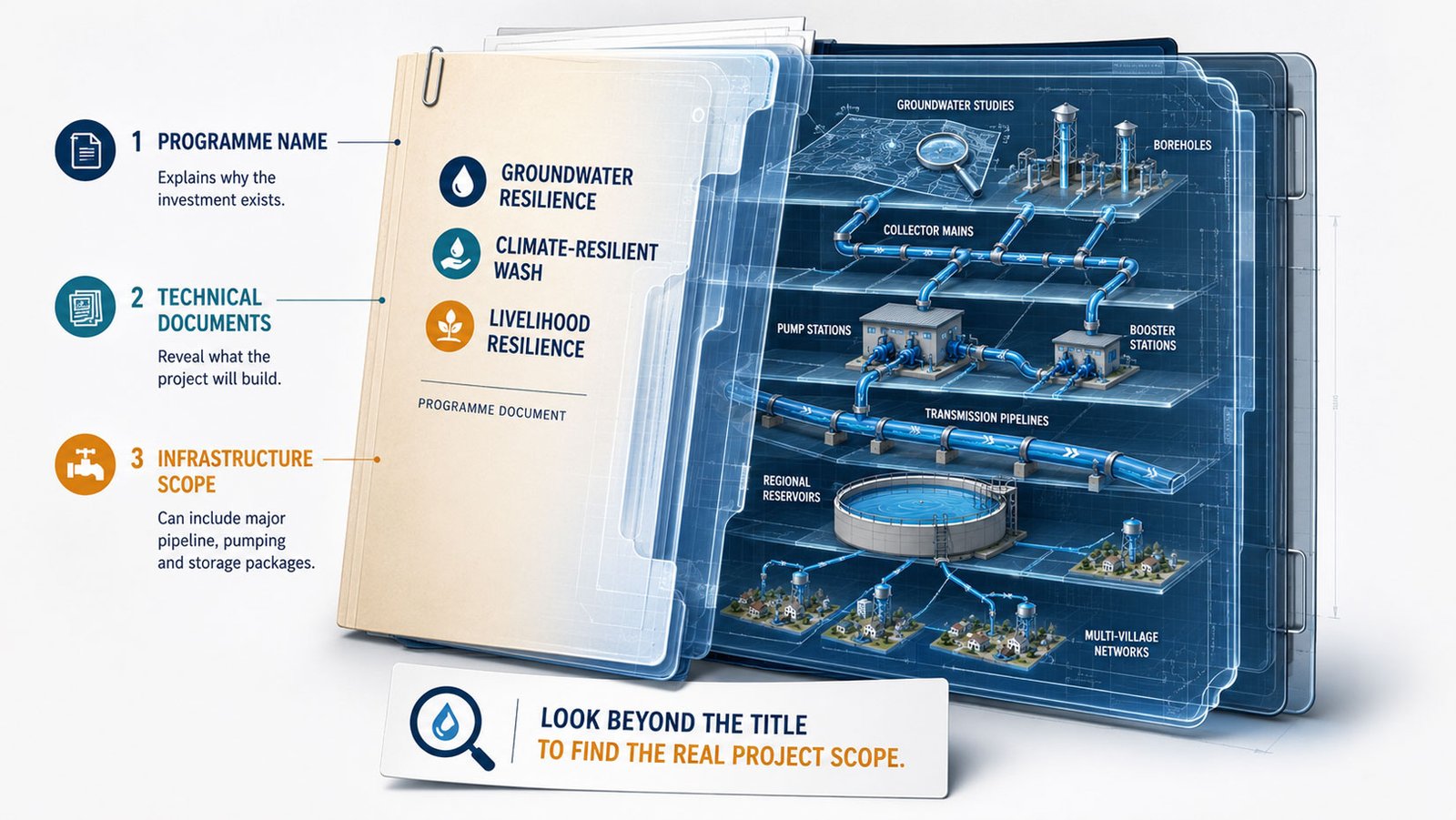
Not every infrastructure opportunity uses the word “pipeline” in its title. You may find these projects under wider programs about groundwater, climate resilience, WASH, livelihoods or regional development.
The program name tells you the main goal. The engineering documents show you what the project actually needs.
“Groundwater Resilience” Can Mean Wellfield-to-Community Conveyance
A groundwater program often starts with studies and test boreholes. Once the team finds a reliable source, the next stage can include production wells, collector pipes, pumps, long transmission lines, reservoirs and village networks.
So, when you see a groundwater study, look beyond the research. It can be the first step towards a much larger water system.
“Climate-Resilient WASH” Can Require Regional Infrastructure
A WASH project can include much more than local taps. If the water source is far away, seasonal or shared by several communities, the project may also need large pipelines, pumps and storage. The tap is only the final part of the system.
“Livelihood Resilience” Can Include Water for People and Livestock
In dryland areas, one system may need to serve homes, schools, health centers and livestock across many communities.
That can lead to long pipeline routes, large reservoirs and several supply lines, even when the program title focuses on livelihoods.
Key takeaway: The program title tells you why the project exists. The technical documents show you what will actually be built.
Feasibility studies, environmental reports, design TORs, procurement plans and funding approvals can help you spot these projects long before the final EPC tender appears.
Ethiopian Examples of Transmission-Led Drought Mitigation
These three examples show how resilience goals become transmission infrastructure.
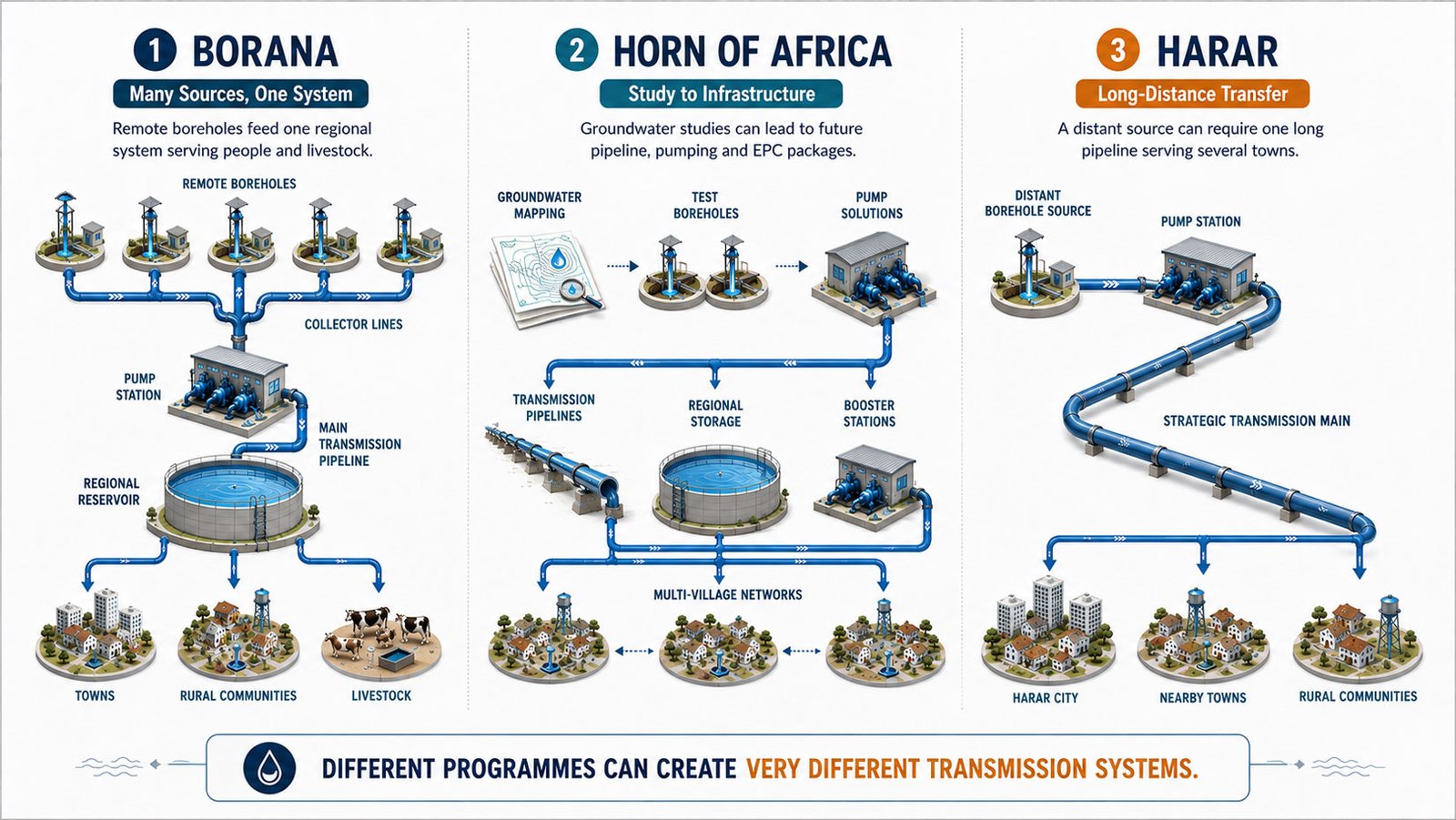
1. Borana: Remote Wellfields Connected to a Regional Supply System
The Borana program aims to improve drought resilience and support local livelihoods. According to the African Development Bank, the project depends on a large water-transmission system.
It includes nine boreholes at Galchet and two at Sarite. Pumps move the water through booster reservoirs and a main pipeline to a reservoir near Yabello. The two water sources are around 80 km and 60 km from the town. The system will serve 50 rural kebeles and 12 small towns, providing water for both people and livestock.
Infrastructure lesson: When nearby sources are not enough, communities need a reliable source farther away and a system that can bring the water to them.
2. Horn of Africa Groundwater for Resilience: Program Language Hiding Future Infrastructure
The Horn of Africa Groundwater for Resilience Project supports areas that face drought and water shortages. The project starts with groundwater studies, but the work does not end there.
The Ministry of Water and Energy’s project document outlines 15 groundwater studies across 116,172 km² and test boreholes in 67 priority woredas. It also includes rural water infrastructure in 55 woredas, such as village water systems, pipelines, renewable-powered pumps, observation wells and regional storage.
Infrastructure lesson: When you see a large groundwater program, look beyond the study stage. It can lead to future pipeline, pumping, storage, design and EPC work.
3. Harar: Long-Distance Conveyance as an Established Ethiopian Model
The Harar project shows that Ethiopia already uses long-distance pipelines to bring water to towns.
The system included four boreholes and a 75 km, DN 600 mm pipeline that carried water from a distant source to Harar and nearby towns, as shown in the African Development Bank project completion report.
Infrastructure lesson: When a reliable source is far from the town, the project will often need a major transmission pipeline.
How to Recognize Hidden Bulk Water Transmission Opportunities
You will not always find these opportunities under a clear title like “pipeline tender.” To spot them earlier, start with the wider program and then look for the clues inside the project documents. The following signs can help you recognize when a project is likely to include major transmission infrastructure:
Look Beyond the Project Title
The project title does not always tell you what the work will involve. A program can focus on drought, livelihoods or water security while still requiring long pipelines, pumping stations and regional reservoirs. Titles worth checking include:
- Drought-resilience program
- Groundwater-resilience project
- Climate-resilient WASH
- Regional water-supply improvement
- Water-security program
- Dryland livelihood development
- Multi-village water-supply scheme
- Urban utility improvement
- Integrated refugee-host water supply
- Regional development corridor
When you see one of these titles, open the technical documents before deciding what the project includes. A broad program name can hide a major bulk water transmission system.
Search for Transmission Indicators
Once you open the documents, look for words that describe how water will move from the source to the demand area. Some terms give you a much stronger signal than others.
Very strong indicators
These terms directly point to bulk water transmission:
- Bulk water supply
- Transmission main
- Trunk main
- Main transmission line
- Regional conveyance
- Inter-city pipeline
- Wellfield backbone
- Rising main
- Source-to-town transfer
Strong supporting indicators
These terms often appear alongside a transmission system:
- Production wellfield
- Wellfield collector main
- Pump station
- Booster station
- Main reservoir
- Command reservoir
- Balancing reservoir
- Break-pressure tank
- Multi-village system
- Long-distance pumping
- Several towns served from one source
Contextual indicators
These terms do not confirm a pipeline on their own, but they can show why one is needed:
- Source-option analysis
- Water-demand deficit
- Limited local-source yield
- Deep groundwater development
- High static lift
- Regional service area
- Drought-prone woredas
- Renewable-powered pumping
- Route survey or pipeline right-of-way
- Treatment, transmission, storage and distribution assessment
Do not judge the project from one phrase alone. Look at how the terms connect. If the same document mentions a remote wellfield, booster station and regional reservoir, you are probably looking at a much larger water-transfer system than the project title suggests.
Where Early Opportunities Usually Appear
The strongest signals often appear before the final tender. The table below shows which documents to check and what they can reveal.
| Document | Key details to check | What it reveals |
|---|---|---|
| Feasibility study | Demand, sources, routes, pumps, storage and early cost | Likely system size |
| Detailed engineering TOR | Hydraulics, surge, surveys, materials and tender scope | Technical requirements |
| Environmental and social files | Land, crossings, camps, reservoirs and pump sites | Route and project footprint |
| IFI financing and procurement files | Approvals, plans, EOIs and work packages | Funding and contract structure |
| Utility and government plans | Master plans, growth, groundwater and regional strategies | Early project demand |
The Ministry of Water and Energy terms of reference links demand gaps and source analysis with treatment, transmission, storage and distribution.
Environmental files can reveal camps, borrow areas and community effects. Procurement files show notices, advance contracts and multi-phase programs, while regional plans point to corridors and climate-resilient water-safety needs.
Reviewing these sources together reveals the opportunity before the main decisions are fixed.
The Engineering Decisions That Determine Long-Term Resilience
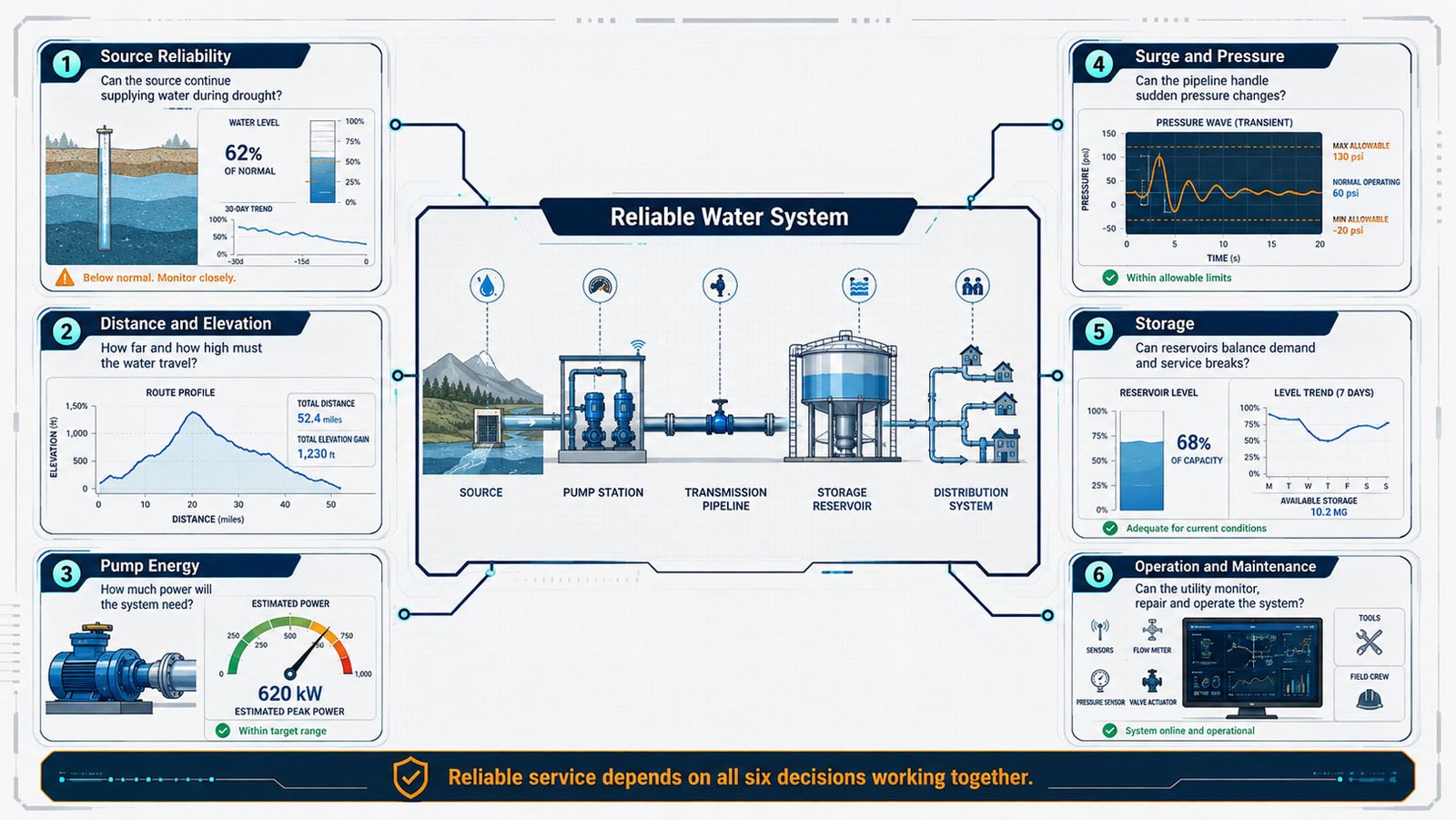
Once you find an opportunity, ask whether the full system can stay reliable during drought. Here is what you need to check:
Source Reliability
Start with the source. Check whether it can supply water through a long drought, its sustainable yield, whether the project uses one source or several, whether treatment is needed and how abstraction could affect communities or the environment.
A wrong estimate can leave the system too large, underused or unable to meet demand.
Distance and Elevation
Next, look at the route. Distance and elevation affect system design, operation, pressure, pump energy, pressure zones and pipe classes.
An uneven route can require booster stations, break-pressure tanks or several pressure classes. It is not just a line on a map; it shapes the whole system.
Pump Energy and Power Reliability
Pumps can create a major lifecycle cost, and water stops when power fails. Pump choice, operating strategy, backup power and renewable-energy options therefore need early attention.
Surge and Pressure Management
Pump starts, stops and power failures can cause sudden pressure changes. A surge review helps you choose the right pipe class, joints, valves, air-control devices and operating procedures.
Review the full pressure range before selecting a pipe material.
Reservoir and Storage Strategy
Storage helps manage pressure and demand. Collector reservoirs gather source water, balance reservoirs respond to demand, service reservoirs supply local networks and command reservoirs support wider areas. Break-pressure tanks control pressure, while emergency storage covers service breaks.
Each asset needs a clear role in the hydraulic design.
Utility Operation and Maintenance Capacity
A strong design must match the utility that will operate it. Check operator skills, spare-parts access, pump maintenance, leak detection, SCADA, power costs and remote repair response.
Without proper maintenance and monitoring, reliable service becomes difficult.
Pipe-Material Selection for Bulk Water Transmission
No pipe suits every project. Compare pressure, surge, diameter, corrosion, terrain, installation quality, utility capacity and lifecycle cost.
Why Lifecycle Performance Matters
The lowest purchase price does not always mean the lowest total cost. Compare transport, installation, pump energy, corrosion protection, maintenance, leakage, downtime, repair access, service life and replacement.
Ask which system makes the most sense over the full life of the project.
Where GRP Can Align With Transmission Requirements
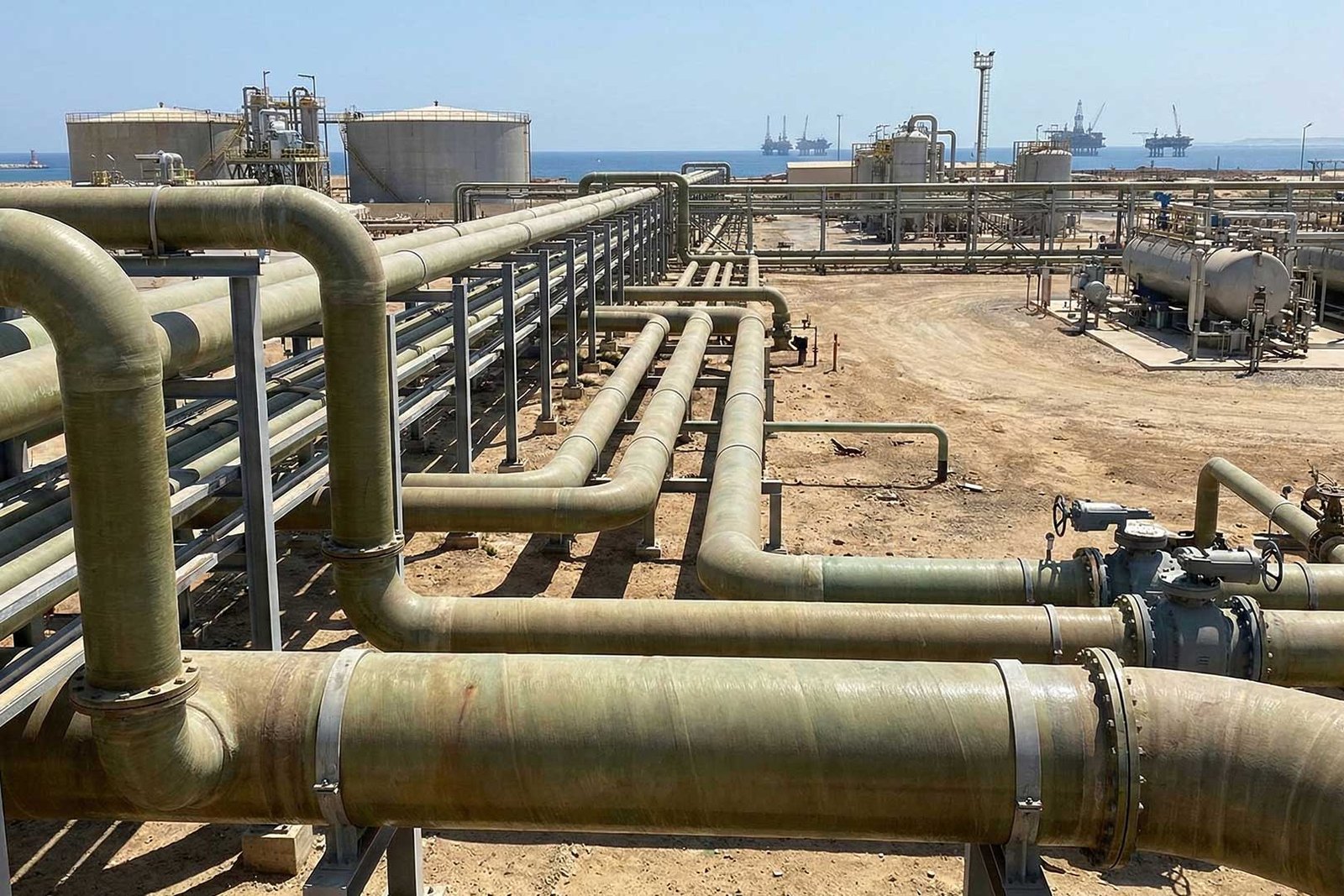
GRP can suit large buried pipelines, long routes, corrosive soil or water, energy-sensitive pumps, remote locations, aggressive service and systems that need a smooth internal surface.
Its corrosion resistance and hydraulic smoothness can support long-term goals when the project conditions suit it.
GRP Design and Execution Requirements
GRP still needs the right pressure and stiffness class, surge analysis, controlled handling, proper trench and bedding work, careful joints, qualified installers, field QA/QC, hydrotests and correct start-up.
It performs well only when the team gets both the design and site work right.
Where Other Materials Can Be More Appropriate
Other materials can fit some conditions better:
- Ductile iron: Urban networks and high mechanical demands
- Steel: Very high pressure, exposed sections and difficult structures
- HDPE: Flexible, smaller-diameter or selected lower-pressure uses
- Concrete or other systems: Gravity, drainage and special needs
Compare the options fairly. Route and operating conditions should guide the choice, not habit or the lowest initial price.
Why Drought-Resilient Systems Need Integrated EPC Delivery
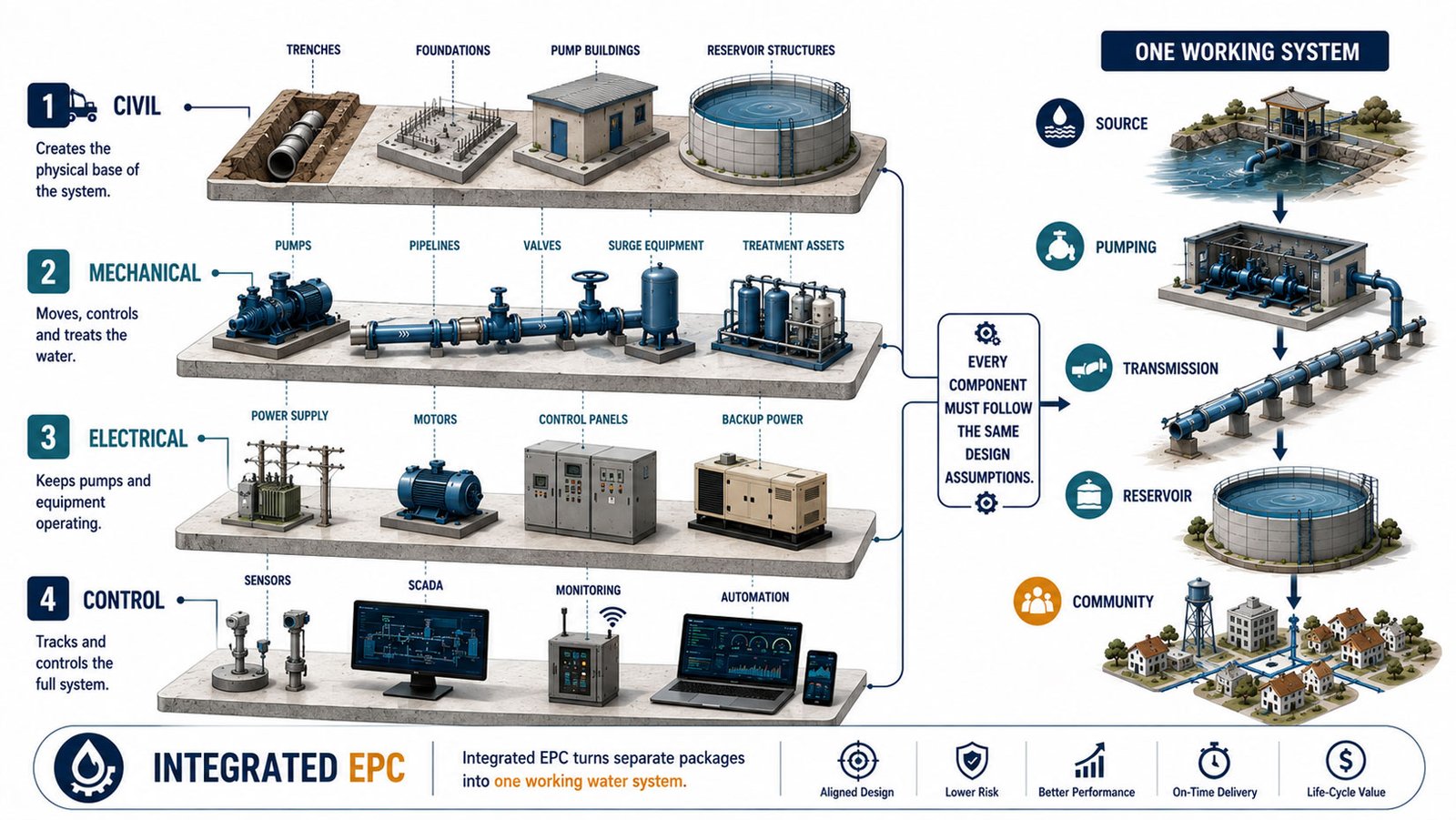
Pipe selection is only one part of delivery. To build a reliable system, you also need to connect the civil, mechanical, electrical and control work. The following shows why these parts must be planned and delivered together:
The Pipeline Cannot Be Separated From the Wider System
Boreholes or intake works must match the pumps. Pumps must match pipeline pressure, and reservoir levels must match the hydraulic model.
Power, valves, surge protection, treatment, instruments, SCADA and the local network must follow the same design assumptions. Together, they form one system.
Fragmented Delivery Increases Interface Risk
When teams work separately, source yield, pumps, pipeline pressure and reservoir levels can conflict. Weak power, civil delays, separate testing and unclear responsibility add more risk. Each contractor can finish its package while the full system still fails.
EPC Should Deliver an Operating Water System
Integrated delivery connects engineering, hydraulic and surge analysis, materials, equipment, procurement, logistics, construction, QA/QC, testing, commissioning, training, handover and lifecycle support.
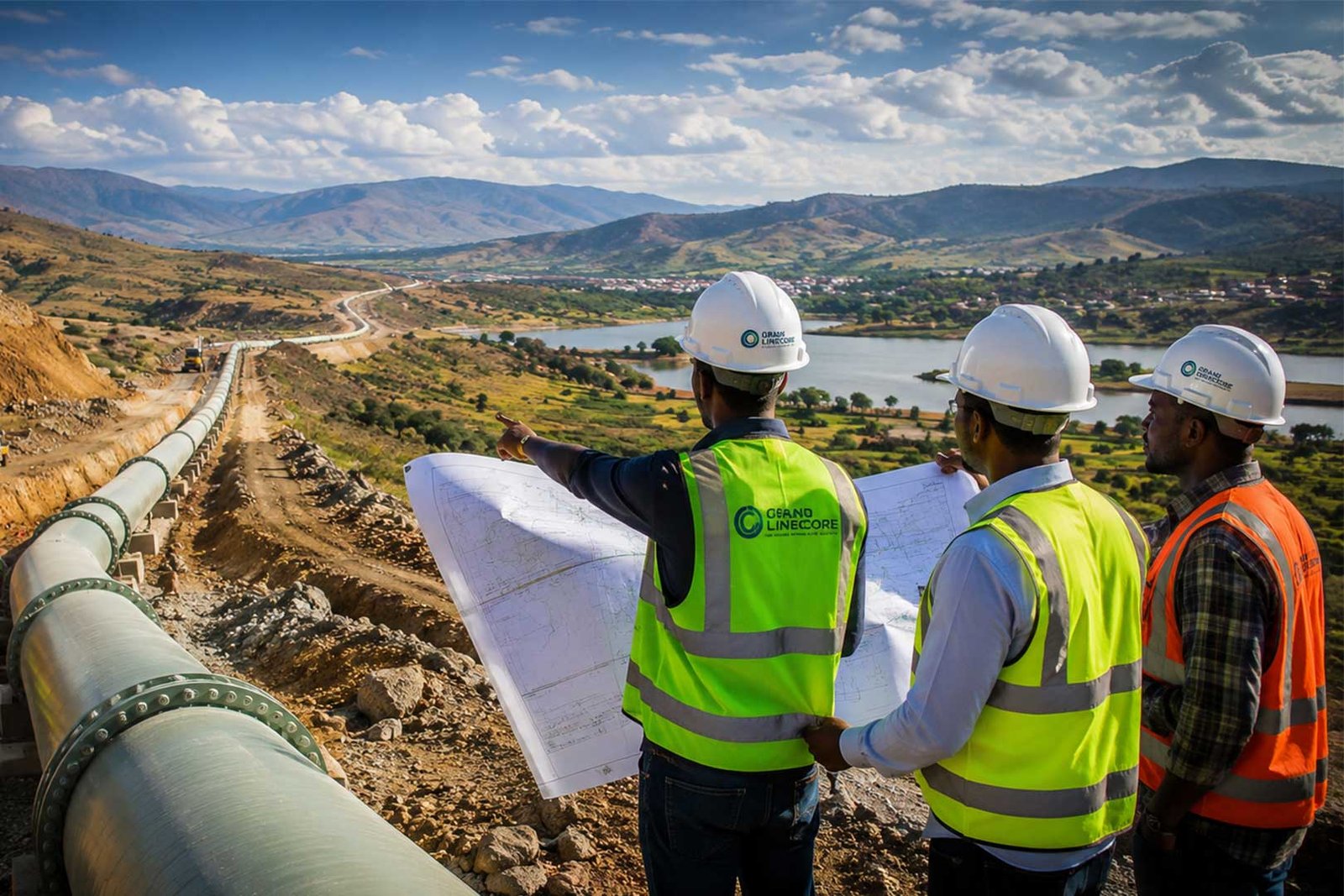
Grand LineCore approaches bulk water transmission as an integrated infrastructure system, combining composite pipeline capability with EPC coordination across pumping, storage, hydraulic control, installation, QA/QC and commissioning. The goal is not just to install a pipeline. It is to deliver a system the utility can operate.
Financing and Stakeholders Behind Ethiopia’s Water-Transmission Pipeline
To understand what can move a water project forward, or slow it down, start by looking at the groups that shape its funding, design and delivery:
- Government institutions: They set priorities, approve plans and support delivery.
- IFIs and development partners: They influence funding, rules, safeguards and timelines.
- Consultants: They help choose the source, route, materials and project structure.
- EPC contractors and local partners: They handle construction, logistics, labor and local needs.
When you review a project, do not look at price alone. You also need a practical local plan.
Key Risks in Long-Distance Drought-Resilience Systems
One weakness can affect the whole system. The table below shows the main risks and effects.
| Risk | Immediate effect | Wider project impact |
|---|---|---|
| Unverified source yield | Wrong system size | Shortages or underuse |
| Unreliable power | Pumps stop | Service interruptions |
| Weak surge design | Pressure shocks | Equipment damage |
| Inadequate storage | Limited water buffer | Rapid service loss |
| Poor installation | Leaks or joint faults | Early repair needs |
| Weak utility capacity | Poor operation and maintenance | Asset decline |
| Procurement delays | Late equipment and works | Higher costs |
| Foreign-exchange constraints | Import difficulties | Equipment gaps |
| Remote logistics | Slow site access | Schedule delays |
| Fragmented contracts | Unclear responsibility | Interface failures |
| Weak lifecycle planning | Focus on low initial cost | Higher operating costs |
| Poor coordination | Land or permit problems | Delayed delivery |
Construction alone does not make the system drought-resilient. It must stay reliable, affordable and practical to operate, maintain and finance during drought.
What Future Drought-Mitigation Investment Is Likely to Require
To see what future projects may need, look at the main changes below:
More Regional Rather Than Isolated Water Systems
Future plans will likely use shared wellfields, multi-town supply, regional reservoirs, connected utilities, strategic backup sources and longer transmission routes.
One secure source can support several demand areas.
Greater Integration of Groundwater, Storage and Conveyance
Groundwater studies can lead to source development, managed recharge where suitable, pumped transfer from remote aquifers, regional storage, regional water balance and controls that protect sustainable yield.
Source, storage and transmission should form one plan.
Increased Emphasis on Lifecycle Performance
Project teams will likely focus more on pump energy, corrosion, maintenance capacity, drought reliability, operator skills, digital controls and asset-management plans.
The cheapest construction option does not always give you the lowest operating cost.
Earlier Engagement During Project Preparation
You can often influence a project during master planning, source studies, feasibility, environmental and social assessment, design and procurement planning.
At these stages, you can still compare routes, pumps, pressure classes, materials and delivery models. By the final tender, the team has often fixed the key decisions.
Conclusion: Drought Resilience Depends on Connecting Water to Demand
Ethiopia’s drought challenge is not only finding water. It is also moving it to the people who need it. Bulk transmission can connect reliable sources to towns, rural communities and economic areas, but pipelines alone are not enough. Pumps, storage, pressure control, reliable power and capable operators must all work together.
Many opportunities sit inside groundwater, WASH, livelihood and drought-resilience programs, so technical documents often reveal the real project scope. The right materials and an integrated EPC approach can reduce risk and help deliver complete, reliable water systems.
Building Integrated Bulk Water Transmission Systems in Ethiopia and Africa
Bring Grand LineCore in early, while the key choices are still open. We can support you with feasibility, early design, EPC planning and material selection. As a Total Infrastructure Solution Provider, we connect technical advice with GRP and composite pipe systems, procurement, installation, QA/QC, testing and commissioning.
We help you compare the best options for your route, pressure, soil, water quality and long-term needs before the final choices are fixed.
about
The Author

Farshid Tavakoli is a seasoned professional in engineering and international trade. Holding degrees in Electrical Engineering, Mechatronics, and a Doctorate in Business Administration (DBA) from the University of Lyon, he also has a strong background in industrial automation and production line technologies.
For over 17 years, he has led an international trading company, gaining deep expertise in commercial solutions tailored to industrial needs. With more than 8 years of active involvement in infrastructure development, he specializes in the supply of electromechanical equipment for water and wastewater treatment plants and transfer projects.
Together with comapny expert team, he now provides consultancy and integrated solutions for sourcing and implementing complex infrastructure projects across the region.