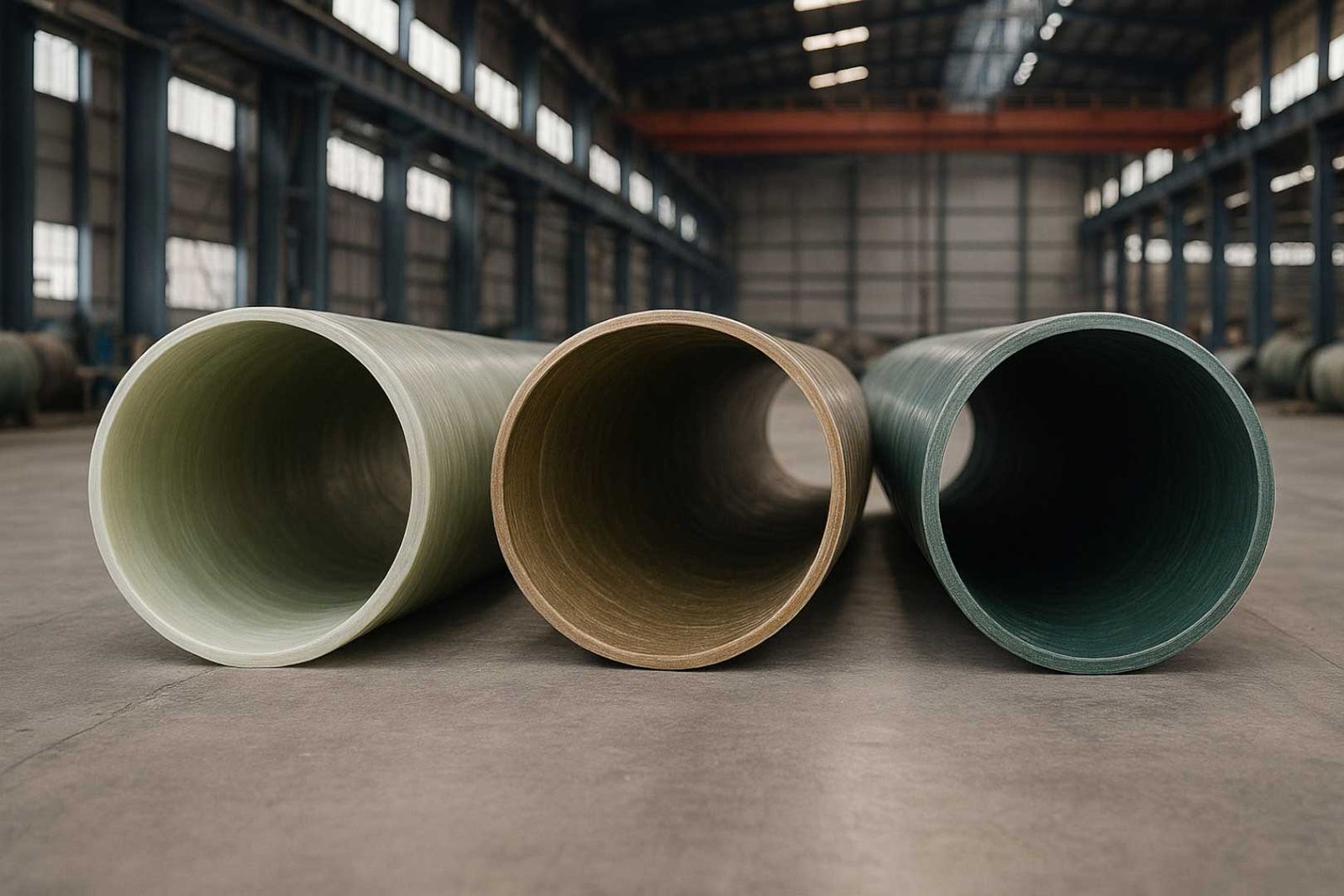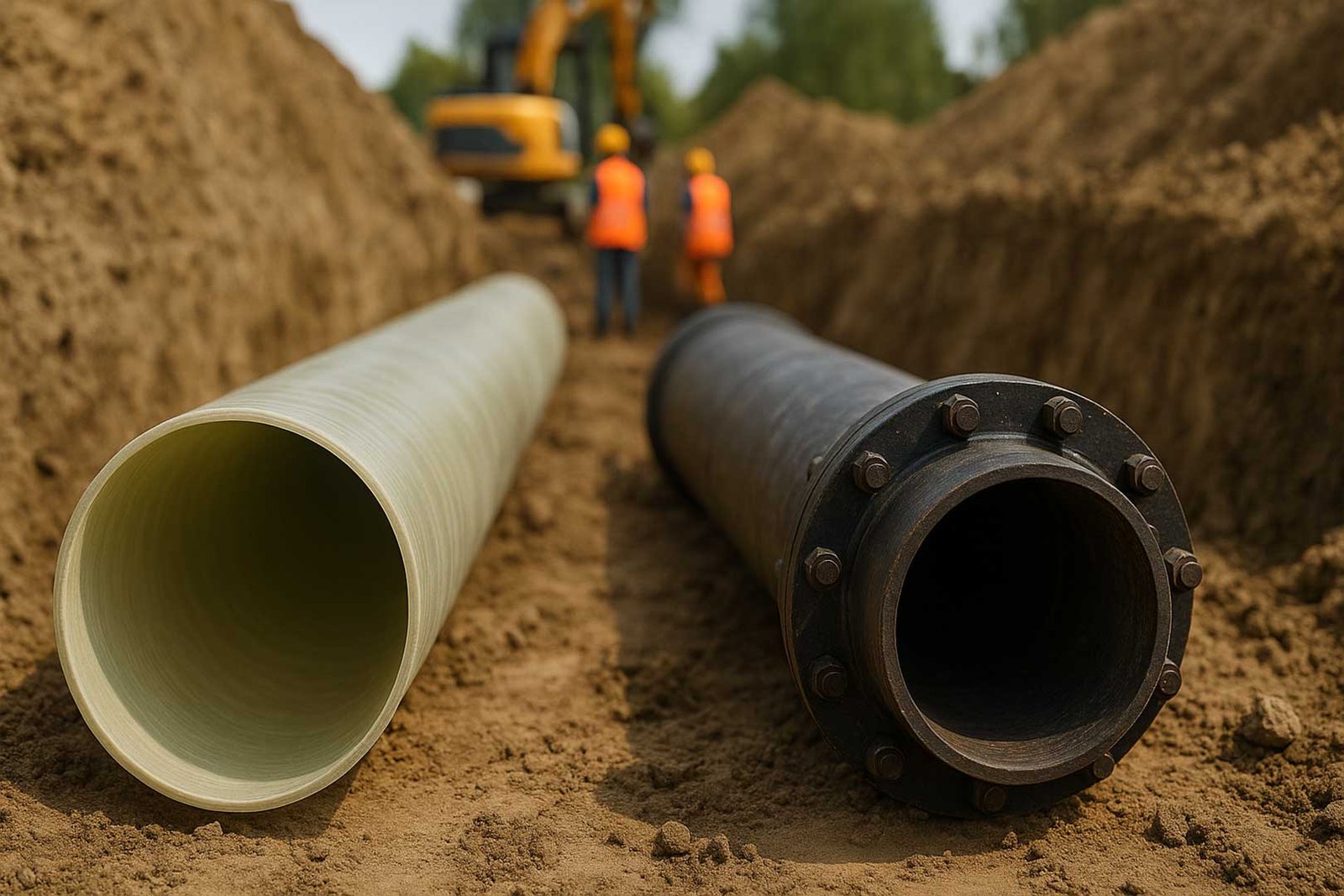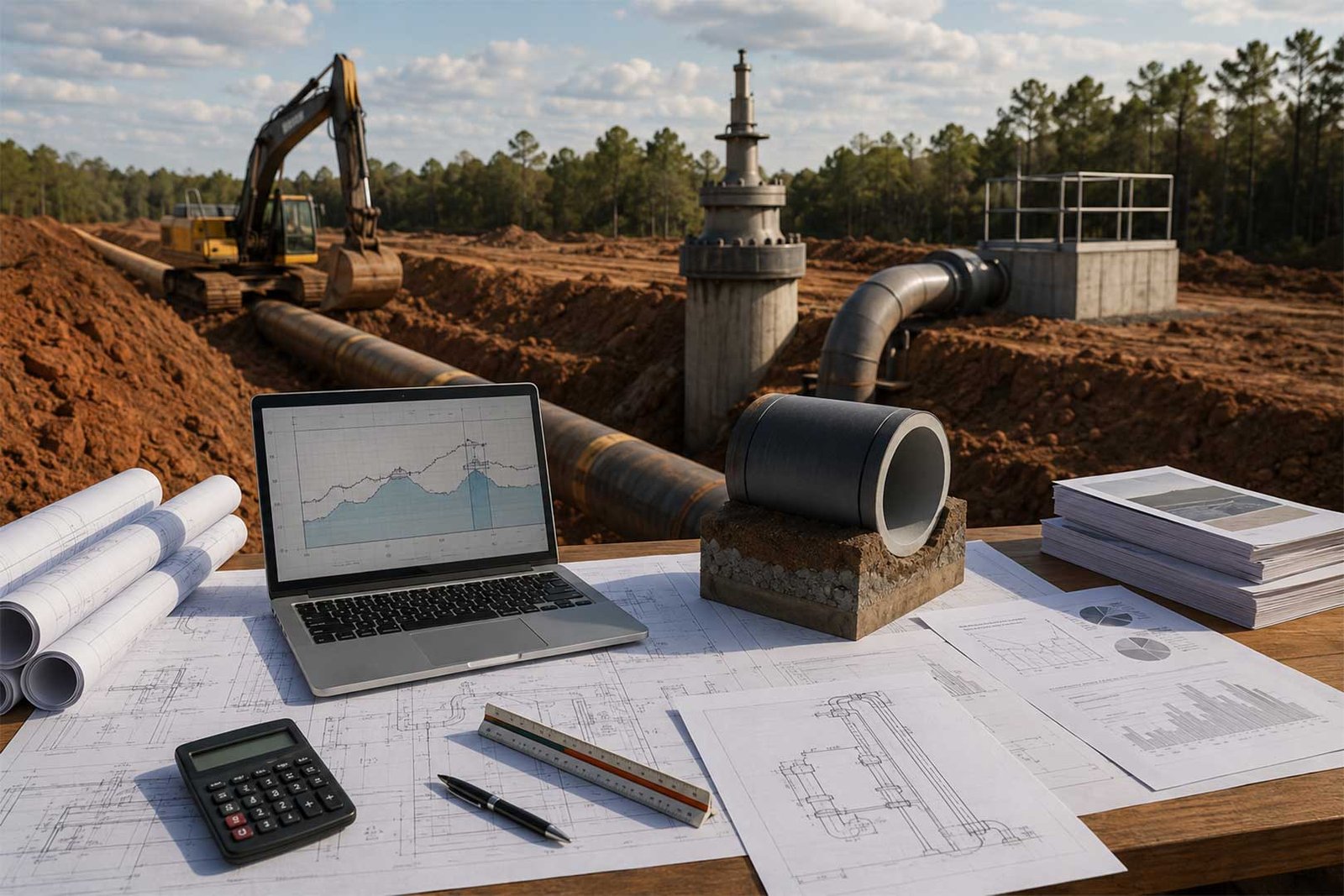
Many pipeline projects commit to major design decisions before the team has fully compared the alternatives. Pipe material, diameter, pressure class, route alignment, and installation method can all affect cost, schedule, and long-term performance.
A pipeline value engineering review helps you challenge those decisions before they become expensive to change. In this article, we explain when a VE workshop should happen, who should participate, how options are evaluated, and what deliverables should come out of the process.
In this article, the word “workshop” means a structured project review meeting, not a training session or seminar.
Why Pipeline Value Engineering Matters
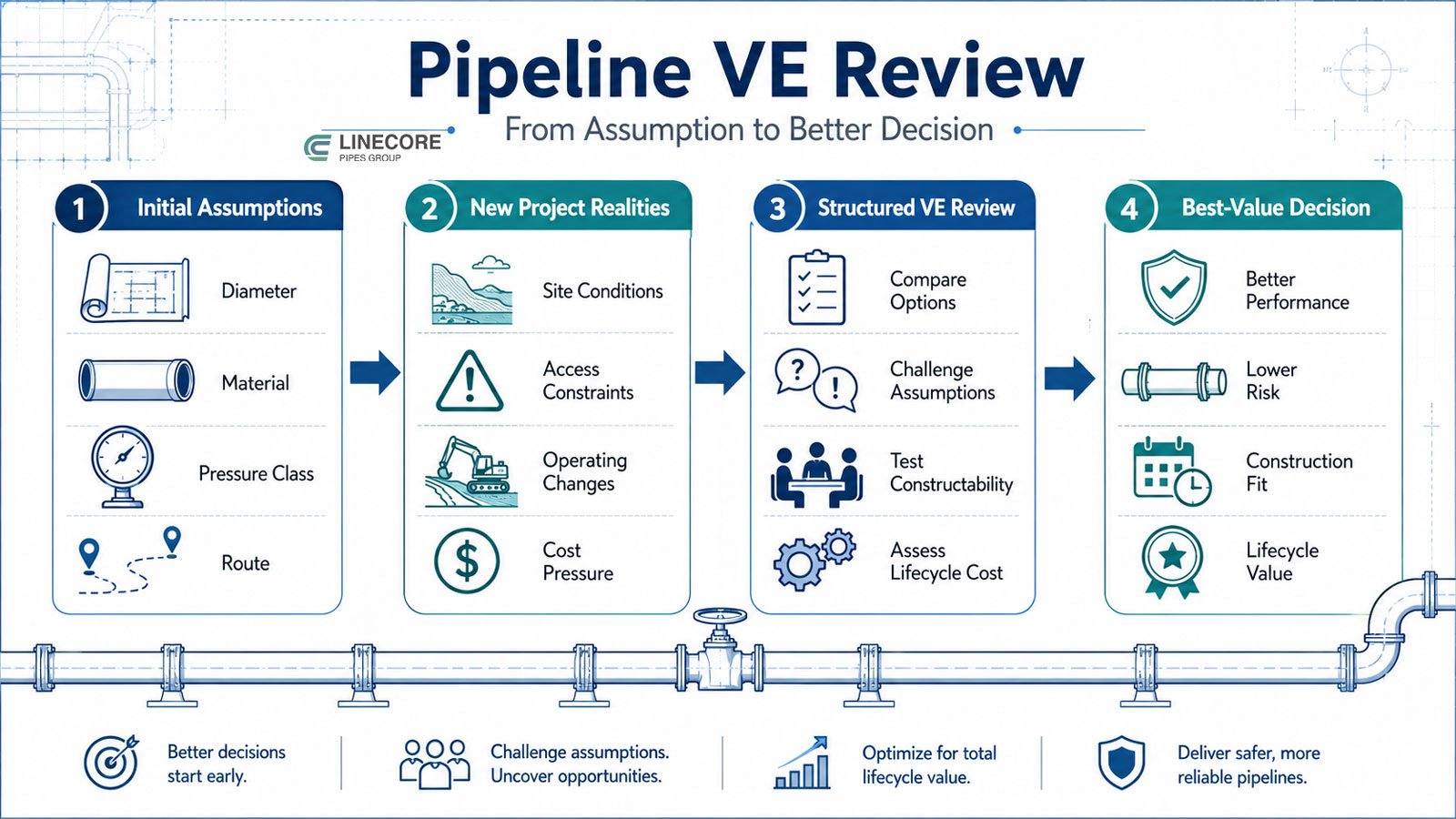
Every pipeline project starts with assumptions. The proposed diameter looks reasonable. The selected pipe material meets the specification. The pressure class appears to provide enough safety margin. On paper, the design may look complete.
What Happens Next?
As the project develops, new details appear. There are multiple issues that may be shown in the next. Site conditions may differ from early surveys. Construction teams may identify access constraints. Operating requirements may change. Procurement teams may discover cost pressures that were not visible during concept design.
Instead of accepting the first solution, the project team takes a structured look at the available options and asks practical questions:
- Is the selected diameter range really necessary?
- Is the pressure class based on actual operating conditions?
- Could another material improve constructability?
- Are there opportunities to reduce lifecycle cost without increasing risk?
The goal is not simply to reduce cost. It is to find the option that delivers the best overall value through performance, constructability, schedule, approval confidence, and long-term operation.
Engineering Consideration
If your team cannot clearly explain why a particular pipe material, diameter, or pressure class was selected, a value engineering review may reveal opportunities that are still worth exploring.
Real-World Example: Melbourne Water North–South Pipeline (Australia)
Big pipeline projects are rarely decided in one simple step. During the development of the Melbourne Water North–South Pipeline, the team had to weigh up route options, environmental limits, construction constraints, and long-term water supply needs before locking in the final direction.
What stands out is not a single technical decision, but the process of working through multiple options before anything became fixed on paper or in procurement.
Why it matters: The strongest pipeline outcomes usually come from slowing down the decision moment just enough to compare options properly, before the project becomes difficult to change later.
What Is Pipeline Value Engineering?
When people hear “value engineering,” they often assume it means cutting costs.
That is not really what it is.
In pipeline projects, value engineering is about checking whether the design still makes sense before it becomes too late to change it easily. You are not asking “what is cheaper?” You are asking “what gives the best overall outcome for this project?”
That Difference Matters
A cheaper option can still increase risk if it leads to higher pumping energy, difficult installation, approval delays, or higher maintenance later. So the workshop is not about pushing costs down in one place. It is about understanding where cost and risk actually sit across the full lifecycle.
A well-rounded pipeline VE review usually looks at things like:
- Can the diameter be adjusted without affecting required flow?
- Is the pressure class aligned with real operating conditions, including surge?
- Is the selected pipe material suitable for soil, water type, and installation method?
- Are we overdesigning in some areas just to “be safe” without justification?
In most real projects, the value is not in changing everything. It is in identifying where a small adjustment early can prevent a large cost or risk later.
Important Point: Value engineering is only useful when it happens before decisions are locked into procurement and manufacturing. Once pipes are ordered or design is frozen, the flexibility drops quickly.
So in practice, this is less about redesigning and more about pressure-testing the design while you still have options.
When Should a Pipeline VE Workshop Be Held?
Timing is where most pipeline value engineering either works well or becomes useless.
If the workshop happens too late, the design is already fixed, procurement is underway, and changing anything means delay and cost. At that point, value engineering becomes a review exercise, not a decision tool.
The Best Timing
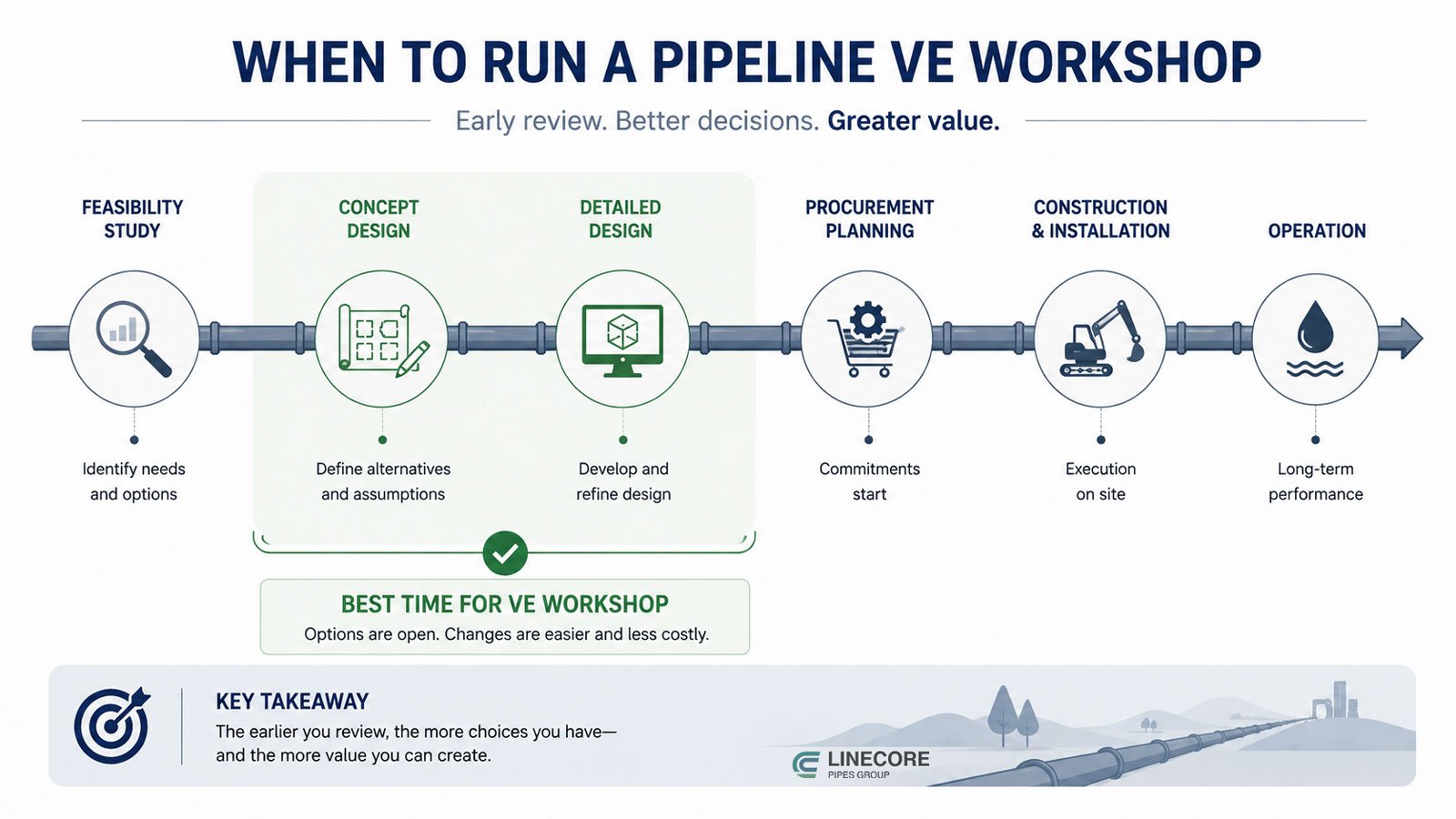
The best time is earlier than most teams expect. Ideally, you hold a VE workshop when the project is still flexible, before final design approval and before long-lead items like pipe manufacturing have started. In practice, the right moment is usually:
- During late feasibility or concept design
- Before final IFC (Issued for Construction) drawings
- Before material procurement is committed
- Before hydraulic and alignment assumptions are locked in
Warning Signs that You Need a VE Workshop
In many projects, the need for value engineering becomes obvious through pressure, not planning:
- Unexplained cost growth
- Unresolved material selection
- High pumping costs
- Complex route conditions
- Misaligned project teams
A simple rule helps you here: if the design is already difficult to explain in one consistent story, it is probably not ready to freeze.
Practical Tip: One of the most common mistakes is waiting for 100% design maturity before reviewing value. In pipeline work, that is often too late. A VE workshop works best when the design is “good enough to discuss, but not yet fixed to build.”
Most Important Decisions a Pipeline VE Workshop Can Influence
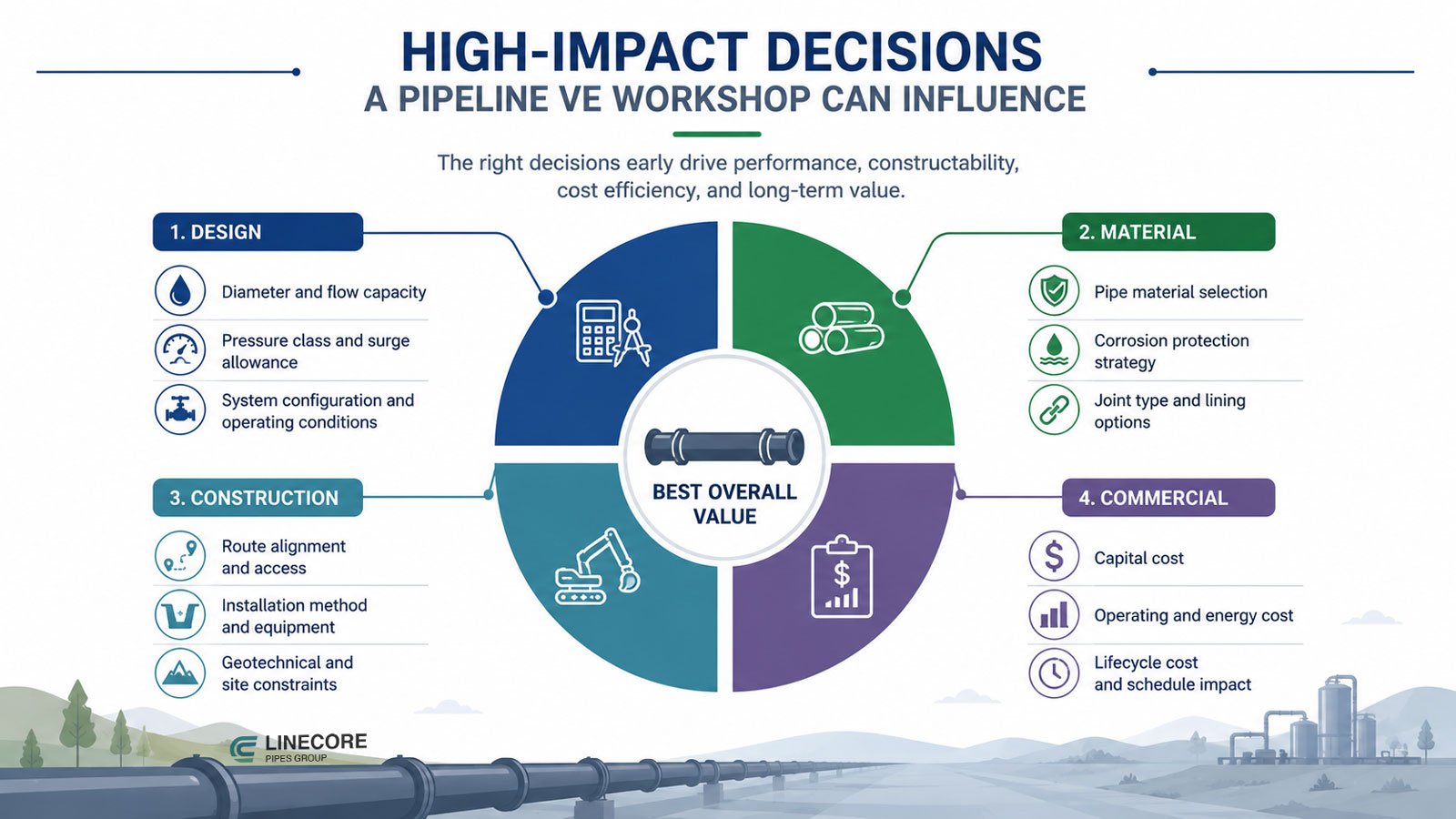
A pipeline value engineering workshop is not about reviewing everything in the project. It is about focusing on the decisions that lock in cost, risk, and constructability for the entire lifecycle of the pipeline.
Once these decisions are fixed, everything downstream becomes harder to change. That is why the workshop focuses on a small number of high-impact areas.
1. Design Decisions
This is usually where the biggest value sits. You are not just checking drawings. You are checking whether the basic engineering choices still make sense. Typical decisions include:
- Route alignment
- Pipe diameter
- Pressure class
- Hydraulic assumptions
- Burial depth
- Valve chamber locations
Even a small adjustment here can affect excavation quantities, pumping energy, approvals, and overall construction complexity.
2. Material Decisions
This is where material choice becomes a system decision, not just procurement. The workshop compares alternative pipe systems such as GRP, steel, ductile iron, or HDPE depending on project conditions.
What Properties to Compare?
You are trying to understand what really fits the environment, not just what fits the specification. Key evaluation points include:
- Corrosion exposure and protection requirements
- Jointing system behavior
- Soil type and water characteristics
- Required standards and approvals
A major point is that material choice is not only about structural capacity. It directly affects installation speed, logistics, and long-term maintenance effort.
3. Construction Decisions
Even a good design can fail if it cannot be built efficiently on site. Here the focus is on how the pipeline will actually be installed:
- Trenching Method
- Bedding Approach
- Jointing Method
- Expected Installation Productivity
You also look at real site constraints such as access roads, storage space, lifting equipment availability, and installation sequencing.
4. Commercial Decisions
This is where many misunderstandings happen. Instead of looking only at pipe supply cost, the workshop considers installed cost and lifecycle impact. The discussion usually includes installation productivity, logistics constraints, energy cost, and maintenance exposure.
As noted by NIST Handbook 135, lifecycle cost analysis evaluates ownership cost over the full service life rather than focusing only on initial capital expenditure.
A simple way to frame this stage is: If a decision affects how the pipeline is built, installed, or operated over time, it belongs in the value engineering discussion.
What Information Must Be Available Before the Workshop?
A pipeline value engineering workshop only works when everyone is looking at the same facts. If inputs are incomplete or outdated, the discussion shifts from engineering decisions to opinions and that is where projects start to lose control.
The table below helps you quickly see what information is required and what the workshop team should verify before making any decision.
| Input Area | Confirm | Key Metric | Why It Matters |
|---|---|---|---|
| Project performance | Flow range | Min / normal / peak flow | Sets hydraulic size and capacity |
| Design pressure | Pressure, bar | Defines pipe class and safety margin | |
| Design life | 25–100 years | Guides material and lifecycle choices | |
| Alignment and route | Route length/profile | Length, km | Drives cost and head loss |
| Elevation range | Min/max elevation, m | Affects pressure zones and pumping | |
| Crossings | Number/type | Impacts method, risk, and cost | |
| Hydraulic operation | Flow scenarios | Normal/peak flow | Checks real-demand performance |
| Head conditions | HGL, m | Supports pump and energy design | |
| Surge pressure | Surge, bar | Controls pressure class and protection | |
| Site conditions | Soil capacity | kPa | Drives structural/stiffness design |
| Groundwater | Depth, m | Affects buoyancy and trench stability | |
| Trench depth | Depth, m | Impacts installation method and cost | |
| Cost baseline | Installed cost | CAPEX/km | Enables fair option comparison |
| Productivity | m/day or joints/day | Impacts schedule and labor cost | |
| Energy cost | $/kWh | Drives lifecycle cost comparison |
A practical way to think about this is simple. If the data going into the workshop is inconsistent, the decisions coming out of it will also be inconsistent.
Tip: Before any VE workshop, ask one question. Is this the latest verified version of the design basis or just the most recent version available. That single check often separates useful workshops from repetitive ones.
Who Should Attend the Pipeline VE Workshop?
A pipeline value engineering workshop only works when the right people are in the room at the same time. If key decision owners are missing, the workshop becomes a discussion that will be repeated later, usually with cost and time impact.
The purpose is simple. All major assumptions should be tested once, together, before design and procurement decisions are locked.
| Participant | Decision Area | Main Input | Key Checks | Output / Approval |
|---|---|---|---|---|
| Employer / Project Owner | Project intent | Goals, budget, priorities | Scope, limits, approvals | Project requirements |
| Consultant / Owner’s Engineer | Design control | Basis, standards, calculations | Compliance, assumptions | Design approval |
| EPC Contractor | Delivery feasibility | Constructability, logistics | Schedule, cost, site limits | Buildability review |
| GRP / Composite Pipe Supplier | Pipe system | Pipe classes, joints, QA docs | Pressure, stiffness, compatibility | Technical proposal |
| Hydraulic Engineer | Hydraulic sizing | Flow, headloss, surge cases | Diameter, HGL, pressure | Hydraulic confirmation |
| Geotechnical Engineer | Ground conditions | Soil, burial, stability data | Stiffness, trench, buoyancy | Ground risk input |
| Construction Manager | Installation | Sequencing, methods, productivity | Access, equipment, crew rates | Installation plan |
| QA/QC Lead | Quality control | Inspection and test points | Factory/site checks | QA/QC plan |
| Procurement / Contracts Team | Commercial control | Sourcing, specs, constraints | Lead time, terms, standards | Procurement strategy |
| O&M Representative | Long-term operation | Access, spares, maintenance needs | Repairability, lifecycle risk | O&M input |
Why the Manufacturer Must Be in the Room
In many pipeline projects, the pipe supplier is brought in late, after key decisions are already fixed. This reduces flexibility and often leads to changes during execution.
In a proper VE workshop, the manufacturer should be involved early because they can clarify:
- DN, PN, and SN ratings
- Manufacturing tolerances
- Joint behavior
- Standard pipe lengths
- Logistics constraints
- Installation requirements
- Testing and documentation
Practical Insight: Many project delays come not from wrong design, but from missing coordination between parties during early decision-making.
How Pipeline Options Are Actually Evaluated
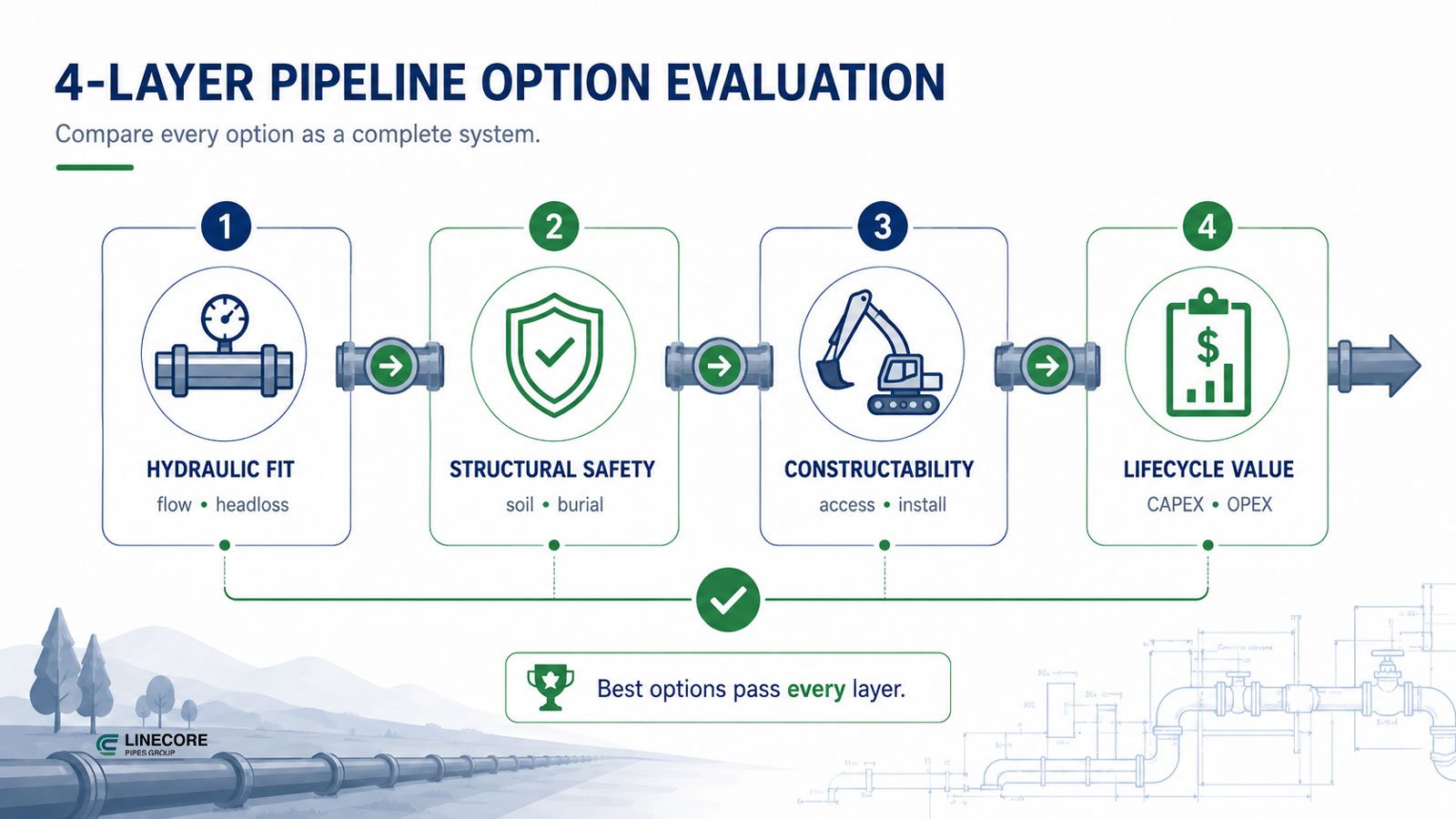
Pipeline options are not chosen by comparing prices or materials alone. In real projects, they are evaluated as complete systems where hydraulics, construction reality, and lifecycle performance all interact. In practice, evaluation follows a simple logic:
- First, check if the pipeline can actually carry the required flow under real operating conditions
- Then confirm if it can survive soil, load, and groundwater conditions safely
- After that, test if it can realistically be installed with available site resources
- Finally, compare long-term cost and operational impact
According to the U.S. Environmental Protection Agency (EPA), hydraulic modeling can be used to evaluate pipe sizing, pressure conditions, pumping energy consumption, and overall network performance before construction begins.
The key point is this. An option is only valid if it passes all four layers, not just one.
Real-World Example: US Water Pipeline Value Engineering
A 75 million USD water transmission pipeline project in the United States underwent value engineering before construction. Alignment and construction methods were optimized to reduce utility relocations and improve constructability.
Result: Around 5.5 million USD in savings and improved delivery efficiency.
Based on TRID, this shows VE works best before construction begins, when changes are still cheap and manageable.
How GRP and Composite Pipe Options Should Be Evaluated
GRP and composite pipes are not just “alternative materials.” They behave as a full system where design, manufacturing, and installation must work together.
Fiberglass pipe design should consider hydraulic performance, structural loading, installation conditions, and long-term service requirements as an integrated system rather than isolated design checks. (Source: AWWA M45)
The Importance of Correct Jointing and Installation
If one part is not aligned, performance issues usually show up later on site, not in design.
When evaluating GRP systems, teams should focus on real operating conditions, not just catalogue data. This is what exactly we’ve discussed in previous sections.
Lastly, just remember GRP can perform very well in water transmission systems, but only when installation conditions and material selection are properly aligned.
Decision Matrix for Pipeline Collecting
A decision matrix helps pipeline teams compare options in a structured way instead of relying on opinion or experience alone. It keeps all alternatives aligned under the same evaluation rules so trade-offs are clear and easier to justify.
Each option is assessed using the same criteria to keep the comparison fair as mentioned in the table below.
| Criterion | Purpose | Key Impact | Scoring Focus | High Score Means |
|---|---|---|---|---|
| Hydraulic Efficiency | Reduce energy demand | Pumping cost | Headloss, flow performance | Lower energy use |
| Pressure & Surge Performance | Protect system safety | Pipe class and surge control | Pressure rating, surge resistance | Stronger pressure margin |
| Structural Suitability | Match site conditions | Deflection and buckling risk | Soil, burial depth, stiffness | Better ground fit |
| Corrosion Resistance | Extend service life | Maintenance and protection needs | Chemical exposure, coating needs | Lower corrosion risk |
| Installed Cost | Compare project value | CAPEX and installation cost | Supply, handling, construction | Better total value |
The value is not in scoring, but in clarity. It shows why one option is preferred and what is being compromised.
Suggested Workshop Agenda for Pipeline Value Engineering
A pipeline value engineering workshop only works if it follows a structured decision path. Without a clear agenda, discussions become fragmented and key decisions stay open.
The purpose of the agenda is to move the team from assumptions to agreed decisions in a controlled way.
1. Before the Workshop
This stage is about preparing a shared baseline so the workshop starts with facts, not interpretations.
- Confirm workshop objective and scope
- Collect latest drawings and design data
- Prepare baseline design and cost summary
- Identify open assumptions
- Align participants on agenda and expectations
If this step is weak, the workshop usually turns into clarification of missing information instead of decision-making.
2. During the Workshop
This is the active decision stage where options are compared and evaluated across engineering, cost, and constructability.
- Confirm project constraints and success criteria so the team stays aligned on what “good” means for the project
- Review baseline design so everyone is working from the same approved technical starting point
- Identify cost and risk drivers to focus discussion on factors that actually influence outcome
- Compare material options such as GRP, steel, or HDPE to understand performance and lifecycle differences
- Evaluate constructability so design choices are tested against real site installation conditions
- Use a decision matrix to structure comparisons and avoid subjective decision-making
- Agree on preferred option or shortlist so the workshop produces a clear direction, not open debate
- Assign actions for missing inputs so unresolved technical gaps do not block progress
The sequence is important because technical validation must always come before cost finalization.
3. After the Workshop
This stage converts workshop decisions into usable project outputs. Without it, the workshop has no real impact on execution.
| Deliverable | What It Covers | Why It Matters |
|---|---|---|
| Calculations update | Revised hydraulic & structural data | Keeps design aligned with decisions |
| Drawing updates | Route, pipe schedule & details | Ensures accurate construction |
| Cost comparison | CAPEX + OPEX summary | Confirms best value option |
| Recommendation report | Final option + justification | Required for approval |
| Decision log | Key decisions & open items | Maintains traceability |
If this step is missed, decisions stay theoretical and do not reach site execution.
Calculations and Checks to Include in the Workshop
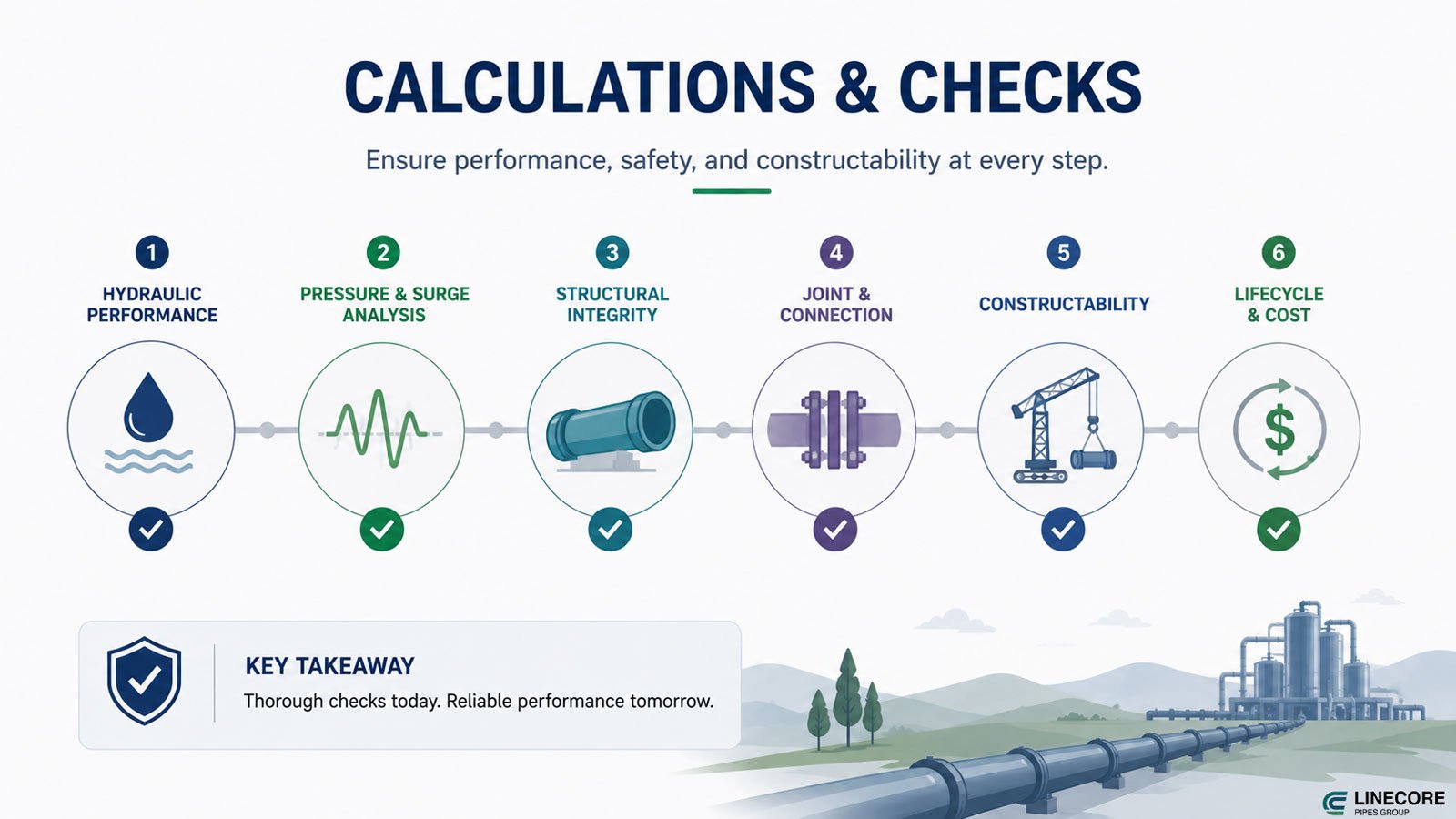
A good Pipeline Value Engineering Workshop includes several important technical validations. These checks are performed at a high level to compare options effectively.
1. Hydraulic Check
The hydraulic check confirms whether the proposed diameter delivers the required flow rate with acceptable velocity and headloss. It also evaluates if a smoother internal surface, such as GRP, can reduce pumping energy costs.
2. Surge / Water Hammer Check
The surge and water hammer check assesses system response during pump trip, power failure, or rapid valve closure. It determines if the selected pressure class provides sufficient safety margin.
Based on the U.S. Bureau of Reclamation Design Standards, pump trips and valve operations can create surge pressures that exceed normal operating conditions.
3. Buried Pipe Structural Check
The buried pipe structural check evaluates whether the chosen stiffness class suits the soil conditions and burial depth. It calculates expected deflection and identifies risks of buckling or flotation.
4. Jointing and Thrust Check
The jointing and thrust check reviews the need for flexible or restrained joints and identifies where thrust blocks are required. It ensures installation tolerances are realistic.
5. Constructability Check
The constructability check examines transport practicality, lifting equipment needs, and expected joint installation speed on site.
6. Lifecycle Cost Check
The lifecycle cost check compares the full ownership cost of each option, including supply, installation, energy, maintenance, and rehabilitation.
7. Risk and Approval Check
The risk and approval check identifies which option offers the lowest technical, construction, and regulatory risks with the best chance of smooth approval.
Final Deliverables from a Pipeline VE Workshop
A Pipeline Value Engineering workshop is only useful if it produces outputs that can be used directly in engineering, procurement, and construction. Without clear deliverables, the discussion stays theoretical and does not influence the project.
In most structured projects, the final outputs are grouped into a clear set of documents and decisions:
- A confirmed baseline and updated design basis
- A comparison of evaluated pipeline options with justification
- Updated hydraulic, structural, and cost assumptions
- A risk register with clear mitigation actions
- A decision log showing what was agreed and why
- A recommendation report for consultant and owner approval
- Updated drawings or marked revisions for implementation
- A cost and lifecycle summary for transparency
These deliverables matter because they connect technical decisions to execution. They also protect the owner later when questions arise during construction or operation. If something changes on site, the project team can trace it back to an agreed decision, not assumptions.
FHWA guidance also emphasizes that value engineering recommendations should be formally documented so project teams can track decisions, approvals, and implementation throughout project delivery. (FHWA Value Engineering Resources)
Without this structured output, even a well-run workshop loses its value quickly because nothing is formally carried into execution.
Why Early Supplier Involvement Creates More Value
Many pipeline decisions are fixed late, when procurement starts and design changes become difficult. At that point, options to improve cost, construction speed, or execution risk are already limited.
Early supplier involvement shifts this timing. When suppliers join during value engineering, they bring practical constraints that are often missing in design-only discussions.
A. Available Real-World Constraints
This includes what pressure classes are actually available, how joints behave under real site conditions, what installation speeds are realistic, and how logistics will affect delivery. These are not theoretical inputs. They directly affect cost, schedule, and risk.
B. Reduces Late Design Changes
It also helps avoid redesign later. If a pipe system is selected without understanding its installation limits, changes often appear during construction, which leads to delay and claims.
C. Better Alignment Between Design And Execution
Early involvement does not reduce engineering responsibility. It improves decision quality by aligning design intent with manufacturing and field reality from the start.Top of Form
How LineCore Supports Pipeline VE Reviews
LineCore Pipes Group supports pipeline value engineering by helping you connect design intent with real manufacturing and site conditions for GRP and composite systems.
In VE workshops, you get practical input on pipe selection, pressure and stiffness classes, joint systems, and hydraulic behavior. This helps you evaluate options based on what can actually be manufactured and installed, not only what looks good in design documents.
Support also extends to constructability, including installation methods, transport limits, handling, and site readiness. These factors often influence your decisions as much as technical design.
On execution, LineCore helps you align QA, testing, and documentation so factory records and site records stay connected. This reduces gaps at handover and makes it easier for you to trace what was done and why.
The focus is simple. You keep design, supply, and installation aligned in one continuous process.
A Conclusion to VE Reviews
Pipeline Value Engineering is not only about reducing cost. It is about ensuring the selected option works in design, construction, and operation. Most risks come from small gaps between assumptions and site reality. A structured VE process helps reduce those gaps early. When suppliers like LineCore are involved from the beginning, decisions become more practical, coordination improves, and project delivery becomes more predictable.
about
The Author

Farshid Tavakoli is a seasoned professional in engineering and international trade. Holding degrees in Electrical Engineering, Mechatronics, and a Doctorate in Business Administration (DBA) from the University of Lyon, he also has a strong background in industrial automation and production line technologies.
For over 17 years, he has led an international trading company, gaining deep expertise in commercial solutions tailored to industrial needs. With more than 8 years of active involvement in infrastructure development, he specializes in the supply of electromechanical equipment for water and wastewater treatment plants and transfer projects.
Together with comapny expert team, he now provides consultancy and integrated solutions for sourcing and implementing complex infrastructure projects across the region.