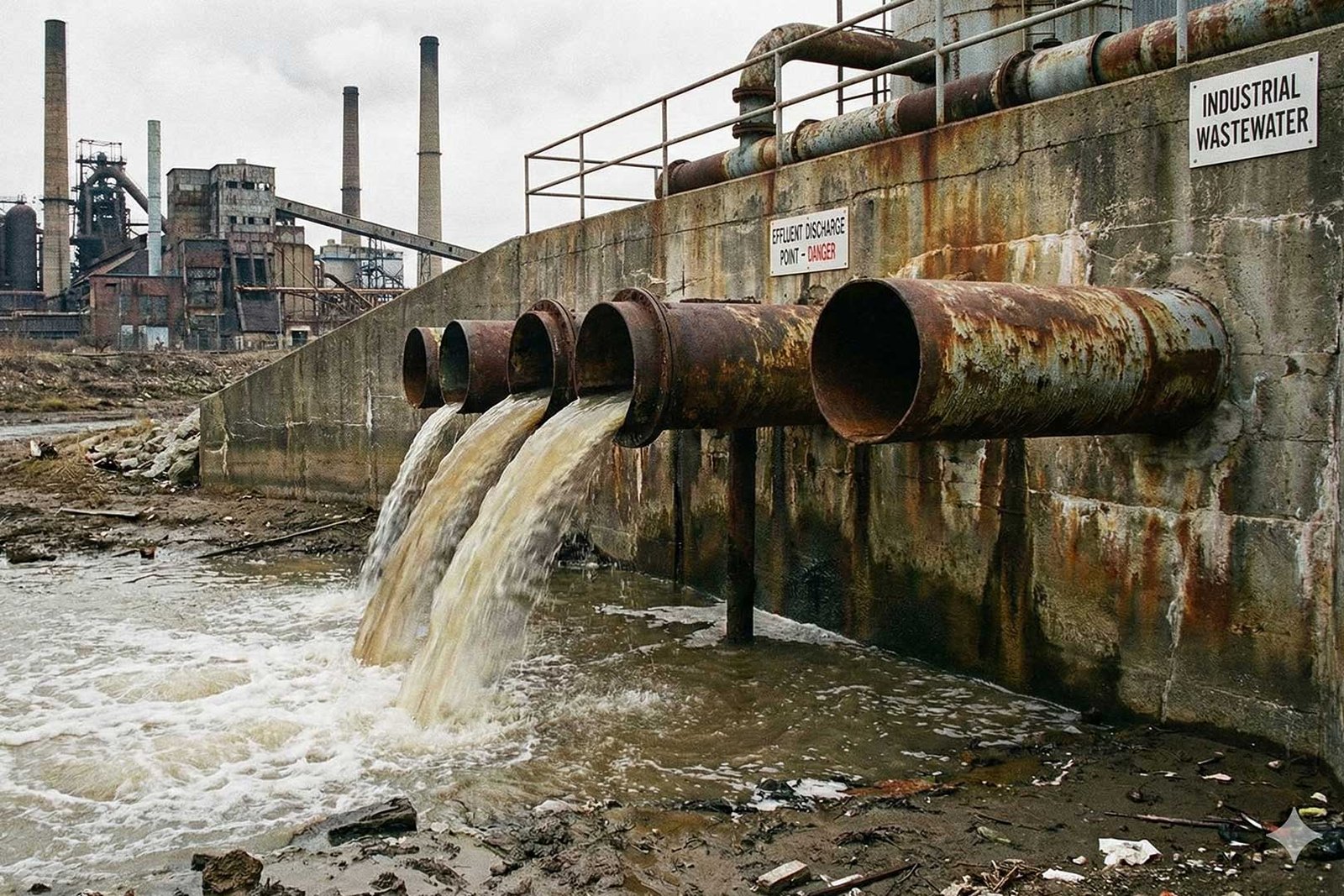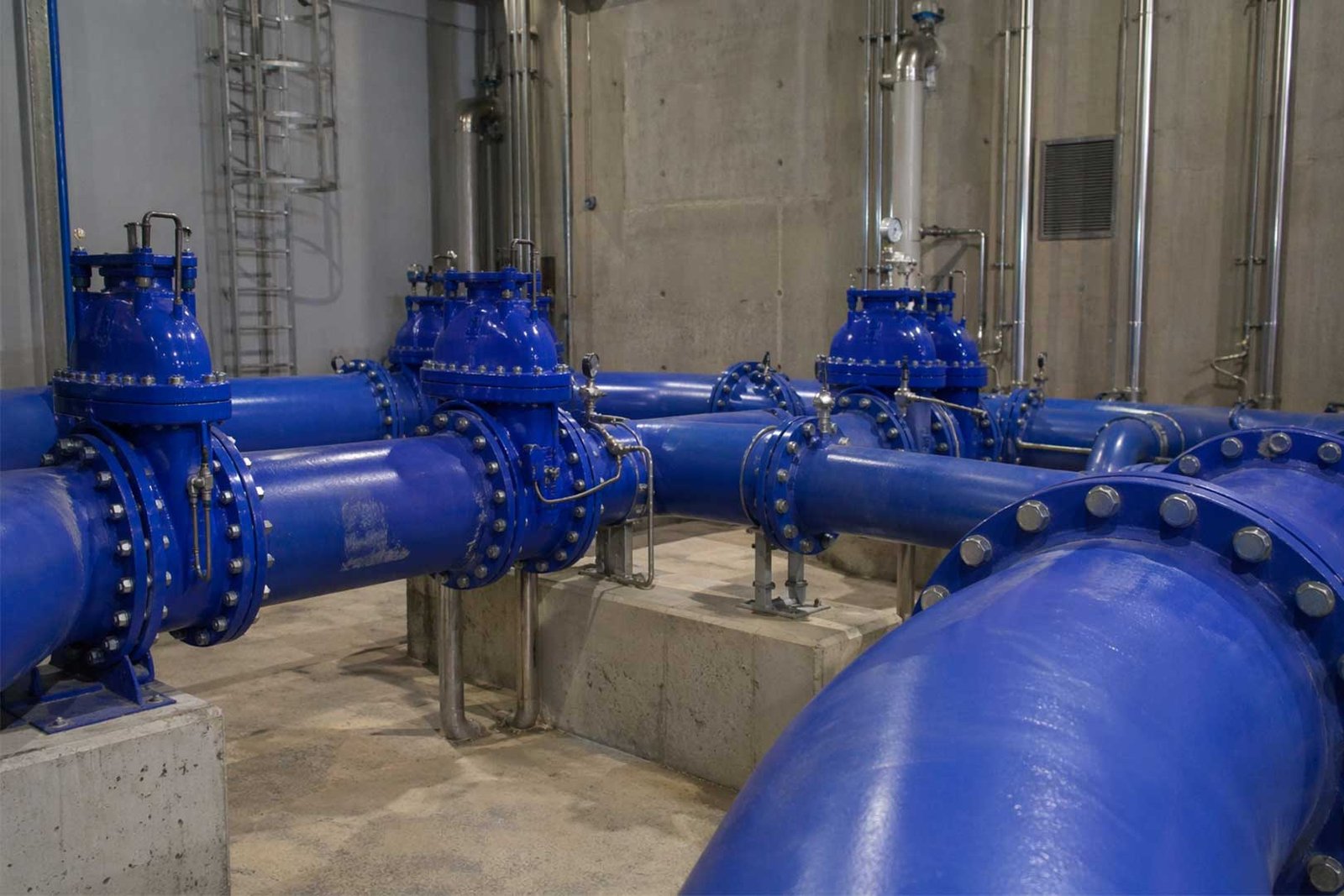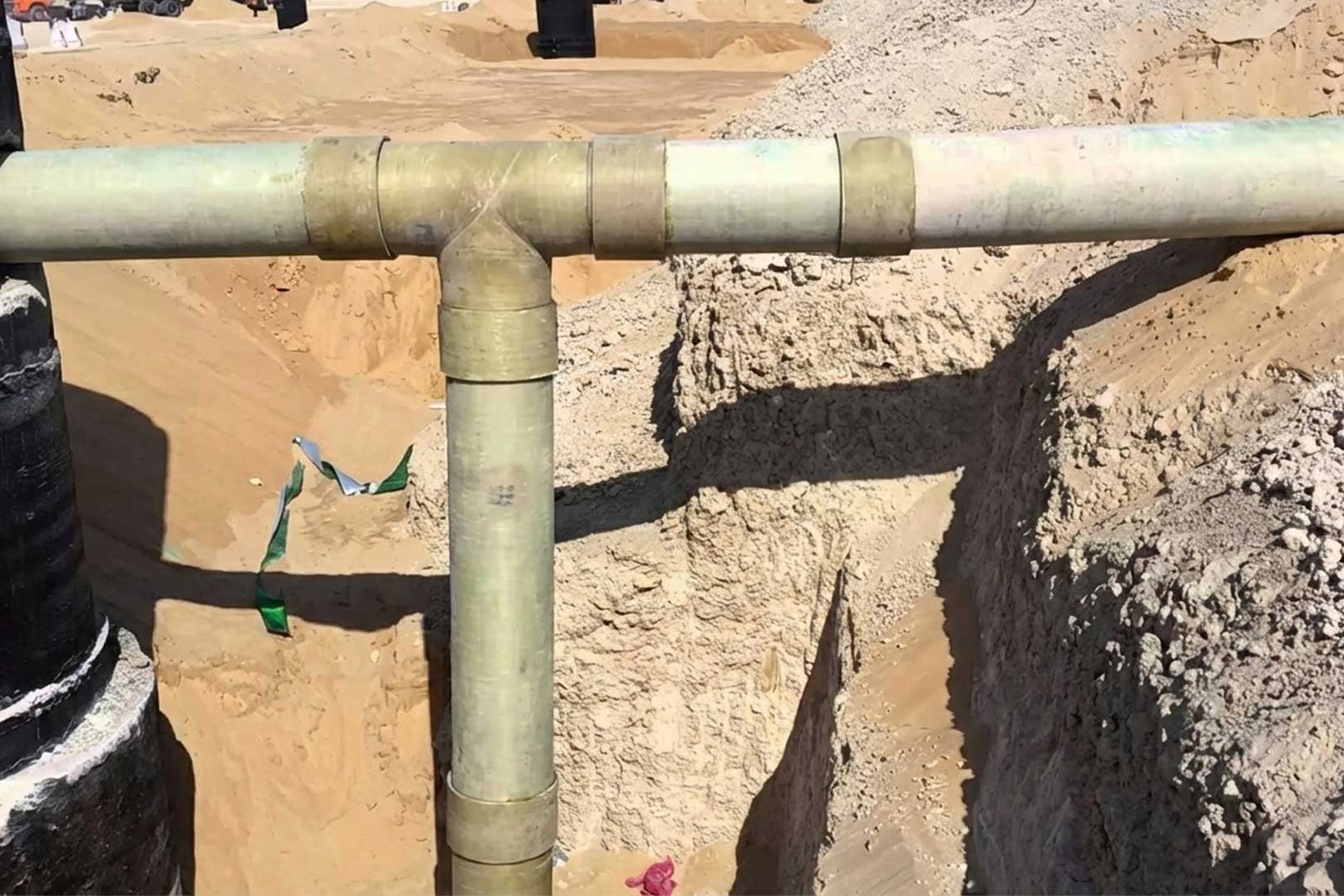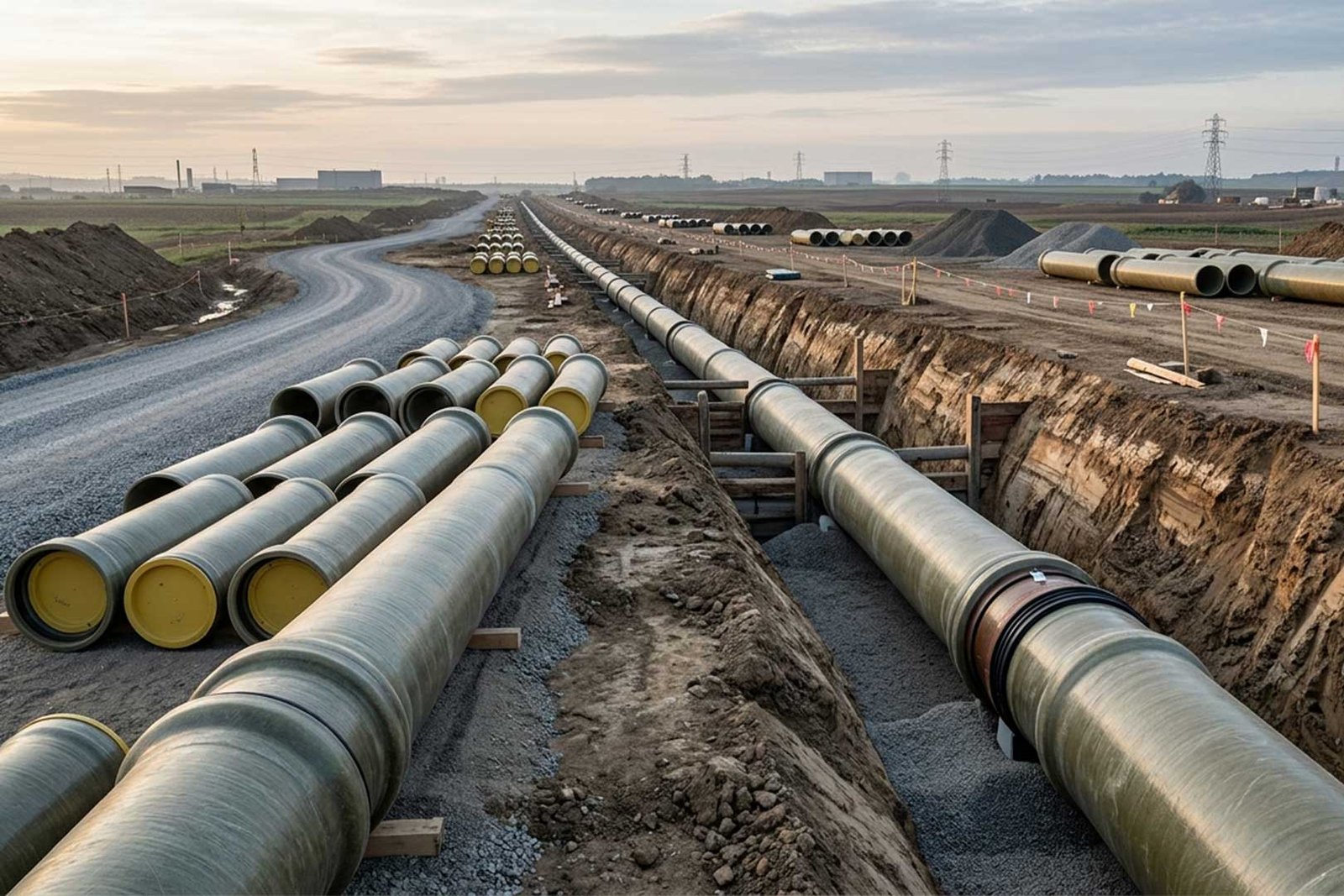
Even one little point can change the whole budgeting for a piping system. A deeper trench, higher pressure class, groundwater condition, or additional crossing can quickly increase EPC costs. GRP and composite pipelines are widely used in water, wastewater, seawater, irrigation, and industrial projects. LineCore Pipes Group supports clients with integrated GRP and composite pipeline EPC solutions.
In this article, we provide well-explained information of effective technical, hydraulic, geotechnical, construction, logistics, and commercial data required to prepare a more realistic EPC budget for GRP and composite pipeline systems.
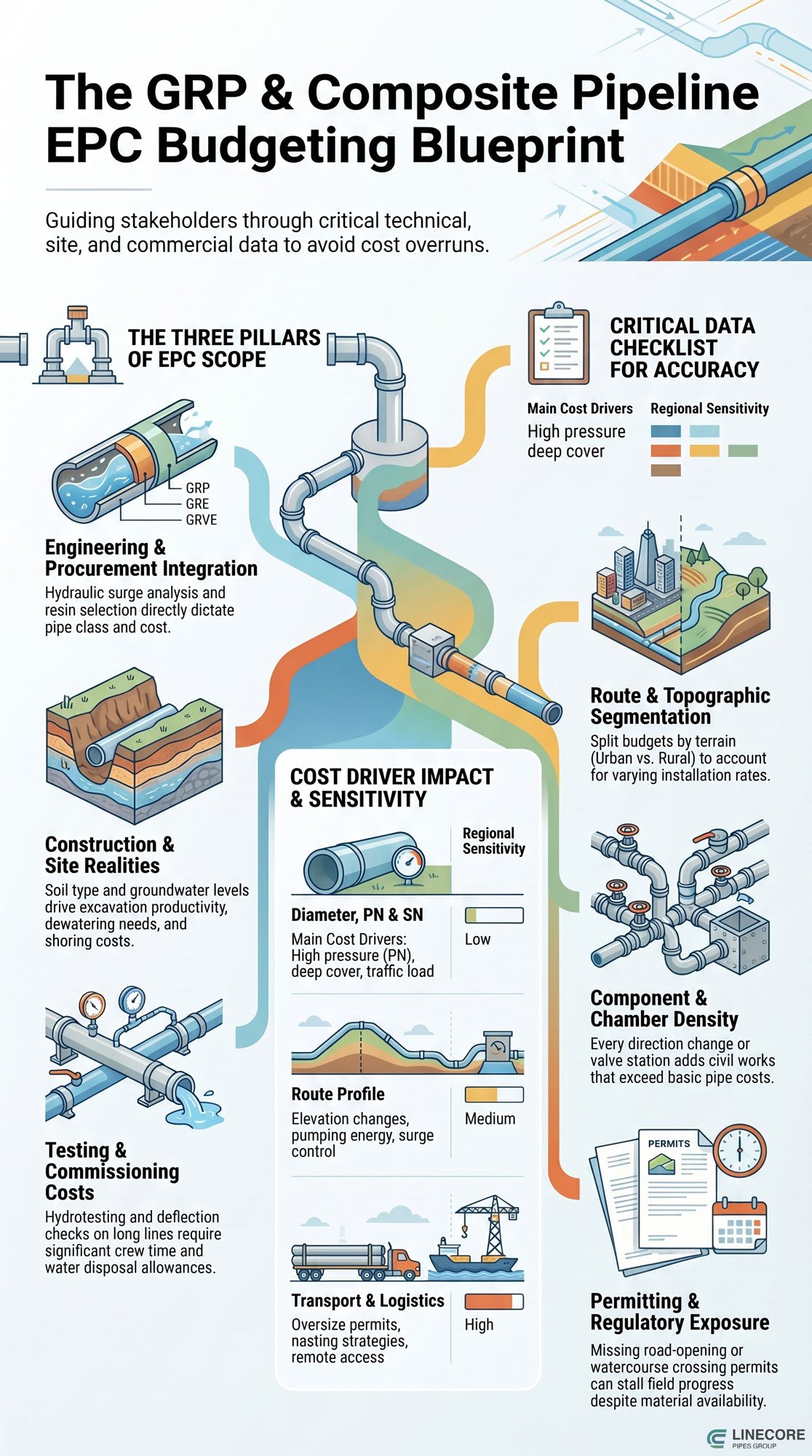
Reliable EPC Budget for GRP and Composite Pipelines infographic
What Is Included in an EPC Budget for GRP and Composite Pipelines?
An EPC budget for GRP and composite pipelines is not a pipe calculation exercise. It combines engineering choices, site conditions, construction methods, and commercial exposure into one cost structure.
Engineering Scope
This part indicates how the technical direction of the pipeline works. Results of hydraulic performance and surge cases show pressure class, while structural conditions influence pipe stiffness and burial depth.
- Hydraulic and surge calculations
- Pipe class and diameter selection
- Route adjustments linked to head loss
- Drawings and construction methods
Aspects above indicate how site conditions make changes in the final budget. Small design changes can lead into pump power demand and pressure rating.
Procurement Scope
Procurement covers pipes, fittings, couplings, valves, supports, and factory inspection. Special fittings and restrained joints often cost more than straight pipe sections and can change the BOQ structure.
Construction Scope
Site conditions control most of this cost. Excavation depth, groundwater, soil type, and crossings directly affect productivity and temporary works. Includes:
- Trenching and bedding
- Pipe laying and jointing
- Crossings and chambers
- Backfilling and reinstatement
Testing and Commissioning Scope
Hydrotesting, flushing, deflection checks, repairs, and handover documentation sit here. On long lines, repeated testing can extend crew and equipment time.
- Technical Insight: Standards such as ISO 14692-3 for GRP piping system design all the EPC process to be aligned with the various site conditions.
Start With Project Definition: The First Requirement for a Reliable EPC Budget
Early EPC numbers for GRP and composite pipelines rarely stay fixed. At concept stage, the project still sits on assumptions, so even small design changes can shift the cost picture. According to AACE International Recommended Practice, estimate accuracy depends heavily on how mature the project definition is during each stage.
Why Early Budgets Stay Approximate
Most early estimates start with just length and a rough diameter. That does not reflect how the pipeline will actually behave. A small change in elevation or design pressure can push pipe class up, deepen the trench, and increase pump duty at the same time. That is where costs start to drift away from the first number.
- Engineering Point: Early figures should be treated as a range. A fixed price only makes sense once the hydraulic profile and route levels are confirmed.
What Makes the Budget Reliable
A budget starts to hold value when the basics are properly defined. Hydraulic results, soil data, procurement limits, and contract terms all need to sit in place. Without them, the estimate just spreads uncertainty across allowances instead of real quantities.
LineCore Pipes Group keeps early screening estimates separate from EPC-ready budgets. One stays for feasibility checks. The other follows full engineering detail and defined scope.
Minimum Project Data Required Before EPC Budgeting
There are multiple data bases which all projects must gather to make sure of further operations. Use points below as a checklist to help you not to lose any data.
- Project location and country
- Pipeline length
- Flow rate and design pressure
- Diameter range
- Route profile and elevation changes
- Soil and groundwater conditions
- Crossing locations
- Applicable standards and client specs
Missing even a few of these usually shows up later in excavation, fittings, or pumping cost shifts.
Pipe System Data Needed for Budgeting
Pipe selection drives most of the early EPC cost movement in GRP and composite systems. Material choice, pressure class, and joint type all sit together, not in isolation. A single assumption here can distort the whole estimate.
Pipe Material and Product Family
GRP, GRE, and vinyl ester composite systems behave differently under pressure, temperature, and chemical exposure.
- GRP is usually used for water and wastewater lines.
- GRE handles higher pressure or temperature.
- GRV/GRVE pipes and Vinyl ester systems come in when seawater or aggressive media enter the picture.
Some projects also use abrasion-resistant composites for slurry or sediment-heavy flow.
Diameter, Pressure Class, and Stiffness Class
Each of DN, PN, and SN ratings that must be aligned with the project demands can have their own impact on the final budget.
- DN or diameter size controls flow capacity, but also head loss. Smaller diameters raise velocity and increase friction losses, which pushes pump duty higher.
- PN or pressure class is for internal pressure limits.
- SN or stiffness class controls external load resistance under burial depth and traffic.
Vacuum cases need separate checks, mostly in long transmission lines with elevation drops.
Resin System and Service Conditions
Polyester resin works for standard water systems. Vinyl ester suits seawater and chemical exposure. Epoxy or GRE systems handle higher temperature or pressure demand. Resin selection changes pipe wall build-up and cost per meter more than most expect.
Jointing System and Thrust Philosophy
Couplings, restrained joints, flanges, and laminated field joints all change installation behavior. Transitions to steel or ductile iron need careful detailing. In long pipelines, thrust blocks increase civil work, while restrained systems add the external load into pipe structure and boost the risk of deformation.
- Technical Note: Avoid the use of single pipe ratings. Break costing by diameter, PN, SN, joint type, fittings, and resin system. This is where most EPC deviations start.
Check the table below to achieve an understanding in short.
| Item | What to Collect | Main Cost Drivers | Regional Sensitivity |
|---|---|---|---|
| Pipe family & resin | GRP, GRE, vinyl ester, restrained systems | Resin type, reinforcement, approvals | Low |
| Diameter, PN & SN | DN, pressure class, stiffness, burial depth | Higher PN/SN, deep cover, traffic load | Low |
| Hydraulic performance | Flow, velocity, surge, head loss | Pumping energy, surge control | Medium |
| Joint system | Couplings, restrained joints, flanges | Thrust points, fittings, transitions | Low |
| Fittings & specials | Bends, tees, reducers, chambers | Custom fabrication, QA, low quantities | Low |
| Liners & protection | Abrasion liner, UV, corrosion protection | Slurry service, marine exposure | Medium |
| Material pricing | Pipe, fittings, gaskets, packing | Exchange rate, approvals, quantity | Medium |
| Production & lead time | Factory slots, testing, FAT schedule | Factory load, special fittings | Medium |
| Transport & storage | Pipe length, weight, nesting, trucking | Oversize permits, remote access | High |
| QA/QC package | Testing records, certificates, ITP | Third-party inspection, hold points | Low |
Hydraulic Data Needed for EPC Budgeting
Hydraulic data shapes both capital cost and long-term operating cost in pipeline EPC projects. Flow rate alone is not enough. Velocity limits, surge pressure, and head loss all feed directly into pipe sizing, pump duty, and pressure class selection.
Required Flow and Velocity
All we need to know about flow and velocity roots the hydraulic model should include:
- Average Flow: The normal operating flow used for daily system performance.
- Peak Demand: The short periods when the system pulls its highest flow, usually during maximum consumption hours.
- Future Expansion Flow: Extra flow capacity is needed when future network growth, industrial expansion, or increasing water demand matter.
- Acceptable Velocity Range: The velocity window that keeps the pipeline with no change in operation that might unstable flows add to the risk.
In total, consider that low velocity rate can include sediment to settle inside the pipe, while high rate of velocity increases friction and adds to the pumping power demand.
Head Loss and Pumping Energy
GRP pipelines carry a smooth internal surface, which keeps friction loss lower than rough or corroded pipe materials over time. In long transmission lines, even a small reduction in head loss can lower installed pump power and reduce energy consumption across the operating life.
Surge and Transient Analysis
Surge analysis checks how the system reacts during pump trips or rapid valve closure. These pressure waves control:
- PN class selection
- Air valve location
- Surge vessel sizing
- Pipe wall requirements
Ignoring transient pressure often leads to under-rated pipe systems or unnecessary overdesign later in the project.
Route and Topographic Data Needed
Route data controls far more than pipeline length. Ground profile, site access, and corridor restrictions all feed directly into excavation quantity, installation speed, and construction method.
What the Route Data Should Include
Route data does more than locate the pipeline. It also shows where excavation becomes difficult, where productivity drops, and where hydraulic conditions start to change along the alignment.
| Route Item | EPC Cost Impact | Typical Risk |
|---|---|---|
| Elevation profile | Higher pump head | Surge pressure |
| Urban sections | Slower installation | Traffic restrictions |
| Utility conflicts | Extra excavation work | Delays and rework |
| Narrow corridor | Limited access | Lower productivity |
| High-groundwater areas | Dewatering cost | Trench instability |
Route Segmentation for Better Budget Accuracy
One average installation rate rarely reflects real field conditions. It is better to split the alignment into sections such as:
- Easy rural trench
- Urban road corridor
- Deep trench area
- Wet or high-groundwater zone
- Rocky terrain
- Crossing-heavy sections
- Steep slope or geohazard areas
This approach produces a far more realistic EPC cost build-up.
Geotechnical and Soil Data Needed
GRP pipelines behave as flexible pipe systems. The surrounding soil becomes part of the structural behavior, not just the trench environment. That is why geotechnical data changes both pipe selection and installation cost.
Soil Classification
The ground profile should identify sand, clay, silt, gravel, rock, collapsible zones, and soft or marshy areas. The way pipes will tolerate external loads also indicates because weak soil can reduce trench stability and increase bed or backfill operations of the pipes.
The Flowtite Installation Guide explains how flexible GRP pipelines rely on proper pipe-soil interaction and controlled backfill conditions.
Groundwater and Backfill Conditions
Groundwater changes construction speed really fast. Wet trenches usually need dewatering and higher bedding control. It can also delay the process of hydrotesting and decrease installation productivity.
Furthermore, the process of backfilling matters when a project goes through quality strict checks. Imported bedding, compaction level, particle size limits, and haulage distance all feed directly into civil cost.
Pipe Stiffness and Soil Support
Poor soil, deep burial, heavy traffic load, or weak compaction may require a higher SN class to control pipe deflection under external loading.
| Soil Condition | Budget Result | Required Data |
|---|---|---|
| High groundwater | Dewatering and shoring | Groundwater depth |
| Rock excavation | Blasting or breaking | Rock hardness |
| Soft soil | Imported bedding | Geotechnical report |
| Urban road | Reinstatement cost | Road specification |
Construction Method Data Needed
Installation method drives a large part of the EPC budget in pipeline projects. Two pipelines with the same diameter and length can end with very different construction costs once trench conditions and crossing methods enter the picture.
Open-Cut Installation
Most GRP pipelines use open-cut installation. Cost depends on trench width, depth, excavation volume, bedding thickness, pipe laying sequence, backfill quantity, and surface reinstatement. Deeper trenches usually slow excavation, increase shoring needs, and reduce laying speed.
Special Crossings
Crossings often become isolated high-cost sections within the route. These may include:
- Road and railway crossings
- River or canal crossings
- Existing utility crossings
- Culvert and drainage sections
Each one may require temporary support, traffic control, or restricted work windows.
Trenchless and Casing Methods
HDD, jacking, casing pipes, or custom crossing systems may become necessary where excavation is restricted or ground conditions create instability.
- Pro Tip: Deep trench sections may require additional shoring and safety measures based on OSHA trenching and excavation guidance, especially in unstable or high-groundwater soil conditions.
Productivity and Crew Output
Crew output changes constantly in the field. Pipe diameter, trench depth, soil condition, groundwater, weather, site access, inspection hold points, and work-hour limits all influence how many meters crews can install per day.
Fittings, Valves, Chambers, and Special Structures
Fittings and structures often control the real cost structure of a pipeline, even when pipe length stays unchanged. Every change in direction, control point, or diameter transition adds both material and civil work.
Engineering and Component Data Required
An EPC budget needs a complete schedule of non-straight components, including:
- Bend schedule with angles and radii
- Tee and branch take-offs
- Reducers and diameter transitions
- Flange adaptors and steel interfaces
- Air release and vacuum valve chambers
- Washout and drain chambers
- Isolation, control, and bypass valve chambers
- Flow measurement chambers
- Thrust blocks and anchor blocks
- Interface pieces to steel or ductile iron systems
Each item carries excavation, concrete works, reinforcement, and installation time, not only supply cost.
What to Consider about Routes and Chambers?
Chamber density often defines how complex a pipeline feels on site. A route with frequent valve stations or directional changes increases civil scope faster than pipe supply. Transmission lines with high pressure or many control points usually show this effect most clearly.
Logistics and Delivery Data Needed
Logistics usually looks simple on paper, but it becomes one of the first places where EPC budgets feel pressure once delivery starts. The way pipes are packed, moved, and stored often decides how smooth or slow installation will be.
Pipe Handling and Site Preparation
Pipe length, weight, lifting points, storage space, laydown area, and available equipment all shape daily site flow. If the site is tight or lifting points are not practical for available cranes, unloading slows down and installation crews end up waiting.
Freight and Customs Requirements
Shipping cost is not just distance. It depends on Incoterms, port of entry, inland haulage distance, road limits, customs duties, VAT, and oversize permits. A short route with heavy restrictions can take more effort than a longer open one.
Freight responsibility, customs exposure, and inland transport scope are usually tied to the selected Incoterms rules within the supply contract.
Packing and Nesting Strategy
Composite pipes can sometimes be nested when different diameters are shipped together. That reduces container space and freight volume, but only works when the diameter mix is planned in advance.
QA/QC, Standards, and Documentation Requirements
Quality control in GRP and composite pipeline projects is not limited to final inspection. It runs from material selection at the factory to final pressure testing on site, and each stage carries its own documentation load that feeds directly into EPC cost and schedule.
The table below includes each of the essential standards for pipelines in water transmission lines. Each of these standards may contain a couple of practical standards for each stage of piping system operations.
| Standard Type | Typical Use in Projects |
|---|---|
| AWWA | Water transmission pipe systems |
| ISO | System design and material compliance |
| ASTM | Testing methods and material properties |
| EN standards | European project specifications |
| Client/utility specs | Project-specific requirements |
Factory Quality Control
Factory QA starts with raw material certificates and continues through dimensional checks, pressure or hydrostatic testing, stiffness testing, joint qualification, and inspection and test plans (ITP). These records show that each pipe set is enough for the project requirements before shipping.
Site Quality Control
Site checks include bedding inspection, joint inspection, deflection testing, pressure testing, as-built documentation, and final handover dossier. Poor control at this stage usually leads to re-testing and schedule delays.
Environmental, Permitting, and Social Data Needed
Permitting and environmental requirements rarely sit inside early EPC numbers, but they quickly become visible once construction starts. They shape when work can begin, how fast crews move, and how smoothly cash flow follows site progress. What regulatory and site approval the system requires to be prepared for long-term operations:
- Road-Opening Permits: Needed before any trenching in public roads. When approvals take time, multiple work fronts can pause even if materials are already on site.
- Watercourse Crossing Approvals: Needed for work near rivers, canals, and drainage lines where construction may disturb water flow.
- Environmental Impact Assessment: Sets rules for noise, dust, disposal, and working hours during construction (World Bank environmental framework).
- Land Access and Right-of-Way: Controls access to private or restricted land. One missing approval can stop work across part of the route.
- Community and Stakeholder Requirements: Local authorities or nearby communities may limit site access or working times.
- Disposal of Excavated Material: Disposal location and haul distance directly change trucking time and excavation cost.
- Dewatering Discharge Permits: Define where pumped groundwater can go. In wet ground conditions, this becomes a daily operational constraint.
- Reinstatement and Restoration Obligations: Set the final condition of roads, land, and utilities after construction is finished.
Engineering Warning
Permitting delays usually don’t stop engineering work, but they do stop field progress. On long pipelines, approval timing often ends up affecting productivity and standby costs as much as material delivery.
Commercial and Contractual Data Needed
Commercial setup can change the final EPC outcome as much as the engineering design. Two identical pipelines may end up with different costs just because risk and payment terms sit differently in the contract.
EPC Pricing Model
The pricing model controls how uncertainty is handled:
- Lump sum EPC used when design and quantities are already stable, with most variation risk carried by the contractor
- Unit-rate EPC ties payment to measured work, useful when quantities may still change
- EPCM separates construction packages while the client manages procurement exposure
- Time and materials based on actual site effort and duration
- Hybrid model combines fixed and variable work sections
Risk Allocation
This part sets who carries what when things don’t go as planned. It covers design changes, ground conditions, permits, delays, material price movement, currency shifts, customs clearance, testing issues, and warranty claims. In pipeline works, unclear soil responsibility can quickly turn into cost disputes once excavation starts.
Risk allocation in EPC contracts is commonly structured around frameworks such as the FIDIC Silver Book, particularly for design responsibility, delays, and ground condition exposure.
Bonds, Insurance, and Payment Terms
Projects usually require advance payment guarantees, performance bonds, retention, insurance, delay damages, and milestone payments. These terms control cash flow during long construction cycles which may overload the project budget if forgotten.
Contingency and Risk Allowance
Contingency in EPC budgets reflects uncertainty, not a fixed add-on. In GRP and composite pipeline projects, most cost variation comes from site conditions that are not fully known at the early design stage. What drivers we include for this matter:
- Incomplete geotechnical data
- Unknown underground utilities
- Groundwater variation along the route
- Rock excavation conditions
- Permit and approval delays
Each of these can change excavation method, productivity, or installation sequence once work starts on site.
A single unknown utility crossing or unexpected rock layer can influence multiple activities at once, from trenching to reinstatement.
Phase-Based EPC Budget Checklist
EPC budgets for GRP and composite pipelines make more sense when they follow how the project actually develops. Each phase adds detail, and missing information early usually shows up later on site as cost changes.
1. Pre-Bid Stage
At this point, the budget is still rough and based on limited information. The focus is simply to understand what the project looks like and where the main constraints might be.
You usually work with a preliminary route, expected flow, basic diameter and pressure assumptions, a desktop soil view, initial crossings, and a rough logistics idea.
A small change in elevation or alignment here can already change pipe class and installation approach.
2. Design Stage
Here the pipeline starts to take a real shape. Hydraulic profile and surge behavior define pressure conditions, while topography and geotechnical data explain how the ground will actually behave. Route drawings, trench details, and valve or chamber layouts are what can begin to fix construction scope.
3. Procurement Stage
Costs become clearer once supplier input comes in. Pipe approvals, final BOQ, quotations, production schedule, packing plan, and QA/QC requirements start to create the real EPC shape which engineers are looking for.
4. Construction Stage
This is where site conditions start driving costs. Method statements, permits, crew productivity, equipment planning, dewatering, traffic handling, and reinstatement work define how fast installation actually progresses.
5. Commissioning Stage
always double check the whole stages to reduce the risk of missed items. Hydrotesting, water handling, acceptance checks, O&M manuals, and handover complete the cycle. Testing cycles are likely to increase unpredicted downtimes. Bottom of Form
Common Budgeting Mistakes in GRP and Composite Pipeline Projects
Early EPC estimates often fail not because of missing formulas, but because some field realities are simplified too much. The table below turns common mistakes into direct questions and short fixes.
| Question | What goes wrong | Fix |
|---|---|---|
| Same pipe rate for all sizes? | One average rate used | Split by DN, PN, SN |
| Soil and groundwater included? | Uniform excavation cost | Adjust by soil and water level |
| Bedding and backfill counted? | Missing imported material | Add bedding and haulage |
| Fittings and chambers included? | Only straight pipe priced | Add full fittings and structures list |
| Is logistics treated lightly? | Freight underestimated | Separate transport and handling |
| Joint types separated? | Same method assumed | Split restrained and unrestrained |
| Hydrotest included? | Testing ignored | Add water, disposal, retesting |
| Permits included? | Compliance excluded | Add permits and reinstatement |
| Contingency based on data? | Flat percentage used | Link to real uncertainties |
| Early accuracy claimed? | Incomplete data used | Separate early vs bid-ready estimate |
Why GRP and Composite Pipelines Can Improve Total Project Value
GRP and composite pipelines are usually not selected for lowest upfront price alone. Their value shows up later, when installation speed, energy use, and maintenance demand start to matter in real operation.
1. Corrosion Resistance
GRP does not rust or corrode like steel systems. This removes coating cycles and reduces repair work in aggressive water or wastewater environments over time.
2. Low Friction Surface
GRP pipe walls stay smooth during their service life due to the internal layer of resin. Lower friction means decreased head loss, which cuts pumping energy over long transmission lines.
3. Lightweight Handling
Lower weight and higher strength-to-weight ratio make lifting and placement easier, especially in long trench sections. It also reduces dependence on heavy lifting equipment and keeps installation moving steadily.
4. Simple Joints
Most GRP systems use mechanical couplers instead of welding. This reduces specialized labor on site and keeps installation steps more consistent.
5. Long Service Life
GRP systems maintain performance with limited maintenance needs. In water transmission projects, this reliance usually is more important than small differences in initial material cost.
How LineCore Pipes Group Supports EPC Budget Development
Reliable EPC budgets come from accurate technical inputs, realistic installation assumptions, and clear scope separation. In GRP and composite pipeline projects, small gaps in early data usually appear later as cost variation on site.
Technical Review
LineCore Pipes Group reviews flow, pressure, diameter, PN/SN class, and surge behavior together instead of treating them as separate items. This matters because a smaller diameter may lower pipe cost while increasing head loss and long-term pumping demand across the transmission line.
Supply Package Development
Pipe selection is coordinated with fittings, joint systems, QA/QC documentation, packing arrangement, and logistics planning. Since LineCore Pipes Group works directly with GRP and composite systems, packaging and delivery plans are developed around real transport and installation conditions rather than standard assumptions.
EPC Solution Support
Route sections, installation methods, construction planning, testing sequence, and contingency inputs are reviewed against actual site conditions. This route-based approach helps avoid the common mistake of applying one average installation rate across completely different trench environments.
LineCore Pipes Group supports clients from early concept budgeting through EPC-ready estimates for GRP and composite water transmission pipelines.
about
The Author

Farshid Tavakoli is a seasoned professional in engineering and international trade. Holding degrees in Electrical Engineering, Mechatronics, and a Doctorate in Business Administration (DBA) from the University of Lyon, he also has a strong background in industrial automation and production line technologies.
For over 17 years, he has led an international trading company, gaining deep expertise in commercial solutions tailored to industrial needs. With more than 8 years of active involvement in infrastructure development, he specializes in the supply of electromechanical equipment for water and wastewater treatment plants and transfer projects.
Together with comapny expert team, he now provides consultancy and integrated solutions for sourcing and implementing complex infrastructure projects across the region.