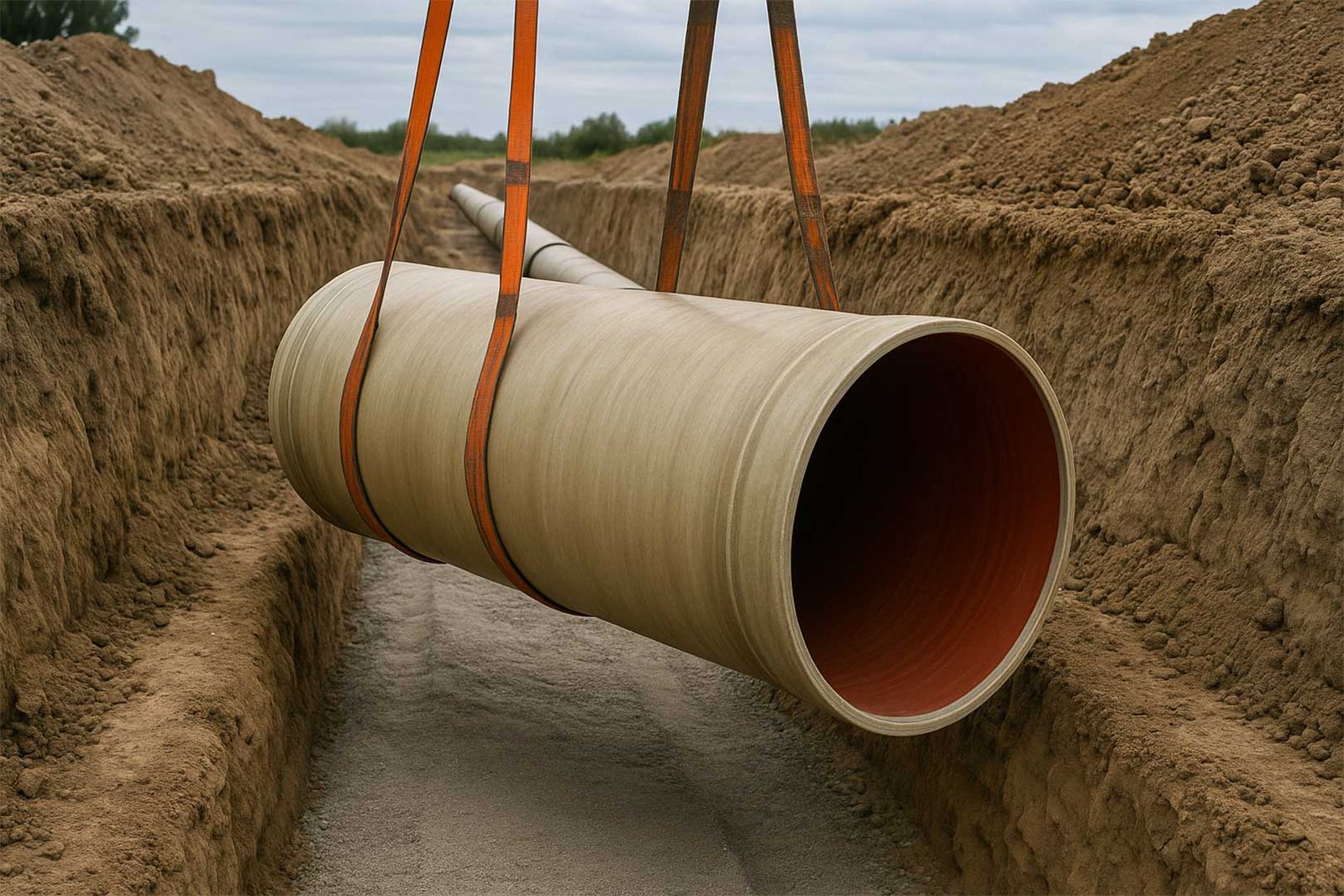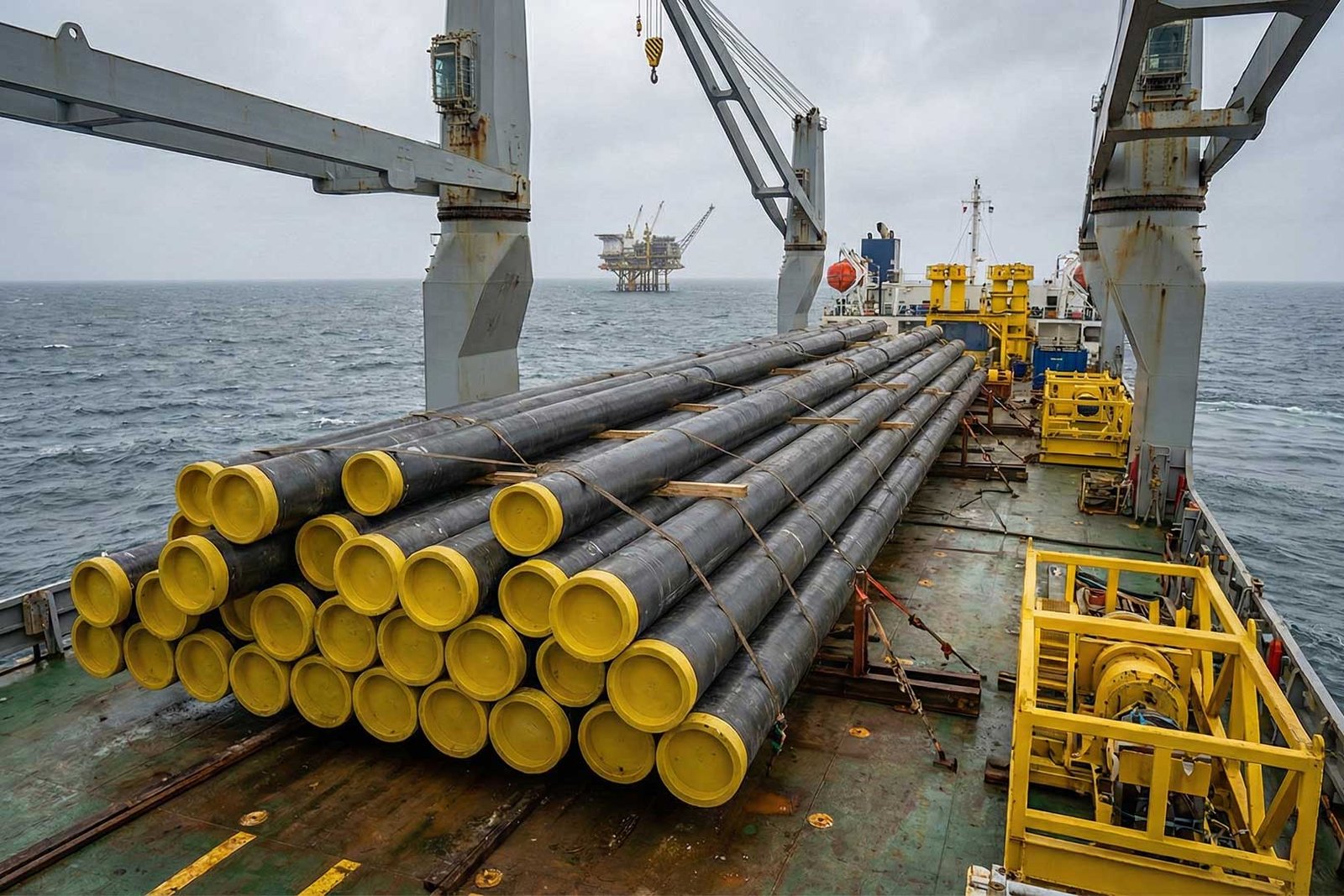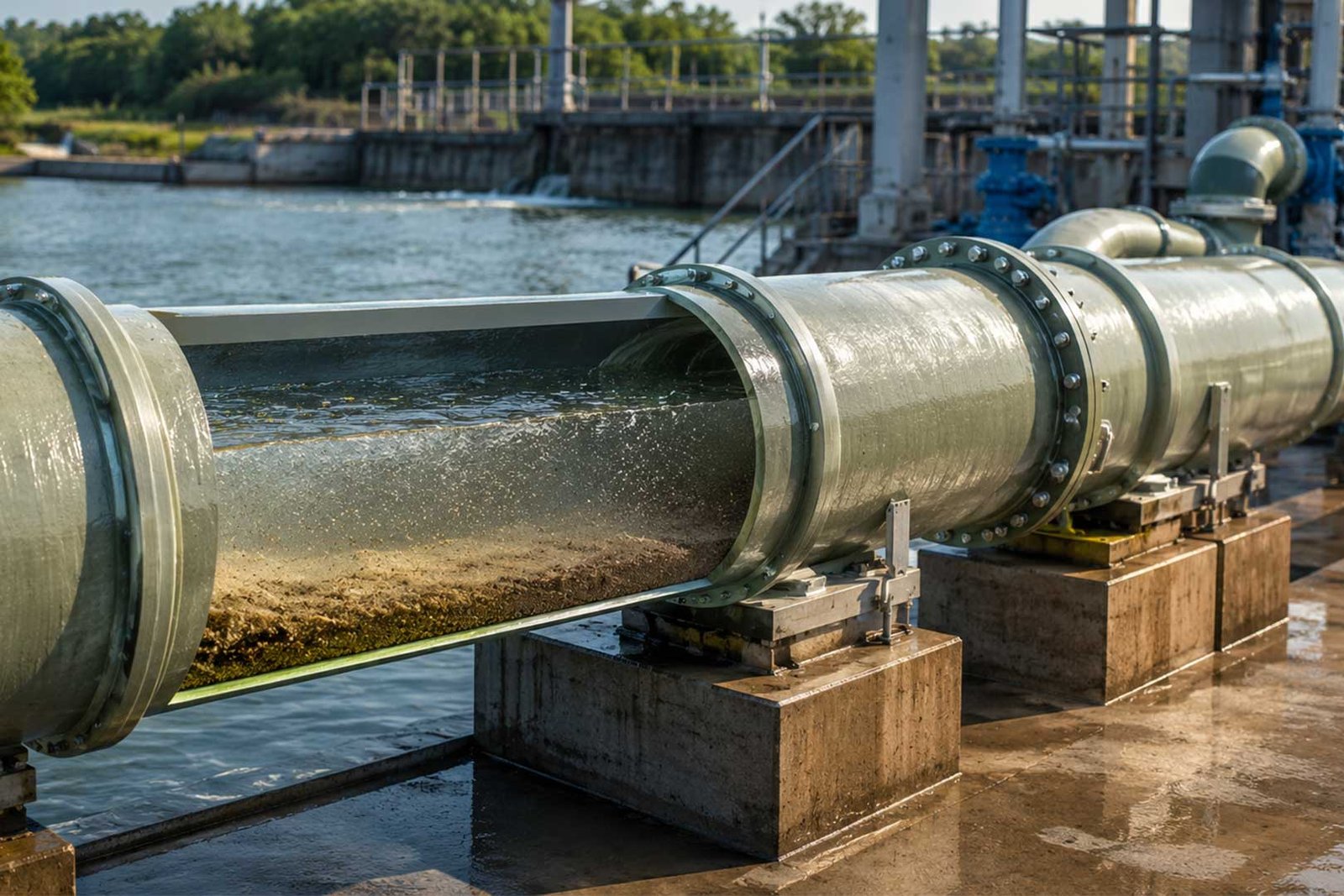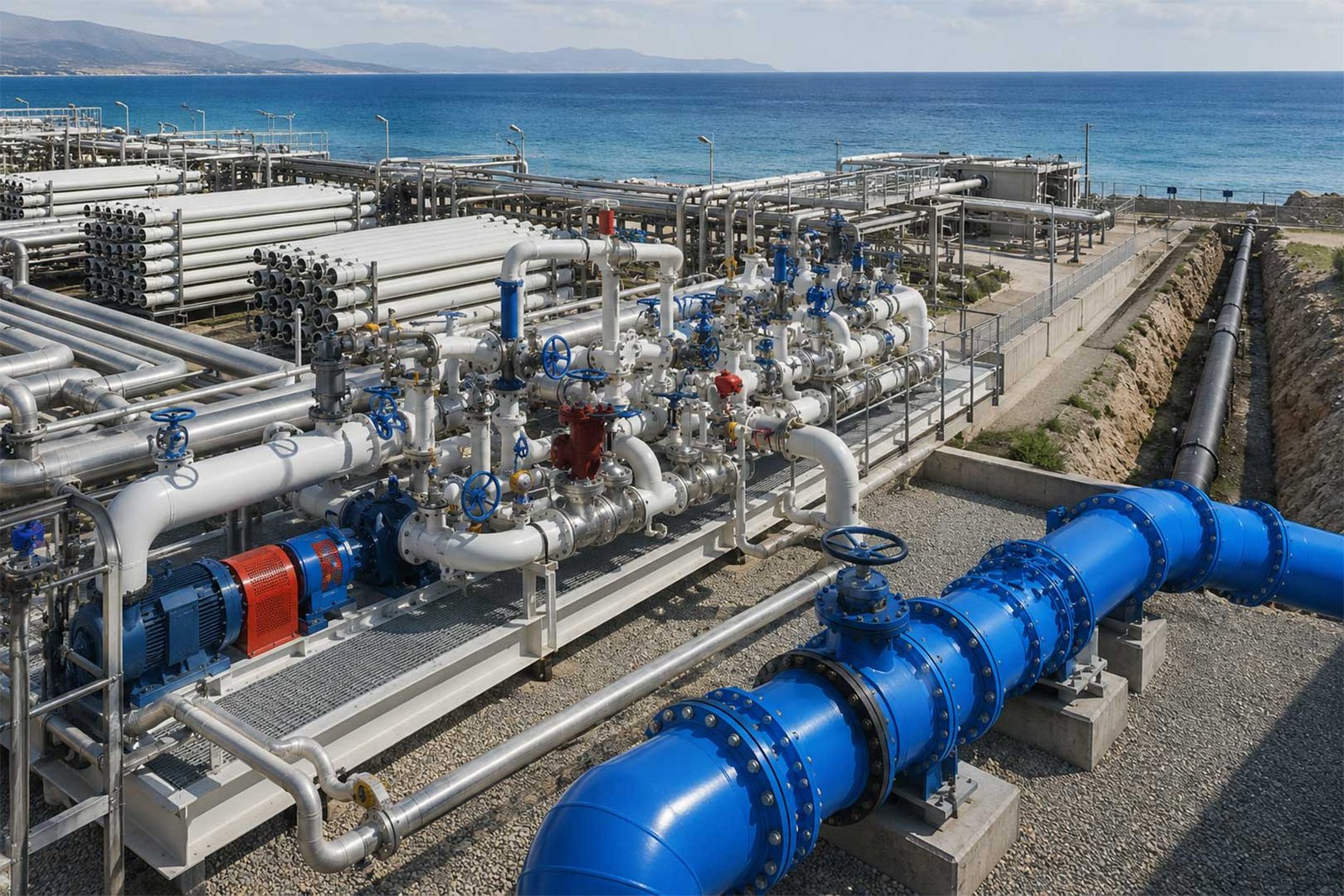
A desalination system may be designed and hit the full output and still experience failure during its lifespan. When water goes through the RO system, it’s not what users see. In fact, tie-in transmission points represent how efficient the system works. Tie-in includes a non-delayed flow along the plant outlet to storage, pumps, pipelines, and the final distribution lines.
Problems are made when it comes to touch points. When battery limits and pipe materials (GRP to Steel) shifts, operational risks of existing networks appear. Utilities block progress. Shutdown windows slip. Testing, disinfection, SCADA, and handover fall out of sync.
Linecore Pipes Group covers both sides. Our team provides clients with composite pipes and EPC transmission. They manage the tie-in as one coordinated system.
Why Tie-ins Are Critical in Desalination Water Transmission Projects
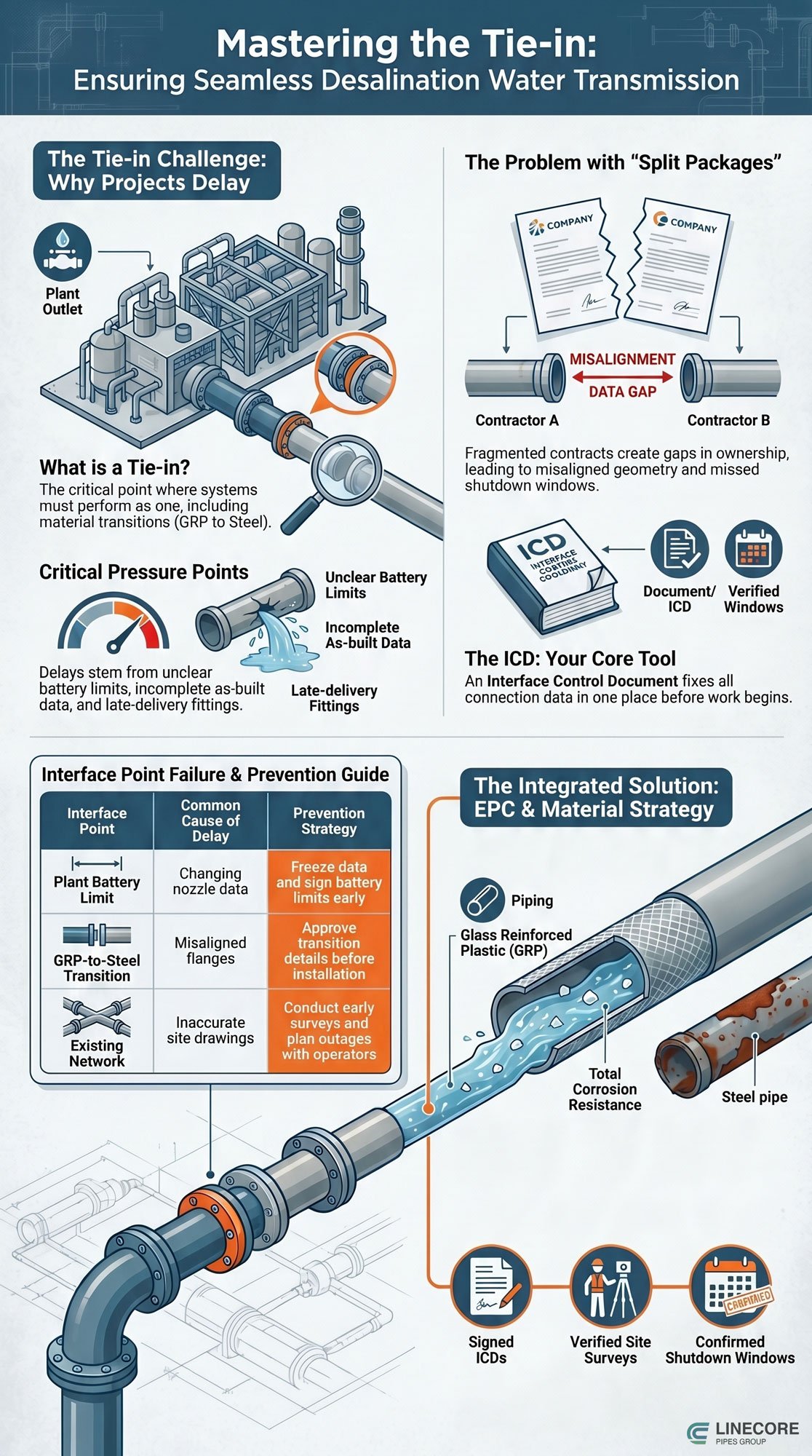
A desalination plant only will have done its responsibility when water goes through the transmission networks and distributions. That’s where tie-in systems matter as a fundamental factor to avoid failure of poor coordination.
What Is a Tie-in?
A tie-in is where systems connect and must perform as one. In practice, this includes plant outlet to transmission main, pump discharge to pipeline, GRP to steel transitions, and new lines to existing networks. It also covers reservoirs, control systems, and final testing and handover.
Engineering Note: Each tie-in combines hydraulics, materials, and real site conditions. Treat it as a design task, not just installation.
Why Tie-ins Cause Delays
Delays often start small and grow fast. A mismatch in spool dimensions or missing fitting can stop progress. A missed shutdown window can shift the entire schedule. Common pressure points:
- Unclear battery limits
- Incomplete as-built data
- Late fittings or long-lead items
- Utility conflicts and permits
- SCADA or control gaps
- Unapproved water-quality criteria
- Practical tip: lock interface data early and verify geometry before fabrication.
The Real Approach
Tie-ins should start at early engineering, not at the end. Plan them as a separate system with clear ownership, frozen data, and coordinated timing.
How to Reduce Interface Risk in EPC Tie-in System
Interface risk appears when too many sections share one connection point. As published in StudyLib, in desalination projects, the plant, pipeline, suppliers, and operator often work under separate contracts. This creates gaps exactly where coordination matters most.
The Problem with Split Packages
Each team delivers its own scope, but no one controls the full interface. On site, this leads to familiar conflicts. The plant contractor waits for the pipeline. The pipeline team reports changes at the outlet. The operator has not cleared the shutdown window. The supplier flags late fittings.
These issues do not come from poor work. They come from fragmented responsibility.
- Technical Point: tie-ins fail when geometry, schedule, and ownership are not aligned early.
Why EPC Integration Matters
An EPC approach brings design, materials, and execution into one system. The same team handles transmission engineering, selects the right composite system, plans fittings, and prepares the tie-in method. Testing, disinfection, and commissioning follow the same logic.
Supplier Side: Supply & EPC Integration
A supplier which provides both composite supply and EPC trustfulness can control the entire system to reduce the risk of interface points. Companies like Linecore Pipes Group works in this way to ensure a complete, detailed piping system for desalination plants.
Where Interface Delays Usually Happen
Most delays follow a pattern. They show up at known interface points where design, site reality, and operations must align. Teams that map these early avoid pressure at the final stage. Check the table below which starts with each touchpoint, then goes through the reasons and ends up with solutions.
| Interface Point | What Usually Happens | Why It Delays | How to Prevent It |
|---|---|---|---|
| Plant battery limit | Nozzle data not fixed | Design keeps changing | Freeze data and sign battery limits early |
| GRP-to-steel transition | Flanges don’t align | Stress builds at joints | Approve transition detail before install |
| Existing network tie-in | Real pipe differs from drawings | Shutdown time is limited | Survey early and plan outage with operator |
| Route crossings | Unknown utilities appear | Work stops for permits | Track crossings and permits from early stage |
| Pumping/storage interface | Pressure spikes or unstable flow | System not fully checked | Run full hydraulic and surge study |
| Water-quality release | Water passes tests but not approval | Criteria not aligned | Agree on quality targets early |
| SCADA and metering | Signals missing or late | Systems not connected | Lock signal list and test early |
| Commissioning handover | Docs and tests incomplete | Handover gets delayed | Use a live checklist from day one |
| Tie-in execution window | Site or materials not ready | Shutdown window is lost | Confirm full readiness before tie-in |
- Table Tip: What makes tie-in important in desalination is the site assumption will lead the project into failure. Then, add authenticated site surveys and inspections before design and production.
Why GRP and Composite Pipes Are Strong for Desalination Transmission
The choice of material indicates how a transmission line will perform during its lifespan. GRP and other composite systems are likely to satisfy all desalination projects due to their corrosion resistance and flexible design as a full system.
Corrosion Resistance in Marine and Saline Environments
Desalination plants require such resistant pipes that unlike traditional materials such as steel show no corrosion or degradation. GRP pipes include high toleration under saline soil, marine conditions, and chemical exposure.
- Coating Superiority: As ScienceDirect highlighted, while metallic pipes need to be coated once a while, GRP pipes, specially GRV or GRE types require no extra coating due to sophisticated resin materials like epoxy or vinyl ester.
Lightweight Handling and Faster Installation
Another reason which makes GRP pipes win the competition for desalination plants over metallic ones is their higher strength-to-weight ratio which helps them cut handling and installation costs.
Hydraulic Efficiency
GRP pipes contain a resin-rich internal surface which not only keeps them away from damages, but also increases the pumping efficiency and reduces the need for extra energy in long-length transmissions.
Large-Diameter Transmission Capability
GRP systems are widely used in large-diameter mains. They suit long routes where handling, installation speed, and environmental exposure all matter.
GRP as a Standards-Based System
GRP pipes are designed in a way that follows standards from the scratch (from material choice to installation and maintenance). This part shows related standards for GRP pipes in short and other in-line aspects.
| System Aspect | Relevant Standard |
|---|---|
| Pipe system | ISO 10639 |
| Pressure design | ASTM D2992 |
| Pipe specification | ASTM D3517 |
| Joint performance | ASTM D4161 / ISO 8639 |
- Pipe system sets material and water service requirements
- Pressure design confirms long-term strength under load
- Pipe specification defines size and performance limits
- Joint performance checks sealing and flexibility
Design the pipe, fittings, joints, supports, and tie-in sequence as one system, not as separate parts
Technical Tie-in Challenges for GRP and Composite Pipe Systems
GRP systems perform well in transmission lines, but tie-in zones demand tighter control. Most issues appear where materials change, forces concentrate, and site tolerances are tight.
GRP-to-Steel and Mixed-Material Connections
These connections often sit at pump headers, valve chambers, plant outlets, and existing metallic mains. Each location brings alignment and load challenges.
- Flanges must match exactly.
- Gaskets must suit pressure and water conditions.
- Bolt torque must follow a clear sequence.
Supports and anchors must carry loads without transferring stress into composite flanges.
- Engineering Error: Small mistakes at this stage can lead to leakage or long-term damage.
Joint Selection
Jointing methods are variable contexts in composite systems, even if the other side will be metal. Below we fully explained how each jointing method can ease the installation process.
- Gasketed couplings suit flexible sections and fast work.
- Flanged joints fit pumps and valves.
- Laminated joints serve permanent sections.
- Restrained joints carry axial force where thrust blocks are not used.
Adapter couplings handle material changes. Field closure spools help close the final gap.
Thrust and Surge Management
Tie-ins sit near bends, valves, and pumps where forces peak. Pressure can rise fast.
Run a surge study early. Use thrust blocks or restrained lengths at key points. Place anchors where loads transfer. to avoid spikes the valve timing must be accurate. Add air valves to control transients.
Field Lamination and Final Spool Risk
Field lamination works well but needs time and control. For tight shutdown windows, prefabricated spools or simple mechanical closures give more predictable results.
Interface Control Documents: The Core Tool for Avoiding Delays
Most tie-in problems come from missing or unclear information. Teams work with different assumptions, and the gap shows up on site. An Interface Control Document (ICD) solves this by fixing all interface data in one place before work begins.
What an ICD Document Should Cover + Document Sample File
An ICD is not just a drawing. It is a full definition of the connection. Below, we provide you a filled sample, and a ready-to-use template to apply it easily on your project.
| Field | Example Data |
|---|---|
| Interface ID | ICD-PLT-OUT-001 |
| Location | Plant outlet to DN1400 transmission main |
| Parties Involved | Plant EPC / Transmission EPC / Operator |
| Drawing Reference | P&ID-PLT-OUT-221, ISO-PIPE-445 |
| Pipe Material | GRP PN16 |
| Design Flow | 2.5 m³/s |
| Design Pressure | 16 bar |
| Surge Case | Pump trip scenario included |
| Connection Type | GRP-to-steel flanged joint |
| Required Components | Flange adaptor, gasket EPDM, M24 bolts |
| Access Requirements | Crane access, 6m clearance |
| Shutdown Requirement | 12-hour approved window |
| Testing Scope | Hydrotest + leak test |
| Water Quality Criteria | Chlorine residual 0.5 mg/L |
| SCADA Signals | Flow meter + pressure transmitter |
| Required Approvals | Operator + QA/QC + Consultant |
| Target Date | 15 June 2026 |
Pro Tip: if one item is unclear, the tie-in is not ready.
Interface Register: Tracking Every Critical Point
An ICD works best when supported by a live interface register. This acts as a control dashboard for the project.
| Interface Point | Risk Level | Owner | Due Date | Status | Open Actions | Impact if Delayed |
|---|---|---|---|---|---|---|
| Plant outlet | High | EPC | 10 May | Open | Final nozzle check | Delays spool fabrication |
| Network tie-in | High | Operator | 18 May | Pending | Shutdown approval | Stops final connection |
| Valve chamber | Medium | Contractor | 22 May | Open | Support alignment | Rework on site |
This register keeps focus on what matters most and shows where action is needed.
Why Spreadsheets Fail in Complex Projects
A spreadsheet stores data, but it does not connect it. In desalination EPC work, each interface depends on design, procurement, site readiness, QA/QC, and commissioning.
When these stay separate, gaps appear. Spools get fabricated before surveys. Shutdowns get booked before materials arrive. Tests fail due to missing approvals.
A proper system links each ICD to live inputs. Drawing updates, material status, site conditions, and test records stay aligned.
This shift turns interface tracking into real project control.
Digital Verification: BIM, 3D Models, and As-Built Surveys
Modern EPC projects rely on digital verification to control tie-in risk. Drawings alone are not enough. Many existing systems differ from old records, and small deviations can stop a tie-in on site.
A. Why Design Drawings Are Not Enough
Design drawings show intent, not reality. Field conditions often shift over time. A fabricated spool based only on drawings may not fit during installation.
B. Laser Scanning and Reality Capture
Laser scanning gives accurate site data before fabrication. On one hand, this shows pipe positions, valve chamber dimensions, nozzle situations, supports, and clearances. On the other hand, it highlights clash risks early. (Source: AutoDesk.com)
C. Virtual Fit-Up Before Fabrication
The process is simple and effective. Survey the site, build the model, check the fit, then fabricate. This reduces errors and avoids rework during shutdown windows.
Procurement Planning for Long-Lead Tie-in Components
Tie-in success depends on what arrives on site and when. Many delays come from late or missing components, not from installation work.
Components That Must Be Ordered Early
There are multiple components which require to be ordered early. In this part we bring most of them as well as pointing out why this matters.
- GRP fittings: custom pieces often need longer production time
- Large-diameter bends: limited suppliers and longer fabrication cycles
- Flanges: must match exact pressure class and dimensions
- Transition couplings: critical for mixed-material connections
- Restrained joints: required where thrust control is needed
- Valves: long lead times, especially for large diameters
- Gaskets and bolts: small items that can stop final assembly
- Expansion joints: needed in specific movement zones
- Steel transition spools: require precise fabrication after survey
- Repair materials: needed for contingency during tie-in
- Special supports and anchors: must match load and layout conditions
Why Late Specials Delay the Whole Project
Mainline installation can move fast. But one missing fitting can stop the final tie-in for weeks. This delay often appears at the worst stage, during shutdown windows.
Supplier/EPC Alignment
An integrated approach links supply, design, and installation. When one team controls all three, procurement aligns with real site needs and timing.
Construction Readiness Before the Tie-in Window
Good preparation lowers risk during the tie-in window. It also helps avoid delays when the shutdown starts. Each of these stages includes multiple smaller steps to pass and reach the readiness for further operations.
- Site Readiness: Keep access roads clear. Make sure excavation permits are approved. Sign off the utility clearances. Check traffic plans to be ready before work begins. Arrange crane lifts and dewatering machineries. Secure all HSE permits. Missing one item can stop the work.
- Technical Readiness: Finish the as-built survey. Check spool sizes against site conditions. Install supports and anchors. Inspect all fittings and check them to be correct. Train the crew. Approve the jointing method and procedure. Do not leave decisions for site time.
- Operational Readiness: Confirm the shutdown window with the operator. Make sure the operator is on site. Prepare isolation and bypass plans. Keep repair materials close to the work area to avoid increase in downtime.
Testing, Flushing, Disinfection, and Water-Quality Release
Mechanical completion is not enough. A pipeline may be connected, but still not ready for service. Water-quality release confirms real readiness.
Hydrotesting
Teams set test limits and install temporary supports where needed. Pressure follows the design class. Instruments must show stable readings. Witness points are agreed with the operator. The line must hold pressure and meet acceptance rules. (Source: ResearchGate)
How to Flush and Clean the Piping System
The pipeline must be clean before potable use. Water goes through the line to remove impurities and dust.
Infection Reduction
use chlorination or another well-used method to get rid of infections. Samples are taken from several points. The system stays closed until results pass. Then neutralization and disposal follow local rules. Final approval comes from the operator.
Desalinated Water Chemistry
Desalinated water often needs pH adjustment and remineralization before entry into the network.
Below we bring you a short table that guides EPC managers for essential standards for each step.
| Activity | Standard |
|---|---|
| Hydrotesting | ISO 14692 / AWWA C600 |
| Flushing | AWWA C651 |
| Disinfection | AWWA C652 |
| Water quality | WHO Guidelines |
Check links of each standard for more information and get a subscription.
Commissioning the Whole System, Not Just the Pipe
Commissioning goes far beyond the pipeline itself. It connects the transmission line to the full desalination plant operation and ensures everything works together smoothly.
Integrated Commissioning
Teams check the full system, not single parts. They test key equipment and control functions:
- Pumps start flow
- Valves open close
- Flow meters read right
- Pressure transmitters steady
- SCADA alarms signals
- Interlocks safety action
Performance Run
During the performance run, operators check real-world conditions. They monitor flow rates, pressure levels, leakage, water quality, and overall operating stability.
Handover Documentation
Complete records make future operation easier. Handover includes as-built drawings, test records, disinfection certificates, material certificates, O&M manuals, spare parts list, training records, and emergency response procedures.
This full-system approach helps avoid surprises after handover and ensures reliable long-term performance.
Practical Pre-Tie-in Readiness Checklist
Tie-ins only work when preparation matches reality on site. One small gap can block the shutdown window or force rework under pressure. This checklist keeps the focus on what must be physically and contractually ready before connection.
Before executing the final tie-in, confirm:
- Interface control document signed
- Hydraulic and surge cases frozen
- Water-quality limits agreed
- As-built survey completed
- Tie-in spool checked and verified
- GRP–steel transition detail approved
- All valves and fittings delivered
- Supports and thrust blocks installed
- Permits and access cleared
- Shutdown window confirmed
- Hydrotest plan approved
- Flushing and disinfection ready
- SCADA signals tested
- HSE plan approved
- Emergency materials on site
- Handover documents prepared
A tie-in succeeds when nothing is left to interpretation on the day of execution.
Tie-in Workflow
Tie-in execution in desalination projects follows a strict sequence from design freeze to commissioning. Each step depends on the one before it, and delays usually impact the shutdown window.
Tie-ins succeed when all stages connect without gaps from engineering to commissioning. It is a continuous chain, not isolated tasks.
How Linecore Pipes Group Helps Avoid Interface Delays
A leading company in desalination transmission must connect design, supply, and field execution without gaps. It must keep every discipline aligned and prevent delays caused by fragmented responsibility.
Linecore Pipes Group helps desalination projects move from design to field without delays or friction. It supplies GRP and composite piping systems built for long-distance and saline water transmission.
Your Trusted Partner in EPC Transmissions
Linecore also works as an EPC transmission partner. It supports engineering, procurement, installation planning, tie-ins, testing, commissioning, and handover. This keeps all project aspects connected.
What Our Team Provides
The team designs the system as a single-point package. It makes pipes, fittings, installation, and tie-in steps connected together from the scratch. This decreases the risk of last-minute changes and field confusion.
This approach cuts interface issues. It reduces disputes, delays, rework, missed shutdown windows, and commissioning gaps in your piping projects trustfully.
about
The Author

Farshid Tavakoli is a seasoned professional in engineering and international trade. Holding degrees in Electrical Engineering, Mechatronics, and a Doctorate in Business Administration (DBA) from the University of Lyon, he also has a strong background in industrial automation and production line technologies.
For over 17 years, he has led an international trading company, gaining deep expertise in commercial solutions tailored to industrial needs. With more than 8 years of active involvement in infrastructure development, he specializes in the supply of electromechanical equipment for water and wastewater treatment plants and transfer projects.
Together with comapny expert team, he now provides consultancy and integrated solutions for sourcing and implementing complex infrastructure projects across the region.