You install a GRP pipeline, it passes the first tests, but months later, you start seeing leaks or cracks. That’s frustrating, right?
GRP pipes are flexible, so a little deflection is completely normal. But when it goes too far, you get joint leaks, liner strain, or long-term headaches. The secret isn’t just the pipe strength. It’s how well the pipe works together with the surrounding soil. Linecore Pipes Group supplies the pipes and supports the full EPC chain so you get reliable, long-lasting results.
What Is Pipe Deflection in GRP Pipes?
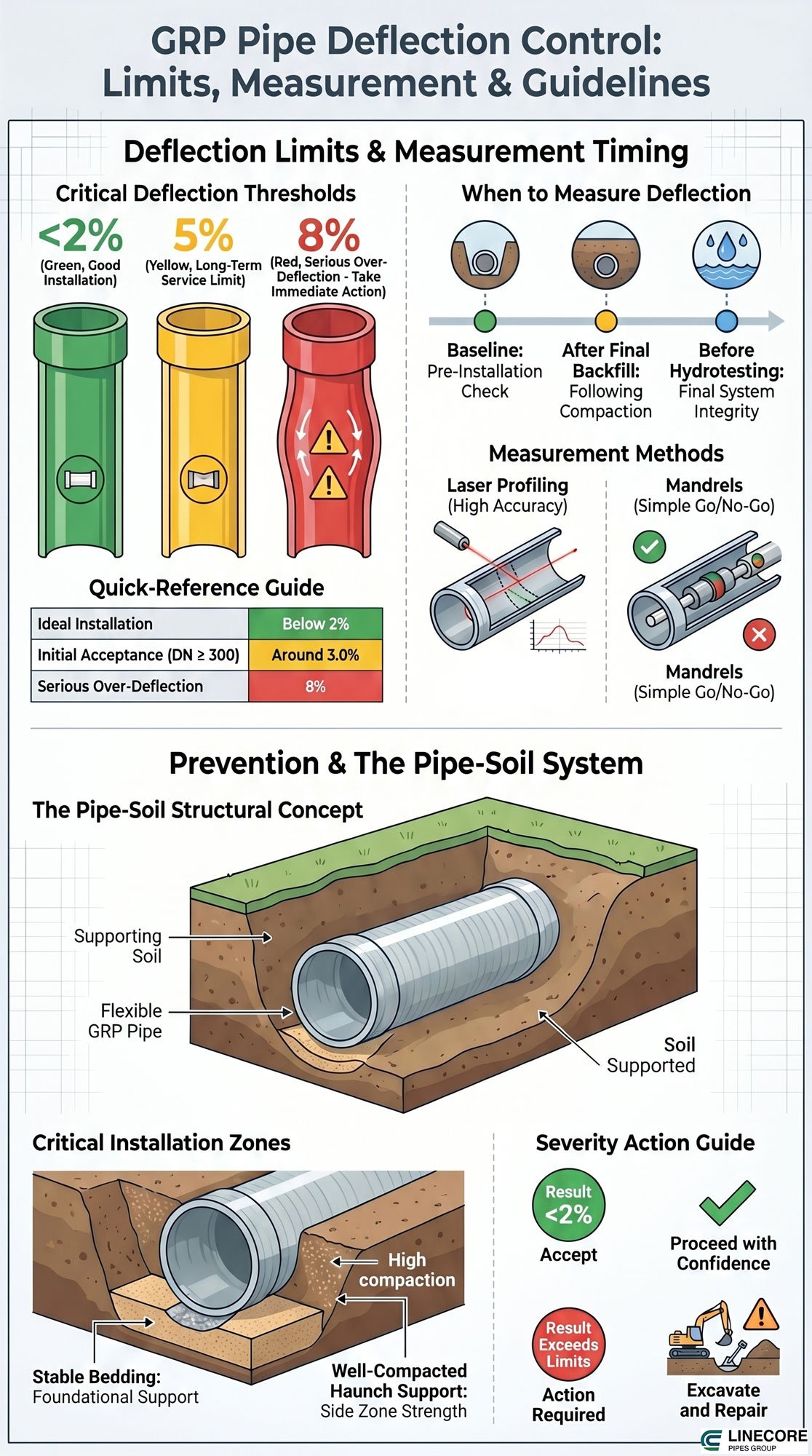
GRP pipe deflection control infographic (source: pipelinecoregroup.com)
Deflection is really straightforward in the field. It’s simply how the pipe changes shape after you bury it. Below are different kinds of deflection:
- Vertical deflection: How much the vertical inside diameter shrinks.
- Horizontal expansion: The normal outward push caused by soil loading.
- Ovalization: The pipe becomes slightly oval.
- Local distortion: Bulges, flat spots, or sudden curves. These are the ones that can really cause trouble.
A small, uniform deflection is usually fine. But a local bulge or flat area can be a problem even if the average percentage still looks low.
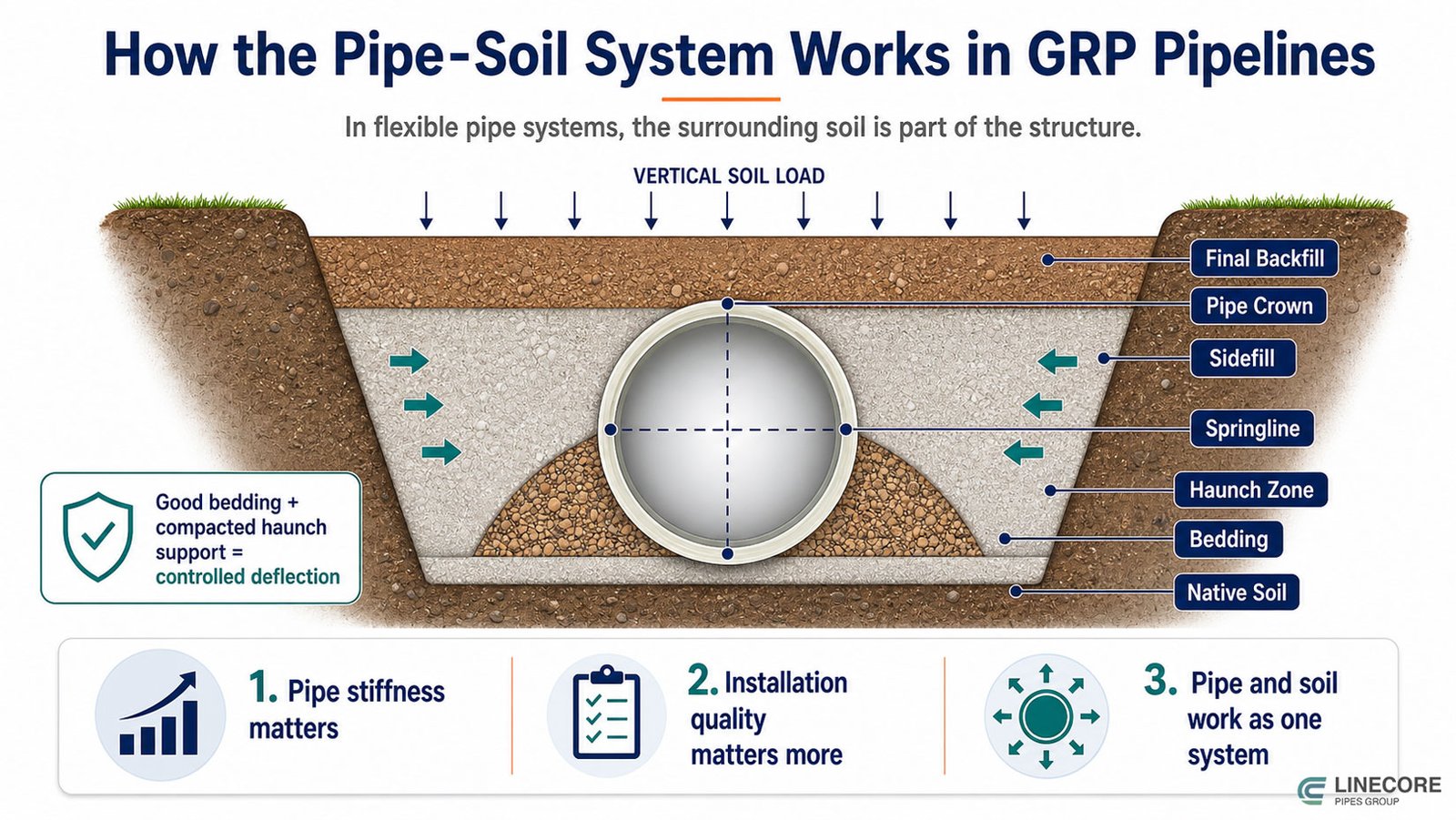
GRP Pipes Are Flexible Pipes: The Pipe-Soil System Concept
According to the U.S. Bureau of Reclamation, the soil around your pipe is actually part of the structure. It’s not just dirt holding the pipe in place. Pipe stiffness is important, sure, but your installation quality usually matters even more. Good bedding and haunch support allow the soil to push back against the load and keep the pipe stable.
Poor compaction in the pipe zone lets the pipe deform too much. And even high-quality imported backfill can underperform if the native soil underneath is weak.
Typical Deflection Limits for GRP Pipes
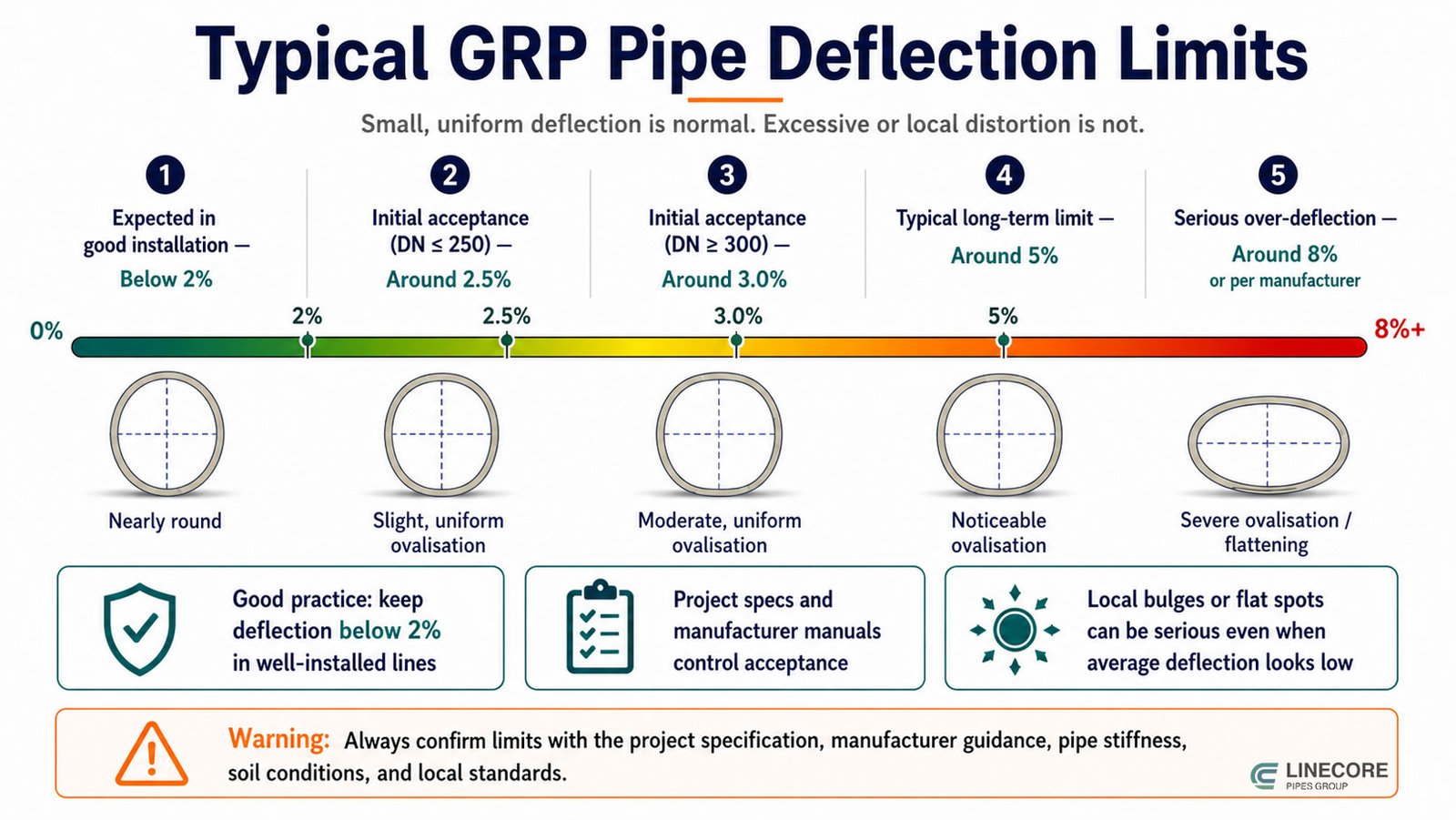
Here’s what you will actually see on site when installing GRP pipelines. These are the practical numbers most projects work with in the field. They give you a clear idea of what counts as good work, what’s acceptable, and when you need to stop and fix something (Source: ScienceDirect).
- In a good installation, deflection should stay below 2%.
- For initial acceptance after backfill, you can usually go up to 0% for pipes DN 300 and bigger.
- For smaller pipes (DN 250 and below), keep it around 5%.
- Over the long term, 5% is the normal service limit you should stay under.
- Once you hit 8% or more, it becomes serious, and you need to take action fast.
The table below summarises these typical deflection limits for quick reference:
| Control Item | Typical Practical Limit |
|---|---|
| Expected in good installation | Below 2% |
| Initial acceptance (DN ≥ 300) | Around 3.0% |
| Initial acceptance (DN ≤ 250) | Around 2.5% |
| Typical long-term limit | Around 5% |
| Serious over-deflection | Around 8% or per manufacturer |
Warning: These are typical numbers only. Always check the manufacturer’s manual, your project specification, pipe stiffness, diameter, pressure class, soil conditions, and local standards before you use them.
Standards and Guidelines Used for GRP Deflection Control
You will see quite a few standards when working with GRP pipes. For example, For GRP piping systems, ISO 23856 for GRP piping systems is a useful product-standard reference for pressure and non-pressure applications Here’s what actually matters in practice:
- Product standards: ISO 10639, AWWA C950, ASTM D3517. These set the quality and performance requirements for the pipes themselves.
- Installation guides: ASTM D3839, AWWA M45, EN 1610, EN 805, CEN/TS 14578. These tell you how to install buried flexible pipelines properly.
- Structural design: ISO/TS 20656-1, AWWA M45. These cover the engineering calculations for the pipe-soil system.
- Testing & measurement: ISO 10466, ISO 10471, ASTM F3095 (laser profiling). These are the standards you use to measure deflection and check the pipe condition.
Important point: Installation standards show you the methods, but they don’t always give you the exact deflection limits. Your project specification and the manufacturer’s approved procedure are what set the final acceptance limits you must follow. Have a look at this clear summary:
| Category | Standards & Guidelines | What They Cover | Relevance to Deflection |
|---|---|---|---|
| Product standards | ISO 10639, AWWA C950, ASTM D3517 | Pipe quality & performance | Pipe stiffness classes |
| Installation guides | ASTM D3839, AWWA M45, EN 1610, EN 805, CEN/TS 14578 | Installation methods | Bedding, haunching, backfill |
| Structural design | ISO/TS 20656-1, AWWA M45 | Pipe-soil system calculations | Expected deflection limits |
| Testing & measurement | ISO 10466, ISO 10471, ASTM F3095 | Deflection measurement | Field inspection & acceptance |
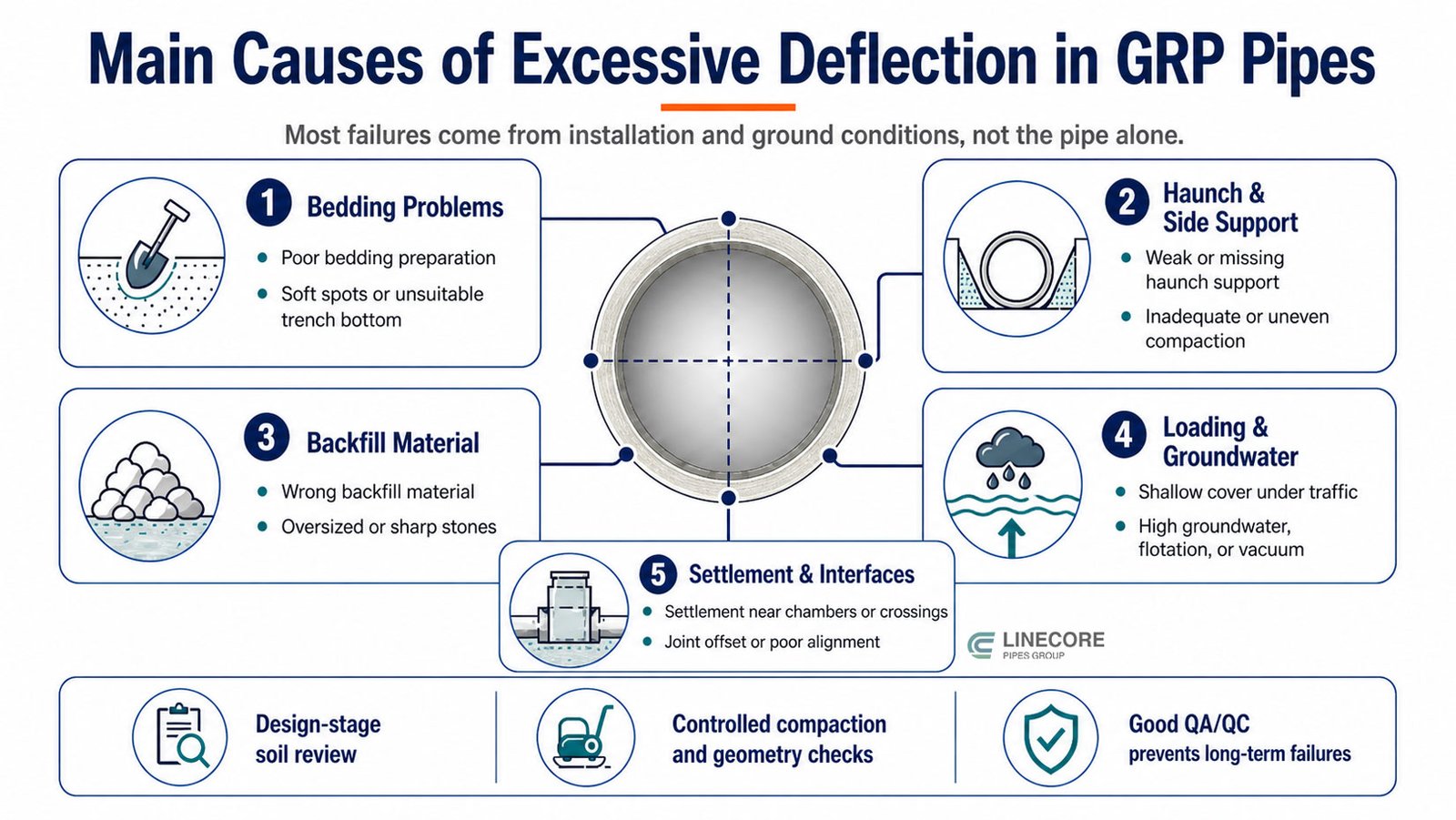
Main Causes of Excessive Deflection in GRP Pipes
You see these problems on-site all the time. Here are the most common causes, explained clearly so you can spot and avoid them:
Installation-related causes:
- Poor bedding preparation leaves the pipe with bad support right from the start.
- Weak or missing haunch support lets the pipe deflect downward too much.
- Unsuitable backfill material fails to give the pipe proper support.
- Oversized stones or sharp particles in the pipe zone damage the pipe.
- Inadequate compaction beside the pipe reduces the side support you need.
- Unequal backfill placement on both sides causes uneven deflection.
Site and condition-related causes:
- Shallow cover under traffic loading puts too much pressure on the pipe.
- High groundwater or pipe flotation during installation moves the pipe out of position.
- Vacuum or negative pressure conditions deform the pipe.
- Settlement near chambers, valves, thrust blocks, slopes, and crossings distorts the pipe.
How Linecore Pipes Group Helps:
Linecore’s EPC approach controls these risks with design-stage soil review, material approval, trained crews, compaction records, geometry checks, and proper commissioning documentation.
Installation Quality Controls That Prevent Deflection
The best way to stop excessive deflection is to get the installation right from the very beginning. Here are the key things you need to do on-site:
Pipe Handling and Storage
You have to handle the pipes carefully so you don’t damage them before they even go into the trench. Use fabric slings instead of chains, protect the ends and spigots, avoid any impacts, and inspect every pipe thoroughly before lowering it.
Trench Bottom and Bedding
A stable foundation makes a big difference. You should:
- Keep the trench bottom stable and level.
- Use a uniform bedding layer of the right thickness.
- Dig proper bell holes at every coupling.
- Remove all rocks, frozen soil, organic material, or soft spots.
Haunching and Side Support
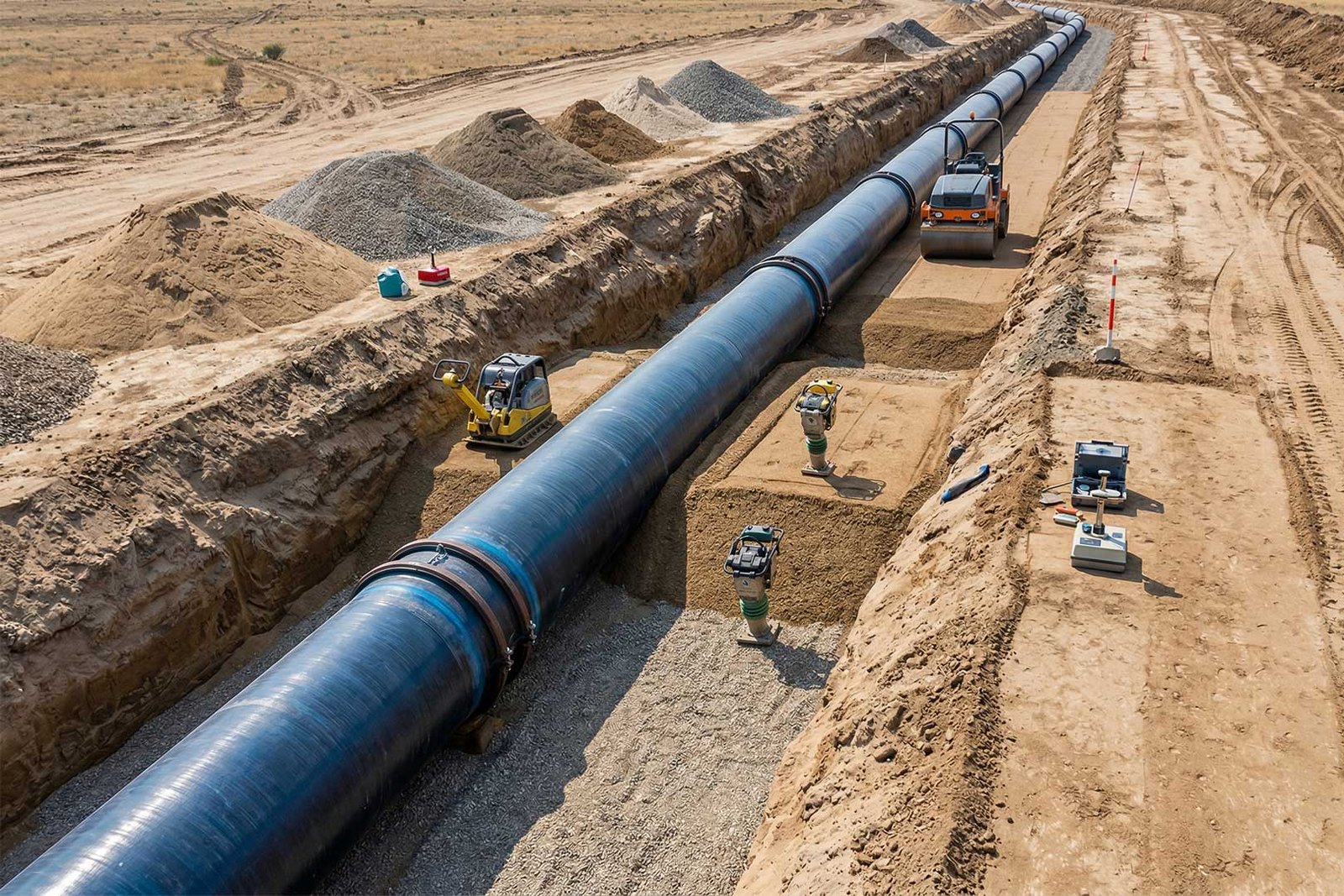
This is the most important zone for flexible GRP pipes. You must give it solid, well-compacted support under the lower sides of the pipe. If the haunch is weak, the pipe loses side resistance and deflects too much.
Backfilling and Compaction
How you backfill and compact is critical. Make sure you:
- Place the material in controlled lifts.
- Compact evenly on both sides of the pipe.
- Keep heavy equipment away from areas with shallow cover.
- Always verify the field density.
Joint Assembly and Alignment
Pay close attention when joining the pipes. Clean the gaskets and grooves properly, use the approved lubricant, control the insertion depth, check the angular deflection, and keep adjacent pipes well aligned.
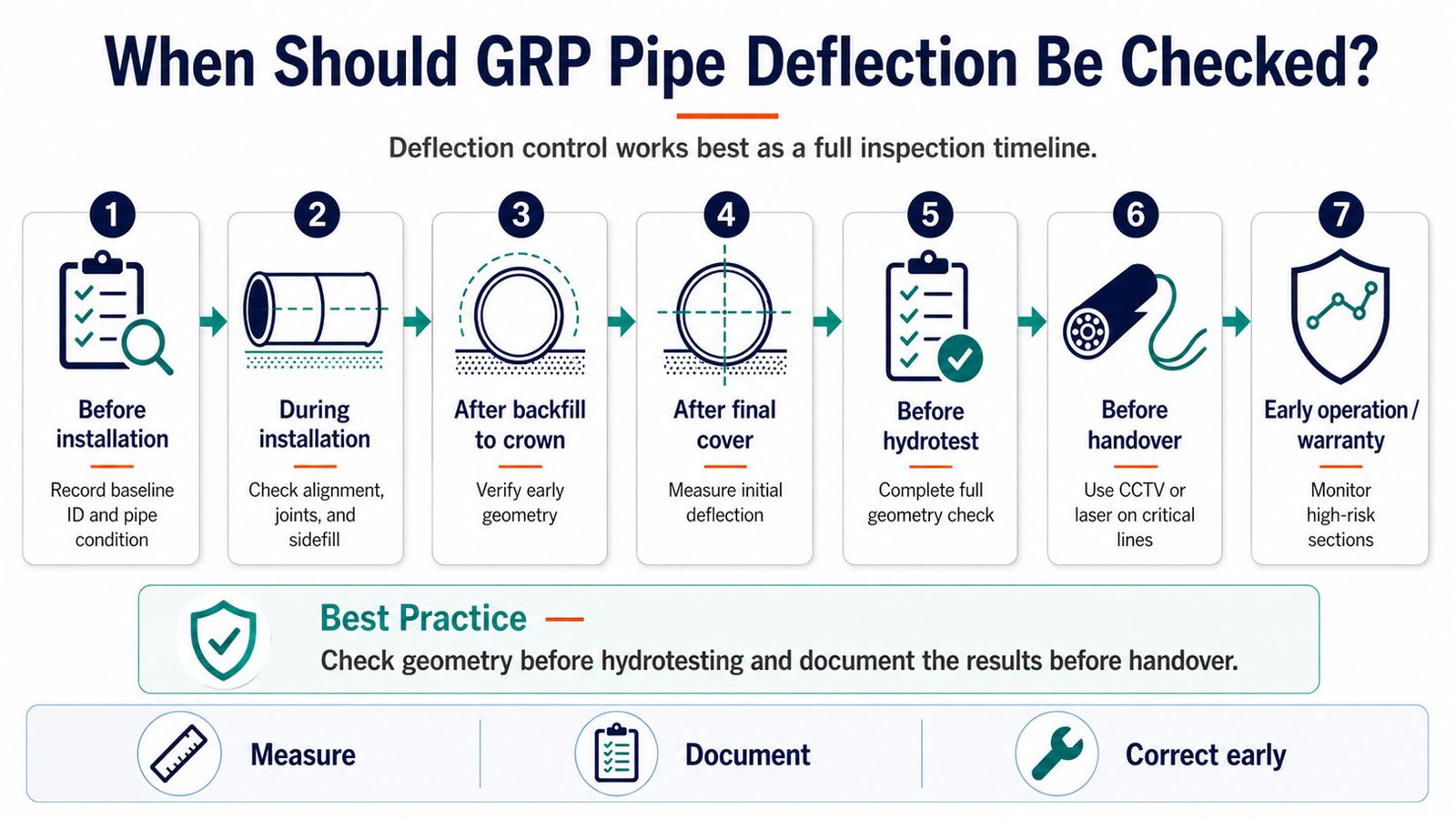
When Should Deflection Be Checked?
You should check deflection at several key points during the project. The earlier you catch a problem, the easier and cheaper it is to fix. Below are the practical timelines you need to follow:
- Before installation: Measure the actual inside diameter and inspect the pipe condition. This is your baseline.
- During installation: Check alignment, joint gaps, and sidefill quality as you work.
- After backfill to the crown: Do an early check where it’s required.
- After final cover: Measure the initial deflection.
- Before hydrotesting: Do full geometry and visual checks.
- Before handover: Run CCTV or laser profiling on critical lines.
- During early operation or warranty: Go back and recheck high-risk sections.
Check early and often. It will save you a lot of headaches later.
How to Measure GRP Pipe Deflection in the Field
You need good measurements to know whether your installation is successful or needs fixing. Here are the practical methods you can use, from simple to advanced:
Basic Formula
Deflection % = [(Actual ID − Installed Vertical ID) / Actual ID] × 100
Always use the actual inside diameter, either from the manufacturer’s data or by measuring the pipe while it is still loose. Do not use the nominal diameter, because it is not accurate enough.
Manual Measurement
Use a caliper or telescopic gauge. This is a simple and quick method that works well for spot checks, especially on large diameter pipes that are easy to access after installation.
Mandrel Testing
This is a go/no-go test where you pull a mandrel through the pipe. It is commonly used on smaller sewer pipes, but it only tells you if the deflection is acceptable or not, it does not give detailed information about the pipe shape.
CCTV Inspection
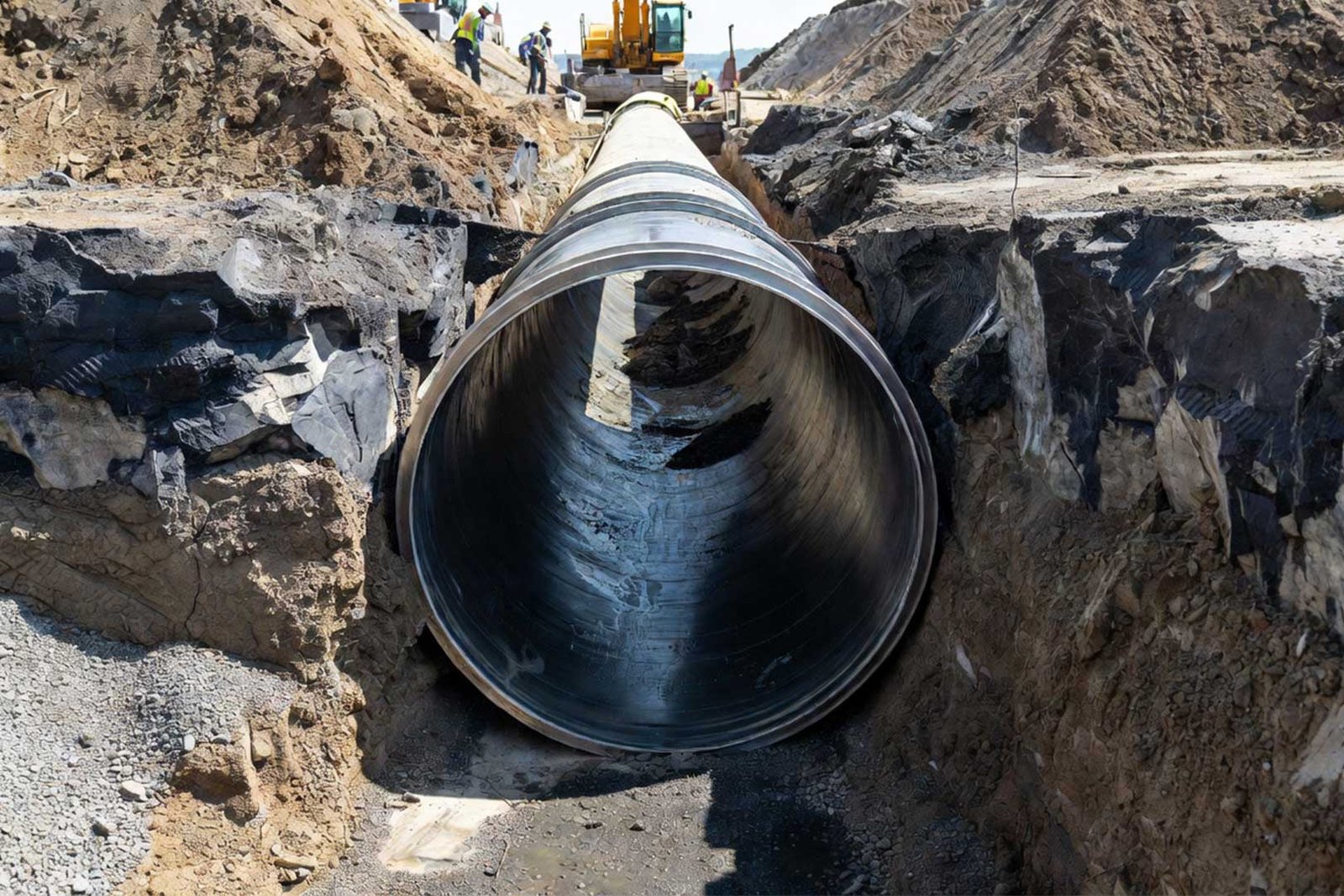
You send a camera through the pipeline to visually check the inside. It helps you see joints, cracks, offsets, bulges, and other visible defects. CCTV Inspection is very useful before handover or during inspections.
Laser Profiling
This is the best and most accurate method for major water transmission lines. The laser scans the pipe continuously, measures ovality and deformation precisely, and creates digital records that you can use for acceptance, dispute prevention, and long-term asset management.
Advanced Monitoring
On critical or high-risk sections, you can install strain gauges, distributed fiber-optic sensors, or use survey monitoring points to track deflection over time.
Field Acceptance Decision Guide
Once you have measured the deflection, use this guide to decide what to do next. It helps you take the right action quickly and avoid costly mistakes.
| Field Result | Severity | Recommended Action | Urgency |
|---|---|---|---|
| Below 2% + no local distortion | Good | Accept the section if all other checks pass | None |
| Above 2% but below project/OEM limit | Mild | Get engineering review and increase monitoring | Low |
| Above initial acceptance limit | Moderate | Excavate, repair haunch/backfill, then remeasure | Medium |
| Bulge, flat spot, abrupt curvature, or joint offset | High | Reject the section and correct it immediately | High |
| Severe deflection or structural damage | Critical | Replace the affected pipe section | Very High |
Note: Always follow your project specification and the manufacturer’s approval for final acceptance.
Deflection Control for Water Transmission EPC Projects
At Linecore Pipes Group, deflection control is not just one inspection at the end. It is a complete EPC quality system. We start at the design stage and stay involved all the way through procurement, installation, measurement, testing, and handover.
You get proper pipe stiffness selection, soil review, method statements, backfill approval, crew training, QA/QC checklists, measurement protocols, hydrotest support, and full documentation. This way, you reduce risks and end up with a reliable pipeline.
Common Mistakes to Avoid
You can avoid a lot of deflection problems if you stay away from these common mistakes that happen on many sites:
- GRP pipes get treated like rigid pipes
- Pipe stiffness gets chosen without proper soil checks
- Unapproved or poor-quality backfill gets used
- Proper haunch compaction gets skipped
- Deflection gets measured too late, after paving or commissioning
- Average deflection gets accepted while local bulges get ignored
- Hydrotesting happens before geometry and deflection checks
- Generic limits get used without checking manufacturer and project specs
Pro Tip: Always check deflection and fix problems while the trench is still open. It saves you a lot of time and money later.
Practical QA/QC Checklist for GRP Deflection Control
Use this checklist on-site to stay in full control of deflection throughout the project.
1. Before Installation
This is your first important quality gate. Take time to verify the pipe itself before it goes into the trench so you start with good material.
- Pipe ID and class are verified
- Pipe is visually inspected for damage
2. During Installation
While the pipe is being lowered and positioned, you need to focus on the foundation and jointing. These steps have a big impact on how the pipe will behave after backfilling.
- Bedding is approved and stable
- Pipe-zone material is approved
- Trench water is fully controlled
- Joints are properly assembled and checked
- Sidefill is placed evenly on both sides
3. During Backfilling & Compaction
This is one of the most critical stages for preventing excessive deflection. Proper compaction in the right zones gives the pipe the support it needs. Make sure compaction records are fully completed before you continue.
4. After Installation
Once the pipe is buried, you must verify the actual results before you proceed to hydrotesting or handover. This is your chance to catch and fix issues while it is still relatively easy.
- The installed vertical ID is measured
- Deflection percentage is calculated
- CCTV or laser profiling report is attached (where required)
- All nonconformities are fixed before hydrotesting
- Complete records are included in the handover file
Pro Tip: Go through this checklist at the end of every stage before you backfill or move forward. Fixing problems early is always much cheaper and faster.
Why Early Deflection Control Saves Project Cost
You save a lot of money when you control deflection early. If you find a problem while the trench is still open, you only do a small local excavation and recompaction.
But when you discover the issue late, after the pipe is buried, paved, or the line is already in service, the cost becomes much higher. You face shutdowns, difficult access, relining, full pipe replacement, claims, and long delays. Clear deflection records also reduce disputes between the owner, consultant, contractor, and supplier.
Conclusion: Deflection Control Is a System, Not a Single Test
GRP pipes can give you long service life, excellent corrosion resistance, and good flow. But they only perform well when you treat the pipe, soil, trench, backfill, joints, and quality control as one complete system. Deflection control is the practical bridge that connects good design to reliable long-term performance.
Linecore Pipes Group supports you with GRP pipe supply, installation guidance, full EPC water transmission solutions, field QA/QC planning, and commissioning support to help you build strong and reliable buried pipelines.
about
The Author

Farshid Tavakoli is a seasoned professional in engineering and international trade. Holding degrees in Electrical Engineering, Mechatronics, and a Doctorate in Business Administration (DBA) from the University of Lyon, he also has a strong background in industrial automation and production line technologies.
For over 17 years, he has led an international trading company, gaining deep expertise in commercial solutions tailored to industrial needs. With more than 8 years of active involvement in infrastructure development, he specializes in the supply of electromechanical equipment for water and wastewater treatment plants and transfer projects.
Together with comapny expert team, he now provides consultancy and integrated solutions for sourcing and implementing complex infrastructure projects across the region.