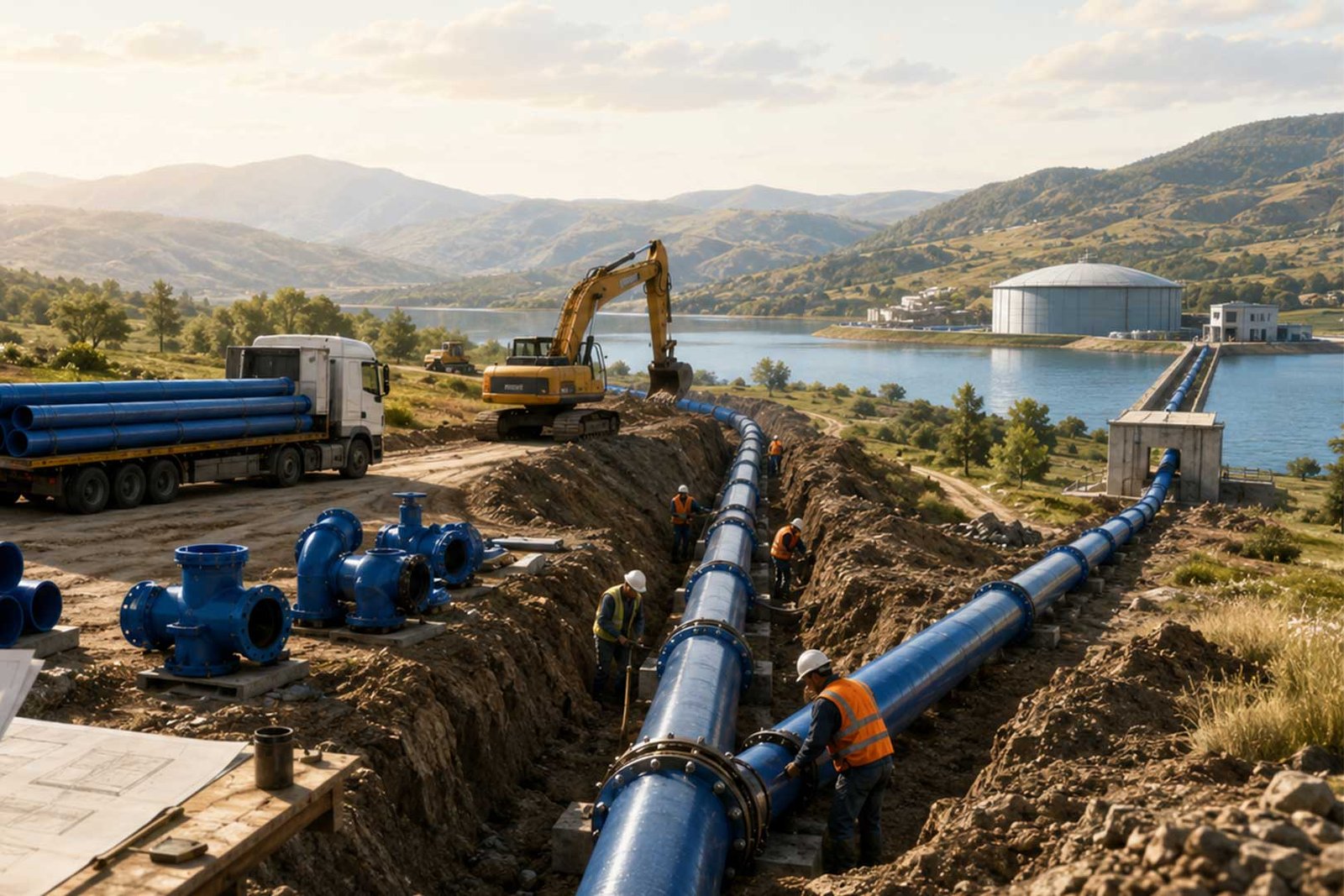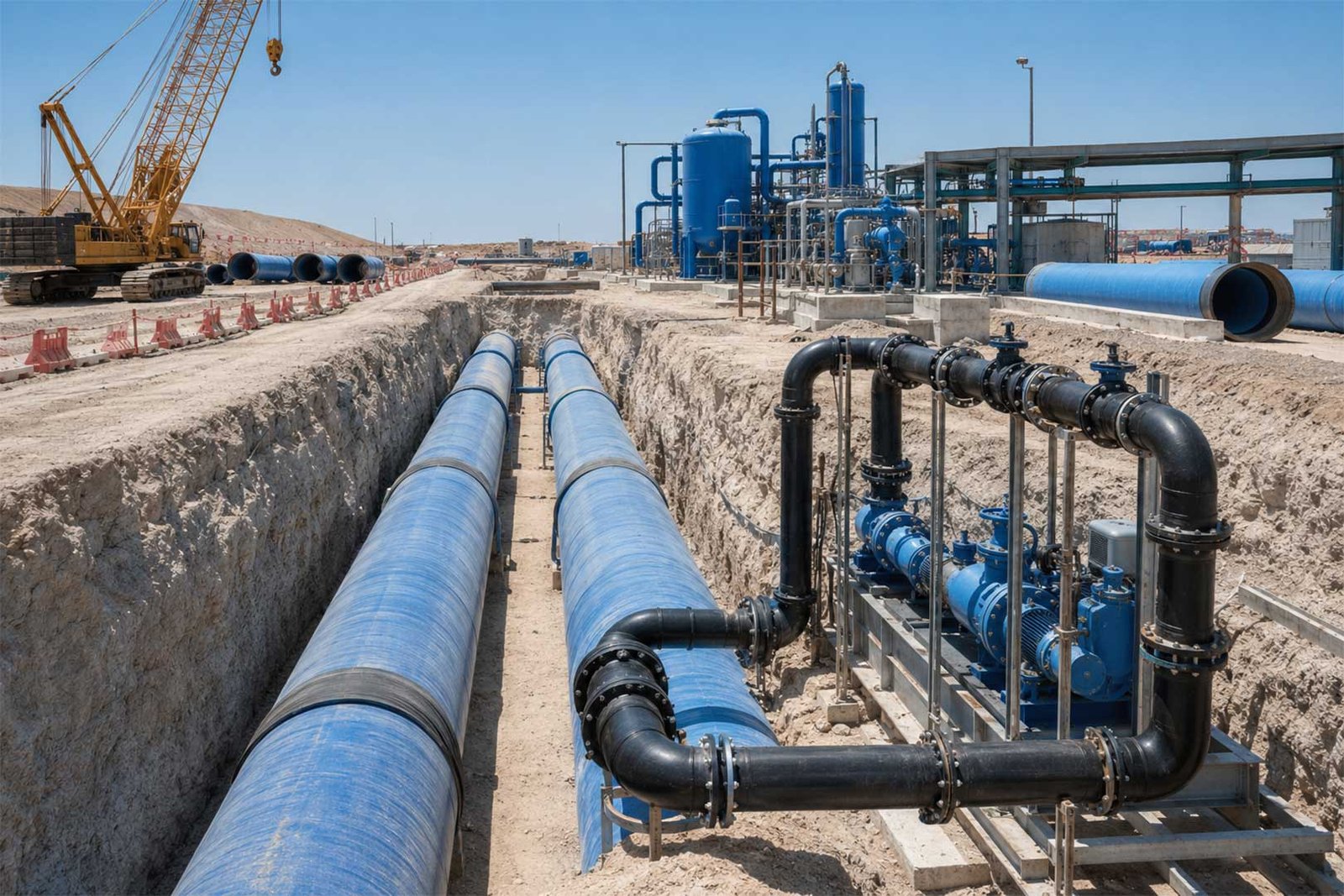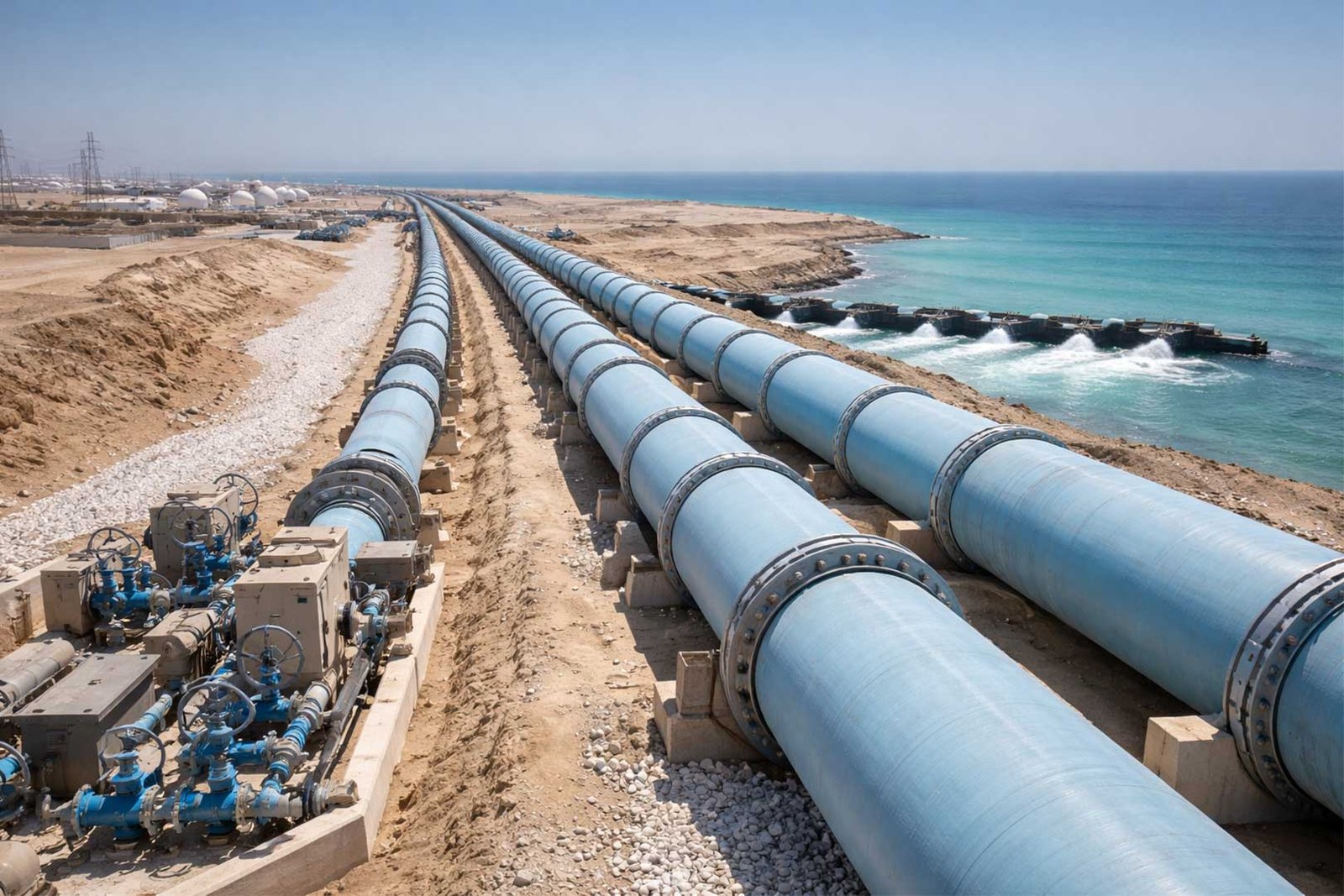
Imagine a water pipeline over 20 km long along the GCC coast. These projects face much tougher conditions than normal pipelines. You face issues such as salty air, soil full of chloride and sulfate, shallow saline groundwater, and sabkha ground that can cause unevenness or make pipes float. The GCC produces a huge portion of the world’s desalinated seawater, so one failure can disrupt municipal, industrial, and strategic water supply for many people.
As a result, you need something more than the right pipe type, like combining hydraulics, geotechnics, installation, and QA/QC from the start. Now, we share practical design, construction, and operational lessons from real GCC coastal transmission projects to help you in this way.
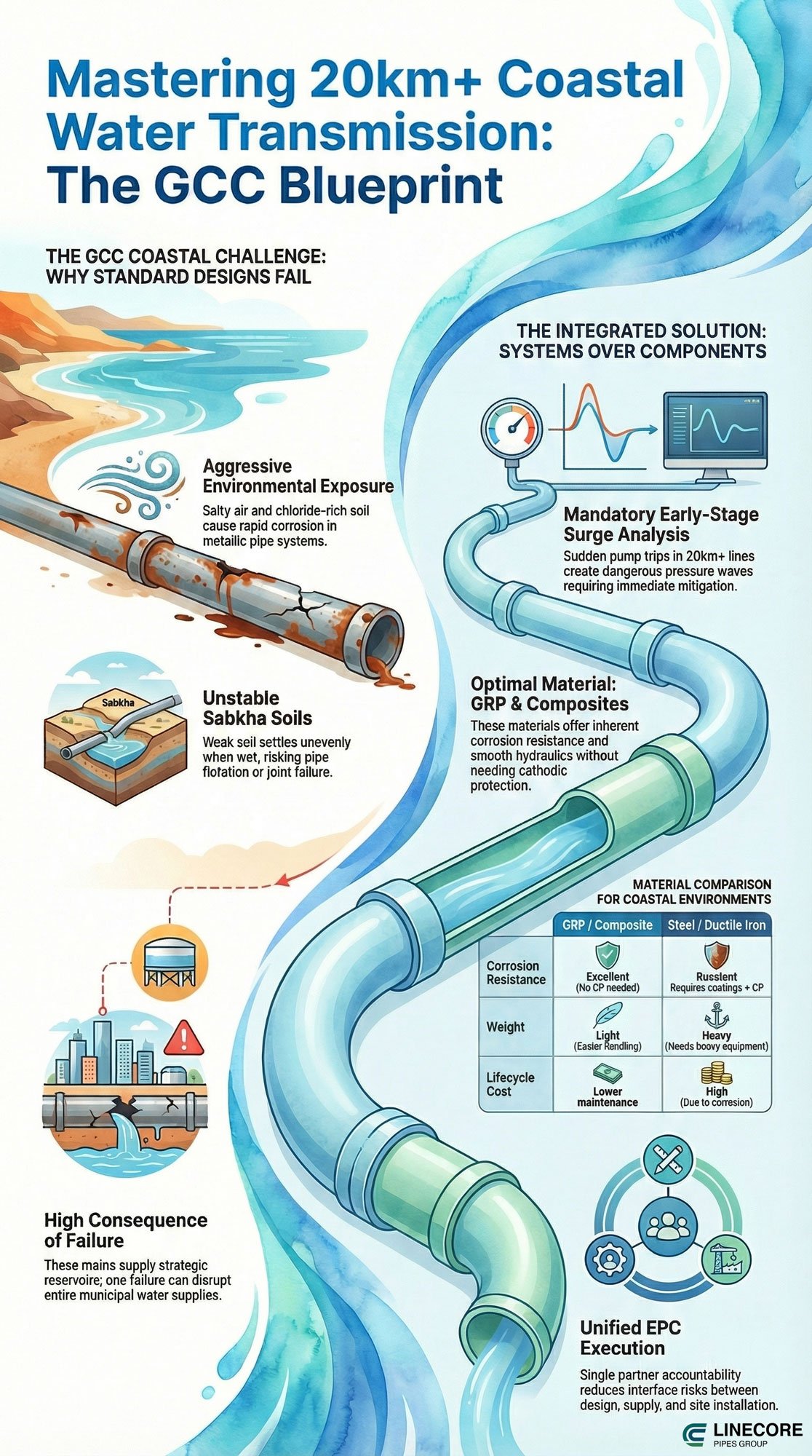
Mastering 20km+ coastal water transmission infographic (Source: Pipelinecoregroup.com)
Why GCC Coastal Transmission Mains Are Uniquely Demanding
You know that long transmission mains are not like normal pipelines. You may have to deal with three big challenges that make them very special, including:
- Aggressive coastal exposure: Salty air attacks the pipes every day. The soil contains high chloride and sulfate. Groundwater is shallow and salty. These conditions cause strong corrosion on both steel and ductile iron pipes. North Penn Now explains that is why metallic pipes usually need extra coatings and cathodic protection to survive.
- Sabkha and unstable ground conditions: Sabkha soil is very common along the coast. It is weak and has low bearing capacity. When it gets wet, it settles unevenly. This creates risks of pipes settling differently, floating up, or causing trench problems during construction.
- High consequence of failure: The GCC produces a huge share of the world’s desalinated water. These long mains supply strategic reservoirs and carry bulk water for cities and industries. One failure can seriously affect the water supply for many people and businesses for a long time.
Case Study: Saudi Rayis–Rabigh IWTP Pipeline
Saudi Arabia built a 150 km pipeline from Rayis to Rabigh. According to Meed, It carries 500,000 m³ of desalinated water every day. The project moves water from the coast to inland areas. It shows how big and important these long coastal pipelines are.
Start with System Design, Not Just Pipe Material Selection
You want your transmission main to work reliably for many years. That is why you must start with the full system design, not just the pipe material.
A transmission main is much more than a long pipe. It is a complete system that runs from the source to the destination. This includes pump stations, connections to reservoirs, valves, fittings, thrust restraint, road crossings, and chambers. Good projects make important decisions early. These decisions control the biggest risks:
- Choosing the best route
- Defining the flow and demand needs
- Selecting the right pressure class and stiffness class
- Getting corridor approvals
- Deciding the construction methods (open cut, HDD, or others)
If you leave these decisions until later, problems become very expensive.
Hydraulic Design Priorities for 20+ km Transmission Mains
Good hydraulic design is very important for your 20+ km transmission main. It decides how well the pipeline will act and how much money you spend on pumping every year. Below, you can see what to do for a flawless project:
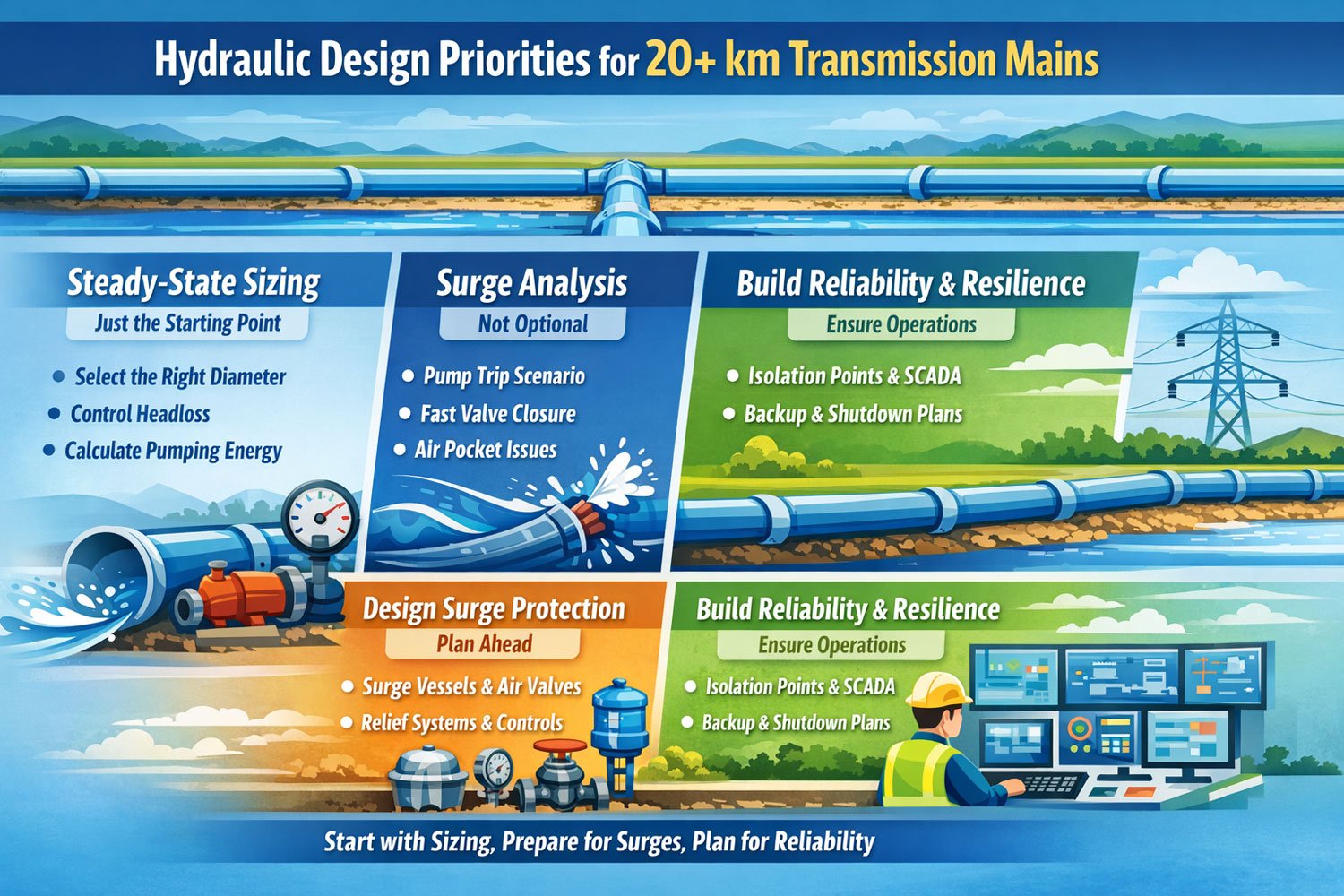
Steady-state sizing is just the starting point
First, you look at the normal flow. You choose the right pipe diameter, control headloss, and calculate pumping energy. A smooth pipe helps reduce energy costs.
But this is only the beginning. You cannot stop here.
Surge analysis is not optional
On long pipelines of 20 km or more, sudden changes can create dangerous pressure waves called surge or water hammer. You must study what happens when:
- A pump suddenly trips or loses power.
- A valve closes quickly.
- Air pockets move inside the pipe.
You need to check the lowest and highest pressures. If pressure drops too much, column separation can occur and damage the pipe.
Design surge protection as part of the system
You should include surge protection right from the start. Common solutions are surge vessels, air valves, and relief systems. You also need smart valve closure logic and good pump control.
Build reliability and operational resilience
Finally, think about how it is going to work on a daily basis. Repeat the process and make sure the system can keep running if one part fails. Plan clear isolation points, use SCADA for good visibility, and follow strict startup and shutdown procedures.
Choosing the Right Pipe System for 20+ km Coastal Mains
Choosing the right pipe is very important for your long coastal project. So let’s test various options you will have to pick between:
Where GRP and composite pipes help
In GCC coastal areas, GRP and other composite pipes often work well. They resist corrosion from salty air, salty soil, and saline groundwater. You usually do not need cathodic protection for the pipe wall. They have a smooth inside that helps water flow better and lowers pumping costs. They are also much lighter than steel or ductile iron. This makes transport and installation easier.
GRP vs GRE vs GRV/GRVE
You can choose from three main types as follows:
- GRP is good for normal potable water and transmission mains.
- GRV / GRVE is better when you need strong chemical resistance.
- GRE is better when you need higher temperature resistance or very high pressure.
Pick the resin type based on your water chemistry, pressure, and operating conditions.Here is how they compare:
| Feature | GRP (Polyester) | GRV / GRVE (Vinyl Ester) | GRE (Epoxy) |
|---|---|---|---|
| Best For | Potable water & transmission | Strong chemical resistance | High temperature & pressure |
| Max Temperature | Up to 60°C | Up to 90°C | Up to 110°C |
| Corrosion Resistance | Good | Very good | Excellent |
| Common Use in GCC | Municipal water mains | Industrial water | Seawater & high-pressure lines |
Pro Tip: Compare the pipes using your real conditions. Look at corrosion resistance, weight and logistics, how smooth the inside is, surge behavior, joint type, and total cost over the full life. There is no single best pipe for every case.
Case Study: Saudi Refinery Seawater GRP Pipeline
A big refinery in Saudi Arabia installed a 3000 mm GRP seawater pipe. Later, the pipe started leaking because of bad ground and installation problems. Sylmasta explains that workers fixed it fast with composite repair. This shows even GRP pipes need good installation near the coast.
Take a look at this comparison, too:
| Attribute | GRP / Composite | Ductile Iron (DI) | HDPE | Steel |
|---|---|---|---|---|
| Corrosion Resistance | Excellent (no CP needed) | Needs coatings + CP | Excellent | Needs coating + CP |
| Hydraulic Smoothness | Very smooth (C ≈ 150-155) | Good but drops over time | Very smooth | Depends on lining |
| Weight | Light | Heavy | Light | Heavy |
| Installation | Easier and faster | Needs heavy equipment | Easy | Needs welding |
| Surge Behavior | Lower wave speed | High wave speed | Lower wave speed | Highest wave speed |
| Lifecycle Cost | Lower maintenance | Higher due to corrosion | Low maintenance | High due to corrosion |
Geotechnical and Coastal Route Design Challenges
The ground along the GCC coast can create serious problems for your pipeline. You need to understand these challenges early and plan carefully.
Working with sabkha, reclaimed land, and shallow groundwater
Sabkha soil is very common on the coast. When it gets wet, it can suddenly settle or collapse. Reclaimed land and shallow groundwater also make construction difficult. You must use good trench support and manage the groundwater properly.
Bedding, haunching, and embedment are very important
Composite pipes are flexible. They need strong soil support around them to stay stable. Good bedding and haunching under and beside the pipe are critical.
Many problems happen because of poor compaction. That is why you must control compaction carefully during installation.
Buoyancy and anti-flotation design
In areas with high groundwater or reclaimed land, your pipes can float up. You need to design anti-flotation measures. You can solve this with staged backfilling and by adding anchors or weights.
Nearshore and marine interface risks
If your route goes near the sea or includes coastal crossings, you face extra risks. Waves and currents can cause scour around the pipe. You must choose the right burial depth and prevent free-span problems.
Pro Tip: Do all your geotechnical investigations early and share the results with your pipe supplier and contractor. This helps everyone make better decisions and avoid expensive surprises later.
| Challenge | What Happens | Why It Matters |
|---|---|---|
| Sabkha Soil | Settles or collapses when wet | Causes pipe settlement |
| Shallow Saline Groundwater | High water table | Risk of pipe floating |
| Differential Settlement | Uneven ground movement | Stress on joints and pipe |
| Low Bearing Capacity | Weak soil support | Needs better bedding & compaction |
Case Study: Bahrain TSE Phase II Program
Bahrain built 41 km of transmission lines for treated sewage water. GRUNDFOS reports that the project also added reservoirs and pumping stations. They reuse the water instead of wasting it. This helps save fresh water in the country.
EPC Execution Matters as Much as Design
Good design is important, but execution on site matters just as much. Many long transmission mains fail during construction, not just in the design stage. You need to pay close attention to these areas:
- Joint assembly issues, poor handling, bad bedding, installation damage, and wrong sequencing
- Choosing the right construction methods – open cut for the main route, HDD for crossings, microtunneling for critical spots, and marine installation where needed.
- Logistics and coordination for 20+ km jobs – pipe supply phasing, storage and handling, fittings and valve coordination, and construction front planning
- The big advantage of working with a single solution partner is that it reduces interface risks, improves coordination between design, supply, and site teams, solves problems faster, and gives you clear accountability.
Case Study: Bahrain EWA Water Transmission Project
Bahrain EWA installed pipelines from 600 mm to 1000 mm in size. EWA reports that the project cost BD 9.2 million and included fittings and valves. They built it to give more water to people in coastal areas.
This table shows which method works best:
| Method | Best Used For | Main Advantage | Main Risk |
|---|---|---|---|
| Open Cut | Most of the main route | Simple and cost-effective | Groundwater and sabkha issues |
| HDD | Road and utility crossings | No open trench | Pipe damage during pull |
| Microtunneling | Critical or deep crossings | Minimal surface disruption | High cost |
| Marine Installation | Nearshore or sea sections | Suitable for coastal areas | Weather, scour and buoyancy |
QA/QC, Testing, and Commissioning Requirements
You want your pipeline to run safely and reliably for many years. That is why good QA/QC and proper testing matter so much. You need strong quality checks in two places:
- Factory QA: Make sure the pipes meet the correct pressure and stiffness class, check resin and laminate quality, control dimensions, and keep full traceability.
- Site QA: Focus on clean joints, proper alignment, correct gasket seating, good field supervision, and clear inspection hold points.
After installation, it is time for testing and commissioning. Plan good hydrotesting, do staged commissioning, disinfect the system if it is for potable water, and clear the punch-list carefully before handover.
Pro Tip: Start preparing for operation and maintenance early, right before handover. Set clear operating rules, transient control procedures, spare parts plan, and repair methods.
Lessons Learned from GCC Coastal Transmission Projects
Working on long coastal pipelines in the GCC teaches you a lot. Here are the six most important lessons I want to share with you:
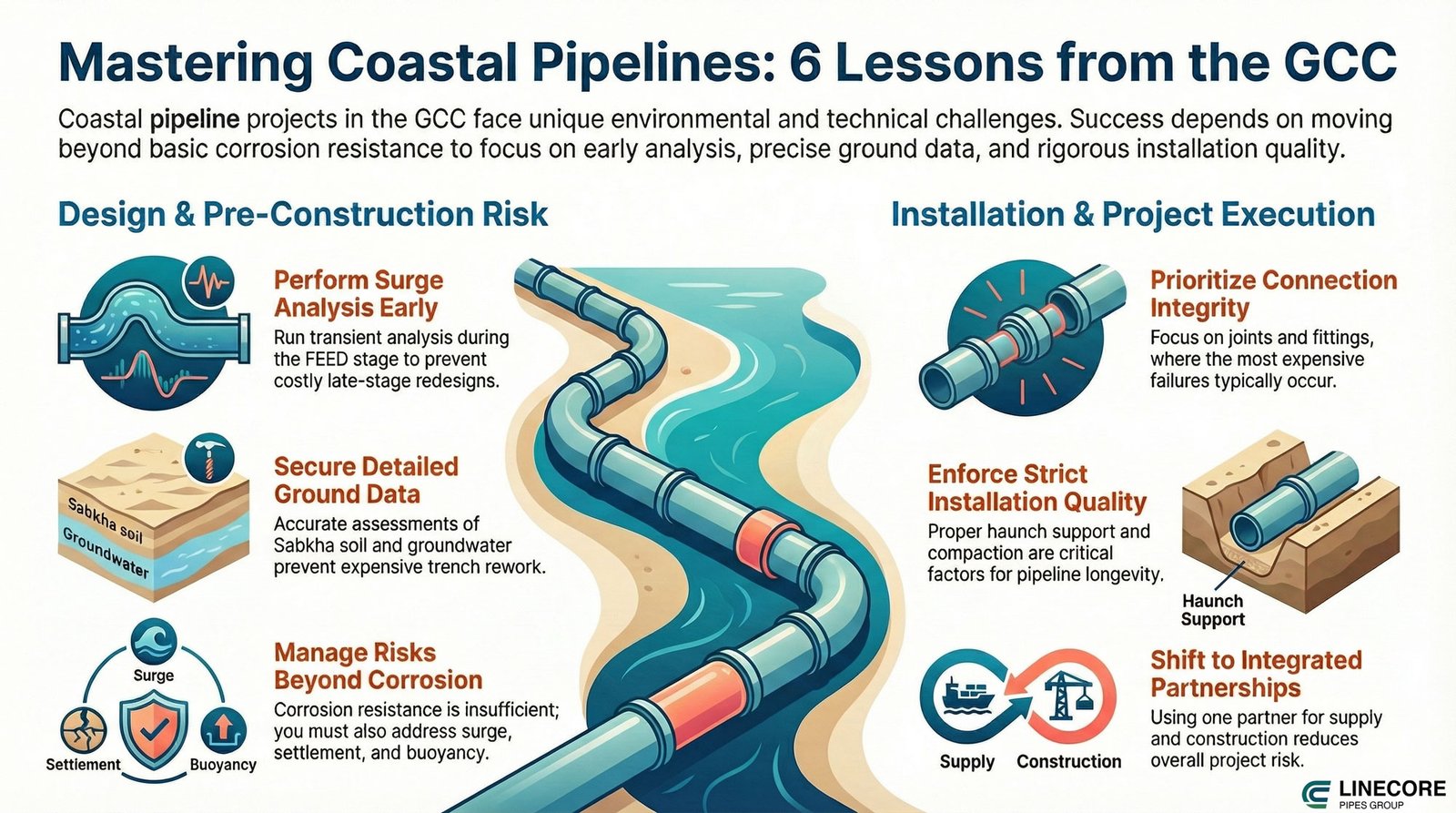
Lesson 1: Corrosion resistance is not enough
GRP pipes resist corrosion very well in salty conditions. But they do not solve everything. Surge, settlement, buoyancy, and poor QA/QC can still cause big problems. You need to manage all risks, not just corrosion.
Lesson 2: Most expensive failures happen at connections
The biggest headaches usually start at the joints, fittings, chambers, pump station tie-ins, and places where composite pipe meets metal. These interface points need your special attention.
Lesson 3: Bad ground information is very costly
Sabkha soil can be tricky and changes quickly. If you underestimate groundwater or skip proper ground improvement, you will face expensive trench redesign and rework later.
Lesson 4: Do surge analysis early
Do not wait until after you order the pipes. Run transient analysis during the FEED stage. Late surge studies often lead to changes in pipes, valves, surge vessels, and delays in commissioning.
Lesson 5: Installation quality controls how long the pipe lasts
Good haunch support, proper compaction, careful handling, and strict visual checks during installation make a huge difference. Poor installation hurts the pipeline for its entire life.
Lesson 6: Owners now want integrated partners
More owners prefer working with one partner who handles pipe supply, design support, construction, and commissioning. It reduces risk and makes the whole project much smoother.
Case Study: Qatar KAHRAMAA Mega Reservoirs Project
Qatar started a very big project to increase water storage. The project includes large reservoirs and many kilometers of transmission pipelines. The goal is to store more desalinated water for the future. This helps Qatar have a stronger and safer water supply (source: Qatar General Electricity & Water Corporation).
What Project Owners Should Look for in a Transmission Main Partner
As a project owner, you want a partner who does more than just supply good pipes. You need someone who can support the whole project. Look beyond product compliance. The right partner should have:
- Strong design capability
- Good hydraulic and surge support
- Solid geotechnical awareness
- Strict QA/QC discipline
- Proven construction experience
The Main Questions to Ask Before Awarding the Job
Before you award the job and sign that contract, ask these essential questions and gain the necessary information:
- Who owns the surge design?
- Who coordinates the pipe specification with the actual route and ground conditions?
- Who supports installation QA on site?
- Who manages interfaces with valves, chambers, and pump stations?
- Who supports commissioning and handover?
One integrated partner makes everything easier. You get less confusion, better schedule control, and fewer gaps between design and actual construction. This reduces your long-term risk and helps the project run smoothly.
Delivering Reliable Coastal Transmission Systems — End to End
A 20+ km transmission main along the GCC coast is not simple. You need more than just a good pipe. You need a partner who understands the full system.
At LineCore Pipes Group, we support clients through the entire project. We supply GRP pipe systems built for coastal conditions and long service life. We provide hydraulic and surge design support. We handle full EPC delivery from route planning to commissioning. We give installation guidance and QA/QC supervision on site. Our team also coordinates everything to reduce risks between design, supply, and construction.
Whether you plan a new transmission corridor or improve an existing system, our team brings both pipe expertise and real project experience. Get in touch with our team to discuss your next transmission main project.
about
The Author

Farshid Tavakoli is a seasoned professional in engineering and international trade. Holding degrees in Electrical Engineering, Mechatronics, and a Doctorate in Business Administration (DBA) from the University of Lyon, he also has a strong background in industrial automation and production line technologies.
For over 17 years, he has led an international trading company, gaining deep expertise in commercial solutions tailored to industrial needs. With more than 8 years of active involvement in infrastructure development, he specializes in the supply of electromechanical equipment for water and wastewater treatment plants and transfer projects.
Together with comapny expert team, he now provides consultancy and integrated solutions for sourcing and implementing complex infrastructure projects across the region.