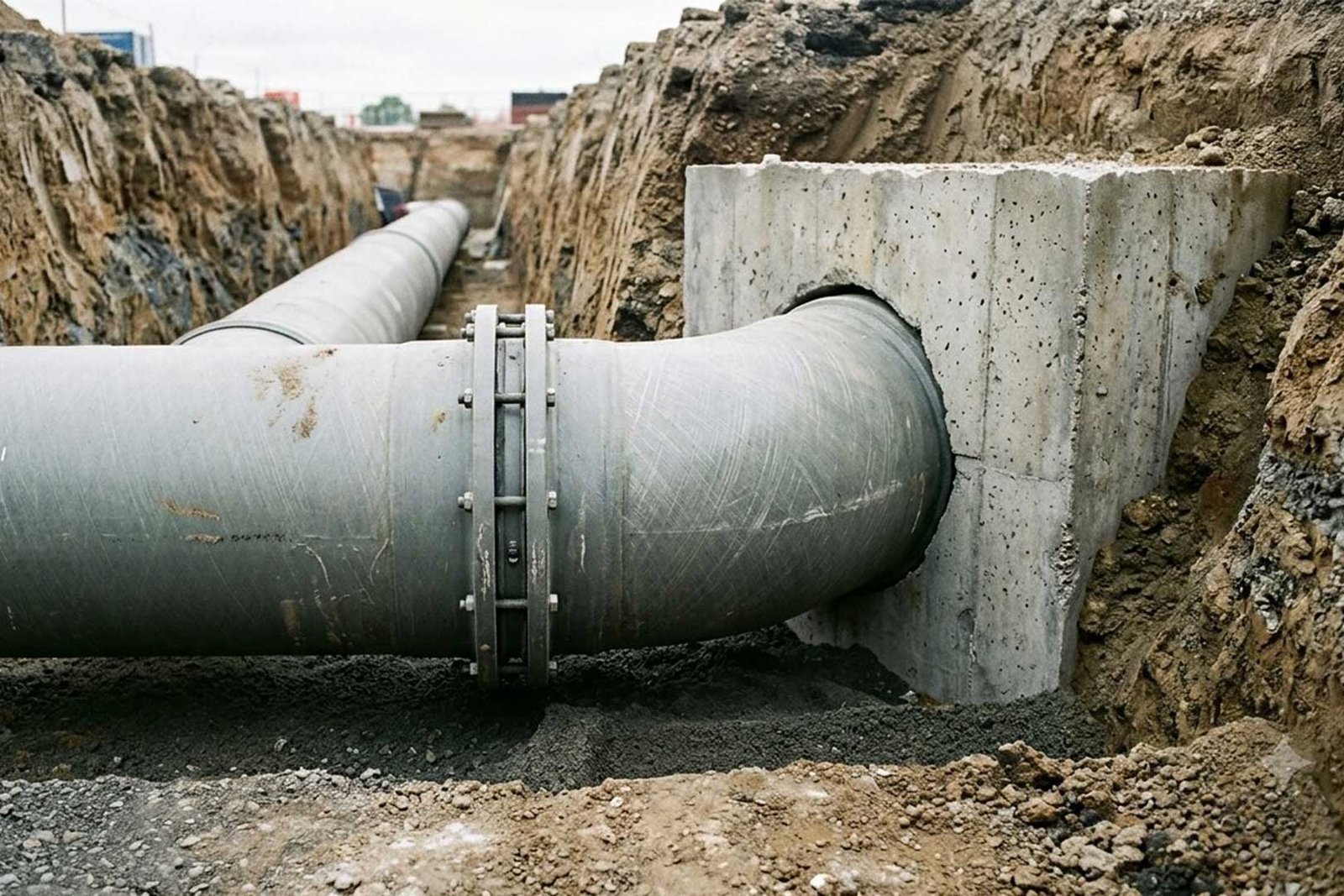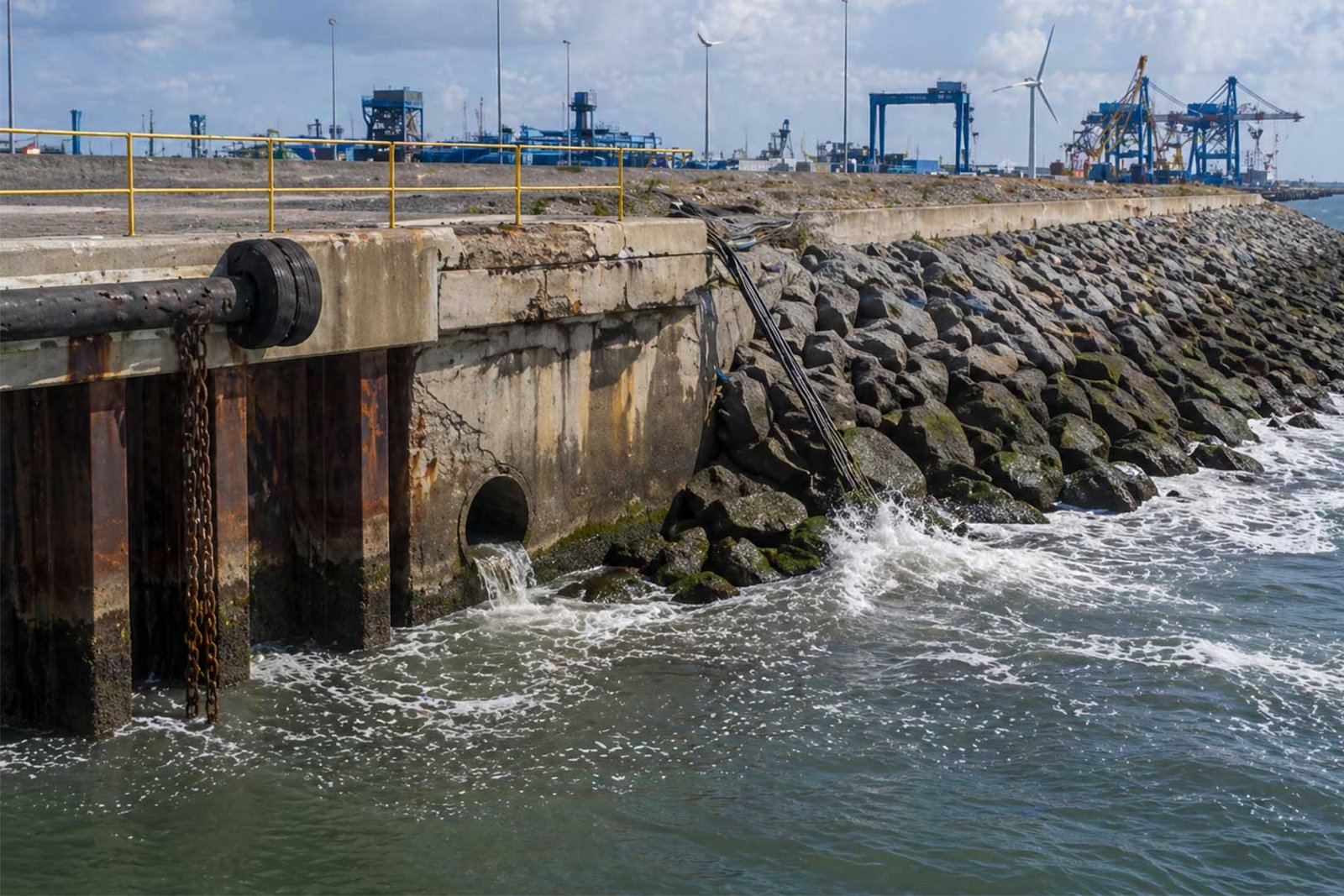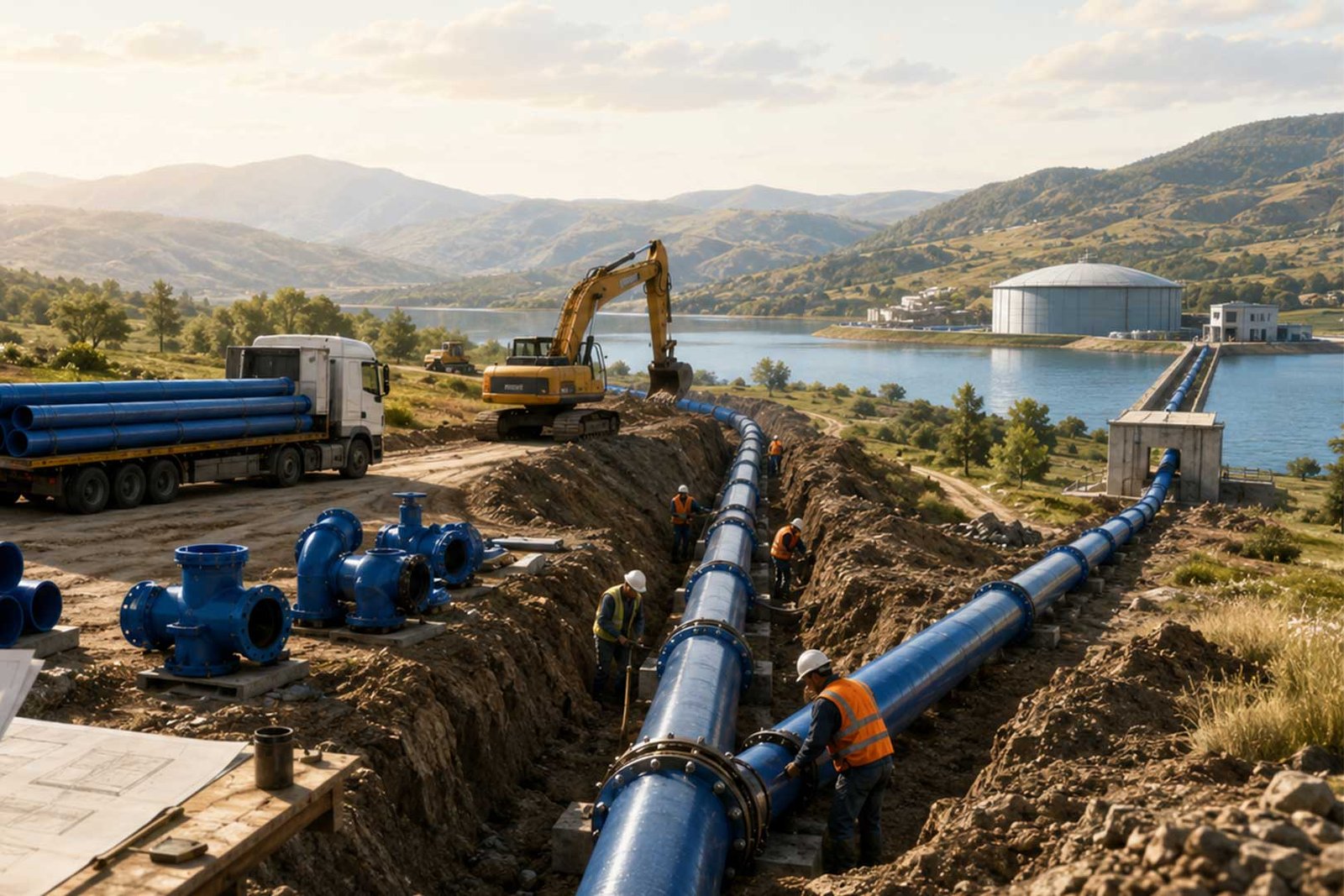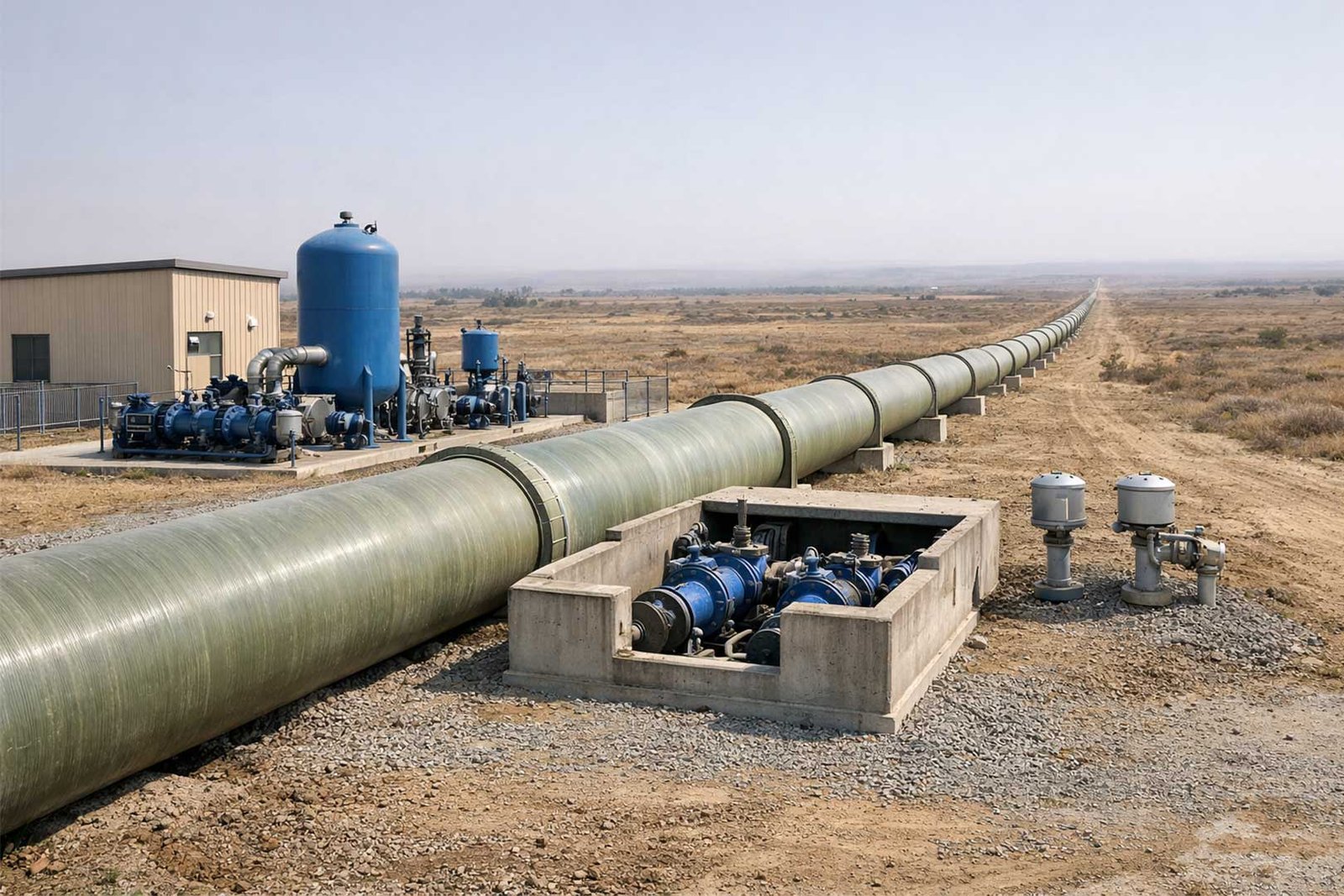
Water pipelines are getting longer in various projects, making water transmission easier. Our growing cities require these long pipelines for moving water. Global warming has also raised the need for them. This is when the GRP pipes come in. They are light, corrosion-resistant, and popular for long lines.
All in all, despite all the advantages of GRPs, these pipelines may encounter some issues, such as sudden pressure surges. All EPC contractors need to consider surge analyses, not just as paperwork, but as a necessary job to do. LineCore Pipes Group will tell you everything about surge analysis in long GRP transmission mains and help make sure this is done right for major projects.
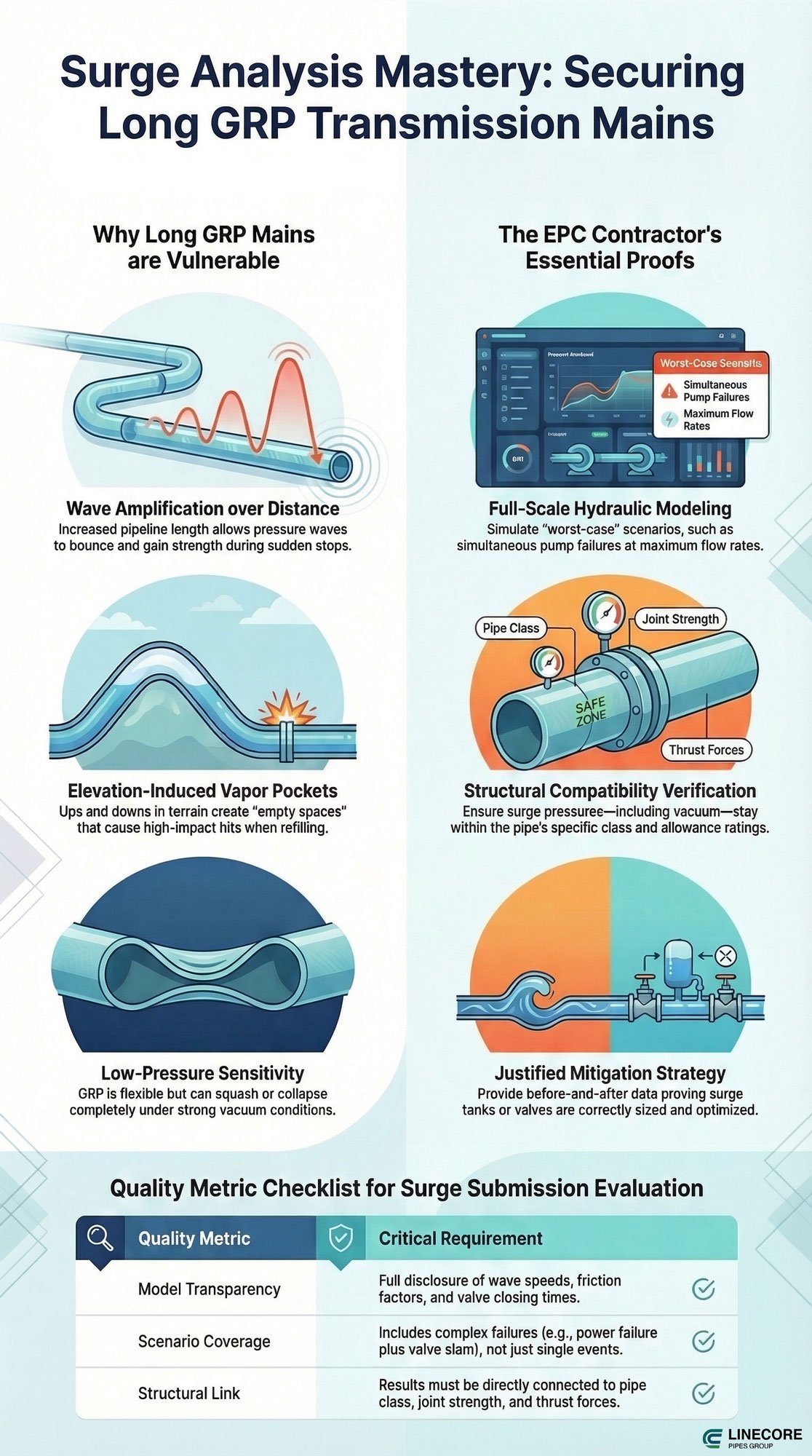
surge analysis in Long GRP transmission mains infographic (source:Pipelinecoregroup.com)
Why Long GRP Transmission Mains Are More Vulnerable
Long GRP transmission mainly faces many more issues than the normal ones (source: ResearchGate). These issues always show themselves in real projects. Let’s review some of these issues:
Length makes waves worse
When the pipeline is very long (many kilometers), a sudden stop (like a pump turning off or a valve closing fast) sends a pressure wave that travels a long way. The wave bounces back from the ends and gets stronger. This can create much higher pressure or very low pressure than in short pipes.
Elevation changes add danger
When a pipeline is extended over the hills and has ups and downs, pressure may drop to a significant extent due to a surge happening. At high points, the water can break apart and make empty spaces. When these spaces suddenly fill again, it hits the pipe very hard. This is why you must watch them.
GRP material specifics make it sensitive
GRP pipes bend more easily than steel pipes. In other words, they are flexible enough for such purposes. This can help reduce some high-pressure surges a little. But GRP has a few weaknesses:
- It does not like low pressure or vacuum at all. Strong low pressure can make the pipe squash, bend, or collapse completely.
- The rubber seals in GRP joints can pull out, leak, or break if surges happen again and again.
- As stated by TragWerk, because GRP is not as stiff as steel, the pushing forces from surges hit harder on bends, supports, and connections.
Multiple pumping stations increase complexity
Long pipelines often have more than one pump station to push water farther. If one station stops working, it affects the whole line. Pressure drops in one part, rises in another, and the waves from different stations mix together. This makes the surges harder to predict and control.
What EPC Contractors Must Prove in Surge Analysis
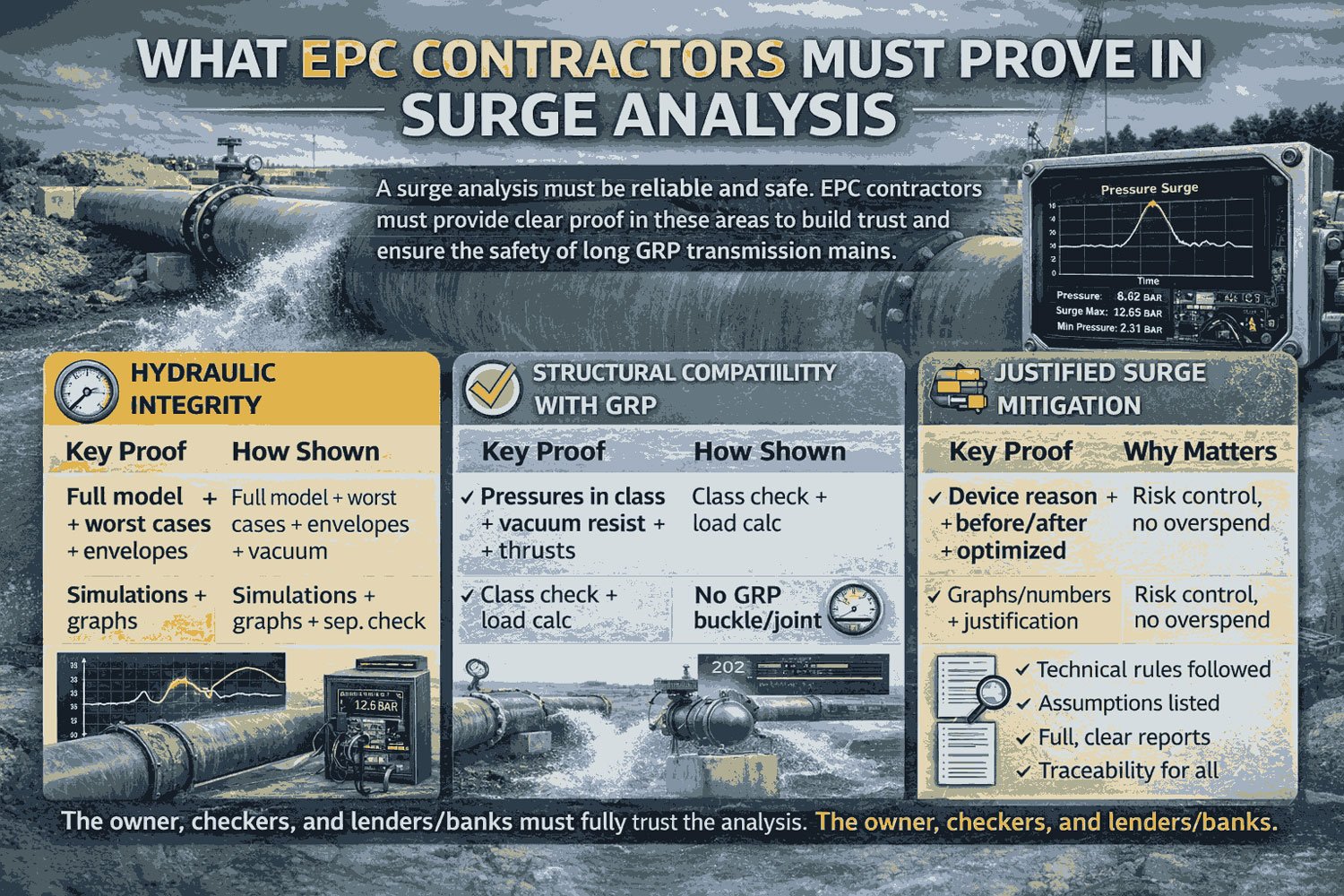
A surge analysis must be reliable and safe, and this is the EPC contractor’s job to prove it. These documents need to follow the contract and be totally correct. Such a comprehensive analysis project involves problems, delays, and arguments. Here is what they need to show in simple words:
| Category | Key Proof | How Shown | Why Matters |
|---|---|---|---|
| Hydraulic Integrity | Full model + worst cases + envelopes + vacuum | Simulations + graphs + sep. check | Emergency safety |
| Structural Compatibility | Pressures in class + vacuum resist + thrusts | Class check + load calc | No GRP buckle/joint fail |
| Justified Surge Mitigation | Device reason + before/after + optimized | Graphs/numbers + justification | Risk control, no overspend |
| Contractual & Risk Compliance | Specs match + assumptions + traceability | Full report + links | Passes audits/claims/lenders |
Hydraulic Integrity
The first thing you need is a complete computer model of the pipeline. Run tests for the worst possible events, like all pumps stopping suddenly at full flow. Show the clear highest and lowest pressure maps for every part of the pipe during these bad events. Carefully check if water columns can split and make empty spaces (vapor pockets) that collapse and hit the pipe hard.
Structural Compatibility with GRP
GRP pipes bend more easily than steel but break faster under low pressure. Show that surge pressures fit the pipe’s strength limits, and also:
- Make sure all high and low surge pressures stay safely within the pipe’s class rating, including the short-term extra allowance.
- Prove the GRP pipe can handle full or almost full vacuum without squashing, bending, or breaking (According to AVK). You need extra careful checks here for GRPs.
- Show that surge forces on bends, joints, supports, and anchors won’t damage joints or shift the pipe too much.
Justified Surge Mitigation
If surges are too high or too low, explain clearly why you chose the fixes and show they work well without extra cost. Give good reasons for using surge tanks, air valves, non-slam check valves, surge prevention valves, or slow-closing valves. Show before-and-after numbers to prove that pressures drop a lot. Prove the fix is the right size, not too big or expensive.
Contractual & Risk Compliance
And, do not forget to match everything and all parts tailored to the contract. The owners, the checkers, and the bank must understand it very well so they can trust the analysis. To achieve such a purpose,
- Follow all technical rules, pressure limits, and project guidelines exactly.
- List all assumptions openly, such as wave speed, friction, how fast valves close, pump stop time, and any shortcuts in the model.
- Give clear, full reports. Show model setup, input numbers, results, tests of changes, and simple explanations.
- Make every design choice traceable, link pipe class, fixes, and support directly back to model results, so anyone can follow the steps easily.
Common Weaknesses in EPC Surge Submissions
We reviewed numerous surge analysis reports and realized that they have some weaknesses and issues in common. We have listed these weaknesses as follows so that you can avoid them:
- Oversimplified models: People miss important details like changes in the pipeline profile, air pockets, or how boundaries really work.
- Limited scenario coverage: They only test simple cases (like one pump trip). They skip real-life combos such as power failure plus valve trouble or several stations failing together.
- No sensitivity analysis: They never check what happens if you change key numbers, like wave speed, valve closing time, or friction factor.
- Ignoring vacuum risk: They focus only on high pressure and forget low pressure. Vacuum or column separation can easily buckle or crush GRP pipes.
- Poor integration between hydraulic and structural design: The surge results sit alone. Nobody clearly connects them to the GRP pipe class, joint strength, thrust forces, or combined loads.
| Weakness | What Wrong | Impact | Fix It |
|---|---|---|---|
| Oversimplified models | Miss profile/air/boundaries | Wrong pressures | Add full details |
| Limited scenario coverage | Only single events | Miss real failures | Add combos |
| No sensitivity analysis | No change tests | Fragile results | Run what-if |
| Ignoring vacuum risk | Skip downsurge/sep. | Hidden GRP collapse | Check vacuum always |
| Poor hydraulic-structural link | No tie to class/joints/thrust | Hard safety proof | Link outputs to structure |
What Project & EPC Consultants Should Look For
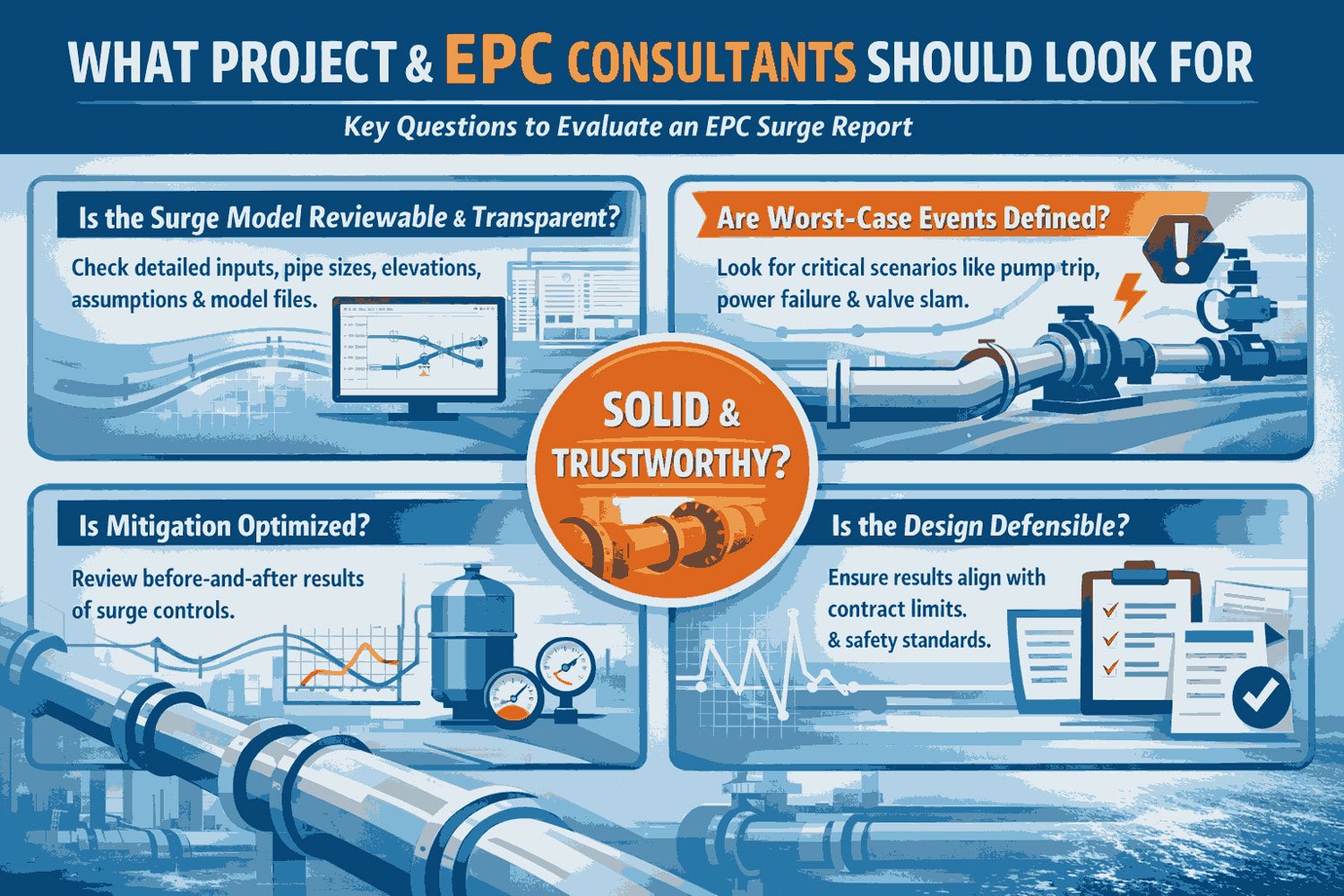
If you are the project owner, consultant, auditor, or decision-maker, take a close look at the EPC surge report. These four questions help you decide fast if the work is solid and trustworthy:
Is the surge model reviewable and transparent?
You want to open the model and understand it right away. Check for full details on inputs, including pipe sizes, elevations, assumptions like wave speed and friction, valve closing times, boundary conditions, and which software they used. The good ones share the actual model files or very clear write-ups.
Are worst-case events clearly defined?
See if they list and explain the really tough scenarios they tested. They should cover things like a full pump trip at max flow, a power cut plus valve slam, several stations failing together, or other events that could actually happen on your project. If they only show simple single events and skip the real combinations, the study isn’t complete.
Is mitigation optimized?
Check if the fixes really do the job in a smart way. Look at before-and-after graphs or numbers that show how much lower the pressures go after they add surge vessels, air valves, non-slam check valves, or other equipment. The design should be just right and strong enough to keep things safe, but not loaded with extra stuff that costs too much.
Is the design truly defensible under contractual scrutiny?
Ask if every part of the final design connects clearly back to the model results. Make sure they list assumptions openly, give a complete report, and link pressure envelopes to GRP pipe class limits, vacuum checks, thrust forces, and combined loads. If it all lines up and follows the contract rules, it should stand strong in audits, lender questions, claims, or arguments.
Our Approach to Surge Analysis in Long GRP Mains
Long GRP transmission mains are what we at LineCore Pipes Group do best. We do reviews that combine hydraulic and structural elements and make models based on scenarios that are like real operations. We choose mitigation based on risk and give you clear pressure envelopes and sensitivity checks. Our deliverables are clear and easy to follow, which is great for EPC review, client approval, and lender trust. We have extensive experience with long-distance pumped-storage transmission systems.
We don’tdon’t just perform surge calculations, but deliver defensible, review-ready engineering packages for major transmission projects. Get in touch for more information.
about
The Author

Farshid Tavakoli is a seasoned professional in engineering and international trade. Holding degrees in Electrical Engineering, Mechatronics, and a Doctorate in Business Administration (DBA) from the University of Lyon, he also has a strong background in industrial automation and production line technologies.
For over 17 years, he has led an international trading company, gaining deep expertise in commercial solutions tailored to industrial needs. With more than 8 years of active involvement in infrastructure development, he specializes in the supply of electromechanical equipment for water and wastewater treatment plants and transfer projects.
Together with comapny expert team, he now provides consultancy and integrated solutions for sourcing and implementing complex infrastructure projects across the region.