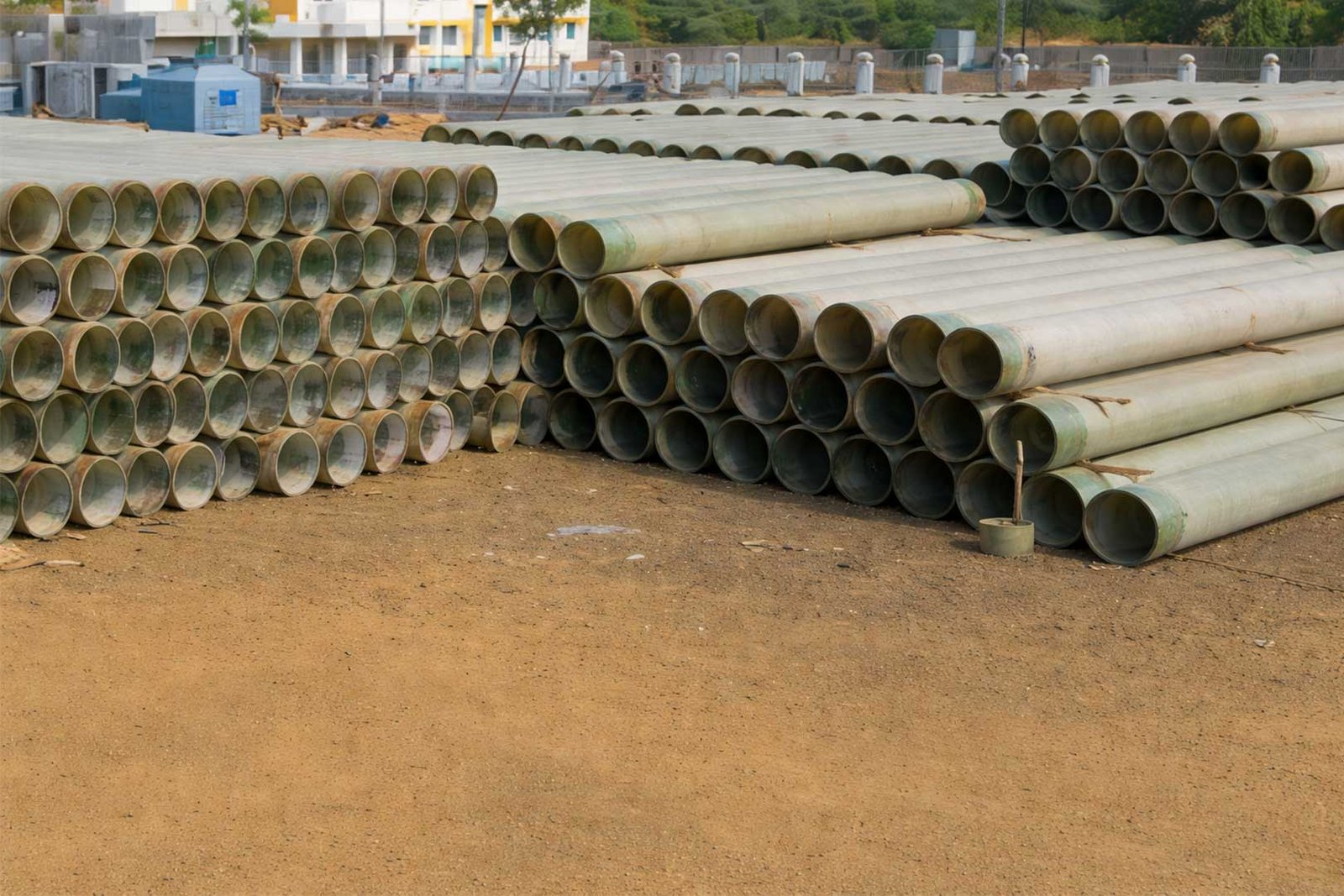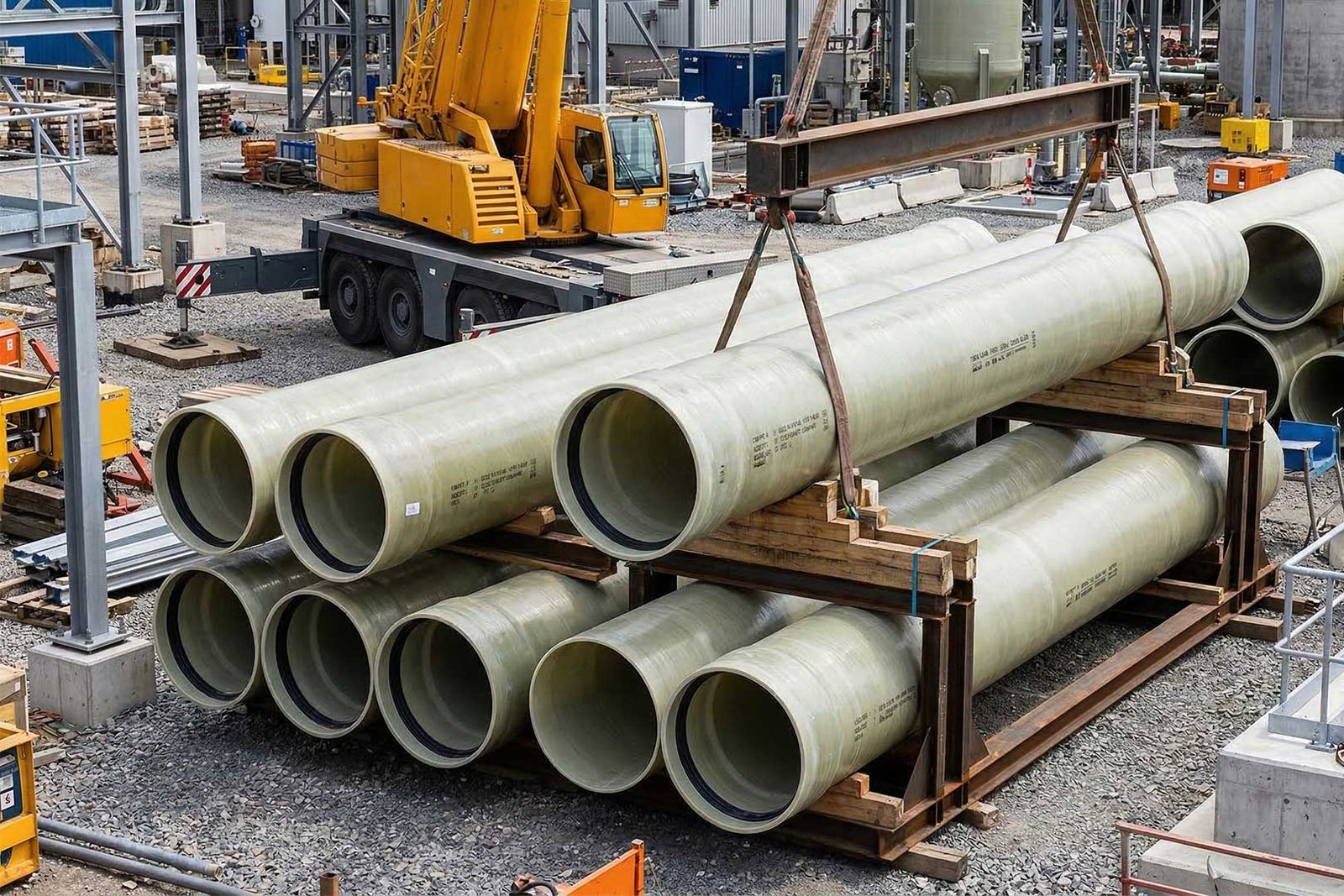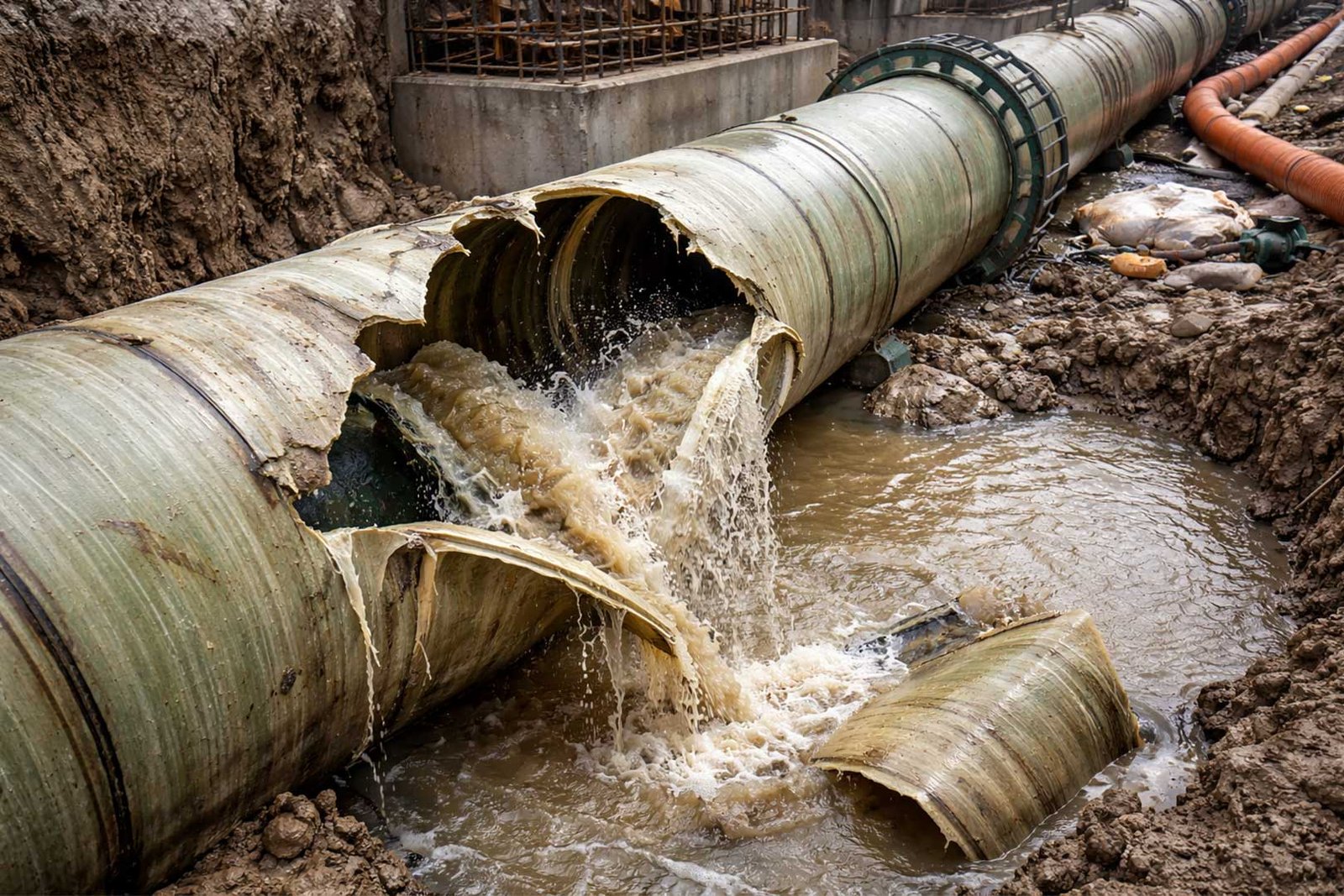
In the piping world, all pipelines may fail under harsh conditions. Although GRP pipes are known as a resistant material in piping systems lasting over 50 years, they probably show some failures, which cause multiple consequences such as functional, structural, progressive, or outer surface damages. These aspects force engineers and contractors to evaluate available methods for avoiding failure during the lengthy lifetime of GRP pipes.
This post presents all the ways a GRP pipe can fail and how to prevent them from happening, or how to fix them if they occur.
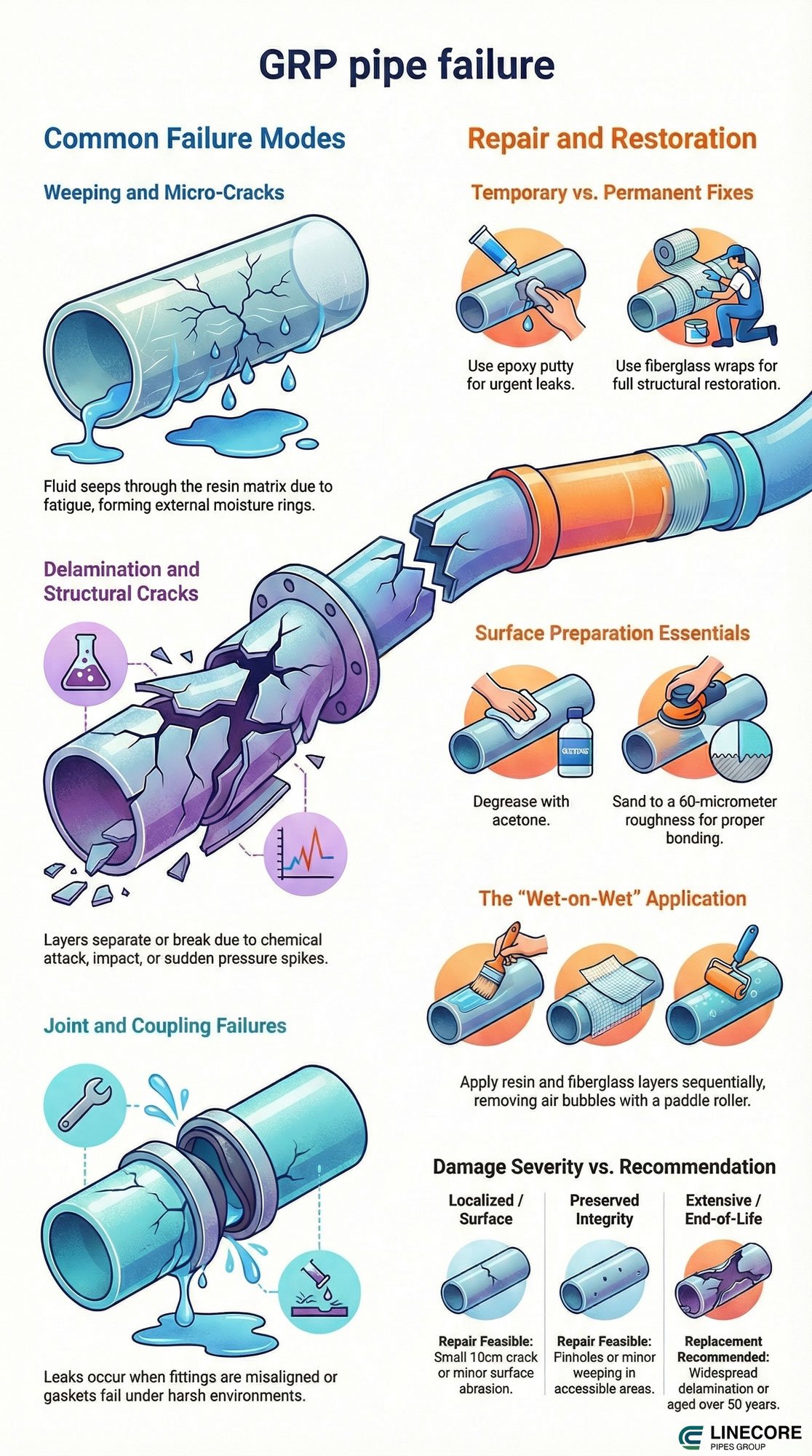
GRP pipe failures infographic (source: Pipelinecoregroup.com)
Common Types of GRP Pipe Failures
GRP pipes are strong pipelines in water, wastewater, oil, and gas, or industrial systems that require corrosion-free pipe material. They may show flaws in some situations. We bring them all below.
Micro-Cracks and Weeping: The Case of Unseen Failures
Weeping happens when fluid gently seeps through the pipe wall without any obvious holes.
Pressure cycling or material fatigue causes minor breaches in the resin matrix that let fluid flow through.
As early warning indicators, you can detect rings of wetness, stains, or wet spots on the outside.
Cracks and Breaks in Structures
These cracks are noticeable and could weaken the pipe.
They frequently happen because of damage from collision, sudden pressure spikes like water hammer, or external mechanical force.
Cracks can go along the length of the pipe or around its circumference, and they can get bigger quickly if the pipe is under stress for a long time.
Separation of Laminate Layers
When the resin comes off the fiberglass reinforcement, delamination ensues.
The layers come apart because they are too tired from being bent over and over again, chemicals attacking the resin, or problems with the way they were made, such as not getting the fibers wet enough. (Source: ScienceDirect)
This frequently means that the material gets whiter, less rigid, and eventually leaks.
Failures of joints and couplings
Connection is another dilemma that GRP pipes are dealing with during their lifetime. However, there are many ways to connect GRP pipes; they are likely to fail under harsh surrounding environments.
Related
Industrial gaskets and sealing solutions for flanged pipe joints: materials, pressure ratings and sizes for water, chemical and oil and gas service.
- They happen when the fittings are not lined up properly or are too loose, the adhesive bonding is not done correctly, or the gasket fails and extrudes.
- There are leaks at the joint, and sometimes you can see gasket material pushing out.
Pipe Burst or Catastrophic Rupture
This is a total failure of the wall under a lot of force.
It usually happens in lines or systems that are too pressured or don’t have enough support, which causes the containment to suddenly and completely fail.
| Failure Type | Main Causes | Key Signs |
|---|---|---|
| Weeping & Micro-Cracks | Pressure cycling, fatigue | Moisture rings, staining |
| Structural Cracks | Impact, water hammer, loading | Visible cracks |
| Delamination | Fatigue, chemical attack | Whitening, reduced stiffness |
| Joint & Coupling Failures | Misalignment, poor bonding | Gasket extrusion, leaks |
| Catastrophic Burst | Overpressure, poor support | Sudden rupture |
Where Does the Failure of GRP Pipes Come From?
What makes GRP pipes fail mainly stems from their bad design, jointing method, installation, operations, or the surrounding environment. This section explores all these aspects and consequences.
Problems with Design
Bad design is one of the main reasons why pipes break early. Long spans without support cause the pipe to sag and bend over time.
Ignoring GRP’s inherent flexibility and movement can cause problems when the load is normal. Without the right protection against pressure spikes or water hammer, even tiny things can cause a lot of damage.
Mistakes during Installation
A lot of complications happen during installation. Leaks are often caused by joints that aren’t lined up properly or glue that isn’t applied correctly. If the bedding, backfill, or anchoring is too weak, the pipe will be under uneven stress.
Consider that when staff don’t know how to handle GRP, tiny mistakes might lead to significant problems months or even years later.
Operational Stress and Misuse
This happens when the wrong property is considered at the wrong place, for example, when a pipe with a thin wall thickness is placed in deep burials, it’s more likely to get deformed and fail. What normally happens:
- Too much pressure within, especially from water hammer that happens when valves close too quickly
- Pumps or flow systems that start and stop quickly, which causes cyclic fatigue
- No adequate ventilation or drainage, which causes air to get trapped and pressure to rise
Environmental and Material Degradation
Even if the choice of design, installation, and operational stress is right, failure is also in the game. But why? Its roots are in many factors, such as:
- The case of UV exposure in above-ground installations results in chalking of the resin and degradation.
- Chemical attacks can happen when the choice of resin type is not right, or when the grade of corrosion is inevitably higher than expectations.
Manufacturing or Material Defects
Engineers face another danger sign during their pipeline selection: the wrong choice of manufacturer. GRP pipes can be manufactured incorrectly, which can cause failure in many cases, even with the right installation and handling. (Source: ResearchGate)
Inspection and Damage Assessment Techniques
Once the GRP pipe is considered for the project, visual inspections and several tests help engineers ensure the reliability of GRP pipe performance under harsh conditions. Check pipes for:
- Cracks, scrapes, or abrasions on the surface
- Fading, chalking, or damage from UV rays
- Moisture rings, stains, or wet spots that show weeping
- Gasket extrusion, loose couplings, or joints that aren’t lined up properly
Check things out in good light while the pressure is low, and take pictures to record what you find.
Non-Destructive Testing (NDT)
Non-Destructive Testing (NDT) gives you more information without hurting the pipe. Some common ways are:
- Ultrasonic thickness testing to find out if the walls are getting thinner or peeling off
- Use of acoustic emission to find cracks that are growing
- Use thermography to find heat problems caused by stress or leakage.
- These methods work well on pipes that are buried or hard to get to.
Severity Classification
Severity Classification tells you how to react. Patches can fix little problems like pinholes, cracks in the surface, or minor weeping. If there is a lot of delamination, deep structural cracks, joint failure, or rupture, the item normally has to be replaced.
Fix or Replace a GRP Pipe? What to Choose?
It takes considerable thought to decide whether to fix or replace a broken GRP pipe, taking into account cost, safety, and dependability.
Criteria for Evaluation
Think about the size of the pipe and how easy it is to get to the broken part. Find out how much damage has been done inside and outside the pipeline, and how important it is. Utility lines may be able to handle repairs better than vital process lines.
When Repair Is Rational
When repair is possible, it is when the damage is limited to one area, the wall’s structural integrity is still intact, and the pipe can still handle the pressure.
When You Need to Replace Pipes
If the structure is compromised, there are several failures that are connected, or the pipe has reached the end of its useful life, it needs to be completely replaced.
| Criteria | Repair Feasible? | Replacement Recommended? | Example Case |
|---|---|---|---|
| Localized damage (e.g., small crack or pinhole) | Yes | No | Single 10cm crack on accessible above-ground pipe |
| Wall integrity mostly preserved | Yes | No | Minor surface abrasion with no delamination |
| Limited accessibility (buried, large diameter) | Sometimes | Often | Small leak on 1200mm underground seawater line |
| Extensive delamination or deep structural cracks | No | Yes | Widespread layer separation over 2-meter section |
| Multiple interconnected failures | No | Yes | Several joints + cracks in critical process line |
| End-of-life condition (aged >50 years) | No | Yes | Pipe showing widespread UV degradation & thinning |
The table above shows when to choose between replacement and repair to avoid unnecessary spending on the wrong method.
How to Repair GRP Pipes?
There are two types of GRP pipe repair methods: interim fixes for urgent situations and permanent fixes that restore full structural integrity.
- Repairs for Temporary Cases: Temporary fixes are used to stop leaks and prevent further damage from happening without turning off the system.
- Epoxy Putty Patching is great for tiny holes or weeps. It dries quickly, usually in 5 to 30 minutes, and can be used on wet surfaces.
- Clamp and Bandage Systems keep everything in place right away. Mechanical clamps or composite bandages wrap around the pipe and work well for pressurized lines in an emergency.
- Standard Protocols for Permanent Repairs: Permanent repairs strengthen the pipe and are meant to last the life of the pipe.
- External Fiberglass Wrap with Resin: The most frequent way is to use an external fiberglass wrap with resin. To restore hoop and axial strength, it needs to be sanded and prepared well, and then layers of chopped strand mat and epoxy resin need to be added.
- Internal GRP Liner Application: For pipes with a large diameter, the Internal GRP Liner Application is employed. A composite sleeve is put inside the injured area and left to heal.
- Sectional Replacement: To do a sectional replacement, you take out the broken part and put in a new pipe segment with couplings or adhesive-bonded joint sleeves. (Source: FuturePipe)
Step-by-Step GRP Repair Process
A successful repair of the GRP pipe requires a well-structured process to ensure its safety, weldability, and long-term performance. Safety measures always come first, which include the use of PPE equipment, lockout/tag out devices, etc., to mention a few.
1. Site Preparation
First, the damaged segment is isolated by fully depressurizing the pipe to avoid any risks. Drainage of any fluid residue is then conducted in the pipe. Scribd highlights that for underground pipe networks, space is provided to perform the required operations by carefully excavating the surrounding area.
2. Surface Cleaning and Preparation
Thorough preparation is important to achieve good bonding in adhesion. Debris, materials, and coatings, as well as existing layers of moisture, must first be thoroughly removed.
How to clean the surface properly?
Acetone or approved solvents must be used to degrease, followed by sanding or grinding to produce a rough profile with a roughness of 60 micrometers or more. This process removes the glossy coating, allowing proper bonding in the laminate.
3. Damage Evaluation and Material Selection
This step goes through the assessment of the injured section to find the best way to wrap it up.
- First, choose the right resin type, mainly the same as the base pipe or epoxy, as the most resistant one.
- Then, check for glass fibers and their types to reach the most proper bandage.
4. Application Process
Follow the steps below to reach the repaired area of GRP pipes:
- Apply the resin generously and overlap the fiberglass material by a minimum of 50 to 100 mm beyond the damaged area.
- The process must be carried out wet on wet with air bubbles removed using a paddle roller after each layer to ensure a smooth, void-free laminate.
- The fibers should be applied according to the correct lay-up sequence, usually starting with hoop direction layers to resist internal pressure, followed by longitudinal axial fibers to resist bending.
5. Curing and Testing
Allow full cure according to manufacturer recommendations, usually 24 hours at 20 to 25 degrees Celsius, or accelerate curing with heat blankets where approved.
Afterward, perform hydrostatic or pneumatic testing at 1.5 times the working pressure along with non-destructive testing to validate that the repair holds.
6. The Final Step: Coating or Protective Layer
To protect the repaired section a UV-resistant layer or that injured protective layer of resin or so. Lastly, backfill pipes properly to prevent further damage.
Also, you can use the checklist below to make sure that whatever you need for repair is ready.
| Category | Item | Check |
|---|---|---|
| Safety | Gloves | |
| Goggles | ||
| Respirator | ||
| Surface Prep | Grinder | |
| Sandpaper | ||
| Acetone | ||
| Repair Materials | Epoxy putty | |
| Resin | ||
| Fiberglass mat | ||
| Tools | Brushes | |
| Rollers | ||
| Clamps | ||
| Mixing containers | ||
| Testing | Pressure gauge | |
| Water test kit |
Real-World GRP Repair Examples
As we understood, GRP pipe, like all other materials, is likely to get damaged or fail in certain conditions. Here is what truly happened to those who are dealing with GRP pipe failure.
- In a Saudi Arabian oil refinery, a GRP seawater pipe, which was 3000 mm in diameter, leaked due to numerous holes, causing flooding. By excavating the pipe, it was sealed using epoxy putties, and the work was completed in 2 days at a low cost.
- Industrial drain lines, especially those buried underground, often fail due to delamination and misalignment of joints, which occur due to improper installation. Repairs include cut-outs, wraps, and non-destructive tests to correct design faults and prevent recurrence of problems.
- During the hydrotest, GRP pipes leaked due to weak points in the structure. Repairs involved the use of internal and external wraps after proper evaluation.
Linecore Pipe Group: A Reliable Partner When It Comes to Pipe Dilemmas
Struggling with GRP pipe failures or planning a replacement? Linecore Pipes Group is your aid for GRP pipe systems, which are designed to resist the most common failure causes. Get an expert consultation today for a project-specific protection solution at our website PipeLineCoreGroup.com. Rely on us for a repair-resistant GRP and Composite piping system.
FAQs
1- Most common GRP failure?
Weeping from microcracks due to pressure or fatigue.
2- Repair under pressure?
Use temporary clamps or putties; permanent fixes need depressurization.
3- How long does the repair last?
Decades, if done right, with proper materials and testing.
about
The Author

Farshid Tavakoli is a seasoned professional in engineering and international trade. Holding degrees in Electrical Engineering, Mechatronics, and a Doctorate in Business Administration (DBA) from the University of Lyon, he also has a strong background in industrial automation and production line technologies.
For over 17 years, he has led an international trading company, gaining deep expertise in commercial solutions tailored to industrial needs. With more than 8 years of active involvement in infrastructure development, he specializes in the supply of electromechanical equipment for water and wastewater treatment plants and transfer projects.
Together with comapny expert team, he now provides consultancy and integrated solutions for sourcing and implementing complex infrastructure projects across the region.