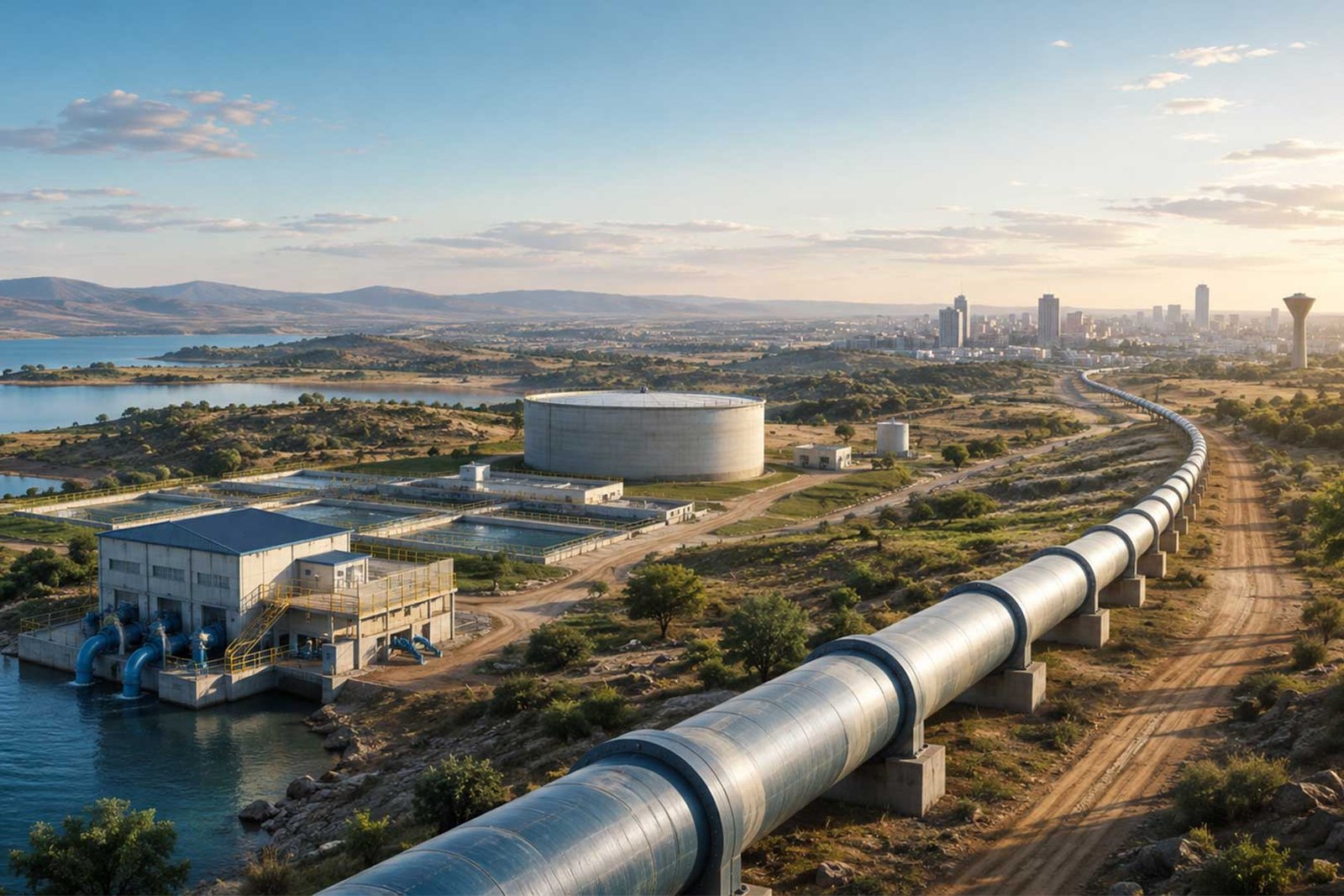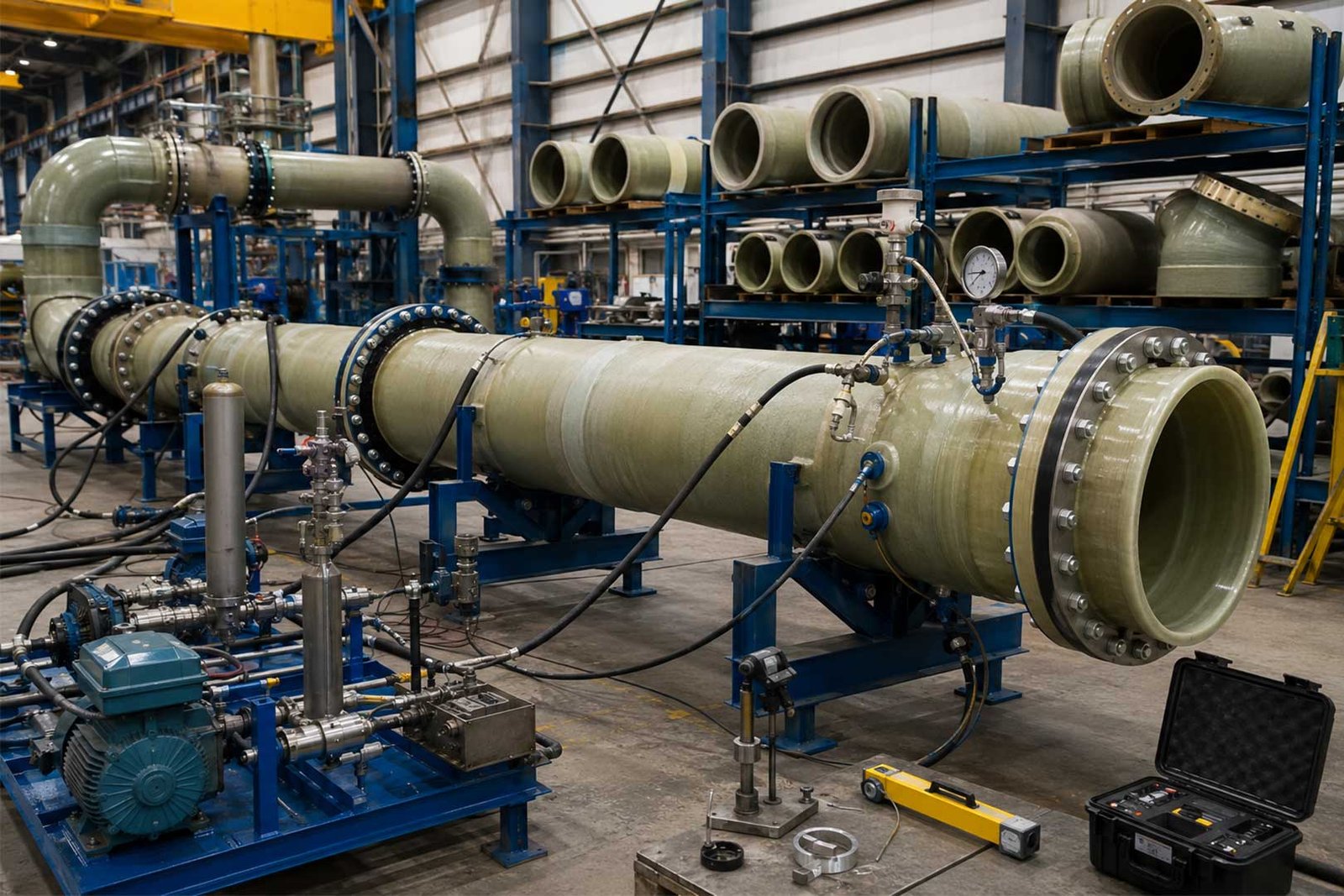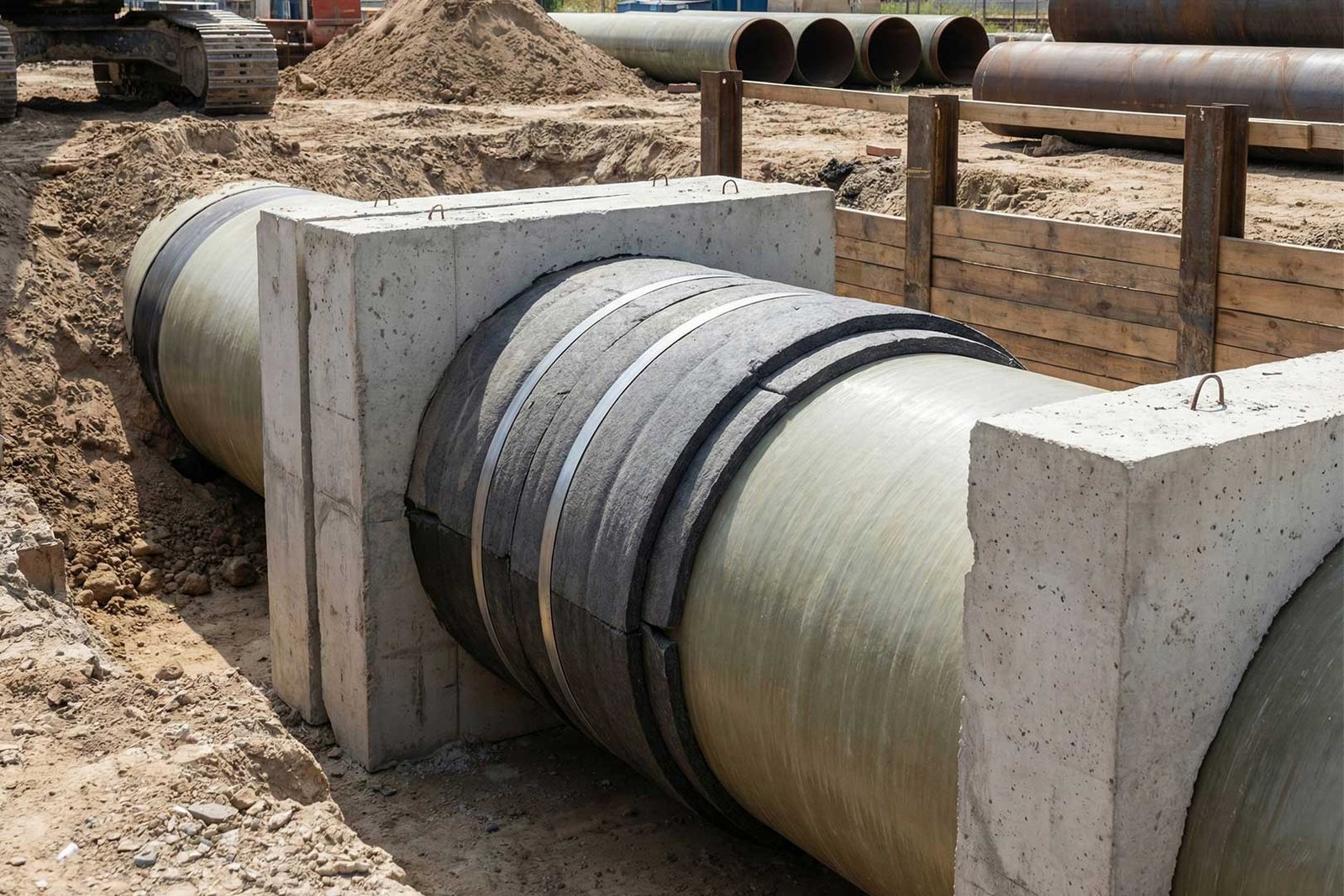
When it comes to GRP pipes, added safeguards help keep them away from harm, like scratches or crushing, during setup. Even though they resist rust by design, blows, wear, or blistering from direct sunlight can still cause trouble. In cases where soil shifts or pressure builds underground, shielding becomes essential rather than optional. Lines running above ground, kept outside year after year, also demand extra care. Any setting where materials scrape against each other, such as factories and transit zones, calls for similar defense strategies.
This post explores all methods for GRP pipes to protect them from harmful factors like UV or corrosive environments around. Stay tuned till the end.
Why GRP Pipe Protection Is Necessary
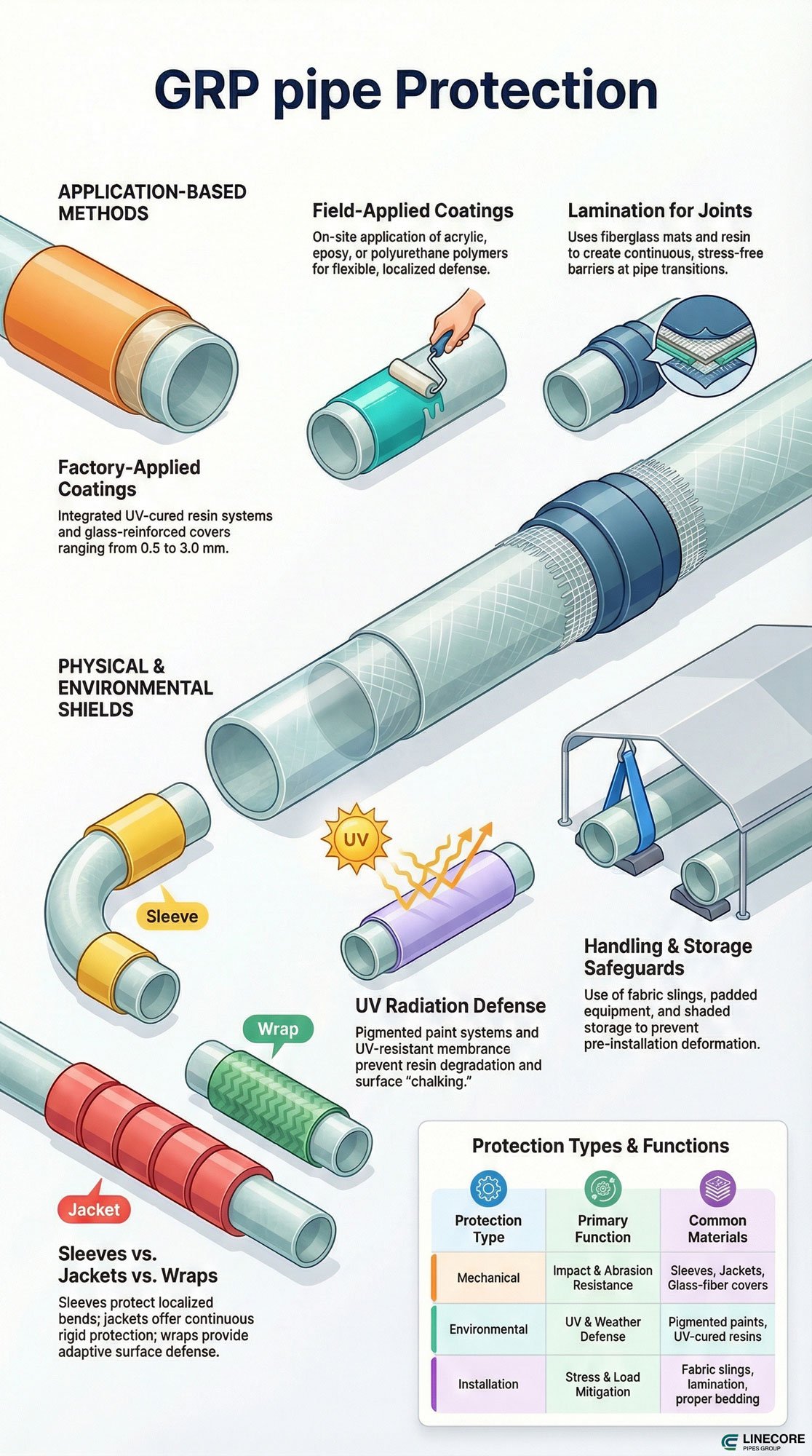
GRP pipe protection infographic (source: Pipelinecoregroup.com)
Should weather or exposure harm GRP’s inner structure, reliability drops fast. Protection matters because outside forces might break the system’s stability without warning.
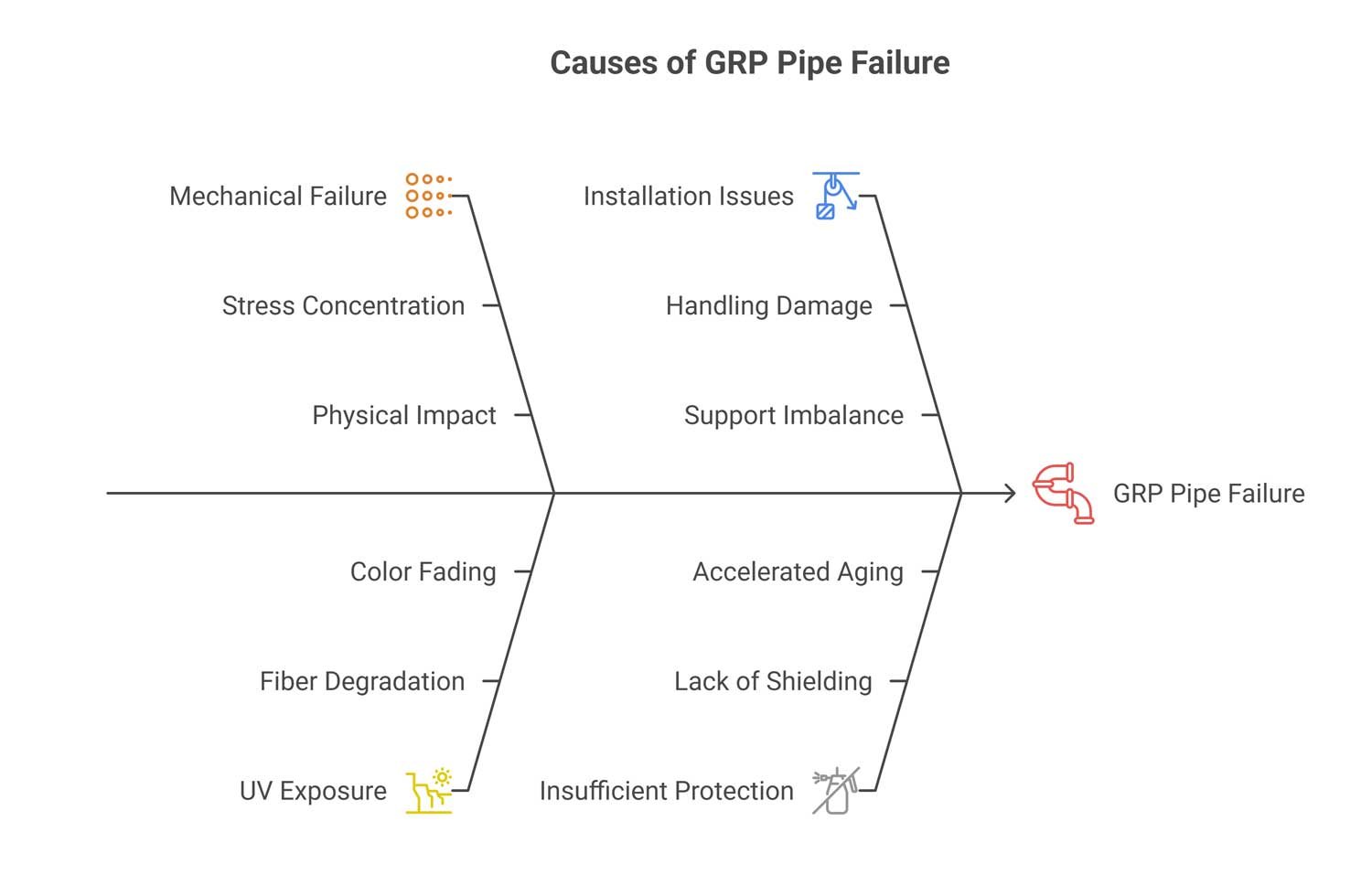
- Mechanical Failure of GRP Pipes: When stress gathers in small spots, GRP pipes carry risks. A hit, rough contact, or uneven pressure might wear away the outer shield, leaving fibers bare and weakening the structure.
- Risk of UV Exposure: Sunlight hits rubber over the years, breaking it down. Chalk forms on the edges where the color fades thin. Fibers peek out more as time passes without shields. Light hues wear faster under constant rays. (ScienceDirect)
- Installation-Related Issues: Most harm happens when people handle it, moving, picking up, placing, or keeping. When slings are off balance or supports are mismatched, trouble follows. Trenchless pulling stress adds to the list.
- Insufficient Protection: When pipes go without protection, they age faster. Their useful years drop. Failures become more likely. Fixing them happens more often. Replacing them costs more.
What Are the Main Risks for The Protective Layer of GRP Pipes?
GRP pipe protection is there to reduce the risk of external damage that can harm the structural performance of GRP pipes before or after the installation process and during their lifetime.
Mechanical Damage Risks
A tap on the surface might scratch GRP tubing, especially when moving through bumpy terrain or factory zones.
When something rigid presses against it unevenly, say, a metal edge or weak ropes, the outer shell may split. Even small bumps during setup tend to build up stress over time.
Sliding too hard along concrete or steel sets tiny cracks, even if the pipe looks fine afterward.
UV and Weather Exposure Risks
Sunlight hits rubber nonstop, breaking it down and turning the outer layer white. As years pass, inner fibers show through, weakening support and rigidity. A brief burst of ultraviolet light often changes color first. Only after many years does the strength inside the pipe start to wear too, more so if buried or left outdoors.
Installation and Storage Risks
When pipes sit under heavy loads or face uneven support, they might bend or warp. High pull forces during trenchless setups add pressure on the outside surface. MDPI shows that abrasion from moving parts or rough surfaces wears down the material over time.
Oval shapes appear instead of straight lines if things go wrong. Deformation shows up early if the setup details are off by even a little.
Overview of GRP Pipe Protection Methods: The Choice of Lifespan and Application
GRP pipes are coated based on several basic reasons, such as how long they’re in danger, where they’re installed, or what requirements are considered during their long-term performance.
Temporary vs Permanent
This protection may be divided into permanent or temporary ones. In this case, what matters is just how they can handle, store, install, and perform other risky operations.
- In the temporary method, installation and handling get easier with reduced risk of physical damage.
- In permanent type, pipes are designed in a way to resist during their long lifetime with less damage included.
Mechanical or Environmental
Mechanical protection is for impact, abrasion, or stresses of installation and handling, while the environmental method is for UV light and weather changes.
Factory-Applied vs Field-Applied
Factory-applied or field-applied ones are when pipes require consistency in thickness to make them stronger in demanding areas. Or field-applied ones in the case of flexibility in localized protective aspects like joints, repairs, fittings, or some of the site-specific criteria.
Protective Coatings for GRP Pipes
As we discussed in the last section, the protection of GRP pipes is whether factory-applied or field-applied. In this section, we’ll dive deeper into each of them to see how each works for GRP pipes.
Factory-Applied GRP Pipe Coatings
Coatings start as part of making pipes, built in factories where processes are carefully managed.
- Outside covers strengthened with glass fibers resist wear better because they handle shocks well.
- Sunlight and weather conditions are balanced evenly by UV-cured resin systems. Protection spreads without gaps or weak spots across the surface.
- From 0.5 to 3.0 mm covers most coating thicknesses, shaped by how they must withstand forces or outside conditions. (Source: Scribd)
- Often chosen when systems face heavy demands, such as underground renewal or outdoor exposure, or high-activity settings.
Field-Applied Protective Coatings
On-site setups happen when ready-made coatings lack access or situational needs demand custom shields.
Ordinary stuff often involves acrylic, epoxy, and polyurethane, along with paint-like polymers for coatings.
- What Happens Above Matters Most: dirt gets removed, air flows in, surfaces stay dry, then a quick scratch helps bonding take hold.
What holds the coating in place also influences how fast it sets, while steady layer thickness shapes its lasting performance.
What Are the Benefits of Protective Coatings?
A layer of protection cuts down scratches and shocks, keeping wear away.
These layers block UV light and resist weather damage, helping slow down resin breakdown over time.
Some materials handle chemicals well while keeping electrical insulation strong, which helps them last longer under stress.
| Characteristic | Application | Materials | Thickness | Best Use | Benefits |
|---|---|---|---|---|---|
| Factory-Applied | Part of pipe manufacturing | UV-cured resin systems | 0.5 to 3.0 mm | Heavy demands, underground renewal | Resists wear, balances sunlight |
| Field-Applied | On-site application | Acrylic, epoxy, polyurethane | Steady layer thickness | Custom shields, situational needs | Cuts down scratches, blocks UV light |
How is GRP in FRP Family Protected by Sleeves and Jackets?
Sleeves and jackets are what engineers choose to keep their pipelines away from physical harm. Here is how they work and benefit the system.
What Are GRP Protection Sleeves?
GRP protection plays a role in protecting the pipes’ surface from damage or load forces. These are selected based on the level of risk factors and their requirements.
Sleeves: Localized protection where needed, especially around bends, intersections, or exposed areas
Jackets: Provide continuous rigid protection on longer pipe sections
Wraps: These setups adapt easily yet often serve only to protect surfaces instead of adding strength.
Applications of Protection Sleeves
Protection sleeves are what can save pipes from mechanical exposures or stresses from installation. The priority of sleeve usage is indicated by project specifications or risk evaluations.
- Water and wastewater transmission pipelines
- Industrial and chemical process pipelines
- Road, rail, and river crossings
- Exposed pipes, often outdoors or easily seen, tend to suffer more wear
Benefits of Protective Coatings
GRP sleeves can improve several aspects of external dangers around the pipelines; these are listed below:
- Improved resistance to impact and abrasion
- Stress drops when vibration kicks in, plus tiny shifts in soil do their part.
- Outside support was added while keeping the water movement untouched
- Even in harsh environments, these systems now operate with greater consistency
Lamination as a GRP Pipe Protection Method
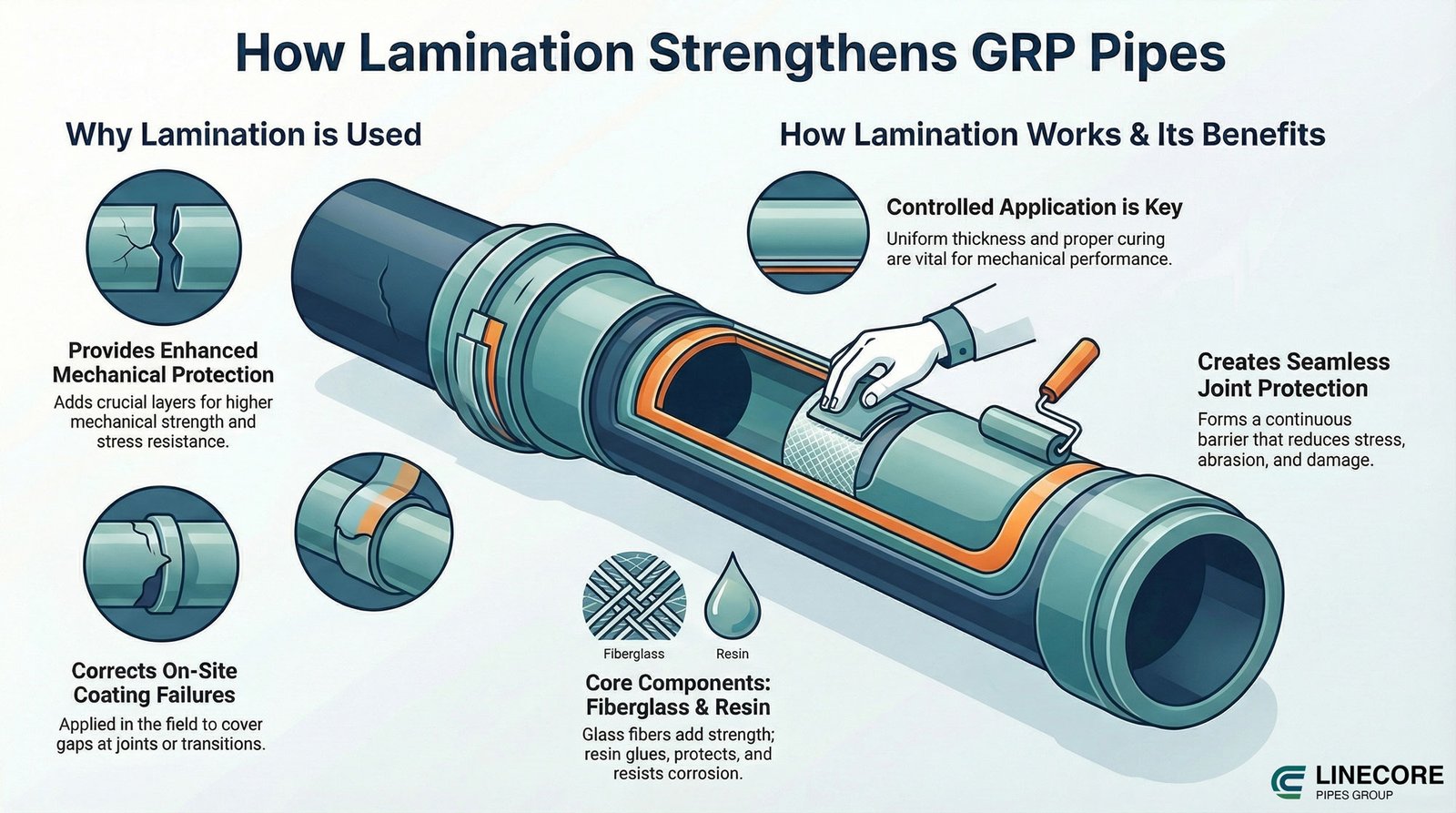
Lamination is used when pipes require higher mechanical or stress-free layers of protection.
Why Lamination Is Used for GRP Pipe Protection?
Field lamination is used to improve where factory coatings fail (interruption or insufficiency), like in jointing sections or transitions.
Use of Fiberglass Mats and Resin Systems
Glass fibers are used to add strength to that section, while resin is used to glue the whole part and add to the resistance against pressure, physical damage, and corrosive conditions.
Thickness Build-Up and Curing Control
As noted in Michigan Technological University, the thickness of the laminated section relies on controlled layers for uniformity in strength and flexibility. Also, how the curing process goes on is what matters for the mechanical performance of GRP pipes under external forces.
Joint Protection Through Lamination
Lamination at joints forms a continuous barrier that reduces stress concentration, abrasion, and long-term surface damage.
Mechanical Protection During Installation
GRP pipes experience these external damages mainly when they’re handled or installed. Then, what should we do to prevent such a thing?
Handling and Lifting Protection
To prevent pre-installation damages on the surface or mechanical issues of installation, the handling must proceed correctly.
- Use fabric slings or padded equipment for lifts
- To add the impact and forces of pipe loads, support them correctly
- No dragging or putting down (with no control)
Trenchless Installation Protection
Trenchless methods are used for GRP pipes to reduce the impacts of mechanical stress or surface issues.
- HDD (Horizontal Directional Drilling) requires control of pull forces and bore alignment
- Pipe jacking and microtunneling demand abrasion-resistant external protection
- And finally, control the loads and their pultrusion to reduce the risk of friction.
Strategies for Protecting GRP Pipes against UV Radiation
Provision for protection from the ultraviolet rays of the sun is required whenever GRP pipes are laid in the open for an extended period.
1. UV Resistant Paint
UV-resistant coatings and membranes help resist degradation of the resin and surface chalking from ultraviolet exposure.
2. Pigmented vs. Clear Systems
The degree of resistance to UV light is stronger in pigmented systems, while clear systems are recommended for short-term use.
3. Temporary UV Protection
Covers, Wraps, and Removable Coating: These materials have been widely used in storage and installation in order to regulate sunlight and prevent early aging.
What Protection Must Be Considered in the Storage Step?
Storing the GRP pipes properly is also essential for maintaining the integrity and surface of the pipes prior to installation.
The Risks of Incorrect Considerations in Storing
Inadequate storage procedures may result in long-term damage even before the installed piping is used.
- Exposure to direct sunlight while stored outdoors may deteriorate the resin due to aging.
- Deformation, ovalization, and lack of dimensional accuracy may occur as a result of improper stacking and leveling of supports.
Best Practices in Storing GRP Pipes
What can we do to prevent damage from incorrect or careless storage of GRP pipes? Try the practices below:
- When possible, store pipes in a covered or shaded area
- Use UV-resistant covers or Tarpaulins for outdoors
- Check for the correct spacing of support points to avoid excessive loading due to height
What to Consider in Design and Engineering of GRP Pipe Protection
The protection systems need to be integrated with the design requirements of the structure in order to prevent the performance of the GRP pipes from being affected.
- Deflection Limit: Methods of protection should not interfere with the designed loading capacity of the pipe or its allowed deflection. The outer layers should cooperate with the structure of the pipe. (Source: ResearchGate)
- Bedding and Spacing: Proper space and support can minimize localized loading on the pipe wall. Poor conditions of support are associated with increased demands for external protection.
- Stress Concentration: The design detail work should remove sharp edges and rigidly fixed restraining points, as well as reduce stresses at transitions.
QC and Further Inspections of GRP Pipe Protection
Once the design is verified, it’s time to make sure of pipe protection after the installation to check if there’s any probable damage on the pipe’s surface that requires extra maintenance. Check the table below till it ends for pipe inspection:
| Inspection Item | Key Check | Acceptance Criteria |
|---|---|---|
| Coatings and Sleeves | Surface defects, alignment | No cracks, blisters, or delamination |
| Coating Thickness | Uniform coverage | Within specified tolerance |
| Adhesion | Bond to pipe surface | No peeling or lifting |
| Lamination Quality | Fiber wet-out, voids | Fully cured, no air pockets |
| Joints and Transitions | Protection continuity | No exposed pipe surface |
| Installation Damage | Handling-related defects | No visible damage before backfilling |
Examples of GRP Pipe Damage
The majority of protection failures are a consequence of preventable errors that occur in the process of handling the equipment and surface preparation.
- Prolonged Sunlight: GRP pipes left exposed to direct sunlight affect their material properties and cause degradation if left for a long time.
- Inadequate Surface Preparation: Insufficient cleaning, drying, or surface roughing can result in poor adhesion, which can cause the material to fail.
- Installation Dilemmas: Misalignment of sleeves or improper thickness of coatings, overlaps, or incompletely cured areas are major drawbacks for protection.
- Wrong Handling and Storage: Dragging pipes, rigid lifting equipment, stacking them high, and using unbalanced supports can lead to hidden damage, making it become apparent only at the time of startup.
Partner with LineCore Pipes Group for Project-Specific GRP Pipe Protection
LineCore Pipes Group is the leading supplier for GRP piping systems, which are highly customized to your specific project requirements. These systems are designed with protection methods to match all installations, exposure, or service conditions. Choose LineCore for either factory-applied or field-applied protection solutions due to reliability and durability in long-lasting GRP pipe performance.
FAQs
1- Does UV protection work on underground GRP pipes?
Normally, none, except in cases when pipes are piled outside or before backfilling.
2- Are factory-applied coatings superior to field-applied systems?
Factory-applied coatings provide better consistency, although the flexibility of having it applied in the field is an advantage.
3- Could protection sleeves substitute for external coating?
In many instances, the answer is yes. Their application is useful for local mechanical protection.
4- When is Lamination recommended in GRP pipe protection?
When Lamination takes place in areas of joints, repair areas, or zones of high stress.
about
The Author

Farshid Tavakoli is a seasoned professional in engineering and international trade. Holding degrees in Electrical Engineering, Mechatronics, and a Doctorate in Business Administration (DBA) from the University of Lyon, he also has a strong background in industrial automation and production line technologies.
For over 17 years, he has led an international trading company, gaining deep expertise in commercial solutions tailored to industrial needs. With more than 8 years of active involvement in infrastructure development, he specializes in the supply of electromechanical equipment for water and wastewater treatment plants and transfer projects.
Together with comapny expert team, he now provides consultancy and integrated solutions for sourcing and implementing complex infrastructure projects across the region.