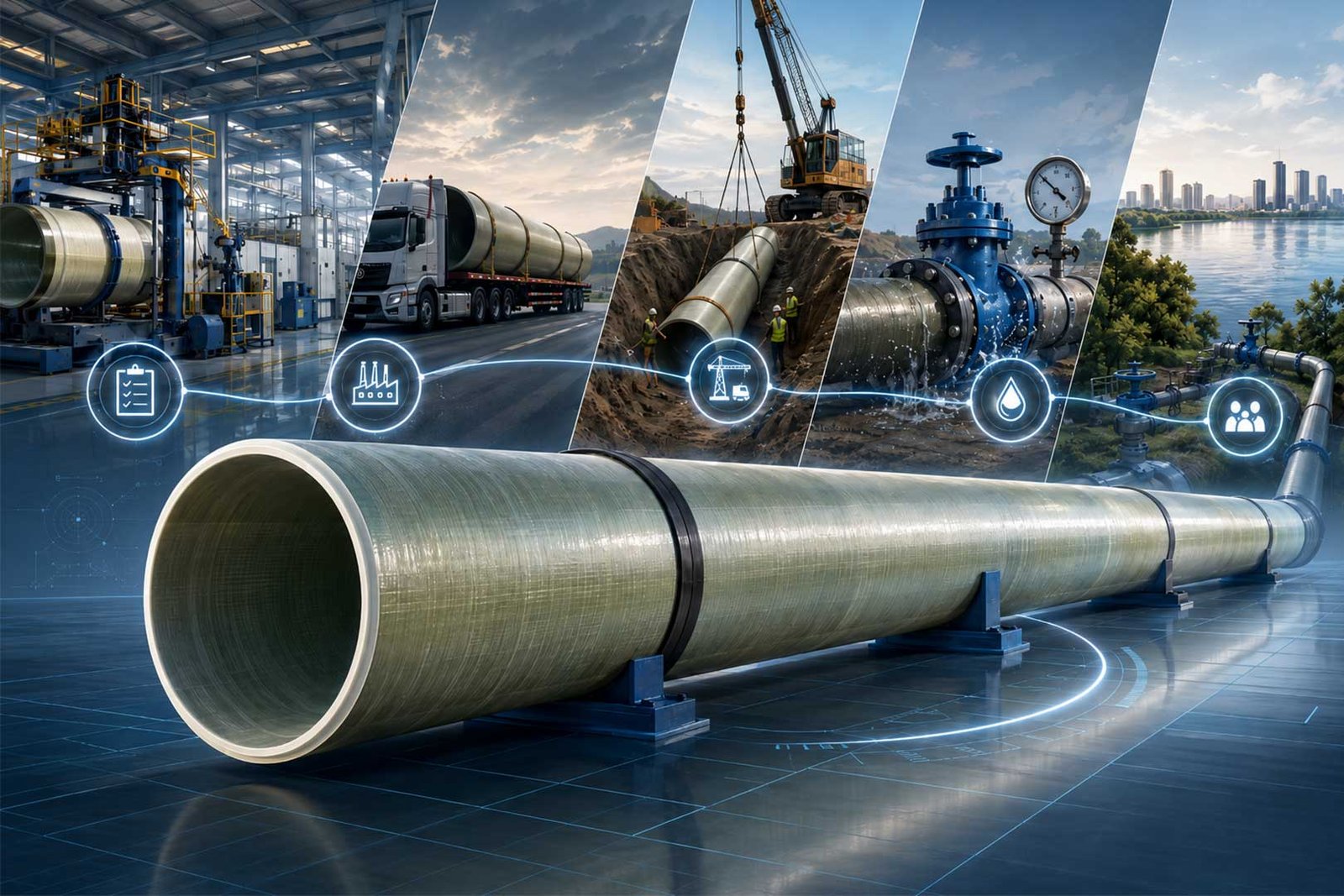
The GRP pipe family revolutionized the piping systems market with its modern solution for aging water infrastructure. The GRP pipe manufacturing process determines how strong and resistant GRP pipes will be, enabling them to handle high-pressure flows in corrosive environments. As time goes by, manufacturing methods improve, while automated machines increase pipeline speed and quality.
In this article, we’ll discuss how perfectly GRP pipes are manufactured, what compositions are required, and what equipment can pave the way for special designs. Check the table below before going through the main post.
| Method | Equipment | Application | Typical Pipe Diameter | Pressure Rating | Key Advantage |
|---|---|---|---|---|---|
| Filament Winding | Mandrels, Resin bath, Winding machine | Water, oil, chemical pipelines | Up to 3,000 mm | Medium to high | High strength, uniformity |
| Centrifugal Casting | Rotating mold, Resin feeder | Large diameter pipelines | 150 mm to 2,000 mm | High | Smooth finish, strong wall |
| Hand Lay-Up | Molds, Brushes, Rollers | Custom shapes, marine, large diameters | Custom (up to 5,000 mm) | Low to medium | Flexible, low-cost |
| Pultrusion | Resin bath, Heated die | Small diameter pipes, profiles | Up to 300 mm | Low to medium | Automated, minimal waste |
What Are GRP Pipes Made of? Raw Materials in Manufacturing Process
To design GRP pipes in a way that resists both internal and external pressure, while handling harsh environments, the type of resin, glass fibers, and additives can be changed to align the design with the desired process. This section goes through all these materials.
Resin Types: Polyester, Vinyl Ester, and Epoxy
The type of resin indicates where exactly pipes can be used, from general purposes to special and high-tolerance use cases.
Polyester is the most common type that’s used for general use cases like water infrastructures or sewer lines.
Vinyl ester improves the resistance to chemicals in applications like chemical processing or desalination plants, where saline conditions require such resistance in pipelines.
Epoxy is the superior one that’s used for special use cases like oil and gas pipelines, where thermal stability and resistance to heat matter.
- Technical Insights: Though epoxy can increase the resistance to heat, this tolerance goes up to 120°C, while by adding some additives, this matter rises over 1000°C for a limited time. (Source: Future Pipe Industries)
Glass Fiber Options: Continuous, Chopped, and Woven
The choice of glass fibers shows how GRP pipes will resist external and internal pressures. The axial or hoop strength of these pipes comes from both the method and fiber type used in GRP pipes.
- Continuous fibers provide high strength and are used in winding processes for maximum durability.
- Chopped fibers are randomly oriented, typically applied in hand lay-up for cost-effective solutions.
- Woven fabrics show a perfect strength profile and are helpful for structural layers.
Additives and Fillers: Silica Sand, Antimony Oxide
There are several additives or fillers for GRP pipes to improve some characteristics. Here are some of these materials:
- Silica Sand: Decreases the use of resin, which makes the whole process cheaper. Also, it can improve stiffness under heavy loads.
- Antimony Oxide: Used to boost the resistance to flames in high-risk sectors like oil and gas pipelines.
The Role of Curing Agents and Catalysts
In the curing process of resin, peroxides can speed up the process, while keeping the material properties stable.
What Are the Manufacturing Methods of GRP Pipes?
The manufacturing process of GRP pipes relies on four primary methods: Filament Winding, Centrifugal Casting, Hand Lay-Up, and Pultrusion. Each may provide pipes with specific characteristics for their own applications.
1. Filament Winding
The most common method includes continuous winding of materials to shape the pipes.
How The Process Works
Firstly, the preparation involves impregnating the glass fibers with resin. Then, they go through shaping the piping with a rotating mandrel in hoop, helical, axial, or all. Once this step is done, the curing process starts to harden the pipe and resin.
The Right Mandrel Material
The standard material for mandrels is steel or composites that should position correctly to shape the pipes at the right angles.
Common Applications of the Filament Winding Method
- Water supply
- Sewer systems
- Chemical processing
- Pressure mains
Tips for Curing: To cure the resin added via the resin bath to glass fibers, they must be placed in a room temperature or an oven at 20°C to 40°C. (Source: ResearchGate)
2. Centrifugal Casting
In this method, a rotating mold pushes the mixture of resin and glass fibers to make the pipe shape. This process creates a smooth inner surface that reduces the pumping energy requirements.
What Should Be the Layers of Glass and Resin?
To create that strength in structural layers, resin must be added layer by layer to glass fibers and make a rigid bond that won’t crack under heavy loads.
Common Applications of the Centrifugal Casting Method
- Large diameter water transmission pipes
- Sewerage systems
- Industrial piping systems
Technical Note: As noted in Amiblu, perfect hydraulic properties come from the exceptional design of the internal surface that can speed up the flow, while reducing the need for pumping energy.
3. Hand Lay-Up Process
This method requires manual pipe shaping. More specifically, layers of glass fibers are placed onto a mold, then resin is added by brushes or spray.
What Tools Are Used in the Hand Lay-Up Process?
- Brushes
- Rollers
- Fiberglass mat
- Resin
Point: Unlike other methods, hand lay-up is a labor-intensive process that raises the costs. However, the pipes in this method are created in special shapes and sizes.
4. Pultrusion Process
The act of pulling glass fibers in a bath of resin that creates such smooth pipes is called pultrusion. Then, they go through a heated die to cure the resin to shape a continuous profile.
Applications in Pipe and Profile Manufacturing
- For smaller diameters
- In continuous lengths
Tip: Use for smaller diameter pipes or structural applications where the uniform shape of the pipes is required.
Now, check the table below to understand how these methods can be beneficially used to shape your desired pipeline:
| Method | Pros | Cons |
|---|---|---|
| Filament Winding | – High fiber-to-resin ratio
– Consistent quality – High tensile strength |
– High initial equipment cost
– Limited to certain diameters – Not ideal for complex shapes |
| Centrifugal Casting | – Smooth interior surface
– High strength – Suitable for large diameters |
– Less flexibility for custom shapes
– High equipment cost |
| Hand Lay-Up | – Flexible
– Low-cost for custom designs – Ideal for non-standard shapes |
– Labor-intensive
– Inconsistent quality – Slower production |
| Pultrusion | – High automation
– Minimal waste – Uniform profiles |
– Limited to small diameters
– Not suitable for large or high-pressure pipes |
Comparative Overview of Manufacturing Methods
GRP pipe manufacturing methods vary in automation, cost efficiency, pipe size suitability, strength, and environmental impact.
Automation Levels and Cost Efficiency
The cases of filament winding and pultrusion are highly automated. For instance, machines like CNC can ease the process of cutting and shaping the pipes for a leak-free connection. In the next stage, centrifugal casting includes a lighter use of automated systems, while larger diameters are wanted to be made through this process, more setups are required.
At the last step, the hand lay-up method with the most labor requirement has the least dependence on automated processes.
The correct pipe diameters and shapes
- Filament Winding: Medium to large pipes, cylindrical shapes.
- Centrifugal Casting: Large diameters, less flexible.
- Hand Lay-Up: Flexible for custom or large shapes.
- Pultrusion: perfect for small diameter pipes.
Strength Characteristics (Tensile, Hoop)
While the filament winding allows both hoop and axial orientation for pipes, which improves the stiffness. Centrifugal casting provides a smooth inner side for boosting the flow speed in any direction.
Then, hand lay-up includes less consistency in strength, but requires special pipe shapes for fittings and jointing. Pultrusion makes small diameters that handle low-pressure flows.
Environmental and Production Considerations
Pultrusion and filament winding are more eco-friendly choices than centrifugal casting, which requires higher energy for the rotation process. Lastly, hand lay-up makes more waste compared to other methods.
GRP Pipe Layer Structure and Composition
The structure of GRP pipe layers stems from its materials and the choice of final application, which can change the design.
- Inner Layer: This layer includes a rich amount of resin to withstand chemicals like harsh fluids or acids.
- Structural Layer: This layer contains a combination of glass fiber, silica, and resin to make a rigid layer, while balancing these matters can change the wall thickness for various use cases and pressure ratings.
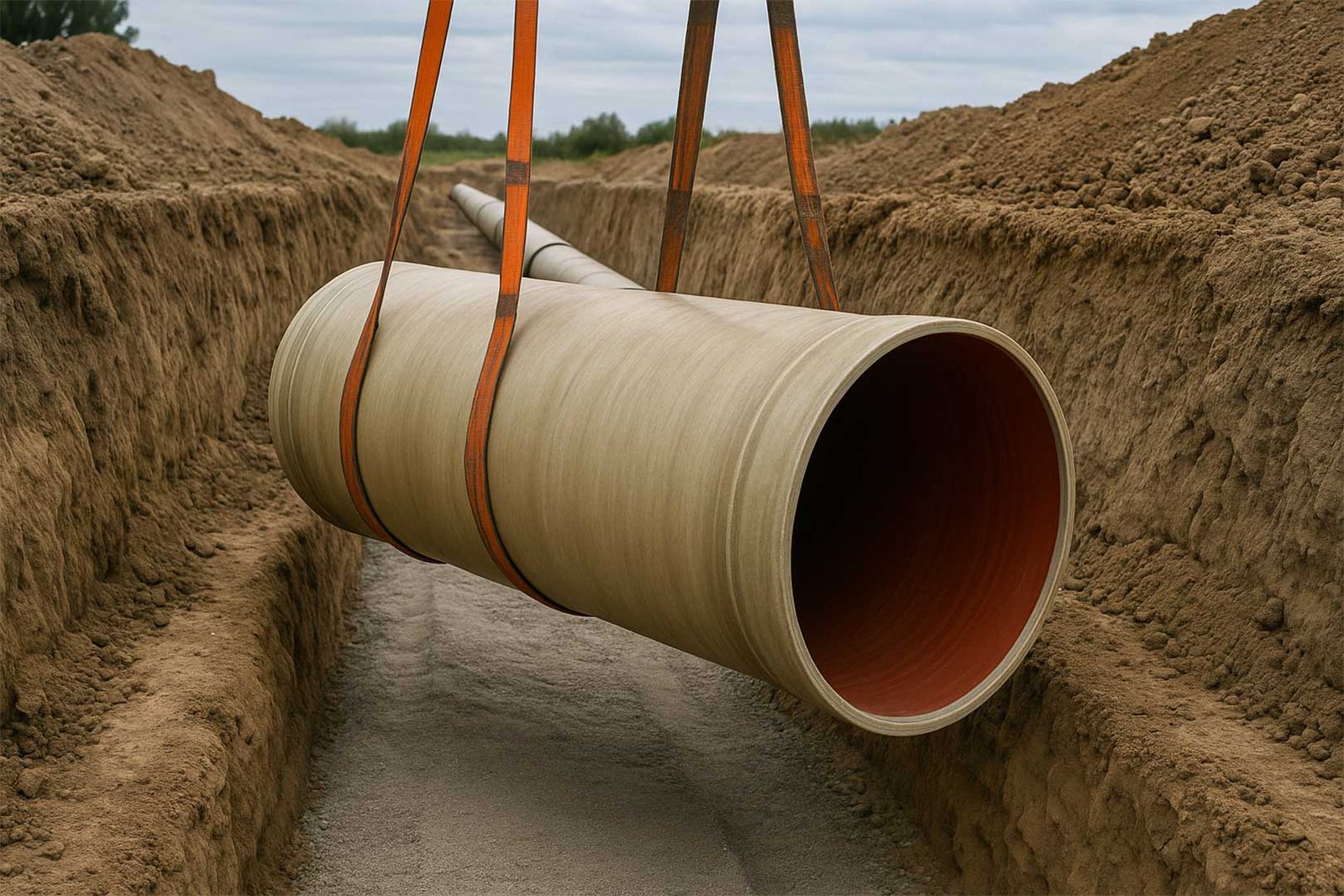
- Outer Layer: This layer in all types includes such coatings for pipes (mainly epoxy that resists chemicals, heat, and UV light) to protect them from aggressive environmental conditions.
- Additional Layers: There are some optional choices of films or veils that can be Mylar or C-glass that improve the smoothness of the internal surface in applications where the speed of the fluid’s flow matters the most. Also, these layers can avoid corrosion whether internally or externally.
Machinery and Automation in Manufacturing
Each machinery in the manufacturing of GRP pipes plays a beneficial role that can reduce the costs or waste, or ease the process by conducting even pipe shaping or cutting. Check these components below:
- Mandrel System: During production, it can shape the pipe and indicate the diameter size.
- Resin Mixing and Sprays: These machines are for applying resin to the glass fibers evenly.
- Fiber Feeder: For a uniform winding that results in a smooth inner surface of pipes, tensioners can make the process happen.
- Curing Ovens: These machines speed up the curing process compared to curing in a temperature-controlled room.
- Testing and Cutting Equipment: To cut the pipes and test them to ensure they’re ready to connect correctly together and resist under heavy loads.
| Machinery | Description | Role | Automation | Cost |
|---|---|---|---|---|
| Mandrel Systems | Shape the pipe. | Maintains uniform diameter. | High | High |
| Resin Mixing & Dispensing | Mixes and applies resin. | Provides even resin coating. | High | Medium |
| Fiber Feeders & Tensioners | Feeds and tension fibers. | Maintains fiber consistency. | Medium | Medium |
| Curing Ovens | Cures resin. | Hardens the pipe. | High | High |
| Cutting & Testing | Cuts and tests pipes. | Verifies size and strength. | Medium | Low |
Quality Control in GRP Pipe Manufacturing
GRP pipes can be internationally used in various applications by following global standards and guidelines. Here are some considerations for GRP pipes to be verified for international use cases.
- Dimensional Correctness: There are lasers and CMM systems that indicate the tolerance:
- Diameter (±1%)
- Wall thickness (±0.5 mm)
- Ovality (<1%)
- Length (±5 mm)
- Mechanical Test: These tests are based on standards such as ASTM D2290 for hoop strength, ASTM D2105 for axial strength, hydrostatic test, and burst test that go with PN ratings.
- Curing Quality: This matter goes with barcol hardness (>35), acetone sensitivity test, ultrasonic C-scan, and acoustic emission monitoring to detect voids or incomplete cure.
Check the table below for the most common standards used for the manufacturing process of GRP pipes:
| Standard | Focus | Key Test |
|---|---|---|
| ISO 14692 | Oil & Gas | 1000-h regression |
| ASTM D3517 | Pressure pipe | Hydrostatic design basis |
| AWWA M45 | Water/sewer infrastructure | 10,000-h pressure test |
| ASTM D3262 | Gravity sewer | Chemical & joint tightness |
How To Finish and Customize the Pipes Based on Project Demands
Once the pipe’s cured, they undergo length adjustment and cutting process (there might be automated machines for alignment), edge preparation, and joint specifications (bell & spigot with O-rings, flanged ends, or adhesive-bonded couplings). The customization process includes adjustment of the design by diameter, pressure class, stiffness, fittings, and jointing method to be aligned with exact project requirements.
Conclusion
The GRP pipe manufacturing process impacts the overall cost and result of pipes that can be aligned with various project demands. Due to the lightweight, corrosion resistance, and high strength-to-weight ratio of GRP pipes, they surpass traditional pipelines. Then, the right selection of production methods can avoid waste of money and material. Check standards and compliance for global verifications in the long lifespan of GRP pipes.
FAQs
1- What is the lifespan of GRP pipes?
GRP pipes can last over 50 years under certain conditions with the least maintenance requirements.
2- Which manufacturing method is best for high-pressure applications?
Filament winding can be the best option due to cost-efficiency in large-scale productions.
3- Can the GRP pipe be manufactured custom-made?
Yes, GRP pipes can be designed in a variety of diameter ranges, pressure classes, stiffness, and lengths as the customer desires.
about
The Author

Farshid Tavakoli is a seasoned professional in engineering and international trade. Holding degrees in Electrical Engineering, Mechatronics, and a Doctorate in Business Administration (DBA) from the University of Lyon, he also has a strong background in industrial automation and production line technologies.
For over 17 years, he has led an international trading company, gaining deep expertise in commercial solutions tailored to industrial needs. With more than 8 years of active involvement in infrastructure development, he specializes in the supply of electromechanical equipment for water and wastewater treatment plants and transfer projects.
Together with comapny expert team, he now provides consultancy and integrated solutions for sourcing and implementing complex infrastructure projects across the region.